
.jpg/250px-Huangpu_Park_20124-Shanghai_(32208802494).jpg)


.jpg/2000px-Huangpu_Park_20124-Shanghai_(32208802494).jpg)
Community hub
Recent from talks
Contribute something
Nothing was collected or created yet.
Lujiazui
View on Wikipedia.jpg)

.jpg)


Lujiazui (traditional Chinese: 陸家嘴; simplified Chinese: 陆家嘴; pinyin: Lùjiāzuǐ, Wu Chinese pronunciation: [lʊʔ˩ ka̱˨ t͡sz̩˧]) is a locality in Shanghai, a peninsula formed by a bend in the Huangpu River. Since the early 1990s, Lujiazui has been developed specifically as a new financial district of Shanghai. The decision to earmark Lujiazui for this purpose reflects its location: it is located on the east side of the Huangpu River in Pudong, and sits directly across the river from the old financial and business district of the Bund.
Lujiazui is a national-level development zone designated by the government. In 2005, the State Council reaffirmed the positioning of the 31.78 km2 (12.27 sq mi) Lujiazui area as the only finance and trade zone among the 185 state-level development zones in mainland China.
Geography
[edit]Lujiazui is located in the Pudong New District on the eastern bank of Huangpu River. It forms a peninsula on a bend of the Huangpu River, which turns from flowing north to flowing east. The importance of Lujiazui stems from the fact that it lies directly across the river from the Bund, the old financial and business district of Shanghai, and just south of the confluence of the Suzhou Creek with the Huangpu River. Until the 1980s, Lujiazui was a relatively low-built area, featuring residential houses, warehouses, and factories. Following the allocation of Lujiazui as a special investment zone in 1992, the development of Lujiazui's skyline began. This was largely driven by Chinese state owned enterprises investing and developing the property within the area, with the inaugural landmark, the Oriental Pearl Tower, being completed in 1994.
Economy
[edit]The success of Lujiazui in the past 20 years has fueled tourism and business related travel to Shanghai. Pictures of the Lujiazui skyline dominate Shanghai tourism materials, and there are 5 five-star hotels in the area, providing approximately 2,443 rooms, and three more five-star hotels are expected in the area in the coming years, adding more than 1,200 luxury units.[1]
History
[edit]Formation
[edit]The modern configuration of the Huangpu River and Suzhou Creek beyond the old county town of Shanghai is the result of engineering works completed during the early Ming dynasty. The result is that the wider Huangpu River, flowing north past the county town, then turned east at its confluence with the now narrower Suzhou Creek, proceeding along the former downstream channel of the Suzhou Creek to enter the sea at Wusongkou, the former mouth of Suzhou Creek.
The bend in the Huangpu River resulted in the formation of an alluvial beach east and south of the bend. This alluvial floodplain was called a "mouth" (zui) after its shape. It was named after the family of Lu Shen, a 15th-century scholar-official of the Ming dynasty. Lu's family became one of the most prominent in Ming dynasty Shanghai, and lived in the Yangjing canal area, east of the Huangpu River and close to today's Lujiazui.[2]
Settlement
[edit]During the Ming dynasty, fishermen were recorded as living in Lujiazui. During the Qing dynasty, the construction of levees on the peninsula encouraged settlement in greater numbers, with a number of villages forming in the part of the peninsula within the levees. Mudflats remained outside the levees.
The opening of Shanghai as a treaty port in the mid-19th century led to rapid development of Lujiazui as an industrial and commercial area servicing Shanghai. The middle part of the peninsula became a town called Lannidu (烂泥渡, literally "Mud Ferry"), named after one of the wharves on the river bank. British, American, French, German and Japanese interests built a series of factories, warehouses and storage yards, and wharves to service them. A busy commercial street developed in Lannidu to service the commodities trade as well as the daily needs of the many workers employed by the industrial facilities.
Development since 1986
[edit]In 1986, as part of reform measures to use Shanghai as a centre for increasing economic development and trade in China, a Chinese government policy document referred to the development of Pudong for the first time, including the creation of a new financial and trading center in Lujiazui.[3] The policy of "developing and opening up Pudong" was officially announced in 1990. Pudong was quickly transformed over the next few decades from its industrial past into a financial and commercial centre. As well as a large number of skyscrapers housing the offices of corporations, banks and professional service firms, the area also features a number of hotels and shopping centres, and a convention centre by the waterfront. The Oriental Pearl Radio & Television Tower has dominated the skyline of Lujiazui since it was completed in 1995, although there are now two skyscrapers taller than it.
In 2015, the Shanghai Free Trade Zone was expanded to include Lujiazui.
Buildings
[edit]Landmark buildings in Lujiazui include:
Transportation
[edit]By water, Lujiazui is linked to the rest of central Shanghai by ferry services from two wharves, located at the northern and southern ends of the area respectively. At the southern end, the Dongchang Road ferry terminal provides river-crossing services across the Huangpu River to central and southern central Shanghai. The most popular ferry service for tourists connects Dongchang Road wharf with Jinling East wharf, located on the Bund. At the north end, the Xichang Inn wharf provides river-crossing services across the Huangpu River to northern central Shanghai. The former Lujiazui ferry wharf, once part of the most popular river crossing in Shanghai, was closed in 1999, with its wharf structure now used as a waterfront seating area.
By road, Lujiazui is connected to the rest of central Shanghai by the Yan'an East Road Tunnel, linking the southern end of the Bund with the centre of Lujiazui. Further away from the centre of Lujiazui, the Renmin Road Tunnel and Fuxing East Road Tunnel link southern Lujiazui with southern central Shanghai, while Xinjian Road Tunnel and Dalian Road Tunnel link northern Lujiazui with northern central Shanghai.
By metro, Lujiazui is served by Lujiazui station, which is on Shanghai Metro Line 2 and Shanghai Metro Line 14.
Additionally, the Bund Sightseeing Tunnel is a tourist attraction consisting of slow-moving underground vehicles which move between the Bund and Lujiazui accompanied by light and sound effects in the tunnel.
Gallery
[edit]-
 Lujiazui Roundabout in December 2023
 -

-
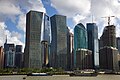 CITIC Pacific HQ & Mandarin Oriental
 -

-
 Lujiazui Finance and Trade Zone, Pudong
 -
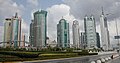 Lujiazui skyline, Pudong
 -
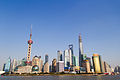 Lujiazui panorama
 -
 Lujiazui from the Oriental Pearl Tower


.jpg)
References
[edit]- ^ Knight Frank China Knight Frank China, Shanghai Annual Commercial Report 2009
- ^ "陆家嘴 一部摩天大楼的发展史". 简书. Retrieved 2019-12-08.
- ^ 界面新闻©. "陆家嘴四十年:从烂泥路到金融中心". www.huxiu.com. Retrieved 2019-12-08.
External links
[edit]
- "Lujiazui still on the rise," by Tian Xiuzhen, Shanghai Star. 2004-12-16 Archived 2008-06-18 at the Wayback Machine
- "Lujiazui to become top biz district," Shanghai Daily. 2006-09-14
- ShanghaiDaily.com - Area review. Archived 2007-02-15 at the Wayback Machine
- 陆深和陆家嘴 Lu Shen and Lujiazui (Video with English subtitles)
Lujiazui
View on GrokipediaGeography
Location and Administrative Boundaries
Lujiazui Subdistrict occupies the western sector of Pudong New Area in Shanghai Municipality, China, positioned along the eastern bank of the Huangpu River at approximately 31°14′N 121°30′E. This placement situates it directly across from the Bund in Huangpu District, forming a strategic peninsula on a bend of the river that enhances its role as a modern counterpart to the historic financial enclave on the western (Puxi) side.[8][5][3] Administratively, Lujiazui functions as a subdistrict (街道, jiēdào) within Pudong New Area, which itself is one of the 16 districts comprising Shanghai Municipality. The subdistrict aligns closely with the designated Lujiazui Financial City, encompassing roughly 31.78 square kilometers of developed urban land focused on finance and trade activities.[9][3] Geographically, its boundaries are marked by the Huangpu River to the west and north, providing a natural demarcation from central Shanghai's Puxi districts. To the south and east, it interfaces with adjacent Pudong subdistricts, including Tangqiao Subdistrict and Weifang Xincun Subdistrict, as well as broader planning units extending toward areas like the Expo site and Jinqiao Export Processing Zone. These limits reflect coordinated urban development policies integrating Lujiazui into Pudong's expansive framework since the area's designation in the early 1990s.[10][3]Physical and Environmental Features
Lujiazui occupies a peninsula on the eastern bank of the Huangpu River in Shanghai's Pudong New Area, formed by a bend where the Huangpu meets influences from the nearby Suzhou Creek.[11][8] The Huangpu River, averaging 400 meters wide and 9 meters deep, bounds the area to the west, separating it from the Puxi side of the city, while eastward extensions connect to zones like Jinqiao and Zhangjiang.[12][13] The Lujiazui Finance and Trade Zone spans 28 square kilometers of this low-lying terrain.[5] The physical landscape consists of flat alluvial plains typical of the Yangtze River Delta, with minimal topographic variation and an average elevation of about 7 meters above sea level.[14] This elevation aligns with Shanghai's broader geography, rendering the area vulnerable to tidal influences and requiring extensive land reclamation and embankment infrastructure along the riverfront.[6] Environmentally, Lujiazui's high-density urban development incorporates green spaces designed for carbon sequestration and ecological mitigation, with studies estimating vegetation sinks via UAV-based 3D modeling of occupancy rates.[15][16] Waterfront enhancements along the Huangpu serve as ecological corridors, supporting biodiversity amid skyscraper density, while city-wide trends show expanded green coverage in central districts like Pudong since the 1990s.[17][18] Soil contamination from prior industrial uses has necessitated remediation at select sites, addressing pollutants such as polycyclic aromatic hydrocarbons.[19] Air quality reflects Shanghai's urban challenges, though green infrastructure aims to improve local microclimates and visibility indices for buildings.[20]History
Pre-20th Century Origins
Lujiazui, deriving its name from "Lùjiāzuì" (陆家嘴), literally meaning the "Lu family's mouth" in reference to the mouth-shaped alluvial beach formed by a bend in the Huangpu River, originated as a modest waterfront settlement associated with the prominent Lu clan during the Ming Dynasty (1368–1644). The designation traces to Lu Shen (1477–1544), a scholar-official and poet of the Imperial Academy who retired to the area, where his ancestors were buried and the family resided on the eastern bank of the Huangpu River.[5] [21] The Lu family, a renowned lineage in Ming-era Jiangnan society, maintained ancestral lands there, reflecting typical patterns of scholarly gentry establishing estates in fertile riverine zones conducive to agriculture and local trade.[22] Prior to the 20th century, the locality remained a low-lying, sparsely developed expanse characterized by residential houses, warehouses, and rudimentary docks serving fishing and small-scale riverine commerce, emblematic of Pudong's broader rural profile east of the Huangpu. Unlike the burgeoning county seat of Shanghai on the western bank, which grew into a cotton-textile hub by the late Ming with populations nearing 200,000 by 1664, Lujiazui and surrounding Pudong areas stayed agrarian, focused on rice paddies, fisheries, and silt-rich alluvial farming amid marshy terrain.[23] This underdevelopment persisted into the Qing Dynasty (1644–1912), when maritime trade liberalization post-1664 ban lifted spurred western Shanghai's port growth, yet Pudong settlements like Lujiazui saw minimal urbanization, serving primarily as peripheral villages without significant infrastructure or foreign influence until treaty port expansions confined to the Bund opposite.[24] Archaeological and historical records indicate no major urban centers or monumental structures in pre-20th-century Lujiazui, underscoring its role as a peripheral appendage to Shanghai's early economic axis, reliant on the river for subsistence rather than commerce on par with Puxi counterparts. The area's strategic riverine position facilitated local boat traffic but lacked the defensive walls or administrative prominence of Ming-Qing Shanghai proper, preserving its village-like character amid regional cotton cultivation and seasonal flooding.[23]20th Century Settlement and Industrialization
Throughout the early to mid-20th century, Lujiazui remained a predominantly rural area on the eastern bank of the Huangpu River, characterized by sparse settlement in fishing villages and farming communities that supported Shanghai's urban population with agricultural produce and aquatic resources.[25] Land use focused on cultivation of rice, vegetables, fruits, and aquaculture, with strip-like development patterns including limited urban service centers amid extensive fields.[25] Population density stayed low, tied to agrarian livelihoods, as major urban and industrial expansion concentrated in Puxi, the western side of the river, leaving Pudong—including Lujiazui—underdeveloped despite Shanghai's overall growth as a treaty port and manufacturing hub since the 1840s.[25] Following the establishment of the People's Republic of China in 1949, Lujiazui's lands underwent collectivization under people's communes, reinforcing agricultural production while introducing minimal mechanization and state-directed output quotas to supply Shanghai's food needs.[25] Settlement patterns persisted as rural, with housing clustered in villages and basic infrastructure inadequate for large-scale urbanization; rural-to-urban migration increased pressure on local resources but did not spur significant residential expansion.[25] Industrial activity was negligible in Lujiazui itself, limited to scattered small factories and warehouses servicing cross-river trade and logistics, rather than heavy manufacturing, which dominated other Shanghai districts.[26] By the late 20th century, particularly in the 1980s, Lujiazui exhibited a modest mix of farmland, residential villages, and rudimentary industrial facilities like warehouses, reflecting gradual but constrained economic shifts under initial reform policies.[26] Agricultural dominance continued, with fields producing staple crops and perishables for the city's markets, while industrial output in broader Pudong grew sluggishly at 0.8% in early 1988—half the national average for the decade—highlighting systemic underinvestment and infrastructural deficits.[25] This period marked limited preparation for future transformation, as state priorities emphasized self-sufficiency over rapid modernization in peripheral areas like Lujiazui.[25]Reform-Era Transformation Since 1990
Prior to 1990, Lujiazui consisted mainly of farmland, villages, and agricultural fields east of the Huangpu River, serving as a rural counterpart to Shanghai's Puxi district.[27][28] On April 18, 1990, the Chinese central government announced the development and opening-up of the Pudong New Area, a policy initiative led by Deng Xiaoping to accelerate Shanghai's role in national economic reforms.[29][30][31] This decision earmarked Lujiazui specifically for development as Shanghai's central business district and financial hub, shifting the area from agrarian use to high-density urban finance and trade functions.[26][2] The initial phase from 1990 to 2000 emphasized master planning, infrastructure construction, and financial sector establishment, including bridges, tunnels, and metro lines to connect Pudong with Puxi.[29][32][26] In 1992, the Shanghai Lujiazui Finance & Trade Zone Development Co., Ltd. was founded to oversee land development and urban functions in the zone.[33] Construction of landmark structures commenced in the early 1990s, such as the Oriental Pearl Tower, whose building began in 1991 and completed in 1994, symbolizing the onset of vertical urban growth.[34] By the decade's end, Lujiazui had transitioned into a burgeoning skyline of skyscrapers, replacing rice paddies with office towers and trade facilities.[31] Into the 2000s and beyond, the transformation accelerated with the completion of supertall buildings like the Jin Mao Tower in 1999 and the Shanghai World Financial Center in 2008, alongside expanded preferential policies that attracted foreign investment and financial institutions.[2][34] This period saw Lujiazui evolve into a global financial node, hosting over 40% of foreign-funded banks in Shanghai by 2021, driven by state-directed incentives and infrastructure investments totaling billions in yuan.[35] The zone's GDP contribution from finance reached 99.16 billion yuan in 2011 alone, reflecting sustained growth from its reform-era foundations.[36] By 2020, marking 30 years since Pudong's opening, Lujiazui stood as a testament to rapid, policy-orchestrated urbanization, though not without challenges like uneven development and environmental pressures.[2]Urban Planning and Policies
International Design Competition and Master Plan
In 1991, the Shanghai Urban Planning Design Institute (SUPDI) commenced strategic studies for Lujiazui's development as part of Pudong's broader transformation following the Chinese government's 1990 decision to open the area.[37] To refine this vision, the Pudong New Area Preparatory Committee launched an international urban design competition in 1992, soliciting proposals to position Lujiazui as Shanghai's central business district opposite the historic Bund.[38] Prominent architects invited included Richard Rogers from the United Kingdom, Dominique Perrault from France, Massimiliano Fuksas from Italy, and Toyo Ito from Japan, alongside domestic teams, marking one of China's earliest engagements with global urban design expertise.[39] The submissions presented contrasting concepts: international entries often favored innovative, lower-density configurations with green corridors and mixed uses, while Chinese proposals emphasized high-density vertical growth to maximize land efficiency in a constrained riverside site.[40] No single design was declared the outright winner; instead, SUPDI synthesized key ideas—such as landmark clustering and skyline definition—into a cohesive framework, approved in August 1993.[38] This process introduced modern urban design principles to Shanghai planners, shifting from rigid zoning to holistic spatial strategies informed by site-specific topography and visibility from Puxi.[39] The resulting master plan delineated an 82-hectare core zone across 69 plots, mandating a skyline height limit of 200 meters punctuated by three super-tall towers to create iconic silhouettes, with 34% of the area reserved for green spaces and public amenities.[38] Prioritizing finance, trade, and headquarters functions, it allocated densities for commercial dominance while integrating metro lines, roads, and waterfront access to support projected daily flows of workers and visitors.[41] A revised version, formalized in 1994, authorized 69 buildings overall, guiding phased construction that balanced economic imperatives with infrastructural resilience, though later adjustments accommodated taller structures exceeding initial caps.[42]Preferential Economic Policies and Incentives
In 1990, the Chinese central government announced the development of Pudong New Area, designating Lujiazui as its core financial and trade zone with preferential policies modeled on special economic zones to accelerate foreign direct investment and urban transformation from farmland to a modern hub.[25] These included a reduced corporate income tax rate of 15% for foreign-invested enterprises in encouraged industries, such as manufacturing and services, versus the national rate of 33% at the time, alongside tax holidays typically granting two years of exemption followed by three years at half the rate for productive FIEs.[43][44] Streamlined administrative approvals, such as one-stop services for investment registration, and extended land use rights up to 70 years for commercial projects further incentivized inflows, enabling rapid infrastructure buildup and attracting early investments from state-backed entities before broader private and foreign participation.[45] Lujiazui's policies emphasized financial sector liberalization, positioning it as China's primary gateway for international capital; by the mid-1990s, it hosted the first foreign bank branches, like Japan Fuji Bank, and insurance firms, supported by exemptions on certain import duties for financial equipment and preferential treatment for headquarters of multinational corporations.[2] Value-added tax incentives allowed retention of a portion of local VAT for reinvestment, while export-oriented incentives exempted income from duties on imported materials, fostering trade finance and asset management clusters that by 2021 accounted for over 40% of China's foreign-funded banks and 90% of foreign private equity firms.[2][35] Under the 2013 China (Shanghai) Pilot Free Trade Zone framework encompassing Pudong areas including Lujiazui, additional incentives emerged, such as simplified customs procedures and negative lists for foreign investment access, reducing barriers in finance and professional services.[46] In 2021, as part of a national plan to elevate Pudong's role by 2035, corporate income tax was further cut to 15% for five years for qualified firms in semiconductors, AI, biotechnology, and related fields, with Pudong granted legislative leeway to pilot yuan convertibility and derivatives markets tailored to Lujiazui's financial ecosystem.[47][48] These measures, extended through incentives like exemptions for domestic reinvestments by foreign enterprises, have sustained Lujiazui's appeal, evidenced by 156 new foreign projects signed in 2025 alone.[49][50]Economy
Financial Hub Development
Lujiazui's development as a financial hub commenced in 1990 when the State Council approved the Pudong New Area's opening-up, designating Lujiazui as the sole national-level finance and trade zone within it.[42] This initiative transformed the formerly rural area into the core of Shanghai's international financial center aspirations, supported by infrastructure investments and preferential policies to attract capital and institutions.[2] Early efforts focused on establishing foundational financial entities, including hosting China's first foreign bank branch (Japan Fuji Bank Shanghai Branch) and the first foreign-invested insurance company (AIA Shanghai Branch).[2] By the early 2000s, Lujiazui had solidified its role through the influx of multinational corporations and the construction of key landmarks like the Jin Mao Tower (completed 1999) and Shanghai World Financial Center (opened 2008), which housed major financial tenants.[3] The Shanghai Stock Exchange, relocated to the district, and the China Financial Futures Exchange further anchored its trading infrastructure.[51] Preferential treatments for foreign financial services, such as relaxed market access, spurred growth, with the district pioneering Sino-foreign joint ventures like the first fund management company (CPIC Fund Management Co., Ltd.).[2] As of recent years, Lujiazui hosts over 6,000 domestic and foreign financial institutions, including more than 925 licensed entities such as banks, securities firms, and insurers, representing a significant concentration of China's foreign financial presence—around 80% of foreign asset management institutions.[52][53] By 2022, its economic aggregate reached 630 billion yuan, driven by 285 business buildings and over 40,000 enterprises, with 113 high-rises each generating at least 100 million yuan in annual tax revenue.[3] This expansion has positioned Lujiazui as Asia-Pacific's leading financial and trading center, facilitating global investment into China while contributing disproportionately to national GDP despite its small land area.[2]Real Estate and Construction Boom
The real estate and construction boom in Lujiazui commenced following the Chinese government's April 1990 decision to develop Pudong New Area, positioning Lujiazui as the core for finance and trade activities.[54] This policy shift catalyzed large-scale infrastructure projects, beginning with the Oriental Pearl Tower, whose construction started in 1991 and concluded in 1995 as Shanghai's first major landmark structure.[55] Subsequent initiatives included supertall developments like the Jin Mao Tower (completed 1999 at 421 meters) and the Shanghai World Financial Center (topped out 2008 at 492 meters), transforming the former rural and industrial landscape into a dense cluster of high-rises.[56] By 1992, Lujiazui's designation as a special investment zone spurred skyline formation through targeted real estate projects, funded partly via stock market issuances and land lease revenues managed by entities like the Lujiazui Group.[57] Demand surged rapidly, with over 80 percent of Lujiazui's buildings sold or leased by early 2000, reflecting robust investor interest in the emerging financial hub.[58] Property values in the area's secondary market exemplified this growth, escalating from 8,700 RMB per square meter in January 2005 to a peak of 20,686 RMB per square meter in May 2010.[59] The boom extended into the 2010s with completions like the 632-meter Shanghai Tower in 2015, contributing to Pudong's accumulation of 285 commercial buildings by 2020, many generating substantial tax revenues exceeding 100 million yuan annually.[60] This era of intensive construction, supported by preferential policies, established Lujiazui as a symbol of China's urban expansion, though it relied heavily on state-directed financing rather than purely market dynamics.[25]Current Challenges Including Overcapacity
Despite rapid construction of high-rise office towers in the 2010s and early 2020s, Lujiazui has faced significant overcapacity in commercial real estate, manifested in persistently high vacancy rates for Grade-A office space. As of Q1 2025, Shanghai's citywide Grade-A office vacancy rate reached 22.2%, driven by sluggish absorption and new supply completions, with core submarkets like Pudong—including Lujiazui—experiencing upward pressure on vacancies due to limited tenant demand.[61] In Q3 2024, vacancy rates specifically in Lujiazui continued to rise amid economic headwinds, exacerbating the mismatch between supply and occupancy.[62] This overcapacity stems from pre-pandemic overbuilding fueled by local government incentives and developer optimism, resulting in excess inventory that now strains asset values and rental yields. Rents for prime office space in Lujiazui and surrounding Pudong areas have declined sharply, reflecting the glut; core Shanghai office rents fell approximately 10% year-over-year by mid-2024, with average rates dropping to around RMB 256 per square meter per month in central districts.[63] In response, state-owned entities have initiated large-scale asset disposals, such as Lujiazui Finance & Trade Zone Development Co.'s plan announced in April 2024 to sell 20 office towers valued at about $4 billion, amid Shanghai's office vacancy hitting a nearly two-decade high.[64] These measures highlight underlying structural issues, including a slowdown in foreign direct investment and domestic financial firms' cautious expansion, compounded by China's broader property sector deleveraging since 2021. Beyond real estate, Lujiazui's role as a financial hub contends with macroeconomic pressures, including decelerating GDP growth and diminished business confidence. Foreign firms, key tenants in the district's international-oriented buildings, reported historically low optimism in China by September 2024, citing geopolitical tensions and a weakening economy as top barriers to operations.[65] This has led to subdued leasing activity in finance and professional services sectors, despite Lujiazui's preferential policies, as global supply chain shifts and domestic regulatory tightening on tech-finance integration reduce demand for premium space. Efforts to mitigate these challenges, such as the 2025 Lujiazui Forum's emphasis on financial opening-up, aim to bolster resilience but face hurdles from persistent overcapacity and external trade frictions.[66]Notable Buildings and Infrastructure
Iconic Skyscrapers
Lujiazui's skyline is characterized by a cluster of supertall structures that emerged during Pudong's development from the 1990s onward, serving as symbols of Shanghai's transformation into a global financial center. The most prominent include the Oriental Pearl Tower, Jin Mao Tower, Shanghai World Financial Center, and Shanghai Tower, which together form a distinctive silhouette visible across the Huangpu River. These buildings combine functional office, hotel, and observation spaces with innovative designs that pushed engineering boundaries. The Oriental Pearl Tower, a 468-meter-tall telecommunications and observation structure, was completed in 1995 and held the title of China's tallest building until 2007.[67] Its design features eleven spheres connected by columns, housing observation decks, a revolving restaurant, and broadcasting equipment.[68] The Jin Mao Tower, reaching 421 meters with 88 floors, was completed in 1999 and briefly served as China's tallest building.[69] Designed by Adrian Smith of Skidmore, Owings & Merrill (SOM), it incorporates setbacks inspired by ancient Chinese pagoda architecture, housing offices in the lower sections and the Grand Hyatt Hotel in the upper floors.[70] Adjacent to it, the Shanghai World Financial Center stands at 492 meters across 101 floors and opened in 2008 after topping out in 2007.[71] Its defining feature is a trapezoidal opening at the summit, originally intended as a circular cutout but modified due to cultural sensitivities regarding circular shapes symbolizing the sun; the structure includes high-end offices, the Park Hyatt Hotel, and observation decks.[72] The Shanghai Tower, at 632 meters and 128 floors, completed construction in 2015 and remains China's tallest building.[73] Designed by Gensler under Jun Xia, its spiraling form twists 120 degrees from base to apex, reducing wind loads by 24% through aerodynamic shaping and housing offices, retail, hotels, and cultural facilities within a double-skin curtain wall system.[74]| Building | Height (m) | Floors | Completion Year | Architect/Firm |
|---|---|---|---|---|
| Oriental Pearl Tower | 468 | N/A (tower) | 1995 | Shanghai Modern Architectural Design Co. |
| Jin Mao Tower | 421 | 88 | 1999 | SOM (Adrian Smith) |
| Shanghai World Financial Center | 492 | 101 | 2008 | Kohn Pedersen Fox |
| Shanghai Tower | 632 | 128 | 2015 | Gensler |
Supporting Structures and Landmarks
The Oriental Pearl Tower, constructed between 1991 and 1994, stands at 468 meters as a prominent television and radio broadcasting tower in Lujiazui along the Huangpu River.[67] It features observation decks, a revolving restaurant, and facilities for tourism, marking an early symbol of Pudong's modernization efforts post-1990 reforms.[76] Beyond broadcasting, the structure supports visitor access to panoramic views of the skyline, contributing to Lujiazui's identity as a tourist and financial hub.[77] Supporting pedestrian infrastructure includes the Lujiazui Ring Road Circular Footbridge, completed around 2009-2011, which encircles the Lujiazui Roundabout to facilitate safe crossings amid heavy traffic.[78] This elevated girder bridge, spanning the terminus of Lujiazui Road, elevates pedestrians approximately 5.5 meters above the roadway, connecting financial centers to commercial areas while minimizing ground-level congestion.[79] The associated Lujiazui skywalk, opened in 2013, handles daily foot traffic exceeding 200,000, peaking at 500,000 during high periods, and integrates with the roundabout's design for efficient urban mobility.[80] The Lujiazui Roundabout itself functions as a critical traffic node, managing flows from major avenues into the district's core, with the overlying pedestrian bridge enhancing safety and views of adjacent landmarks like the Oriental Pearl Tower.[81] These elements collectively underpin the area's high-density operations by prioritizing both vehicular efficiency and pedestrian accessibility in a zone dominated by towering commercial developments.[80]Transportation
Connectivity to Greater Shanghai
Lujiazui maintains robust connectivity to the Puxi side of Shanghai across the Huangpu River through a network of bridges, tunnels, and rail infrastructure, enabling efficient commuter and commercial flows. The Nanpu Bridge, opened on December 1, 1991, serves as the primary vehicular link from central Huangpu District in Puxi directly to the Lujiazui area, handling heavy traffic volumes as the most utilized crossing for work-related travel between urban residential zones and Pudong's business hubs.[82][83] The Yangpu Bridge, completed in September 1993, connects Yangpu District in northern Puxi to Pudong via the Inner Ring Road, supporting broader regional access with its cable-stayed design spanning 8,346 meters.[84][85] Subsurface tunnels supplement these bridges for uninterrupted road travel. The Dapu Road Tunnel, operational since 1993, runs beneath the Huangpu River to link Huangpu District in Puxi with Pudong New Area, accommodating vehicles and reducing surface congestion. Pedestrians utilize the Bund Sightseeing Tunnel, a 646.7-meter pedestrian passageway opened in 2000, providing a direct, multimedia-equipped route from the Bund in Puxi to Lujiazui in Pudong, though primarily touristic rather than high-volume commuter.[86] By the early 2010s, Pudong's infrastructure included at least four major bridges and five road tunnels, with expansions continuing to handle growing cross-river demand.[26] Public transit via the Shanghai Metro offers rapid links to the city center, with Lujiazui station anchoring Lines 2 and 14. Line 2, extending 64 kilometers since its Pudong extension in 2000, connects Lujiazui eastward to Pudong International Airport and westward to People's Square in about 4 minutes, serving as a high-capacity east-west artery for daily commuters.[87][88] Line 14 provides north-south connectivity within Pudong and transfers to central lines, while interchanges at nearby stations like Century Avenue enable access to additional routes such as Lines 4 and 6.[89] This metro integration, combined with elevated roads like the Yan'an Elevated Road, has transformed Lujiazui from a peripheral zone into a seamlessly integrated financial node, with travel times to downtown reduced to under 10 minutes under normal conditions.[90]Public Transit Systems
Lujiazui is served primarily by the Shanghai Metro system, with Lujiazui Station functioning as a major interchange hub on Line 2 and Line 14. Key landmarks such as the Oriental Pearl Tower (near Exit 1) and the Shanghai Tower (near Exit 6) are conveniently accessible from the station via Metro Line 2, and the two towers are approximately 10-15 minutes walk apart.[91][92] Line 2 facilitates high-volume east-west travel, connecting the district directly to Pudong International Airport eastward and central Shanghai hubs like People's Square westward, with trains operating every 2-5 minutes during peak hours and fares starting at ¥4 for short segments such as People's Square to Lujiazui.[93][88] Line 14, an automated driverless line, provides north-south connectivity across Pudong New Area, extending from northern districts like Jiading to eastern areas including Jinqiao, enhancing intra-Pudong mobility for commuters in the financial zone.[94] Bus services supplement metro access, with multiple routes originating or terminating near Lujiazui Station and integrating with nearby landmarks such as the Oriental Pearl Tower and Jin Mao Tower.[93] These routes link to broader Shanghai networks, though coverage remains limited compared to rail, with some analyses noting inefficiencies in bus network structure and lower site density in high-density areas like Lujiazui.[42] The Shanghai Public Transportation Card enables seamless transfers across metro and buses, supported by apps like Shanghai Metro Daduhui for ticketing and real-time tracking.[95] Pedestrian and cycling infrastructure ties into transit nodes, but the district's wide roads and skyscraper spacing prioritize rail over surface options, reflecting planning focused on high-capacity mass transit to handle daily commuter flows exceeding millions across Pudong.[96] Daily ridership at Lujiazui Station contributes to Shanghai Metro's overall network, which spans over 800 kilometers and serves as one of the world's busiest systems.[97]Impacts and Controversies
Economic and Urban Achievements
Lujiazui's development since the 1990 opening of Pudong New Area transformed it from predominantly agricultural land into Shanghai's central financial district, encompassing 31.78 square kilometers with over 285 business buildings and skyscrapers.[98] This urban evolution positioned Lujiazui as a key node in China's financial liberalization, hosting 850 licensed financial institutions that represent 60 percent of Shanghai's total and 13 state-level factor markets.[99] The district's infrastructure supports high-density economic activity, contributing significantly to Pudong's GDP, which reached 1.2734 trillion yuan in 2019—200 times the level from three decades prior.[2] Financial services dominate Lujiazui's economy, accounting for nearly 60 percent of its GDP as of 2025, underscoring its role as a growth pole for Pudong.[100] In 2022, the Lujiazui Financial City's annual economic aggregate surpassed 630 billion yuan, reflecting sustained expansion in banking, securities, and leasing sectors.[3] Foreign direct investment has accelerated, with contracted inflows hitting $923 million in early 2025—a 14.37 percent year-on-year increase—and actual utilization rising 44.18 percent, driven by policies enhancing cross-border finance.[101] Urban achievements include the creation of a vertically integrated business environment, with the district's leasing firms alone generating nearly 5.6 billion yuan in tax revenue in 2019, comprising half of Shanghai's total for the sector.[102] This density has elevated Lujiazui's global profile, attracting multinational headquarters and fostering innovation in fintech and green finance, while integrating with broader Shanghai connectivity to amplify trade and capital flows.[100]Social, Environmental, and Planning Criticisms
The rapid development of Lujiazui displaced thousands of local residents, fostering social dislocation and resentment. In 1998 alone, 3,859 households were relocated to accommodate avenue construction and related infrastructure in the district.[103] This formed part of a broader pattern in Pudong, where former agricultural land and villages were cleared for high-end commercial zones, often prioritizing economic output over community continuity.[104] Displaced individuals frequently reported diminished place-identity, with many viewing resettlement in Pudong as a downgrade from central Shanghai's Puxi districts, encapsulated in resident sentiments like "Pudong is not my Shanghai."[105] Compensation disparities amplified these issues, as households received varying payouts—some sufficient for relocation, others inadequate relative to developers' profits—leading to perceptions of inequitable wealth distribution favoring state-linked entities.[106] Citywide displacement exceeded one million urban households since the 1990s, with Pudong absorbing many through peripheral resettlement, which strained social networks and reinforced east-west divides in access to amenities and cultural heritage.[105] Lujiazui's skyline of energy-intensive skyscrapers has drawn environmental scrutiny for amplifying Shanghai's resource demands and emissions footprint. The district's high-rises, reliant on extensive air conditioning, elevators, and lighting, contribute to the building sector's outsized role in the city's approximately 200 million tonnes of annual carbon emissions, where structures account for around 45% alongside industry and transport.[107] Proximity to polluting facilities, including the Waigaoqiao coal-fired power plant—which violated national nitrogen oxide standards weekly after 2012 regulations—has historically degraded local air quality, with fine particulate matter levels in Pudong occasionally exceeding safe thresholds during peak operations.[108] Dense construction has also exacerbated land subsidence, with Pudong's heavy building loads and groundwater depletion for cooling systems accelerating sinking rates by up to 20-30 mm annually in vulnerable zones, compounding flood risks along the Huangpu River.[109] Planning approaches in Lujiazui, emphasizing prestige-driven megastructures, have faced criticism for fostering overcapacity and inefficient land use. Grade-A office vacancy rates in the district surged to 34% in 2022, driven by post-pandemic demand weakness and prior oversupply, pressuring rents downward and leaving premium spaces underutilized.[110] Shanghai-wide, prime office vacancies persisted at 20.1-21.6% through 2024, reflecting misaligned supply with economic realities like slowed foreign investment.[111][112] The Shanghai Tower exemplifies these flaws: completed in 2015 at 632 meters, it languished at roughly 50% occupancy for years, failing to draw multinational tenants due to high operational costs and a design prioritizing symbolic height over flexible leasing.[113] Such outcomes stem from top-down directives favoring vertical spectacle, which critics contend overlooked demand forecasting and promoted car-dependent layouts akin to critiqued Western suburban models, hindering walkability and long-term vitality.[26]References
- https://commons.wikimedia.org/wiki/Category:Nanpu_Bridge