Recent from talks
Nothing was collected or created yet.
Pudong
View on WikipediaKey Information
| Pudong | |||||||||||||||
|---|---|---|---|---|---|---|---|---|---|---|---|---|---|---|---|
"Pudong" in Simplified (top) and Traditional (bottom) Chinese characters | |||||||||||||||
| Simplified Chinese | 浦东 | ||||||||||||||
| Traditional Chinese | 浦東 | ||||||||||||||
| Postal | Pootung | ||||||||||||||
| Literal meaning | "East of the Pu [River]" | ||||||||||||||
| |||||||||||||||
Pudong is a district of Shanghai located east of the Huangpu, the river which flows through central Shanghai. The name Pudong was originally applied to the Huangpu's east bank, directly across from the west bank or Puxi, the historic city center. It now refers to the broader Pudong New Area, a state-level new area which extends all the way to the East China Sea.
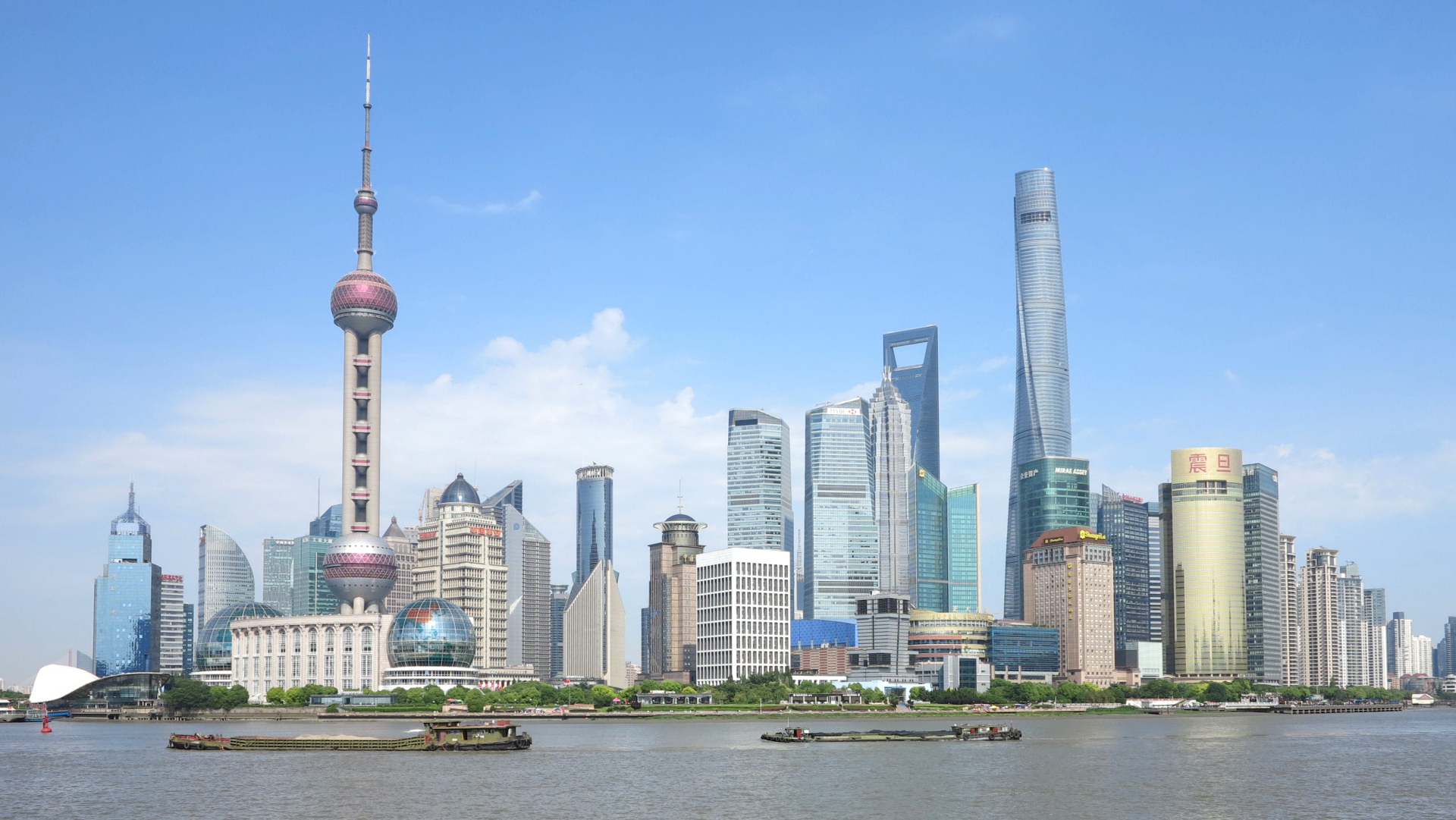
The traditional area of Pudong is now home to the Lujiazui Finance and Trade Zone and the Shanghai Stock Exchange and many of Shanghai's best-known buildings, such as the Oriental Pearl Tower, the Jin Mao Tower, the Shanghai World Financial Center, and the Shanghai Tower. These modern skyscrapers directly face Puxi's historic Bund, a remnant of former foreign concessions in China. The rest of the new area includes the Port of Shanghai, the Shanghai Expo and Century Park, Zhangjiang Hi-Tech Park, Shanghai Pudong International Airport, the Jiuduansha Wetland Nature Reserve, Nanhui New City, and the Shanghai Disney Resort.
History
[edit]Pudong—literally "The East Bank of the Huangpu River"—originally referred only to the less-developed land across from Shanghai's Old City and foreign concessions. The area was mainly farmland and only slowly developed, with warehouses and wharfs near the shore administered by the districts of Puxi on the west bank: Huangpu, Yangpu, and Nanshi. Pudong was originally established as a county in 1958 until 1961 when the county was split among Huangpu, Yangpu, Nanshi, Wusong and Chuansha County.
Premier Li Peng announced the policy of Pudong's opening and development on April 18, 1990. Speaking at a celebration for the fifth anniversary of the Shanghai Volkswagen Corporation, Li stated that "some policies of the economic and technological zones and Special Economic Zones can be implemented in the Pudong area".[2]: 23 Li stated that future investors from Hong Kong, Macau, and Taiwan were welcomed and that China would provide preferential conditions for cooperation and improve the investment environment.[2]: 23 The occasion is often described as Pudong's "birthday".[2]: 23 Nonetheless, development in the area was slow for the rest of 1990.[2]: 23
On October 1, 1992, the original area of Pudong County and Chuansha County merged and established Pudong New Area.
In 1993, the Chinese government set up a Special Economic Zone in Chuansha, creating the Pudong New Area. Deng Xiaoping had initiated its development three years earlier to build further confidence in Reform and Opening Up.[3]: 158 Pudong's description as a New Area served to distinguish it from existing SEZs.[3]: 158 It had even more open policies than existing SEZs, in terms of attracting foreign direct investment and developing the local economy.[3]: 158
The western tip of the Pudong district was designated as the Lujiazui Finance and Trade Zone and has become a financial hub of modern China. Several landmark buildings were constructed, including the Oriental Pearl Tower, and the supertall Jin Mao Building (420.5 m or 1,380 ft), Shanghai World Financial Center (494 m or 1,621 ft) and Shanghai Tower (632 m or 2,073 ft), the world's first trio of adjacent supertall skyscrapers. These buildings—all along Century Avenue and visible from the historic Bund—now form the most common skyline of Shanghai.
In official discourses on urbanization in China, Pudong is considered the paradigmatic example of the 1990s approach to urbanization.[3]: 157
On May 6, 2009, it was disclosed that the State Council had approved the proposal to merge Nanhui District with Pudong and comprise the majority of eastern Shanghai. In 2010, Pudong was host to the main venues of the Shanghai Expo, whose grounds now form a public park.
Pudong New Area consists of the original Pudong County (northeastern portion of Shanghai County), Chuansha County, and Nanhui County.
Climate
[edit]Pudong has a humid subtropical climate (Köppen climate classification Cfa), influenced by monsoons and Siberian winds as well as rains and typhoons from the Pacific. The average annual temperature in Pudong is 17.2 °C (63.0 °F). The temperatures are highest on average in July and August, at around 28.6 °C (83.5 °F), and lowest in January, at around 5.1 °C (41.2 °F).
| Climate data for Pudong, elevation 4 m (13 ft), (1991–2020 normals, extremes 1981–present) | |||||||||||||
|---|---|---|---|---|---|---|---|---|---|---|---|---|---|
| Month | Jan | Feb | Mar | Apr | May | Jun | Jul | Aug | Sep | Oct | Nov | Dec | Year |
| Record high °C (°F) | 23.9 (75.0) |
27.6 (81.7) |
31.6 (88.9) |
33.8 (92.8) |
35.4 (95.7) |
37.2 (99.0) |
40.6 (105.1) |
40.9 (105.6) |
37.0 (98.6) |
35.6 (96.1) |
29.7 (85.5) |
24.8 (76.6) |
40.9 (105.6) |
| Mean daily maximum °C (°F) | 8.9 (48.0) |
10.7 (51.3) |
15.1 (59.2) |
20.7 (69.3) |
25.4 (77.7) |
28.0 (82.4) |
32.8 (91.0) |
32.3 (90.1) |
28.4 (83.1) |
23.6 (74.5) |
18.1 (64.6) |
11.6 (52.9) |
21.3 (70.3) |
| Daily mean °C (°F) | 5.1 (41.2) |
6.7 (44.1) |
10.6 (51.1) |
15.9 (60.6) |
20.9 (69.6) |
24.2 (75.6) |
28.7 (83.7) |
28.5 (83.3) |
24.7 (76.5) |
19.7 (67.5) |
13.9 (57.0) |
7.6 (45.7) |
17.2 (63.0) |
| Mean daily minimum °C (°F) | 2.1 (35.8) |
3.4 (38.1) |
6.9 (44.4) |
11.8 (53.2) |
17.1 (62.8) |
21.2 (70.2) |
25.5 (77.9) |
25.6 (78.1) |
21.7 (71.1) |
16.2 (61.2) |
10.4 (50.7) |
4.3 (39.7) |
13.9 (56.9) |
| Record low °C (°F) | −7.4 (18.7) |
−5.1 (22.8) |
−2.3 (27.9) |
2.5 (36.5) |
8.3 (46.9) |
14.1 (57.4) |
17.2 (63.0) |
19.0 (66.2) |
13.4 (56.1) |
6.8 (44.2) |
−1.7 (28.9) |
−6.2 (20.8) |
−7.4 (18.7) |
| Average precipitation mm (inches) | 77.2 (3.04) |
69.8 (2.75) |
85.1 (3.35) |
87.1 (3.43) |
91.1 (3.59) |
231.1 (9.10) |
154.2 (6.07) |
227.0 (8.94) |
136.3 (5.37) |
78.1 (3.07) |
70.4 (2.77) |
57.1 (2.25) |
1,364.5 (53.73) |
| Average precipitation days (≥ 0.1 mm) | 10.6 | 10.8 | 12.2 | 11.0 | 11.3 | 14.4 | 12.2 | 13.3 | 10.7 | 7.5 | 9.7 | 9.0 | 132.7 |
| Average snowy days | 2.0 | 1.7 | 0.6 | 0 | 0 | 0 | 0 | 0 | 0 | 0 | 0 | 0.8 | 5.1 |
| Average relative humidity (%) | 73 | 74 | 72 | 71 | 74 | 82 | 78 | 79 | 77 | 73 | 75 | 71 | 75 |
| Mean monthly sunshine hours | 107.1 | 111.1 | 147.0 | 168.4 | 173.1 | 120.0 | 189.8 | 191.4 | 156.8 | 152.3 | 122.7 | 123.4 | 1,763.1 |
| Percentage possible sunshine | 33 | 35 | 39 | 43 | 41 | 28 | 44 | 47 | 43 | 44 | 39 | 40 | 40 |
| Source: China Meteorological Administration[4][5]All-time September high[6] | |||||||||||||
| Climate data for Huinan Town, elevation 5 m (16 ft), (1991–2020 normals, extremes 1981–2013) | |||||||||||||
|---|---|---|---|---|---|---|---|---|---|---|---|---|---|
| Month | Jan | Feb | Mar | Apr | May | Jun | Jul | Aug | Sep | Oct | Nov | Dec | Year |
| Record high °C (°F) | 22.1 (71.8) |
25.6 (78.1) |
27.4 (81.3) |
31.7 (89.1) |
34.3 (93.7) |
35.5 (95.9) |
39.0 (102.2) |
40.1 (104.2) |
36.6 (97.9) |
32.2 (90.0) |
27.6 (81.7) |
23.5 (74.3) |
40.1 (104.2) |
| Mean daily maximum °C (°F) | 8.6 (47.5) |
10.2 (50.4) |
13.9 (57.0) |
19.3 (66.7) |
24.2 (75.6) |
27.1 (80.8) |
31.6 (88.9) |
31.3 (88.3) |
27.6 (81.7) |
23.0 (73.4) |
17.8 (64.0) |
11.5 (52.7) |
20.5 (68.9) |
| Daily mean °C (°F) | 4.8 (40.6) |
6.2 (43.2) |
9.8 (49.6) |
14.9 (58.8) |
20.0 (68.0) |
23.7 (74.7) |
28.0 (82.4) |
27.9 (82.2) |
24.2 (75.6) |
19.1 (66.4) |
13.6 (56.5) |
7.3 (45.1) |
16.6 (61.9) |
| Mean daily minimum °C (°F) | 1.8 (35.2) |
3.0 (37.4) |
6.4 (43.5) |
11.2 (52.2) |
16.5 (61.7) |
21.0 (69.8) |
25.3 (77.5) |
25.4 (77.7) |
21.4 (70.5) |
15.7 (60.3) |
10.1 (50.2) |
4.0 (39.2) |
13.5 (56.3) |
| Record low °C (°F) | −7.9 (17.8) |
−6.0 (21.2) |
−4.2 (24.4) |
−0.7 (30.7) |
7.1 (44.8) |
12.7 (54.9) |
18.7 (65.7) |
18.8 (65.8) |
11.5 (52.7) |
1.9 (35.4) |
−1.7 (28.9) |
−7.8 (18.0) |
−7.9 (17.8) |
| Average precipitation mm (inches) | 72.2 (2.84) |
67.9 (2.67) |
97.5 (3.84) |
85.2 (3.35) |
94.0 (3.70) |
211.2 (8.31) |
135.7 (5.34) |
187.8 (7.39) |
126.0 (4.96) |
73.8 (2.91) |
63.7 (2.51) |
54.6 (2.15) |
1,269.6 (49.97) |
| Average precipitation days (≥ 0.1 mm) | 10.9 | 10.1 | 13.4 | 12.0 | 11.8 | 15.0 | 11.6 | 11.9 | 10.2 | 7.8 | 9.4 | 8.8 | 132.9 |
| Average snowy days | 1.8 | 1.5 | 0.5 | 0 | 0 | 0 | 0 | 0 | 0 | 0 | 0 | 0.8 | 4.6 |
| Average relative humidity (%) | 77 | 78 | 78 | 77 | 78 | 85 | 82 | 83 | 81 | 78 | 78 | 75 | 79 |
| Mean monthly sunshine hours | 112.4 | 117.0 | 140.7 | 164.3 | 172.6 | 123.8 | 207.4 | 202.1 | 170.4 | 164.3 | 131.9 | 130.1 | 1,837 |
| Percentage possible sunshine | 35 | 37 | 38 | 42 | 41 | 29 | 48 | 50 | 46 | 47 | 42 | 42 | 41 |
| Source: China Meteorological Administration[4][7] | |||||||||||||
Government
[edit]Districts of the Direct-Controlled Municipality of Shanghai are administratively on the same level as prefecture-level cities. However, the government of Pudong has a status equivalent to that of a sub-provincial city, which is a half-level above a prefecture-level city. This is due to Pudong's size and importance as the financial hub of China. The Pudong Communist Party Secretary is the top office of the district, followed by the district governor of Pudong. The Pudong party chief is customarily also a member of the Shanghai Party Standing Committee.[citation needed]
On April 27, 2015, the People's Government of Pudong New Area is working with China (Shanghai) Pilot Free-Trade Zone Administrative Committee.[8]
Demographics
[edit]Pudong is bounded by the Huangpu River in the west and the East China Sea in the east. Pudong is distinguished from Puxi ("West Bank"), the older part of Shanghai. It has an area of 1,210.4 square kilometres (467.3 sq mi) and, according to the 2020 census, a population of 5,681,512 inhabitants, accounting for around 22.8 percent of Shanghai and 1.85 million more than in 2010. Pudong's resident population growth is well above national average because it is a popular immigration destination. The 2020 census shows an 8% increase in the last decade, or an annual pace of 0.8%.[9]
Excluding immigrants, the birth rate in 2010 was 0.806% while the death rate is 0.729, resulting a net growth of 0.077%. The total fertility rate is 1.03, well below the replacement level.[10] The district actually has a negative registered household population growth if immigrants are excluded, thus the growth is purely driven by immigration.
The 2020 census shows a population density of 3,006/km2.[9] About 3/4 of the population live in the northern part and part of city center called "Northern Territory". 1/4 live in the "Southern Territory" that was the Nanhui District. The Northern Territory has a 6,667 population density, while the Southern Territory has 1,732/km2. Suburbs saw a greater increase in population during 2000–2010 with the help of the city's suburb expansion policy. Some counties in the traditional city center saw a population decrease.
Subdistricts and towns
[edit]| Name | Chinese (S) | Hanyu Pinyin | Shanghainese Romanization | Population (2010)[11] | Area (km2) |
|---|---|---|---|---|---|
| Weifang Xincun Subdistrict | 潍坊新村街道 | Wéifāng Xīncūn Jiēdào | vij vaon sin tsen ka do | 100,548 | 3.89 |
| Lujiazui Subdistrict | 陆家嘴街道 | Lùjiāzuǐ Jiēdào | loq ka tzyu ka do | 112,507 | 6.89 |
| Zhoujiadu Subdistrict | 周家渡街道 | Zhōujiādù Jiēdào | tzoe ka du ka do | 144,668 | 5.52 |
| Tangqiao Subdistrict | 塘桥街道 | Tángqiáo Jiēdào | daon djio ka do | 76,916 | 3.86 |
| Shanggang Xincun Subdistrict | 上钢新村街道 | Shànggāng Xīncūn Jiēdào | zaon kaon sin tsen ka do | 104,932 | 7.54 |
| Nanmatou Road Subdistrict | 南码头路街道 | Nánmǎtóulù Jiēdào | neu mau doe lu ka do | 107,130 | 4.22 |
| Hudong Xincun Subdistrict | 沪东新村街道 | Hùdōng Xīncūn Jiēdào | wu ton sin tsen ka do | 112,031 | 5.51 |
| Jinyang Xincun Subdistrict | 金杨新村街道 | Jīnyáng Xīncūn Jiēdào | cin yan sin tsen ka do | 206,017 | 8.02 |
| Yangjing Subdistrict | 洋泾街道 | Yángjīng Jiēdào | yan cin ka do | 146,237 | 7.38 |
| Puxing Road Subdistrict | 浦兴路街道 | Pǔxìnglù Jiēdào | phu xin lu ka do | 177,468 | 6.25 |
| Dongming Road Subdistrict | 东明路街道 | Dōngmínglù Jiēdào | ton min lu ka do | 121,449 | 5.95 |
| Huamu Subdistrict | 花木街道 | Huāmù Jiēdào | hau moq ka do | 221,327 | 20.93 |
| Chuanshaxin Town* (Chwansha) | 川沙新镇 | Chuānshāxīn Zhèn | tseu sa sau sin tzen | 420,045 | 148.05 |
| Gaoqiao town | 高桥镇 | Gāoqiáo Zhèn | ko djio tzen | 184,486 | 38.73 |
| Beicai town | 北蔡镇 | Běicài Zhèn | poq tsa tzen | 276,547 | 24.91 |
| Heqing town | 合庆镇 | Héqìng Zhèn | req chin tzen | 132,038 | 41.97 |
| Tang town | 唐镇 | Tángzhèn | daon tzen | 129,267 | 32.16 |
| Caolu town | 曹路镇 | Cáolù Zhèn | dzo lu tzen | 186,012 | 45.58 |
| Jinqiao town | 金桥镇 | Jīnqiáo Zhèn | cin djio tzen | 81,537 | 25.28 |
| Gaohang town | 高行镇 | Gāoháng Zhèn | ko raon tzen | 137,625 | 22.85 |
| Gaodong town | 高东镇 | Gāodōng Zhèn | ko ton tzen | 110,552 | 36.24 |
| Zhangjiang town | 张江镇 | Zhāngjiāng Zhèn | tzan kaon tzen | 165,297 | 42.10 |
| Sanlin town | 三林镇 | Sānlín Zhèn | se lin tzen | 360,516 | 34.19 |
| Huinan town | 惠南镇 | Huìnán Zhèn | we neu tzen | 213,845 | 65.24 |
| Zhoupu town | 周浦镇 | Zhōupǔ Zhèn | tzoe phu tzen | 147,329 | 42.60 |
| Xinchang town | 新场镇 | Xīnchǎng Zhèn | sin dzan tzen | 84,183 | 54.30 |
| Datuan Town | 大团镇 | Dàtuán Zhèn | da deu tzen | 71,162 | 50.45 |
| Kangqiao town | 康桥镇 | Kāngqiáo Zhèn | khaon djio tzen | 174,672 | 41.25 |
| Hangtou town | 航头镇 | Hángtóu Zhèn | raon doe tzen | 110,060 | 60.40 |
| Zhuqiao town | 祝桥镇 | Zhùqiáo Zhèn | tzoq djio tzen | 104,945 | 146.28 |
| Nicheng town | 泥城镇 | Níchéng Zhèn | gnij zen tzen | 62,519 | 61.50 |
| Xuanqiao town | 宣桥镇 | Xuānqiáo Zhèn | si djio tzen | 59,567 | 45.78 |
| Shuyuan town | 书院镇 | Shūyuàn Zhèn | syu yeu tzen | 59,323 | 66.90 |
| Wanxiang Town | 万祥镇 | Wànxiáng Zhèn | ve zian tzen | 24,346 | 23.35 |
| Laogang town | 老港镇 | Lǎogǎng Zhèn | lo kaon tzen | 37,408 | 38.90 |
| Nanhui Xincheng Town** | 南汇新城镇 | Nánhuì Xīnchéng Zhèn | neu we sin zen tzen | 47,381 | 67.76 |
| Luchaogang Farm | 芦潮港农场 | Lúcháogǎng Nóngchǎng | lu dzo kaon non dzan | 688 | 9.40 |
| Donghai Farm | 东海农场 | Dōnghǎi Nóngchǎng | ton he non dzan | 508 | 15.20 |
| Chaoyang Farm | 朝阳农场 | Cháoyáng Nóngchǎng | dzo yan non dzan | 862 | 10.67 |
| Waigaoqiao Free-trade Zone | 外高桥保税区 | Wàigāoqiáo Bǎoshuìqū | nga ko djio po seu chiu | 1,349 | 10.00 |
| Jinqiao Export Processing Zone | 金桥经济技术开发区 | Jīnqiáo Jīngjì Jìshù Kāifāqū | cin djio cin tzij djij dzeq khe faq chiu | 5,514 | 67.79 |
| Zhangjiang Hi-tech Park | 张江高科技园区 | Zhāngjiāng Gāo Kējì Yuánqū | tzan kaon ko khu djij yeu chiu | 23,617 | 75.90 |
- * – Liuzao town merged into Chuanshaxin town.
- ** – Luchaogang town and Shengang Subdistrict merged and form Nanhui Xincheng town.
Education
[edit]Universities and higher education
[edit]
- Shanghai Maritime University
- Shanghai Dianji University
- Shanghai Fisheries University
- China Executive Leadership Academy in Pudong
- Fudan University in Zhangjiang
- New York University Shanghai
- ShanghaiTech University
Primary and secondary schools
[edit]This section needs expansion. You can help by adding to it. (October 2015) |
Public schools:
- No. 2 High School Attached to East China Normal University
- Jianping High School
- Dongchang High School of ECNU
- Pudong Foreign Languages School of Shanghai International Studies University
- Shanghai Jincai Experimental Junior Middle School
International schools:
- Dulwich College Shanghai[12]
- French School of Shanghai Pudong Campus[13]
- Nord Anglia International School Shanghai Pudong
- German School Shanghai Pudong Campus[14]
- Shanghai American School Pudong Campus[15]
- Shanghai Japanese School (SJS) Pudong Campus (elementary and junior high),[16] and SJS Senior High School[17]
- Wellington College International Shanghai[18]
- Concordia International School Shanghai Pudong Campus[19]
Other private schools:
Economy
[edit]This section needs additional citations for verification. (March 2010) |

With the Nanhui District merger in May 2009, the size of Pudong's economy grew. The district's 2024 gross domestic product amounts to an estimated CN¥1.73 trillion (US$238,13 billion), and the output values of its three leading industries are projected to reach CN¥840 billion.[20] Its GDP per capita in 2022 was CN¥281,180, corresponding to around US$41,755 by nominal values and US$68,647 by purchasing power parity values.[1]
The area is divided into four distinct economic districts. Apart from Lujiazui Trade and Finance Zone, there is Waigaoqiao Free Trade Zone, the largest free trade zone in mainland China covering approximately 10 square kilometres (3.9 sq mi) in north-east Pudong. The Jinqiao Export Processing Zone is another major industrial area in Pudong covering 19 square kilometres (7.3 sq mi). Zhangjiang Hi-Tech Park is a special area for technology-oriented businesses.[21]
The Pudong area continues to experience rapid development, especially in the commercial sector, with 1.3 million square meters of prime office space reaching completion in 2008, more than the previous two years combined.[22] Pudong has also attracted considerable fixed asset and real estate investment, reporting 87.268 billion RMB in fixed asset investment and 27.997 billion RMB in real estate investment in 2008.[23]

The newest Disney resort, with a Disneyland included, is located in Pudong, which opened to tourists in June 2016.[24]
Businesses
[edit]Bao Steel has its head office in the Bao Steel Tower (simplified Chinese: 宝钢大厦; traditional Chinese: 寶鋼大廈; pinyin: Bǎogāng Dàshà) in Pudong.[25] Comac has its head office in Pudong.[26] The headquarters of Yangtze River Express, a cargo airline, are in the Pufa Tower (浦发大厦; 浦发大廈; Pǔfā Dàshà) in Pudong.[27]
Hang Seng Bank has its mainland offices in the Hang Seng Bank Tower in Pudong.[28] Kroll has an office in the Hang Seng Bank Tower.[29] Google has its Shanghai offices in the Shanghai World Financial Center.[30]
Transportation
[edit]The Shanghai Pudong International Airport opened its doors in 1999, shortening the travel time for visitors.
In the same year, Line 2 of the Shanghai Metro commenced services. An extension brought the line further east, where it serves the airport. Other lines, namely Lines 4, 6, 7, 8, 9, 10, 11, 12, 13, 14, 16, and 18 also have sections that serve parts of Pudong. A magnetic levitation train began operating in 2004, moving passengers between the airport and Longyang Road Metro station.
Pudong is connected to downtown Puxi by fourteen tunnels (out of eighteen cross-Huangpu tunnels in total) and four major bridges (out of eleven in total). The first of these bridges were the Nanpu Bridge (1991) and the Yangpu Bridge (1993). The Xupu Bridge opened in 1996. The latest of these is Lupu Bridge, which is the world's second longest arch bridge and was completed in 2002. Currently, there are fourteen tunnels that link Pudong and downtown Puxi. Dapu Rd. Tunnel is the first tunnel across the Huangpu River, followed by Yan'an Rd. Tunnel (running east–west), Waihuan Tunnel[31] (one part of the Shanghai Outer Ring Expressway), Dalian Rd. Tunnel (running north–south), and Fuxing Rd. Tunnel (complementing the Yan'an Rd. Tunnel). Many new tunnels have been constructed since then, especially around the Lujiazui area.
Roads in Pudong have no particular longitudinal or latitudinal orientation. Major thoroughfares Pudong Avenue, Zhangyang Road and Yanggao Road run east–west until Yangpu Bridge before turning gradually to become north–south. Century Avenue crosses all three major roads and extends from Lujiazui to Century Park. Yanggao Road extends south to the S20 Shanghai Outer Ring Expressway, which runs east–west from Xupu Bridge and then north–south beginning at the interchange near Renxi Village, when the east–west expressway turns into Yingbin Avenue, headed for Pudong International Airport.
Metro
[edit]Pudong is currently served by thirteen metro lines operated by Shanghai Metro and one maglev line operated by Shanghai Maglev Train, in addition to the Airport Link Line:
- Line 2 - Lujiazui 14 , Dongchang Road, Century Avenue 4 6 9 , Shanghai Science and Technology Museum, Century Park, Longyang Road 7 16 18 Maglev , Zhangjiang Hi-Tech Park, Jinke Road, Guanglan Road, Tangzhen, Middle Chuangxin Road, East Huaxia Road, Chuansha, Lingkong Road, Yuandong Avenue, Haitiansan Road, Pudong International Airport Maglev
- Line 4 - Pudong Avenue 14 , Century Avenue 2 6 9 , Pudian Road (4), Lancun Road 6 , Tangqiao
- Line 6 - Gangcheng Road 10 , North Waigaoqiao Free Trade Zone, Hangjin Road, South Waigaoqiao Free Trade Zone, Zhouhai Road, Wuzhou Avenue, Dongjing Road, Jufeng Road 12 , Wulian Road, Boxing Road, Jinqiao Road, Yunshan Road 14 , Deping Road, Beiyangjing Road, Minsheng Road 18 , Yuanshen Stadium, Century Avenue 2 4 9 , Pudian Road (6)), Lancun Road 4 , Shanghai Children's Medical Center, Linyi Xincun, West Gaoke Road 7 , Dongming Road 13 , Gaoqing Road, West Huaxia Road, Shangnan Road, South Lingyan Road, Oriental Sports Center 8 11
- Line 7 - Houtan, Changqing Road 13 , Yaohua Road 8 , Yuntai Road, West Gaoke Road 6 , South Yanggao Road, Jinxiu Road, Fanghua Road, Longyang Road 2 16 18 Maglev , Huamu Road
- Line 8 - China Art Museum, Yaohua Road 7 , Chengshan Road 13 , Yangsi, Oriental Sports Center 6 11 , Lingzhao Xincun Station
- Line 9 - Shangcheng Road, Century Avenue 2 4 6 , Middle Yanggao Road 18 , Fangdian Road, Lantian Road 14 , Taierzhuang Road, Jinqiao, Jinji Road, Jinhai Road 12 , Gutang Road, Minlei Road, Caolu
- Line 10 - Shuangjiang Road, West Gaoqiao, Gaoqiao, Gangcheng Road 6 , Jilong Road
- Line 11 - Disney Resort, Kangxin Highway, Xiuyan Road, Luoshan Road 16 , Yuqiao 18 , Pusan Road, East Sanlin, Sanlin, Oriental Sports Center 6 8
- Line 12 - Donglu Road, Jufeng Road 6 , North Yanggao Road, Jinjing Road, Shenjiang Road, Jinhai Road
- Line 13 - Shibo Avenue, Changqing Road 7 , Chengshan Road 8 , Dongming Road 6 , Huapeng Road, Xianan Road, Beicai, Chenchun Road, Lianxi Road 18 , Middle Huaxia Road 16 , Zhongke Road, Xuelin Road, Zhangjiang Road
- Line 14 - Lujiazui 2 , South Pudong Road, Pudong Avenue 4 , Yuanshen Road, Changyi Road 18 , Xiepu Road, Longju Road, Yunshan Road 6 , Lantian Road 9 , Huangyang Road, Yunshun Road, Pudong Football Stadium, Jinyue Road, Guiqiao Road 9
- Line 16 - Longyang Road 2 7 18 Maglev , Middle Huaxia Road 13 , Luoshan Road 11 , East Zhoupu, Heshahangcheng, East Hangtou, Xinchang, Wild Animal Park, Huinan, East Huinan, Shuyuan, Lingang Avenue, Dishui Lake
- Line 18 - Changyi Road 14 , Minsheng Road 6 , Middle Yanggao Road 9 , Yingchun Road, Longyang Road 2 7 16 Maglev , Fangxin Road, Beizhong Road, Lianxi Road 13 , Yuqiao 11 , Kangqiao, Zhoupu, Fanrong Road, Shenmei Road, Hetao Road, Xiasha, Hangtou
- Shanghai maglev train - Longyang Road 2 7 16 18 , Pudong International Airport 2
Gallery
[edit]-
The Oriental Pearl tower at night
-
Lujiazui
-
Pudong from the Bund
-
Jin Mao building
-
Lujiazui Finance and Trade Zone, Pudong
-
Lujiazui skyline, Pudong
-
CITIC Pacific HQ & Mandarin Oriental
-
Pudong at night (video)
-
Pudong at night with Oriental Pearl Tower
-
Huangpu River at night. “Better City, Better Life” is the theme of Expo 2010.
-
Shanghai Oriental Pearl Tower
-
View of the Oriental Pearl Tower
-
Lujiazui at night
-
Lujiazui at night
-
Satellite image of Shanghai's Pudong district.
Twin towns — sister cities
[edit]Pudong is twinned with:
See also
[edit]- Shanghai Premier League, amateur football (soccer) league based in Pudong
- Chinese cutter Pudong, Chinese Coast Guard cutter formerly named for the district
References
[edit]- ^ a b "【直击引领区】2022年浦东GDP超1.6万亿元".
- ^ a b c d Chatwin, Jonathan (2024). The Southern Tour: Deng Xiaoping and the Fight for China's Future. Bloomsbury Academic. ISBN 9781350435711.
- ^ a b c d Hu, Richard (2023). Reinventing the Chinese City. New York: Columbia University Press. ISBN 978-0-231-21101-7.
- ^ a b 中国气象数据网 – WeatherBk Data (in Simplified Chinese). China Meteorological Administration. Retrieved 26 August 2023.
- ^ "Experience Template" 中国气象数据网 (in Simplified Chinese). China Meteorological Administration. Retrieved 26 August 2023.
- ^ "Sina Visitor System" 【高温最后的疯狂】今天湖南江西浙江站点包揽高温榜前十,湖南衡南40℃排名第一。包括衡南在内,今天有7个站点气温打破9月最高纪录,上海浦东连续2天破纪录。今天有54站气温打破9月中旬最高纪录,上海徐家汇37.3℃平9月中旬最高纪录。今天4个省会直辖市出现高温,南昌杭州上海均创造了1951年以来,全年高温日数最多纪录。不过未来三天,冷空气南下,明天和后天,高温天气明显缩减,20日基本无高温。虽然不敢拍板说秋老虎彻底归隐,但短时间内,高温终于消停了。而北方地区未来气温波动下滑,秋意渐浓。今天太原全天气温低于20℃。明天西安和郑州也会全天低于20℃。而且明天早晨,北方还会有大量城市气温创立秋后新低。今晚被子要盖好,小心别着凉。 (in Simplified Chinese). weatherman_信欣 on Weibo. Retrieved 17 September 2025.
- ^ "Experience Template" 中国气象数据网 (in Simplified Chinese). China Meteorological Administration. Retrieved 26 August 2023.
- ^ 上海自贸区空间扩大4倍 将与浦东新区合署办公. People's Daily. April 27, 2015. Retrieved April 27, 2015.
- ^ a b "上海发布第七次全国人口普查主要数据,浦东常住人口568万人占上海22.8%". Pudong District People's Government. 20 May 2021. Retrieved 8 May 2023.
- ^ Population analysis of Pudong, 2011 http://rkjsw.sh.gov.cn/dr/qxinfo/310115/2012227/000000003500038000944464363.html?openpath=spfp/qxinfo/310115 Archived 2015-01-09 at the Wayback Machine
- ^ Census Office of the State Council of the People's Republic of China; Population and Employment Statistics Division of the National Bureau of Statistics of the People's Republic of China (2012). 中国2010人口普查分乡、镇、街道资料 (1 ed.). Beijing: China Statistics Print. ISBN 978-7-5037-6660-2.
- ^ "Contact Us." Dulwich College Shanghai. Retrieved on October 12, 2013. "DCS MAIN CAMPUS 266 LanAn Rd, JinQiao, PuDong, 201206 地址:上海市浦东金桥蓝桉路266号,201206" and "DUCKS 425 LanAn Rd, Jin Qiao, PuDong 201206 地址:上海市浦东金桥蓝桉路425号,201206"
- ^ "Home." French School of Shanghai. Retrieved on 23 May 2014. "Campus de Pudong : 1555, Jufeng Lu, Pudong District 201208 Shanghai (Chine)"
- ^ "Kontakte." German School of Shanghai Pudong. Retrieved on 23 May 2014. "DS Shanghai Pudong 1100 Jufeng Lu 201206 Shanghai - VR China" - Chinese address: "上海德国学校浦东校园201206上海市巨峰路1100号综合楼"
- ^ Home page. Shanghai American School. Retrieved on February 19, 2014. "Puxi Campus 258 Jinfeng Road Huacao Town, Minhang Dist. Shanghai, China 201107 6221-1445" and "Pudong Campus Shanghai Links Executive Community 1600 Lingbai Road Sanjiagang, Pudong Shanghai, China 201201 6221-1445"
- ^ "Shanghai Japanese School Pudong Campus." Shanghai Japanese School. Retrieved on February 18, 2014. "上海日本人学校 浦東校 〒200127 上海市浦東新区錦康路277号"
- ^ "Home Archived 2014-02-22 at the Wayback Machine." SJS Senior High School. Retrieved on February 18, 2014. "〒200127 上海市浦東新区錦康路277号"
- ^ "Contact Us." Wellington College International Shanghai. Retrieved on September 30, 2015. "Wellington College No. 1500 Yao Long Road (near the Oriental Sports Center) Pudong, Shanghai 200126 上海惠灵顿国际学校 上海市浦东新区 耀龙路1500号 (靠东方体育中心) 邮编:200126"
- ^ "Concordia International School Shanghai". Home Page. Retrieved 16 November 2019.
- ^ "Pudong New Area unveils 2024 economic achievements and 2025 development goals". China Daily. Retrieved 2025-08-20.
- ^ "Pudong New District". ecph-china. 2018-01-10. Retrieved 2025-08-08.
- ^ Knight Frank China Knight Frank China, Shanghai Commercial Market Quarterly Report, Q4 2009
- ^ Knight Frank China Knight Frank China, Shanghai Commercial Market Quarterly Report, Q1 2009
- ^ "[1]." THE WALT DISNEY COMPANY REACHES ANOTHER MAJOR MILESTONE ON SHANGHAI THEME PARK PROJECT. Retrieved on July 7, 2010.
- ^ "Contact Us." Baosteel. Retrieved on November 10, 2012. "ADD:Baosteel Tower, Pu Dian Road 370, Pudong New District, Shanghai, 200122, P.R. China Postal Code:200122" - Chinese: "上海市浦东新区浦电路370号宝钢大厦"
- ^ "Contact Us." Comac. Retrieved on November 10, 2012. "25 Zhangyang Road, Shanghai" - Chinese Archived 2019-08-05 at the Wayback Machine: "上海市张杨路25号"
- ^ "Yangtze River Express Airlines Company Limited Archived 2016-05-02 at the Wayback Machine." HNA Group. Retrieved on February 24, 2014. "Address: Pufa Tower, 588 Pudong South Road, Pudong New Area, Shanghai" - Address in Chinese Archived 2014-03-01 at the Wayback Machine: "地址:上海市浦东新区浦东南路588号浦发大厦 邮编:200120"
- ^ "Mainland Service Network." Hang Seng Bank. Retrieved on 11 September 2011. "Hang Seng Bank(China)Limited Address: 34/F & 36/F, Hang Seng Bank Tower, 1000 Lujiazui Ring Road, Pudong, Shanghai, China"
- ^ "Office locations Archived 2011-08-10 at the Wayback Machine." Kroll Inc. Retrieved on 14 August 2011. "Shanghai Room 3031, 30F 1000 Lujiazui Ring Road, Hang Seng Bank Tower Pudong New Area Shanghai 200120 China"
- ^ "Google locations." Google. Retrieved on May 25, 2016. "Google Shanghai 60F, Shanghai World Financial Center 100 Century Avenue, Pudong New Area Shanghai 200120, China"
- ^ This tunnel links Pudong to Baoshan district in suburban Puxi, not to downtown Puxi.
- ^ "Sister Cities Committee". City of Beverly Hills. 2019-07-01. Retrieved 2019-07-01.
- ^ "Vice Chairman of Shanghai visited Kuopio". Kuopio Innovation. 2013-06-04. Retrieved 2015-12-01.
Further reading
[edit]- Kris Olds, “Globalizing Shanghai: The ‘Global Intelligence Corps’ and the Building of Pudong," Cities 12, no. 3 (1997) 109–23.
External links
[edit]Pudong
View on GrokipediaGeography and Environment
Location and Administrative Boundaries
Pudong New Area is a district of Shanghai Municipality located on the eastern bank of the Huangpu River, directly opposite the historic Puxi region of central Shanghai. It occupies the strategic position at the Yangtze River estuary, where the river meets the East China Sea, facilitating its role as a key gateway for maritime trade and urban expansion. The district's western boundary follows the course of the Huangpu River, separating it from western districts such as Huangpu, Yangpu, and Minhang; its northern extent approaches the Yangtze River mouth, bordering Yangpu District; the southern boundary adjoins Fengxian District; and the eastern edge extends toward coastal areas along Hangzhou Bay.[5][2] Administratively, Pudong New Area encompasses a total land area of 1,210 square kilometers, established as a special development zone in 1990 and formalized as a district in 1993, with subsequent expansions including the merger of Nanhui District in 2011 to define its current boundaries. It is directly governed by Shanghai Municipality and subdivided into 12 subdistricts—such as Lujiazui, which houses the financial hub—and 24 towns, including Chuansha and Gaoqiao, managing local affairs through street offices and township governments. This structure supports decentralized administration while aligning with Shanghai's overarching municipal policies.[1][6]Physical Features and Urban Landscape
Pudong New Area spans 1,210 square kilometers on the eastern bank of the Huangpu River, comprising a flat alluvial plain within the Yangtze River Delta. The terrain features low-lying elevations averaging 3.87 meters above sea level, with a gentle slope descending from west to east, rendering the district vulnerable to tidal influences and requiring extensive land reclamation and embankment projects for development. The Huangpu River, measuring 113 kilometers in length and averaging 9 meters in depth, delineates the district's western boundary, isolating Pudong from the older Puxi region of Shanghai, while eastern extensions approach the East China Sea along a 115-kilometer coastline supplemented by inland canals and tributaries.[1][7][8] The urban landscape of Pudong exemplifies accelerated transformation from agricultural fields to a high-density metropolis, dominated by the Lujiazui Financial and Trade Zone's assemblage of supertall structures that form one of the world's most prominent skylines. Prominent edifices include the Oriental Pearl Tower, standing at 468 meters and operational since 1995 as a broadcast and observation tower; the Jin Mao Tower, 421 meters tall and completed in 1999 with 88 floors of mixed-use space; the Shanghai World Financial Center, reaching 492 meters upon its 2008 completion and featuring a distinctive trapezoidal aperture; and the Shanghai Tower, China's tallest at 632 meters, finalized in 2015 with a spiraling form enclosing offices, hotels, and retail. This vertical proliferation, exceeding 35 buildings over 200 meters by 2011, integrates extensive metro networks, elevated roadways, and Pudong International Airport, fostering a hyper-modern aesthetic in stark contrast to the low-rise historical core across the river.[9][10]Climate and Environmental Conditions
Pudong, as part of Shanghai, experiences a humid subtropical climate (Köppen Cfa) characterized by four distinct seasons, with hot, humid summers and mild, damp winters. The annual average temperature is approximately 16.6°C, with January averages around 7°C and July peaking at 28°C.[11] [12] Annual precipitation totals about 1,141 mm to 1,327 mm, concentrated in summer months due to the East Asian monsoon, with June being the wettest (averaging 12.1 rainy days). Typhoons occasionally impact the region from July to September, contributing to heavy rainfall and strong winds.[11] [13] Rapid urbanization in Pudong has intensified environmental pressures, including urban heat island effects that elevate local temperatures and reduce relative humidity and wind speeds compared to less developed areas. Air quality remains a concern, with fine particulate matter (PM2.5) levels often in the moderate range (AQI 50-100), driven by industrial emissions, vehicle traffic, and regional pollution transport; however, levels have improved due to stricter emission controls, as evidenced by declining acid rain incidence over the past five years. Public green spaces, such as parks in Pudong, attenuate ground-level pollutants like TSP, SO2, and NO2 by 10-30% within their boundaries, supporting biodiversity and resident health amid dense development.[14] [15] [16] Water quality in Pudong's waterways, including segments of the Huangpu River and Dishui Lake, has seen targeted protections through regulations on construction and resource utilization, though legacy pollution from upstream sources persists. Municipal efforts emphasize ecological restoration, including green development funds and adaptation to climate change via upgraded infrastructure to mitigate flooding and heat. Despite progress, challenges like noise pollution and cooking fumes continue, with ongoing monitoring indicating the need for sustained reforms in high-density zones.[17] [18]History
Early Development and Pre-1990 Era
The Pudong area, east of the Huangpu River, functioned primarily as rural farmland and villages throughout much of the 20th century, serving agricultural purposes with limited urban or commercial infrastructure. This contrasted sharply with the developed Puxi side, which hosted Shanghai's economic and cultural hubs. Land use centered on crop cultivation, supplemented by small-scale fishing, warehousing along wharves, and scattered industrial sites like shipyards.[19][20][21] Administratively, the region was formalized as Pudong County in 1958 under the People's Republic of China, reflecting post-1949 efforts to organize suburban areas around Shanghai. However, by 1961, the county was dissolved and its territories redistributed among the Huangpu, Yangpu, and Nanshi districts, integrating Pudong's rural zones into the municipal framework without dedicated development focus. Economic activities remained agrarian-dominated, with residents engaged in farming and basic logistics, hampered by inadequate connectivity—travel to central Shanghai often involved a 20-minute walk to a bus stop, followed by an hour-long bus ride and another hour by ferry, totaling up to half a day.[21][20] Limited industrialization occurred in pockets, such as the Shanghai Shipyard, but overall growth stagnated amid national policies prioritizing heavy industry elsewhere in Shanghai, leaving Pudong's expansive marshes and fields underutilized until the cusp of reforms in the late 1980s. No major infrastructure projects or policy incentives targeted the area, preserving its status as peripheral to the city's core functions.[19][21]Launch of Pudong New Area and Initial Reforms (1990s)
On April 18, 1990, the Central Committee of the Chinese Communist Party and the State Council approved the development and opening up of Pudong, designating it as a pioneering zone for national economic reforms and foreign investment attraction.[1][22] This initiative transformed the largely agricultural Pudong peninsula, east of the Huangpu River, into a focal point for Shanghai's modernization, with plans emphasizing export-oriented industries, infrastructure buildup, and integration into global trade networks.[23] Initial reforms included a package of preferential policies to lure foreign direct investment (FDI), such as reduced land use fees, tax exemptions for imported equipment, and simplified approval processes for joint ventures in sectors like electronics and manufacturing.[23][24] These measures positioned Pudong as a testing ground for market-oriented experiments, including the establishment of free trade zones and bonded areas to facilitate customs clearance and re-exports.[25] Between 1990 and 1992, authorities approved 704 foreign-funded projects totaling over $3 billion in contracted investment, marking a sharp influx compared to prior Shanghai FDI levels.[24] Development stalled briefly after the 1989 Tiananmen Square events amid conservative pushback against rapid liberalization, but momentum resumed following Deng Xiaoping's southern inspection tour in early 1992, which reaffirmed commitment to coastal opening and criticized reform hesitancy.[26] Post-tour, Pudong saw accelerated FDI, with the number of investing firms tripling by late 1994 and early infrastructure projects like the Lujiazui financial district taking shape.[23] Key milestones included the launch of China's first stock exchange in Lujiazui and the entry of foreign banks, starting with Japan's Fuji Bank, fostering a nascent international financial hub.[27] By the mid-1990s, these reforms yielded tangible growth, with Pudong's GDP rising from negligible levels in 1990 to contribute significantly to Shanghai's economy, driven by over 1,000 multinational firms establishing operations and export processing zones handling billions in trade volume annually.[22][25] The emphasis on policy innovation, such as pilot negative lists for FDI restrictions, laid groundwork for Pudong's role as a national reform vanguard, though outcomes depended on sustained central government support amid fluctuating domestic political climates.[27]Expansion and Maturation (2000s–2010s)
Pudong's economy continued its rapid ascent into the 2000s, building on the foundational reforms of the prior decade, with GDP reaching approximately 13 billion USD by 2001, an 18-fold increase from 1990 levels driven by foreign direct investment and export-oriented manufacturing.[28] The district's population expanded significantly, growing from 3.187 million residents in 2000 to 5.044 million by 2010, reflecting aggressive urbanization policies that integrated migrant workers into high-density residential and industrial zones.[29] This demographic shift supported labor-intensive sectors, though it strained local resources and infrastructure capacity. Key infrastructure projects underscored Pudong's maturation as a global hub. The Shanghai Maglev Train, the world's first commercial magnetic levitation line, opened in 2004, linking Pudong International Airport to Longyang Road station in just eight minutes at speeds up to 431 km/h, enhancing connectivity and facilitating over 10 million annual passengers by the late 2000s.[30] Expansions at Pudong Airport, including Terminal 2's completion in 2008, boosted annual capacity to over 40 million passengers, positioning it as East Asia's premier aviation gateway. In Lujiazui, the financial core, landmark skyscrapers like the 492-meter Shanghai World Financial Center were completed in 2008, symbolizing the district's evolution into a dense cluster of over 25 high-rises by the early 2000s, attracting multinational financial institutions.[31] The 2010 Shanghai World Exposition, hosted primarily in Pudong along the Huangpu River, marked a pinnacle of maturation, attracting 73 million visitors and generating direct revenues while catalyzing urban renewal projects such as improved public transport and waterfront redevelopment.[32] The event's theme, "Better City, Better Life," highlighted Pudong's role in showcasing sustainable urban models, though post-expo analyses noted benefits in global branding and infrastructure legacies outweighing initial costs exceeding 4 billion USD.[33] Concurrently, Zhangjiang Hi-Tech Park expanded, establishing dedicated leadership in 2000 and fostering clusters in biotechnology and software, with over 3,600 firms by the late 2000s, contributing to Pudong's pivot toward knowledge-intensive industries.[34] These developments solidified Pudong's GDP trajectory, nearing 1 trillion yuan by the late 2010s, though growth relied heavily on state-directed investments amid varying global economic headwinds.[35]Recent Developments (2020s)
In the early 2020s, Pudong New Area faced significant disruptions from the COVID-19 pandemic, including stringent lockdowns in Shanghai during March-May 2022 that halted economic activity and supply chains across the district. Recovery accelerated post-2022, supported by national stimulus and local reforms, with GDP expanding to 1.601 trillion RMB in 2022 and further to 1.672 trillion RMB in 2023.[36] Under the 14th Five-Year Plan (2021-2025), Pudong prioritized high-level reforms and opening-up, issuing dedicated plans for industrial and manufacturing development in August 2021 that emphasized innovation in biomedicine, artificial intelligence, and advanced manufacturing.[37] These initiatives included launching the Shanghai Data Exchange to facilitate data trading and streamlining business registration to reduce administrative barriers.[38] By mid-2025, biomedicine pipelines had expanded to nearly 2,000 projects, while AI efforts focused on large-model applications, contributing to clustered innovation hubs.[38] Economic performance strengthened markedly in 2025, with first-half GDP growth of 5.8%, industrial value-added up 10.5%, foreign direct investment rising 36.1% year-on-year, and newly registered enterprises increasing 28.1%.[39] Regional GDP exceeded 1.73 trillion RMB for 2024, driven by sectors like integrated circuits and new energy vehicles.[40] Pudong set 2025 targets for over 5% GDP growth, 3% industrial value-added increase, and enhanced openness, backed by a record 169.2 billion RMB investment in major projects.[41][42] Policy innovations included legislative reforms since 2021 to foster a market-oriented environment, such as negative lists for foreign investment and simplified cross-border data flows, granting Pudong greater reform autonomy in key areas like finance and talent.[43][44] In March 2025, new tax measures promoted foreign reinvestment through deferred taxation on profits, targeting high-tech industries.[45] A 2023-2027 reform plan further focused on leveraging strengths in finance, data, and high-tech, while an urban development blueprint outlined five major corridors and eight specialized zones to integrate growth with sustainability.[46][47] Marking the 35th anniversary of its development and opening-up in April 2025, Pudong positioned itself as a pioneer for socialist modernization, with initiatives to attract foreign talent and investment amid global economic headwinds.[48] These efforts yielded sweeping gains by late 2025, including optimized land-use policies and enhanced services for expatriates, though official metrics reflect state-guided reporting that may understate structural challenges like debt in local projects.[38]Government and Administration
Governance Structure
Pudong New Area operates under a governance framework typical of Chinese districts, with the Communist Party of China (CPC) Pudong New Area Committee exercising paramount leadership over policy direction, cadre appointments, and major decisions. The committee secretary, concurrently often a deputy secretary of the Shanghai Municipal CPC Committee, holds the highest authority, ensuring alignment with central directives from Beijing while adapting to local economic imperatives. This structure reflects the centralized nature of China's political system, where party organs supersede governmental bodies in strategic oversight.[49] The executive arm consists of the Pudong New Area People's Government, headed by a district head (equivalent to a mayor) who reports to both the local party committee and Shanghai municipal authorities. Established formally in 2000 following the area's designation as a development zone in 1990, the government manages daily administration through specialized commissions and bureaus, including the Pudong Development and Reform Commission for economic planning, the Education Commission for schooling, and the Economy and Informatization Commission for industrial policy. These entities coordinate with Shanghai's municipal departments but possess delegated authority for local implementation, such as land use and investment approvals.[6][50] Legislative functions are handled by the Pudong New Area People's Congress, which convenes annually to review reports, approve budgets, and elect government leaders, though its role remains subordinate to party guidance. Pudong's sub-provincial status, granted due to its economic significance, endows it with enhanced decision-making powers compared to standard districts, including streamlined approvals for foreign investment. In January 2024, the State Council approved a 2023–2027 pilot comprehensive reform plan, expanding Pudong's autonomy in fiscal, trade, and regulatory matters to test socialist modernization models, with 22 local regulations and 31 management measures enacted by 2025. This reform emphasizes party-led innovation while maintaining oversight from central authorities.[51][52]Key Policies and Reform Initiatives
The development of Pudong New Area was initiated on April 18, 1990, through a State Council decision to accelerate its opening-up, featuring preferential policies such as tax exemptions for foreign-invested enterprises—typically a two-year holiday followed by three years at a reduced 15% rate—and simplified administrative approvals to attract foreign direct investment in previously restricted sectors like infrastructure and high-tech industries.[22][53] These measures positioned Pudong as a testing ground for China's broader economic reforms, enabling the creation of sub-zones like Waigaoqiao Free Trade Zone (1990) for export processing and Zhangjiang High-Tech Park (1992) for technology incubation, with incentives including duty-free imports for re-exports.[54] Land reform policies introduced in the early 1990s allowed for the marketable transfer of land-use rights, diverging from national norms by permitting 50- to 70-year leases to foreign entities, which catalyzed rapid urbanization from agricultural land to commercial districts and generated revenue through auctions exceeding RMB 100 billion by the 2000s.[25] In the financial sector, Lujiazui Finance and Trade Zone reforms from 1990 onward permitted foreign banks to establish branches and introduced qualified foreign institutional investor (QFII) schemes in 2002, amassing over $102.95 billion in cumulative foreign capital inflows by 2020.[53][55] The 2013 establishment of the China (Shanghai) Pilot Free Trade Zone within Pudong marked a pivotal expansion, implementing the world's first negative list for foreign investment access—initially 190 restricted sectors, reduced over iterations—and trial mechanisms for convertibility of RMB under capital accounts, alongside expedited customs clearance averaging 24 hours.[22][56] This framework facilitated over 36,200 foreign-invested enterprises by 2020, emphasizing service sector liberalization.[53] Under the 14th Five-Year Plan (2021–2025), Pudong was designated a pilot zone for socialist modernization by 2035, with reforms granting greater institutional autonomy in key areas like trade facilitation and innovation governance, including the 2021 Shanghai Data Exchange for secure data trading and streamlined business registrations reducing setup time to three days.[57][38] Additional 2021 guidelines introduced industry-specific tax rebates, such as up to 3% subsidies on patent licensing costs in Lingang Special Area, and market openings in biomedicine and AI, amid efforts to counter economic slowdowns.[58][59] In January 2024, a comprehensive reform plan further empowered Pudong to experiment with offshore trade finance and eliminate regulatory barriers, targeting GDP growth above 5% in 2025.[51][41] These initiatives, drawn from state directives, reflect Pudong's role as a vanguard for national policy trials, though implementation efficacy varies by sector due to centralized oversight.[38]Economy
Economic Overview and Growth Metrics
Pudong New Area's designation as a development zone in 1990 marked the onset of its economic transformation from predominantly agricultural land to a global financial and trade hub, facilitated by policies such as tax incentives, land-use reforms, and openness to foreign direct investment.[60] This initiative, part of China's broader opening-up strategy, spurred initial double-digit annual GDP growth rates exceeding 20% in the early 1990s, driven by infrastructure investments and the establishment of export-oriented industries.[60] By leveraging its proximity to the Huangpu River and Shanghai's port, Pudong quickly outpaced many national averages, with cumulative growth compounding to elevate its economic output from negligible levels in 1990 to a mature urban economy.[1] In recent years, Pudong's GDP has stabilized at high absolute levels amid China's maturing economy. The area's GDP reached 1.601 trillion RMB in 2022 and increased to 1.672 trillion RMB in 2023, reflecting approximately 4.4% year-on-year growth.[36] For 2024, official reports indicate a GDP of 1.78 trillion RMB, surpassing Shanghai's overall growth trajectory and representing about 35% of the city's total economic output.[61] With a permanent population of approximately 5.78 million, per capita GDP stood around 288,000 RMB in 2023, significantly above national averages and approaching targets of 300,000 RMB set for the late 2020s.[2][36]| Year | GDP (trillion RMB) | Growth Rate (%) |
|---|---|---|
| 2021 | 1.53 | - |
| 2022 | 1.601 | - |
| 2023 | 1.672 | 4.4 |
| 2024 | 1.78 | ~6.5 |

