



Community hub
Joint Service Small Arms Program
View on Wikipedia | This article has multiple issues. Please help improve it or discuss these issues on the talk page. (Learn how and when to remove these messages)
|


The Joint Service Small Arms Program, abbreviated JSSAP, is an office that was created in 1978 to coordinate weapon standardization between the various United States military service branches,[1] including the Army, Navy, Marine Corps and later the USCG and SOCOM.[2]


.jpg)


History
[edit]In 1962, the Air Force adopted the Smith & Wesson Model 15 revolver over the M1911A1.[3] By 1977 their inventory was wearing out, and the USAF requested special ammunition for the M15 to improve its effectiveness due to malfunctions it suffered.[4]
A subsequent Congressional investigation revealed that the USAF had 25 different handguns in inventory.[citation needed] Congressman Addabbo from New York said, "The current proliferation of handguns and handgun ammunition in Air Force inventory is intolerable." Congress encouraged DOD to select a standard handgun and phase out all others.[citation needed]
This task was assigned to the newly created Joint Service Small Arms Program (JSSAP).
The United States Military forces had been using a variety of different small arms which grew over the years to about ten different types of handguns. Models in use included the M1911A1 (Colt .45 Automatic), Smith & Wesson (Combat Masterpiece in .38 Special caliber), Smith and Wesson Model 1917 (.45 ACP and .45 Auto Rim) and various other small arms. By the 1970s it became obvious that the M1911A1 (Colt Government .45ACP) model was going to have to be replaced.[5]
The program to purchase the new standardized handgun was designated the XM9 program. There were 85 criteria for handgun characteristics that must be met to satisfy the procurement requirements.[1]
XM9 requirements
[edit]Of the 85 requirements for the new handgun, 72 were mandatory, and 13 were optional.[6] Basic Requirements:
- Chambered in 9mm NATO caliber
- Detachable magazine with capacity of at least 13 rounds
- Magazine catch which ejects magazine without the use of the second hand
- First round trigger pull to be double action, followups single action
- Slide stop that locks slide open when the magazine is empty
- Durability of 5000 rounds with no more than 8 malfunctions
Safety System:
- Thumb-safety system ambidextrous
- De-cocking device to safely lower a cocked hammer
- Firing pin block when the hammer is lowered
The Air Force invited several makers to compete in this testing program.[1]
JOINT SERVICE SMALL ARMS SYNCHRONIZATION TEAM (JSSAST)
Key Responsibilities:
- Reviews and approves annual updates to Joint Service Small Arms capability gaps.
- Evaluates and endorses the annual JSSAP Science & Technology project portfolio.
- Identifies opportunities for potential joint programs across services.
- Develops and maintains a unified Joint Service Small Arms Master Plan (JSSAMP), aligning and integrating the individual strategies of each service within the DoD.[7]
The tests
[edit]A whole series of tests arranged by the Air Force included accuracy, environmental testing, and an endurance trial in which Mean Rounds Between Stoppages (MRBS) was tallied. Tests included exposure to high levels of dust, mud, extreme heat and cold, as well as human factors testing.
Human factors testing included the ability of shooters to fire accurately. There were three levels of shooters who fired these guns for accuracy.[1]
First tests - USAF Eglin AFB Florida
[edit]The XM9 program name had not yet been assigned when these tests took place. The first round of these handgun tests occurred in 1979-1980 at Eglin Air Force Base in Northwestern Florida.[8]
The eight pistols that were entered for the 1979-1980 trials were:[9]
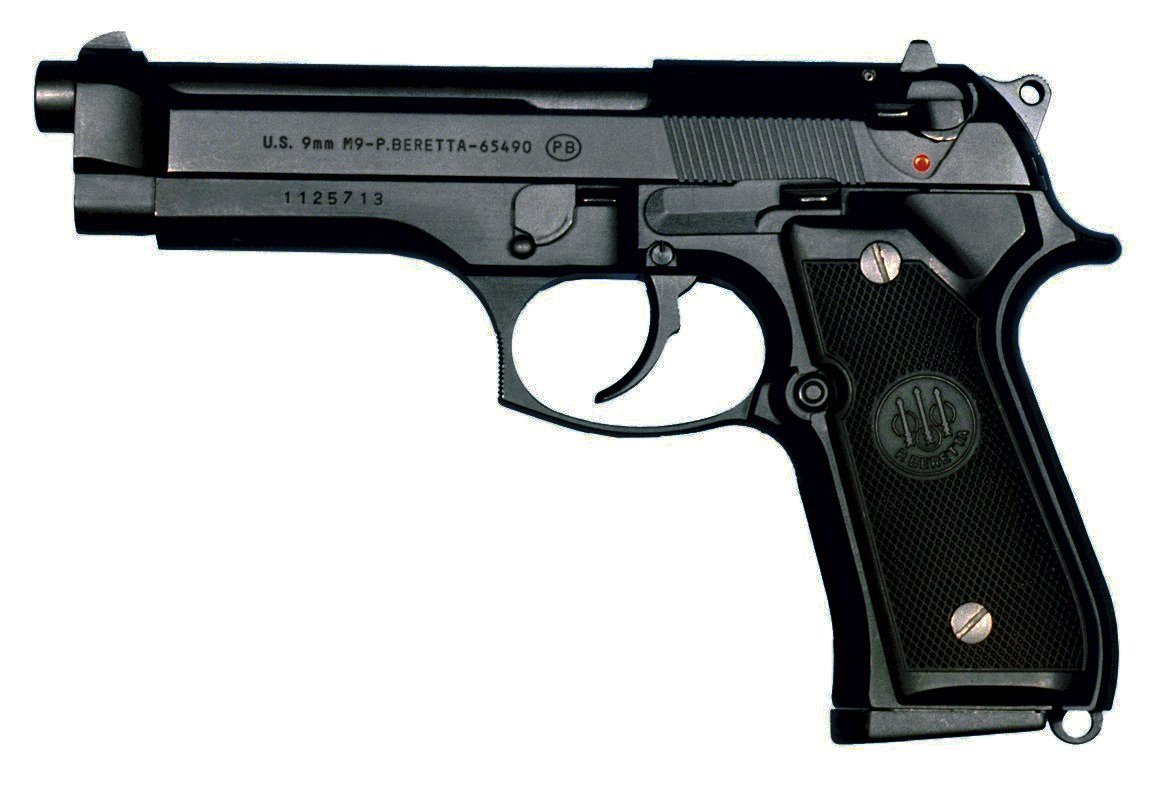
 : Beretta entered their Beretta 92S-1 (later renamed 92SB), which would be considered the best entry of the 1979-1980 trials. In the 1984 trials, Beretta would submit 92S-1's successor, the 92SB-F (later renamed to 92F), which would be chosen and adopted as the M9 pistol in January 1985.
 : FN Herstal submitted two entries, the FN Browning M1935 High Power and the FN Browning Fast Action, a special double-action version of the M1935 High Power.
 : Colt's Manufacturing Company of the United States submitted the Colt SSP (stainless steel pistol), a 9×19mm Parabellum variant of the Colt Model 1971, which was an earlier attempt to develop a new service pistol to replace the M1911, with some minor mechanical alterations made for the trials. Colt submitted 30 new SSPs out of a production run of around 50, but their pistol was not selected. One example is on display at the Aberdeen Proving Ground.[10][11]
 : Heckler & Koch submitted two pistols, the Heckler & Koch P9S and the Heckler & Koch VP70. The former carried the smallest magazine of all the pistols tested, while the VP70 boasted the highest capacity magazine.
- : Smith & Wesson of the United States submitted their Smith & Wesson 459A.
 : Star Bonifacio Echevveria S.A. submitted their Star Model 28.


The existing standard M1911A1 and the Smith & Wesson M15 .38 Special handguns were also tested to compare to those which were submitted for comparison.[1]
Results of the first tests
[edit]Six of the submitted firearms passed the test.[citation needed] The Beretta 92S-1 performed the best overall and was announced as the clear winner, having exceeded the stated goals in several cases.[12][13]
P9S easily won the accuracy phase of testing but fell into disfavor when its operating controls failed to adapt themselves to left-handed use. The magazine capacity (nine rounds) was one short of the desired (later required) capacity.
The Heckler & Koch VP70, with its then unusual trigger mechanism (a three round burst selection was available when the supplied stock was attached), allowed only double action firing and failed the hand-held accuracy portion of the tests. As for the endurance tests, the four P9S specimens fired a total of 18,697 rounds with 360 stoppages, producing an MRBS number of 52 (18,697/360).
The VP70 performed far worse, firing a mere 771 rounds with 137 stoppages for an MRBS of only 5. In fairness to the VP70, the ammunition used for these tests was extremely suspect. None of it approached the "hot" power ratings of the European 9mm ammunition for which Heckler & Koch—and indeed all European manufacturers—had designed their guns.
Star's Model 28, ordinarily a strong, reliable handgun with an excellent service record, also stumbled over the low-powered cartridges, recording the same dismal MRBS number as the VP70.
Accuracy testing showed that the Air Force had been correct in their selection of the S&W M15 over the M1911A1. The shooters of the M15 performed better in accuracy than those with the M1911A1 .45 pistol. The new submission of 9mm handguns was the most accurate group. Very importantly, the 9mm accuracy was even greater over that of the M15 and M1911A1 with the least experienced shooters than it was with experienced shooters.
In durability testing the M1911A1 was experiencing 1 failure for every 748 rounds fired. The Smith & Wesson 459A was performing at 1,952 and the Beretta at 2,000. This caused controversy since the new M1911A1 pistol had achieved 6000 rounds previously. The Air Force was testing guns from existing inventory. Some observers of the test record believe that defective magazines were the reason for the M1911A1's poor performance.
The US Army used the fact that the Air Force did not replace the magazines which caused poor M1911A1 performance was cited as a reason to invalidate all test results. The Army did not like the Air Force's sand, mud, and extreme temperature testing. The Army conducts their tests of this type with rigorous accuracy recording. The Army rejected the results of the Air Force Testing.
The JSSAP program managers agree to have the test run again only in the next tests they would be conducted by the Army.
New requirements were created and the new handgun to be procured would now be called the XM9 (prototype, will be type accepted as the M9).[1][14]
Second tests from 1981
[edit]![[icon]](https://en.wikipedia.org/wiki/File:Wiki_letter_w_cropped.svg) | This section needs expansion. You can help by adding to it. (June 2024) |
Results of the second tests
[edit] |
In February 1982 issued this statement; "The Army, in its role as Defense Department executive agent for 9mm handgun procurement, has cancelled the procurement. It was not possible to make an award because the submitted weapon samples substantially failed to meet the essential requirements contained in the procurement solicitation. The Department of Defense intends to reexamine its requirements for a new handgun."[citation needed]
This cause a firestorm of protest. Supporters[who?] in the military and Congress denounced the Army tests as rigged and a fiasco. The last line in particular was interpreted as allowing the purchase of the M1911A1 models in 9mm or .45 ACP. Colt exacerbated this thought when they subsequently offer an unsolicited proposal to convert existing M1911A1 handguns to 9mm.[citation needed]
The Army's response was that all the contenders had failed in areas of reliable operations in low temperature, sand and mud. No data to support this was provided. This denial was justified[by whom?] that since a new competition might be held that data might be competition sensitive. (Note:[according to whom?] Why? Having this data would simply allow the competitors to see where they needed to improve)
An unsupported rumor[according to whom?] was that the adverse dirty conditions test required 1000 rounds without failure although 800 would be acceptable. A claim was made[by whom?] that none of the firearms achieved even 600 rounds.
As a result of this there were threats of lawsuits by the makers[example needed] who felt defamed and worse a Congressional investigation.[1]
Third tests from 1983-1984
[edit]By November 1983, a new program was started, now under the XM9 name.[15] These later trials did not have all of the same pistols competing, as some had dropped out, and some were added to the competition.
This time the Army required 30 handguns and spares for each submitted handgun design. The magazine capacity requirement was changed from 10 to 13. The price was now a fixed price requirement for a procurement of 220,000 pieces. These changed requirements caused the elimination of some handguns which has participated in the first trial.[15]
Eight pistols were entered into the XM9 competition were:[16][17]
- : Beretta of Italy entered their Beretta 92SB-F (later renamed to 92F), which was an improvement of their previous entry, the Beretta 92S-1. This emerged as the winner of these trials as well, and would be eventually adopted as the Beretta M9.
 : SIG Sauer (under the name SigArms) introduced their new pistol specifically designed for the trials, the P226. The P226 was the runner-up to the M9, as both were the only two to satisfactorily pass the trials. However, the P226 would ultimately not be chosen. In a later competition for a compact service pistol, SIG Sauer's P228 became the M11 pistol.
 : Steyr of Austria submitted the Steyr GB.
- : FN Herstal of Belgium gave up on the other two designs and submitted again their BDA, a modified double-action version of the Browning Hi-Power.
- : Colt's Manufacturing Company of the United States submitted the Colt SSP (stainless steel pistol).
- : Walther of Germany submitted the Walther P88.
- : Heckler & Koch, also of Germany, gave up on their previous two efforts and entered the P7.
- : Smith & Wesson of the United States submitted their Smith & Wesson 459M.


The third trials commenced in January 1984[15] with the first tests carried out in following February.[18]
Results of the third tests
[edit]During the dry mud test, the S&W, H&K, and Beretta passed with nearly perfect scores but the SIG only received 79 percent. The Walther failed both the wet and dry mud tests.[19][additional citation(s) needed]
Out of the eight submitted entries, only the Beretta 92SB-F and the SIG Sauer P226 were found "technically acceptable finalists". Steyr's GB pistol was the first design to be rejected by Army on May 4, due to reliability issues. Subsequently, both Fabrique Nationale Herstal and Colt Manufacturing Company would voluntarily withdraw their entries, with the former on May 31 and the latter on July 18. On September 18, 1984, the submissions by Carl Walther Waffenfabrik, Heckler & Koch and Smith & Wesson were all terminated. The P88 was terminated for failing drop test, dispersion, corrosion resistance, and adverse conditions requirements. The P7M13 was terminated for failing reliability and corrosion resistance requirements and the 459M for failing service life and firing pin energy requirements.[16]
In both trials where the Beretta 92SB-F and SIG Sauer P226 competed the SIG was either equal or superior to the Beretta in most tests.[20] The purchase price for the Beretta M9 handgun was US$178.50 per unit.[20]
The P226 lost out in the final bidding and the Beretta emerging the winning design once again. On January 14, 1985, the Department of Defense and the Army announced that the five-year contract would be awarded to Beretta, with the Beretta 92SB-F subsequently adopted as the M9 pistol.[15][21]
Aftermath
[edit]Controversy over these trials led to the XM10 trials in spring of 1988. These trials were boycotted by most of the arms manufacturers that submitted their designs in prior trials, with the only entrants being the Beretta 92F, slightly improved Smith & Wesson 459 and Ruger submitting their new P85. Both Ruger and Smith & Wesson designs failed the trial perimeters, resulting in Beretta winning again.[22]
In the 2000s, a new joint service handgun was started, the Joint Combat Pistol, which was the result of a merger of two earlier programs: the U.S. Army's Future Handgun System[23] and United States Special Operations Command's SOF Combat Pistol. However, the Army ultimately pulled out of the competition.
As a result of the Modular Handgun System trials, the SIG Sauer P320 was selected as the new service pistol for the United States Armed Forces, supplanting the M9 pistol.[24] The military designations are M17/M18 for the full size and compact models respectively.[25]
See also
[edit]References
[edit]Sources
[edit]- Thompson, Leroy (2011-09-20). The Beretta M9 Pistol. Bloomsbury Publishing. ISBN 9781849088374.
- "Toward a New Hand Gun!!!". Army R, D & A. Volume 22, Number 1. Development and Engineering Directorate, HQ, U.S. Army Materiel Development and Readiness Command. January 1981. pp. 1–4.
- United States. Congress. House. Committee on Armed Services. Subcommittee on Investigations (1981). Proposed Procurement of 9--MM Handgun by the Department of Defense (Report). U.S. Government Printing Office.
- United States. Congress. House. Committee on Government Operations. Legislation and National Security Subcommittee (1986). The Beretta Pistol: Should it be the Defense Department's Standard Handgun? : Hearing Before a Subcommittee of the Committee on Government Operations, House of Representatives, Ninety-ninth Congress, Second Session, June 5, 1986 (Report). University of California: U.S. Government Printing Office. Retrieved June 4, 2024.
Citations
[edit]- ^ a b c d e f g Rogers, Patrick F. "The Service Pistol Controversy" (PDF). American Handgunner. Retrieved 4 July 2016.
- ^ Funcasta, Gus, "PowerPoint Presentation (unclassified) Joint Service Small Arms Program Office" (PDF), ndiadtic.mil, p. 2, retrieved 6 September 2025
- ^ Kelley, Tom (2016-05-09). Bunker Hill and Grissom Air Force Base. Arcadia Publishing. ISBN 9781439656044.
- ^ Rogers, Patrick F. (1983). "The Service Pistol Controversy" (PDF). American Handgunner (May/June): 56–58, 88, 91.
- ^ Subcommittee on Investigations (1981). In July 1981, there were 412,339 .45 caliber pistols and 127,745 .38 caliber revolvers in the inventories of the Army, Navy, Air Force and Marine Corps. The last procurement of the .45 caliber pistol occurred in 1945. Since that time the existing inventory has been maintained by rebuilding and reconditioning the worn weapons. Department of Defense witnesses testified that $1.5 million is currently budgeted for the procurement of replacement components for those handguns. They also testified "field reports indicate that it is reaching the end of its maintainable life." After urging of House Committee on Appropriations, the Department of Defense, in 1978, initiated two studies to investigate the benefits of standardizing ammunition and handguns of the military departments.
- ^ XM9/XM10 Trials
- ^ https://ndia.dtic.mil/wp-content/uploads/2021/future/T-SA_JSSASP.pdf [bare URL PDF]
- ^ Army R, D & A. Volume 22, Number 1; "JSSAP management committee[...] coordinated their service inputs. This study was comprised of two principal parts, the first being the on-going Air Force Evaluation of handguns which was being conducted at Elgin Air Force Base, FL, in which various model 9mm pistols were evaluated against the M1911A1's and M15 .38 cal revolvers. The second part of the study considered a review of compilation of all existing historical reports and studies relative to pistols, hand-guns and their performance."
- ^ Army R, D & A. Volume 22, Number 1
- ^ Firearms, Historical. "- Colt Model 1971 In 1971 Colt unveiled a new modern..." Historical Firearms.
- ^ "Modern Firearms - Colt SSP". 22 October 2010.
- ^ Gangarosa, Gene (2001). Heckler and Koch : Armorers of the Free World (First ed.). Stoeger Publications; 1st edition. ISBN 0739431773.
- ^ Legislation and National Security Subcommittee (1986); Page 4. Interest in the 9-mm handgun started in 1978 with informal Air Force testing of 9-mm pistols.[...] DOD concluded 2 years later that handgun standardization using 9-mm ammunition was feasible. At first, DOD planned to rely on the results of Air Force testing, which concluded that Beretta [92S-1] was by far the superior weapon tested. The Army, however, opposed awarding a sole-source contract to Beretta on grounds that the Air Force testing was not scientific. Since 1980, the Army has conducted two additional extensive rounds of testing the 9-mm pistol.
- ^ Markham, George. Guns Of The Elite: Special Forces Firearms, 1940 To The Present. London: Arms and Armour, 1987. Print. P.58,62 ISBN 0-85368-866-4
- ^ a b c d Thompson (2011), Chapter: "Army Takes Charge"
- ^ a b Legislation and National Security Subcommittee (1986); Page 15.
- ^ Annual Historical Review. Historical Office, U.S. Army Armament Materiel Readiness Command. 1983.
- ^ Legislation and National Security Subcommittee (1986); Page 9
- ^ McClellan, Angus. "25 Years of Service The Beretta M9" (PDF).
- ^ a b Dockery, Kevin (2007-12-04). Future Weapons. Berkley; Reprint edition. ISBN 978-0425217504.
- ^ Legislation and National Security Subcommittee (1986); Page 112.
- ^ Neville, Leigh (2019-10-30). "Chapter One: Combat Pistols". Infantry Small Arms of the 21st Century: Guns of the World's Armies. Pen & Sword Books. ISBN 9781473896154.
- ^ Pike, John. "Future Handgun System (FHS)".
- ^ Myers, Meghann (19 January 2017). "Army: Your new handgun will be a Sig Sauer". Army Times. Archived from the original on 31 January 2018. Retrieved 31 January 2018.
- ^ "The Top Three Contenders For The U.S. Military's XM17 Modular Handgun System Contract - Bearing Arms - APX, Beretta, Detonics Defense, Modular Handgun System, P320 MHS, Sig Sauer, STI". 1 July 2015.
Joint Service Small Arms Program
View on GrokipediaBackground and Rationale
Historical Context of U.S. Military Pistols
The Colt M1911 pistol, chambered in .45 ACP, was adopted by the U.S. Army on March 29, 1911, following trials initiated after the Philippine-American War (1899–1902), where revolvers like the .38 Long Colt proved inadequate in stopping power against determined adversaries.[7] Designed by John Moses Browning, the semi-automatic, single-action pistol featured a 5-inch barrel, 7-round single-stack magazine, and manual thumb safety, prioritizing reliability and one-shot incapacitation over capacity or lighter weight.[8] The Navy and Marine Corps adopted it in 1913, marking the first widespread semi-automatic sidearm in U.S. service and replacing diverse revolvers across branches.[9] During World War I, production reached approximately 68,000 units, with the pistol proving effective in close-quarters combat despite limited deployment.[7] World War II saw massive scaling, with over 2 million M1911 and M1911A1 variants manufactured by Colt, Remington Rand, Ithaca, and Union Switch & Signal, equipping all services amid global conflict demands.[8] Minor updates in the M1911A1 (1938) included a shorter trigger, arched mainspring housing, and plastic grips for improved ergonomics, but the core design remained unchanged.[7] Post-war, the pistol continued in Korea (1950–1953) and Vietnam (1955–1975), where its durability in mud, sand, and jungle environments sustained its reputation, though field reports noted occasional failures to eject under extreme neglect.[10] By the 1970s, the inventory—largely comprising World War II-era pistols exceeding 30 years of age—faced accelerated wear, with maintenance challenges arising from corroded parts and inconsistent armorer training.[10] The .45 ACP's 230-grain bullet offered superior terminal ballistics but limited magazine capacity to 7 rounds (versus 15 in contemporary double-stack 9mm designs), while the loaded weight of 39 ounces burdened soldiers carrying additional gear.[4] NATO's 1957 standardization on 9×19mm Parabellum for interoperability amplified logistical strains, as U.S. forces expended .45 ACP at rates diverging from allies during joint operations.[11] Earlier replacement efforts included 1950s Army evaluations of 9mm prototypes like the High Standard 9mm and early SIG designs, which tested favorably for capacity but faltered in durability against the M1911 benchmark.[11] A 1970 Infantry Board review recommended transitioning to 9mm for weight savings and NATO alignment, yet procurement delays and doctrinal attachment to .45 stopping power deferred action, with modified M1911A1s (e.g., hard-chromed "MEU" variants) issued to elite units.[10] These factors culminated in the late 1970s imperative for a joint-service program to field a modern, high-capacity 9mm pistol capable of 5,000-round endurance without the M1911's maintenance intensity.[4]Strategic Objectives for Modernization
The Joint Service Small Arms Program (JSSAP), established in 1978 under the authority of the Office of the Under Secretary of Defense, aimed to achieve standardization of small arms across U.S. military branches to streamline logistics, reduce maintenance burdens, and enhance operational efficiency. By designating the U.S. Army as the executive agent, the program addressed fragmented inventories where multiple services maintained disparate handgun models—identified as 25 distinct makes and variants in a 1978 study—leading to inefficiencies in training, parts procurement, and ammunition supply.[2][12] Modernization efforts prioritized consolidating these into a single, joint-service pistol design to minimize long-term sustainment costs and improve readiness, as aging World War II-era M1911 .45 ACP pistols approached the end of their service life after over 70 years of use.[13] A core objective was alignment with NATO standardization agreements, particularly adopting the 9×19mm Parabellum cartridge as the common service pistol round to facilitate interoperability with allied forces, shared ammunition logistics, and reduced dependency on U.S.-specific .45 ACP stockpiles, which were costlier to produce and store.[14][4] This shift sought to leverage the lighter, higher-velocity 9mm for greater magazine capacity—targeting at least 15 rounds versus the M1911's 7—while maintaining adequate stopping power for secondary weapon roles, reflecting tactical lessons from post-Vietnam analyses emphasizing volume of fire over per-round lethality in handgun engagements.[15] Additional goals included incorporating modern safety features, such as double-action triggers to mitigate accidental discharges among non-specialist personnel, and enhanced durability requirements for environmental resilience, endurance (e.g., 5,000-round mean rounds between failures), and ergonomic improvements over the single-action M1911. These specifications, outlined in the XM9 pistol trials initiated in 1979, balanced warfighter sustainment with fiscal constraints, projecting lifecycle savings through reduced caliber-specific infrastructure despite initial procurement costs. Critics within military circles, however, argued that the emphasis on standardization overlooked the .45 ACP's proven terminal ballistics, potentially compromising close-quarters effectiveness for logistical gains.[4][12]Program Requirements and Specifications
XM9 Pistol Criteria
The XM9 pistol criteria, developed under the Joint Service Small Arms Program, comprised 85 requirements, of which 72 were mandatory and 13 desirable, aimed at replacing the Colt M1911A1 .45 ACP pistol with a modern 9mm design emphasizing reliability, safety, and NATO interoperability.[16] Mandatory specifications included chambering for the standard 9×19mm NATO cartridge, a minimum detachable magazine capacity of 10 rounds (with 15 rounds desirable), and an expected service life of at least 5,000 rounds without significant degradation.[16] The design required a double-action trigger mechanism permitting gloved operation, an ambidextrous thumb safety, and a decocking device enabling safe hammer lowering without discharge, alongside safeguards against accidental firing from drops or uncocking.[16] [17] Physical constraints mandated a loaded weight not exceeding approximately 3.5 pounds (1.6 kg), an overall length of no more than 8.75 inches (22.2 cm), and a barrel length limited to 5 inches (12.7 cm), ensuring compactness comparable to the M1911 while accommodating military holsters and lanyards via a butt loop for braided rope lines.[4] Additional mandatory features encompassed corrosion resistance equivalent to the M1911 under field conditions and seawater immersion, a fixed rear sight adjustable by drifting, and firing pin energy of 24 inch-ounces to reliably ignite NATO primers.[16] Performance criteria emphasized superiority over the M1911 in reliability, defined as mean rounds between operational failures exceeding 165, demonstrated through extensive environmental testing including 60-second mud immersion (requiring 100% successful firings post-submersion), salt water corrosion exposure for 10 days, and endurance trials firing up to 7,000 rounds per pistol with zero failures allowed through the initial 5,000 rounds.[16] Desirable enhancements included a removable front sight and extension of service life to 10,000 rounds.[16] These standards, finalized by 1980-1981, prioritized empirical durability over optional innovations, with submissions evaluated at sites like Eglin Air Force Base and Aberdeen Proving Ground using sample sizes of 2-7 pistols per test protocol.[16]Caliber Selection and NATO Alignment
The Joint Service Small Arms Program (JSSAP), initiated in the late 1970s, mandated that candidate pistols for the XM9 designation be chambered exclusively in the 9×19mm Parabellum cartridge, formalized as the NATO standard pistol round. This requirement stemmed from the U.S. Department of Defense's emphasis on logistical compatibility with North Atlantic Treaty Organization (NATO) allies, most of whom had adopted 9mm as their service pistol caliber since the alliance's formation in 1949, with widespread standardization by the mid-1950s.[18][17] The U.S. military, which had relied on the .45 ACP cartridge in the M1911 pistol since 1911 for its proven stopping power in close-quarters engagements—evidenced by empirical data from World War I and II combat reports showing higher one-shot incapacitation rates compared to 9mm—shifted to prioritize alliance interoperability over historical preferences.[4] NATO's adoption of 9×19mm, originally the German Parabellum design from 1902, facilitated shared ammunition stocks across member nations, reducing supply chain complexities during multinational operations. By the 1970s, over 20 NATO countries, including the United Kingdom, Canada, and West Germany, utilized 9mm pistols such as the Browning Hi-Power and SIG P220, creating a de facto standard that the JSSAP aligned with to avoid the burdens of maintaining separate .45 ACP production lines amid shrinking defense budgets post-Vietnam War. The cartridge's ballistics—approximately 115-grain full metal jacket (FMJ) projectiles at 1,250 feet per second muzzle velocity—offered adequate penetration against unarmored threats while enabling higher magazine capacities (minimum 13 rounds required by JSSAP specifications) and lighter overall ammunition weight, allowing soldiers to carry roughly twice as many rounds compared to the 7- or 8-round .45 ACP magazines without exceeding weight limits.[14][17] This caliber choice disregarded domestic advocacy for retaining .45 ACP, rooted in early 20th-century U.S. Army tests like the 1904 Thompson-LaGarde trials, which favored larger-diameter bullets for physiological incapacitation via hydrostatic shock and tissue disruption over smaller, higher-velocity rounds. Proponents of .45 ACP cited real-world data from conflicts, including Marine Corps after-action reports from the Pacific Theater indicating superior terminal effects against charging Japanese soldiers, but JSSAP evaluators prioritized empirical logistics modeling showing that NATO alignment could streamline resupply in coalition scenarios by up to 30% for small arms ammunition. No formal caliber trials occurred within JSSAP, as 9mm was a non-negotiable criterion from program outset in 1979, reflecting causal priorities of joint force integration over unilateral ballistic preferences.[4]Testing Phases
Initial Trials at Eglin AFB (1979-1980)
The initial trials for the Joint Service Small Arms Program's (JSSAP) new service pistol were managed by the United States Air Force and conducted at Eglin Air Force Base in Florida during 1979-1980.[19] These evaluations preceded the formal XM9 designation and aimed to assess candidate 9mm Parabellum designs for potential standardization across U.S. military branches, focusing on replacing the aging .45 ACP M1911A1 with a modern, higher-capacity handgun aligned with NATO ammunition standards.[19] Manufacturers submitting prototypes included Beretta with its Model 92S-1, alongside offerings from Colt, Smith & Wesson, Fabrique Nationale (FN), Star, and Heckler & Koch.[19] The trials emphasized key performance metrics such as accuracy, endurance (prolonged firing sequences), reliability under stress, and functionality in varied environmental conditions like temperature extremes and humidity, while verifying compliance with emerging requirements including double-action trigger mechanisms, detachable magazines holding at least 13 rounds, and ambidextrous safety features for left-handed operators.[19] Air Force testers concluded that the Beretta Model 92S-1 demonstrated superior overall performance compared to competitors, excelling in reliability and handling during the regimen of live-fire and durability assessments.[19] [20] However, the U.S. Army contested the outcomes, citing inconsistencies in testing protocols and procedural discrepancies, which resulted in the invalidation of results and prompted a shift to Army-led follow-on trials beginning in 1981.[20] This inter-service disagreement highlighted early tensions in JSSAP's joint oversight, delaying pistol modernization despite the Air Force's favorable empirical findings on the Beretta design.[20]Follow-on Evaluations (1981-1983)
Following the initial trials at Eglin Air Force Base, the U.S. Army assumed lead responsibility for the Joint Service Small Arms Program pistol evaluations in late 1981, conducting follow-on testing to address perceived shortcomings in the earlier Air Force-led phase and to apply more rigorous standards aligned with Joint Service Operational Requirements (JSOR).[16] These evaluations, spanning late 1981 to February 1982, involved four primary contenders: Beretta's Model 92, SIG Sauer's P226 (submitted via SACO), Smith & Wesson's Model 459, and Heckler & Koch's entry.[16] Testing occurred at sites including Fort Dix, New Jersey, and Aberdeen Proving Ground, Maryland, focusing on approximately 50 mandatory performance specifications, such as endurance, reliability under adverse conditions (e.g., mud, salt water), accuracy, and logistics supportability, with an emphasis on surpassing the M1911 .45 ACP pistol in key metrics.[16][19] The protocol demanded exceptionally high reliability, including a mean rounds between failures (MRBF) threshold exceeding 600 rounds—far stricter than prior benchmarks—and service life of at least 5,000 rounds without critical failures, alongside environmental resilience tests simulating combat stresses.[4][16] Smith & Wesson’s Model 459 demonstrated superior performance in several areas compared to Beretta, including higher overall reliability scores during preliminary assessments, though exact round counts for this phase were not publicly detailed beyond the overarching failure criteria.[16] However, no entrant satisfied more than 11 of the 72 combined mandatory and desirable requirements, with universal shortfalls in achieving the elevated MRBF and consistent endurance under the JSOR's demanding parameters, leading to the program's temporary cancellation in February 1982.[19][4] Critics, including congressional oversight, attributed the blanket failures to overly ambitious and unrealistic specifications that prioritized theoretical ideals over practical achievability, potentially influenced by internal Army preferences for retaining .45 ACP capabilities or skepticism toward 9mm adoption.[16] The Government Accountability Office later reviewed these evaluations as part of broader procurement scrutiny, finding no evidence of procedural bias in the 1981-1982 phase but noting the stringent criteria effectively reset the competition without favoritism toward any single design.[16] In response, mid-1982 directives from the Secretary of Defense mandated revisions to the requirements, paving the way for resumed testing under moderated standards by late 1983, though the 1981-1982 outcomes underscored persistent challenges in balancing NATO 9mm interoperability with U.S. service demands.[19][16]Final Endurance and Reliability Tests (1983-1984)
The XM9 trials' final phase, initiated in November 1983 and culminating in testing from February to August 1984, focused on endurance and reliability under joint service specifications at sites including Aberdeen Proving Ground and Fort Benning. Eight pistol models were evaluated, including the Beretta 92SB-F, SIG Sauer P226 (via SACO Defense), Heckler & Koch P7M13, Smith & Wesson Model 459, Walther P88, Steyr GB, Colt SSP, and FN DA. Each manufacturer's submission consisted of seven pistols subjected to a total of approximately 35,000 rounds, with individual weapons fired 3,500 to 7,000 rounds to determine service life, requiring an average of at least 5,000 rounds without failure necessitating replacement beyond standard parts. Reliability was quantified via mean rounds between stoppages (MRBS), alongside assessments of parts breakage, maintenance costs, and field-strip simplicity.[16][19] Endurance results highlighted disparities: the Beretta 92SB-F achieved a full 7,000 rounds per pistol without slide or frame failures, incurring $11.30 in maintenance costs over 5,000 rounds, with its integral front sight eliminating separate replacements. The SACO P226 recorded 6,841 rounds average service life and zero parts replacements in initial 5,000-round evaluations, though two frame failures occurred beyond that threshold. Smith & Wesson Model 459 averaged 6,000 rounds but failed due to one pistol's slide cracking between 4,500 and 5,000 rounds; Heckler & Koch P7M13 reached only partial endurance before elimination. Steyr GB was withdrawn early after reliability failures, while Colt SSP and FN DA were pulled by their makers mid-testing.[16] Reliability metrics further differentiated performers, with Beretta's MRBS of 1,750 surpassing the .45 ACP control pistol's 162 but trailing SACO's 2,877; Smith & Wesson scored a low 434, and Heckler & Koch 158, both below thresholds. Integrated with environmental exposures (e.g., salt water corrosion, where H&K notably failed) and firing pin energy tests, these outcomes eliminated Walther P88, Steyr GB, Smith & Wesson, and Heckler & Koch, leaving Beretta and SIG P226 as the sole qualifiers for procurement bidding. Beretta's balanced endurance—sustaining full test rounds without major defects—contributed to its selection edge, despite GAO observations of test variability from small sample sizes.[16][19]Competing Designs and Manufacturers
Overview of Submitted Prototypes
The XM9 Service Pistol Trials, part of the Joint Service Small Arms Program's final evaluation phase from 1983 to 1984, evaluated prototypes from eight manufacturers selected after preliminary screening. These submissions were required to demonstrate compliance with specifications including a minimum magazine capacity of 15 rounds, ambidextrous controls, a service life of at least 5,000 rounds without significant degradation, and resistance to environmental stressors such as salt water exposure and extreme temperatures.[16] The prototypes represented a mix of established designs and new developments, primarily double-action/single-action 9mm Parabellum pistols with aluminum frames or slides for weight reduction.[19] The submitted models included:| Manufacturer | Model | Country |
|---|---|---|
| Beretta | 92SB-F | Italy |
| Colt | SSP | United States |
| FN Herstal | Double Action | Belgium |
| Heckler & Koch | P7M13 | Germany |
| SIG Sauer | P226 | Switzerland |
| Smith & Wesson | 459 | United States |
| Steyr Mannlicher | GB | Austria |
| Walther | P88 Compact | Germany |
Performance of Leading Contenders
In the final phase of the XM9 trials conducted in 1983-1984, the Beretta 92SB-F and SIG Sauer P226 emerged as the leading contenders after other submissions, including the Heckler & Koch P7M13, Smith & Wesson Model 459, Walther P88, Steyr GB, Colt SSP, and FN double-action pistol, were eliminated for failing criteria such as service life, firing pin energy, reliability, or environmental resistance.[19][16] The Heckler & Koch P7M13 was rejected primarily due to inadequate performance in reliability and salt water corrosion tests, while the Smith & Wesson Model 459 failed service life requirements after one unit cracked between 4,500 and 5,000 rounds and did not meet firing pin energy standards (average indent of 0.01172 inches versus the required 0.0115 inches).[16][17] Reliability testing measured mean rounds between failures (MRBF) and percentage of successful firings, with the SIG P226 demonstrating superior results at 2,877 MRBF and 99.97% successful firings, compared to the Beretta 92SB-F's 1,750 MRBF and 99.94% successful firings.[16][23] In overall scoring across six evaluation factors, the SIG P226 initially led with 853.6 points against the Beretta's 835.34, reflecting its edge in reliability and other technical metrics.[23] However, the Beretta exhibited stronger environmental resilience in mud tests, achieving 97% success in wet conditions and 98% in dry, versus the SIG's 98% wet but only 79% dry.[16][19] Endurance and service life evaluations required pistols to withstand at least 5,000 rounds with no more than eight malfunctions, a threshold both finalists met, though the Beretta averaged 7,000 rounds before testing concluded, slightly outlasting the SIG's average of 6,841 rounds.[16] Salt water corrosion resistance was high for both, with the SIG at 100% overall and the Beretta at 99%.[16] All contenders chambered in 9×19mm NATO met baseline ballistic specifications, including muzzle velocity and energy consistent with the cartridge standard, but no differential accuracy or velocity data distinguished the finalists beyond general compliance.[17]Selection and Adoption
Decision-Making Process and Allegations
The XM9 Service Pistol Trials, managed by the U.S. Army under the Joint Service Small Arms Program from 1983 to 1984, formed the basis of the final selection decision. These trials evaluated prototypes against 13 mandatory criteria, including mechanical safety features to prevent accidental discharge, ergonomic design for gloved operation, accuracy within 1.5-inch groups at 25 meters, and endurance of at least 5,000 rounds without part breakage or stoppages exceeding 4%. The Beretta 92SB-F excelled, completing over 10,000 rounds in reliability tests with minimal failures and requiring no design alterations to meet specifications, while competitors like the SIG Sauer P226 exhibited magazine retention issues and the Smith & Wesson 459 suffered frame cracks under prolonged firing.[16][19] On January 14, 1985, the Army announced the Beretta 92SB-F—modified slightly for U.S. military rail mounting—as the winner, designating it the XM9 pistol for type classification.[24] A production contract followed on February 28, 1985, for 331,510 units at $75.9 million, with Beretta USA committing to domestic manufacturing to address procurement concerns.[16] The decision prioritized NATO 9×19mm Parabellum compatibility and cost-effectiveness, estimated at $200–$250 per unit versus higher bids from U.S. firms, while aligning with allied standardization efforts.[25] Allegations of favoritism and testing irregularities surfaced immediately from domestic manufacturers like Colt and Smith & Wesson, who argued that ammunition variability, mud exposure protocols, and limited sample sizes (as few as six pistols per entrant) systematically disadvantaged American entries by inducing failures not reflective of real-world use.[26] Critics, including congressional figures, claimed the process favored foreign designs to expedite NATO interoperability, potentially overlooking superior .45 ACP options despite empirical data showing the Beretta's edge in double-action trigger consistency and parts commonality.[16] A 1986 Government Accountability Office (GAO) investigation, prompted by these protests, found no deliberate bias toward Beretta but identified procedural lapses, such as the exclusion of one U.S. competitor from endurance phases due to administrative errors; overall, it validated the selection as compliant with JSSAP requirements, attributing disqualifications to objective failures rather than manipulation.[16][27] These claims fueled "Buy American" pressures, leading to the XM10 trials in 1988 as a post-selection review for U.S.-built alternatives, with Beretta serving as the baseline. Limited participation—only Smith & Wesson and Ruger entered viable prototypes—resulted in both failing reliability benchmarks, while informal mockery (e.g., a mock "hot dog gun" submission) underscored perceptions of a rigged or futile exercise; no replacement emerged, affirming the M9.[28][29]Implementation of the Beretta M9
The Beretta 92F was officially designated as the M9 pistol by the U.S. Army on February 14, 1985, marking the culmination of the Joint Service Small Arms Program's efforts to standardize a 9mm service handgun across U.S. military branches.[4] This adoption followed the program's final trials and aimed to replace the aging M1911A1 .45 ACP pistol with a higher-capacity, double-action design compatible with NATO's 9×19mm Parabellum cartridge. The M9's implementation involved coordinated procurement, production, and distribution to the Army, Navy, Air Force, Marine Corps, and Coast Guard.[19] In 1985, the Department of Defense awarded Beretta an initial five-year contract valued at $56.4 million for the production of 315,930 M9 pistols, with the quantity later adjusted to 321,260 units by 1988 at a total cost of approximately $75 million.[30][31] To meet U.S. manufacturing requirements, Beretta established production at its U.S. facility, ensuring domestic assembly of the pistols for military issue. Fielding commenced shortly after adoption, with initial deliveries supporting a phased replacement of the M1911A1; by the late 1980s, M9s were being issued to frontline units, though some personnel retained .45 pistols into the early 1990s during the transition.[32] Implementation included the development of new training protocols and accessories tailored to the M9's ergonomics and 15-round magazine capacity, facilitating its integration into service-wide small arms doctrine. Over time, Beretta delivered more than 600,000 M9 variants to the Department of Defense, with subsequent contracts extending production into the 2010s to sustain inventories amid ongoing use.[33] The program's emphasis on joint service standardization ensured uniform adoption, though logistical challenges in full rollout were noted in early evaluations.[34]Operational Outcomes
Service Introduction and Early Use
The Beretta Model 92F was officially adopted by the U.S. Army as the 9mm M9 pistol on February 14, 1985, following the conclusion of the Joint Service Small Arms Program trials.[4] This selection marked the end of over seven decades of .45 ACP dominance with the Colt M1911A1, transitioning U.S. forces to a higher-capacity, double-action handgun standardized across Army, Navy, Air Force, and Marine Corps branches.[19] Initial production contracts awarded to Beretta, an Italian manufacturer, required establishment of U.S.-based facilities to meet domestic procurement preferences, with the first deliveries occurring in 1986.[35] Fielding proceeded incrementally, prioritizing units with high sidearm usage such as military police, aviators, and special operations personnel.[36] By the late 1980s, the M9 had supplemented or replaced legacy pistols in training and garrison environments, with over 100,000 units distributed by 1989.[36] The pistol's 15-round magazine capacity and ambidextrous controls facilitated broader adoption, though the Marine Corps delayed full issuance until the mid-1990s due to doctrinal preferences for the .45 ACP.[37] The M9's early operational debut came during Operation Just Cause in Panama on December 20, 1989, where U.S. forces employed it in close-quarters engagements against Panamanian Defense Forces.[20] In this low-intensity conflict, the weapon provided reliable suppressive fire and personal defense, logging initial combat hours without widespread malfunctions reported in after-action reviews.[14] Subsequent non-combat uses in training exercises validated its ergonomics for diverse service members, setting the stage for broader integration into military doctrine emphasizing lighter, NATO-compatible ammunition.[38]Documented Reliability and Durability Issues
The Beretta M9 pistol encountered documented durability concerns primarily involving slide failures during early production and testing phases post-adoption in 1985. A 1988 Government Accountability Office (GAO) assessment identified 14 instances of slide failures, which injured four shooters by causing fragments to strike personnel.[39] These failures stemmed from fatigue cracks initiating near the slide's locking lug slot, potentially leading to catastrophic separation during firing.[34] The U.S. Army's analysis confirmed metal fatigue as the root cause, though the precise mechanisms remained under investigation, with Beretta attributing incidents to ammunition loads exceeding the design specifications, such as higher-pressure variants like the M882 cartridge.[34] [40] In response to these issues, Beretta implemented design modifications by late 1988, reinforcing the slide to contain fragments even if a crack propagated, thereby mitigating risks of projectile-like debris.[40] Additional durability problems included cracking of the locking block in early models, which contributed to frame stress under repeated high-round-count use, though these were addressed through part replacements without widespread recalls.[41] Reliability in operational environments drew mixed evaluations; while mean rounds between failures exceeded 2,000 in controlled trials, field reports from units in arid conditions, such as during the 1991 Gulf War, noted elevated malfunction rates linked to sand ingress and inadequate maintenance, though the Army attributed many to user error or non-standard ammunition rather than inherent flaws.[4] [40] A 1989 Army Science Board review further scrutinized slide vulnerabilities, recommending enhanced metallurgical testing and lot-specific inspections to prevent recurrence, reflecting ongoing concerns over material consistency in production batches.[42] Despite these interventions, a GAO follow-up highlighted persistent quality variances, including inconsistent ejection patterns and magazine retention issues in some pistols, which eroded operator confidence in surveys where up to 46% of troops expressed doubts about the M9's dependability under combat stress.[43] These findings underscored causal factors like design tolerances for military-grade abuse and ammunition variability, rather than isolated manufacturing defects.[39]Controversies and Debates
Procurement Irregularities and Favoritism Claims
The Joint Service Small Arms Program's (JSSAP) pistol trials, culminating in the selection of the Beretta 92F as the XM9 on January 14, 1985, drew allegations of procurement irregularities from eliminated competitors, including Smith & Wesson (S&W) and SACO Defense. Critics claimed the process was "wired" to favor Beretta from the outset, with covert testing allegedly conducted to ensure its success, such as unannounced firing pin energy tests at Fort Dix, New Jersey, in 1984.[16] Additional accusations involved the leakage of S&W's bid price to Beretta prior to final offers on December 11, 1984, enabling Beretta to reduce its price by 18% to $178.50 per unit, and influence from a purported secret U.S.-Italy agreement tied to a 1978 Memorandum of Understanding on defense cooperation.[16] The U.S. Government Accountability Office (GAO) investigated these claims in its June 16, 1986, report (NSIAD-86-122), finding no evidence of deliberate bias or a "wired" procurement, though it noted perceptions of favoritism stemming from earlier 1978 Air Force trials. The GAO dismissed covert testing allegations, attributing them to standard but undisclosed procedural variations, and found no substantiation for bid leakage, viewing Beretta's price adjustment as a legitimate competitive response. Regarding international influence, the GAO confirmed Italian government lobbying but rejected notions of a secret agreement, describing the 1978 memorandum as public and routine, with no impact on the 1984 trials where Beretta outperformed rivals in endurance testing (averaging over 5,000 rounds without major failure). However, the report identified procedural flaws, such as S&W's erroneous disqualification for firing pin energy (failing by 0.0001 inch) and service life evaluation discrepancies, which reduced competition fairness.[16][16] SIG Sauer, producer of the competing P226, filed a protest against the Beretta award in 1985 but was deemed late by the General Accounting Office, preventing review; suggestions of Army bias persisted informally due to Beretta's lower service and support costs in the final evaluation. SACO alleged irregularities like double-counting in provisioning costs and an arbitrary 10% spare parts factor, but the GAO determined these either disadvantaged Beretta more (e.g., $13.90 per unit overage for Beretta vs. $9.32 for SACO) or were justified by real-world reliability data beyond lab tests. The contract, awarded April 10, 1985, for 315,930 pistols at approximately $75 million, proceeded despite these disputes, with the GAO recommending Congress consider reopening competition but concluding no systemic favoritism or corruption.[44][16][16] Claims of broader political favoritism, including NATO alliance pressures or Italian diplomatic leverage, surfaced in contemporaneous discussions but lacked empirical support beyond acknowledged lobbying efforts, which the GAO viewed as transparent and non-determinative. These controversies contributed to subsequent XM10 trials in 1988, boycotted by major manufacturers like SIG and Beretta amid distrust, though they did not alter the M9's adoption.[16][28]Caliber Efficacy: 9mm vs. .45 ACP Analysis
The debate over 9mm Parabellum and .45 ACP efficacy centers on terminal ballistics, particularly with full metal jacket (FMJ) ammunition mandated for military use, where .45 ACP demonstrates superior stopping power due to its larger bullet diameter creating a broader permanent wound cavity. Historical U.S. military experience, including the 1899-1902 Philippine Insurrection, revealed deficiencies in smaller calibers like .38 Long Colt, prompting adoption of .45-caliber rounds for reliable incapacitation at close range. In 1903 Army tests against livestock simulating human threats, .45 Colt required an average of 6 shots to drop cattle, compared to 12 for 9mm Parabellum, underscoring the larger caliber's advantage in energy transfer and tissue disruption without reliance on expansion.[45] Ballistic specifications further highlight differences: standard military .45 ACP FMJ uses a 230-grain bullet at 720 feet per second (fps), yielding 288 foot-pounds (ft-lbs) of muzzle energy and a wound cavity volume of approximately 3 cubic inches, while 9mm FMJ employs a 124-grain bullet at 1,000 fps for 301 ft-lbs but only 2 cubic inches of cavity due to narrower diameter. Penetration tests, such as FBI protocols adapted for military evaluation, show .45 ACP achieving 100% success in 12-18 inches of gelatin (simulating tissue), versus 95.5% for 9mm, with the .45's blunt profile promoting earlier yawing and fragmentation for greater incapacitative effect. Wound value metrics, factoring diameter and penetration, assign .45 ACP a score of 2.91 compared to 1.65 for 9mm, emphasizing causal impact on hydrostatic shock and vascular disruption over mere kinetic energy.[45]| Caliber | Bullet Weight (gr) | Muzzle Velocity (fps) | Muzzle Energy (ft-lbs) | Approx. Wound Cavity (cu in, FMJ) | Penetration Success (FBI-style, %) |
|---|---|---|---|---|---|
| .45 ACP | 230 | 720 | 288 | 3 | 100 |
| 9mm | 124 | 1,000 | 301 | 2 | 95.5 |