Hubbry Logo
Josephus problemJosephus problemMain
Open search
Josephus problem
Community hub
Josephus problem
logo
8 pages, 0 posts
0 subscribers
Be the first to start a discussion here.
Josephus problem
Josephus problem
from Wikipedia
Claude Gaspar Bachet de Méziriac's interpretation of the Josephus problem with 41 soldiers and a step size of 3, showing that places 16 and 31 are last to be killed – time progresses inwards along the spiral, green dots denoting live soldiers, grey dead soldiers, and crosses killings

In computer science and mathematics, the Josephus problem (or Josephus permutation) is a theoretical problem related to a certain counting-out game. Such games are used to pick out a person from a group, e.g. eeny, meeny, miny, moe.

A drawing for the Josephus problem sequence for 500 people and skipping value of 6. The horizontal axis is the number of the person. The vertical axis (top to bottom) is time (the number of cycle). A live person is drawn as green, a dead one is drawn as black.[1]

In the particular counting-out game that gives rise to the Josephus problem, a number of people are standing in a circle waiting to be executed. Counting begins at a specified point in the circle and proceeds around the circle in a specified direction. After a specified number of people are skipped, the next person is executed. The procedure is repeated with the remaining people, starting with the next person, going in the same direction and skipping the same number of people, until only one person remains, and is freed.

The problem—given the number of people, starting point, direction, and number to be skipped—is to choose the position in the initial circle to avoid execution.

History

[edit]

The problem is named after Flavius Josephus, a Jewish historian and leader who lived in the 1st century. According to Josephus's firsthand account of the siege of Yodfat, he and his 40 soldiers were trapped in a cave by Roman soldiers. They chose suicide over capture, and settled on a serial method of committing suicide by drawing lots. Josephus states that by luck or possibly by the hand of God, he and another man remained until the end and surrendered to the Romans rather than killing themselves. This is the story given in Book 3, Chapter 8, part 7 of Josephus's The Jewish War (writing of himself in the third person):

However, in this extreme distress, he was not destitute of his usual sagacity; but trusting himself to the providence of God, he put his life into hazard [in the manner following]: "And now," said he, "since it is resolved among you that you will die, come on, let us commit our mutual deaths to determination by lot. He whom the lot falls to first, let him be killed by him that hath the second lot, and thus fortune shall make its progress through us all; nor shall any of us perish by his own right hand, for it would be unfair if, when the rest are gone, somebody should repent and save himself." This proposal appeared to them to be very just; and when he had prevailed with them to determine this matter by lots, he drew one of the lots for himself also. He who had the first lot laid his neck bare to him that had the next, as supposing that the general would die among them immediately; for they thought death, if Josephus might but die with them, was sweeter than life; yet was he with another left to the last, whether we must say it happened so by chance, or whether by the providence of God. And as he was very desirous neither to be condemned by the lot, nor, if he had been left to the last, to imbrue his right hand in the blood of his countrymen, he persuaded him to trust his fidelity to him, and to live as well as himself.

— Josephus n.d., p. 579, Wars of the Jews, Book III, Ch. 8, para 7

The details of the mechanism used in this feat are rather vague. According to James Dowdy and Michael Mays,[2] in 1612 Claude Gaspard Bachet de Méziriac suggested the specific mechanism of arranging the men in a circle and counting by threes to determine the order of elimination.[3] This story has been often repeated and the specific details vary considerably from source to source. For instance, Israel Nathan Herstein and Irving Kaplansky (1974) have Josephus and 39 comrades stand in a circle with every seventh man eliminated.[4] A history of the problem can be found in S. L. Zabell's Letter to the editor of the Fibonacci Quarterly.[5]

As to intentionality, Josephus asked: “shall we put it down to divine providence or just to luck?”[6] But the surviving Slavonic manuscript of Josephus tells a different story: that he “counted the numbers cunningly and so managed to deceive all the others”.[6][7] Josephus had an accomplice; the problem was then to find the places of the two last remaining survivors (whose conspiracy would ensure their survival). It is alleged that he placed himself and the other man in the 31st and 16th place respectively (for k = 3 below).[8]

Variants and generalizations

[edit]
Variant of the Josephus problem with 30 people and a step size of 9 – time progresses inwards along the spiral, green dots denoting live soldiers, grey dead soldiers, and crosses killings

A medieval version of the Josephus problem involves 15 Turks and 15 Christians aboard a ship in a storm which will sink unless half the passengers are thrown overboard. All 30 stand in a circle and every ninth person is to be tossed into the sea. The Christians need to determine where to stand to ensure that only the Turks are tossed.[9] In other versions the roles of Turks and Christians are interchanged.

Graham, Knuth & Patashnik 1989, p. 8 describe and study a "standard" variant: Determine where the last survivor stands if there are n people to start and every second person (k = 2 below) is eliminated.

A generalization of this problem is as follows. It is supposed that every mth person will be executed from a group of size n, in which the pth person is the survivor. If there is an addition of x people to the circle, then the survivor is in the p + mx-th position if this is less than or equal to n + x. If x is the smallest value for which p + mx > n + x, then the survivor is in position (p + mx) − (n + x).[10]

Solution

[edit]
Penultimate (pink) and ultimate (ultramarine) places in the Josephus problem for various group size, n and step size, k. In the SVG file, hover over the values to show the full order of killing.

In the following, denotes the number of people in the initial circle, and denotes the count for each step, that is, people are skipped and the -th is executed. The people in the circle are numbered from to , the starting position being and the counting being inclusive.

k = 2

[edit]

The problem is explicitly solved when every second person will be killed (every person kills the person on their left or right), i.e. . (For the more general case , a solution is outlined below.) The solution is expressed recursively. Let denote the position of the survivor when there are initially n people (and ). The first time around the circle, all of the even-numbered people die. The second time around the circle, the new 2nd person dies, then the new 4th person, etc.; it is as though there were no first time around the circle.

If the initial number of people were even, then the person in position x during the second time around the circle was originally in position (for every choice of x). Let . The person at who will now survive was originally in position . This yields the recurrence

If the initial number of people were odd, then person 1 can be thought of as dying at the end of the first time around the circle. Again, during the second time around the circle, the new 2nd person dies, then the new 4th person, etc. In this case, the person in position x was originally in position . This yields the recurrence


When the values are tabulated of and a pattern emerges (OEISA006257, also the leftmost column of blue numbers in the figure above):

n 1 2 3 4 5 6 7 8 9 10 11 12 13 14 15 16
1 1 3 1 3 5 7 1 3 5 7 9 11 13 15 1

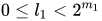
This suggests that is an increasing odd sequence that restarts with whenever the index n is a power of 2. Therefore, if m and l are chosen so that and , then . It is clear that values in the table satisfy this equation. Or it can be thought that after l people are dead there are only people and it goes to the st person. This person must be the survivor. So . Below, a proof is given by induction.

Theorem: If and , then .

Proof: The strong induction is used on n. The base case is true. The cases are considered separately when n is even and when n is odd.

If n is even, then choose and such that and . Note that . is had where the second equality follows from the induction hypothesis.

If n is odd, then choose and such that and . Note that . is had where the second equality follows from the induction hypothesis. This completes the proof.

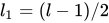
l can be solved to get an explicit expression for :

The most elegant form of the answer involves the binary representation of size n: can be obtained by a one-bit left cyclic shift of n itself. If n is represented in binary as , then the solution is given by . The proof of this follows from the representation of n as or from the above expression for .


Implementation: If n denotes the number of people, the safe position is given by the function , where and .

Now if the number is represented in binary format, the first bit denotes and remaining bits will denote l. For example, when , its binary representation is:

n    = 1   0   1   0   0   1
2m   = 1   0   0   0   0   0
l    =     0   1   0   0   1
/**
 * @param n the number of people standing in the circle
 * @return the safe position who will survive the execution 
 *   f(N) = 2L + 1 where N =2^M + L and 0 <= L < 2^M
 */
public int getSafePosition(int n) {
	// find value of L for the equation
	int valueOfL = n - Integer.highestOneBit(n);
	return 2 * valueOfL  + 1;
}

Bitwise

[edit]

The easiest way to find the safe position is by using bitwise operators. In this approach, shifting the most-significant set bit of n to the least significant bit will return the safe position.[11] Input must be a positive integer.

n    = 1   0   1   0   0   1
f(n) = 0   1   0   0   1   1
/**
 * @param n (41) the number of people standing in the circle
 * @return the safe position who will survive the execution 
 */
public int getSafePosition(int n) {
    return ~Integer.highestOneBit(n*2) & ((n<<1) | 1);
    //     ---------------------- ---  | ------------
    //     Get the first set bit   |   | Left Shift n and flipping the last bit
    //    and take its complement  |   |
    //                             |   |
    //                Multiply n by 2  |
    //                         Bitwise And to copy bits exists in both operands.
}

k = 3

[edit]

In 1997, Lorenz Halbeisen and Norbert Hungerbühler discovered a closed-form for the case . They showed that there is a certain constant


that can be computed to arbitrary precision. Given this constant, choose m to be the greatest integer such that (this will be either or ). Then, the final survivor is


if is rounded up else

for all .

As an example computation, Halbeisen and Hungerbühler give (which is actually the original formulation of Josephus' problem). They compute:

and therefore
(note that this has been rounded down)

This can be verified by looking at each successive pass on the numbers 1 through 41:

1, 2, 4, 5, 7, 8, 10, 11, 13, 14, 16, 17, 19, 20, 22, 23, 25, 26, 28, 29, 31, 32, 34, 35, 37, 38, 40, 41
2, 4, 7, 8, 11, 13, 16, 17, 20, 22, 25, 26, 29, 31, 34, 35, 38, 40
2, 4, 8, 11, 16, 17, 22, 25, 29, 31, 35, 38
2, 4, 11, 16, 22, 25, 31, 35
2, 4, 16, 22, 31, 35
4, 16, 31, 35
16, 31
31

The general case

[edit]

Dynamic programming is used to solve this problem in the general case by performing the first step and then using the solution of the remaining problem. When the index starts from one, then the person at shifts from the first person is in position , where n is the total number of people. Let denote the position of the survivor. After the -th person is killed, a circle of remains, and the next count is started with the person whose number in the original problem was . The position of the survivor in the remaining circle would be if counting is started at ; shifting this to account for the fact that the starting point is yields the recurrence[12]


which takes the simpler form

if the positions are numbered from to instead.

This approach has running time , but for small and large there is another approach. The second approach also uses dynamic programming but has running time . It is based on considering killing k-th, 2k-th, ..., -th people as one step, then changing the numbering.[citation needed]

This improved approach takes the form

See also

[edit]

References

[edit]
[edit]
Revisions and contributorsEdit on WikipediaRead on Wikipedia
from Grokipedia
The Josephus problem is a classic puzzle in mathematics and computer science, describing a scenario where n people stand in a circle and are systematically eliminated by counting every k-th person (with k ≥ 2) until only one survivor remains; the goal is to determine the initial position of that survivor, denoted as J_k(n). This elimination process forms a permutation of the positions, and the problem has been generalized to various counting rules and moduli. The problem originates from a historical account by the first-century Jewish historian Flavius Josephus in his work (c. 75 AD), where he described 41 soldiers trapped in a during the Romano-Jewish War of 67 AD; to avoid capture, they agreed to form a circle and kill every third person until none remained, but Josephus calculated positions 16 and 31 to be the last survivors, allowing him and another to surrender. Although Josephus did not pose it as a general , his inspired later formulations, with the earliest explicit puzzle version appearing in Claude Gaspard Bachet de Méziriac's Problèmes plaisants et délectables (1624) for n=41 and k=3. The problem gained rigorous mathematical treatment in the through Leonhard Euler's 1760s analysis of related circular permutations, leading to a recursive solution published in 1776. Mathematically, the classical Josephus function J_k(n) satisfies the recurrence J_k(1) = 1 and J_k(n) = (J_k(n-1) + k) mod n for n > 1, with adjustments to map results to positions 1 through n. For the common case k=2, a closed-form solution exists: J_2(n) = 2l + 1, where n = 2^m + l and l < 2^m, or equivalently J_2(n) = 2n - 2^{\lfloor \log_2 n \rfloor + 1} + 1, allowing efficient computation in O(\log n) time. No general closed form is known for arbitrary k, but algorithmic solutions, such as those by Donald Knuth using binary representations or dynamic programming, achieve O(n) or better complexity, with applications in algorithm design, queue simulations, and analyzing elimination games. The problem's variants, including non-constant k or modular arithmetic, extend its relevance to number theory and combinatorics, with fixed points (where J_k(n) = n) and periodic behaviors studied in modern analyses.

Problem Formulation

Classic Setup

The Josephus problem originates from an account by the first-century historian Flavius Josephus, but its classic mathematical formulation abstracts the scenario into a combinatorial puzzle. In the standard setup, there are nn people standing in a circle, numbered consecutively from 1 to nn. Counting begins at position 1 and proceeds clockwise around the circle. Every kk-th person (where kk is a fixed positive integer, typically k2k \geq 2) is eliminated from the circle, and the counting resumes from the next remaining person, continuing this process sequentially until only one person remains. The objective is to determine the original position of this last survivor. The survivor's position is denoted Jk(n)J_k(n), using 1-based indexing. For illustration, consider n=5n = 5 and k=2k = 2: starting at 1, the first eliminated is 2 (count: 1, 2); next from 3, eliminates 4 (3, 4); next from 5, eliminates 1 (5, 1); next from 3, eliminates 5 (3, 5); leaving 3 as the survivor. The full elimination order is thus 2, 4, 1, 5.

Parameters and Variations in Counting

The is defined in terms of two key parameters: nn, the total number of people arranged in a circle, and kk, the fixed step size used for counting out every person to be eliminated, where both are positive integers satisfying n1n \geq 1 and k1k \geq 1. These parameters determine the sequence of eliminations and the position of the sole survivor, with the process continuing until only one person remains. Special cases arise depending on the value of kk relative to nn. When k=1k = 1, counting eliminates each person in sequential order starting from the first, resulting in the survivor being the last person in the circle (position nn in 1-based indexing). If k>nk > n, the effective step size for the initial count reduces to kmodnk \mod n (with adjustment if the remainder is 0, equivalent to nn), as the counting wraps around the circle multiple times before the first elimination. This modular reduction ensures the process remains well-defined even for large kk. Variations in the counting procedure introduce additional flexibility while preserving the core elimination mechanism. The starting point for counting can differ across formulations; typically, it begins at position 1 (1-based), but some analyses start at position 0 for mathematical convenience. Direction of counting is usually , but counterclockwise variants exist, effectively reversing the order of eliminations and altering the survivor position accordingly—once a direction is chosen, it remains consistent throughout. Indexing conventions also vary: 1-based numbering (positions 1 to nn) is common in historical and applied contexts, while 0-based (positions 0 to n1n-1) simplifies recursive computations, requiring an offset of +1 to convert results to 1-based positions. To illustrate the impact of changing kk, consider n=8n = 8 people numbered 1 to 8 in a circle, starting at position 1 and counting (1-based). For k=3k = 3, the first eliminations proceed as position 3, then 6 (continuing from 4), then 1 (from 7), leading to a different sequence than for k=5k = 5, where the first eliminations are position 5, then 2 (from 6), then 8 (from 3), demonstrating how larger steps accelerate wrapping and shift the elimination order. These parameter tweaks highlight the problem's sensitivity to counting rules without altering the fundamental circular elimination process.

Historical Background

Flavius Josephus's Account

Flavius (c. 37–c. 100 CE), a Jewish aristocrat, priest, and military commander during the First Jewish-Roman War (66–73 CE), described a pivotal personal episode from the siege of (modern ) in his historical text , composed around 75 CE in . As commander of the Jewish forces at Jotapata, Josephus defended the town against the Roman general for 47 days before its fall in July 67 CE. When the city was overrun, Josephus and 40 companions sought refuge in a to evade capture by the Romans. The group, preferring death to enslavement or execution, resolved to commit collective and drew lots to establish the sequence in which each would kill the next. This process continued systematically until only two remained: Josephus and one other soldier. Josephus then convinced his companion that surrender offered a path to survival, arguing against self-destruction when mercy might be possible from the Romans. The pair emerged from the cave and submitted to Roman custody; initially imprisoned Josephus but later freed him, granting citizenship and patronage that enabled his later writings. The incident involved approximately 41 participants ( plus 40 others), with the elimination method based on lots rather than a fixed rule, though subsequent analyses have retrofitted a step of every third person (k=3) to model it mathematically. Josephus implied he influenced the lot's outcome to ensure he was among the final survivors, a claim that underscores his of providence and . Scholars question the story's historical veracity, viewing it potentially as an allegorical or self-justifying device to explain Josephus's defection, which branded him a collaborator among some . As the sole attestation, unconfirmed by or other records, the account may blend fact with rhetorical embellishment to portray Josephus as guided by reason and divine favor amid crisis.

Mathematical Interpretations Over Time

Following the account attributed to in the first century AD, mathematical interpretations of the problem remained sparse for centuries, with limited references appearing in medieval texts. A version of the counting-out puzzle is traced to the Jewish scholar around 1140, who discussed a similar elimination process in his commentary on the , potentially linking to earlier Talmudic riddles involving circular arrangements and selection. These early mentions treated the scenario more as a logical or interpretive exercise rather than a formalized mathematical query. The first explicit mathematical formulation of the puzzle appeared in Claude Gaspard Bachet de Méziriac's Problèmes plaisants et délectables (1624), which presented a version with 41 people and elimination every third (k=3), directly inspired by Josephus's account. The problem saw a revival in the among European , notably Leonhard Euler, who in 1776 analyzed it in the context of progressions and recursive patterns, providing one of the first systematic treatments in Western . Concurrently, Japanese such as Takebe Katahiro and explored generalizations during the , extending the counting rules to broader combinatorial scenarios and emphasizing its relevance to enumeration problems. In the , the Josephus problem gained popularity as a recreational puzzle through W. W. Rouse Ball's Mathematical Recreations and Essays (1892), which presented it as an engaging arithmetic challenge and helped disseminate it among amateur and professional mathematicians alike. Ball's work emphasized its intuitive appeal, drawing on historical anecdotes to illustrate the interplay between position and survival. By the early , the problem had evolved into a staple of , recognized for its connections to and theory, with influential analyses in the 1960s highlighting its utility in understanding iterative processes. This period marked its transition from isolated curiosities to a foundational example in theoretical studies of permutations and elimination sequences.

Specific Solutions

Binary Case (k=2)

When every second person is eliminated in the circle (k=2), the Josephus problem simplifies significantly, allowing for an elegant closed-form solution that leverages the binary structure of n. This case is particularly insightful because it reveals a direct connection between the survivor's position and the binary representation of the total number of n. The solution is derived recursively by distinguishing between even and odd values of n. Define f(n, 2) as the 1-based position of the survivor. The base case is f(1, 2) = 1. For even n = 2p, the first elimination round removes all even-positioned , leaving p survivors starting the next round from position 1; thus, f(2p, 2) = 2 f(p, 2) - 1. For odd n = 2p + 1, the first round eliminates even positions up to 2p and then position 1, leaving p survivors starting from position 3 (which maps to 2 in the reduced circle); thus, f(2p + 1, 2) = 2 f(p, 2) + 1. These recurrences lead to the : write n = 2^m + l where m = \lfloor \log_2 n \rfloor is the highest power of 2 less than or equal to n, and l = n - 2^m with 0 \leq l < 2^m; then f(n, 2) = 2l + 1. Equivalently, the binary representation of f(n, 2) is obtained by rotating the binary digits of n one position to the left (cyclic shift), moving the leading 1 to the least significant bit. For instance, with n=1 (binary 1), f(1, 2)=1 (binary 1). For n=5 (binary 101), rotation yields 011 (decimal 3), so f(5, 2)=3. For n=10 (binary 1010), rotation yields 0101 (decimal 5), so f(10, 2)=5. This formula can be proved by induction on m. For the base case m=0, n=1=2^0 + 0, f(1, 2)=2\cdot0 + 1=1, which holds. Assume it holds for all values up to 2^m; for n=2^m + l with l < 2^m, the proof splits into cases using the recurrences: for n=2^{m+1}, l=0, f=1 by direct recursion from f(2^m)=1; for general l, apply the even/odd recurrences iteratively to reduce to the inductive hypothesis, yielding 2l + 1. The binary rotation follows similarly, as the recurrences preserve the bit-shift property under induction.

Ternary Case (k=3)

The ternary case of the Josephus problem, with every third person eliminated (k=3), lacks a simple closed-form solution like that for k=2, necessitating reliance on recursion, iterative algorithms, or tabulation for determining the survivor position f(n,3). This contrasts with the binary case's cyclic rotation around powers of 2, highlighting the ternary case's distinct structural irregularities. Computational approaches often use dynamic programming to build a table of survivor positions up to n, achieving O(n) time complexity, as direct simulation via linked lists would be less efficient for large n. A prominent example is the historical scenario with n=41, where the survivor occupies position 31 (1-based indexing), aligning with Flavius Josephus's described positioning to ensure survival. For n=7, the elimination proceeds as positions 3, 6, 2, 7, 5, 1, leaving the survivor at position 4. An explicit non-recursive for the survivor position in the k=3 case is provided by Halbeisen and Hungerbühler: using collapsing numbers c_m = \round(a \cdot (3/2)^m) where a \approx 0.8111 and m \approx \round(\log n / \log(3/2)), the position (0-based) is j(n,3,n) = 3(n - c_m) + d_m with d_m \in {0,1} determined by fractional part comparisons; adding 1 yields the 1-based f(n,3). For n=41, m=9, c_9=31, d_9=0, so f(41,3)=31. A useful approximation, exact for many n, is f(n,3) = 3n + 1 - \floor{ K(3) \cdot (3/2)^{\lceil \log_{3/2} ((2n+1)/K(3)) \rceil } }, where K(3) \approx 1.62227 is the constant solving x = e^{(3/2) \ln(1 + 1/x)} from functional iteration analysis. This stems from modeling the elimination as iterated maps, providing insight into the asymptotic behavior where f(n,3) grows roughly as (3/2)n offset by periodic adjustments tied to powers of 3. The sequence f(n,3) (OEIS A054995) displays notable irregularities, with increments (f(n+1,3) - f(n,3) + 3) \mod (n+1) forming cycles of lengths scaling with powers of 3, complicating pattern recognition beyond the binary case's bitwise simplicity. These cycles contribute to computational challenges for very large n, though the approximations and formulas mitigate this for practical purposes.

Recursive and Iterative Approaches

The Josephus problem can be solved using a recursive approach based on the observation that after eliminating the k-th person in a circle of n people, the problem reduces to finding the survivor in a circle of n-1 people, with the counting offset adjusted accordingly. The position of the survivor, denoted f(n, k) and assuming 1-indexed positions, satisfies the base case f(1, k) = 1 for any k ≥ 1. For n > 1, the recursive formula is f(n, k) = [(f(n-1, k) + k - 1) \mod n] + 1. Equivalently, in a form that directly uses without the offset adjustment, f(n, k) = (f(n-1, k) + k) \mod n, where the result 0 is replaced by n to maintain 1-indexing. This naive recursive implementation computes f(n, k) in O(n) time, as it performs a linear number of recursive calls, each involving constant-time modular arithmetic; however, for the special case k=2, optimizations using binary representations allow computation in O(\log n) time by leveraging the closed-form relation to the highest power of 2 less than or equal to n. For general k, no such logarithmic-time recursion exists without additional structure, and the O(n) bound remains standard. An iterative approach simulates the elimination process directly using a data structure to represent the circle, such as a queue or doubly-linked list, where every k-th person is removed until one remains. In the queue-based variant, the n people are initially enqueued in order; for each elimination round, the first k-1 people are dequeued and re-enqueued to rotate the circle, and the k-th is dequeued and eliminated, repeating until the queue has one element. This simulation runs in O(n k) time due to the rotations per elimination, making it inefficient for large k relative to n. To illustrate the recursive or iterative computation, consider n=10 people and k=3, with positions labeled 1 through 10 and counting starting at position 1. The elimination order proceeds as follows: first, count to 3 and eliminate 3 (next start at 4); then eliminate 6 (next at 7); then 9 (next at 10); then 2 (next at 4); then 7 (next at 8); then 1 (next at 4); then 8 (next at 10); then 5 (next at 10); then 10, leaving survivor at position 4. This trace confirms f(10, 3) = 4 via direct or by unfolding the recursive formula from the base case upward. For handling large n where full simulation becomes prohibitive, the iterative version of the recursive avoids explicit list structures by computing the survivor position using a loop over modular updates: initialize f = 0 (0-indexed equivalent), then for i from 2 to n, set f = (f + k) \mod i, and adjust to 1-indexed by adding 1 at the end; this achieves O(n time using only arithmetic operations, independent of k.

Generalizations and Extensions

Modified Counting Rules

In variants of the Josephus problem, the core elimination mechanics are altered to explore different survival dynamics, such as allowing multiple survivors or changing the spatial arrangement of participants. A key modification involves generalizing the process to leave survivors rather than a single one, extending the historical scenario where and his accomplice positioned themselves as the last two remaining among 41 soldiers by eliminating every third person. In this setup, counting proceeds as in the classic case—every kth person is eliminated in a —but halts when exactly individuals remain, with the goal of determining their positions. This applies the same recursive structure as the standard problem but adjusts the termination condition; for r=2 and k=3 with n=41, the survivors occupy positions 16 and 31. Another significant alteration is the linear arrangement, where participants stand in a straight line instead of a , fundamentally changing the path. Here, n players are lined up, and elimination begins from one end, removing every kth person while traversing the line; upon reaching the end, the process may reverse direction or stop, depending on the specific rules. For example, with n=5 and k=2 starting from the left, the second and fourth are eliminated first, leaving the first, third, and fifth in adjusted positions for subsequent rounds. This non-circular variant introduces boundary effects absent in the circular case, leading to different survival patterns. The Feline Josephus problem further modifies the rules by assigning ℓ lives to each of n soldiers arranged in a , requiring multiple "hits" for elimination rather than instant removal. Counting eliminates or damages k consecutive soldiers per pass, skipping one after each group, and continues until all but one soldier's lives are depleted. For ℓ=2 (double elimination), n=7, and k=3, soldiers lose lives in groups of three, with soldier 4 surviving after two rounds where others are fully eliminated. This introduces layered elimination mechanics, generalizing to higher ℓ for more complex . Some variants incorporate variable k, where the counting step changes after each elimination. For example, using pseudorandom sequences generated by systems, applied in a circular setup until one remains; however, closed-form solutions are rare, relying on for specific n. This dynamic adjustment alters the of eliminations compared to fixed k. Recent work has also explored randomized variants, where the elimination step includes probabilistic choices, further extending the problem's scope. Regarding counting resumption, the standard rule continues from the person immediately after the eliminated one, assigning count 1 to them for the next cycle. A contrasting variant restarts the full count from 1 at a fixed starting point after each elimination, though this is less common and leads to repetitive patterns favoring initial positions.

Applications in

The Josephus problem serves as a foundational example in algorithm design, demonstrating techniques for handling circular data structures and elimination processes efficiently. Implementations often leverage queues or circular linked lists to simulate the counting-out procedure, achieving O(n time complexity for generating the full elimination order, where n is the number of participants. This approach is particularly useful for understanding in systems where elements are processed in a cycle until depleted, such as in certain task elimination scenarios within operating systems. The recursive formulation provides a basis for these implementations, enabling straightforward adaptation to iterative methods for practical computation. In , the Josephus permutation is applied to generate pseudorandom rearrangements, enhancing in algorithms. For instance, it is integrated with maps to shuffle pixels, ensuring high and resistance to statistical attacks by producing non-linear that obscure pixel dependencies. This technique has been shown to improve effects in encrypted images, making it suitable for secure data transmission. Similar uses appear in constructing strong S-boxes for block ciphers, where the permutation's properties aid in achieving balanced substitution tables resistant to differential . The problem is a common fixture in programming interviews, testing candidates' proficiency with dynamic data structures and optimization. A typical challenge involves simulating the elimination process using a to model the circle, removing nodes in O(1) per elimination after initial setup, resulting in overall O(n performance. Platforms like feature variants, such as finding the winner in a circular , to evaluate problem-solving under constraints. This relevance stems from its illustration of real-world circular traversals, like in network routing or buffer management. Modern extensions link the Josephus problem to and sequence generation. In , it relates to impartial games like Maximum , where elimination rules mirror heap reductions, leading to new O(k log n) algorithms for general k. These connections enable simulations of strategic decision-making in multi-player scenarios, such as games. Additionally, the binary variant (k=2) ties into de Bruijn sequences through cyclic binary representations, aiding in applications like and pseudorandom number generation.

References

Add your contribution
Related Hubs
User Avatar
No comments yet.