Recent from talks
Nothing was collected or created yet.
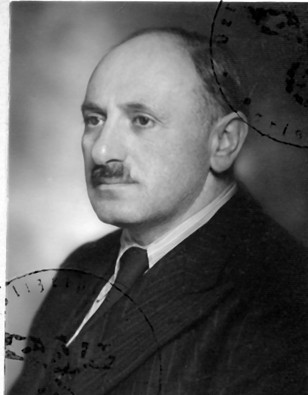
Julius Hirsch
View on Wikipedia
Julius Hirsch (7 April 1892 – declared dead 8 May 1945)[3] was a German international footballer. A Jew, he was executed at Auschwitz concentration camp during the Holocaust.[4][5] He helped the Karlsruher FV win the 1910 German football championship, and also played for the Germany national team, including at the 1912 Summer Olympics.[6] He then joined SpVgg Fürth, with whom he won the 1914 German football championship.
Key Information
Biography
[edit]Hirsch was born in Achern, Germany (and later lived in Karlsruhe),[7] was Jewish,[8] and was the seventh child of a Jewish merchant. He joined Karlsruher FV at the age of ten.

Together with Fritz Förderer and Gottfried Fuchs, Hirsch formed an attacking trio.[8] Nicknamed "Juller", he was a dynamic midfielder and striker best known for his attacking style, his hard shot, and powerful left foot.[8][9][10] He helped Karlsruher FV win the 1910 German football championship.[8]
After joining SpVgg Fürth in 1913, he won the 1914 German football championship with them the following year.[8][11]
Hirsch was the first Jewish player to represent the Germany national team, which he joined at 18 years of age in 1911.[8][12] He played in a number of matches for Germany, including at the 1912 Olympic Games in Stockholm, Sweden.[12] Hirsch scored four goals for Germany against the Netherlands in 1912, becoming the first German to score four goals in a single match.[8][11]
Hirsch enlisted in and served for four years in the German Army in World War I, and was decorated with the Iron Cross.[12][13] His brother Leopold was killed in action in June 1918, also fighting for the German Army.[14][15]
He returned to KFV after World War I, and retired in 1925.[12] However, he remained with the club as a youth coach.[14]
In the Holocaust
[edit]Reading in a newspaper on 10 April 1933 that all Southern German clubs would ban Jewish members, Hirsch left KFV by his own choice after over 30 years as a member. In a letter to his club he requested that it should not be forgotten that many Jews had given their life blood for the German nation and believed themselves to be true patriots, as shown by their deeds and words.[14]
Hirsch's children Esther and Heinold, deemed second-grade "Mischlinge", were forced to leave their school in 1938.[16][7] In 1941 they were required to wear the yellow star.[7] In 1942 he divorced his non-Jewish wife in an effort to flee from the Nazis.[7]
Hirsch, now 50 years old, was deported from Karlsruhe, Germany, to Auschwitz concentration camp on 1 March 1943.[8][17] He had not believed that the government would harm him, as he had fought for Germany in World War I and played for Germany's national football team.[8] His exact date of death is unknown. In 1950, a German court declared him dead with the date of death set on 8 May 1945, past his 53rd birthday and after the camp's occupation by the Red Army in January that year.[18][19][20] His arrival was not registered in surviving camp records and it has been assumed from this he may have been gassed immediately after arrival in camp.[21] In February 1945 his children were deported to Theresienstadt, from which they were liberated by the Red Army in May 1945.[7]
Legacy
[edit]Since 2005 the German Football Federation has awarded the "Julius-Hirsch-Preis" for outstanding examples of integration and tolerance within German football.[22][23][8]
In January 2020, Chelsea unveiled a mural by Solomon Souza on an outside wall of the West Stand at Stamford Bridge stadium, as part of their 'Say No to Antisemitism' campaign. Included on the mural are depictions of footballers Hirsch and Árpád Weisz, who died at Auschwitz concentration camp, and Ron Jones, a British prisoner of war known as the 'Goalkeeper of Auschwitz'.[24]
See also
[edit]References
[edit]- ^ "Deutscher Meister, Nationalspieler, Olympionike". DFB. Retrieved 20 September 2025.
- ^ "Julius Hirsch". Lizenzmannschaft der SPVGG Greuther Fürth. Retrieved 27 July 2023.
- ^ "Deutscher Meister, Nationalspieler, Olympionike". DFB. Retrieved 20 September 2025.
- ^ Bell, Jack (20 September 2005). "German Federation Admits to Nazi Past". The New York Times. Retrieved 8 October 2007.
- ^ Schaffer, Kay; Smith, Sidonie (2000). The Olympics at the Millennium: Power, Politics, and the Games. Rutgers University Press. pp. 60–62. ISBN 978-0-8135-2820-5.
- ^ "Julius Hirsch". Olympedia. Retrieved 26 May 2021.
- ^ a b c d e Schollmeyer, Swantje (2007). Julius "Juller" Hirsch 1892 Aachen-1943 Auschwitz: deutscher Fussballnationalspieler. Hentrich & Hentrich. ISBN 9783938485330 – via Google Books.
- ^ a b c d e f g h i j Kevin E. Simpson (2016). Soccer Under the Swastika; Stories of Survival and Resistance During the Holocaust
- ^ Skrentny, Werner (2012). "Gotti" and "Juller": Gottfried Fuchs/Godfrey E. Fochs and Julius Hirsch; international soccer players, friends and Jews; [special print in occasion of the 2nd Fuchs Family Reunion Canada 2012]. Verlag Die Werkstatt – via Google Books.
- ^ Grunwald-Spier, Agnes (2016). Who Betrayed the Jews?: The Realities of Nazi Persecution in the Holocaust. The History Press. ISBN 9780750958011 – via Google Books.
- ^ a b David Bolchover (6 May 2019). "Remembering the cream of Jewish footballing talent killed in the Holocaust". The Guardian.
- ^ a b c d "The War Generation – Julius Hirsch". Inside Futbol. 14 April 2011.
- ^ Nationalspieler und Opfer des Nationalsozialismus Archived 17 June 2008 at the Wayback Machine (in German) Der Westen, Published: 7 April 2008. Retrieved 13 July 2009
- ^ a b c Deutscher Meister, Nationalspieler, Olympionike Archived 1 July 2012 at the Wayback Machine (in German) DFB website. Retrieved 25 June 2012
- ^ Michael Coren (13 January 2020). "The German soccer hero who escaped the Nazis for Canada". Macleans.
- ^ "German Football Museum". Liga Terezin. 17 October 2015.
- ^ "Jews and Sport Before the Holocaust – A Visual Retrospective: Julius Hirsch". Yad Vashem. Retrieved 2 March 2014.
- ^ "Hirsch, Julius". Jews in Sports. Retrieved 27 March 2009.
- ^ "Olympians Who Were Killed or Missing in Action or Died as a Result of War". Sports Reference. Archived from the original on 17 April 2020. Retrieved 24 July 2018.
- ^ Bandyopadhyay, Kausik (2013). Why Minorities Play Or Don't Play Soccer; A Global Exploration. Routledge. ISBN 9781317989523.
- ^ Julius Hirsch, national player murdered. Biography of a Jewish Footballer (2012), p.352, publisher Verlag Die Werkstatt (Gottingen), ISBN 978-3-89533.
- ^ Ein Zeichen gegen Diskriminierung Archived 1 July 2012 at the Wayback Machine (in German) DFB website. Retrieved 25 June 2012
- ^ Mendel, Jack (20 March 2020). "Living with the ghost of my grandfather, a German Jewish football icon". Times of Israel.
- ^ "Chelsea unveils mural with Jewish soccer players murdered at Auschwitz". The Jerusalem Post. 20 January 2020.
External links
[edit]- Julius Hirsch at WorldFootball.net
- Pictures at Karlsruher-fv1891.de at the Wayback Machine (archived 11 October 2010) (in German)
- Julius Hirsch at Yad Vashem website
Julius Hirsch
View on GrokipediaJulius Hirsch (7 April 1892 – c. 1943) was a German-Jewish association footballer who excelled as a powerful striker and left winger, earning seven international caps for Germany from 1911 to 1913, competing in the 1912 Summer Olympics, and winning German football championships in 1910 with Karlsruher FV and in 1914 with SpVgg Fürth.[1][2] Born in Achern to a Jewish merchant family, he began playing competitively at age ten and rose rapidly through the ranks of Karlsruher FV, forming a formidable attacking trio with teammates that contributed to early dominance in German football.[2][3] A decorated veteran of the German Army in World War I, Hirsch later faced persecution under the Nazi regime due to his Jewish heritage, refusing opportunities to emigrate despite warnings from fellow Jewish players; he was deported from Dortmund in 1943 and murdered at Auschwitz concentration camp.[2][3] His legacy endures as one of the pioneering Jewish figures in German international football, with posthumous recognition including the Julius Hirsch Prize awarded by the German Football Association for efforts against antisemitism.[4]
Early Life
Family Background and Upbringing
Julius Hirsch was born in 1892 in Achern, a town in southwest Germany, to a Jewish merchant family.[5] He was the youngest of seven children born to his parents, Berthold Hirsch—a prosperous merchant—and Emma Hirsch, over a span of 15 years; the couple had aspired to have 13 children, symbolizing the tribes of Israel.[6] The family relocated to Karlsruhe, where Hirsch grew up and pursued his education.[5] Raised in a relatively affluent household tied to commerce, Hirsch's early environment reflected the integration of German Jews into urban professional life prior to World War I, though marked by the era's underlying antisemitic undercurrents in broader society.[7] His upbringing emphasized discipline and opportunity, fostering skills that later distinguished him in sports, amid a community where Jewish participation in athletics was increasingly prominent yet precarious.[5]Entry into Football
Julius Hirsch began his football involvement at age ten by joining the youth team of Karlsruher FV, a prominent club in Karlsruhe, Germany, where he developed his skills as a left winger known for his powerful left foot.[6][8]
In 1909, at the age of 17, Hirsch made his debut for the club's senior team, quickly gaining recognition for his impressive shooting ability and prolific scoring.[9][5]
This early entry into competitive play laid the foundation for his rapid rise within German football, contributing to Karlsruher FV's successes in regional and national competitions shortly thereafter.[10]
Football Career
Club Successes with Karlsruher FV
Julius Hirsch debuted for the senior team of Karlsruher FV in 1909 at the age of 17, rapidly establishing himself as a key left winger with a reputation for his powerful left-footed shots.[5] He formed part of an potent attacking trio alongside Fritz Förderer and Gottfried Fuchs, contributing to the club's dominance in southern German football.[11] During his initial stint from 1909 to 1913, Karlsruher FV secured the South German Championship in 1910, 1911, and 1912, qualifying for the national finals each time.[12] The pinnacle came in 1910 when the team defeated Holstein Kiel 1–0 in the German championship final, marking KFV's only national title during this era.[1] Hirsch's involvement helped propel the club to these victories, showcasing their regional supremacy before the disruptions of World War I.[13] Following military service in World War I, Hirsch returned to Karlsruher FV from 1918 to 1925, continuing to play and later coaching youth players until his retirement in 1923. However, this period yielded no major national or regional championships comparable to the pre-war achievements, as German football reorganized amid post-war challenges.[14]
