


Community hub
Recent from talks
Contribute something
Nothing was collected or created yet.
Pentax K-mount
View on Wikipedia | This article needs additional citations for verification. (December 2024) |
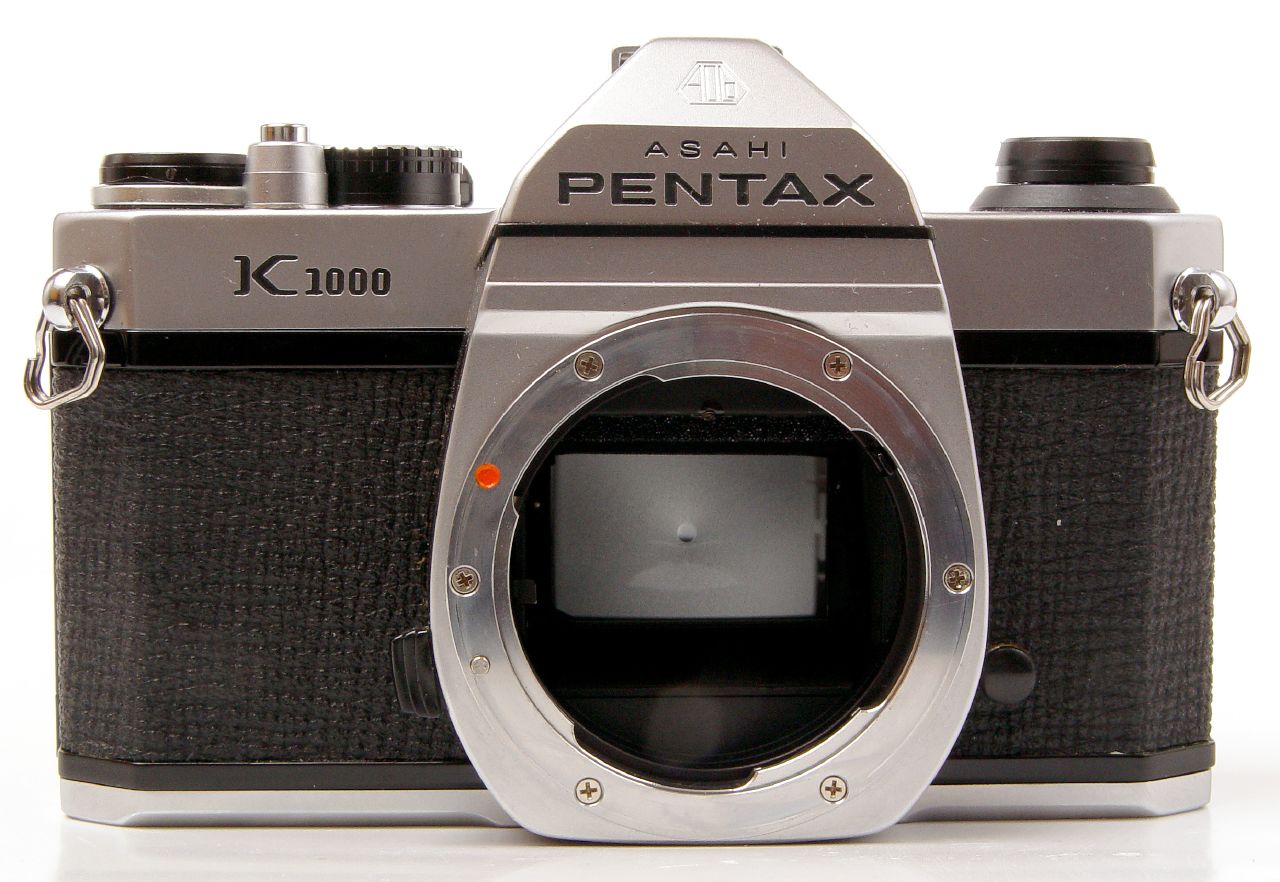
 Pentax K1000 without lens, showing the original K mount | |
| Type | bayonet |
|---|---|
| Tabs | 3 |
| Connectors | electrical pins, drive shaft for focus. |
The Pentax K-mount, sometimes referred to as the "PK-mount", is a bayonet lens mount standard for mounting interchangeable photographic lenses to 35 mm single-lens reflex (SLR) cameras. It was created by Pentax in 1975,[1] and has since been used by all Pentax 35 mm and digital SLRs and also the MILC Pentax K-01. A number of other manufacturers have also produced many K-mount lenses and K-mount cameras.
Mounts
[edit]The Pentax K-mount has undergone a number of evolutions over the years as new functionality has been added. In general, the term K-mount may refer to the original K-mount, or to all its variations.
Originally designed by Zeiss for an alliance with Pentax, it was intended to be a common lens mount for a proposed series of cameras and lenses. However, the plan failed to work out and the two firms parted company amicably, but Pentax retained the lens mount and at least one Zeiss lens design for its own use.[2]
K-mount
[edit]The original K-mount is a simple bayonet connection with three tabs. It was introduced with the K series of cameras. The lens is locked into the camera with an approx. 70° clockwise turn (when looking at the front of the camera).
The only linkage with the camera is mechanical and involves the aperture. A slot between two of the bayonet tabs on the lens allows the stop-down coupler from the camera to sense the aperture setting on the lens and adjust the light meter display accordingly. Opposite this is the diaphragm release from the lens which extends into the camera body and holds open the spring-loaded diaphragm of the lens. When setting up a shot this keeps the diaphragm fully open. When the shutter is released, so is this lever. It allows the diaphragm to close to the desired setting while the film is being exposed, and opens it again after the shutter closes.
Both of these linkages are arranged so that they are aligned and spring-loaded by the act of inserting the lens and turning it until it locks.
Bodies equipped with the original K-mount include the K series, the M series except the ME F, and the LX. Lenses that support it include those labelled 'SMC Pentax', 'SMC Pentax-M' and 'SMC Pentax-A'. These K-mount bodies cannot use lenses that lack an aperture ring, such as FAJ or DA.
K-mount lenses can be used on all Pentax bodies, but are restricted to stopped down mode when used with "crippled" KAF-mount bodies (see below).
KF-mount
[edit]
The KF-mount was Pentax's first attempt at an autofocus system. This autofocus system used sensors in the camera body and a motor in the lens. The two were connected via five new electrical contacts on the bayonet mount itself. One permitted the lens to turn on the camera's metering and focus sensors, two focused the lens (towards and away from infinity) and two appear to have been unused and may have been reserved for future functionality.
The KF-mount was largely a failure. Only one camera and one lens ever used this mount, the Pentax ME F and SMC Pentax-AF 35-70/2.8. The lens was somewhat large and cumbersome since it had to enclose both the focusing motor (with gears) and batteries to power it. KF and the ME-F are similar in many ways to the system used by Canon in the ill-fated Canon T80, introduced several years later.
The ME F can use all Pentax K-mount lenses which feature an aperture ring. The 35–70 mm lens can be used on all other Pentax K-mount bodies in manual focus mode, but it must be used stopped down on "crippled" KAF bodies.
KA-mount
[edit]
The KA-mount is derived from the original K-mount. It allows the lens's aperture to be set by the body, and thus permits shutter priority and program auto exposure modes. It was introduced in 1983, and is supported by A-series and P-series bodies; Pentax lenses that support it are marked 'SMC Pentax-A'. It is completely backward-compatible with the original K-mount.
The aperture on the lens is set from the body by the same stop-down lever found on the original K-mount, but on KA-lenses this lever is proportional to the area of the aperture opening, rather than the diameter as on previous lenses. This allows the body to easily set a specific aperture, since the relationship to F stops is linear. The lenses add an 'A' setting on the aperture dial, which gives the body control of the aperture. Other, numeric settings are used for manual aperture modes—aperture priority and full manual mode.
Six electrical contacts are added to the bayonet ring. One is slightly recessed and allows the lens to indicate whether the aperture ring is set at 'A' or not. If it is, a pin on the lens extends slightly and makes contact, while if the lens is at any other setting the pin is retracted and does not make contact. The other five contacts are used to encode the lens's aperture range. Each contact on the lens is either conducting or non-conducting, providing a binary 1 or 0, respectively. Two contacts encode the lens's minimum aperture—f/16, f/22, f/32 or f/45; although no Pentax K-mount lens has ever had an f/16 minimum aperture, OEM lenses often have. The other three contacts encode the lens's maximum aperture; their meaning is dependent on the minimum aperture indicated by the lens. (There are at least 2 newer lenses that have a minimum aperture of only f/16: HD D FA 85mm F1.4 and HD D FA* 50mm F1.4. https://www.pentaxforums.com/lensreviews/hd-pentax-d-fa-85mm-f14-sdm-aw.html and https://www.pentaxforums.com/lensreviews/hd-pentax-d-fa-50mm-f14-sdm-aw.html)
KAF-mount
[edit]The KAF-mount was Pentax's second and much improved attempt at adding auto-focus to lenses. It adds a small drive shaft to the KA-mount, allowing the body to adjust the focus of the lens. This makes the lenses less bulky than the earlier KF-mount, which had both a motor and batteries inside the lens.
It also adds a seventh electrical contact, this one carrying digital information from the lens to the camera. It carries the following information: focal length, distance to the subject, exact absolute f-stop value, and lens size. This information is used to make better exposure decisions, along with the multi-segmented metering that was introduced in cameras using the KAF-mount.
The MZ-30/ZX-30, MZ-50/ZX-50, MZ-60/ZX-60, the *ist series and the K100D/K110D lack the mechanical stop-down coupler/indicator. In these cameras – in aperture priority mode – the aperture is set by a dial on the camera body, and no longer on the lens. Pre-A lenses can only be used in manual stop down metering mode and manual flash mode.
KAF2-mount
[edit]
The KAF2-mount is the same as the KAF-mount except that it adds two extra power contacts to the inside of the mounting ring and transmits modulation transfer function (MTF) data through the digital seventh contact. The power contacts were originally used for power zooming. Since the introduction of the K10D digital SLR model, they are mainly used for powering Silent Drive Motor and DC motor lenses.
The K10D/K100D Super and later cameras do not have a mechanical stop-down coupler/indicator and thus can only use stop-down metering on pre-A lenses.
KA2-mount
[edit]The KA2 is identical to KAF, but lacks the autofocus drive shaft. Another way of looking at it is that it adds the seventh contact for digital information to the KA-mount.
KAF3-mount
[edit]The KAF3-mount is used on Pentax lenses that solely rely on SDM or DC autofocus motors. It is identical to the KAF2, but lacks the screw-drive autofocus drive shaft.[3] Another way of looking at it is that it adds the power zoom/in-lens autofocus motor contacts to the KA2 mount.
KAF4-mount
[edit]The KAF4-mount was introduced in June 2016 with the HD Pentax-DA 55-300mm F4.5-6.3 ED PLM WR RE lens. It is identical with KAF3, apart from the missing aperture control lever. Instead, aperture control information is transmitted digitally through the data pin and the aperture is stopped down through a motor built into the lens. It also introduced a new type of autofocus motor, designated PLM or Pulse Motor. At the time of its introduction, the following Pentax DSLR bodies were compatible with the new mount: K-70, K-50, K-S2, K-S1, K-1, K-3 II, with all but the K-70 requiring a firmware update. Also after a recent firmware update the original K3 can use the new mount.[3]
K-mount without aperture simulator coupling
[edit]All digital K-mount Pentax SLR bodies as well as some lower-end film cameras lack the ability to read the position of the aperture simulator. This means that lenses that lack the lens information contacts introduced with the KA-mount (Pentax K- and M-series lenses as well as some third-party products) do not support open-aperture metering on these bodies. Instead, stop-down metering must be carried out by pushing the “green button” on the camera before taking a shot. This variation of the mount is commonly referred to as the “crippled“ K-mount.[3]
R-K-mount
[edit]The R-K-mount is a variation on the original K-mount by Ricoh. It supports Ricoh's own implementation of shutter priority and auto exposure modes, similar to the KA-mount but much simpler. The only addition to the original K-mount is a small pin, commonly dubbed Ricoh pin,[3] at the bottom which tells the body when the aperture ring has been set to the "P" setting (similar to the "A" setting on Pentax KA lenses). The 'P' setting is not compatible with the 'A' setting as the 'P' pin is in a different location than the 'A' contact on Pentax 'A' lenses and the flange on Pentax bodies.
The R-K-mount is used on Rikenon P lenses, Ricoh bodies that include the letter 'P' in their model number, and some non-Ricoh lenses. It is compatible with all other K-mount cameras and lenses when in manual or aperture-priority exposure modes, however the extra pin needs to be removed for safe use on autofocus Pentax cameras, as it can otherwise become locked within the autofocus shaft.[3] Lenses locked to the camera body this way are difficult to remove and may require complete dismantling.
Adaptors to use on K-mount
[edit]L39 / LTM
[edit]Adaptors can be found to allow use of lenses with Leica M39 thread (screw) mount. If a lens originally intended for Leica Rangefinder cameras is used, focusing is limited to about 10 cm. However, some SLR lenses were made in LTM 39 mount, mostly by KMZ for use in the early Zenit SLRs which had LT 39 mounts. These "Zenit" TM 39 lenses will focus properly. Or these lenses can be used in conjunction with the M42 to LTM 39 adapter.
M39
[edit]Adaptors can be found to allow use of a non-Leica 39 mm mount into the K-mount, typically as a M39-M42 adapter ring that is mounted in a M42-PK adapter; they may focus to infinity.
M42
[edit]
Pentax supplies adapters to fit M42 screw-mount lenses, as do several third-party manufacturers. The M42 screw-mount system was used by Pentax prior to the introduction of the K-mount. Pentax designed the K-mount wide enough to allow an adapter to fit between the M42 thread and the K bayonet. They also kept the same flange focal distance (also called registration distance or register) as the M42 screw-mount, so that M42 lenses focus correctly using the correct adapter (such as Pentax original[4] or Bower). There are however other third-party adapters that add to the flange focal distance so that one loses the ability to focus to infinity. The loss of infinity-focus may not be significant in macro or close-up photography.
There is great debate in the Pentax community over the applicability and safety of adapters other than those supplied by Pentax. Many users[who?] of third-party infinity-focus adapters, such as Bowers, report difficulty in removing the adapters from camera bodies.[citation needed] Such adapters may require modification before they may be safely used. Official Pentax adapters, and flanged non-infinity-focus adapters, do not provoke such problems.
Many old M42 lenses have a modern-day cult reputation, including the (Pentax) Asahi Takumar range. Some manufacturers, including Carl Zeiss AG, still make lenses in the M42-mount. K-mount cameras have a suitable flange focal distance (45.46 mm) to adapt old M42 lenses without any optical correction or loss of infinity focus/changed close focus distance. Other SLRs with a short flange-focal distance can accept M42 lenses as well: Canon EF-mount (44.00 mm), Sony and (Konica) Minolta A-mount (44.50 mm), Sigma (44 mm), Olympus 4/3rd (38.67 mm), and many more, but notably not Nikon F-mount (46.5 mm).
Nikon AI/AIS
[edit]Optically corrected adapter to use Nikon AIS AI lenses on K-mount.
Voigtländer Bessamatic / Kodak Retina
[edit]Adapter for Voigtländer Bessamatic and Voigtländer Ultramatic lenses, Kodak Retina Reflex, or Kodak Retina IIIs lenses.
Petri
[edit]There are some Petri adapters to K-mount but they do not allow to infinity focus due to the different flange distance.
Medium format
[edit]Pentax made adapters for its medium-format lenses to use on the K-mount, both the 645 and 6×7, and for the Hasselblad Bayonet type. Also there is a Pentacon-Six (Kiev88 CM) adapter still in production and a shift adapter to use Pentacon lenses as shift lens.
- Pentax 645
- Pentax 6×7
- Hasselblad Bayonet type
- Pentacon Six
- Mamiya 645
T-mount
[edit]Mounts used for Telescopes, microscopes and generic optics. The T-mount was initially developed by Tamron (1957) to allow the easy adaption of generic 35 mm SLR optics into multiple mounts. The T-mount is a 42 mm diameter 0.75 mm pitch screw mount with a 55 mm flange focal distance. Later versions (T2, T4, TX) were more advanced and complex. Several other manufacturers besides Tamron have used these mounts. Because the T-mount is still used for many telescopes and microscopes, they are still available new. Note that while both T-mount and M42-mount are 42mm screw mount systems, and will mount if they are forced, they are not compatible. The difference in pitch can cause damage to the lens, adapter or camera mount if they are confused.[citation needed]
Adaptall
[edit]These are adaptors designed by Tamron to allow the transfer of aperture setting from lens to camera or vice verse, including the Adapt-A-matic (1969), Adaptall (1973) and Adaptall-2 (1979). When Pentax introduced the KA-mount in 1983 Tamron upgraded their Adaptall-2 K-mount into an Adaptall-2 KA-mount. For more details see the Tamron article or the Adaptall-2 web site.[5]
Available adaptors for other cameras to use K-mount
[edit]- Four Thirds (Olympus)
- Micro Four Thirds (Olympus and Panasonic)
- Canon EF-mount (EOS)
- Minolta/Sony A-mount (Sony Alpha)
- M39 lens mount (Leica)
- Samsung NX-mount
- Sony E-mount (NEX)
- Fujifilm X-mount
Cameras
[edit]|
Manual focus
Auto focus
Carena[edit]
Cimko[edit]
Edixa[edit]
Exakta[edit]
Lindenblatt[edit]
|
Porst[edit]
Promaster[edit]
Quantaray[edit]
Source:[6] A lot of Sears cameras were made by Ricoh or Chinon and use the Pentax K-mount. Some are simply rebadged models, while others are quite different.
|
List of lenses with any K-mount variant
[edit]Access
[edit]- Access 28 mm f2.8 P-MC Macro (49 mm filter)
- Access 75–300 mm f5.6 PMC Zoom (55 mm filter)
Angenieux a lens manufacturer in France, mainly known for its movie equipment than for photographic lenses, but it has built optics for Leica, Nikon, Canon and a few K-mount lenses.
- Angenieux 70–210 mm f3.5
The Agfa K mount cameras were rebadged Chinons.
- Agfa Color 50 mm f1.4 (49 mm filter)
Arsat is a trade mark of Ukrainian lens manufacturer Arsenal, Kiev.
- PCS Arsat 35 mm f2.8 Shift Lens
Beroflex
[edit]Beroflex seems to have been a German commercial firm of photographic lenses;information is scarce yet but it appears that it designed lenses made overseas by Japanese companies like Soligor.
- Beroflex 85–210 mm f3.8
- Beroflex 500 mm f8/f22 lens, 5° view; 72 mm diameter × 42 mm. Adapter fitted for use on M42 screw thread. In 1975 came complete with lens caps and case.
Braun
[edit]Carl Braun Camera-Werk of Nuremberg, Germany, or Braun, as it was more commonly called, was founded as an optical production house. It is best known for its 35mm film cameras named Paxette, and for slide projectors named Paximat.
- Braun Ultralit Zoom 28–70 mm f3.4-4.8
Carl Zeiss Jena
[edit]Carl Zeiss of East Germany marketed a number of lenses for the K-mount through its sales network. These lenses were in fact made by Sigma in Japan. The "real" 35 mm East German made Carl Zeiss Jena Lenses were available at the same time but only in Praktica B-mount.
- Carl Zeiss Jena 20 mm f4 (zebra)
- Carl Zeiss Jena II 24 mm f2.8
- Carl Zeiss Jena 28 mm f2.8
- Carl Zeiss Jena 28–70 mm f2.8-4.3 Macro Jenazoom
- Carl Zeiss Jena 70–210 mm f4.5-5.6 Macro
- Carl Zeiss Jena 75–300 mm f4.5-5.6 ED IF MC Macro Jenazoom
- Carl Zeiss Jena 100–500 mm f5.6-8 MC Macro Jenazoom (72 mm filter)
Carl Zeiss
[edit]Carl Zeiss is one of the most prestigious names on the photographic world; it re-launched its line of lenses for the K-mount in 2008, mainly due to the growing popularity of both Pentax and Samsung digital SLRs. Carl Zeiss announced in September 2010 that the ZK lenses would be discontinued that year. [1]
- Carl Zeiss 18 mm f3.5 Distagon T* (June 2008)
- Carl Zeiss 21 mm f2.8 Distagon T* (September 2008) (Europe Only)
- Carl Zeiss 25 mm f2.8 Distagon T* ZK (2008)
- Carl Zeiss 35 mm f2 Distagon T* ZK (2008)
- Carl Zeiss 50 mm f1.4 Planar T* ZK (2008)
- Carl Zeiss 50 mm f2 Planar T* ZK (2008)
- Carl Zeiss 50 mm f2 Makro-Planar T* ZK (August 2008)
- Carl Zeiss 85 mm f1.4 Planar T* ZK (2008)
- Carl Zeiss 100 mm f2 Makro-Planar T* ZK
- Chinon 24 mm f2.5
- Chinon 28 mm f2.8
- Chinon 35 mm f2.8 AUTO CHINON MULTI-COATED (49 mm filter)
- Chinon 35–70 mm f3.3-4.5 MC Auto Focus (52 mm filter)
- Chinon 35–70 mm f3.5-4.5 MC Macro (55 mm filter)
- Chinon 35–80 mm f3.5-4.9 MC Macro
- Chinon 35–100 mm f3.5-4.3 multicoated CLOSE FOCUS (67 mm filter)
- Chinon 45 mm f2.8 Auto Multicoated
- Chinon 50 mm f1.4 Auto Multicoated
- Chinon 50 mm f1.7 Auto Multicoated
- Chinon 50 mm f1.7 Auto Multicoated Auto Focus (58 mm filter)
- Chinon 50 mm f1.9 Auto (52 mm filter)
- Chinon 135 mm f2.8 Auto Multicoated
- Chinon 200 mm f3.3 Auto Multicoated
- Chinon Makinon 500 mm f8 catadioptric
Cima Kogaku
[edit]Cima Kogaku had a patented[7] system that allowed them to build common lens bodies, and add the appropriate lens mount at the factory. The Pentax version was only K-mount, not KA-mount. They mostly sold their lenses on an OEM basis, with them sold under a variety of different brands. In the UK, they were sold by Photax as Super-Paragon PMC lenses. Tokyo Kogaku sold them as AM Topcor lenses for their Topcon RM300 camera. Cima Kogaku also sold them directly under the Cimko brand. (Some of the lenses below may not have ever been sold under the Cimko brand.)
- Cimko MT 24 mm f2.8
- Cimko MT 28 mm f2.8
- Cimko MT 35 mm f2.8
- AM Topcor 55 mm f1.7
- Cimko MT 135 mm f2.8
- Cimko MT 200 mm f3.3
- Cimko MT 28–50 mm f3.5-4.5 (two touch)
- Cimko MT 28–50 mm f3.5-4.5 (one touch)
- Cimko MT 28–80 mm f3.5-4.5
- Cimko MT 35–100 mm f3.5-4.3
- Cimko MT 55–230 mm f3.5-4.5
- Cimko MT 70–200 mm f3.8-4.8
- Cimko MT 80–200 mm f3.8
- Cimko MT 80–200 mm f4.5
Cosina
[edit]- Cosina 19–35 mm f3.5-4.5 AF
- Cosina 24 mm f2.8 MC macro (KA-mount)
- Cosina 28 mm f2.8 macro (KA-mount)
- Cosina 28–210 mm f4.2-6.5 Aspherical AF
- Cosina 28–210 mm f3.5 Aspherical AF
- Cosina 28 mm f2.8
- Cosina 35–70 mm f3.5-4.8
- Cosina 40 mm f2.5
- Cosina 50 mm f1.2
- Cosina 50 mm f2
- Cosina 55 mm f1.2
- Cosina 100 mm f3.5 AF macro
- Cosina 100–300 mm f5.6 AF macro
- Cosina 135 mm 1:2,8 MC
Cosmicar
[edit]Cosmicar is a division of Pentax, it commercialized video lenses, but some were released for the K-mount.
- MC Cosmicar 28 mm f2.8 (28 mm filter)
- MC Cosmicar 28–80 mm f3.5-4.5 (Macro at 80 mm end; KA mount)
- Cosmicar 70–200 mm f4
CPC
[edit]CPC Lenses are also known as Phase 2 or Phase 2 CCT.
- CPC 28 mm f2.8 Auto A (52 mm filter)
- CPC 28-80 f2.8-4.0 (62 mm filter)
- CPC 28–80 mm f3.5-4.5
- CPC 28–85 mm f3.5-4.5
- CPC 135 mm f2.8 MC Auto A (55 mm filter)
Eikor
[edit]- Eikor 28mm f2.8 (49mm filter)
- Eikor 80-200mm f4.5 (55mm filter)
Focal
[edit]- Focal 28 mm f2.8 MC Auto (52 mm filter)
- Focal 28 mm f2.8 MC Auto (55 mm filter)
- Focal 135 mm f2.8 MC Auto (58 mm filter)
Gemini
[edit]- Gemini 28 mm f2.8 (49 mm filter)
- Gemini 1:4.5 80-200mm Macro MC Zoom 55 (55mm filter thread size).
Hanimex
[edit]Hanimex was an Australian distributor founded by Jack Hannes after the Second World War. [8] The name is a contraction of HANnes IMport and EXport[9] and the company imported both European and Japanese lenses, bodies and accessories. Hannes apparently sought low cost providers and Hanimex lenses have a poor reputation among users.
- Hanimex AUTO ZOOM f3.5-4.5
- Hanimex AUTOMATIC-MC-MACRO 135 f2.8
- Hanimex MC 80–200 mm f4.5
Hervic Zivnon
[edit]- Hervic Zivnon 23 mm f3.5(62 mm filter)
Helios
[edit]Made for the Zenit cameras by KMZ
- MC Helios 44K-4 58 mm f2 (52 mm filter)
- MC Helios 77K-4 50 mm f1.8
Hoya
[edit]Hoya, a leading manufacturer of optical glass, purchased Pentax in 2008.
- Hoya 24mm f2.8 HMC
- Hoya 28 mm f2.8 HMC (52 mm filter)
- Hoya 28–50 mm f3.5-4.5 HMC (55 mm filter)
- Hoya 28–85 mm f4 HMC (72 mm filter)
- Hoya 70–150 mm f3.8 HMC (55 mm filter)
- Hoya 100–300 mm f5 macro HMC (62 mm filter)
- Hoya 135 mm f2.8 macro HMC (52 mm filter)
- Hoya 300mm f5.6 HMC
- Hoya 135mm f2.8 HMC
- Hoya 200mm f4.0 HMC
Irix
[edit]- Irix 11 mm f/4.0 Blackstone
- Irix 11 mm f/4.0 Firefly
- Irix 15 mm f/2.4 Blackstone
- Irix 15 mm f/2.4 Firefly
JC Penney
[edit]- JC Penney 135 mm f2.8
Kalimar
[edit]Kalimar was an American distributor of camera equipment from 1952 to 1999 when it was acquired by Tiffen.[10]
- Kalimar 28 mm f2.8 Macro (52 mm filter)
- Kalimar 28–105 mm f3.5-4.5 Macro
- Kalimar 35–70 mm f2.8
- Kalimar 60–300 mm f4-5.6 MC AF (67 mm filter)
- Kalimar 500 mm f8 (72 mm filter) (catadioptric)
Kiron
[edit]Kiron was a third party lens manufacturer,[11] it manufactured lenses for other mounts as well on the decade of 1980-1990
LOMO
[edit]LOMO is a Russian photographic manufacturer, it made some lenses for the Almaz camera on K-mount, but caution must be used as the Almaz version has some differences with the standard K-mount
- Volna-10K 35 mm f1.8
- Volna 50 mm f1.8, kit lens for Almaz-103 kamera.
Lester A. Dine
[edit]- Lester A. Dine Kiron 105 mm f2.8 macro (52 mm filter)
Lensbaby
[edit]- Lensbaby 1.0 Selective Focus Lens (2006–2008)
- Lensbaby 2.0 Selective Focus Lens (2008)
- Lensbaby Muse Double Glass Optic
- Lensbaby Muse Plastic Optic
- Lensbaby Composer
- Lensbaby Scout with Fisheye Optic
- Lensbaby Control Freak
Loreo
[edit]Luxon
[edit]Luxon is a Chinese manufacturer, and there is little information available on the company or its products.
- Luxon 50 mm f2.0 MC (China)
Mir
[edit]- Mir-20K 20 mm f3.5 (rear filter)
- Mir-47K 20 mm f2.5 (rear filter), made by VOMZ
Miranda
[edit]Miranda was a brand name used by the Dixons group in the UK, mostly for Cosina made products.
- Miranda 28 mm f2.8 (49 mm filter)
- Miranda 28 mm f2.8 MC (52 mm filter)
- Miranda 50 mm f2 (49 mm filter)
- Miranda 70–210 mm f4 Macro (52 mm filter)
- Miranda 70–210 mm f4.5 Macro
- Miranda 75–200 mm f4.5-5.3 Macro (52 mm filter)
Mitakon
[edit]- Mitakon 80–200 mm f4.5 MC Zoom (55 mm filter)
- Mitakon 28–200 mm f3.8-5.5
Makinon
[edit]Makinon lenses were made by Makina Optical in Japan.
- Makinon MC Reflex 400m f6.7 Macro
- Makinon MC Reflex 500 mm f8 Macro (catadioptric) (67 mm filter)
- Makinon MC ZOOM 35–70 mm 1:2.8 (62 mm filter)
- Makinon MC 135mm 1:2.8 (55 mm filter) not to be confused with the macro version.
- Makinon MC 135mm 1:2.8 (52 mm filter) (non-macro version, has a built-in hood)
- Makinon MC 80-200mm f4.5 Macro (62 mm filter) Manual or Auto Part #744699
- Makinon 28mm 1:2.8
Oberon
[edit]- Oberon-11K 200 mm f2.8
Opteka
[edit]- Opteka OPT500MIR-C 500mm f8
Ozunon
[edit]- Ozunon 35 mm-75 mm F3.5-4.5
Panagor
[edit]Panagor is an alternative name for Kino lenses sold in Europe:
- Panagor-E PMC Auto Zoom 28 mm-80 mm F3.5-4.5
Petri was a Japanese camera manufacturer, which tried to capitalize on the popularity of the K-mount lens base and made one camera that used the K-mount with one standard lens:
Peleng
[edit]Peleng is a lens manufacturer based in Belarus, it was founded in the Soviet era and released most of its lenses for the M42 mount, but it has a K-mount lens:
- Peleng 8 mm f3.5 (2008)
Pentax
[edit]Bold text indicates lenses in current production/stock sale from Pentax.[12]
Special optics
[edit]- Pentax Stereo Adapter I
- Pentax Stereo Adapter II
- SMC Pentax Rear Converter K T6-2x
- SMC Pentax Rear Converter-A 1.4x-L
- SMC Pentax Rear Converter-A 2x-L
- SMC Pentax Rear Converter-A 1.4x-S
- SMC Pentax Rear Converter-A 2x-S
- SMC Pentax-F 1.7x AF Adapter
- HD Pentax-DA AF Rear Converter 1.4x AW (2014)
Phoenix
[edit]- Phoenix 500 mm f8 Reflex (catadioptric) (2006)
- Phoenix 800 mm f8 Reflex (catadioptric) (2008)
Polar
[edit]Polar is a brand of Samyang Optics, a South Korean third party lens manufacturer.
- Polar 800 mm f8 Reflex (catadioptric) (2008)
- Polar 85 mm Portrait Lens f1.4 Aspherical IF (2008)
Porst
[edit]- Porst 28 mm f2.8 MC Auto
- Porst 40 mm f2.5 MC Auto
- Porst 55 mm f1.2 Reflex MC Auto (55 mm filter)
- Porst 55 mm f1.2 MC Auto
- Porst 135 mm f2.8 Tele-AS MC E (55 mm filter)[13]
- Porst 75–260 mm f4.5
- Porst 200 mm f3.5
Promaster
[edit]- Promaster 18–200 mm f3.5-6.3 AF XR EDO
- Promaster 18–200 mm f3.5-6.3 AF XR EDO(2007)
- Promaster 19–35 mm f3.5-4.5 AF
- Promaster 24–200 mm f3.5-5.6 AF XLD ASP
- Promaster 28–80 mm f3.5-5.6 AF
- Promaster 28–70 mm f2.8-4.2 MC Auto ZOOM MACRO
- Promaster 28–70 mm f3.9-4.8 Spectrum 7 MC Macro Auto
- Promaster 28–80 mm f3.5-5.6 Spectrum 7 AF
- Promaster 28–105 mm f4-5.6 AF IF
- Promaster 28–200 mm f3.5-5.6 AF XR
- Promaster 28–210 mm f3.5-5.6 Spectrum 7 MC Macro
- Promaster 50 f1.7
- Promaster 60–300 mm f4-5.6 Spectrum 7 (67 mm filter) (2008)
- Promaster 70–210 mm f4-5.6 AF Macro
- Promaster 70–300 mm f4-5.6 Spectrum 7 AF EDO LD Macro (2007)
- Promaster 80–200 mm f3.5 MC (62 mm filter)
- Promaster 80–210 mm f4.5-5.6 AF
- Promaster 85–210 mm f3.8 Auto Zoom Macro MC
- Promaster 135 mm f1:2.8 MC
Quantaray
[edit]- Quantaray AF 100–300 mm f/4.5-6.7 LDO
Revue
[edit]- Revue 35 mm f2.8
- Revue 80–200 mm f4.5
- Revue 28–70 mm f3.5-4.5
- Revue 28–50 mm f3.5-4.5
- Revue 70–210 mm f4.5 AF
Revu
[edit]- Revu 50 mm f1.2 (1975)
Revuenon
[edit]- Revuenon Auto multicoated 28 mm f/2.8
- Revuenon Auto MC 28 mm f/2.8
- Revuenon Auto 45 mm f/2.8
- Revuenon Auto MC 55 mm f/1.4
- Revuenon Auto MC 55 mm f/1.7
- Revuenon 55 mm f/1.2
- Revuenon 135 mm f/2.8
- Revuenon Auto MC 135 mm f/2.8
- Revuenon 200 mm f/3.3
- Revuenon 200 mm f/3.5
- Revuenon 300 mm f/5.6
- Revuenon 500 mm f/8.0 Mirror
Ricoh - Rikenon - Riconar
[edit]This lens uses the Ricoh KR-mount version, Ricoh made both a XR version without the zoom pin, and the P version which has it.[14]
- Rikenon 24 mm f2.8 (52 mm filter)XR Version
- Rikenon 28 mm f2.8 (52 mm filter)XR Version
- Rikenon 28 mm f3.5 (52 mm filter)XR Version (probably a renamed smc PENTAX-M 28mm f/3.5, very sharp wide-open)
- Rikenon 35 mm f2.8 XR Version
- Rikenon 50 mm f2 (52 mm filter)XR Version
- Rikenon 50 mm f2 L (52 mm filter)XR Version
- Rikenon 50 mm f2 S (52 mm filter)XR Version
- Rikenon 50 mm f1.4 (52 mm filter)XR Version
- Rikenon 50 mm f1.7 (52 mm filter)XR Version
- Riconar 55 mm f2.2 (52 mm filter)
- Rikenon 55 mm f1.2 (58 mm filter)XR Version
- Rikenon 135 mm f2.8 (55 mm filter)XR Version
- Rikenon 200 mm f4 XR
- Rikenon 50 mm f2 (52 mm filter)P Version
- Rikenon 600 mm f8 Reflex XR Version
Rokinon
[edit]This lens uses the Ricoh KR-mount version:
- Rokinon 500 mm f6.3 Reflex (catadioptric)
Sakar
[edit]Sakar is a commercial American company that used to sell K-mount lenses.[15]
- 80–210 mm f1:3.8 macro MC (58 mm filter)
- 85–210 mm f1:4.5 macro MC
- 500 mm f/8 macro mirror (catadioptric)
Samyang
[edit]Samyang is an optical manufacturer located in South Korea. Many of their lenses are also sold under the Rokinon and Bower brand names.
- Samyang 8 mm f/3.5 UMC Fish-eye CS II
- Samyang 10 mm f/2.8 ED AS NCS CS
- Samyang 12 mm f/2.8 AS NCS Fish-eye
- Samyang 14 mm f/2.8 ED S IF UMC
- Samyang 16 mm f/2.0 ED AS UC CS
- Samyang 20 mm f/1.8 ED AS UMC
- Samyang 24 mm f/1.4 ED AS IF UMC
- Samyang Tilt/Shift 24 mm f/3.5 ED AS UC
- Samyang 35 mm f/1.4 AS UMC
- Samyang 50 mm f/1.4 AS UMC
- Samyang 85 mm f/1.4 AS IF UMC
- Samyang 100 mm f/2.8 ED UMC Macro
- Samyang 135 mm f/2.0 ED UMC
- Samyang 100–500 mm f5.6-7.1 Macro Tele Zoom Lens
Samsung
[edit]All these lenses had been marketed by Samsung and present on Samsung's GX-series DSLRs. Schneider-Kreuznach is a traditional optics maker that do still make specialised glass and lenses (today mainly high-quality large-format lenses, enlarger lens and photographic loupes), but not for Samsung.[16] They license their name to Samsung granted that certain minimum quality requirements are fulfilled. All the Schneider branded glass from Samsung is manufactured by Pentax and corresponds directly to Pentax lenses.[17][18]
- Schneider-Kreuznach D-Xenogon 10–17 mm F3.5-4.5 ED (2007- ) (rebadged Pentax DA 10-17mm lens, 2006-)
- Schneider-Kreuznach D-Xenon 12–24 mm f4 ED (2007- ) (rebadged Pentax DA 12-24mm lens, 2005-)
- Schneider-Kreuznach D-Xenon 18–55 mm f3.5-5.6 AF (2007- ) (rebadged Pentax DA 18-55mm lens, 2004- )
- Schneider-Kreuznach D-Xenogon 35 mm f2 (2006-) (rebadged Pentax FA 35mm lens, 1999-)
- Schneider-Kreuznach D-Xenon 50–200 mm f/4-5.6 AF (2006-) (rebadged Pentax DA 50-200mm lens, 2005-)
- Schneider-Kreuznach D-Xenon 100 mm MACRO 1:2.8 (2007-) (rebadged Pentax D FA 100mm lens, 2004-)
Schneider-Kreuznach
[edit]The Schneider-Kreuznach lenses feature shift and tilt movements for perspective control; they can be shifted by 12 mm and tilted by 8 degrees simultaneously.[19]
- Schneider-Kreuznach PC-TS Super-Angulon 4.5/28 28mm f4.5
- Schneider-Kreuznach PC-TS Super-Angulon 2.8/50 50mm f2.8
- Schneider-Kreuznach PC-TS Makro-Symmar 4.5/90 HM 90mm f4.5
Sears is an American commercial company that sells relabeled lenses and cameras at their own stores in the United States for a number of years. As the objective was mainly commercial, quality is very different among lenses. Quality on construction in some ones is very good and in some others is plain bad. But it seems to be consistent among the same model. Some of the Sears lenses were made to fit Sears Cameras with the Ricoh K-mount version and are identified as KR, but is prudent to verify it before using it on more modern cameras that may be damaged by the Ricoh pin.
- Sears 28 mm f/2.8 Auto MC
- Sears 50 mm f/1.4 Auto MC
- Sears 50 mm f/1.7 Auto MC
- Sears 50 mm f/2
- Sears 50 mm f/1.7
- Sears 55 mm f/1.4
- Sears 55 mm f/2
- Sears 28–70 mm f/3.5-4.5 Macro
- Sears 60–300 mm f/4-5.6 Macro (KR-mount)
- Sears 75–260 mm f/4.5 MC Macro
- Sears 80–200 mm f/4-5.6 Auto MC
- Sears MC 135 mm f/2.8
- Sears Auto 2X Teleconverter
Sigma is a Japanese manufacturer of cameras and lenses. It has made lenses for the K-mount for a number of years. And quality among them had varied a lot. After the launch of the K10D digital SLR it launched K-mount D series lenses. Such ones are designed to be used with the APS size camera, but older K-mount can be used as well. An increase in model numbers can be seen between 2007 and 2008 due to the success of the K10D, K100D, K100D Super, K110D, K20D and K200D cameras. Use of older Sigma lenses is possible but with caution, some Sigma older K-mount lenses are with the infamous Ricoh pin.

- Sigma 8 mm f/3.5 EX DG Fisheye
- Sigma 8–16 mm f/4.5-5.6 DC HSM
- Sigma 10–20 mm f/4.0-5.6 AF EX DC
- Sigma 10–20 mm F/3.5 EX DC HSM
- Sigma 12–24 mm f/4.5-5.6 EX DG
- Sigma 14 mm f/2.8 EX DG
- Sigma 15 mm f/2.8 EX DG Fisheye
- Sigma 15–30 mm f/3.5-5.6 AF EX DG
- Sigma 17–35 mm f/2.8-4 EX ASP
- Sigma 17–50 mm f/2.8 EX DC OS HSM
- Sigma 17–70 mm f/2.8-4.5 DC Macro
- Sigma 17–70 mm f/2.8-4.5 DC Macro (2007)
- Sigma 17–70 mm f/2.8-4 DC Macro OS HSM
- Sigma 18–50 mm f/3.5-5.6 DC AF
- Sigma 18–50 mm f2.8-4.5 DC OS HSM
- Sigma 18–125 mm f/3.8-5.6 DC HSM
- Sigma 18–200 mm f/3.5-5.6 DC
- Sigma 18–250 mm f/3.5-6.3 DC OS HSM
- Sigma 20 mm f/1.8 EX DG ASP
- Sigma 20–40 mm f/2.8 EX DG ASP
- Sigma 24 mm f/1.8 EX DG
- Sigma 24–70 mm f/2.8 IF EX DG HSM
- Sigma 24–70 mm f/3.5-5.6
- Sigma 24–135 mm f/2.8-4.5 IF ASPH AF
- Sigma 28 mm f/1.8 EX DG
- Sigma 28 mm Mini-Wide f/2.8
- Sigma 28–70 mm f/2.8 EX DF ASP
- Sigma 28–300 mm f/3.5-6.3 DL ASP IF
- Sigma 28 mm f/1.8 EX DG
- Sigma 28–300 mm f/3.5-6.3 CHZ ASP
- Sigma 28–200 mm f/3.5-5.6 DL Macro
- Sigma 28–200 mm f/3.5-5.6
- Sigma 28–105 mm f/2.8-4 ASP
- Sigma 28–80 mm f/2.8 EX DF ASP Macro II
- Sigma 28–80 mm f/2.8 EX DF ASP Macro
- Sigma 28–80 mm f/3.5-5.6
- Sigma 30 mm f/1.4 EX DC
- Sigma 35–70 mm f/2.8-4 Macro 1:6.7(52 mm filter)
- Sigma 50 mm f1.4 EX DG HSM
- Sigma 50 mm f/2.8 EX DG Macro
- Sigma 50–150 mm APO f/2.8 EX DC II
- Sigma 50–200 mm f4-5.6 DC O S HSM
- Sigma 50–500 mm f/4-6.3 EX APO HSM
- Sigma 70 mm f/2.8 EX DG Macro
- Sigma 70–200 mm f/2.8 EX DG Macro
- Sigma 70–200 mm f/2.8 EX APO
- Sigma 70–200 mm f/2.8 EX DG OS HSM
- Sigma 70–200 mm f/2.8 EX DG APO Macro MkII
- Sigma 75–210 mm f/3.5-4.5 ZOOM-K III MC
- Sigma 70–300 mm f/4-5.6 DG APO Macro
- Sigma 70–300 mm f/4-5.6 DG Macro
- Sigma 70–300 mm f/4-5.6 DG OS
- Sigma 70–300 mm f/4-5.6 DI LD Macro (2008)
- Sigma 70–300 mm f/4-5.6 DL Macro
- Sigma 70–300 mm f/4-5.6 DG Macro
- Sigma 70–300 mm f/4-5.6 EX APO Macro
- Sigma 75–300 mm f4-5.6 AF
- Sigma 85 mm f/1.4 EX DG HSM
- Sigma 100–200 mm f/4.5 Macro
- Sigma 100–300 mm f/4.5-6.7 DL
- Sigma 100–300 mm f/4 EX APO IF
- Sigma 100–300 mm f/4.5-6.7 DL
- Sigma 105 mm f/2.8 EX DG Macro
- Sigma 120–400 mm f/4.5-5.6 APO DG OS HSM
- Sigma 135–400 mm f/4.5-5.6 APO ASP
- Sigma 150–500 mm f/5.0-6.3 DG OS HSM
- Sigma 170–500 mm f/5-6.3 APO ASP
- Sigma 180 mm f/3.5 EX Macro
- Sigma 300 mm f/2.8 EX DG
- Sigma 500 mm f/4 XQ Reflex (catadioptric)
- Sigma 500 mm f/4.5 EX DG
- Sigma 500 mm f/8 Reflex (catadioptric)
- Sigma 600 mm f/8 Reflex (catadioptric)
Soligor
[edit]- Soligor 70–210 mm f/4.5
- Soligor MC 80/135 f/4 dualfocal
- Soligor 85–205 mm f/3.8
- Soligor MC 90 mm-230 mm f/4.5
- Soligor 135 mm f/2.8
- Soligor 200 mm f/2.8
- Soligor 80/200 mm MC f/4.5
- Soligor C/D 28–200 mm f/3.8-5.5 Macro
- Soligor 35-105/3.5 Macro
Spiratone
[edit]Spiratone was a company devoted to sell photographic accessories and manage to sell some lenses under their own brand name until it closed, very few were made for the K-mount, and none of them are known to be of good quality.
Sun
[edit]- Sun 28–80 mm f3.5-4.5 Macro (62 mm filter)
- Sun 80–200 mm f4.5 Macro (55 mm filter)
- Sun 85–210 mm f4.8 telephoto zoom (55 mm filter)
- Sun 70–140 mm f3.8 auto zoom (49 mm filter)
Sunagor
[edit]- Sunagor 75–300 mm F5.6
Suntop
[edit]- Suntop 28–135 mm f3.8-5.2 MC (67 mm filter)
Takumar
[edit]- Takumar 135 mm f2.5 prime
- Takumar A 28–80 mm f3.5-4.5 Macro

Tamron is a third party vendor of photographic lenses, quality among them varies a lot. It is important to distinguish the adaptall versions from everything else, the adaptall is a generic adapter that allowed Tamron to manufacture a single lens design for a wide range of cameras, and commercialize those for specific brands with the use of the Adaptall I and Adaptall II adapters. So there are Tamron Lenses on K-mount, and Tamron Adaptall I and II for K- and KA-mount adapters. More Information on the Adaptall can be found on the Tamron article of Wikipedia. Here the non-Adaptall versions:
- Tamron 10–24 mm f/3.5-4.5 Di II LD AF SP Aspherical (IF)
- Tamron 17–50 mm f/2.8 SP AF XR Di-II LD Aspherical IF
- Tamron 18–250 mm f/3.5-6.3 AF Di-II LD Aspherical IF Macro
- Tamron 18–200 mm f/3.5-6.3 XR Di-II LD IF (2008)
- Tamron 24 mm f/2.5 (Adaptall 2, two versions (01BB) and (01B)
- Tamron 28–75 mm f/2.8 SP AF XR Di LD Aspherical IF Macro
- Tamron 28–80 mm f/3.5-5.6 AF
- Tamron 28–300 mm f/3.5-6.3 XR DI LD
- Tamron 70–200 mm f/2.8 SP AF
- Tamron 70–300 mm f/4-5.6 DI LD Macro (2008)
- Tamron 80–250 mm f/3.8-4.5 Macro (Adaptall) (QZ-825M/QZ-250M)
- Tamron 90 mm f/2.8 SP Di Macro (No Adaptall version)
- Tamron 90 mm f/2.5 Macro (Adaptall)
- Tamron 90 mm f/2.8 SP AFDi 1:1 Macro
- Tamron 300 mm f/2.8 DL (Adaptall)
- Tamron 500 mm f/8 SP (Adaptall 2) Reflex (catadioptric)
Tokina
[edit]- Tokina 17 mm f3.5
- Tokina 28 mm f2.8
- Tokina 90 mm f2.5 macro AT-X
- Tokina 90 mm f2.8 macro
- Tokina 200 mm f3.5
- Tokina 20–35 mm f2.8 AT-X Pro
- Tokina 28–70 mm f/2.6-2.8 AT-X Pro
- Tokina 28–70 mm f2.8
- Tokina 28–70 mm f3.5-4.5 PKA-mount
- Tokina 28–200 mm f3.5-5.3 zoom, 72 mm filter
- Tokina 35–70 mm f3.5-4.6 SZ-X - close focusing zoom and macro
- Tokina 35–105 mm f3.5 RMC - close focusing zoom
- Tokina 60–120 mm f2.8 AT-X (portrait lens, 55 mm filter)
- Tokina 70–210 mm f4.0-5.6 (manual + AF, AF lens was also made for Vivitar)
- Tokina 70–210 mm f4.5
- Tokina 75–150 mm f3.8
- Tokina 80–200 mm f2.8
- Tokina 80–200 mm f4.5-5.6 SZ-X (49 mm filter)
- Tokina 80–400 mm f4.5-5.6 AT-X
- Tokina 150–500 mm f5.6 AT-X SD
- Tokina 500 mm f8 RMC Reflex (catadioptric)
Tou/Five Star
[edit]Tou Five Star was the commercial brand from Toyo Optics; some lenses are labeled as Toyo Optics, Toyo Five Star or Tou Five Star. They were manufactured between 1967 and sometime around 1980, when the company seems to have changed its focus to video lenses.
- Tou/Five Star MC Auto 28 mm 1:2.8 (to f/22) (52 mm)
- Toyo/Five Star MC Auto 28 mm 1:2.8 (to f/16) (52 mm)
- Tou/Five Star 28–80 mm 1:3.5-4.5 macro
- Tou/Five Star 28–135 mm 1:3.5-5.2 macro (67 mm)
- Tou/Five Star MC Auto 35–75 mm 1:3.5-4.8 macro (55 mm)
- Tou/Five Star 70–210 mm 1:4.5-22 macro (55 mm)
- Tou/Five Star 75–200 mm 1:4.5 macro
- Tou/Five Star MC Auto 200 mm 1:4.5 (52 mm)
- Tou/Five Star 500 mm 1:8
- Laowa 12 mm f/2.8 Zero-D
- Laowa 15 mm f4 Wide Angle Macro
- Laowa 25 mm f/2.8 2.5-5X Ultra Macro
- Laowa 60 mm f2.8 2X Ultra-Macro
- Laowa 105 mm f/2 Smooth Trans Focus (STF)
Vivitar
[edit]- Vivitar 17 mm f3.5 MC Wide-Angle
- Vivitar 19–35 mm f3.5-4.5 Series 1
- Vivitar 24 mm f2
- Vivitar 24 mm f2.8
- Vivitar 24–70 mm f3.3-4.8 Series 1
- Vivitar 28 mm f2
- Vivitar 28 mm f2.5
- Vivitar 28 mm f2.8
- Vivitar 28–85 mm f2.8-3.8
- Vivitar 28–90 mm f2.8-3.5 Series 1
- Vivitar 28–105 mm f2.8-3.8 Series 1
- Vivitar 35–200 mm f3-4.5 Macro 1:5 (65 mm filter)
- Vivitar 35 mm f2.8 VMC (49 mm filter)
- Vivitar 40 mm f2.5 VMC
- Vivitar 50 mm f1.4 VMC
- Vivitar 50 mm f2 (49 mm filter)
- Vivitar 55 mm f1.2 VMC Series I (58 mm filter)
- Vivitar 70–210 mm f3.5 Macro Zoom Series 1 & f2.8-4 Series 1[20]
- Vivitar 75–200 mm f4.5
- Vivitar 85–205 mm f3.8
- Vivitar 90 mm f2.5 SL I Macro (2002-?)
- Vivitar 90–180 mm f4.5 Macro
- Vivitar 100–500 mm f5.6-8 (67 mm filter) Series 1
- Vivitar 105 mm f2.5 Macro Series 1
- Vivitar 135 mm f2.3 Series 1
- Vivitar 135 mm f2.8
- Vivitar 135 mm f3.5 VMC (49 mm filter)
- Vivitar 200 mm f3 Series 1 (72 mm filter)
- Vivitar 450 mm f4.5 Series 1 aspherical catadioptric
- Vivitar 600 mm f8 Series 1 solid catadioptric
- Vivitar 800 mm f11 Series 1 solid catadioptric
Cosina Voigtländer
[edit]- Cosina Voigtländer Color Skopar 20 mm f3.5 SL-II (2009)
- Cosina Voigtländer 35–70 mm f3.5-4.8 (2004)
- Cosina Voigtländer Ultron Aspherical 40 mm f2 SL-II (2008, limited)
- Cosina Voigtländer Ultron Aspherical 40 mm f2 SL (2007, limited)
- Cosina Voigtländer Nokton 58 mm f1.4 (2008)
- Cosina Voigtländer Nokton 58 mm f1.4 SL-II (2008, SL never available for K-mount)
- Cosina Voigtländer Color-Heliar 75 mm f2.5 (2002-200?)
- Cosina Voigtländer Apo-Lanthar 90 mm f3.5 SL
- Cosina Voigtländer Apo-Lanthar 125 mm f2.5 SL (2002–2006)
- Cosina Voigtländer Apo-Lanthar 180 mm f4 SL (2002–2006)
VOMZ
[edit]Vologda Optical-and-Mechanical Plant.
- Mir-47K 20 mm f2.5
- Oberon-11K 200 mm f2.8
Zenitar
[edit]Zenitar[21] is a Russian lens brand, made by KMZ. Most Zenitar lenses are also available in M42-mount. Some of these are sold as K-mount lenses but use an adapter.
- MC Zenitar-K 16 mm f2.8
- MC Zenitar-K 1:2.8 20 mm
- MC Zenitar-K 1:2.8 28 mm
- MC Zenitar-К 1:1.4 50 mm
- MC Zenitar-K 1:1.9 50 mm
- MC Zenitar-K2 50 mm f2 (1995-?)
- MC Zenitar-1K 1:1.4 85 mm telephoto
- MC APO Telezenitar-K 1:2.8 135 mm telephoto
- MC APO Telezenitar-K 300 mm f4.5 (2008) telephoto
- MC Variozenitar-K 25–45 mm f2.8-3.5 (1980-? version)(60 mm filter) zoom
- MC Variozenitar-K 25–45 mm f2.8-3.5 (2008) zoom
- MC Variozenitar-K 35–100 mm f2.8 (1980?) zoom
- MC Variozenitar-K 1:3.5-4.5 35–105 mm zoom
- MC Variozenitar-K 1:4.0 70–210 mm zoom
Special lenses
[edit]References
[edit]- ^ "Bojidar Dimitrov's Pentax K-mount page". Retrieved 2021-04-11.
- ^ "$60 Pentax that's actually a $800 Zeiss by designer of Stanley Kubrick's NASA glass - EOSHD.com - Filmmaking Gear and Camera Reviews". Retrieved 2021-04-11.
- ^ a b c d e "The Evolution of the Pentax K-mount – Technical Information and a Little Bit of History". pentaxforums.com. 29 December 2014. Retrieved 14 June 2016.
- ^ "PentaxWebstore Mount Adapter B (35mm Screwmount to Bayonet)". Archived from the original on 2009-07-25. Retrieved 2009-06-02.
- ^ GA, MEM-TEK, Ellijay. "Tamron Adaptall-2 lenses - Adaptall-2.com". www.adaptall-2.com. Retrieved 22 April 2018.
{{cite web}}: CS1 maint: multiple names: authors list (link) - ^ "Samsung Digital Camera". Samsung Techwin (subsidiary of Samsung Group). April 4, 2008. Archived from the original on April 5, 2008. Retrieved 2008-04-05.
- ^ "US Patent 4,174,167". US Patent and Trademark Office. November 13, 1979.
- ^ Paul Burrows (2012-10-05). "The Australian Way". Archived from the original on 2014-02-01.
- ^ Paul Curtis. "JACK HANNES: 1923-2005: Hanimex and the Founding Distributor of Fujifilm in Australia". Archived from the original on 2021-01-15.
[Hanimex was named after] the first three letters of [Hannes'] name and the words IMport and EXport
- ^ "Kalimar Acquisition by Tiffen with some history". unknown. February 3, 2000. Archived from the original on January 29, 2014. Retrieved 2008-09-17.
- ^ "General Reference to kiron Lenses on MFLenses". MFLenses. September 17, 2008. Archived from the original on 2008-04-18. Retrieved 2008-09-16.
- ^ "HOME - RICOH IMAGING". www.pentax.jp. Retrieved 22 April 2018.
- ^ "Porst Automatik-Tele 1:2,8 135mm Objektiv ~ Bilder und Infos ( Daten, Pictures, Images, Data )". Archived from the original on 2011-06-03. Retrieved 2010-03-09.
- ^ Ricoh, Dr. "The Unofficial Guide to Ricoh SLR Cameras and Rikenon Lenses". www.drricoh.de. Retrieved 22 April 2018.
- ^ Sakar Current Corporate website Sakar Corp.
- ^ Schneider Kreuznach Site Archived 2013-02-03 at the Wayback Machine
- ^ Resource, The Imaging. "NEWS! - Samsung rebadges Pentax DSLR". www.imaging-resource.com. Retrieved 22 April 2018.
- ^ "Lens Test: Schneider-Kreuznach D-Xenon 18-55mm f/3.5-5.6 AF". popphoto.com. Retrieved 22 April 2018.
- ^ "Tilt/Shift Lenses".
- ^ Roberts, Mark. "Vivitar 70-210 Series 1 Macro Zoom Lenses - Mark Roberts Photography". www.robertstech.com. Retrieved 22 April 2018.
- ^ Keng. "ZENITcamera: Объективы Красногорского завода". www.zenitcamera.com. Retrieved 22 April 2018.
External links
[edit]
- The Evolution of the Pentax K-mount, PentaxForums
- Pentax K-mount page, KMP (former Bojidar Dimitrov)
- Pentax K Lens Database, Aperturepedia. A comprehensive table with detailed information on all first-party Pentax K-mount lenses
- Pentax K-Mount Lenses Explained, Mosphotos.com
- Pentax Lens Compatibility Chart, Mosphotos.com
- Pentax Lens Review Database and Third-Party PK-mount Lens Review Database, PentaxForums
- The Pentax Lens Gallery: List of some film-era Pentax K lenses and some comparison on bokeh and flare, also selected non-Pentax ones
- Pentax DSLR lenses catalog, Pentax UK
- The PENTAX optical system - Magical moments captured in detail and clarity, archived Pentax lens product page
- Stan's Pentax Photography, Stan Halpin
Pentax K-mount
View on GrokipediaHistory and Development
Origins and Introduction
The Pentax K-mount was developed in the mid-1970s by Asahi Optical Co. (later known as Pentax) as a bayonet lens mount system to replace the older M42 screw-mount, which had been in use since the late 1940s but was becoming outdated for faster lens changes and more reliable connections. The K-mount was co-developed with Carl Zeiss in the early 1970s, though Zeiss ultimately did not adopt it.[5] Announced and launched in 1975 with the Asahi Pentax K2, KX, and KM camera bodies, with the Pentax K1000 following in 1976, marking a significant shift toward modern SLR design that emphasized user-friendliness and compatibility.[3] Key design principles of the K-mount centered on practicality and versatility for 35mm full-frame photography, featuring a bayonet mechanism that enabled secure and rapid lens attachment without threading, a flange focal distance of 45.46 mm to ensure precise focus registration, a throat diameter of 44 mm to accommodate lens elements, and an overall structure optimized for mechanical durability in professional environments. This configuration allowed for efficient light transmission and supported the evolving needs of photographers transitioning from manual screw mounts to quicker bayonet systems.[6][7] Compared to contemporaries like the Minolta MD mount (introduced in 1977) and Canon FD mount (1971), the K-mount offered advantages in open-aperture metering through its automatic aperture lever, which allowed the camera to meter at full aperture and automatically stop down to the selected aperture for exposure, alongside a robust all-mechanical build that enhanced reliability for extended professional use.[8][2] Its specification was publicly released by Pentax, encouraging third-party lens production and broadening ecosystem growth. Market reception was strong, with rapid adoption driving Pentax SLR production to over 8 million units by 1979 and contributing to cumulative sales exceeding 20 million K-mount cameras by the 1990s, solidifying its status as a cornerstone of 35mm photography.[3][4]Evolution Through the Decades
In the 1980s, the K-mount evolved to incorporate electronic apertures with the introduction of the KA variant in 1983, enabling program, shutter-priority, aperture-priority, and manual exposure modes on compatible cameras such as the Pentax LX.[4] This shift allowed for automated aperture control via electrical contacts, marking a significant advancement from the original manual K-mount's mechanical stop-down lever.[4] The 1990s brought autofocus integration, beginning with the KAF-mount in 1988, which retained KA functionality while adding a drive shaft for in-body autofocus motors and lens data transmission.[4] This was followed by the KAF2 variant in 1991, which introduced power contacts to support in-lens autofocus motors, power zoom capabilities, and direct aperture control, enhancing compatibility with advanced lenses like the Pentax-FA series.[4][9] During the 2000s, the transition to digital photography prompted further adaptations, with the KAF3-mount debuting in 2004 to accommodate in-lens motors exclusively, eliminating the need for a body-side drive shaft in newer designs.[4] The KAF4 variant emerged in 2016, featuring electromagnetic diaphragm control for precise aperture adjustments without a mechanical lever, optimized for full-frame digital SLRs like the Pentax K-1.[4][9] In the 2010s and 2020s, the K-mount has seen continued support across APS-C and full-frame bodies, including the K-3 III released in 2021, without introducing new variants beyond KAF4; instead, firmware updates have enhanced compatibility for legacy lenses.[10][11] Early digital bodies faced "crippled" mount challenges, where certain low-end models limited functionality for older lenses, but these were largely resolved through adapters and software updates.[12] As of 2025, the mount remains relevant, with rumors circulating about a potential K-1 Mark III announcement in late 2025 to further extend its digital legacy.[13]Technical Specifications
Core Mechanical Features
The Pentax K-mount employs a bayonet-style attachment mechanism featuring three protruding tabs on the lens that align with corresponding slots on the camera body for secure locking. This design enables quick and reliable lens attachment by rotating the lens clockwise until it clicks into place, while also permitting full 360-degree rotational freedom during the alignment process to achieve the desired lens orientation before final locking. The simplicity and robustness of this three-tab configuration have contributed to the mount's longevity and ease of use across generations of equipment.[14] A key physical specification of the K-mount is its flange focal distance of 45.46 mm, measured from the mounting flange to the image plane. This precise distance was intentionally matched to that of the preceding M42 screw mount, facilitating direct compatibility with 35mm full-frame sensors and film formats without requiring optical corrective elements in adapters, thereby preserving infinity focus and minimizing aberrations in legacy lens adaptations. Complementing this, the mount's throat diameter measures 44 mm, with an inner diameter of 48 mm, providing ample clearance for light paths. These dimensions ensure that lenses ranging from ultra-wide-angle designs to long telephoto optics can project full-frame image circles onto the sensor without mechanical interference or peripheral vignetting, supporting versatile photographic applications from landscapes to wildlife.[15][6] The K-mount incorporates dedicated mechanical linkages to facilitate core lens-camera interactions independent of electronic signaling. Prominent among these is the automatic aperture lever, a spring-loaded actuator that couples the lens diaphragm to the camera's shutter release mechanism. In early K-mount implementations, this lever enables stop-down metering by mechanically closing the aperture blades to the pre-selected stop for exposure measurement and capture, while allowing the lens to remain wide open during composition and focusing for a brighter viewfinder image. Additionally, a mechanical coupling transmits focus adjustments from the lens helicoid to the camera's viewfinder focusing aids, such as split-image rangefinders or microprism collars, providing tactile and visual confirmation of sharp focus without relying on powered systems. These linkages underscore the mount's emphasis on reliable, purely mechanical performance in foundational models.[16][2]Electrical and Data Communication Protocols
The original Pentax K-mount, introduced in 1975, featured no electrical contacts and relied entirely on a mechanical aperture lever for stop-down metering, where the lens diaphragm closed to the selected aperture during exposure to allow light measurement through the lens.[2] The KA-mount variant, launched in 1983, introduced six electrical contacts to the mount's data interface, enabling electronic communication for aperture information and supporting full-aperture metering as well as program exposure modes.[17] These contacts encoded the lens's maximum and minimum apertures in binary form, allowing the camera body to read the data and maintain the lens at its maximum aperture for brighter viewfinder viewing and more accurate metering until the moment of exposure, when the body electronically signaled the aperture adjustment.[17] In 1989, the KAF-mount added a seventh electrical contact for serial data communication with an integrated ROM chip in the lens, while retaining the six KA contacts and introducing a mechanical AF coupler shaft for body-driven autofocus using the camera's in-lens motor.[18] This setup totaled eight contacts including ground, facilitating the transmission of lens data such as focal length, subject distance, and precise aperture values to the body for enhanced exposure calculations and focus confirmation.[18] The KAF2-mount, introduced in 1991, expanded to nine contacts by adding two power supply pins to the KAF configuration, supporting in-lens power zoom mechanisms while retaining mechanical aperture control via the lever.[4] These additional contacts provided electrical power from the camera body to lens functions, enabling automated zoom adjustments and improved compatibility with advanced exposure automation.[9] With the KAF3-mount in 2007, the design shifted to nine contacts, eliminating the mechanical AF coupler in favor of in-lens DC motors for autofocus, while incorporating a dedicated lens data ROM for storing calibration information. The contacts included the original aperture and data pins, plus multiple power and control lines to drive the lens's internal motors and communicate operational status bidirectionally with the body.[9] The KAF4-mount, debuted in 2016, maintained the nine-contact array but replaced the mechanical diaphragm lever with electromagnetic actuation for aperture control, paired with PLM (Piezo Linear Motor) technology in compatible lenses for quieter, faster autofocus.[19] This allowed precise, software-driven diaphragm adjustments without physical linkage, reducing mechanical wear and enabling smoother video operation.[9] Across these electronic variants, data communication protocols utilize a proprietary serial interface, often resembling SPI without chip select, to exchange information between the camera body and lens ROM chip.[20] The ROM stores key parameters like focal length and maximum aperture, with bidirectional signaling in digital bodies to record EXIF metadata such as lens model and used aperture for post-capture analysis.[18]Mount Variants
Original K-mount and Early Iterations
The Pentax K-mount was introduced in 1975 as a purely mechanical bayonet lens mount, replacing the earlier M42 screw mount used in Pentax cameras. Developed by Asahi Optical Co. (later Pentax), it featured a flange focal distance of 45.46 mm and three attachment lugs for secure, quick lens changes, enabling support for manual focus operation and automatic aperture control in compatible camera bodies. The mount's design allowed for open-aperture metering in aperture-priority modes on cameras like the K2, KX, and KM, where an external aperture lever on the lens rear interacted with the camera body to adjust the diaphragm without stop-down metering for each exposure. Initial lenses, designated as the SMC Pentax-K series, included 27 prime and four zoom options, emphasizing compatibility with faster optics such as the 50mm f/1.2 and 85mm f/1.8, which benefited from the mount's larger inner diameter compared to the M42 system.[2][16] Early iterations of the K-mount maintained the core mechanical structure but introduced refinements for compactness and integration with evolving camera designs. By 1976, the mount supported additional bodies like the K1000, a fully mechanical student camera that relied on the same bayonet for manual exposure control, while the introduction of the ME in April 1976 prompted the SMC Pentax-M lens series. These M-series lenses featured a shorter aperture actuator lever to accommodate the smaller chassis of compact bodies like the ME and MX (introduced in 1976), reducing overall size and weight without altering the mount's bayonet dimensions or registration distance. This update improved lens-camera fit in slimmer designs, potentially aiding dust resistance through tighter tolerances, though formal sealing was not yet standard. The transition from K-series to M-series lenses marked a shift toward lighter construction, with M lenses comprising 17 models by 1977, all retaining full mechanical compatibility for manual focus and aperture priority where supported.[2][5] A notable third-party adaptation appeared in the Soviet LOMO Almaz-103 camera, produced from 1979, which adopted the standard K-mount for its professional-grade 35mm SLR body. This implementation preserved the mechanical bayonet and aperture lever for automatic diaphragm control, ensuring compatibility with Pentax K and M lenses, though Almaz-specific optics like the MC Volna 50mm f/1.8 used manual aperture rings with depth-of-field preview via the camera's stop-down button. Unlike standard Pentax designs, some Almaz configurations reportedly omitted full aperture simulation for certain indigenous lenses, relying instead on manual preset adjustments, but the mount itself allowed seamless interchange with original K-mount equipment for basic manual operation.[21] Ricoh's R-K mount, introduced around 1977 with cameras like the XR-1, represented another early mechanical variant tailored for third-party use. Essentially a standard K-mount with an additional interlock pin for Ricoh's proprietary exposure automation in program modes, the R-K maintained identical bayonet lugs and flange distance, enabling full mechanical compatibility with Pentax lenses for manual focus and stop-down metering on non-Ricoh bodies. This pin, absent in pure Pentax designs, facilitated left-handed winding ergonomics in select Ricoh models by altering lever orientations, though it did not affect core mount functionality.[22] All original K-mount and early iterations shared the same mechanical bayonet foundation, ensuring backward compatibility across Pentax, Ricoh, and Almaz bodies for manual focus and aperture control, even on later digital SLRs when electronic features are ignored. This design philosophy allowed lenses from the 1975 K-series to function fully on modern K-mount cameras in manual mode, with the aperture lever providing reliable stop-down operation. Subsequent developments in the 1980s added electrical contacts to the mount, extending functionality beyond these mechanical roots.[2][16]Electronic and Autofocus Variants
The electronic and autofocus variants of the Pentax K-mount represent evolutionary steps beyond the original mechanical design, incorporating electrical contacts and mechanisms to enable advanced exposure automation, data communication, and focusing capabilities while maintaining the core bayonet structure for broad compatibility.[4] These iterations, introduced starting in the 1980s, added features like aperture information transmission and in-body or in-lens autofocus motors, supporting shutter-priority (Tv), program (P), and aperture-priority (Av) modes alongside manual (M) operation on compatible bodies.[9] Backward compatibility with earlier K-mount lenses remains a hallmark, allowing manual focus and stop-down metering on newer cameras, though full electronic functions require matching lens-body pairs.[4] The KA-mount, introduced in 1983, marked the first electronic enhancement by adding five electrical contacts to transmit maximum and set aperture data between lens and camera, enabling automated exposure modes without altering the mechanical aperture linkage.[4] This allowed smc Pentax-A series lenses, such as the smc Pentax-A 50mm f/1.7, to support full program and shutter-priority automation on A-series bodies like the Pentax A3000, while retaining the aperture ring for manual control.[3] Lenses with this mount lack autofocus but provide open-aperture metering for faster operation compared to purely mechanical predecessors.[9] An early autofocus experiment, the KF-mount introduced in 1981, added electrical contacts similar to KA for aperture data and included a focus clutch mechanism for selective autofocus on the Pentax ME F camera body. It was used exclusively with the SMC Pentax-AF 35-70mm f/2.8 zoom lens, marking Pentax's first AF system, though the KF's AF functionality is incompatible with later mounts.[23] Building on the KA design, the KAF-mount debuted in 1989 with the addition of an autofocus coupler—a mechanical screw-drive linkage driven by the camera body's inboard motor—to enable autofocus alongside electronic aperture control.[4] This variant, used in smc Pentax-F lenses like the smc Pentax-F 50mm f/1.7, transmitted lens data for precise exposure calculations and supported all automated modes on F-series bodies such as the Pentax SF10.[9] The screw-drive system provided reliable focusing for a wide range of focal lengths, though it generated audible noise during operation.[4] The KAF2-mount, launched in 1991, extended the KAF by incorporating two additional electrical power contacts to support power zoom functionality in compatible lenses, allowing camera-body control of zoom motors for variable-speed adjustments.[4] Representative examples include the smc Pentax-FA* 28-70mm f/2.8 AL [IF] power zoom lens, which integrated with PZ/Z-series bodies like the Pentax MZ-5, enabling electronic zoom presets and one-touch adjustments while retaining screw-drive autofocus and full electronic metering.[9] This mount also backward-supported KAF and KA lenses via the existing contacts, ensuring seamless integration across film-era systems.[4] Introduced in 1997 as a cost-effective electronic variant, the KA2-mount mirrors the KA design but omits the autofocus coupler, providing aperture data transmission for automated exposure without focusing automation, primarily for budget manual-focus lenses.[4] Though no dedicated Pentax lenses adopted it extensively, it appeared on bodies like the Pentax MZ-M for simplified compatibility with existing KA optics, emphasizing program and priority modes in entry-level setups.[9] The KAF3-mount, arriving in 2007, shifted toward quieter operation by removing the screw-drive coupler and relying exclusively on in-lens Supersonic Drive Motor (SDM) for autofocus, with electromagnetic diaphragm control in select models to eliminate mechanical linkages.[4] Lenses like the smc Pentax-DA 18-135mm f/3.5-5.6 ED [AL] [IF], designed for digital SLRs such as the Pentax K10D, offered smoother, near-silent focusing and precise aperture adjustments, though they default to manual focus on pre-SDM bodies.[9] This design prioritized compactness and reduced wear on camera mechanisms, marking a transition for APS-C sensor compatibility.[4] The most recent iteration, the KAF4-mount from 2016, refines the KAF3 by standardizing electromagnetic aperture actuation—removing the physical diaphragm lever entirely—and supporting advanced in-lens motors like Piezo Linear Motor (PLM) alongside SDM and DC types for faster, quieter autofocus.[4] Debuting in full-frame lenses such as the HD Pentax-D FA* 50mm f/1.4 SDM AW, it enables precise exposure control on modern bodies like the Pentax K-1 and K-3 III, with firmware updates ensuring compatibility for earlier DSLRs from 2013 onward (e.g., K-3, K-50).[9] As of 2025, KAF4 dominates new Pentax lens releases, maintaining full backward compatibility for manual operation with all prior K-mount variants while requiring electronic bodies for automated features.[4]Compatibility and Adapters
Backward Compatibility Among Variants
The Pentax K-mount maintains full mechanical compatibility across all its variants, allowing any K-mount lens to physically attach to any K-mount camera body without adapters. This ensures that manual focus operation is universally functional, as the bayonet design has remained consistent since 1975. Additionally, stop-down metering is always available for pre-KA lenses (K and M series) on all bodies, enabling exposure assessment by stopping down the aperture via the camera's depth-of-field preview or green button mechanism.[9][4] Electronic compatibility introduces limitations depending on the lens and body variants. Lenses predating the KA mount (lacking electrical contacts) can be used on KA and later bodies but forfeit program (P) and shutter-priority (Tv) modes, relying instead on aperture-priority (Av) with stop-down metering or full manual control. Conversely, KAF-series lenses on pre-KAF bodies (such as KA or earlier) function in manual mode only, as the bodies lack the electrical data pins for aperture communication, though the aperture ring can still control the diaphragm mechanically.[24][9] Autofocus constraints arise primarily from differences in drive mechanisms. Screw-drive autofocus, standard in KAF and KAF2 lenses, operates on compatible AF bodies (KAF and later) via the in-body motor, but it is incompatible with KAF3 and newer lenses, which require in-lens motors for focusing since they omit the mechanical AF coupler. PLM (piezo linear motor) lenses, introduced under the KAF4 variant, demand bodies with specific PLM support for autofocus, such as the K-70 or later models, rendering them manual-focus only on older AF bodies.[24][4] In the digital era, early bodies like the *ist D exhibited "crippled" functionality with certain lenses, such as limited stop-down metering ranges for K- and M-series optics, which was resolved through firmware updates starting with version 1.10. Full EXIF data recording, including aperture values, necessitates matching electrical contacts between lens and body; older lenses without these contacts result in incomplete metadata, though image capture remains unaffected.[20][9] As of 2025, modern bodies such as the Pentax KF provide comprehensive support for all K-mount variants, accommodating manual, autofocus, and electronic features to varying degrees—full automation for KAF4 lenses, screw-drive AF for KAF/KAF2, and stop-down metering for legacy optics—while maintaining the mount's legendary interoperability.[25][26]Adapters for Non-K Lenses on K-mount Cameras
Adapters for non-K lenses on Pentax K-mount cameras enable the use of vintage and third-party optics from various systems, expanding creative options for photographers while often requiring manual operation. These adapters bridge differences in mount design and flange focal distance (FFD), the measurement from the lens mount to the sensor or film plane, which is 45.46 mm for the Pentax K-mount.[6] When the source lens's FFD matches or exceeds the K-mount's, simple mechanical adapters suffice for infinity focus without optical elements; however, shorter FFDs necessitate corrective glass to maintain focus at infinity, though this can introduce minor aberrations or light transmission losses.[27] Screw-mount adapters are among the most straightforward for K-mount bodies. The M42 (Universal screw) mount shares the exact 45.46 mm FFD with the K-mount, allowing infinity focus via a thin, non-optical adapter that simply converts the screw thread to the K bayonet.[6] This compatibility revives classic Takumar and other M42 lenses without compromising focus range. In contrast, rangefinder mounts like L39/LTM (Leica Thread Mount, FFD 28.8 mm) and M39 have significantly shorter FFDs, requiring adapters with corrective optics to achieve infinity on K-mount SLRs; without them, focus is limited to close distances, and simple adapters are unsuitable for landscape or distant subjects.[27] Universal screw mounts such as T-mount (FFD 55 mm), used for telescopes and accessories, employ simple adapters for full infinity focus on K bodies, preserving the mount's versatility for astrophotography.[28] For SLR lenses from other brands, adapters often address FFD mismatches. Nikon AI/AIS lenses (FFD 46.5 mm) mount via simple adapters that enable infinity focus due to the slight excess distance, though autofocus is lost and operation remains fully manual.[6] Canon FD/FL lenses (FFD 42 mm), however, require adapters with integrated glass elements to correct the 3.46 mm shortfall and restore infinity, as simple mechanical versions prevent distant focusing; these optical adapters may slightly reduce contrast but allow stop-down metering on compatible K-mount cameras. Tamron's Adaptall system, a universal bayonet for teleconverters and lenses, uses dedicated non-optical adapters to K-mount, supporting manual focus and aperture control for a wide range of focal lengths. Specific vintage SLR mounts, such as Petri bayonet (FFD 43.5 mm) and Voigtländer Bessamatic's DKL (FFD 44.7 mm), typically need corrective optics in adapters to reach infinity, enabling the use of rare 1960s optics on modern K bodies.[29] Medium-format adapters extend compatibility to larger systems, though with format implications. Pentax 645 lenses (FFD 70.87 mm) attach via simple adapters like the official Pentax Adapter K, achieving infinity focus without optics due to the ample distance difference; however, the 35mm sensor crops the medium-format image circle, effectively increasing the focal length by approximately 1.6x while risking edge vignetting on full-frame K-mount sensors with wide-angle 645 lenses.[30] Hasselblad V-system lenses (FFD 74.9 mm) follow a similar pattern, using non-optical adapters for infinity on K-mount, but the substantial crop factor (approximately 1.8x) transforms medium-format primes into telephoto equivalents, and corrective optics are mandatory only if adapting to systems with even longer FFDs—though not typically for K-mount.[31] Despite their utility, these adapters impose limitations inherent to cross-system use. Virtually all are manual-focus only, as K-mount protocols differ from most non-Pentax systems, precluding autofocus and electronic aperture control; stop-down metering is common but requires manual diaphragm adjustment.[32] Electronic adapters are rare and limited to basic compatibility due to mismatched data communication. Optical elements in corrective adapters can cause minor light loss (typically 0.5-1 stop) or introduce flare, while even simple adapters may produce vignetting with wide-angle lenses on full-frame sensors or slight light falloff from imperfect alignment.[27] Overall, these trade-offs prioritize access to diverse optics over native performance.Adapters for K-mount Lenses on Other Systems
Adapters for mounting Pentax K-mount lenses on non-Pentax camera systems have become increasingly available, enabling photographers to leverage legacy K lenses across various platforms despite the loss of native electronic features like autofocus and automatic aperture control in most cases.[33] These adapters exploit differences in flange focal distances, where the K-mount's 45.46 mm register allows straightforward adaptation to systems with shorter distances without corrective optics, preserving infinity focus for manual operation.[27] However, compatibility varies by target mount, with electronic enhancements limited primarily to select mirrorless systems. For mirrorless cameras, the shorter flange distances of mounts like Sony E (18 mm), Nikon Z (16 mm), and Canon RF (20 mm) permit thin, optics-free adapters that maintain infinity focus while enabling manual focus and exposure.[27] Popular options include Vello and Fotodiox adapters for Sony E and Canon RF, which support manual aperture control on compatible K-series lenses but forego autofocus.[34] A notable exception is the MonsterAdapter LA-KE1 for Sony E-mount, which incorporates electronic contacts to enable full autofocus, aperture control, and EXIF data transfer for KAF, KAF2, KAF3, and KAF4 lenses on compatible Sony bodies, including eye-detection AF. As of October 2025, it received firmware v06 enhancing autofocus performance.[35][36] Similar manual adapters exist for Nikon Z, such as those from PHOLSY, though without electronic functionality.[37] Adapters for DSLR systems present more challenges due to varying flange distances. For Canon EF-mount cameras (44 mm register), simple metal adapters from Vello or Urth allow infinity focus without optics, but electronic K lenses lose autofocus and require manual aperture adjustment via the lens ring if equipped.[38] In contrast, adapting to Nikon F-mount (46.5 mm) necessitates corrective optical elements to achieve infinity focus, as seen in Vello's adapter, which introduces minor light loss and further eliminates any aperture or focus automation.[39] Rangefinder and micro-four-thirds-like systems, such as Leica M (27.8 mm) and Fujifilm X (17.7 mm), also use optics-free adapters for infinity focus, but practical limitations arise from lens design. KIPON and Rayqual adapters for Leica M enable manual operation on bodies like the M10, though wide-angle K lenses often suffer from rear element protrusion interfering with the rangefinder mechanism or causing vignetting.[40][41] For Fujifilm X-series cameras, Vello and Fotasy adapters support manual focus and limited aperture control, but protruding elements on shorter focal lengths can lead to incompatibility or optical aberrations.[42][43] Specialty adapters for medium-format systems like the Fujifilm GFX (26.7 mm register) follow the same principle, with K&F Concept and Fotodiox providing manual adapters that achieve infinity focus without optics.[44] However, the 43.3 mm diagonal image circle of standard K lenses results in significant vignetting on the GFX's 43.8 × 32.9 mm sensor (diagonal ≈54.8 mm), making these setups suitable primarily for telephoto lenses where the central coverage suffices, effectively functioning like a cropped or teleconverter-adapted configuration.[45] As of 2025, smart adapters with advanced features like autofocus chips remain scarce beyond the Sony E ecosystem, with full electronic compatibility confined largely to Pentax's own bodies; emerging options for other mounts, such as basic electronic chips in some Canon RF adapters, offer only partial EXIF support without AF.[46][33]K-mount Cameras
Pentax and Ricoh Cameras
The Pentax K-mount was introduced in 1975 with the launch of the K-series 35mm film SLRs, including the manual-focus models K2, KX, and KM, which featured mechanical shutters and compatibility with the new bayonet mount for interchangeable lenses.[3] In 1976, the K1000 debuted as a rugged, fully manual student camera with a battery-independent shutter, becoming one of the most produced SLRs of its era and a staple for photography education through the 1980s.[16] The following year saw the MX, a compact manual-exposure model with a titanium honeycomb shutter for quiet operation, and the ME, which introduced aperture-priority automation while retaining full manual control.[47] Later in the film era, the 1980s brought advanced models like the LX, a professional-grade weather-resistant SLR with multi-mode exposure, and the ME-F of 1981, the world's first 35mm SLR with through-the-lens (TTL) autofocus using a dedicated lens.[3] By the 1990s, Pentax shifted toward autofocus with the Z-series (also marketed as ZX in some regions), starting with the Z-1 in 1991, a high-end AF SLR offering program, shutter-priority, and aperture-priority modes alongside innovative features like multiple exposure capability.[3] Subsequent ZX models, such as the ZX-5 (MZ-5) in 1996, provided mid-range autofocus performance with built-in flash, pan-and-tilt focus tracking, and broad KAF-mount lens compatibility, appealing to enthusiasts transitioning to electronic controls.[48] These film cameras emphasized durability and optical integration, with the ZX line extending into the early 2000s before digital adoption. Pentax entered the digital era with the *ist D in 2003, its first K-mount DSLR featuring a 6.1-megapixel APS-C sensor and compatibility with existing K-mount lenses, marking a bridge from film workflows.[3] The lineup evolved rapidly, with the K10D in 2006 introducing Shake Reduction, Pentax's in-body image stabilization (IBIS) system that compensates for camera shake across all lenses, a feature retained in nearly all subsequent digital bodies.[3] Mid-range models like the weather-sealed K-5 II in 2010 offered 16.3-megapixel resolution, high ISO performance up to 51200, and enhanced dynamic range for professional use.[49] More recently, the APS-C K-3 III in 2021 incorporated a 25.7-megapixel high-resolution sensor with pixel-shift technology for up to 100-megapixel images, alongside improved pixel-level autofocus and 4K video, solidifying its role in the hybrid shooter market through 2025. The K-3 III Monochrome in 2023 introduced a dedicated black-and-white APS-C sensor, enhancing dynamic range and detail for specialized photography.[49][50] Full-frame K-mount digital cameras arrived with the K-1 in 2016, Pentax's first 35mm sensor DSLR boasting a 36.4-megapixel CMOS, five-axis IBIS providing up to 5 stops of stabilization, and GPS integration for astrophotography.[3] The K-1 II followed in 2018, refining noise reduction at high ISOs and accelerator processing for better dynamic range without altering the core sensor. As of November 2025, rumors of a K-1 Mark III persist without official announcement, potentially featuring a 61-megapixel back-illuminated sensor, upgraded SAFOX 14 autofocus with astrophotography enhancements, and dual CFexpress slots, though no official confirmation has emerged beyond development reports from mid-2025.[13][51] Ricoh, which acquired the Pentax imaging division in 2011, produced K-mount film SLRs independently in the 1980s under the XR series, including the XR-1 (1983) and XR-7 (1985), which offered aperture-priority automation, TTL metering, and program modes optimized for Ricoh Rikenon-P lenses while maintaining backward compatibility with standard K-mount optics.[52] Post-acquisition, Ricoh continued Pentax branding for K-mount bodies, though compact lines like the GR Digital series provided only partial lens support via third-party adapters, not native K-mount integration.[53] A hallmark of Pentax and Ricoh K-mount cameras since the digital transition is in-body stabilization, implemented in models from the K100D onward to enable handheld shooting at slower shutter speeds without lens-specific mechanisms.[3] Recent bodies, including the K-3 III and KF, support up to the KAF4 mount variant, enabling full electronic communication, DC motors for quieter autofocus, and electromagnetic aperture control for precise exposure in video and stills.[9]Third-Party K-mount Cameras
Several manufacturers licensed the Pentax K-mount to produce their own 35mm SLR cameras, particularly during the late 1970s and 1980s, allowing them to leverage the growing ecosystem of compatible lenses while offering distinct features tailored to budget or specialized markets.[54] These third-party models often emphasized affordability, innovative exposure modes, or regional distribution, contributing to the mount's widespread adoption beyond Pentax's core lineup.[54] Chinon emerged as a prominent third-party producer, introducing a range of K-mount SLRs starting in the late 1970s. The Chinon CE-4 Memotron (1979) featured aperture-priority automation and manual override, setting an early benchmark for accessible electronic controls in the mount.[54] By the mid-1980s, models like the CP-7m (1986) advanced this with motorized film advance and multi-program modes, supporting up to three distinct exposure algorithms for varied shooting scenarios.[54] Chinon's pinnacle in K-mount innovation came with the CP-9 AF (1988), the first third-party film SLR to incorporate electrical contacts for autofocus lenses, enabling compatibility with emerging AF optics while maintaining full manual capabilities.[55] Ricoh, prior to its 1987 imaging division merger with Pentax, produced several influential K-mount SLRs that bridged manual and automated photography. The XR-P Multi-Program (1984) offered aperture-priority, shutter-priority, and three program modes, powered by a reliable electronic shutter spanning 16 seconds to 1/1000 second, making it a versatile choice for enthusiasts.[54] Earlier Ricoh models, such as the XR-2 (1978) with its exposure compensation and depth-of-field preview, laid the groundwork for these advancements, often rebadged for international markets.[54] In the 1990s, Samsung entered the fray with the SX series, including the SX-1 (1994), which integrated K-mount compatibility into compact, consumer-oriented designs with basic auto-exposure and flash automation.[55] Vintage makers from the late 1970s onward occasionally adopted or adapted the K-mount for niche audiences. Miranda's MT series, produced in collaboration with Cosina, included late-1970s models like the MT-1 with manual focus and basic TTL metering, targeting photographers transitioning from Miranda's proprietary mounts.[56] Soviet-era Zenit cameras, such as the Almaz variant with R-K mount (a K-mount derivative introduced in the 1980s), provided rugged, all-mechanical options for export markets, featuring cloth focal-plane shutters up to 1/1000 second.[55] Rebranded models expanded K-mount accessibility through department store distribution. Sears offered the KS series in the 1980s, such as the KSX (Ricoh KR-10 rebrand, 1980) with aperture-priority and LED viewfinder indicators, appealing to entry-level users.[54] Vivitar's V series, including the XV-3 (1978), provided compact manual SLRs with hot-shoe flash support, often bundled with Vivitar lenses.[54] Similarly, Porst and Quantaray distributed budget film bodies like the Porst K-100 (Cosina CT-1 rebrand, early 1980s), emphasizing durability and simple operation for amateur photographers.[54] Niche producers filled specialized segments with K-mount implementations. Cosina manufactured manual-focus models like the CT-7 (1980), featuring aperture-priority and a 1/1000-second top shutter speed, which were often rebadged for brands like Voigtländer in limited runs for manual enthusiasts.[54] Entry-level 1980s options included Carena's CX-300 and Cimko's equivalents, basic SLRs with fixed shutter speeds and K-mount compatibility for beginners.[54] German variants from Edixa and Lindenblatt, such as the Edixa K (mid-1980s), offered prism viewfinders and mechanical shutters in regional markets.[55] In the digital era post-2000, third-party K-mount cameras became scarce, with no significant native K-mount DSLRs from third parties.[55] As of 2025, no new third-party K-mount cameras are in production, though legacy models persist through enthusiast communities and adapters enabling their use on modern mirrorless systems.[55]| Brand | Representative Model | Year | Key Features |
|---|---|---|---|
| Chinon | CP-9 AF | 1988 | First third-party AF support, multi-program modes, 1/2000s shutter |
| Ricoh | XR-P | 1984 | Multi-program, priorities, 16s-1/1000s exposure range |
| Samsung | SX-1 | 1994 | Auto-exposure, built-in flash, compact design |
| Cosina | CT-7 | 1980 | Aperture priority, manual override, 1/1000s top speed |
| Sears | KSX | 1980 | Aperture priority, LED metering, rebranded Ricoh |
| Vivitar | XV-3 | 1978 | Manual focus, hot-shoe sync at 1/60s |