Hubbry Logo
KM2000KM2000Main
Open search
KM2000
Community hub
KM2000
logo
8 pages, 0 posts
0 subscribers
Be the first to start a discussion here.
KM2000
KM2000
from Wikipedia

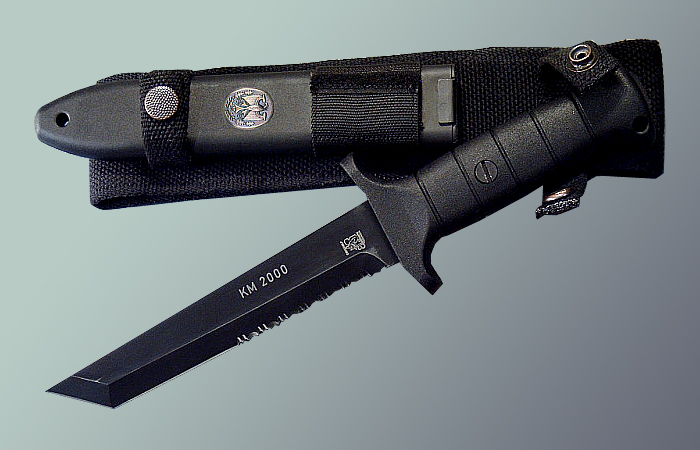
The KM2000 (German: Kampfmesser 2000, lit.'Combat knife 2000') is the standard combat knife of the German Bundeswehr.

Key Information

Production

[edit]

The knife is manufactured in Germany by the Eickhorn-Solingen company (aka "Original Eickhorn").

The knife is produced according to NATO regulations by the German company Eickhorn-Solingen GmbH.

Design

[edit]
New Model of KM2000

The assembly consists of three components: the laser cut 172 mm Black Kalgard coated, forged X55CrMo14 or 1.4110 (440A) stainless steel Westernized tantō blade, the ergonomic ambidextrous polyamide handle and screw.

The entire knife weighs approximately 320 grams (11 oz). The sheath for the KM2000 is turnable, and includes an adapter to allow it to be mounted onto the MOLLE/PALS load bearing system(s).

Later revisions of the KM2000 (as of 2008) use a different stainless blade steel alloy with better edge-holding properties, X105CrMo17 or 1.4125 (440C) Böhler N695 (HRC 57).

Apart from the hard polyamide sheath, a special leather sheath is available from Eickhorn.

The newer version of the KM2000 has a modified tip for greater strength and stability while thrusting and prying windows and containers open.

The blade of both models has two versions: plain and partially serrated. The serrations are used for cutting ropes and fabric fibers for survival techniques. The scabbard has a strip of diamond sharpener used for field sharpening of the knife.

The handle end has a glass breaker tip which is actually the end of the knife blade tang and a lanyard hole.

The scabbard is MOLLE and IDZ military vest compatible.

Variants

[edit]

Based on the popularity of the design, Eickhorn has developed the line-up introducing many variations in shape, material used, colors.

Models other than KM2000 are also introduced by Eickhorn such as Para-Commando, KM5000, FS knife etc. Most of these variations are not actually issued in the German Army.

KM1000

[edit]

KM2000 without blade-coating. Available with sand-colored grips and scabbards intended in desert environments like Afghanistan.

KM3000

[edit]

KM2000 with a spear-point blade instead of the KM2000's westernized-tanto point. Available with sand-colored grips and scabbards intended in desert environments like Afghanistan.

Desert Command I

[edit]

KM2000 variant for desert environment.

Desert Command II

[edit]

KM3000 variant for desert environment.

Users

[edit]

Legacy

[edit]

The KM2000 owes a lot of its fame to the fact that it is among the few (if not the only) "tantō"-style military knives actually issued in significant numbers.

See also

[edit]
[edit]
Revisions and contributorsEdit on WikipediaRead on Wikipedia
from Grokipedia
The KM2000 (Kampfmesser 2000) is the standard-issue of the German , serving as a multifunctional tactical tool for soldiers in various operational environments. Introduced in 2001 as part of the modernization efforts for the 's and infantry units, including the (IDZ) program, the KM2000 replaced earlier models and has been deployed in missions across , , and , remaining in service as of 2025. Featuring a 17 double-sided tanto blade crafted from 1.4110 with a of 57 HRC and a black Kalgard for resistance, the knife measures 30.3 in overall length, weighs 330 g, and includes a half-serrated edge for enhanced cutting versatility. Its ergonomic handle, made of fiberglass-reinforced , provides a non-slip grip suitable for temperatures from -30°C to +50°C, while the integrated pommel serves as a for emergency applications. The accompanying sheath, constructed from durable black synthetic material, incorporates a diamond sharpening plate, drainage holes, and compatibility with and IDZ modular systems for secure attachment to tactical gear. Designed for tasks beyond combat—such as stabbing, slashing, levering, prying, splitting, chopping, chiseling, and light hammering—the KM2000 meets supply standards under number 1095-12-355-6742 and is produced by Eickhorn , a firm with over 150 years of expertise in edged tools.

Development and Production

Development History

The development of the KM2000 combat knife originated in the late 1990s, as the German Bundeswehr sought to modernize its equipment by replacing earlier models such as the Kampfmesser 68 and Feldmesser 78/89, along with other outdated bayonets and knives, with a more versatile tool suited to contemporary global operations. This initiative reflected broader Bundeswehr efforts to enhance soldier capabilities amid post-Cold War deployments, emphasizing multifunctional utility beyond traditional combat roles. The project involved a competitive bidding process, with Eickhorn-Solingen GmbH ultimately selected over competitors like Waffentechnik Borkott. Eickhorn-Solingen , a longstanding Solingen-based manufacturer with a history of military knife production, led the design in close collaboration with technical experts and operational personnel, incorporating feedback from experienced soldiers to ensure practical effectiveness. Knife designer Dietmar Pohl contributed to the conceptualization, focusing on and robustness for tasks like cutting, prying, and piercing in diverse environments. Prototypes underwent iterative testing in the early to evaluate performance under field conditions, prioritizing durability against impacts, efficient cutting across materials, and seamless integration with modern loadouts such as modular vests. The KM2000's blade design drew inspiration from the Japanese style, selected for its superior piercing strength and stability when penetrating hard surfaces like or barriers, but adapted to European manufacturing techniques using high-quality for corrosion resistance and edge retention. Following successful field trials that validated these attributes, the knife was officially adopted by the in 2003, entering widespread service as the standard with 1095-12-355-6742.

Production Details

The KM2000 is manufactured by , a company based in , , known for its expertise in edged weapons and military tools. Production of the knife began in the early 2000s, following its official adoption as the standard for the German , with manufacturing adhering to codification standards (NSN 1095-12-355-6742). The production emphasizes precision and durability suitable for use. Blades are precision-forged from high-carbon alloys, such as 1.4110 or Böhler N695, then laser-cut to achieve the double-edged Tanto profile with partial serrations. A corrosion-resistant Kalgard is applied to the for non-reflective properties and enhanced protection against environmental wear. Handles are formed from fiberglass-reinforced via injection molding, ensuring a yet robust that integrates seamlessly with the full-tang design. Scale of production reflects the knife's role as standard-issue equipment, with approximately 20,000 units delivered to forces. Manufacturing occurs in batches tailored to procurement cycles, supported by ongoing contracts for , sharpening services, and spare components. follows German DIN standards, including rigorous testing for edge retention, impact resistance, and overall structural integrity.

Design and Features

Blade Specifications

The KM2000 features a blade measuring 172 (6.8 in) in length, designed in a Westernized style that incorporates a reinforced tip optimized for piercing hard materials such as armor or tough barriers. This configuration enhances the blade's thrusting capability while maintaining structural integrity during high-impact use. Early production models of the KM2000 utilized X55CrMo14 or 1.4110 , equivalents to 440A, prized for its resistance and ease of maintenance in field conditions. Subsequent upgrades transitioned to higher-performance alloys, including X105CrMo17 (equivalent to ) or Böhler N695 steel, both hardened to approximately HRC 57 for superior edge retention and wear resistance. These later steels provide enhanced durability without compromising the blade's balance or sharpness over extended deployments. The blade receives a Kalgard , a non-reflective finish that minimizes visibility in low-light operations and offers protection against corrosion in diverse environmental conditions, including humidity and saltwater exposure. This treatment also reduces glare, making it suitable for tactical scenarios where stealth is paramount. The standard KM2000 blade features a half-serrated edge for versatile cutting tasks, including slicing through , , or fibrous materials, with plain edge variants also available.

Handle and Ergonomics

The handle of the KM2000 is made from black glass fiber-reinforced , a nylon-based material offering lightweight durability, impact resistance, and chemical resistance suitable for harsh field environments. This ergonomic, ambidextrous design incorporates finger grooves and a textured, non-slip surface with raised transverse ridges, providing secure control during wet conditions or when wearing gloves. The handle measures approximately 130 mm in length, contributing to the knife's overall dimensions of 302 mm (11.9 in) and a total weight of 330 g (11.6 oz). Key features include a hole at the pommel base for wrist retention in scenarios and an integrated tip, formed by a 2 mm protrusion of the tang, for emergency breaching tasks. The full-tang construction ensures seamless integration with the for reliable handling.

Sheath and Accessories

The KM2000's standard sheath is constructed from black synthetic , providing and resistance to environmental wear in tactical environments. This material allows for a lightweight yet robust design, with the sheath weighing approximately 100 grams when empty, contributing to the overall system portability. The sheath features a -compatible mounting with adjustable straps, enabling to belts, vests, or backpacks for versatile carry options. It is specifically engineered for compatibility with the German Bundeswehr's IdZ () tactical vest , as well as U.S. standards, facilitating quick-draw access during operations. A built-in sharpener rod is integrated into the sheath for field maintenance, allowing users to restore the blade's edge without additional tools. The design includes a for retention and a secure locking mechanism to prevent accidental release during movement. Standard accessories include the aforementioned and sharpener, with the sheath supporting ambidextrous insertion for left- or right-handed users. An optional universal leather sheath is available from the manufacturer, featuring a belt loop for alternative carry configurations and added protection against scratches. This accessory enhances versatility for non-tactical applications while maintaining compatibility with the KM2000's dimensions.

Variants

KM1000

The KM1000 was developed as a non-coated variant of the KM2000 , tailored for scenarios and environments requiring low maintenance due to reduced risk. This adaptation maintains the core functionality of the standard model while eliminating the blade's protective coating to simplify upkeep in dry or arid conditions. Key differences from the base KM2000 include a black handle and sheath, alongside an uncoated satin-finished blade that minimizes glare and eases cleaning. The blade retains the 172 mm length and tanto profile but features partial serrations. These modifications enhance durability in sandy terrains by reducing material buildup on the uncoated surfaces.

KM3000

The KM3000 is a variant of the KM2000 , developed by Eickhorn as an adaptation featuring a spear-point for enhanced versatility in cutting, , and slashing tasks. At the suggestion of experienced soldiers, designer Dietmar Pohl modified the design to provide a broader range of applications compared to the base model's tanto , while retaining core construction elements for military use. Key differences from the KM2000 include the spear-point blade geometry, which improves performance in thrusting and slicing over the original's more puncture-focused tanto shape, and a standard partial serration along the edge for added utility in fibrous materials. The blade is forged from Böhler N695 stainless steel with an HRC hardness of 57 and a black Kalgard coating for corrosion resistance, matching the upgraded material quality of later KM2000 iterations but with optional variations in coating application. Specifications for the KM3000 include a 17.2 blade length, 5 mm thickness, overall length of 30.2 , and weight of 330 g, with a glass-fiber-reinforced grip incorporating a at the pommel end. The handle is insulated to withstand electrical surges up to 1000 volts, and it includes a lanyard hole for retention. The knife ships with a sheath featuring a strap system compatible with standard IDZ and U.S. attachments, allowing integration with the base model's accessory ecosystem. This variant emphasizes tactical adaptability, positioning it as a robust tool for professional and applications, including hollow-ground edges for superior cutting performance.

Desert Command I

The Desert Command I is a specialized variant of the KM2000 , developed by Original Eickhorn-Solingen (OES) to support operations in arid and desert environments. Introduced as a coyote-colored following the Bundeswehr's post-2001 engagements, it addresses the need for equipment that blends with desert camouflage while maintaining the core functionality of the standard model. This variant was created in response to experiences in dusty and sandy theaters, such as , where the German contributed to ISAF missions. Key differences from the base KM2000 include a full finish on the glass-fiber-reinforced handle and sheath, enhancing visual integration with uniforms and reducing visibility in arid . The tantō-style , retained from the original , features a double-edged profile with partial and a Kalgard that provides enhanced protection against and abrasion in sandy conditions. This meets U.S. MIL-STD-171 salt spray standards, making it particularly suitable for prolonged exposure to dust and fine particles common in operations. Additional features emphasize durability in harsh environments, including improved resistance on all metal components to withstand sands and the handle's ability to endure extreme temperatures from -40°C to high heat. The sheath, compatible with both U.S. and German IDZ modular systems, incorporates a sharpener and strap for secure carry, while the exposed tang serves as a for emergency use. Overall dimensions match the KM2000, with a 17.2 cm blade length, 5 mm thickness, and total weight of 330 g (525 g with sheath), ensuring familiarity for users transitioning from the standard issue. Production focused on military-grade quality, with units issued to forces supporting ISAF deployments starting in the early .

Desert Command II

The Desert Command II is a specialized variant of the KM3000 combat knife, developed by Eickhorn as a desert-optimized model for military operations in arid environments. It serves as an adaptation of the standard KM2000, incorporating enhancements for hot climates and sandy conditions based on feedback from personnel. Key modifications include a coyote-brown coloring on the handle and sheath for improved in terrains, along with a spear-point featuring partial serrations for versatile cutting tasks. The is constructed from Böhler N695 , which provides excellent edge retention and corrosion resistance in abrasive, sandy environments, and is coated in matte black Kalgard to minimize reflections and enhance durability. Additional features emphasize functionality in harsh conditions, such as a glass-fiber-reinforced grip with textured surfaces for secure handling when hands are sweaty, an integrated at the pommel, and an exposed tang for prying. The sheath is compatible with and IDZ systems, includes drainage ports to facilitate sand evacuation, and incorporates a built-in diamond sharpener for field maintenance. The overall length measures 30.2 cm, with a 17.2 cm blade thickness of 5 mm and a total weight of 330 g. Production is handled by Eickhorn Solingen in under military specifications, with units primarily supplied to the for deployment in desert-like areas, though exact quantities remain undisclosed.

Operational History

Primary Users

The KM2000 serves as the standard for the , issued to infantry units and as part of their basic equipment kits. Introduced in 2001 through the (IdZ) program, it replaced earlier models to meet modern operational requirements for the . The knife carries the supply number 1095-12-355-6742, facilitating procurement and standardization within alliance frameworks, with integrated training for its use in soldier preparedness. While primarily associated with the , the KM2000 has been used by German special units participating in the Multidimensional Integrated Stabilization Mission in (MINUSMA). As of November 2025, the KM2000 remains in active service across various theaters, with ongoing issuances supporting theater-specific adaptations.

Combat Deployment

The KM2000 was deployed with German forces during the War in Afghanistan from 2001 to 2021, where it supported operations in dusty environments including close-quarters combat encounters and utility tasks such as cutting and prying. Soldiers utilized it for penetrating stable materials in field conditions, contributing to its role in tactical engagements. It has also been used in operations in . In the Multidimensional Integrated Stabilization Mission in (MINUSMA) from 2013 to 2023, the KM2000 equipped troops for desert patrols. The sheath's compatibility with IDZ carrying systems facilitated secure attachment during mobile operations. The knife's Böhler N695 construction at 57 HRC hardness has been noted for resisting degradation from environmental abrasives like sand. The pommel can serve as a for emergency applications. Integrated into the Bundeswehr's IdZ (Infanterist der Zukunft) equipment suite via its MOLLE/IDZ-compatible sheath, the KM2000 supports training for bayonet drills and survival tasks, emphasizing its multi-role utility in soldier preparation programs.

Legacy and Influence

Reception and Impact

The KM2000 received positive feedback from personnel for its ergonomic handle design, which features a non-slip, glass fiber-reinforced thermoplastic grip with transverse grooves and a thumb rest, ensuring comfortable handling even in wet or low-light conditions. Users also praised its versatility as a multi-purpose tool, capable of performing cutting, stabbing, prying, splitting, chopping, and light hammering tasks in field operations across deployments in , , and . However, some criticisms highlighted the knife's weight of 550 grams (including sheath), which could be burdensome for extended carry, and its initial black-only color scheme, which clashed with patterns in diverse environments. The KM2000's adoption as the standard for the German armed forces established it as a benchmark for modular designs in equipment, with its sheath compatible with both U.S. and German IDZ systems, facilitating integration across NATO-compatible forces. Its double-edged Tanto blade with partial serration set a for robust, tool-oriented tanto-inspired knives in professional applications, emphasizing non-lethal utility over pure combat roles. This design philosophy influenced Eickhorn's subsequent models, such as the KM3000 and KM4000, developed in response to soldier feedback on real-world performance. The knife's official status enhanced Eickhorn Solingen's reputation as a premier supplier of tactical gear, with approximately 20,000 units delivered to the . Furthermore, the KM2000's core features inspired Eickhorn's civilian product lines, including the "Kitchen Warrior" series of high-performance kitchen knives adapted for enthusiasts using similar military-grade materials and ergonomics.

Successors or Replacements

As of 2025, the KM2000 remains the standard of the German , with no full replacement introduced or planned in the immediate term. Upgrades to the have emphasized material improvements rather than wholesale redesigns, particularly in blade quality to enhance and resistance under field conditions. The version employs 1.4110 , while non-military or upgraded civilian variants use Böhler N695 at HRC 57 hardness. The Bundeswehr's , an enhanced modular soldier system rolled out progressively since 2010 with recent modernization contracts in 2025, integrates the KM2000 as its primary edged weapon while incorporating provisions for attachments to expand utility in networked infantry operations. This approach prioritizes compatibility and incremental enhancements over substitution, ensuring the knife's role in close-quarters tasks persists within the system's ecosystem. Eickhorn Solingen, the primary manufacturer, developed the KM4000 as a versatile knife, featuring a 17.2 cm tanto blade with integrated back saw and wire cutter notches, weighing 330 g and compatible with IDZ and U.S. systems. Introduced around 2022, prototypes and early models were evaluated for due to their lighter, more modular construction compared to dedicated combat knives, though it functions as a supplementary rather than replacement tool for the KM2000's stabbing and slashing roles. The KM2000's double-edged tanto profile has influenced edged weapons in allied forces. Desert-optimized variants of the KM2000, such as the Desert Command I, continue to be extended in service for arid mission profiles, underscoring the design's adaptability amid evolving operational demands.

References

Add your contribution
Related Hubs
User Avatar
No comments yet.