


Community hub
Recent from talks
Contribute something
Nothing was collected or created yet.
Kalimath
View on Wikipedia
Kalimath is a village in Rudraprayag District of the Indian state of Uttarakhand.
Key Information


Geography
[edit]It lies at an altitude of around 6,000 feet (1,800 m) on the Saraswati river in the Himalayas, surrounded by the peaks of Kedarnath. Kalimath is situated close to Ukhimath and Guptakashi.
Religion
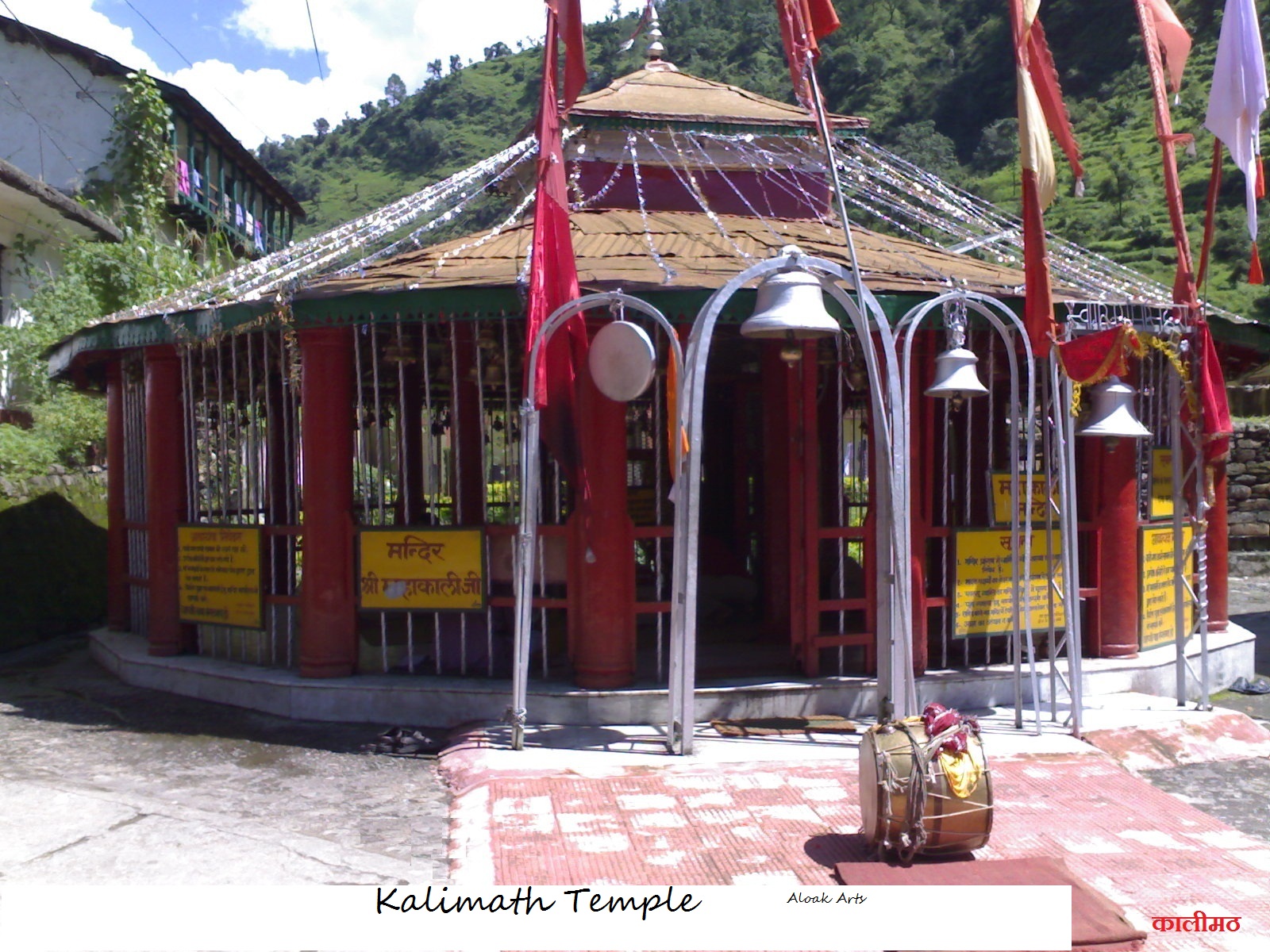
[edit]The temple of the Hindu goddess Kali there is visited by devotees year round, especially during the Navratras.[1] It is one of 108 Shakta pithas in India as per Srimad Devi Bhagwat.[2]
The Sri Yantra is the object of devotion. The idol of Kali is only taken out and worshipped in the temple one day each year when Puja is performed at midnight, with only the chief priest present.[3] Near the temple are other ancient temples to Laxmi, Saraswati, Gauri Shankar and many antique Shivlings, idols of Nandi and Ganesh, etc.
An eternal flame always burns in the temple of Laxmi. Bhairava Mandir is located nearby.[4]
Satpal Maharaj set up a small Dharamshala near the temple where pilgrims can stay. About 2 km east is Kunjethi village, hosting two temples of Mata Manana Devi and Mankameshwar Mahadev. 6 km from Kalimath at the top of a hill there is a huge Kalishila and another Kali Temple.
Notables
[edit]References
[edit]- ^ "Kalimath: District of Rudraprayag, Uttarakhand, India". rudraprayag.nic.in. Archived from the original on 23 October 2011.
- ^ "Shri Badrinath - Shri Kedarnath Temple Committee". Archived from the original on 28 March 2013. Retrieved 3 September 2012..
- ^ a b "Kalimath, Kalimath in Rudraprayag, Rudraprayag Villages, Uttarakahnd Villages, Uttaranchal Villages, Rudraprayag, Villages, Uttarakhand, Uttaranchal". Archived from the original on 23 December 2011. Retrieved 22 March 2012.
- ^ "Kalimath". wikimapia.org. Retrieved 19 March 2019.
Kalimath
View on GrokipediaGeography
Location and Terrain
Kalimath is situated in the Rudraprayag district of Uttarakhand, India, at coordinates 30.563887°N 79.085083°E.[4] This positioning places it within the Garhwal region of the Himalayas, directly on the banks of the Saraswati River, a tributary that flows through the rugged valleys of the area.[1] The site lies at an approximate altitude of 1,800 meters (6,000 feet) above sea level, contributing to its remote and elevated character amid the Himalayan foothills.[5] The village and temple are enveloped by the towering Kedarnath peaks and the broader Garhwal Himalayan range, which provide a dramatic natural backdrop of snow-capped summits and steep escarpments.[6] Nearby towns include Ukhimath, approximately 20 kilometers to the southeast, serving as a regional administrative and pilgrimage hub, and Guptkashi, about 13 kilometers to the south, known as a key stop on routes toward Kedarnath.[5][7] These proximities integrate Kalimath into a network of Himalayan settlements while maintaining its relative seclusion. The terrain surrounding Kalimath features a hilly landscape characterized by undulating slopes, dense forested areas of oak, rhododendron, and pine, and occasional meadows that typify the Garhwal Himalayan ecology.[8] This topography is influenced by the adjacent Kedarnath Wildlife Sanctuary, which spans parts of Rudraprayag and neighboring districts, encompassing diverse alpine and subalpine habitats that extend protection to the region's flora and fauna near Kalimath.[9] The combination of riverine proximity and forested hills creates a verdant yet challenging environment, shaped by the geological dynamics of the western Himalayas.[2]Climate and Biodiversity
Kalimath, situated in the Garhwal Himalayas at an elevation of approximately 1,800 meters, experiences a temperate Himalayan climate characterized by distinct seasonal variations. Winters, from December to February, are cold with temperatures often dropping to around 0°C, accompanied by snowfall in higher surrounding areas. Summers, spanning April to June, are mild with daytime temperatures reaching up to 25°C, providing comfortable conditions despite occasional cooler nights. The monsoon season, from June to September, brings heavy rainfall averaging 1,500–2,000 mm annually in the region, which significantly increases the risk of landslides and flash floods along the steep terrain.[10][5][11] The optimal period for visiting Kalimath is from March to June and September to November, when weather is pleasant with moderate temperatures between 10°C and 25°C and lower precipitation, facilitating safer access to the temple and surrounding trails. This subtropical highland climate supports a transition from subtropical to alpine zones, influencing local ecological patterns without extreme aridity or prolonged freezes.[11][12][13] The region's biodiversity is enriched by its proximity to the Kedarnath Wildlife Sanctuary, fostering diverse oak and rhododendron-dominated forests that cover the mid-altitude slopes. These temperate forests host a variety of wildlife, including the Himalayan black bear and endangered musk deer, alongside more than 200 bird species such as the Himalayan griffon and monal pheasant.[9][14][15] The sanctuary's influence extends to Kalimath, preserving habitats for these species amid the Himalayan ecosystem's high endemism.[2]History and Legends
Mythological Origins
According to Hindu mythology, Kalimath is revered as the site where Goddess Kali vanquished the demon Raktabija, whose blood drops spawned countless clones upon touching the ground, making him nearly invincible.[16] In the fierce battle, Kali extended her tongue to lick up every drop of Raktabija's blood before it could multiply, ultimately defeating him and then entering the earth underground at this location, establishing the site's sanctity as her abode.[3] The temple's mythological origins are also intertwined with the legend of Daksha Yagna, where Sati, the consort of Lord Shiva and daughter of Daksha Prajapati, immolated herself in protest against her father's insult to Shiva.[5] As Shiva carried her burning body in grief, parts of Sati's remains fell to earth at various sacred sites, and in one variant, her back is believed to have fallen at Kalimath, marking it as a Shakti Peeth and imbuing it with divine energy.[2] This connection positions Kalimath among the 108 Shakti Peeths, symbolizing the manifestation of the goddess's power.[2] References in ancient texts further underscore Kalimath's prominence, with the Skanda Purana describing it as a key temple dedicated to Mother Kali and, in certain traditions, her birthplace, highlighting its role in cosmic preservation.[3] The text praises the site's spiritual magnificence, linking it to the goddess's eternal presence.[17] Kalimath is additionally associated with Dhari Devi, another manifestation of Kali, where the lower form of the goddess is worshipped here, while her upper form resides at the Dhari Devi Temple near Srinagar, forming a complementary sacred linkage across the region.[1] This duality emphasizes the temple's role in embodying the goddess's complete, protective essence.[18]Historical References
Kalimath is referenced in ancient Hindu scriptures, particularly in Chapter 62 of the Kedarkhand section of the Skanda Purana, which describes it as a prominent sacred site associated with the worship of Goddess Kali and highlights its spiritual significance in the Kedar region.[19] Local traditions claim Kalimath as the birthplace of the renowned Sanskrit poet Kalidas, who lived in the 4th-5th century CE, asserting that he was intimately associated with the Garhwal valley from birth and received divine inspiration from the goddess at this site, though this attribution remains debated among scholars and is largely considered legendary rather than historically verified.[20] In the 20th century, infrastructure developments supported growing pilgrimage traffic, including the establishment of a dharamshala near the temple by politician Satpal Maharaj to provide accommodation for devotees.[21] The 2013 Uttarakhand floods, triggered by heavy cloudbursts, posed a severe threat to Kalimath's infrastructure, with the Kali River swelling and endangering the temple and surrounding villages; Border Security Force personnel intervened to construct temporary embankments, averting direct submersion of the site while broader regional damage included washed-out roads and bridges.[22] Administratively, Kalimath became part of Rudraprayag District upon its formation on September 16, 1997, carved from portions of Chamoli, Pauri Garhwal, and Tehri Garhwal districts, which facilitated its integration into state pilgrimage networks.[23] This administrative change contributed to Kalimath's evolution as a vital stopover for pilgrims en route to Kedarnath, enhancing its accessibility and role in the Char Dham circuit despite the challenging Himalayan terrain.[23]Religious Significance
The Temple Complex
The Kalimath temple complex is a compact cluster of shrines dedicated to multiple deities, primarily centered around the main Kali Mata Temple. Unlike typical Hindu temples, the Kali Mata Temple does not house a traditional idol of the goddess; instead, it enshrines a silver Sri Yantra, a sacred geometric diagram representing divine energy, placed over a kund (sacred pit). This yantra is the focal point of worship and symbolizes the spot where Goddess Kali is believed to have entered the earth.[2][1] Adjacent to the main temple are several smaller shrines that enhance the site's spiritual layout, forming a unified complex spanning a small area amid the Himalayan foothills. The Lakshmi Mata Temple, located nearby, features an eternal akhand jyoti (unbroken flame) that has been continuously burning for centuries, signifying perpetual divine presence. Other key structures include the Saraswati Temple, dedicated to the goddess of knowledge; the Gauri Shankar Temple, honoring the union of Shiva and Parvati; and the Bhairav Mandir, devoted to the fierce guardian deity Bhairava. These shrines are arranged in close proximity, allowing devotees to circumambulate the complex easily.[5][1][21] The architecture of the complex embodies a simple yet enduring Himalayan vernacular style, primarily constructed from local stone and timber, which provides resilience against the region's harsh weather. The buildings feature modest designs with sloped roofs to shed snow, and the overall layout integrates seamlessly with the surrounding forested terrain, emphasizing functionality over ornate decoration. Beyond the core complex, additional sacred sites extend the temple's influence: approximately 2 km east in Kunjethi village lie the Mata Manana Devi Temple and the Mankameshwar Mahadev Temple, serving as subsidiary shrines for local worship. Further afield, about 6-8 km away on a hilltop, stands another Kali Temple encompassing the prominent Kalishila, a large natural stone revered for its yantra-like markings and inscribed mantras, accessible via a moderate trek.[24][21][25]Shakti Peeth Status
Kalimath holds a prominent position among the 108 Shakti Peeths in Hindu tradition, revered as a sacred site where a portion of Goddess Sati's body is believed to have fallen during the mythological dispersal by Lord Vishnu's Sudarshana Chakra, embodying the divine feminine power known as Shakti.[6] These Peeths are power centers that manifest the goddess's energy, drawing devotees for spiritual fulfillment and divine communion.[3] Distinguished as a Siddha Peeth, Kalimath is the only such site in the Kedarnath valley, uniquely venerated for facilitating tantric sadhana or spiritual practices aimed at attaining siddhis, or supernatural powers, through intense meditation and yogic discipline.[6][3] This status underscores its role as a hub for esoteric rituals, where practitioners seek enlightenment and mastery over inner energies.[26] Central to its symbolism is the Sri Yantra, a geometric diagram installed as a silver plate over the sacred immersion spot of Goddess Kali, serving as a meditative tool to harness cosmic energy and align the practitioner's consciousness with divine forces.[6] The temple's association with Kali, the fierce destroyer of evil and ignorance, amplifies this symbolism, representing transformation and the triumph of righteousness over demonic forces like Raktabija.[3][27] Kalimath's pan-Indian recognition stems from its mentions in ancient texts such as the Devi Bhagavata Purana, which lists it among the key Shakti centers, and the Skanda Purana, affirming its status as Kali's sacred abode.[6][3] These scriptural references highlight its enduring theological importance across Hindu traditions.[28]Rituals and Worship
The rituals at Kalimath Temple emphasize devotion to Goddess Kali through the sacred Sri Yantra, a geometric symbol representing her cosmic energy, rather than traditional idol worship. Daily worship begins with the Mangala Aarti at dawn, followed by Abhishekam (ritual bathing of the yantra) and Alankar (decoration), culminating in the evening Maha Aarti. These ceremonies, conducted by the temple's dedicated priests, involve offerings of flowers, incense, and prasad to invoke blessings for prosperity and spiritual growth.[29][30] A distinctive annual tradition occurs on the eighth day of Navratri, when the chief priest exclusively performs a midnight puja, unveiling the silver-covered Sri Yantra for darshan—a rare revelation that underscores the site's tantric heritage and draws spiritual seekers for profound meditation. This practice highlights the temple's abstract form of devotion, where the yantra serves as a focal point for contemplative practices aimed at transcending ego and attaining inner harmony, aligning with tantric principles of energy visualization.[1][26] Pilgrims engage in customary practices such as parikrama (circumambulation) around the temple complex and the sacred kundi (small reservoir) beneath the yantra, symbolizing the encircling of divine energy. Devotees often take special vows, offering items like coconuts, bangles, or bindis to the goddess for wish fulfillment, such as health or family well-being, before completing their rituals and departing with prasad. These observances foster a sense of communal reverence and personal transformation within the serene Himalayan setting.[3][31]Festivals and Cultural Practices
Major Festivals
The major festivals at Kalimath Temple revolve around the worship of Goddess Kali and her consort Shiva, drawing large crowds of devotees from across Uttarakhand and beyond. These events amplify the temple's spiritual atmosphere, with enhanced rituals and communal gatherings that highlight the site's status as a Shakti Peeth.[32][5] Navratri, celebrated twice annually during Chaitra (March-April) and Sharad (September-October), spans nine days and is the most prominent festival at the temple, honoring the various forms of Goddess Durga, culminating in reverence for Kali. The temple is elaborately decorated with lights and flowers, and grand evening aartis are performed daily, accompanied by the distribution of prasad to pilgrims. Women often observe fasts for one or all nine days, seeking blessings for marital bliss and prosperity. The eighth day, known as Ashtami or Kal Ratri, holds particular significance during Shardiya Navratri, as it is dedicated to the fierce form of Kali; at midnight, the silver plate covering the sacred kund believed to house the goddess is removed, allowing for a special Sri Yantra puja conducted exclusively by temple priests. This observance attracts thousands of pilgrims, transforming the site into a vibrant hub of devotion.[32][5][2] Mahashivratri, observed in February or March, focuses on the worship of Lord Shiva as the consort of Goddess Kali, emphasizing their divine union. Devotees participate in all-night vigils, chanting hymns and offering prayers at the Shiva shrine within the complex, with special aartis and fasting practices observed throughout the day leading into the night. The festival underscores the temple's unique integration of Shaiva and Shakta traditions, drawing significant attendance from local and regional pilgrims.[2][32] These festivals, rooted in ancient Hindu scriptures such as the Skanda Purana, have been conducted at Kalimath for centuries, reflecting the site's mythological origins as a place where Kali manifested to vanquish demons. While core rituals remain tied to traditional texts, contemporary celebrations include expanded accommodations for growing pilgrim numbers in recent decades. Daily rituals, such as morning and evening aartis, are intensified during these periods to accommodate the influx of visitors.[5]Local Traditions
The traditions around Kalimath, situated in the Garhwal region of Uttarakhand, reflect broader Garhwali cultural heritage, emphasizing communal harmony and artistic expression. Folk traditions in the region include performances of Garhwali dances such as Langvir Nritya, a rhythmic dance enacted by men using sticks and accompanied by folk instruments during festivals, symbolizing agricultural cycles and devotion.[33] Local folk songs, particularly in the Jagar tradition—a shamanistic vocal form—praise Goddess Kali through narrative chants that invoke her protective powers and recount mythological tales, often performed in community gatherings to foster spiritual connection.[34] Social customs in the region revolve around hospitality and collective participation, including the organization of bhandaras, or community feasts, where pilgrims are offered simple meals like rice, lentils, and prasad, reinforcing bonds of generosity and shared devotion during peak visitation periods.[35] These practices integrate seamlessly with festival celebrations, where traditions like folk dances enhance the festive atmosphere.[36] Handicrafts form an essential part of daily and ceremonial life in Garhwal, with skilled artisans specializing in wood carving to create intricate temple artifacts, such as carved panels and idols depicting divine motifs, using local deodar wood for durability and aesthetic appeal.[37] Traditional attire, particularly the ghagra-choli worn by women during events and festivals, features vibrant handwoven fabrics adorned with mirror work and embroidery, paired with silver jewelry to honor cultural identity and occasion.[38] The region's religious heritage underscores an emphasis on Sanskrit learning, with informal pathshalas and temple-affiliated teachings promoting the language through recitation of scriptures, preserving ancient texts and enhancing cultural literacy among youth.[39]Demographics and Economy
Population Profile
Kalimath, located in the Ukhimath block of Rudraprayag district, Uttarakhand, has a small resident population. As per the 2011 Census, the village recorded 545 individuals, comprising 275 males and 270 females. The broader surrounding area, encompassing Rudraprayag district, had a total population of 242,285 in the same census, with 114,589 males and 127,696 females, predominantly in rural settings (229,421 rural versus 12,864 urban). The district's sex ratio stood at 1,114 females per 1,000 males, reflecting a higher proportion of females compared to the national average, while the village-specific sex ratio was 982 females per 1,000 males. Literacy rates in the district averaged 81.30% overall, with male literacy at 93.90% and female literacy at 70.35%; in Kalimath village, the rate was 69.17%, with 377 literates out of the total population (male literacy 75.64%, female literacy 62.59%).[40][41]| Demographic Indicator | Rudraprayag District (2011) | Kalimath Village (2011) |
|---|---|---|
| Total Population | 242,285 | 545 |
| Males | 114,589 | 275 |
| Females | 127,696 | 270 |
| Sex Ratio (F/1000 M) | 1,114 | 982 |
| Literacy Rate (%) | 81.30 | 69.17 |
| Male Literacy (%) | 93.90 | 75.64 |
| Female Literacy (%) | 70.35 | 62.59 |