Hubbry Logo
KeikiKeikiMain
Open search
Keiki
Community hub
Keiki
logo
8 pages, 0 posts
0 subscribers
Be the first to start a discussion here.
Keiki
Keiki
from Wikipedia
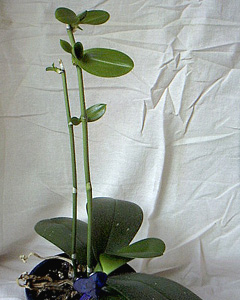
Apical keikis on Phalaenopsis mother plant
Apical keiki in flower on Phalaenopsis mother plant

In horticulture, a keiki (/ˈkk/ KAY-kee) is a plant produced asexually by an orchid plant, especially Dendrobium, Epidendrum (sensu lato), and Phalaenopsis orchids. The baby plant is an exact clone of the mother plant, sometimes flowering while still attached to the mother. The word keiki is Hawaiian for 'baby' or 'child', literally meaning 'the little one'.

On a Phalaenopsis, a keiki is a small plant growing from one node along the flower stem. Keiki growth may be induced by prolonged exposure to high temperatures during the final phase of spike growth.[1] On a Dendrobium, the keiki is typically found sprouting along the length of the cane or from the end of the cane.

In addition to keikis which grow on flower spikes, Phalaenopsis may occasionally produce basal keikis at the base of the orchid.

Removing keikis

[edit]
Phalaenopsis keiki growth progression

If a new plant is desired, the keiki should be left on the mother plant until it develops a healthy root system at least 3 inches (76 mm) long and has two or three leaves (for a Phalaenopsis) or canes (Dendrobium). For a Phalaenopsis keiki, this may take 6–12 months from when the keiki first forms.[2] At this point, it can be carefully removed with a sharp knife and planted in its own pot. Keikis are cut below and above the stem, leaving a small piece of stem on the baby plant.

Some species orchids like Phalaenopsis pulchra frequently produce keikis, which flower while still attached to the mother plant.

If a new plant is not desired, the keiki can be removed at any time. Removing the entire inflorescence after flowering is complete can prevent the production of keikis and result in a "tidier" appearance for the plant.

Hormone paste

[edit]

Keiki paste is a cytokinin hormone which induces growth in the node of a Phalaenopsis inflorescence. It should not be confused with paste or powder containing auxins, which are used to force the production of roots.

Nodes on Phalaenopsis spikes will form either vegetative growth (keiki) or floral growth (a branch with flower buds). If the node tissue is already differentiated so that it will become a floral branch, there is no way to change the result; therefore, the paste must be applied to the node before it is differentiated. However, there is no way to predict if an undifferentiated node will become a keiki or a floral branch.

See also

[edit]

References

[edit]
Revisions and contributorsEdit on WikipediaRead on Wikipedia
from Grokipedia
Keiki (/ˈkeɪki/) is a Hawaiian word meaning "," "offspring," "descendant," or "progeny," commonly used to refer to youngsters, young such as calves or cubs, and plant shoots or suckers, as in . In Hawaiian culture and language, it also connotes workers or even gauges in specific contexts, and it can function as a verb meaning "to have or become a ." The term has been adopted in English to describe a keiki, an asexually produced or clone that emerges from nodes on the flower spike, stem, or pseudobulb of certain , literally translating to "baby" from its Hawaiian roots. These keikis are most common in orchid genera such as , , and , where they form naturally due to hormonal changes, stress, or environmental factors like high temperatures and humidity, serving as a means of vegetative . In practice, orchid keikis can be left attached to the parent plant to draw nutrients or removed and potted independently once they develop 2–3 inches of , requiring , 50–70% , and balanced fertilization to thrive. can also be encouraged artificially using keiki paste, a applied to nodes after blooming, highlighting the term's enduring cultural and practical significance beyond its linguistic origins.

Definition and Etymology

Definition

A keiki is a produced asexually by certain , resulting in a genetic clone of the parent plant. This vegetative propagation method allows the to reproduce without the need for or seed development, ensuring identical traits in the offspring. Keikis are primarily associated with orchids such as , (sensu lato), and , where they develop from nodes on stems, canes, or inflorescences. These plantlets form their own leaves and roots, enabling them to eventually bloom in a manner identical to the parent. Unlike division, which involves separating portions of the , or , which requires and introduces , keikis provide a direct clonal from specific nodal sites. The term "keiki" originates from Hawaiian, meaning "the little one" or "child."

Etymology

The term "keiki" originates from the , where it means "baby," "child," or "offspring," aptly describing the asexual plantlets that emerge from a orchid in a manner reminiscent of a familial bond. This linguistic choice underscores the cultural perspective of propagation as a generative process akin to . The word entered English-language in the mid-20th century, coinciding with the expansion of commercial cultivation in , which positioned the islands as a global hub for breeding and propagation following the establishment of key nurseries and societies in and . Hawaiian growers and publications, such as those from the Hawaii Orchid Society, popularized the term amid the influx of species like and , influencing international literature and enthusiast communities. Unlike many botanical concepts with standardized Latin , "keiki" lacks a direct equivalent in classical and remains a specialized term primarily employed by cultivators and in dedicated horticultural texts. General descriptors like "offset" or "adventitious shoot" are used in broader , but "keiki" persists for its evocative precision in contexts.

Biology and Formation

Formation Process

Keikis in orchids originate from dormant nodes or meristems located on flower spikes, canes, or basal areas of the parent plant, where the orchid redirects energy away from flowering or vegetative growth toward the development of these adventitious shoots. This redirection often occurs as a response to environmental stresses or physiological shifts, activating the latent meristematic tissues to initiate new growth. In species such as , elevated temperatures exceeding 28°C (82°F) during the early stages of development can suppress flower formation and promote keiki production instead, as the plant adapts by favoring vegetative over . This phenomenon is particularly noted in tropical conditions where prolonged warmth alters hormonal balances, favoring shoot initiation at the nodes. Keiki formation is commonly observed in and orchids. The biological process begins with the activation of dormant cells, which differentiate into shoot apices and , supported by endogenous cytokinins that stimulate and . Over time, the keiki develops leaves and , typically becoming visibly established in several months to a year, though initial may occur within a few months under favorable conditions. As products of asexual reproduction, keikis are genetically identical to the parent plant, inheriting all traits such as flower color, growth habit, and even susceptibilities to diseases or pests. This clonal nature ensures the propagation of desirable characteristics without .

Orchid Species Involved

Keikis are most commonly observed in certain orchid genera, particularly those with monopodial or sympodial growth habits that favor adventitious budding. , commonly known as orchids, frequently produce keikis on the nodes of flower spikes, typically the second to fourth nodes from the base, as a natural mechanism. Basal keikis in are rarer and often occur in response to plant stress, such as damage or environmental imbalance, though they can emerge at the stem base under leaf axils. In orchids, keikis commonly develop at the ends of canes or along pseudobulbs, where hormonal accumulation promotes budding. This is especially prevalent in species like , which often forms keikis from top buds after flowering, serving as a survival strategy in variable habitats. Keikis in this genus can also arise from basal nodes, contributing to the plant's clonal expansion. Epidendrum orchids, in the broad sense including hybrids, exhibit frequent keiki production on upright stems, often as offsets that allow rapid colonization. For example, and its hybrids commonly form keikis along the stem, which can be detached once rooted to propagate new plants. This trait aligns with their epiphytic or terrestrial growth in diverse ecosystems. Keiki formation is less common in monopodial orchids like , where growth primarily occurs from a single apical , limiting adventitious shoots unless induced by stress or hormones at the base or nodes. Similarly, in genera such as , keikis are rare due to their sympodial focused on pseudobulb development and back bulb , which rarely activates for offset production without external intervention. This reflects their evolutionary emphasis on robust rhizomatous spread over prolific cloning. Across species, keiki frequency is influenced by factors including plant age, where mature individuals are more prone to budding; environmental stress such as root loss or fluctuating light and humidity; and overall maturity, which triggers hormonal shifts favoring reproduction over flowering. These elements underscore keikis as an adaptive response to ensure species persistence in challenging conditions.

Propagation Methods

Natural Keiki Development

Natural keiki development in orchids occurs spontaneously as a vegetative strategy, often serving as a mechanism when the parent experiences environmental stress. Common triggers include overwatering, insufficient , fluctuations in , or the post-flowering phase, prompting the orchid to produce offsets to ensure species continuity. In species like , high temperatures can also initiate keiki formation at nodes along the flower spike. Once initiated, the keiki emerges as a small shoot, typically on the flower stem or , and remains firmly attached to the parent plant. It draws essential nutrients and water from the mother orchid through this connection, supporting the development of its own leaves and while the parent continues to photosynthesize. This process allows the keiki to mature gradually without immediate separation, though prolonged attachment can strain the parent if it is already compromised by stress. The propagation advantage of natural keikis lies in their ability to produce genetically identical clones, enabling orchids to expand without the need to divide the parent plant, which could otherwise disrupt its structure and health. This asexual method preserves desirable traits and facilitates natural population growth in wild settings or controlled cultivation. Keiki growth typically becomes visible within 1-3 months as leaves emerge, with full independence readiness occurring in 6-12 months, depending on the species and conditions; for instance, keikis require 2-3 leaves and roots at least 1-2 inches long before separation.

Hormone Paste Application

Keiki paste is a synthetic formulation primarily containing such as (6-BAP), designed to stimulate axillary shoot formation at dormant nodes rather than root development, distinguishing it from auxin-based rooting hormones. This promotes and bud break in orchids, mimicking natural signals for vegetative without relying on environmental stress. Commercial formulations often incorporate as a carrier to ensure adhesion and slow release, with concentrations typically around 600-1000 ppm of 6-BAP for effective application. DIY versions can be prepared by dissolving 6-BAP powder in warmed , though precise ratios are adjusted based on experimental recipes to avoid instability. The application process involves selecting a dormant node on the inflorescence spike of Phalaenopsis orchids post-bloom or on the canes of Dendrobium species, where success is highest due to their responsive meristematic tissues. Using a sterile knife or scalpel, gently scrape or make a shallow cut to expose the node, removing any bract covering if present, then apply a small amount of paste—about the size of a pinhead—directly to the site with a toothpick or sterile applicator to prevent contamination. This targeted method activates the node within 1-3 weeks, with full keiki development occurring in 4-8 weeks under optimal conditions of high humidity, indirect light, and temperatures around 24-29°C. However, outcomes vary; while keikis form in compatible species, the treatment may instead induce inflorescences, particularly at upper nodes. Success rates for keiki induction range from 50-80% in responsive orchids like and , yielding 1-3 plantlets per treated node, though results depend on , node position, and environmental factors. Early research demonstrated reliable propagule formation using 0.5% 6-BAP in granular mixtures inserted into spikes, establishing this as a viable alternative to for clonal replication. Developed in the for commercial , keiki paste evolved from applications documented in seminal work like Smeltz (1995), which introduced node-targeted methods for propagation to meet demand for uniform cultivars without seed-based variability. Today, products like KeikiGrow or Crazy Keiki Cloning Paste are widely available from horticultural suppliers, while DIY options use lab-grade s dissolved in carriers, enabling hobbyists to replicate commercial efficacy at lower cost. Precautions are essential to avoid stressing the parent plant; overuse, such as applying to multiple nodes simultaneously, can lead to , resulting in weakened growth or like and at concentrations exceeding 1000 ppm. Limit treatments to 2-3 nodes per plant, and note that is reduced on immature spikes, stressed plants, or non-monopodial species, potentially yielding no response. Always use sterile tools to minimize risk, and monitor for abnormal swelling indicating overdose.

Removal and Cultivation

Removing Keikis

Keikis should be detached from the parent only when they have developed sufficient maturity to survive independently, typically after forming 2-3 mature leaves and roots measuring at least 2-3 inches (5-7.6 cm) in length. This timing ensures the keiki has adequate photosynthetic and absorptive capacity, reducing the risk of or failure post-separation. To perform the removal, use sterilized sharp pruning shears, scissors, or a knife to make a clean cut close to the parent plant, ideally including a small section of the stem or spike base with the keiki for stability. For Phalaenopsis orchids, detach keikis from the flower spike after blooming has concluded, as this aligns with the plant's natural energy redirection phase. In Dendrobium species, keikis typically emerge from cane ends and should be severed between the keiki base and the cane to preserve root integrity. Sterilization of tools is essential to prevent bacterial or fungal infections at the cut sites on both the parent and keiki; wipe blades with 70% or soak in a 10% solution (1 part to 9 parts water) for 10-30 minutes, followed by thorough rinsing. If a keiki is unwanted, as it can divert nutrients and weaken the parent plant, remove it early in its development—before significant root or leaf growth—to redirect energy back to the main . Additionally, trimming flower spikes to the base immediately after flowering can prevent future keiki formation by eliminating potential nodal growth sites. Hormone-induced keikis follow similar maturation criteria for removal as naturally occurring ones.

Potting and Care for Detached Keikis

Once a keiki has been detached from the parent plant, typically when it possesses 2-3 leaves and at least three roots measuring approximately 2-3 inches (5-7.6 cm) in length, it requires prompt potting to support independent growth. Select a small pot sized 2 to 4 inches (5-10 cm) in diameter to accommodate the keiki's developing , ensuring it has drainage holes to prevent water accumulation. Suitable potting media include fine bark for and drainage, for retention, or a mix incorporating to mimic epiphytic conditions. Position the keiki so that its roots are spread out and partially buried in the medium, with the base of the stem at level; secure with if needed to maintain stability. For initial care, maintain high levels of 70-80% to aid acclimation, achievable by enclosing the potted keiki in a clear or humidity dome for the first few weeks, gradually venting to prevent mold. Provide bright, indirect light, such as from an east-facing windowsill, to encourage without scorching the tender leaves. Optimal temperatures range from 68-77°F (20-25°C) during the day, with a slight drop at night to simulate natural conditions. Water sparingly, allowing the top of the medium to dry out between applications to avoid , and mist the leaves daily in the early stages to boost . Fertilization should begin only after the keiki establishes a robust , typically 1-3 months post-potting, using a balanced such as 20-20-20 diluted to one-quarter strength and applied every two weeks during active growth periods. Monitor growth milestones closely; new leaves and roots may emerge within weeks, but expect the keiki to reach maturity and bloom in 1-2 years under optimal conditions. Regularly inspect for common pests in young clones, such as mealybugs or spider mites, which can infest humid environments—treat promptly with if detected. For success, mist daily during the initial phase to sustain , and transplant to a larger pot once the roots fully occupy the container, usually after 6-12 months, using fresh medium to promote continued vigor.

References

Add your contribution
Related Hubs
User Avatar
No comments yet.