Hubbry Logo
Kenneth MappKenneth MappMain
Open search
Kenneth Mapp
Community hub
Kenneth Mapp
logo
8 pages, 0 posts
0 subscribers
Be the first to start a discussion here.
Kenneth Mapp
Kenneth Mapp
from Wikipedia

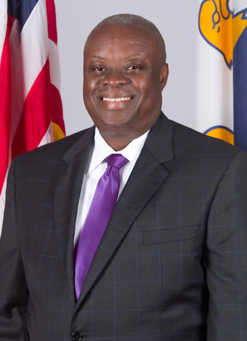
Kenneth Ezra "Ken" Mapp (born November 2, 1955) is an American politician who served as the eighth governor of the United States Virgin Islands, from 2015 to 2019. Though a registered Republican,[1] Mapp was elected Governor in 2014 as an independent. From 1995 to 1999, Mapp served as the seventh lieutenant governor of the United States Virgin Islands, and had previously served for three terms in the Legislature of the Virgin Islands.

Key Information

Mapp was an independent candidate for Governor in 2006 and 2010,[2] but was defeated both times by Democrat John de Jongh.[3] He was elected Governor in 2014, defeating Donna Christian-Christensen, the longtime Delegate to Congress, in a run-off election.[4] Mapp ran for a second term in 2018, but was defeated in the runoff election by Democrat Albert Bryan.[5]

Early life and education

[edit]

Kenneth Ezra Mapp[6][7] was born on November 2, 1955, in Brooklyn, New York, to Al Mapp and Vashti Hewitt Mapp, both from St. Croix.[8] He was one of four siblings. Mapp moved to Saint Croix in the U.S. Virgin Islands in 1961, where he was raised by his maternal grandmother, Almina N. Hewitt, in Estate Rattan. He graduated from St. Croix Central High School in 1973.

Mapp has attended New York City Community College of City University of New York and the University of the Virgin Islands, but has not earned a bachelor's degree. After leaving office as lieutenant governor in 1999, however, he completed the six-week Advanced Management Program at Harvard Business School (which has no formal educational requirements)[9] and received a master's degree in public administration from the John F. Kennedy School of Government at Harvard University.[2] Mapp also completed other fellowships at Harvard University and Carnegie Mellon University in Pittsburgh.[2]

Career

[edit]

Mapp has worked as a police trainee in New York City and a police officer in the U.S. Virgin Islands.[2] He joined the New York City Police Department soon after graduating from high school in 1973 and was based in the 83rd Police Precinct in Brooklyn. He later became a police officer in the U.S. Virgin Islands and was elected president of the U.S. Virgin Islands Police Benevolent Association.

Mapp was elected as a senator in the Virgin Islands Legislature in three separate elections.[2] Mapp was elected to the 15th Legislature of the Virgin Islands[2] in 1982, his first elected office. He would later be elected as a senator in the 18th and 20th Legislatures as well. He chaired the Committee on Public Safety and Judicial Affairs and was a standing member on the Committee on Finance.[2] Additionally, Mapp held other positions within the U.S. Virgin Islands government. He served as the assistant director of the Industrial Development Commission, which later became the Economic Development Authority.[2] Mapp also became the director of the Consumer Services Administration, which is now the Department of Licensing and Consumer Affairs.[2]

In 1994, gubernatorial candidate Roy L. Schneider chose Mapp as his running mate for lieutenant governor in the election.[2] Schneider and Mapp jointly campaigned as independent candidates.[10] Schneider and Mapp were elected Governor and Lt. Governor in a special gubernatorial runoff election held on November 22, 1994.[10] They defeated the Democratic gubernatorial ticket, which consisted of then-Lt. Gov. Derek M. Hodge and his running mate, Alfred O. Heath.[10]

Governor Roy Schneider and Lt. Governor Kenneth Mapp were inaugurated to a four-year term on January 2, 1995.[10] However, Schneider and Mapp had a publicly strained relationship while in office and the two often did not speak to one another during their four-year tenure.[11] Schneider and Mapp did not seek re-election in 1999. Instead, Schneider ran with Finance Commissioner Juan Centeno as his running mate and they were defeated in the election by Democratic candidate Charles Turnbull and his running mate, Gerard Luz James, who were sworn in on January 4, 1999.[12]

After leaving office as lieutenant governor, Mapp earned a master's degree in public administration from Harvard University's John F. Kennedy School of Government and completed the Advanced Management Program (AMP 159) at Harvard Business School.[13] Though he ran for lieutenant governor as independent, Mapp had changed his party affiliation from Republican by 2001.[13] Mapp did not run for governor in 2002.[13] He campaigned for Governor Turnbull who was re-elected to a second term.

In 2002, Governor Charles Turnbull appointed Mapp as the Virgin Island's Public Finance Authority's Director of finance and administration. Mapp raised millions of dollars for the government and Hovensa, the territory's largest private sector employer. The Public Finance Authority acquired its first ever investment grade ratings on VI government-backed securities during Mapp's tenure. Mapp also managed several major capital projects and served on the Governor's financial and budget team. Mapp participated in budget hearings and prepared a variety of detailed analysis and reports. The Governor's financial team worked closely with department heads and legislators to develop and gain legislative approval of the annual territorial budgets.[2]

In 2006, Mapp announced his candidacy for governor as an independent candidate with former Senator at Large Almando Liburd as his running mate. His two main opponents were businessman John De Jongh and Senator Adlah Donastorg. In the general election, de Jongh won 15,914 votes which equalled 49.33% of the total vote, Mapp won 9,100 of the total votes (equalling 26.78 percent) and Donastorg earned 7,871 votes, or 23.16 percent of the votes cast.[14] De Jongh and Mapp, the two top candidates in terms of votes, were forced into a second runoff election on November 21, 2006, since no candidate earned more than 50% of the total votes cast.[14] In the 2006 gubernatorial runoff, De Jongh was elected Governor with 16,644 votes (57.30%), while Mapp came in second, garnering 12,402 votes (42.70%).[15]

2010 gubernatorial election

[edit]

Mapp formally announced his candidacy for Governor of the U.S. Virgin Islands in the 2010 gubernatorial election on August 20, 2010, at his headquarters on Saint Thomas.[2] Mapp, who is running as an Independent rather than a Republican, picked Malik Sekou, a professor and department chair at the University of the Virgin Islands, as his running mate for lieutenant governor.[2][16]

Mapp's main campaign platform included reducing crime and improving education in the U.S. Virgin Islands.[2] Mapp promised to construct a technical school, promote economic growth while protecting the environment and pursue cleaner forms of energy if elected.[2] The general election took place on November 2, 2010. Incumbent governor John de Jongh defeated Mapp in the election to win a second term in office.[3] De Jongh earned 17,535 votes, or 56.27% of the vote, while Mapp came in second with 13,580 votes, or 43.58% of the vote.[3] Mapp initially refused to concede, citing possible voting irregularities and the advice from his campaign advisor.[17]

2014 gubernatorial election

[edit]

Mapp ran for Governor of the U.S. Virgin Islands in the 2014 gubernatorial election, choosing Osbert Potter, a former Virgin Islands senator as his running mate. The general election was held on November 4, 2014. He received 47.47% of the vote, but since no candidate received the required 50%+1 as required by the Revised Organic Act of the Virgin Islands, a runoff was held between him and Donna Christian-Christensen, the two top vote receivers. The runoff was held on November 18, 2014, two weeks after the general election.[18] Mapp went on to win the run-off election, receiving almost 64% of the vote.[4]

2018 gubernatorial election

[edit]

Mapp ran for reelection but lost with 44.67 percent of the vote to Albert Bryan's 55.04 percent in a run-off election.[19][20]

Political career

[edit]

Mapp was sworn in as the 8th elected Governor of the U.S. Virgin Islands on January 5, 2015.[21] Upon taking office, Mapp requested $1 million to file a lawsuit against Hovensa.[22] He later signed legislation appropriating $1 million to further take legal action towards Hess Oil and PDVSA.[23] To combat rising crime in the territory, Mapp formed alliance between the New York City Police Department and the Virgin Islands Police Department.[24] In addition, VIPD officers were sent to New York for training and mentorship.[25] Mapp signed an executive order allowing same-sex marriage in the U.S. Virgin Islands following a U.S. Supreme Court's decision.[26] In July 2015, Mapp became a member of the NGA's Committee on Economic Development.[27] His administration moved to sue HESS Corporation for $1.5 billion given the refinery immediate closure.[28] Mapp created the Virgin Islands Climate Change Council through executive order.[29] In December 2015, Mapp began an agreement with ArcLight Partners, LLC, to operate the oil storage terminal of Hovensa refinery.[30]

Mapp implemented salary increases for government employees while his administration focused on raising the minimum wage from $7.25 to $10.50 over a three-year period.[31] Worked with Sinopec on St. Croix oil refinery and met with Air China officials to attract Chinese tourists to the territory.[32] In February 2017, Mapp faced a government fiscal crisis with over $2 billion in debt and a structural deficit of $110 million.[33] Mapp provided the federal Medicaid program to all eligible Virgin Islands residents, giving vital health care access to many families who lacked health insurance and access to basic health care services.[34] On September 5, 2017, Mapp declared a state of emergency in preparations for Hurricane Irma which was followed by Hurricane Maria thirteen days later. He met President Donald Trump on a ship off Puerto Rico.[35] Within ten months of the storms, over 130 members of Congress led by then House Minority Leader Nancy Pelosi were in the USVI seeing firsthand of the devastation.[36] Mapp was successful in persuading Congress and received bipartisan support for several unprecedented amendments to the Stafford Act as well as an estimated $9 billion of federal funds for the recovery and rebuilding of the territory. Mapp recruited local and national nonprofit organizations to join the recovery effort, including the American Red Cross, Bloomberg Philanthropies, the Clinton Global Initiative, and the Kenny Chesney Foundation. He also appealed help for the territory and received personnel and resources from his fellow governors Andrew Cuomo,[37] Chris Christie,[38] and Larry Hogan.[39]

Major capital projects funded by the federal government started under Mapp tenure, such as the Veterans Drive Improvement Project[40] and the Bridge To NowHere.[41] Mapp offered free tuition to all local high school graduates attending the University of the Virgin Islands.[42]


Cabinet

[edit]
Chief of Staff Eugene Farrell
Randolph "Randy" Knight (2015-2016)
Chief Legal Counsel Emile Henderson III
Director of Communications Kevin Williams
Sam Topp
Cherie Munchez
Nicole Bollentini
Kimberly Jones


Agency Commissioner/Director
Department of Finance Clarina Modeste-Elliott (acting)
Valdamier Collens (2015-2018)
OMB Julio Rhymer
Nellon Bowry (2015-2017)
Department of Education Dionne Wells-Hendrington (acting)
Sharon McCollum (2015-2018)
Department of Sports, Parks & Recreation Calvert White (acting)
Pedro Cruz (2015-2018)
Department of Public Works Nelson Petty (2017-2019)
Gustav James (2015-2017)
Department of Justice Claude Walker
Soraya Diase Coffelt (2015-2015)
Department of Labor Averil George (2018-2019)
Catherine Hendry, Esq (2015-2018)
Bureau of Internal Revenue Marvin Pickering (2015-2019)
Department of Property & Procurement Lloyd Bough Jr. (2017-2019)
Timothy Lake (acting)
Randolph Bennett (2015-2017)
Virgin Islands Police Department Jason Marsh (acting)
Delroy Richards (2015-2018)
Department of Tourism Beverly Nicholson-Doty (2007-2018)
Department of Human Services Felicia Blyden (2017-2019)
Anita Roberts
Vivian Ebbesen-Fludd
Richard Lacombe (acting)
Department of Health Michelle Davis
Department of Personnel Milton E. Potter (2015-2019)
Bureau of Motor Vehicles Lawrence Olive (2015-2019)
Virgin Islands Fire Department Clifford Joseph
Office of Veteran Affairs Patrick Farrell (2015-2019)
Bureau of Corrections Rick Mullgrav
Department of Agriculture Carlos Robles (2015-2019)
Department of Planning & Natural Resources Dawn Henry (2015-2019)
Virgin Islands Energy Office Elmo Roebuck Jr. (2015-2019)
Bureau of Information Technology Angelo Riddick (2016-2019)
Jesus Caban (acting)
Reuben Molloy (2015-2016)
Office of Collective Bargaining Natalie Nelson Tang How (2016-2019)
Joss Springette (acting)
Dr. Valdemar A. Hill, Jr (2015-2015)
VITEMA Mona Barnes (2015-2018)
Department of Licensing & Consumer Affairs Devin Carrington (2015-2019)
Law Enforcement Planning Commission Franz Christian
Virgin Islands National Guard Deborah Howell (2015-2019)

Epstein saga

[edit]

In a 2023 deposition, Mapp stated he met with Jeffrey Epstein for lunch on Little St. James, while as governor. He also said Epstein never received special treatment from him and he was not aware of the late convicted sex offender crimes.[43] On 30 January 2026, the U.S. Justice Department released documents where Mapp once suggested to Epstein if he would be interested in lending $275 million to the V.I. government in July 2016 and separately sought $50,000 to fund his PAC during the 2018 gubernatorial election.[44]

References

[edit]
[edit]
Revisions and contributorsEdit on WikipediaRead on Wikipedia
from Grokipedia
Kenneth Ezra Mapp (born November 2, 1955) is an American politician who served as the eighth elected of the from January 5, 2015, to January 7, 2019. An Independent, Mapp previously served as from 1995 to 1999 under Roy Lester Schneider and was elected to three nonconsecutive terms in the Legislature. Born in , New York, to parents from St. Croix, he began his public service career as a in and the , later earning a in from Harvard University's School of Government. Mapp's tenure as focused on fiscal amid structural deficits, achieving balanced budgets for three years through expenditure controls and revenue measures. His administration faced significant challenges from Hurricanes Irma and Maria in September 2017, which caused extensive damage estimated at billions of dollars; Mapp testified before to advocate for Stafford Act amendments and secured over $243 million in federal housing recovery grants from the U.S. Department of Housing and Urban Development. He established a Hurricane Recovery and Resiliency Task Force to guide long-term rebuilding efforts emphasizing resilience against future storms. Mapp's political career also included unsuccessful bids for in 2006 and 2010 before his 2014 victory in a runoff election, where he garnered 64% of the vote; he was defeated in his 2018 reelection bid by Democrat . Throughout his service, Mapp encountered controversies, including criticisms over past financial dealings and public exchanges perceived as unprofessional. In 2024, the Virgin Islands Legislature passed a resolution commending his years of .

Biography

Early life

Kenneth Ezra Mapp was born on November 2, 1955, in , New York, to Albert Mapp and Vashti Hewitt Mapp, both natives of St. Croix in the . His family's ties to the shaped his early connections to the territory, though he was born on the mainland. Mapp's maternal grandmother, Almina N. Hewitt, and her husband, Cecil Hewitt, played a key role in the family's religious life by facilitating their membership in the . Limited public records detail his childhood beyond these familial origins, with his upbringing occurring amid the socio-economic context of mid-20th-century New York and diaspora communities.

Education

Mapp attended the University of the Virgin Islands but did not complete a degree there. Following his service as lieutenant governor from 1995 to 1999, he pursued graduate studies, earning a Master of Public Administration from the John F. Kennedy School of Government at Harvard University. He also completed the Advanced Management Program at the Harvard Business School, a non-degree executive education initiative focused on leadership and strategic skills for senior professionals. These qualifications supported his subsequent roles in public administration and policy.

Pre-gubernatorial career

Legislative service

Mapp began his legislative career with his election to the 15th Legislature of the in 1982, marking his entry into elected office. He served a two-year term focused on territorial issues, though specific committee assignments or sponsored from this period are not prominently documented in available records. This initial term positioned him as an emerging figure in politics. Re-elected in 1988 to the 18th Legislature, Mapp's service was interrupted in 1989 when the body passed Bill No. 18-0059 by a 9-6 vote, declaring his seat vacant due to noncompliance with Section 6(b) of the Revised Organic Act of 1954, which requires legislators to be bona fide registered voters in the territory. The legislature cited Mapp's in Georgia as disqualifying him from meeting residency and voter qualifications. Mapp challenged the action in federal court, contending it violated and internal legislative rules requiring a two-thirds majority for expulsion; however, the Territorial Court initially ruled in his favor before the Appellate Division reversed, deeming the matter a non-justiciable . The U.S. Court of Appeals for the Third Circuit affirmed the dismissal on August 4, 1989, upholding his removal and preventing reinstatement for the remainder of the term. Mapp returned to the after winning in 1992 to the 20th , completing his third and final senatorial term through 1994. This period preceded his appointment as in 1995, during which he continued advocating for local development and administrative reforms, building on experiences from prior terms. Across his three terms, Mapp operated largely as an independent, emphasizing pragmatic territorial priorities over partisan alignment.

Executive and administrative roles

Mapp was appointed of the Industrial Development Commission—which subsequently evolved into the Economic Development Authority—in 1985. In this administrative capacity, he contributed to efforts promoting industrial growth and economic incentives in the . He later served as of the from January 1995 to 1999, elected on a joint ticket with Roy L. Schneider following their victory in the 1994 runoff election. As second-in-command in the executive branch, Mapp oversaw various administrative functions, including inter-agency coordination and support for territorial operations during Schneider's term. In 2002, Charles Wesley Turnbull appointed Mapp as Director of Finance and Administration for the Public Finance Authority, a quasi-governmental entity responsible for managing public debt issuance, bond financing, and fiscal oversight for territorial projects. During his leadership in this role, the authority handled key financial instruments, including revenue bonds to fund and development initiatives amid the territory's ongoing economic challenges. Mapp also held positions such as Licensing Commissioner, focusing on regulatory administration for business and professional licenses in the territory. These executive and administrative appointments underscored his involvement in , , and regulatory prior to his gubernatorial bids.

Gubernatorial campaigns

2002 campaign

In November 2001, Kenneth Mapp, former under Roy Schneider from 1995 to 1999, announced his candidacy for of the during an interview on a St. Thomas radio station. Mapp, who had served in various public roles including as commissioner of property and procurement, cited his administrative experience as a foundation for his bid to address territorial challenges in and . Mapp's campaign was brief, as he withdrew from the race on February 9, 2002, less than three months after launching it. He stated that "now is not the right time" for him to pursue elected office, without elaborating on specific personal or strategic factors. The withdrawal occurred ahead of the Democratic primary scheduled for August 2002, leaving incumbent Governor Charles W. Turnbull unopposed in that party's contest.

2010 election

Kenneth Mapp entered the 2010 United States Virgin Islands gubernatorial race as a challenger to incumbent Democratic Governor John de Jongh Jr., selecting Malik Sekou as his running mate for lieutenant governor. The campaign highlighted dissatisfaction with the de Jongh administration's handling of economic challenges and governance, though specific policy platforms emphasized reform in public administration and fiscal management. The general took place on November 2, 2010, with voters selecting the and jointly. De Jongh and his , Gregory Francis, secured victory with 17,535 votes, representing 56.3% of the total. Mapp and Sekou received 13,580 votes, or 43.6%, with write-in votes accounting for the remaining 0.1%. Total ballots cast numbered 31,160 across the territory. District-level results showed geographic variation: in St. Croix, Mapp and Sekou obtained 7,312 votes to de Jongh and Francis's 8,506, reflecting stronger support in that district; in St. Thomas-St. John, the margin widened, with de Jongh and Francis earning 9,029 votes against Mapp and Sekou's 6,268. The ticket's broader appeal in the more populous St. Thomas-St. John district proved decisive. Mapp declined to concede immediately after preliminary tallies revealed a 3,955-vote deficit, pointing to reported issues at locations like Joseph Sibilly Elementary School in St. Thomas and delays in precinct-level reporting. His campaign requested detailed breakdowns from the Supervisor of Elections to investigate potential discrepancies. Upon certification by the district boards of elections on November 17, 2010—with no alterations from absentee ballots—Mapp protested, claiming , , broken machine seals, failed cartridges, and chain-of-custody lapses, though he offered no substantiating evidence. Election officials, including Supervisor Lorna Thomas, affirmed the integrity of the process, noting built-in redundancies and flawless execution. Mapp had seven days to mount a formal legal challenge but ultimately did not overturn the certified outcome.

2014 election

The 2014 United States Virgin Islands gubernatorial election occurred on November 4, 2014, featuring multiple tickets as no incumbent sought reelection following John de Jongh's decision not to run for a third term. , a former who had previously run unsuccessfully in and 2010, campaigned as an independent with Osbert Potter as his running mate for , emphasizing fiscal reform and amid ongoing territorial debt issues. Competing tickets included Democrat , the longtime non-voting delegate to the , paired with Basil Ottley Jr.; Republican Kevin Coffelt with John Canegata; and independent Adlah Barnes with Almando "Babe" Coram. In the general , a total of 25,894 ballots were cast. The Mapp-Potter ticket led with 12,108 votes, or 46.76 percent, followed by Christensen-Ottley with 10,173 votes, or 39.29 percent. The Coffelt-Canegata ticket received 1,837 votes (7.09 percent), while Barnes-Coram garnered 1,693 votes (6.54 percent); the remaining Scullion-Quinn independent ticket obtained 83 votes (0.32 percent). As no ticket secured a under territorial law, the Board of Elections certified a runoff on November 16, 2014, pitting the top two finishers—Mapp-Potter against Christensen-Ottley—scheduled for November 18, 2014. The runoff drew approximately 23,841 votes amid low turnout. Mapp-Potter prevailed with 15,268 votes (roughly 64 percent), defeating Christensen-Ottley, who received 8,573 votes (roughly 36 percent). Initial unofficial results were announced on , 2014, with pending absentee ballots insufficient to alter the outcome, and the Board of Elections formally certified Mapp's victory on December 4, 2014. This win marked Mapp's third attempt at the governorship, positioning him to assume office on January 5, 2015.

2018 election

Incumbent Governor Kenneth Mapp sought reelection in the 2018 gubernatorial election, running on an independent ticket with Osbert Potter. The territory's requires a candidate to receive at least 50 percent plus one vote to win outright; otherwise, a runoff occurs between the top two vote-getters. Mapp's campaign emphasized continued recovery efforts from Hurricanes Irma and Maria, which had struck in September 2017, alongside fiscal reforms and infrastructure rebuilding. The general election took place on November 6, 2018. Unofficial results showed the Bryan-Roach ticket leading with 9,265 votes, followed by Mapp-Potter with 8,271 votes; other tickets, including Adlah Donastorg (4,014 votes), (1,168 votes), Soraya Diase Coffelt (1,147 votes), and Janette Millin Young (225 votes), trailed significantly. Neither leading pair achieved a , necessitating a runoff on November 20, 2018, between Mapp-Potter and -. In the runoff, Bryan and Roach defeated Mapp and Potter, receiving 11,796 votes (54.54 percent) to 9,766 votes (45.15 percent), with a total turnout of approximately 21,562 votes—a decline of about 4,000 from the general . Mapp conceded at 9:30 p.m. on , urging Virgin Islanders to unite behind the incoming administration for ongoing recovery and . The election occurred amid voter dissatisfaction with the pace of post-hurricane reconstruction and government financial management under Mapp's tenure, contributing to his loss despite his incumbency advantage.

Governorship

Economic and fiscal policies

During his governorship from 2015 to 2023, Kenneth Mapp prioritized fiscal measures to address the U.S. Virgin Islands' structural budget deficits, high public debt exceeding $2 billion, and looming pension insolvency. In response to these challenges, Mapp implemented hiring freezes for non-essential positions, restricted the use of government-owned vehicles, and suspended wage negotiations across public sectors to curb expenditures. These actions were part of broader efforts to stabilize finances strained by reliance on volatile revenue sources like excise taxes and , which accounted for over 60% of the territory's GDP. Mapp submitted and approved multiple emphasizing spending reductions, including an $883.9 million proposal for 2017 that imposed significant cuts to legislative, executive, and judicial branches. For 2019, he approved a $1.32 billion that incorporated reforms to delay the Employees' Retirement System's projected from 2024 to 2025, primarily through increased employer contributions and adjustments to benefit structures. These navigated federal oversight requirements under the Virgin Islands Recovery and Management Oversight Board's influence, following the territory's financial crisis declaration. On taxation, Mapp signed legislation in March 2017 imposing "sin taxes" on items such as cigarettes, beer, and distilled spirits to generate additional revenue and reduce deficits, despite public opposition. He vetoed proposals to lower occupancy taxes, arguing they would exacerbate revenue shortfalls critical for and services. To stimulate investment, Mapp nominated 14 low-income census tracts as Qualified Opportunity Zones in 2018, securing U.S. approval for federal tax incentives aimed at attracting capital to distressed areas on St. Thomas and St. Croix. Economically, Mapp advocated for policies enhancing federal tax benefits to foster growth, emphasizing the territory's mirror code status under Section 934 of the , which allows deviations from U.S. tax rates to compete for investment. His administration pursued diversification beyond through incentives for and , though outcomes were limited by hurricane recovery demands and persistent rates hovering around 8-10%. Critics noted that while these measures averted immediate default, they did not fully resolve underlying fiscal imbalances, with public debt service consuming over 20% of general fund revenues by 2019.

Response to hurricanes Irma and Maria

Governor Kenneth Mapp declared a on September 4, 2017, ahead of Hurricane Irma's landfall on the U.S. on September 6, 2017, as a Category 5 storm that inflicted severe damage on St. Thomas and St. John, destroying much of the power grid and infrastructure. He issued mobilizing the Virgin Islands National Guard and authorizing potential seizures of private firearms, , and deemed necessary for response. Mapp conducted briefings to coordinate evacuations and distribution while appealing for federal aid, noting on September 13, 2017, that initial assistance from FEMA and other agencies was underway but insufficient for the scale of devastation. With —a Category 5 storm at its peak—approaching on September 18, 2017, Mapp held multiple press briefings urging residents to prepare rigorously, enforce curfews, and shelter in place, emphasizing the territory's vulnerability following Irma's recent impact. Maria struck primarily St. Croix on September 20, 2017, as a high-end Category 4, compounding destruction across all islands by demolishing nine public schools, crippling health facilities, and leaving an estimated $10 billion in uninsured losses. In immediate aftermath, Mapp extended curfews, facilitated FEMA-coordinated supply deliveries including over 146,000 liters of water and 443,000 meals by late September, and met with federal officials such as Department of Interior representatives to align recovery efforts. Post-storm, Mapp prioritized power restoration, setting a target for near-full grid recovery and achieving 90% restoration across the territory by late December 2017 through collaboration with the Department of Energy and local utilities; overall, was restored to most areas within 100 days of the hurricanes. He testified before the U.S. House Committee on Natural Resources on November 14, 2017, detailing the storms' toll—including the condemnation of key hospitals and schools—and advocating for enhanced federal flexibility and infrastructure funding to address systemic vulnerabilities exposed by the disasters. In October 2017, Mapp convened the Hurricane Recovery and Resilience Task Force, comprising public and private stakeholders, to assess damages and blueprint resilient rebuilding, culminating in a June 2018 report outlining strategies for sustainable infrastructure like hardened power systems. Mapp extended the declaration beyond its initial one-year mark into 2018 to sustain federal aid flows and local recovery operations, while coordinating with agencies like the EPA for and the U.S. Army Corps of Engineers for emergency permitting to expedite debris removal and repairs. By the one-year anniversary in October 2018, milestones included reopening airports and cruise terminals to commercial traffic within 60 days of the storms, though long-term challenges persisted in delivery and economic rebound, with Mapp crediting FEMA's support but stressing the need for ongoing investment in resilience.

Public safety initiatives

During his governorship, Kenneth Mapp emphasized reforming the Police Department (VIPD) to address persistent , including , through federal partnerships, recruitment drives, and modernization efforts. Drawing on his prior experience as a , Mapp's administration collaborated with agencies such as the DEA, ATF, and to form anti-crime coalitions, particularly during high-risk events like the 2015 St. Thomas Carnival, where measures included activation via , enhanced with mandatory firearm registration for visitors, aerial , and public reporting hotlines to 911. These initiatives extended beyond events, incorporating post-carnival assessments by former s to target violence, drug interdiction, border patrol, , and corruption, alongside FBI training for VIPD officers, $80,000 in grants for vessel refurbishment, and funding for overtime and vehicles. Mapp's and programs aimed to bolster VIPD ranks amid chronic shortages and low morale, as highlighted in a 2016 assessment revealing issues like poor compensation. In 2015, he announced plans to expand the force and, by in December of that year, assigned territorial peace officers from other agencies to VIPD to fill nearly 100 vacancies. The administration raised starting officer salaries to $40,953 in 2018, including health benefits, and forged partnerships such as with the New York Police Department for and credits at College. A key 2018 initiative was the partnership with the Public Safety Support Foundation, backed by donors like , to implement a five-year plan modernizing VIPD into a rapid-response force; this included specialized in use-of-force, defense tactics, and criminal investigations for new recruits from St. Croix and St. Thomas/St. John districts, plus pilots for body cameras on officers and GPS in 32 police vehicles to support compliance with a U.S. Department of Justice on police practices. To enhance coordination among , Mapp's administration opted into the FirstNet nationwide public-safety network in 2017, making the U.S. the first territory to do so; this deployed a dedicated spectrum by for priority communications, improving response capabilities amid challenges like the 2017 hurricanes. The VIPD also introduced "broken windows" policing strategies in 2016 to curb minor offenses and prevent escalation to major crimes. Despite these efforts, persisted, prompting Mapp to declare states of , such as over weekend in 2015, while approaching stricter gun controls cautiously to avoid backlash. In 2015, shortly after assuming office, Governor Mapp issued 474-2015, establishing the Climate Change Council to coordinate territorial efforts in preparing for and adapting to climate change impacts, including assessments and policy recommendations. The associated program, launched that year, emphasized resiliency planning across sectors such as , , and . Following Hurricanes Irma and Maria in September 2017, Mapp's administration prioritized environmental recovery, including the removal of over 750,000 cubic yards of vegetative debris across the islands by March 2018, alongside the replacement of more than 1,000 transformers to mitigate pollution risks from damaged infrastructure. Collaboration with the U.S. Environmental Protection Agency focused on waste management and turning debris into alternative energy sources, with EPA Regional Administrator Pete Lopez meeting Mapp in April 2018 to oversee progress on landfill and recycling operations. Rebuilding initiatives incorporated sustainability, such as enhanced energy resilience to reduce future environmental vulnerabilities from power outages and fuel dependency. A significant legal action intertwined with environmental concerns was the September 2015 filing of a $1.5 billion lawsuit by the government against , alleging the company failed to remediate environmental contamination from the shuttered refinery on St. Croix, including and liabilities dating back to the joint venture's operations. Mapp signed legislation in 2017 appropriating $1 million specifically to fund further legal pursuit against Hess Oil and its partner for refinery-related cleanup costs and contract breaches. These efforts aimed to secure federal eligibility and hold former operators accountable for long-term ecological restoration.

Controversies and criticisms

Financial dealings and ethics

During his time as director of the Authority in the late 1990s, Kenneth Mapp received over $500,000 in payments from entities linked to Jeffrey Prosser, including $25,000 monthly for two years from St. Maarten Cable TV, ostensibly for consulting services, though testimony suggested it may have been to deter his gubernatorial candidacy. As , Mapp faced scrutiny for assigning a government-employed nurse to provide personal care for his ailing mother, prompting a 2018 by Taxpayers for Accountability in , which alleged illegal use of public resources for private benefit. Administration records and reports highlighted expenditures on luxury items using government credit cards, including a $1,200 steak dinner in New York and $5,000 on linens, alongside arrangements for West Indian Company Limited (WICO) to cover high rent on a St. Thomas villa after denial, though Mapp later reversed the deal amid . In 2016, despite a legislative override, Mapp authorized over $300,000 for ceremonial vehicles, including two armored Chevrolet Suburbans and two sedans, defended as necessary for official security but criticized as excessive amid fiscal constraints. Senator Janette Millin-Young accused Mapp in 2016 of attempting to her for support on the Limetree Bay Terminal agreement, prompting Mapp's public denial and harsh personal rebuke of the senator; no formal charges resulted, and the administration dismissed the claim as unfounded. Critics, including former officials like Denise Diase-Coffelt, alleged patterns of and in appointments, such as unqualified hires and favoritism in the Department of Justice, though specific instances lacked independent verification beyond partisan commentary.

Public communications and administration style

Governor Kenneth Mapp's administration was marked by a direct, confrontational style that emphasized personal engagement and unfiltered responses to criticism. Mapp described his approach as passionate and human, bringing a non-traditional demeanor to the office by "swimming upstream" and vigorously defending his positions without regard for . In a September 16, 2018, , he stated, "I don’t think I’ve had any regrets," asserting that his conduct neither disrespected the governorship nor diminished its dignity despite public backlash over coarse language. Mapp frequently utilized social media for public communications, often responding bluntly to detractors. On October 27, 2017, amid post-hurricane recovery efforts, he replied to a Facebook post criticizing the use of premium bottled water at Government House by telling resident Herbert Schoenbohm, "Herb, go $&#k yourself. I’ve been front and center from two days before Irma and have not stopped since and you complaining about water. Buy some and support the locals you blazing idiot." The response, the first instance of a Virgin Islands governor using an expletive publicly on social media, elicited divided reactions, with some residents decrying it as unprofessional while others viewed it as candid frustration. Similar exchanges included a November 2017 retort of "wit ur mudda" to critic Patrick Deery and a January 2016 Facebook post labeling Senator Janette Millin Young a "confounded liar and a jackass," for which Mapp later apologized to offended Virgin Islanders. Official announcements and events under Mapp's tenure often highlighted administration accomplishments, drawing accusations of self-promotion via taxpayer resources. As the election approached, increased news conferences and town halls, such as a , 2018, event touted as citing "recovery successes" like federal roofing aid and unemployment support, framed as gubernatorial achievements. An October 15, 2018, press release on recovering bonds mirrored wording in Mapp's campaign materials, prompting concerns over blurring governmental and electoral lines, though Claude Walker dismissed it as coincidental. Critics argued this violated laws prohibiting government employees from campaign activities during work hours. Contrasting these controversies, Mapp sought direct public input, including a , 2018, initiative allowing calls for constructive criticism, praise, or suggestions. His January 2016 State of the Territory address received bipartisan senatorial praise for its optimistic tone, with figures like Senator Clifford Graham calling it a "" and others noting a shift from prior "dire" deliveries to an "upbeat" manner focused on reforms like Internal Bureau improvements.

Policy disputes and vetoes

During his tenure as , Kenneth Mapp ed numerous bills passed by the 31st and 32nd Legislatures of the U.S. , often citing risks to fiscal stability, executive authority, and the territory's post-hurricane recovery efforts. These actions frequently led to overrides by the , underscoring ongoing tensions between the executive and legislative branches over revenue protection, oversight of economic incentives, and administrative . Mapp's messages emphasized the need for rigorous to avoid unfunded mandates or policies that could exacerbate the territory's structural deficits. In August 2016, Mapp vetoed Bill No. 31-0005, which aimed to establish a comprehensive study on violence as a issue, describing it as "convoluted" and "poorly written" with unrealistic reliance on uncertain federal grants for funding. He argued the measure could not be effectively implemented without creating ineffective "feel-good ," anticipating a potential legislative override due to patterns of enacting flawed bills. Fiscal policy disputes intensified in when Mapp vetoed a bill sponsored by Sen. Kurt Vialet to eliminate customs duties on imports while mandating a report on alternative excise taxes to address deficits; he warned of economic harm to the still recovering from prior challenges, as duties provided essential protection for local businesses under federal tariff schedules. Earlier that year, similar concerns over revenue loss prompted vetoes of measures that would transfer funds without offsetting impacts. By 2018, conflicts over incentives escalated. Mapp vetoed Bill No. 32-0175, which would have allowed the Economic Development Commission (EDC) to extend tax benefits for up to ten years without gubernatorial approval or public hearings, arguing it bypassed necessary oversight and risked substantial government revenue shortfalls. In a related action, he opposed changes reducing the governor's role in EDC processes, including approvals for benefits and hiring, but the overrode both vetoes—unanimously for the EDC rules and with one for the territorial bill, which he had rejected for creating bureaucratic confusion in artifact management post-Hurricanes Irma and Maria. Further vetoes in July 2018 targeted three bills in full—on hotel occupancy tax reductions (to preserve promotion funds), rezoning (due to department objections), and nurse authority to declare death (lacking regulatory framework)—along with line-item excisions in an for improper procurement, impaired bargaining rights, and overly broad chemical storage rules that could hinder refinery operations. Mapp cautioned against overrides, stating overridden provisions would receive no executive implementation, amplifying disputes over legislative encroachment on amid fiscal constraints.

Political positions and views

Economic philosophy

Mapp's economic philosophy emphasized pragmatic fiscal discipline combined with targeted government incentives to stimulate private investment and diversification in the U.S. ' tourism-dependent . He prioritized stabilizing public finances to restore investor confidence, arguing that consistent debt payments and revenue reforms were prerequisites for growth amid chronic structural deficits exceeding $100 million annually. This involved measures like collecting $125 million in identified in 2015 and implementing adjustments to delay from 2024 to 2025. To drive expansion, Mapp advocated leveraging tax incentives and federal programs to attract businesses, including nominating 14 neighborhoods as Qualified Opportunity Zones in 2018 for capital gains deferrals and exclusions, aimed at spurring development in underserved areas. He promoted the territory's fiscal benefits for investors, such as Economic Development Commission programs offering tax credits, while securing over $13 million in U.S. Treasury funds for small business loans and workforce training to support job creation. Mapp viewed economic resurgence as requiring diversification from rum taxes and tourism volatility, proposing a five-year growth plan with public-private projects like resort financing and to generate 1,000 jobs and reduce 13% . Revenue tools included "sin taxes" on cigarettes, alcohol, and carbonated beverages signed into in March 2017, justified as necessary to reassure bond markets despite unpopularity. His approach reflected first-hand experience in economic authorities, favoring empirical interventions over broad , with and energy cost reductions as key to household affordability.

Governance and federal relations

During his tenure as from January 5, 2015, to January 7, 2019, Kenneth Mapp emphasized strengthening partnerships between the U.S. Virgin Islands government and federal agencies to address territorial challenges, including fiscal constraints and disaster recovery needs. Mapp reported significant improvements in these relationships within the first year of his administration, attributing progress to collaborative efforts that enhanced coordination on public services and allocation. Mapp actively lobbied members of and the Trump administration for reforms to federal disaster relief frameworks, particularly targeting amendments to the Stafford Act to reduce bureaucratic obstacles for territories. His advocacy secured bipartisan congressional support for unprecedented changes, facilitating an estimated $9 billion in federal aid for hurricane-related damages in 2017. These efforts included direct engagements, such as meetings with U.S. Senate Majority Leader in February 2016 and Energy Secretary in September 2018, to discuss hardening and restoration projects. Relations with territorial delegate to Stacey Plaskett were marked by tensions, with Plaskett later describing Mapp's approach as personally antagonistic, complicating some federal advocacy efforts despite shared goals on recovery funding. Mapp's administration also addressed broader federal policy intersections, such as reforms under federal law, in post-hurricane testimony to underscore the need for tailored territorial exemptions. These interactions highlighted Mapp's pragmatic focus on leveraging federal resources while navigating the unincorporated territory's limited under U.S. oversight.

Social issues

In response to the U.S. Supreme Court's ruling in on June 26, 2015, which established a constitutional right to nationwide, Governor Mapp issued No. 15-2015 on July 10, 2015. This directive instructed territorial agencies to recognize and implement marriage equality, enabling same-sex couples to obtain marriage licenses and affirming that "persons of the same-sex can be married in the ." Mapp supported expanded access to education as a means to address socioeconomic challenges in the territory. On January 4, 2019, he signed Act 8155, establishing the Higher Education Scholarship Program to provide tuition assistance and reduce financial barriers for residents pursuing postsecondary . Earlier, in 2018, his administration finalized a two-year with teachers, incorporating long-stalled step increases to improve compensation and retention amid ongoing fiscal constraints. These measures aimed to bolster workforce development and mitigate high dropout rates, which exceeded 20% in some public schools during his tenure. Regarding medical marijuana, the 32nd Legislature passed the Patient Care Act in December 2018 to legalize therapeutic use under regulated conditions. Mapp did not sign the bill before his term ended on January 7, 2019, leaving it for his successor, , who enacted it shortly thereafter; this inaction reflected administrative priorities amid fiscal crises rather than an explicit policy opposition. No public records indicate Mapp's positions on or gun rights during his governorship.

Post-governorship

Recent honors and legacy

In August 2024, the 35th overrode Albert Bryan's of Bill No. 35-0229, enacting legislation that confers the upon Ezra Mapp and designates the segment of Route 75 on St. Croix from Bassin Triangle to Krause Lagoon as the " E. Mapp Highway." The measure, introduced in February 2024 and passed by the on July 22, 2024, explicitly commends Mapp for his "commitment, service, and dedication" as the territory's eighth elected from 2015 to 2023. Bryan's cited fiscal concerns over the $45,000 cost for the gold and ceremony, but the override reflects legislative acknowledgment of Mapp's contributions despite prior administrative disputes. Mapp's post-governorship profile remains tied to this honor, symbolizing a legislative endorsement of his tenure's focus on governance amid fiscal challenges and disaster recovery, as evidenced by the bill's passage over executive opposition. No further major public honors or roles have been documented as of late 2024, with Mapp occasionally engaging in media discussions on territorial issues. His legacy endures through these recognitions, underscoring a record of spanning senatorial terms, a prior lieutenant governorship (1995–1999), and executive leadership during crises like Hurricanes Irma and Maria.

References

Add your contribution
Related Hubs
User Avatar
No comments yet.