Hubbry Logo
Closure operatorClosure operatorMain
Open search
Closure operator
Community hub
Closure operator
logo
7 pages, 0 posts
0 subscribers
Be the first to start a discussion here.
Closure operator
Closure operator
from Wikipedia

In mathematics, a closure operator on a set S is a function from the power set of S to itself that satisfies the following conditions for all sets

     (cl is extensive),
     (cl is increasing),
     (cl is idempotent).

Closure operators are determined by their closed sets, i.e., by the sets of the form cl(X), since the closure cl(X) of a set X is the smallest closed set containing X. Such families of "closed sets" are sometimes called closure systems or "Moore families".[1] A set together with a closure operator on it is sometimes called a closure space. Closure operators are also called "hull operators", which prevents confusion with the "closure operators" studied in topology.

History

[edit]

E. H. Moore studied closure operators in his 1910 Introduction to a form of general analysis, whereas the concept of the closure of a subset originated in the work of Frigyes Riesz in connection with topological spaces.[2] Though not formalized at the time, the idea of closure originated in the late 19th century with notable contributions by Ernst Schröder, Richard Dedekind and Georg Cantor.[3]

Examples

[edit]
Convex hull (red) of a polygon (yellow)

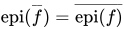
The usual set closure from topology is a closure operator. Other examples include the linear span of a subset of a vector space, the convex hull or affine hull of a subset of a vector space or the lower semicontinuous hull of a function , where is e.g. a normed space, defined implicitly , where is the epigraph of a function .


The relative interior is not a closure operator: although it is idempotent, it is not increasing and if is a cube in and is one of its faces, then , but and , so it is not increasing.[4]

In topology, the closure operators are topological closure operators, which must satisfy

for all (Note that for this gives ).

In algebra and logic, many closure operators are finitary closure operators, i.e. they satisfy

In the theory of partially ordered sets, which are important in theoretical computer science, closure operators have a more general definition that replaces with . (See § Closure operators on partially ordered sets.)

Closure operators in topology

[edit]

The topological closure of a subset X of a topological space consists of all points y of the space, such that every neighbourhood of y contains a point of X. The function that associates to every subset X its closure is a topological closure operator. Conversely, every topological closure operator on a set gives rise to a topological space whose closed sets are exactly the closed sets with respect to the closure operator.

Closure operators in algebra

[edit]

Finitary closure operators play a relatively prominent role in universal algebra, and in this context they are traditionally called algebraic closure operators. Every subset of an algebra generates a subalgebra: the smallest subalgebra containing the set. This gives rise to a finitary closure operator.

Perhaps the best known example for this is the function that associates to every subset of a given vector space its linear span. Similarly, the function that associates to every subset of a given group the subgroup generated by it, and similarly for fields and all other types of algebraic structures.

The linear span in a vector space and the similar algebraic closure in a field both satisfy the exchange property: If x is in the closure of the union of A and {y} but not in the closure of A, then y is in the closure of the union of A and {x}. A finitary closure operator with this property is called a matroid. The dimension of a vector space, or the transcendence degree of a field (over its prime field) is exactly the rank of the corresponding matroid.

The function that maps every subset of a given field to its algebraic closure is also a finitary closure operator, and in general it is different from the operator mentioned before. Finitary closure operators that generalize these two operators are studied in model theory as dcl (for definable closure) and acl (for algebraic closure).

The convex hull in n-dimensional Euclidean space is another example of a finitary closure operator. It satisfies the anti-exchange property: If x is in the closure of the union of {y} and A, but not in the union of {y} and closure of A, then y is not in the closure of the union of {x} and A. Finitary closure operators with this property give rise to antimatroids.

As another example of a closure operator used in algebra, if some algebra has universe A and X is a set of pairs of A, then the operator assigning to X the smallest congruence containing X is a finitary closure operator on A x A.[5]

Closure operators in logic

[edit]

Suppose you have some logical formalism that contains certain rules allowing you to derive new formulas from given ones. Consider the set F of all possible formulas, and let P be the power set of F, ordered by ⊆. For a set X of formulas, let cl(X) be the set of all formulas that can be derived from X. Then cl is a closure operator on P. More precisely, we can obtain cl as follows. Call "continuous" an operator J such that, for every directed class T,

J(lim T) = lim J(T).

This continuity condition is on the basis of a fixed point theorem for J. Consider the one-step operator J of a monotone logic. This is the operator associating any set X of formulas with the set J(X) of formulas that are either logical axioms or are obtained by an inference rule from formulas in X or are in X. Then such an operator is continuous and we can define cl(X) as the least fixed point for J greater or equal to X. In accordance with such a point of view, Tarski, Brown, Suszko and other authors proposed a general approach to logic based on closure operator theory. Also, such an idea is proposed in programming logic (see Lloyd 1987) and in fuzzy logic (see Gerla 2000).

Consequence operators

[edit]

Around 1930, Alfred Tarski developed an abstract theory of logical deductions that models some properties of logical calculi. Mathematically, what he described is just a finitary closure operator on a set (the set of sentences). In abstract algebraic logic, finitary closure operators are still studied under the name consequence operator, which was coined by Tarski. The set S represents a set of sentences, a subset T of S a theory, and cl(T) is the set of all sentences that follow from the theory. Nowadays the term can refer to closure operators that need not be finitary; finitary closure operators are then sometimes called finite consequence operators.

Closed sets

[edit]

The closed sets with respect to a closure operator on S form a subset C of the power set P(S). Any intersection of sets in C is again in C. In other words, C is a complete meet-subsemilattice of P(S). Conversely, if CP(S) is closed under arbitrary intersections, then the function that associates to every subset X of S the smallest set YC such that XY is a closure operator.

There is a simple and fast algorithm for generating all closed sets of a given closure operator.[6]

A closure operator on a set is topological if and only if the set of closed sets is closed under finite unions, i.e., C is a meet-complete sublattice of P(S). Even for non-topological closure operators, C can be seen as having the structure of a lattice. (The join of two sets X,YP(S) being cl(X Y).) But then C is not a sublattice of the lattice P(S).

Given a finitary closure operator on a set, the closures of finite sets are exactly the compact elements of the set C of closed sets. It follows that C is an algebraic poset. Since C is also a lattice, it is often referred to as an algebraic lattice in this context. Conversely, if C is an algebraic poset, then the closure operator is finitary.

Pseudo-closed sets

[edit]

Each closure operator on a finite set S is uniquely determined by its images of its pseudo-closed sets.[7] These are recursively defined: A set is pseudo-closed if it is not closed and contains the closure of each of its pseudo-closed proper subsets. Formally: P ⊆ S is pseudo-closed if and only if

  • P ≠ cl(P) and
  • if Q ⊂ P is pseudo-closed, then cl(Q) ⊆ P.

Closure operators on partially ordered sets

[edit]

A partially ordered set (poset) is a set together with a partial order ≤, i.e. a binary relation that is reflexive (aa), transitive (abc implies ac) and antisymmetric (aba implies a = b). Every power set P(S) together with inclusion ⊆ is a partially ordered set.

A function cl: PP from a partial order P to itself is called a closure operator if it satisfies the following axioms for all elements x, y in P.

x ≤ cl(x) (cl is extensive)
xy implies cl(x) ≤ cl(y)   (cl is increasing)
cl(cl(x)) = cl(x) (cl is idempotent)

More succinct alternatives are available: the definition above is equivalent to the single axiom

x ≤ cl(y) if and only if cl(x) ≤ cl(y)

for all x, y in P.

Using the pointwise order on functions between posets, one may alternatively write the extensiveness property as idP ≤ cl, where id is the identity function. A self-map k that is increasing and idempotent, but satisfies the dual of the extensiveness property, i.e. k ≤ idP is called a kernel operator,[8] interior operator,[9] or dual closure.[10] As examples, if A is a subset of a set B, then the self-map on the powerset of B given by μA(X) = AX is a closure operator, whereas λA(X) = AX is a kernel operator. The ceiling function from the real numbers to the real numbers, which assigns to every real x the smallest integer not smaller than x, is another example of a closure operator.

A fixpoint of the function cl, i.e. an element c of P that satisfies cl(c) = c, is called a closed element. A closure operator on a partially ordered set is determined by its closed elements. If c is a closed element, then xc and cl(x) ≤ c are equivalent conditions.

Every Galois connection (or residuated mapping) gives rise to a closure operator (as is explained in that article). In fact, every closure operator arises in this way from a suitable Galois connection.[11] The Galois connection is not uniquely determined by the closure operator. One Galois connection that gives rise to the closure operator cl can be described as follows: if A is the set of closed elements with respect to cl, then cl: PA is the lower adjoint of a Galois connection between P and A, with the upper adjoint being the embedding of A into P. Furthermore, every lower adjoint of an embedding of some subset into P is a closure operator. "Closure operators are lower adjoints of embeddings." Note however that not every embedding has a lower adjoint.

Any partially ordered set P can be viewed as a category, with a single morphism from x to y if and only if xy. The closure operators on the partially ordered set P are then nothing but the monads on the category P. Equivalently, a closure operator can be viewed as an endofunctor on the category of partially ordered sets that has the additional idempotent and extensive properties.

If P is a complete lattice, then a subset A of P is the set of closed elements for some closure operator on P if and only if A is a Moore family on P, i.e. the largest element of P is in A, and the infimum (meet) of any non-empty subset of A is again in A. Any such set A is itself a complete lattice with the order inherited from P (but the supremum (join) operation might differ from that of P). When P is the powerset Boolean algebra of a set X, then a Moore family on P is called a closure system on X.

The closure operators on P form themselves a complete lattice; the order on closure operators is defined by cl1 ≤ cl2 iff cl1(x) ≤ cl2(x) for all x in P.

See also

[edit]

Notes

[edit]

References

[edit]
[edit]
Revisions and contributorsEdit on WikipediaRead on Wikipedia
from Grokipedia
In mathematics, a closure operator on a set SS is a function cl:P(S)P(S)\mathrm{cl}: \mathcal{P}(S) \to \mathcal{P}(S) from the power set of SS to itself satisfying three key properties: extensivity (Acl(A)A \subseteq \mathrm{cl}(A) for all ASA \subseteq S), monotonicity (if ABA \subseteq B, then cl(A)cl(B)\mathrm{cl}(A) \subseteq \mathrm{cl}(B)), and idempotence (cl(cl(A))=cl(A)\mathrm{cl}(\mathrm{cl}(A)) = \mathrm{cl}(A)). The image cl(A)\mathrm{cl}(A) is called the closure of AA, and a subset CSC \subseteq S is closed if cl(C)=C\mathrm{cl}(C) = C. These properties ensure that the closure is the smallest closed set containing AA, providing a canonical way to "complete" subsets under the operator. The concept of a closure operator originated in the work of , who introduced it in 1910 as part of his foundational studies in general analysis, where it generalized notions of limits and completeness. In 1922, Kazimierz Kuratowski extended and specialized the idea by defining axioms for a closure operator in the context of , including additional requirements like cl()=\mathrm{cl}(\emptyset) = \emptyset and cl(AB)=cl(A)cl(B)\mathrm{cl}(A \cup B) = \mathrm{cl}(A) \cup \mathrm{cl}(B), which axiomatize the closure in topological spaces. This topological variant became a cornerstone for defining topologies via closed sets rather than open ones. Closure operators unify diverse mathematical structures across fields. In linear algebra, the span function serves as a closure operator on subspaces of a , yielding the smallest subspace containing a given set. In group theory, the generated by a acts similarly, producing the minimal containing it. Topological closures define closed sets in spaces like metric or Hausdorff topologies, enabling concepts such as and connectedness. In logic, closure operators model deductive closure, where formulas are closed under entailment rules. More abstractly, in and , they correspond to Moore families (intersection-closed collections) and idempotent monads, respectively, facilitating connections between lattices, posets, and categorical constructions. These applications highlight their role in abstracting "completion" processes, with extensions to fuzzy sets, rough sets, and computational models in .

Core Concepts

Definition

A closure operator on a set SS is a function cl:P(S)P(S)\mathrm{cl}: \mathcal{P}(S) \to \mathcal{P}(S), where P(S)\mathcal{P}(S) denotes the power set of SS, that satisfies the following three axioms for all subsets X,YSX, Y \subseteq S:
  • Extensivity: Xcl(X)X \subseteq \mathrm{cl}(X),
  • Monotonicity: if XYX \subseteq Y, then cl(X)cl(Y)\mathrm{cl}(X) \subseteq \mathrm{cl}(Y),
  • Idempotence: cl(cl(X))=cl(X)\mathrm{cl}(\mathrm{cl}(X)) = \mathrm{cl}(X).
These axioms ensure that cl(X)\mathrm{cl}(X) is the smallest closed set containing XX, where a is defined as a fixed point of the operator, i.e., a subset CSC \subseteq S such that cl(C)=C\mathrm{cl}(C) = C. To see this, suppose CC is closed and XCX \subseteq C; then monotonicity implies cl(X)cl(C)=C\mathrm{cl}(X) \subseteq \mathrm{cl}(C) = C, so cl(X)\mathrm{cl}(X) is contained in every closed set containing XX. Common notations for the closure operator include cl\mathrm{cl}, cc, or \overline{\cdot}, depending on the context. The collection of all closed sets forms the image of cl\mathrm{cl}.

Properties

A closure operator cl\mathrm{cl} on a set XX, satisfying extensivity (Acl(A)A \subseteq \mathrm{cl}(A)), monotonicity (if ABA \subseteq B, then cl(A)cl(B)\mathrm{cl}(A) \subseteq \mathrm{cl}(B)), and idempotence (cl(cl(A))=cl(A)\mathrm{cl}(\mathrm{cl}(A)) = \mathrm{cl}(A)), exhibits several derived properties. The closure cl()\mathrm{cl}(\emptyset) is the smallest closed set. For any closed set SS (i.e., a fixed point where cl(S)=S\mathrm{cl}(S) = S), applying the closure yields cl(S)=S\mathrm{cl}(S) = S. More broadly, every subset XXX \subseteq X satisfies Xcl(X)X \subseteq \mathrm{cl}(X) by extensivity, and XX is closed if and only if equality holds, meaning cl(X)=X\mathrm{cl}(X) = X. A fundamental structural trait is that cl(X)\mathrm{cl}(X) equals the of all s containing XX. This arises because the collection of closed sets forms a Moore family, closed under arbitrary intersections, ensuring the existence of a smallest closed set superset of XX. For unions, monotonicity implies cl(XY)cl(X)cl(Y)\mathrm{cl}(X \cup Y) \supseteq \mathrm{cl}(X) \cup \mathrm{cl}(Y) for any subsets X,YXX, Y \subseteq X. Equality holds under the , which augment the basic properties with additivity: cl(XY)=cl(X)cl(Y)\mathrm{cl}(X \cup Y) = \mathrm{cl}(X) \cup \mathrm{cl}(Y). These axioms further ensure finite additivity: cl(i=1nXi)=i=1ncl(Xi)\mathrm{cl}\left( \bigcup_{i=1}^n X_i \right) = \bigcup_{i=1}^n \mathrm{cl}(X_i) for any finite collection of subsets {Xi}i=1n\{X_i\}_{i=1}^n. However, for infinite unions, the inclusion cl(iIXi)iIcl(Xi)\mathrm{cl}\left( \bigcup_{i \in I} X_i \right) \supseteq \bigcup_{i \in I} \mathrm{cl}(X_i) holds, but equality does not necessarily obtain. Certain closure operators, such as those defining convex geometries, satisfy the anti-exchange : for a AA and distinct elements x,yAx, y \notin A, if xcl(A{y})x \in \mathrm{cl}(A \cup \{y\}), then ycl(A{x})y \notin \mathrm{cl}(A \cup \{x\}). This captures structural rigidity in the closure's behavior toward single-element extensions.

Closed Sets

In the context of a closure operator cl\mathrm{cl} defined on the power set of a set SS, a subset CSC \subseteq S is termed closed if it satisfies cl(C)=C\mathrm{cl}(C) = C. This fixed-point condition arises from the idempotence property of the closure operator, ensuring that applying cl\mathrm{cl} to a closed set yields itself unchanged. The collection of all closed sets under cl\mathrm{cl}, denoted C(S)\mathcal{C}(S), constitutes a closure system, also known as a Moore family, on SS. This family includes the entire set SS (since cl(S)=S\mathrm{cl}(S) = S) and the smallest closed set cl()\mathrm{cl}(\emptyset), and it is closed under arbitrary intersections. That is, for any {CiSiI}\{C_i \subseteq S \mid i \in I\} with each CiC(S)C_i \in \mathcal{C}(S), the intersection iICi\bigcap_{i \in I} C_i is also in C(S)\mathcal{C}(S). These axioms—containment of SS and closure under intersections—fully characterize a Moore family. A key structural property of closed sets is that the closure of any ASA \subseteq S can be expressed as the of all closed sets containing AA: cl(A)={CC(S)AC}\mathrm{cl}(A) = \bigcap \{ C \in \mathcal{C}(S) \mid A \subseteq C \}. This representation underscores the deductive nature of closure systems, where closed sets act as the "generators" of the operator via their intersections. The family C(S)\mathcal{C}(S) is thus stable under such operations, preserving the closure . Under the inclusion order \subseteq, the poset of closed sets C(S)\mathcal{C}(S) forms a . Here, the meet (greatest lower bound) of any collection of closed sets is their , which remains closed, while the join (least upper bound) is the closure of their union, cl(Ci)\mathrm{cl}\left( \bigcup C_i \right), ensuring completeness with SS as the top element and cl()\mathrm{cl}(\emptyset) as the bottom. This lattice structure highlights the algebraic coherence of closure systems.

Historical Background

Early Developments

The foundational ideas underlying closure operators emerged in the late through developments in and , particularly Georg 's work on point sets and limits. In the 1870s, introduced the concept of derived sets, defined as the set of limit points of a given set on the real line, which captured the accumulation points essential for understanding convergence and continuity. This notion evolved by 1884, when defined a as one containing all its limit points, laying groundwork for closure as the smallest set encompassing a given set and its derived points. Influences from further shaped early closure concepts, notably through Richard Dedekind's 1872 construction of real numbers via cuts, where each cut partitions into a lower set closed downward and an , ensuring the for bounded sets. Complementing this, Ernst Schröder's 1890s investigations in , particularly in his Vorlesungen über die Algebra der Logik (1890–1905), explored closure under operations in lattice structures, treating groups and related systems as closed collections of elements generated by syntactic rules. Early 20th-century advancements in analysis built on these ideas, with Frigyes Riesz's 1909 paper addressing point-set topology by proposing a metric-free framework for limits and neighborhoods, emphasizing topological closure systems without reliance on distance. In 1910, E.H. Moore formalized closure operators in his Introduction to a Form of General Analysis, applying them to metric spaces to generalize limits and integrals beyond sequences. These efforts culminated in the 1922 Moore-Smith theory of limits, which extended convergence to directed sets, providing a broader generalization that influenced the abstract closure operators of modern mathematics.

Formalization and Key Contributions

The formalization of closure operators as abstract mathematical objects began in the early 1920s with Kazimierz Kuratowski's axiomatization in the context of . In his 1922 paper, Kuratowski introduced a set of four axioms for a closure operation on the power set of a space—extensivity (cl(A)Acl(A) \supseteq A), (cl(cl(A))=cl(A)cl(cl(A)) = cl(A)), preservation of (cl()=cl(\emptyset) = \emptyset), and additivity (cl(AB)=cl(A)cl(B)cl(A \cup B) = cl(A) \cup cl(B) for all A,BA, B)—which characterize the closure operator of any . This framework abstracted the closure concept beyond metric or Euclidean spaces, enabling the definition of general topological structures solely in terms of closure, and laid the groundwork for extending closure operators to arbitrary posets and lattices. Building on this topological foundation, advanced the abstract theory in the 1930s through his work on deductive systems and . In publications such as his 1935 monograph Der Wahrheitsbegriff in den formalisierten Sprachen, Tarski formalized consequence operators as closure operators satisfying monotonicity, extensivity, and , where the closure of a set of yields all derivable theorems. This linked closure operators to logic, portraying deductive closure as the smallest set containing the and closed under rules, thus unifying syntactic and semantic aspects of formal systems. Post-World War II developments further integrated closure operators into algebraic frameworks, notably through Garrett Birkhoff's lattice theory. In the revised 1948 edition of Lattice Theory, Birkhoff examined closure operators on lattices as monotone, extensive, and idempotent maps, using them to represent ideals, filters, and , which facilitated the study of algebraic closures in structures like fields and rings. This integration highlighted closure operators' role in decomposing lattices and motivated their application to , where they model subalgebra generation. By the 1950s, closure operators achieved key milestones in , recognized as finitary (or algebraic) operators that close under finite applications of operations, enabling the classification of varieties via closed congruences and subalgebras. Kuratowski's axiomatization profoundly influenced the Polish school of , where his leadership in the Polish mathematical community and collaborations advanced abstract closure theory through works on metric and spaces.

Illustrative Examples

Basic Examples

One of the simplest examples of a closure operator is the identity operator on the power set of a set SS, defined by cl(X)=X\mathrm{cl}(X) = X for every XSX \subseteq S. This operator is extensive since XXX \subseteq X, idempotent as applying it twice yields the same result, and monotone because subset inclusion is preserved. Another trivial closure operator maps every to the full set, cl(X)=S\mathrm{cl}(X) = S for all XSX \subseteq S. It satisfies extensivity (XSX \subseteq S), (cl(S)=S\mathrm{cl}(S) = S), and monotonicity (if XYX \subseteq Y, then SSS \subseteq S). These examples illustrate the boundary cases of closure operators on the power set lattice, fulfilling the standard axioms of extensivity, , and monotonicity. In the context of binary relations on a set XX, the reflexive closure of a relation RX×XR \subseteq X \times X is the smallest containing RR, obtained by adding the diagonal relation (identity pairs) to RR, i.e., cl(R)=R{(x,x)xX}\mathrm{cl}(R) = R \cup \{(x,x) \mid x \in X\}./06%3A_Relations/6.05%3A_Closure_Operations_on_Relations) This operation ensures reflexivity while minimally extending RR, and it forms a closure operator on the lattice of relations ordered by inclusion. The transitive closure of a relation RR is the smallest containing RR, given explicitly by cl(R)=n=1Rn,\mathrm{cl}(R) = \bigcup_{n=1}^\infty R^n, where RnR^n denotes the nn-fold composition of RR with itself./06%3A_Relations/6.05%3A_Closure_Operations_on_Relations) For instance, if R={(1,2),(2,3)}R = \{(1,2), (2,3)\} on {1,2,3}\{1,2,3\}, then R2={(1,3)}R^2 = \{(1,3)\}, and cl(R)={(1,2),(2,3),(1,3)}\mathrm{cl}(R) = \{(1,2), (2,3), (1,3)\}, which is transitive. In a partially ordered set (poset) (P,)(P, \leq), the upset closure (or principal filter operator) of an element xPx \in P is the set x={yPxy}\uparrow x = \{y \in P \mid x \leq y\}. This defines a closure operator on PP, as (x)=x\uparrow (\uparrow x) = \uparrow x, xzx \leq z implies xz\uparrow x \subseteq \uparrow z, and xxx \in \uparrow x. For a concrete computation, consider the poset of natural numbers under divisibility, where 242 \mid 4 and 262 \mid 6 but 464 \nmid 6. The upset closure of {2}\{2\} is all even natural numbers greater than or equal to 2, i.e., {2,4,6,8,}\{2,4,6,8,\dots\}. Extending to subsets, the closure of a subset AA is aAa\bigcup_{a \in A} \uparrow a.

Examples in Linear and Convex Structures

In vector spaces over a field KK, the of a VV of vectors is defined as the smallest subspace containing VV, consisting of all finite linear combinations span(V)={λiviλiK,viV}\operatorname{span}(V) = \left\{ \sum \lambda_i v_i \mid \lambda_i \in K, v_i \in V \right\}. This operation forms a closure operator on the power set of the , satisfying extensivity (Vspan(V)V \subseteq \operatorname{span}(V)), (span(span(V))=span(V)\operatorname{span}(\operatorname{span}(V)) = \operatorname{span}(V)), and monotonicity (if VWV \subseteq W, then span(V)span(W)\operatorname{span}(V) \subseteq \operatorname{span}(W)). The monotonicity property ensures that adding more vectors to VV can only enlarge or maintain the span. In Rn\mathbb{R}^n, the of a set XX of points is the smallest containing XX, expressed as conv(X)={λixiλi0,λi=1,xiX}\operatorname{conv}(X) = \left\{ \sum \lambda_i x_i \mid \lambda_i \geq 0, \sum \lambda_i = 1, x_i \in X \right\} using finite convex combinations. This hull operator acts as a closure on the family of subsets of Rn\mathbb{R}^n, preserving the closure properties while ensuring the result is convex, meaning any between points in conv(X)\operatorname{conv}(X) lies entirely within it. The affine hull of a set XRnX \subseteq \mathbb{R}^n is the smallest affine subspace containing XX, which can be viewed as a translate of the linear span of the differences xx0x - x_0 for a fixed x0Xx_0 \in X. As a closure operator, it shares the standard properties with the linear and convex hulls, and the convex hull of XX is always a convex subset of the affine hull of XX, highlighting their structural relationship through translation invariance in affine geometry. For instance, in the Euclidean plane R2\mathbb{R}^2, the convex hull of the three vertices of a triangle forms the filled triangular region itself, which is a convex polygon bounded by the line segments connecting the vertices.

Applications in Mathematics

In Topology

In topology, the closure operator provides a fundamental way to characterize topological spaces through the concept of topological closure. For a subset XX of a topological space (S,τ)(S, \tau), the topological closure cl(X)\mathrm{cl}(X) is defined as the set of all points pSp \in S such that every open neighborhood of pp intersects XX. Equivalently, cl(X)\mathrm{cl}(X) is the smallest closed set containing XX, formed as the intersection of all closed sets that contain XX. This operator satisfies the Kuratowski closure axioms, which are: (1) cl()=\mathrm{cl}(\emptyset) = \emptyset; (2) Xcl(X)X \subseteq \mathrm{cl}(X) for every XSX \subseteq S; (3) cl(cl(X))=cl(X)\mathrm{cl}(\mathrm{cl}(X)) = \mathrm{cl}(X) for every XSX \subseteq S; and (4) cl(XY)=cl(X)cl(Y)\mathrm{cl}(X \cup Y) = \mathrm{cl}(X) \cup \mathrm{cl}(Y) for every X,YSX, Y \subseteq S. These axioms ensure idempotence, extensivity, and additivity under binary unions, with the first axiom preserving the empty set. A closure operator satisfying the Kuratowski axioms uniquely determines a on SS, where the closed sets are precisely those subsets equal to their own closure, and the open sets are their complements. Conversely, every induces such a closure operator. One equivalent is cl(X)=XX\mathrm{cl}(X) = X \cup X', where XX' is the derived set of limit points of XX. The operator preserves finite unions by repeated application of the additivity but does not necessarily preserve arbitrary infinite unions; for instance, cl(iIXi)iIcl(Xi)\mathrm{cl}(\bigcup_{i \in I} X_i) \supseteq \bigcup_{i \in I} \mathrm{cl}(X_i), with equality holding in some spaces but not others. Illustrative examples highlight these properties. In the indiscrete topology on a nonempty set SS, the only closed sets are \emptyset and SS, so cl(X)=S\mathrm{cl}(X) = S for any nonempty XSX \subseteq S and cl()=\mathrm{cl}(\emptyset) = \emptyset; finite unions of closed sets remain closed, but the topology lacks separation. In contrast, the discrete topology renders every closed, yielding cl(X)=X\mathrm{cl}(X) = X for all XSX \subseteq S, preserving both finite and infinite unions trivially. Closure operators also play a key role in separation axioms, which measure the ability of a to distinguish points or sets. A is T0T_0 (Kolmogorov) if for distinct points p,qSp, q \in S, either pcl({q})p \in \mathrm{cl}(\{q\}) or qcl({p})q \in \mathrm{cl}(\{p\}). It is T1T_1 (Fréchet) if and only if cl({p})={p}\mathrm{cl}(\{p\}) = \{p\} for every pSp \in S, meaning singletons are closed. For Hausdorff (T2T_2) spaces, the closures of distinct singletons are disjoint: if pqp \neq q, then cl({p})cl({q})=\mathrm{cl}(\{p\}) \cap \mathrm{cl}(\{q\}) = \emptyset. These conditions leverage the closure to ensure points can be separated by open sets, with stronger axioms like regularity and normality extending the framework to closed sets.

In Algebra

In algebraic structures, a closure operator assigns to each XX of the carrier set the smallest containing XX, known as the subalgebra generated by XX. This generated subalgebra is obtained by iteratively applying the finitary operations of the to elements of XX and constants until no new elements are produced. A concrete example arises in group theory, where the closure of a SS of a group GG is the generated by SS, consisting of all finite products of elements from SS1S \cup S^{-1} (where S1S^{-1} denotes the set of inverses). This subgroup is the of all subgroups of GG containing SS, and it satisfies the closure operator axioms of extensivity, monotonicity, and . In , such closures extend to varieties of algebras, where the generated subalgebra preserves the identities defining the variety. Finitary closure operators are central in , as the operations defining an algebra have finite . For such an operator cl\mathrm{cl}, the closure cl(X)\mathrm{cl}(X) of a XX equals the union over all finite YXY \subseteq X of cl(Y)\mathrm{cl}(Y). This finitary property implies that the lattice of closed sets (subalgebras) is an algebraic lattice, where every element is the join of compact elements corresponding to finitely generated subalgebras. Matroids formalize dependence relations analogous to , with a closure operator cl\mathrm{cl} on a finite ground set EE defined such that cl(A)={xEr(A{x})=r(A)}\mathrm{cl}(A) = \{ x \in E \mid r(A \cup \{x\}) = r(A) \}, where rr is the rank function measuring the size of a maximal independent subset of AA. This closure captures the "span" in the , and the closed sets () form the geometric structure of the . Antimatroids, as convex geometries dual to matroids, feature a closure operator on the family of feasible sets, emphasizing convexity rather than linear dependence. In field extensions, closure operators appear in the context of algebraic extensions. For a field KK, the algebraic closure K\overline{K} is the smallest algebraically closed field containing KK, obtained as the union of all finite algebraic extensions of KK. Specifically, the algebraic closure of the rationals Q\mathbb{Q} is the field Q\overline{\mathbb{Q}} of algebraic numbers, comprising all complex numbers that are roots of non-constant polynomials with rational coefficients; this is an algebraic extension of infinite degree over Q\mathbb{Q}, and every non-constant polynomial over Q\overline{\mathbb{Q}} splits completely in it. As a special case, the linear span in a vector space provides a finitary closure operator, where the closure of a set of vectors is the subspace they generate.

In Logic

In logic, closure operators model the process of logical deduction by associating to each set of premises the set of all formulas derivable from them. A consequence operator CnCn is a function Cn:P(L)P(L)Cn: \mathcal{P}(L) \to \mathcal{P}(L), where LL is the set of formulas of a formal language and P(L)\mathcal{P}(L) is its power set, such that Cn(Γ)Cn(\Gamma) denotes the set of all theorems logically implied by the premises in Γ\Gamma. Alfred Tarski characterized such operators in 1930 as satisfying three key properties: extensivity (ΓCn(Γ)\Gamma \subseteq Cn(\Gamma)), monotonicity (if ΓΔ\Gamma \subseteq \Delta, then Cn(Γ)Cn(Δ)Cn(\Gamma) \subseteq Cn(\Delta)), and (Cn(Cn(Γ))=Cn(Γ)Cn(Cn(\Gamma)) = Cn(\Gamma)). For finitary logics, where deductions rely on finitely many premises, Tarski further introduced the finite character property: a ϕ\phi belongs to Cn(Γ)Cn(\Gamma) if and only if there exists a finite FΓF \subseteq \Gamma such that ϕCn(F)\phi \in Cn(F). These properties ensure that the operator captures the essential structure of in formal systems. The fixed points of a consequence operator—sets Θ\Theta such that Cn(Θ)=ΘCn(\Theta) = \Theta—correspond to deductively closed sets, including consistent theories and the set of all theorems Cn()Cn(\emptyset). In deductive systems, soundness means that every syntactically provable formula is semantically valid (the syntactic closure is contained in the semantic closure), while completeness means the converse holds (the closures coincide). These properties are verified by showing that the operator induced by the system's axioms and rules matches the model-theoretic notion of logical consequence. A representative example is classical propositional logic, where the closure operator is defined by a set of axioms (such as all tautologies or a finite axiomatization like (p(qp))(p \to (q \to p)), ((p(qr))((pq)(pr)))((p \to (q \to r)) \to ((p \to q) \to (p \to r))), and ((¬p¬q)(qp))(( \neg p \to \neg q) \to (q \to p))) together with the rule: from ϕ\phi and ϕψ\phi \to \psi, infer ψ\psi. The closure Cn()Cn(\emptyset) then yields precisely the set of propositional tautologies, illustrating how the operator generates the full deductive content from basic principles.

In Order Theory

In order theory, a closure operator on a (poset) (P,)(P, \leq) is defined as a function cl:PP\mathrm{cl}: P \to P that is order-preserving (monotonic), extensive (xcl(x)x \leq \mathrm{cl}(x) for all xPx \in P), and idempotent (cl(cl(x))=cl(x)\mathrm{cl}(\mathrm{cl}(x)) = \mathrm{cl}(x) for all xPx \in P). The fixed points of cl\mathrm{cl}, i.e., elements xx such that cl(x)=x\mathrm{cl}(x) = x, form the closed elements of the poset and are themselves a subposet. These operators generalize the notion of closing elements under order relations, preserving the partial order while expanding elements to their "minimal enclosing" forms. Examples of closure operators arise from the structure of principal ideals and filters in posets, often via upset and operators defined on the power set P(P)\mathcal{P}(P). The operator :P(P)P(P)\downarrow: \mathcal{P}(P) \to \mathcal{P}(P), given by Y={zPyY,zy}\downarrow Y = \{ z \in P \mid \exists y \in Y, z \leq y \}, is a closure operator whose closed sets are the downsets (ideals), and principal downsets {x}={zPzx}\downarrow \{x\} = \{ z \in P \mid z \leq x \} generate the basic building blocks. Dually, the upset operator :P(P)P(P)\uparrow: \mathcal{P}(P) \to \mathcal{P}(P), defined by Y={zPyY,yz}\uparrow Y = \{ z \in P \mid \exists y \in Y, y \leq z \}, yields closed sets that are upsets (filters), with principal upsets {x}={zPxz}\uparrow \{x\} = \{ z \in P \mid x \leq z \} serving as the fundamental examples. These operators are finitary, meaning the closure of any set is the union of closures of its finite subsets, and they highlight how order-theoretic closures connect to deductive and inductive limits in posets. Closure operators on posets are intimately linked to Galois connections, which are pairs of monotone functions (f:PQ,g:QP)(f: P \to Q, g: Q \to P) between posets (P,)(P, \leq) and (Q,)(Q, \leq) satisfying f(x)yf(x) \leq y if and only if xg(y)x \leq g(y) for all xPx \in P, yQy \in Q. Such connections induce closure operators: the composition gf:PPg \circ f: P \to P is extensive, monotone, and idempotent, with fixed points corresponding to the image of ff. A canonical example occurs with binary relations RP×QR \subseteq P \times Q, where the lower maps subsets to their "implied" upper sets and the upper to lower sets, generating closures whose fixed points are the closed sets under the relation. The Dedekind-MacNeille completion provides a key application, embedding any poset (P,)(P, \leq) into a via closure operators on P(P)\mathcal{P}(P). Define the lower closure cl(X)={yPyz for all zXu}\mathrm{cl}_\downarrow(X) = \{ y \in P \mid y \leq z \text{ for all } z \in X^u \}, where XuX^u is the set of upper bounds of XX, and the upper closure cl(X)={yPyz for all zXd}\mathrm{cl}_\uparrow(X) = \{ y \in P \mid y \geq z \text{ for all } z \in X^d \}, with XdX^d the set of lower bounds; the composition clcl\mathrm{cl}_\uparrow \circ \mathrm{cl}_\downarrow (or dually) is a closure operator whose fixed points form the cuts of the completion. This construction yields the smallest containing PP as a join- and meet-dense sublattice, preserving all existing suprema and infima of PP.

Extensions and Variants

Pseudo-closed Sets

In the theory of closure operators, particularly within formal concept analysis, a pseudo-closed set (also known as a pseudo-intent) for a closure operator cc on a set EE is defined as a subset PEP \subseteq E such that Pc(P)P \neq c(P) and for every proper pseudo-closed subset QPQ \subset P, it holds that c(Q)Pc(Q) \subseteq P. This recursive definition identifies sets that are not fixed points under the closure but serve as minimal generators influencing the overall closure structure. Unlike standard closed sets, where c(P)=Pc(P) = P, pseudo-closed sets relax this equality to capture intermediate structures essential for deriving implications. Pseudo-closed sets relate to closure operators in contexts like approximate reasoning and error-tolerant systems, where exact fixed points may be computationally expensive or unavailable due to noisy data. In applied to databases, they form the basis for minimal implication sets (e.g., the Duquenne-Guigues basis), allowing efficient reconstruction of all closed sets from partial or approximate attribute relations without enumerating every possible subset. This approach supports error-tolerant knowledge discovery, as the basis remains valid even if minor inconsistencies arise in the input , enabling robust approximations of the full closure system. Key properties of pseudo-closed sets include their role in forming non-redundant implicational bases: the implications Pc(P)PP \to c(P) \setminus P for all pseudo-closed PP generate exactly the closed sets, and the collection of pseudo-closed sets together with closed sets constitutes a . They are not necessarily , as c(P)Pc(P) \neq P, but satisfy closure containment for subordinate pseudo-closed subsets, ensuring minimality. In approximate , extensions to fuzzy or rough set frameworks use pseudo-closed sets to model vague boundaries, where standard closed sets (fixed points) represent stricter topological closures. For instance, in a formal with objects as points and attributes as open covers, a pseudo-closed set like {a,b}\{a, b\} might imply additional attributes under noisy relations, approximating topological closures without full . To compute pseudo-closed sets, algorithms traverse the lattice of subsets, starting from non-closed candidates and iteratively checking the containment condition via -based closure applications. This iterative process—refining candidates by intersecting with closures of subsets—facilitates efficient in database applications, avoiding exhaustive search over 2E2^{|E|} subsets.

Finitary Closure Operators

A finitary closure operator on a set SS, also termed an algebraic closure operator in the context of , is a closure operator cl\mathrm{cl} satisfying the that for every XSX \subseteq S, cl(X)={cl(Y)YX,Y<}.\mathrm{cl}(X) = \bigcup \{ \mathrm{cl}(Y) \mid Y \subseteq X, |Y| < \infty \}. This condition ensures that the closure of any set is generated by iteratively applying the operator to its finite subsets, making the operator computationally tractable in settings where finite approximations suffice. Equivalently, finitary closure operators possess the finite character : a ZSZ \subseteq S is closed (i.e., cl(Z)=Z\mathrm{cl}(Z) = Z) cl(F)Z\mathrm{cl}(F) \subseteq Z for every finite FZF \subseteq Z. This implies that membership in closed sets can be determined by examining only finite portions of the input, which underpins many finiteness results in . The finite character property has profound implications in logic, particularly for compactness theorems. For instance, the consistency of a in has finite character, as inconsistency arises from finite subsets of axioms; Lindenbaum's lemma then guarantees that every consistent extends to a maximally consistent one, facilitating the construction of models via the completeness theorem. In algebra, Noetherian rings exemplify this through their ideal structure: a is Noetherian if every ideal is finitely generated, meaning the closure operator assigning to a subset its generated ideal is finitary, ensuring the ascending condition on ideals. Representative examples illustrate the utility of finitary closures. In group theory, the generated by a XX of a group GG is the smallest containing XX, obtained by closing XX under finite products and inverses—a process that yields a finitary closure, as the generated is the union of closures of finite of XX. Similarly, in , the Herbrand universe for a with function symbols is the finitary closure of the constant symbols under finite applications of those functions, forming the domain for Herbrand interpretations and enabling resolution-based theorem proving. Finitary closure operators often preserve unions of directed families of closed sets under inclusion. Specifically, if {CiiI}\{C_i \mid i \in I\} is a directed family of closed sets (i.e., for any i,jIi, j \in I, there exists kIk \in I with CiCjCkC_i \cup C_j \subseteq C_k), then their union iICi\bigcup_{i \in I} C_i is closed, because any finite of the union lies within some single CkC_k, which is closed. This preservation facilitates inductive constructions in algebraic settings, such as building free structures or varieties.

Modern Applications

In Computer Science

In , closure operators find significant applications in and knowledge representation, particularly through (FCA). Introduced by Rudolf Wille in the , FCA employs closure operators to derive concept lattices from formal contexts, which consist of objects and attributes. Specifically, the derivation operators ↑ (object intent) and ↓ (attribute extent) form a , and their composition yields closure operators that generate formal concepts as fixed points, enabling hierarchical structuring of data for knowledge discovery and visualization. This approach has been widely adopted for tasks like ontology building and pattern mining, where the closure ensures idempotent and monotone expansion of attribute sets to their conceptual extents. In , closure operators underpin the inference of functional dependencies (FDs) and ensure the closure properties of query languages. The attribute closure of a set of attributes X under a set of FDs F, denoted X⁺, is computed using Armstrong's axioms—reflexivity, augmentation, and transitivity—which provide a sound and complete set of inference rules for deriving all implied FDs. This closure operator identifies candidate keys and supports normalization to eliminate redundancies, as seen in design. Additionally, exhibits closure under its operations (selection, projection, join, etc.), meaning the result of any expression remains a relation, facilitating compositional query processing without type mismatches. Data mining leverages closure operators for pattern extraction in geometric and graph-based settings. In clustering, serve as closure operators in Euclidean spaces, defining the smallest containing a point cluster; algorithms like the clustering-based (CBCH) use this to prune support vectors in SVM training, reducing computational overhead while preserving decision boundaries. For graph databases, computes all reachable pairs in directed graphs, enabling path queries in systems like or ; efficient algorithms, such as seminaive evaluation, iteratively apply this closure to handle large-scale relationship mining, with applications in and recommendation systems. Recent advancements post-2020 integrate closure operators into for enhanced interpretability and . In , closure operators model monotonic preferences over feature subsets, allowing tractable of minimal closed sets for , as demonstrated in frameworks that reduce from exponential to time for specific operator classes. For , extensions of FCA construct hierarchical concept models to rank attributes by , improving model sparsity and explainability in high-dimensional data; for instance, entropy-based reduction in fuzzy FCA contexts selects discriminative features while preserving conceptual hierarchies. These methods address interpretability by revealing closed implications in feature dependencies, aiding post-hoc in black-box models like neural networks. More recent works as of 2025 explore closure operators in scientific for modeling closures in multiscale systems, combining physics-based and data-driven approaches to simulate complex phenomena. Additionally, in graph algorithms, closure operators facilitate the exploration of minimal a,b-separators, aiding efficient in network . Emerging applications include closure-free in two-level , enabling efficient monad implementations without runtime overhead (2024), and supra soft sd-closure operators for soft topological spaces in accuracy measures (2025).

In Category Theory

In , closure operators generalize to idempotent monads on a category C\mathcal{C}, where an endofunctor T:CCT: \mathcal{C} \to \mathcal{C} equipped with natural transformations μ:T2T\mu: T^2 \to T and η:IdCT\eta: \mathrm{Id}_\mathcal{C} \to T satisfies the monad axioms, and idempotence requires μ\mu to be a natural , ensuring TTTT \circ T \cong T. This structure categorifies the classical properties of closure operators—extensivity (xT(x)x \leq T(x)), monotonicity, and —by encoding reflective subcategories, where the Eilenberg-Moore category of TT-algebras forms a reflective subcategory of C\mathcal{C} via the free-forgetful adjunction induced by the monad. For instance, on the category Set\mathbf{Set}, the powerset monad P\mathcal{P}^*, with ηX(x)={x}\eta_X(x) = \{x\} and μX(U)=U\mu_X(\mathcal{U}) = \bigcup \mathcal{U} for UP(P(X))\mathcal{U} \in \mathcal{P}(\mathcal{P}(X)), yields a closure operator where algebras are complete join-semilattices, reflecting closure under unions. Galois connections extend categorically through adjunctions, where a pair of functors L:CR:DL: \mathcal{C} \dashv R: \mathcal{D} induces closure-like operations via the unit η:IdCRL\eta: \mathrm{Id}_\mathcal{C} \to R L and counit ϵ:LRIdD\epsilon: L R \to \mathrm{Id}_\mathcal{D}, with the composite RLR L acting as an idempotent comonad on C\mathcal{C} and LRL R as an idempotent monad on D\mathcal{D}, generalizing the order-theoretic Galois connection between posets as a special case of such adjunctions. This framework appears in four progressive levels: classical Galois connections between posets, concrete versions preserving underlying sets, and higher Galois adjunctions that fully integrate categorical structure to produce closure functors. In algebraic contexts, the free-forgetful adjunction between Set\mathbf{Set} and the category of algebras for a finitary monad (e.g., groups via the free group functor FUF \dashv U) yields the monad UFU F, whose algebras are precisely the closed elements under the induced closure, such as free generations in varieties of algebras. In toposes, closure operators manifest as universal operations on subobject lattices, where for an object XX in a topos E\mathcal{E}, a closure c:Sub(X)Sub(X)c: \mathrm{Sub}(X) \to \mathrm{Sub}(X) preserves pullbacks along morphisms and is induced by a reflector of a reflective subcategory, such as sheaves over a site. These are represented by Lawvere-Tierney topologies, monads j:ΩΩj: \Omega \to \Omega on the subobject classifier Ω\Omega that commute with inverse images, yielding the closed subobjects as the locale of points or the étale topos. For example, in the topos of sets, the subobject lattice Sub(X)P(X)\mathrm{Sub}(X) \cong \mathcal{P}(X) admits the standard powerset closure, while in sheaf toposes, dense subobjects under the regular-epimorphisms closure form the basis for geometric morphisms. Post-2020 developments integrate closure operators into theory and . In quantale-enriched categories over a V\mathbf{V}, a closure operator arises from the enrichment structure, preserving weighted limits and enabling notions for functors, as in quantitative Hennessy-Milner theorems where LL-dense subcategories characterize logical expressiveness via closures like codirected infima. In , Čech closure spaces—sets equipped with extensive, monotone operators forming a category Cl\mathbf{Cl}—support a unified for discrete and continuous structures, including on point clouds and graphs, with a Seifert-van Kampen theorem computing fundamental groups for circles and wedges under varying closures. Subsequent advances as of 2025 include studies on localic separation via closure operators in locales, establishing dualities between closedness and fittedness (2024), and E-unitary inverse monoids with closure operators on group congruences, linking algebraic and categorical structures (2024).

References

Add your contribution
Related Hubs
User Avatar
No comments yet.