


Community hub
Recent from talks
Contribute something
Nothing was collected or created yet.
Knight of Kerry
View on Wikipedia | This article includes a list of general references, but it lacks sufficient corresponding inline citations. (May 2017) |

Knight of Kerry (Irish: Ridire Chiarraí[1]), also called The Green Knight, is one of three Hiberno-Norman hereditary knighthoods, all of which existed in Ireland since feudal times. The other two were The White Knight (surname fixed as Fitzgibbon), being dormant since the 19th century, and the Knight of Glin (The Black Knight), dormant since 2011. All three belong to the FitzMaurice/FitzGerald dynasty, commonly known as the Geraldines, being created by the Earls of Desmond for their kinsmen.
Sir Maurice Buidhe FitzJohn, 1st Knight of Kerry, was the illegitimate son of John FitzGerald, 1st Baron Desmond (d. 1261 Battle of Callann), son of Thomas FitzMaurice, Lord OConnello, son of Maurice FitzGerald, Lord of Lanstephan, son of the Princess Nest ferch Rhys of Deheubarth and Gerald de Windsor.
Knights of Kerry
[edit]- Sir Maurice Buidhe FitzJohn, 1st Knight of Kerry
- Sir Richard FitzMaurice, 2nd Knight of Kerry
- Sir Maurice FitzRichard, 3rd Knight of Kerry (married Margaret de Courcy in 1382)
- Sir Edmond FitzMaurice, 4th Knight of Kerry
- Sir Nicholas FitzMaurice, 5th Knight of Kerry (held the office of Bishop of Ardfert circa 1408)
- Sir John Caoch FitzNicholas, 6th Knight of Kerry (fl. 1470s)
- Sir Maurice FitzJohn, 7th Knight of Kerry
- Sir John FitzMaurice, 8th Knight of Kerry (appointed Bishop of Ardfert on 20 November 1495)
- Sir William FitzJohn, 9th Knight of Kerry
- Sir John FitzGerald, 10th Knight of Kerry (d. 7 September 1595)
- Sir William FitzGerald, 11th Knight of Kerry (d. 6 November 1640)
- Sir John FitzGerald, 12th Knight of Kerry
- Sir John FitzGerald, 13th Knight of Kerry
- Sir Maurice FitzGerald, 14th Knight of Kerry
- Sir John FitzGerald, 15th Knight of Kerry (1706–1741)
- Sir Maurice FitzGerald, 16th Knight of Kerry (c. 1734–1779)
- Sir Robert FitzGerald, 17th Knight of Kerry (1717–1781)
- Sir Maurice FitzGerald, 18th Knight of Kerry (1774–1849)
- Sir Peter George FitzGerald, 1st Baronet of Valentia, 19th Knight of Kerry (1808–1880)
- Sir Maurice Fitzgerald, 2nd Baronet of Valentia, 20th Knight of Kerry (1844–1916)
- Sir John Peter Gerald Maurice Fitzgerald, 3rd Baronet of Valentia, 21st Knight of Kerry (1884–1957)
- Sir Arthur Henry Brinsley Fitzgerald, 4th Baronet of Valentia, 22nd Knight of Kerry (1885–1967)
- Sir George Peter Maurice FitzGerald, 5th Baronet of Valentia, 23rd Knight of Kerry (1917–2001)
- Sir Adrian James Andrew Denis FitzGerald, 6th Baronet of Valentia, 24th Knight of Kerry (born 1940)
See also
[edit]
References
[edit]- (List of Knights). PUBLIC RECORD OFFICE of NORTHERN IRELAND. The FitzGerald (Knights of Kerry) Papers (MIC/639 and T/3075).
- (Other Knighthoods). BURKE'S PEERAGE & GENTRY'S A TO Z GUIDE .
Knight of Kerry
View on GrokipediaOrigins and Early History
Creation of the Title
The Knight of Kerry is one of three unique hereditary Hiberno-Norman knighthoods that originated in medieval Ireland and endured as non-peerage titles, distinguishing them from the formal nobility of the British peerage system. Alongside the Knight of Kerry, known as the Green Knight, were the White Knight (associated with the FitzGibbon branch of the FitzGeralds) and the Knight of Glin (or Black Knight, linked to another FitzGerald cadet line). These titles emerged from the feudal arrangements of the Anglo-Norman invasion and settlement, granting military and territorial privileges within the lordships of southern Ireland without elevation to baronial or higher ranks.[1] The title was founded by Sir Maurice Buidhe FitzJohn, an illegitimate son of John FitzThomas FitzGerald, 1st Baron Desmond, who was slain at the Battle of Callann in 1261 during conflicts with native Irish forces in County Kerry. Knighted around 1330–1345, possibly by Edward III after the Battle of Halidon Hill or by virtue of his father's status, Maurice (d. c. 1346) served as the 1st Knight of Kerry and marked the establishment of a distinct cadet branch focused on Kerry territories. As a member of the powerful FitzGerald dynasty, which played a central role in consolidating Anglo-Norman control over Munster, his elevation established the title. The title's Irish name is Ridire Chiarraí, reflecting its regional ties, while its nickname "The Green Knight" derives from the green mantle worn in ceremonial dress.[3][9][1] In the broader feudal context of 13th-century Ireland, the Knight of Kerry was created as a knight banneret, a rank allowing the holder to lead troops independently under a personal banner while serving the overlords of the Earls of Desmond. This status was not conferred by a royal patent but arose through prescriptive right—long-standing custom and possession of lands in County Kerry—solidifying the title's transmission through male primogeniture within the FitzGerald sept. Such arrangements underscored the decentralized nature of Hiberno-Norman governance, where local knights maintained autonomy in exchange for military allegiance to greater lords.[1]Descent from the FitzGeralds
The Knight of Kerry represents a cadet branch of the powerful FitzGerald (Geraldine) dynasty, tracing its origins to Maurice Buidhe FitzJohn FitzGerald (d. c. 1346), an illegitimate son of John FitzThomas FitzGerald, 1st Baron Desmond (d. 1261). John, who was granted the barony of Desmond in Munster around 1259, established the family's extensive holdings through conquest and royal favor following the Anglo-Norman invasion of Ireland. Maurice Buidhe, often distinguished by his epithet "Buidhe" meaning "the yellow," emerged as the progenitor of the Kerry line after receiving a grant of lands in County Kerry, including the barony of Magunihy, which formed the core of the family's regional influence.[10] This Kerry branch differentiated itself from other FitzGerald septs, such as the senior Desmond line that evolved into the Earls of Desmond and the parallel cadet branches like the Knights of Glin (descended from John's illegitimate son, Sir John FitzGerald) and the White Knights (from his illegitimate son, Gilbert). While the Desmond earls held overarching lordship in Munster, the Knights of Kerry maintained a more localized focus in southwest Munster, particularly Kerry, as vassals rather than principal heirs, avoiding the broader political entanglements that plagued the main line. Maurice Buidhe's inheritance solidified this autonomy, with his descendants adopting the hereditary knighthood tied to their Kerry estates, emphasizing martial service and land stewardship over the earldom's grander ambitions.[10] Throughout the turbulent 16th century, the Knights of Kerry upheld their allegiance to the Desmond earls, participating in the Geraldine League of 1534–1540—a confederation of Geraldine lords resisting English centralization under Henry VIII—and the subsequent Desmond Rebellions (1569–1583). As loyal retainers, they provided military support and coordinated with allies like the MacCarthys and O'Sullivans, though their involvement was often constrained by their regional scope, positioning them as steadfast but secondary players in the broader Geraldine resistance against Tudor encroachment.[11]Development of the Knighthood
Medieval and Tudor Periods
The Knight of Kerry, as a hereditary title within the cadet branch of the FitzGerald family of Desmond, emerged during the 14th century amid the broader Anglo-Norman struggles in Ireland. The family's ancestors, closely tied to the lords of Desmond, contributed to the defense against the Bruce invasion of 1315–1318, a pivotal conflict that saw Scottish forces under Edward Bruce challenge English authority and incite Gaelic resurgence across Munster and beyond. Maurice fitz Thomas FitzGerald, a key figure in this lineage and later the first Earl of Desmond, actively opposed the invaders, rallying forces to protect Anglo-Norman holdings in Kerry and Cork despite the widespread devastation from famine and warfare.[12] This involvement underscored the knighthood's role in maintaining feudal loyalties during a period of intense pressure from Gaelic revivalism, where Norman settlers like the FitzGeralds increasingly adopted Irish customs to secure their estates. A significant development in the mid-14th century was the marriage of Maurice FitzRichard, the 3rd Knight of Kerry, to Margaret de Courcy in 1382, which forged vital alliances with the de Courcy family, lords of Kinsale. This union not only expanded the FitzGeralds' influence into the barony of Imokilly in County Cork but also integrated the knighthood into a network of Norman-Irish nobility, enhancing landholdings through inheritance and prescriptive rights.[4] By the late medieval period, the Knights of Kerry had consolidated control over territories in southwestern Kerry, navigating the shifting dynamics of Anglo-Norman wars and local power struggles.[4] The Tudor era brought acute challenges to the knighthood, particularly during the Desmond Rebellions of 1569–1583, when the earls of Desmond led uprisings against English centralization in Munster. Unlike the main Desmond line, which faced attainder and near-extermination, the Knights of Kerry endured by pragmatically aligning with or submitting to Crown authorities, avoiding the full brunt of confiscations. Figures like Sir George Carew, Lord President of Munster, noted the lesser Geraldine knights, including those of Kerry, as more amenable to pacification efforts, allowing them to retain influence through oaths of allegiance.[13] This survival highlighted the title's resilience, preserved through prescriptive usage and traditional inheritance rather than formal peerage patent, distinguishing it from higher titles vulnerable to royal forfeiture. While the Desmond earldom collapsed under Tudor conquest, the Kerry knighthood's lower profile and adaptive feudal strategies ensured its continuity into the early modern period.[2]Early Modern Era
The Knight of Kerry title faced significant challenges during the 17th century amid the Cromwellian conquest and subsequent upheavals. The family's lands, primarily in County Kerry, were subject to confiscations during the Confederate Wars of 1641-1653, as the then-holding Knight aligned with Protestant interests. However, due to demonstrated "Constant Good Affection" to the Parliament, the Knight retained lands, largely bog and mountain, accounting for a significant portion of the 40,000 Irish acres (80,000 English acres) held by 26 Catholic landowners.[14] Following Oliver Cromwell's campaigns, which devastated Irish Catholic landowners, the Knights navigated survival through pragmatic accommodations, including reported faithful service to Cromwellian forces in some accounts.[4] The Williamite War (1689-1691) further tested loyalties, with Maurice FitzGerald, the 14th Knight (d. 1729), supporting James II at the Battle of the Boyne, resulting in temporary estate forfeitures before partial restoration.[15] The Restoration of 1660 brought opportunities for recovery under the Act of Settlement and Explanation, enabling the Knights to reclaim core holdings by a 1679 grant, though diminished from pre-conquest extents.[4] As the Penal Laws intensified from the late 17th century, restricting Catholic landownership and political rights, successive Knights adapted through strategic conversions to the Established Church or trusts to retain control, ensuring the title's continuity despite ongoing economic pressures on Kerry estates. These measures allowed the family to consolidate surviving properties, avoiding the wholesale dispossession faced by many Gaelic lords. In the 18th century, the Knights focused on estate consolidation and emerging political engagement. Robert FitzGerald, the 17th Knight (1717-1781), rented the Valentia Island estate around 1780 from Lord Orkney, marking an expansion into strategic coastal lands that bolstered family influence in west Kerry.[1] He served as a Member of the Irish Parliament for Dingle from 1741 to 1781, reflecting the family's integration into the Anglo-Irish political sphere.[2] His son, Maurice FitzGerald, the 18th Knight (1774-1849), continued this trajectory, elected to the Irish Parliament for County Kerry in 1795 and advocating for Catholic relief, laying groundwork for later Whig alignments.[16] The era culminated in modern augmentations, such as the creation of the FitzGerald Baronetcy of Valencia in 1831 for Peter George FitzGerald, son of the 18th Knight, formalizing the title's status under the British peerage.List of Knights
1st to 12th Knights
The Knight of Kerry title originated in the 14th century as a hereditary feudal knighthood within the FitzGerald sept, descending from the Barons Desmond, with early holders serving as military retainers in Munster. The first twelve knights, spanning from the mid-14th to the late 17th century, exemplified the family's role in regional defense, land acquisition through marriage, and loyalty to the earls of Desmond amid Anglo-Irish conflicts. Their tenures reflect patterns of martial service, such as peacekeeping commissions and participation in rebellions, alongside strategic estate building, including the construction of tower houses like Rahinnane around 1500 for fortification against local threats.[3]-
Sir Maurice Buidhe FitzJohn, 1st Knight of Kerry (d. 1346)
Illegitimate son of John FitzThomas, 1st Baron Desmond (d. 1261), Maurice was created the first Knight of Kerry on 19 July 1333, likely by royal grant from Edward III following the Battle of Halidon Hill or through his father's palatine rights as lord of Kerry. He held lands in County Kerry and died as a prisoner in Dublin Castle. No recorded marriage or children survive in primary accounts, though he is acknowledged as the progenitor of the Kerry FitzGeralds. His knighthood marked the formal distinction of the Kerry branch from the main Desmond line.[3] -
Sir Richard FitzMaurice, 2nd Knight of Kerry (d. after 1356)
Eldest son of the 1st Knight, Richard succeeded his father and was knighted between 1330 and 1345. He served as a loyal retainer to Maurice FitzThomas, 1st Earl of Desmond, and was appointed Keeper of the Peace in Fermoy, County Cork, in 1347 and again in 1356, underscoring the family's early military administrative roles under the Desmond earldom. He had at least one son, the 3rd Knight, but no marriage is documented. His tenure solidified the title's association with Kerry lordships.[17] -
Sir Maurice FitzRichard, 3rd Knight of Kerry (d. after 1382)
Son of the 2nd Knight, Maurice succeeded around 1356 and expanded family holdings through his marriage in 1382 to Margaret de Courcy, heiress of the manor of Rathcourcy, which brought estates including Ballycrenan, Rathcourcy, and Killowny in County Cork. This union linked the Kerry Knights to Norman lineages and enhanced their feudal status. He fathered at least two sons: Edmond (4th Knight) and Nicholas (5th Knight, later Bishop of Ardfert). His activities focused on estate consolidation rather than major battles.[17] -
Edmond FitzMaurice, 4th Knight of Kerry (fl. late 14th century)
Eldest son of the 3rd Knight and Margaret de Courcy, Edmond briefly held the title but was displaced by his brother Nicholas around 1408–1411. He is noted as an ancestor of the FitzGeralds of Ballycrenan, retaining portions of the de Courcy inheritance. No specific birth, death, or marriage details are recorded, and his short tenure highlights early intra-family disputes over succession. His military service likely aligned with Desmond interests in Munster skirmishes.[17] -
Nicholas FitzMaurice, 5th Knight of Kerry (d. after 1411)
Younger son of the 3rd Knight, Nicholas assumed the title after deposing his brother Edmond and was appointed Bishop of Ardfert circa 1408, though deprived in 1409 and restored by 1410–1411. As bishop, he wielded ecclesiastical influence alongside secular knightly duties, blending spiritual and feudal authority common in medieval Ireland. He fathered at least two sons, including John Caoch (6th Knight), indicating he was not strictly celibate. His episcopal role involved land grants and church patronage in Kerry.[17] -
John Caoch FitzNicholas, 6th Knight of Kerry (d. before 1479)
Son of the 5th Knight (Bishop Nicholas), John succeeded before 1479 and married Helena (surname unknown). In the 1450s–1460s, as a Yorkist adherent during the Wars of the Roses' Irish extensions, he supported the earl of Desmond against Lancastrian forces, participating in regional alliances that preserved FitzGerald power in Munster. Before 1475, he granted the site of Glanworth Friary, reflecting pious endowments. His nickname "Caoch" (meaning "the squinting") appears in contemporary records. He had at least one son, the 7th Knight.[18] -
Maurice FitzJohn, 7th Knight of Kerry (d. after 1496)
Son of the 6th Knight and Helena, Maurice married Joan (surname unknown) in 1479 and succeeded shortly after. He received a royal pardon in 1496 for supporting Perkin Warbeck's Yorkist uprising against Henry VII, illustrating the family's entanglement in late medieval English dynastic struggles spilling into Ireland. Under Desmond patronage, he contributed to early fortifications, possibly initiating works at sites like Rahinnane. He fathered John (8th Knight). His service emphasized border defense in Kerry.[18] -
John FitzMaurice, 8th Knight of Kerry (d. after 1495)
Son of the 7th Knight, also known as Shane, John held the bishopric of Ardfert from 20 November 1495 while retaining the knighthood, mirroring his great-uncle's dual role. No marriage is recorded, but he had two younger sons, including William (9th Knight). His tenure involved clerical administration and feudal oversight, with limited military engagements noted. The overlap of ecclesiastical and knightly titles underscores the FitzGeralds' influence in Kerry church lands.[19] -
William FitzJohn, 9th Knight of Kerry (fl. early 16th century)
Son of the 8th Knight, William married Una FitzMaurice, strengthening ties to the Lixnaw barons. Around 1500, during his era, the family constructed Rahinnane Castle as a tower house atop an ancient ringfort near Ventry, serving as a key residence and defensive structure until the mid-17th century. He fathered John (10th Knight), Richard, and William McRuddery. His knightly duties included military support to the Desmond earls amid growing Tudor pressures.[19] -
John FitzGerald, 10th Knight of Kerry (d. 7 September 1595)
Son of the 9th Knight and Una, John married Shile (Julia) O'Sullivan, daughter of a Cork chieftain, acquiring further southwestern lands. In 1579–1580, he joined the Second Desmond Rebellion against English crown forces, leading Kerry contingents before submitting and receiving a pardon. Father of William (11th Knight), Maurice McRuddery, and Patrick, his actions exemplified the transition from medieval fealty to resistance against Elizabethan conquest. He held estates in Iveragh and Corca Dhuibhne.[19] -
William FitzGerald, 11th Knight of Kerry (d. 6 November 1640)
Eldest son of the 10th Knight and Shile, William succeeded in 1595 and married firstly Margaret Tobin (dau. of Thomas Tobin) and secondly, before 1603, Mary O'Connor. He received pardons in 1603 at Rathannane and 1604 for residual rebellion ties, navigating post-Desmond settlement. Father of at least four sons and two daughters, including John (12th Knight), his tenure saw the family retain core Kerry lands despite confiscations. Rahinnane remained a primary seat under his oversight.[20] -
John FitzGerald, 12th Knight of Kerry (d. 1676)
Son of the 11th Knight and Margaret Tobin, John succeeded in 1640 and married Katherine FitzMaurice, daughter of Thomas, 16th Baron of Kerry and Lixnaw. His era coincided with the Confederate Wars and Cromwellian settlements, where the Knights avoided major confiscation by nominal loyalty shifts. He was the father of John (13th Knight of Kerry). He resided at Rahinnane until circa 1650, marking the shift from medieval tower houses to more vulnerable estates.[21][22]
13th to 24th Knights
The lineage of the Knight of Kerry from the 13th to the 24th holder maintained an unbroken male succession, reflecting the family's enduring status as hereditary knights in Ireland despite political upheavals in British-Irish relations.[23] 13th Knight: Sir John FitzGerald (1621–1681)Sir John FitzGerald succeeded as the 13th Knight of Kerry around 1676 upon the death of his father, the 12th Knight. He was the son of Sir John FitzGerald, 12th Knight, and married Honora O'Brien, daughter of Connor O'Brien, 2nd Baron Ikerryn, with whom he had issue including Maurice, who became the 14th Knight. His tenure occurred during the turbulent period of the Williamite War, though specific roles are not well-documented beyond family succession.[22] 14th Knight: Sir Maurice FitzGerald (c. 1680–1729)
Sir Maurice FitzGerald, son of the 13th Knight, succeeded in 1681 and held the title until his death. He married Elizabeth Crosbie, daughter of Sir John Crosbie, and they had several children, including John (15th Knight) and Robert (later 17th Knight). Known for his involvement in local Kerry affairs, he died at Ballinruddery, County Kerry.[22][24] 15th Knight: Sir John FitzGerald (d. 1741)
Sir John FitzGerald, eldest son of the 14th Knight, succeeded upon his father's death in 1729 and served until 1741. He married Margaret Deane, daughter of Rt. Hon. Joseph Deane, and focused on estate management in Kerry during the early Hanoverian era. His death led to succession by his son Maurice.[25] 16th Knight: Sir Maurice FitzGerald (d. 1780)
Sir Maurice FitzGerald succeeded his father in 1741 as the 16th Knight and held the title for nearly four decades. He married Lady Anna Maria FitzMaurice, daughter of Thomas FitzMaurice, 1st Earl of Kerry, strengthening family ties to prominent Anglo-Irish nobility. His tenure emphasized the family's adaptation to post-Jacobite stability in Ireland.[26] 17th Knight: Sir Robert FitzGerald (1717–1781)
Sir Robert FitzGerald, a younger son of the 14th Knight, succeeded his cousin in 1780 as the 17th Knight, serving briefly until his death the following year. He married Katherine Sandes and represented Dingle in the Irish House of Commons from 1761 to 1768. His short hold bridged the family through the American Revolutionary War period.[23][27] 18th Knight: Sir Maurice FitzGerald (1774–1849)
Sir Maurice FitzGerald, son of the 17th Knight, succeeded in 1781 and became a prominent Whig politician. He served as Member of Parliament for County Kerry in the Irish Parliament (1794–1800) and then in the British House of Commons (1801–1831), advocating for Catholic emancipation and Irish reforms during a key era of unionist politics. Appointed to the Privy Council of Ireland in 1801, he played a role in naval administration as a Lord of the Admiralty (1834). His parliamentary career from 1801 to 1831 highlighted the family's engagement in British-Irish governance.[28] 19th Knight: Sir Peter George FitzGerald, 1st Baronet (1808–1880)
Sir Peter George FitzGerald, son of the 18th Knight, succeeded in 1849 and was created 1st Baronet of Valencia in 1880. Born in Dublin, he initially pursued banking but shifted to estate management after inheriting, overseeing over 5,300 acres in County Kerry and more than 2,000 acres in County Carlow. His efforts included land reforms and infrastructure improvements on Valentia Island, such as telegraph cable connections, contributing to regional development amid the Great Famine's aftermath. He married Julia Mary Hussey in 1838 and died at Glanleam House.[29] 20th Knight: Sir Maurice FitzGerald, 2nd Baronet (1844–1916)
Sir Maurice FitzGerald, eldest son of the 19th Knight, succeeded in 1880 as the 20th Knight. A captain in the Rifle Brigade, he served as equerry to the Duke of Connaught and participated in the Ashanti War (1873–1874). He married Adelaide Jane Harriet Forbes in 1879 and focused on estate duties and yachting in later life, dying at Glanleam.[30][31] 21st Knight: Sir John Peter Gerald Maurice FitzGerald, 3rd Baronet (1884–1957)
Sir John Peter Gerald Maurice FitzGerald, son of the 20th Knight, succeeded in 1916 as the 21st Knight. A major in the Royal Horse Guards, he earned the Military Cross during World War I. He married Angela Dora Millicent Cox in 1919 but had no surviving male issue, leading to collateral succession. He died in London.[32][33] 22nd Knight: Sir Arthur Henry Brinsley FitzGerald, 4th Baronet (1885–1967)
Sir Arthur Henry Brinsley FitzGerald, younger brother of the 21st Knight and son of the 20th, succeeded in 1957 as the 22nd Knight. A captain in the Irish Guards and aide-de-camp to field marshals, he married Barbara Laura Forester in 1914. His tenure involved managing family estates during post-World War II recovery, and he died in London.[34][35] 23rd Knight: Sir George Peter Maurice FitzGerald, 5th Baronet (1917–2001)
Sir George Peter Maurice FitzGerald, son of the 22nd Knight, succeeded in 1967 as the 23rd Knight. A major in the Irish Guards, he received the Military Cross for gallantry in World War II. He married Bridget Mary Bull in 1946 and maintained the family's Kerry estates until his death at age 84.[36][37] 24th Knight: Sir Adrian James Andrew Denis FitzGerald, 6th Baronet (b. 1940)
Sir Adrian James Andrew Denis FitzGerald, son of the 23rd Knight, succeeded on 6 April 2001 as the 24th Knight and remains the current holder as of 2025. Educated at Ampleforth and Oxford, he has served as a Conservative politician and focused on cultural preservation, spending over two decades reuniting the dispersed FitzGerald family archives from private and public collections across Ireland and Britain. These efforts have safeguarded historical documents related to the Knight of Kerry lineage, emphasizing the family's role in Irish heritage. He lives on Valentia Island, County Kerry.[36][38]
Family Estates and Legacy
Associated Lands and Residences
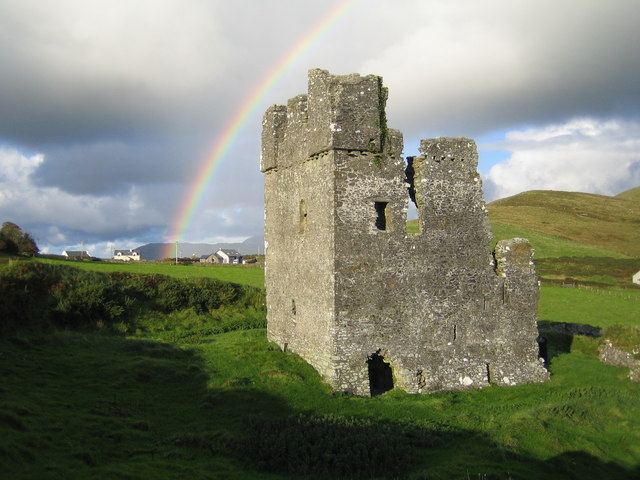
The primary residence of the Knights of Kerry during the medieval and early modern periods was Rahinnane Castle, a tower house constructed around 1500 on the site of an ancient ring fort near Ventry in County Kerry. This fortified structure served as a stronghold for the FitzGerald family until it was ruined amid the Cromwellian conquest of 1649–1653, leading to its abandonment circa 1650.[39] By the late 18th century, the family had shifted their main seat to Glanleam House on Valentia Island, initially renting the estate from 1780 before purchasing it outright in 1807 under the 18th Knight, Sir Maurice FitzGerald.[1] Originally built as a linen mill circa 1775, Glanleam House was converted into a Georgian-style residence with L-plan layout and later underwent Victorian-era expansions around 1820, including additional wings and an orangery, along with further modifications in 1910.[40] The estate's development under successive Knights included the creation of subtropical gardens spanning about 50 acres, featuring exotic plantings that enhanced its role as a family seat through the 19th and early 20th centuries.[41] The Knights' core land holdings centered on extensive estates in County Kerry, totaling over 5,300 acres by the mid-19th century, with key properties such as Ballinruddery near Listowel encompassing around 1,065 acres of arable and pasture land.[5] Secondary holdings included more than 2,000 acres in County Carlow, primarily in the baronies of Idrone East and West, acquired through earlier FitzGerald inheritances and managed for agricultural tenancy, as well as 1,305 acres in County Limerick and 2,022 acres in County Westmeath, both sold by the 1870s.[5] These properties supported the family's status as major landowners, though portions faced financial pressures leading to sales via the Encumbered Estates Court in 1853, including over 5,000 acres in Kerry around Glanleam and the Limerick holdings.[5] In the 20th century, further land reforms under the Congested Districts Board culminated in the sale of over 3,200 acres of the Valentia estate in 1913, with additional divestments occurring post-Irish independence through the Land Commission's compulsory purchase schemes in the 1920s, redistributing tenancies to local farmers.[5] Today, Glanleam House endures as a preserved heritage site and luxury guesthouse, while Valentia Island's landscapes, including the former estate gardens and slate quarries, attract tourists and support ecological conservation efforts focused on its unique subtropical flora and geological features.Notable Contributions and Archives
The Knights of Kerry have left a significant political legacy, particularly through the advocacy of Maurice FitzGerald, the 18th Knight (1774–1849), who as a Whig politician championed Catholic emancipation in the 1820s, urging religious liberty and refusing office unless aligned with his views on the matter.[2] His efforts included defending the Catholic Association and supporting non-sectarian Irish education systems, reflecting broader pushes for reform during a period of intense sectarian tension.[2] Similarly, Peter FitzGerald, the 19th Knight (1808–1880), was a prominent landowner with extensive Kerry estates.[29] In cultural preservation, the FitzGeralds have maintained Geraldine traditions through scholarly efforts, such as Sir Adrian FitzGerald, the 24th Knight (b. 1940), who edited and published A Man of His Times: The Papers of Robert FitzGerald, 17th Knight of Kerry in 2021, compiling letters and documents that illuminate 18th-century family life, politics, and estate management.[42] This work underscores the family's ongoing commitment to documenting their heritage, ensuring the continuity of Geraldine customs amid historical upheavals. The family's archives, notably the Fitzgerald (Knights of Kerry) Papers (reference T3075) held at the Public Record Office of Northern Ireland, preserve over 1,700 documents, primarily 17th- to 19th-century correspondence between Knights like Robert, Maurice, and Peter FitzGerald, covering estate administration, political maneuvers, and local affairs in Kerry.[6] A 2007 summary highlights key items, such as letters on tenancy disputes and parliamentary activities, providing invaluable insights into Anglo-Irish relations.[6] Beyond politics and records, the Knights contributed to local Kerry history, with the 19th Knight playing a pivotal role in establishing Valentia Island as the European terminus for the first permanent transatlantic telegraph cable in 1866, facilitating global communication and boosting the island's economic development through his landownership and negotiations with the Anglo-American Telegraph Company.[43]Modern Holders
20th and 21st Century Knights
In the early 20th century, the Knight of Kerry title adapted to significant socio-political changes in Ireland, including military service and land reforms. The 21st Knight, Sir John Peter Gerald Maurice FitzGerald (1884–1957), served as a Major in the Royal Horse Guards during World War I, where he was awarded the Military Cross for gallantry and mentioned in despatches.[44] Under the Wyndham Land Purchase Act of 1903, which facilitated tenant purchases of estates, the FitzGerald family undertook land sales; by 1909, the Congested Districts Board had offered to acquire over 3,200 acres of their Kerry holdings to redistribute to smallholders, reflecting broader agrarian transitions through the 1920s.[5] The establishment of the Irish Free State in 1922 profoundly impacted the knighthood's status. The 22nd Knight, Sir Arthur Henry Brinsley FitzGerald (1885–1967), oversaw the title during this period of independence, as the new constitution abolished official recognition of British hereditary honors, stripping them of political privileges such as representation or precedence in state affairs. The 23rd Knight, Sir George Peter Maurice FitzGerald (1917–2001), continued this navigation amid the economic and social upheavals of the mid-20th century, maintaining the family's estates on a reduced scale post-independence land reforms.[44] Entering the 21st century, the Knight of Kerry stands as the only active hereditary knighthood originating from medieval Ireland. The death of Desmond FitzGerald, 29th Knight of Glin, in 2011, left the title dormant, while the White Knight (Fitzgibbon) branch became extinct in the early 17th century, making the Kerry line unique across Ireland and Britain.[7][45] Despite these modern shifts, ceremonial traditions persist in limited contexts. The Knight of Kerry retains the historic green mantle—symbolizing the "Green Knight" moniker—in rare public or formal appearances, preserving a link to the title's Hiberno-Norman feudal origins.[1]Current Knight of Kerry
Sir Adrian James Andrew Denis FitzGerald, 6th Baronet of Valencia and 24th Knight of Kerry, was born on 24 June 1940 as the son of Major Sir George Peter Maurice FitzGerald, 5th Baronet and 23rd Knight of Kerry, and Angela Dora Mitchell. He succeeded to both the baronetcy and the hereditary knighthood upon his father's death on 6 April 2001. Educated at Harrow School in London, England, FitzGerald spent much of his early life in England while maintaining close connections to County Kerry, where he holidayed at his grandparents' home, Barrow House, near Tralee.[36][46] FitzGerald divides his time between homes in London, England, and Cappoquin, County Waterford, Ireland, while maintaining family connections to Valentia Island in County Kerry, where he serves as the custodian of the FitzGerald family archives. Over two decades, he has worked to locate and compile these widely dispersed documents from private and public collections, preserving the historical legacy of the Knights of Kerry. Since the death of Desmond FitzGerald, 29th Knight of Glin, in 2011, Sir Adrian has been recognized as the sole remaining active holder of an Irish hereditary knighthood.[36][38][7][47] As of November 2025, the title of Knight of Kerry persists through prescriptive right and longstanding traditional usage, without official recognition or patent from the Irish or United Kingdom governments—a status consistent with its medieval origins and historical precedents. Sir Adrian remains actively engaged in heritage efforts, including editing and publishing A Man of His Times: The Papers of Robert FitzGerald, 17th Knight of Kerry in 2021, which compiles ancestral correspondence to illuminate family history. In 2025, he continued his heritage work by participating in the Daniel O'Connell Summer School, launching further publications on family papers.[44][2][38]References
- https://en.wikisource.org/wiki/Confiscation_in_Irish_history/Chapter_5