Hubbry Logo
Knobcone pineKnobcone pineMain
Open search
Knobcone pine
Community hub
Knobcone pine
logo
8 pages, 0 posts
0 subscribers
Be the first to start a discussion here.
Knobcone pine
Knobcone pine
from Wikipedia

Knobcone pine
Scientific classification Edit this classification
Kingdom: Plantae
Clade: Tracheophytes
Clade: Gymnospermae
Division: Pinophyta
Class: Pinopsida
Order: Pinales
Family: Pinaceae
Genus: Pinus
Subgenus: P. subg. Pinus
Section: P. sect. Trifoliae
Subsection: P. subsect. Australes
Species:
P. attenuata
Binomial name
Pinus attenuata

The knobcone pine, Pinus attenuata (also called Pinus tuberculata),[2] is a tree that grows in mild climates on poor soils. It ranges from the mountains of southern Oregon to Baja California with the greatest concentration in northern California and the Oregon-California border.[3]

Description

[edit]

Individual specimens can live up to a century.[4] The crown is usually conical with a straight trunk. It reaches heights of 8–24 meters (26–79 feet),[5] but can be a shrub on especially poor sites. The bark is thin and smooth, flaky and gray-brown when young, becoming dark[4] gray-red-brown and shallowly furrowed into flat scaly ridges in age. The twigs are red-brown and often resinous. Its wood is knotty and of little interest for lumber.[4]

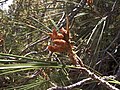
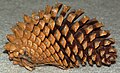
The leaves are in fascicles of three,[6] needle-like, yellow-green, twisted, and 9–15 centimeters (3+12–6 in) long. The cones are resin-sealed and irregularly shaped,[4] 8–16 cm (3+146+14 in) long and clustered in whorls of three to six on the branches. The scales end in a short stout prickle. Cones can sometimes be found attached to the trunk and larger branches.[4]

Distribution

[edit]

The knobcone pine can be found growing in the dry, rocky soils of southern Oregon and northern California, between 300 and 750 m (980 and 2,460 ft) above sea level.[4] It forms nearly pure stands, preferring to grow where there is no competition.[4]

Ecology

[edit]

On the coast, the knobcone pine may hybridize with bishop pine (Pinus muricata), and Monterey pine (Pinus radiata).

In the western foothills of the Sierra Nevada, knobcone pine is often a co-dominant with blue oak (Quercus douglasii).[7]

The species is susceptible to fire, but this melts the cone resin, releasing seeds for regrowth.[4] The species seems to be shade intolerant.[4]

See also

[edit]

References

[edit]

Further reading

[edit]
[edit]
Revisions and contributorsEdit on WikipediaRead on Wikipedia
from Grokipedia
The knobcone pine (Pinus attenuata) is a small to medium-sized native to western , renowned for its serotinous cones that remain sealed on branches until the intense heat of triggers their opening to release seeds for regeneration. This fire-adapted typically reaches heights of 6 to 24 meters with a trunk diameter up to 80 cm, though it forms low shrubs on nutrient-poor sites, featuring a conic crown, purple-brown to dark brown fissured bark, and needles in fascicles of three that measure 9 to 15 cm long. Knobcone pine occupies discontinuous populations from southwestern southward through California's coastal ranges, , Sierra Nevada, and , extending into northern , , generally at elevations from to 1,700 meters. It thrives in Mediterranean climates with mild, wet winters and hot, dry summers, often on dry, rocky slopes, ridges, and foothills with shallow, infertile, well-drained soils derived from ultramafic, , granitic, sedimentary, or volcanic substrates. Ecologically, knobcone pine functions as a shade-intolerant and obligate fire-dependent , forming dense, even-aged stands that succeed or other fire-prone vegetation after stand-replacing crown fires, which are essential for cone dehiscence at temperatures around 203°C. are primarily wind-dispersed, with trees producing heavy seed crops early in life and maintaining cones attached for over 20 years, contributing to its relatively short lifespan of 75 to 100 years. It commonly associates with species like madrone (), various oaks (Quercus spp.), and Douglas-fir (Pseudotsuga menziesii) in and woodlands.

Taxonomy and nomenclature

Etymology and synonyms

The "knobcone pine" refers to the prominent knob-like umbo, or thickened projection, on each scale of its serotinous cones, which distinguishes them from those of related . This feature is evident in the tightly closed cones that persist on the tree for decades until opened by or other intense . The scientific name Pinus attenuata was established by botanist John Gill Lemmon in 1892, based on specimens collected in California; the specific epithet "attenuata" derives from the Latin word meaning "tapering" or "narrowed," alluding to the slender, tapered form of the cones and the overall narrow habit of the tree. Prior to this valid publication in Mining and Scientific Press (volume 64, page 45), the species had been described under synonyms such as Pinus tuberculata Gordon (1849, not D. Don 1836) and P. tuberculata var. acuta Mayr, reflecting early confusion with tuberculate-coned pines but later resolved in favor of Lemmon's name by botanical authorities.

Classification and hybrids

The knobcone pine (Pinus attenuata Lemmon) is classified within the Pinus L. in the Pinus (the diploxylon or hard pines), section Trifoliae Duhamel, and subsection Australes Loudon, a group encompassing the California closed-cone pines. This placement reflects its three-needled leaves, serotinous cones, and phylogenetic relationships derived from allozyme and chloroplast DNA analyses. Like all pines, it has a diploid chromosome number of 2n=24. Natural hybridization occurs where ranges overlap with other closed-cone pines, particularly bishop pine (Pinus muricata D. Don) along coastal northern California, as evidenced by intermediate morphologies and shared chloroplast DNA haplotypes in mixed stands. With Monterey pine (Pinus radiata D. Don), natural hybrids form P. × attenuradiata Stockwell & Righter, though the type specimen originated from controlled crosses in the 1940s; fertile offspring have been documented in overlapping habitats near Monterey Bay. Artificial hybrids, primarily with P. radiata, have been developed for applications to combine the knobcone pine's and serotiny with the Monterey pine's rapid growth. In trials established in 1964 at elevations of 671–991 m in , knobcone × Monterey hybrids exhibited 98% survival after three years at one site and outperformed the knobcone parent in height growth, with some families surpassing P. radiata in volume increment despite minor drought stress. These hybrids also demonstrated enhanced frost hardiness in mild winter tests, supporting their potential for in variable climates. As part of the closed-cone pine group (subsection Australes), P. attenuata exemplifies evolutionary adaptations to fire-prone Mediterranean climates, including serotinous cone retention for post-fire recruitment and genetic divergence from non-serotinous relatives via in California's coastal ranges.

Description

Physical characteristics

The knobcone pine (Pinus attenuata) is a medium-sized that typically grows as a to 8–24 m in height with a (dbh) up to 80 cm, though it often assumes a shrubby form on especially poor sites. The trunk is usually straight, supporting a conical crown that becomes more open and irregular with age, and the species has a relatively short lifespan of up to 75–100 years. The tallest known living specimen, located in , measures 35.6 m tall and 95 cm dbh. The previous record holder, located in , measured 36 m tall and 109 cm dbh before it fell in 2010. The bark is thin and smooth, gray-brown on young trees, transitioning to dark gray-red-brown with age as it becomes furrowed and scaly in irregular, flat plates; some populations exhibit purple-brown tones. Foliage consists of borne in fascicles of three, measuring 9–15 cm long and 1.3–1.8 mm wide, yellow-green in color, straight or slightly curved, and persisting for 4–5 years. Seed cones are serotinous, sealed with and remaining closed for over 20 years until opened by , ovoid to asymmetric in shape, 8–16 cm long, and clustered in whorls of 3–6; each is tipped with a distinct knob-like umbo and measures approximately 5–7 cm wide at maturity. The wood is knotty and dense with pale yellow sapwood, rendering it unsuitable for high-quality due to extensive branching, though it has been used for poles, posts, and .

Reproduction

The knobcone pine (Pinus attenuata) is monoecious, bearing both cones on the same . Male cones are small, ellipsoid to cylindrical, measuring 10–15 mm long, and pale yellow to orange-brown; they develop in clusters and release wind-dispersed primarily from March to May. Female cones form at the branch tips, maturing over two years into larger ovoid-conic structures, 8–16 cm long and yellowish-brown, with thick scales featuring knob-like umbos; these cones are strongly serotinous, sealed shut by that prevents opening under normal conditions and allows them to persist on the for 20 years or more. Seed production begins when trees reach 10–12 years of age, with mature individuals over 20 years old averaging 176 per and capable of bearing annually thereafter. Each closed typically contains 60–96 viable , resulting in thousands of per overall; the are small and , with an oblique-obovoid body about 6–7 mm long and nearly black, attached to a narrow wing up to 20 mm long that aids in wind dispersal, particularly during post-fire conditions enhanced by winds like the Santa Ana. Seed viability remains high in unopened , with reports of success after 27–60 years of storage. Germination is tightly linked to , which melts the seal on cones at temperatures around 203°C (397°F), allowing to disperse within 1–12 hours and continue releasing over several years; the heat also scarifies the seed coat, while or chemical aerosols from burning vegetation further stimulate the process. Optimal requires bare mineral , a slight rise in from , and 60 days of cold moist stratification, typically occurring from February to March post-fire; laboratory tests show rates of 57–91% under these conditions, far higher than without fire cues.

Distribution and habitat

Geographic range

The knobcone pine (Pinus attenuata) is native to the and northwestern , with its range extending from disjunct populations in southwestern southward through the Coast Ranges, Sierra Nevada foothills, and of to northern in . The species occurs in scattered, discontinuous stands across this region, reflecting its adaptation to fragmented, fire-prone landscapes, with denser stands in northern portions of the range compared to sparser distributions farther south. Populations in are quite rare, limited to localized stands on the Sierra Juárez near Ensenada. The elevation range spans near to 1,700 m (0–5,600 ft), with lower elevations typical along coastal areas and higher inland. Historically, the range has remained relatively stable, though fragmentation has increased due to fire suppression and senescence in mature stands, with evidence of local extirpations in decadent populations. Between 1985 and 2015, approximately 6% of the range experienced repeated fires, contributing to ongoing challenges in maintaining population viability without natural regeneration cues. Introduced populations exist outside the native range, primarily from 19th-century plantings in for forestry trials in districts such as , Nelson, and , though the species has not naturalized widely. Limited trial plantings have also occurred in parts of , but these remain experimental and non-invasive.

Environmental preferences

The knobcone pine (Pinus attenuata) thrives in Mediterranean climates characterized by mild, wet winters and hot, dry summers, with annual precipitation typically ranging from 500 to 1,200 mm (varying regionally, higher in northern areas and often supplemented by coastal in summer months). Once established, the species exhibits strong , enabling survival in arid conditions through deep root systems and efficient use. It prefers dry, rocky, well-drained soils that are nutrient-poor and acidic, with a range of 5.0 to 7.0, and commonly occurs on , granitic, ultramafic, or volcanic substrates that limit competition from other . These soils often feature low levels of essential nutrients like and , alongside elevated concentrations of such as and in serpentine-derived sites. Knobcone pine favors open site conditions on south-facing slopes and ridges with gradients from 0 to , where exposure to sun and wind promotes rapid drainage and minimizes frost accumulation at elevations from near to about 1,700 m, though it shows reduced frost tolerance at higher sites. It frequently forms pure stands or borders communities and is positioned transitionally between shrublands and woodlands, co-occurring with blue () in foothill regions.

Ecology

Fire adaptation

The Knobcone pine (Pinus attenuata) displays a strong serotinous , in which mature cones remain tightly sealed by resinous bonds that persist for decades on the tree, forming a persistent canopy . Fire heat melts this resin, causing the cones to open and release numerous viable seeds onto the exposed mineral soil and ash bed, often resulting in dense establishment with densities reaching up to 100,000 seedlings per under favorable post-fire conditions. This mechanism ensures recruitment primarily after disturbance, exploiting reduced competition and enhanced nutrient availability in burned areas. The species thrives under a historical fire regime of frequent, low- to moderate-severity fires with return intervals of 20–50 years, which aligns with the time required to build sufficient seed banks for successful regeneration. Shorter intervals risk immaturity, where young stands lack adequate cone production—typically beginning at 4–6 years but achieving substantial seed banks only after 15–30 years—leading to low self-replacement probabilities (near 0% at 6-year intervals). Conversely, prolonged fire-free periods exceeding 80–100 years trigger , as trees rarely exceed this lifespan without reproducing, resulting in population extirpation across 15% of the range in recent analyses. Post-fire regeneration typically produces even-aged, monospecific stands that dominate the landscape for decades until the next disturbance. A range-wide study from 2019 indicated that while 6% of the ' range experienced reburns between 1984 and 2015, only 4% of those areas developed multi-cohort structures, highlighting the predominance of single-age cohorts in fire-driven dynamics. Seedling survival and growth further depend on post-fire , with high stress delaying comparable regeneration by 4–6 years. Recent studies as of 2024 indicate that while immaturity risk remains low under current conditions, is exacerbating challenges through more frequent short-interval fires and increased post-fire , which can hinder establishment and fuel rapid fuel recovery, potentially leading to conversion to non-forest states in vulnerable areas. Despite these adaptations, Knobcone pine faces vulnerabilities from its obligate-seeding strategy and high flammability; thin bark and resinous needles contribute to crown susceptibility, often killing entire mature stands in severe burns if prior reproduction has not occurred. risk is approximately four times higher than immaturity risk across the range, particularly in areas with suppressed regimes.

Biotic interactions

The knobcone pine (Pinus attenuata) is a highly shade-intolerant that establishes dense, even-aged pure stands following fire disturbance, but it is rapidly outcompeted by more shade-tolerant hardwoods and in the absence of recurring fires. This seral dependency positions it as an early successional dominant in chaparral-conifer transition zones, where it facilitates initial community recovery but declines over time without disturbance. Like most pines, knobcone pine forms ectomycorrhizal associations with soil fungi, which enhance nutrient uptake—particularly phosphorus and nitrogen—in nutrient-poor, rocky substrates typical of its habitat. These symbioses are crucial for seedling establishment and growth in infertile post-fire soils, improving drought tolerance and overall fitness. The species faces several biotic threats from pests and pathogens. It serves as the primary host for the parasitic dwarf mistletoe Arceuthobium siskiyouense, which infests northern populations and can reduce growth and vigor through resource drain and structural damage. Knobcone pine is also susceptible to pine pitch canker caused by the fungus Fusarium circinatum, which infects native stands and leads to resinous cankers, branch dieback, and mortality. Bark beetles, including Ips species, attack weakened trees, exacerbating mortality during droughts or post-fire stress. In hybrids with Monterey pine (P. radiata), susceptibility to western gall rust (Endocronartium harknessii) increases, causing galls that deform branches and reduce yield. Reproduction involves wind from March to May, with dispersed anemophilously across stands. Seeds from serotinous cones are primarily gravity-dispersed short distances immediately after fire-induced opening, with limited wind assistance; unlike large-seeded pines, they lack animal caching, relying instead on mass release for local . In dynamics, knobcone pine plays a key role in early succession by stabilizing eroded post-fire soils through rapid root development and accumulation, while acting as a nurse that provides shade and moisture retention for herbs and shrubs.

Human uses and cultivation

Commercial and ecological applications

The wood of knobcone pine (Pinus attenuata) has limited commercial value due to its knotty grain and small size, which make it unsuitable for high-quality or structural timber. It is occasionally utilized locally for low-grade applications such as , particularly in regions where the species is abundant. In ecological restoration efforts, knobcone pine is planted to stabilize eroded or burned slopes, leveraging its rapid growth on poor soils and fire-adapted regeneration. Seedlings in restoration projects have reached heights of approximately 15 feet (4.6 m) within 10 years when used for on shallow, sandy, or ultramafic soils in riparian and watershed rehabilitation. This application helps prevent post-fire soil loss and promotes landscape recovery in fire-prone and ecosystems. Hybrids between knobcone pine and Monterey pine (), known as P. × attenuradiata or KMX pine, have been developed and tested for since the 1940s to combine the fast growth and of knobcone pine with the timber quality of Monterey pine. These hybrids exhibit improved frost and snow resistance, outperforming parent species in growth trials on marginal sites, and have been outplanted in programs in , southwestern , and . For instance, in trials on cleared rangelands, KMX hybrids demonstrated superior survival and productivity under dry, low-quality conditions compared to pure Monterey pine. As of 2025, ongoing research explores KMX hybrids for fire-resilient on marginal sites, including mixed-provenance trials showing improved early growth. Additionally, its serotinous seeds are employed in studies to investigate post-fire regeneration dynamics and seed limitation in serotinous forests.

Ornamental cultivation

The knobcone pine (Pinus attenuata) has been cultivated ornamentally since the mid-19th century, following its introduction to in 1847 by collector Karl Theodor Hartweg. It thrives in Mediterranean climates, such as those in gardens, where it replicates its native dry, rocky habitats while providing a distinctive coniferous form. In Britain, mature specimens have reached heights of 75–80 feet, demonstrating its adaptability beyond its native range. This species is hardy in USDA Zone 7, tolerating temperatures down to –17.7°C (0°F), though inland Oregon provenances may extend to Zone 8. It exhibits strong drought tolerance once established but requires well-drained, gravelly or sandy soils to prevent root rot, preferring full sun exposure. In cultivation, trees typically grow to 15–30 feet tall, forming a conical to irregular crown that suits low-water landscapes. Propagation primarily occurs via seeds, which demand to break —either through simulating or chemical methods—followed by stratification for about 60 days. Rooting cuttings is possible but uncommon, succeeding mainly from trees under 5 years old. In gardens, it serves as a specimen or screen in dry, naturalistic settings, offering year-round texture with its yellow-green needles and persistent, resin-sealed cones. However, its lifespan in cultivation rarely exceeds 80 years, shorter than in the wild. Challenges in ornamental growing stem from its fire-adapted ; natural reproduction relies on to open serotinous cones, and without , seed release is limited, though ambient can occasionally trigger partial opening. It is ill-suited to high-maintenance, irrigated sites, where excessive moisture may promote , emphasizing its role in xeriscapes over formal gardens.

Conservation

Threats

Fire suppression poses a significant threat to knobcone pine populations by extending fire return intervals beyond the ' natural lifecycle, leading to without reproduction. Knobcone pines typically live 80 to 100 years, after which mature stands senesce and die without to release serotinous cones and enable regeneration. Approximately 75% of the range consists of mature or decadent stands due to 20th-century fire exclusion, with only about 6% of the range having experienced recent reburns sufficient for , while many areas remain fire-free for over 80 years. This has resulted in senescence-related extirpation across roughly 15% of the historical range. Habitat loss and fragmentation from urban development and threaten knobcone pine stands, particularly in coastal regions where low-elevation populations are vulnerable to conversion for human uses. These activities, along with roads and , have reduced and isolated suitable and habitats, limiting dispersal and increasing edge effects. Disjunct populations across , , and exacerbate this risk, as fragmented stands face higher chances of local extirpation. Climate change amplifies threats through altered fire regimes, prolonged droughts, and shifts in suitable habitats. Projected drier summers and an 80% likelihood of multi-decadal droughts by 2100 increase tree stress and mortality, while changing fire patterns could lead to either too-frequent burns in young stands or prolonged suppression in others. A 2024 study found immaturity risk from short-interval reburns to be currently low in young stands. This may force upslope range shifts, reducing available habitat in lower-elevation coastal areas. Pests and diseases further endanger stressed knobcone pines, with bark beetles attacking weakened trees and dwarf mistletoe (Arceuthobium siskiyouense) parasitizing hosts in the region. Seedlings are particularly susceptible to fungal infections, exacerbated by changing temperature and precipitation patterns. Invasive species compete with knobcone pine in disturbed or altered habitats, with non-native plants like and appearing in over 20% of post-drought plots, hindering regeneration. Additionally, hybridization with species like (Pinus radiata) in overlapping areas can dilute genetic purity of natural stands, though primarily observed in cultivated contexts.

Status and efforts

The knobcone pine (Pinus attenuata) is classified as Least Concern on the , with a stable population trend. It holds a global rank of G5 (Secure) from NatureServe, indicating low risk of extinction due to its wide distribution from southwestern to northern , Mexico, though populations are rarer in Mexico. The species is not federally or state-listed as threatened or endangered in the United States. Conservation efforts emphasize maintaining natural fire regimes essential for its serotinous cones and regeneration. Managers recommend allowing wildfires in mature stands to promote seed release while preventing short-interval reburns (less than 10-20 years) that could cause stand extirpation, particularly amid increasing fire frequency from climate change. Seed collection and banking are prioritized to preserve genetic diversity, with recommendations for protecting small Mexican populations near Ensenada as sources for restoration plantings in Baja California Norte. Ex situ collections hold over 4,300 individuals, primarily of wild origin, covering 56% of its geographic range and 75% of ecological variability, though further germplasm collection is needed for underrepresented areas. Local restoration initiatives address localized threats like drought-induced dieback and bark beetle infestations. For instance, at Mount Diablo State Park in California, the Save Mount Diablo organization has led volunteer efforts since 2022 to clear dead biomass from knobcone pine stands, reducing wildfire fuel loads and supporting natural regeneration on thin sandstone soils; these activities include woodchipping operations and trail development to facilitate access, with potential future prescribed burns in collaboration with state parks. Research by Phytosphere Research, funded by the East Contra Costa County Habitat Conservancy, has investigated dieback causes, ruling out non-native pathogens and informing targeted management. Overall, management capacity remains low to moderate due to gaps in understanding serotiny responses to altered fire regimes.

References

Add your contribution
Related Hubs
User Avatar
No comments yet.