Hubbry Logo
KokeshiKokeshiMain
Open search
Kokeshi
Community hub
Kokeshi
logo
8 pages, 0 posts
0 subscribers
Be the first to start a discussion here.
Kokeshi
Kokeshi
from Wikipedia

Kokeshi
Finishing a kokeshi
Modern kokeshi

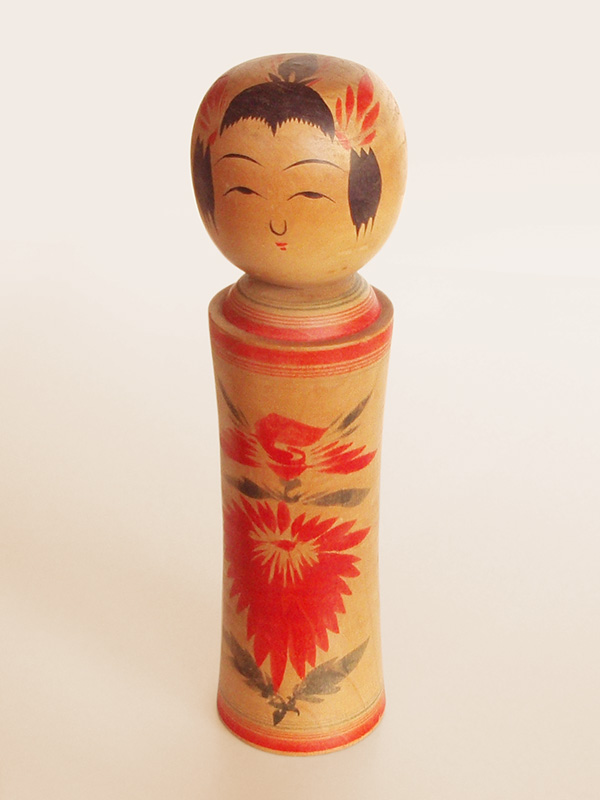
Kokeshi (こけし, 小芥子) are simple wooden Japanese dolls with no arms or legs that have been crafted for more than 150 years as a toy for children. Originally from the Tohoku region in northern Honshu, kokeshi are handmade from wood, having a simple trunk and head with a few thin, painted lines to define the face. The body often has floral and/or ring designs painted in red, black, and sometimes green, purple, blue, or yellow inks, and covered with a layer of wax. Since the 1950s, kokeshi makers have signed their work, usually on the bottom and sometimes on the back.

History and etymology

[edit]

The origin and naming of kokeshi is unclear,[1] with historical ateji spellings including 小芥子, 木牌子, 木形子, and 木芥子. The hiragana spelling こけし was agreed on at the All-Japan Kokeshi Exhibition (全国こけし大会) at Naruko Onsen in August 1939.[citation needed]

A popular theory[2] suggests that kokeshi may be fetish substitutes for unwanted babies killed after birth and the characters can be understood as 子消し made up of child (, ko) and erasing, extinguishing (消し, keshi). While infanticide was commonly practiced in Japan until the 20th century,[3] there is little if any evidence to support the theory that kokeshi have anything to do with the practice, with the earliest references in literature dating only from 1965.[4] The word kokeshi itself is originally of the Sendai dialect, with the dolls being known as, for example, deko, kideko, dekoroko; in Fukushima as kibako, kihohoko; in Miyagi as obokko; and in Naruko as hangyo and kiningyō, none of which supports the theory.[4]

Kokeshi were first produced by kijishi (木地師), artisans proficient with a lathe, at the Shinchi Shuraku, near the Tōgatta Onsen in Zaō[5] from where kokeshi-making techniques spread to other spa areas in the Tōhoku region. It is said that these dolls were originally made during the middle of the Edo period (1600–1868) to be sold to people who were visiting the hot springs in the north-east of the country.[citation needed]

One of the earliest doll-focused associations in Japan was the Sendai Kokeshi Association (Sendai Kokeshi-kai) established in 1923 by Mihara Ryōkichi (三原良吉) and Amae Tomiya. The two released a 1928 book about kokeshi, Kokeshi Hōko no Hanashi, which introduced the local tradition to the entire Japan. Mihara continued his work as a journalist and folklorist to his death in 1982, being responsible for popularization of kokeshi and other elements of Sendai folklore.[6]

Types

[edit]

"Traditional" kokeshi (伝統こけし, dentō-kokeshi) dolls' shapes and patterns are particular to a certain area and are classified under eleven types, shown below. The most dominant type is the Naruko variety originally made in Miyagi Prefecture, which can also be found in Akita, Iwate, and Yamagata Prefectures. The main street of the Naruko Onsen Village is known as Kokeshi Street and has shops which are operated directly by the kokeshi carvers.[citation needed]

"Creative" kokeshi (新型こけし, shingata-kokeshi) allow the artist complete freedom in terms of shape, design and color and were developed after World War II (1945). They are not particular to a specific region of Japan and generally creative kokeshi artists are found in cities.[citation needed]

The woods used for kokeshi vary, with cherry used for its darkness and dogwood for its softer qualities. Itaya-kaede, a Japanese maple, is also used in the creation of both traditional and creative dolls. The wood is left outdoors to season for one to five years before it can be used.[citation needed]

Traditional types

[edit]
Various kokeshi
Dress-up Kokeshi - With a Wardrobe
(Creator: Réka Tóth-Vásárhelyi, photo by Anita Tóth)

Traditional types often correspond to a single or multiple onsen located within the Tōhoku region.[7]

Exhibitions and competitions

[edit]

Traditionally, the National Kokeshi Exhibition and Competition in Shiroishi-Zao is held every year, and in 2022 it took place for the 64th time. In 2015, the event organized for the 57th time was attended for the first time by a master kokeshi maker of non-Japanese nationality, in the person of the Hungarian Réka Tóth-Vásárhelyi. In 2016, she won the main prize in the creative category with her work Dress-up Kokeshi - With a Wardrobe.

In 2022, the Creative Kokeshi Exhibition in Shibukawa was held for the 28th time. Creative Kokeshi Competition is held regularly in Tokyo, Japan.

[edit]
Japanese postage stamp showing kokeshi

Kokeshi dolls have been used as an inspiration for the style of Nintendo's digital avatars, called "Miis", which are created and customized by players. Their appearance has become the symbol of the platform's overall aesthetic.[8]

Inspiration for the Momiji Doll originates from the kokeshi doll.

Japanese professional wrestler Tomoaki Honma is nicknamed "Everybody's Kokeshi" (みんなのこけし, minna no kokeshi) after his finishing move "Kokeshi", a diving headbutt where Honma falls straight down towards his opponent while keeping his arms at his sides, resembling a kokeshi in posture.

Miss Grand Japan 2020, Ruri Saji, wore a kokeshi doll-inspired costume[9] which also transforms into an anime robot, showcasing Japan's technological advancement in the robotics field. It has won the Best in National Costume title at the Miss Grand International 2020 held in Bangkok, Thailand.

See also

[edit]

References

[edit]
[edit]
Revisions and contributorsEdit on WikipediaRead on Wikipedia
from Grokipedia
Kokeshi (こけし) are traditional handmade wooden dolls originating from Japan's in northern , dating back to the (1603–1868). Characterized by their simple, cylindrical form with a large round head atop a slender body and no arms or legs, they are crafted by skilled artisans called kijishi using lathes from woods like cherry or dogwood. The dolls feature painted faces, hair, and clothing in vibrant colors such as red, black, purple, and yellow, often sealed with wax for protection and signed by the maker to reflect their unique style. The name "kokeshi" may derive from "ko" (meaning "wood" or "small") combined with "keshi" (referring to dolls), though its exact remains debated. These dolls emerged as folk crafts in hot spring (onsen) villages of Tōhoku, initially serving as souvenirs for visitors seeking therapeutic baths, with production centered near areas like Togatta Onsen in the Zao mountains. By the mid-19th century, kokeshi had become popular beyond their origins, evolving from simple playthings into symbols with spiritual significance, believed to protect children and, in some traditions, bring good fortune and ward off evil spirits. Post-World War II, modern variations introduced more colorful and creative designs, expanding their appeal as collector's items and tourist keepsakes while preserving traditional techniques. Kokeshi are classified into regional styles, each tied to specific onsen towns and featuring distinct proportions, patterns, and motifs that reflect local culture and the artisan's heritage. Notable types include the Togatta style, the Naruko style, and the Tsugaru style; over ten traditional varieties exist, totaling more than 5,500 examples displayed in museums like the Miyagi Zao Kokeshi Museum. Today, while rooted in rural craftsmanship, kokeshi continue to embody Japan's artisanal legacy, blending utility, spirituality, and aesthetic simplicity in contemporary contexts such as exhibitions and cultural festivals.

History and Origins

Etymology

The etymology of the term "kokeshi" remains uncertain, with several proposed derivations lacking definitive consensus among scholars. One theory posits it originates from "ki" (wood) combined with "keshi" (doll), reflecting the material and form of the wooden figures, while another suggests "ko" (small or child) paired with "keshi" (doll), evoking a diminutive plaything. A popular but unsubstantiated interpretation links "kokeshi" to "ko" (child) and "kesu" (to extinguish), suggesting the dolls commemorated infants lost to infanticide during historical famines, though this lacks supporting evidence. Possible folk derivations include "dokoishi," interpreted as "child stone" in some regional contexts, or "ki ko boko," meaning "wooden doll" or "child of wood," though these are speculative and not universally accepted. Prior to national standardization, kokeshi were known by various regional names across the Tōhoku area, reflecting local dialects and craftsmanship traditions. In Fukushima, terms like "deko" or "kideko" were common, emphasizing the puppet-like quality, while in Miyagi, variants such as "kibako," "kibohoko," or "obokko" highlighted the wooden construction. Other names included "mameko" in certain locales, alongside "kogesu" or "hangyo" in areas like Naruko, underscoring the dolls' diverse linguistic roots before a unified nomenclature emerged. The standardization of "kokeshi" as the official term, written in phonetic hiragana as こけし, was formalized in 1940 during a gathering of artisans and collectors organized by the Kokeshi Club, building on efforts by the Sendai Kokeshi Association founded in 1923 to promote and preserve the craft. This decision unified the disparate regional names and occurred amid growing interest in folk arts, coinciding with exhibitions that elevated kokeshi's profile. Earlier representations sometimes employed ateji kanji, such as 小芥子 (small poppy) or 木形子 (wooden form child), for phonetic approximation, but the shift to hiragana ensured clarity and alignment with traditional folk craft conventions. Modern usage retains the hiragana form, though occasional kanji variants persist in artistic or historical contexts.

Historical Development

Kokeshi dolls originated in the late , particularly between 1804 and 1830, when skilled woodturners known as kijishi in the Shinchi Shuraku settlement near Tōgatta Onsen in Japan's Tohoku region began crafting them from wood scraps as simple toys and souvenirs for visitors. These early dolls emerged from the local traditions of mountain villages, where kijishi used lathes to shape cylindrical forms, marking the beginning of kokeshi as a regional folk craft tied to and daily life. During the (1868–1912), kokeshi production expanded beyond Tōgatta to other Tohoku hot springs, including Naruko and Sakunami, as growing domestic travel boosted demand for affordable, portable souvenirs. This period saw the emergence of distinct regional styles, with artisans adapting designs to local aesthetics while maintaining the core lathe-turned structure, solidifying kokeshi's role in Tohoku's economy and cultural exchange. In the and , as kokeshi gained wider recognition, local associations formed to standardize production, promote quality, and encourage collecting; notably, the Kokeshi Association was established in 1923 by Mihara Ryōkichi and Amae Tomiya to support artisans and preserve traditions amid rising in folk crafts. The of the term "kokeshi" across dialects followed in 1940. World War II brought a sharp decline in kokeshi making due to severe wood shortages, rationing, and wartime disruptions, halting much of the artisan work by the early . Production revived in the , fueled by postwar economic recovery, a surge in , and efforts to revitalize traditional crafts, leading to the classification of traditional kokeshi as a protected with eleven recognized regional strains.

Design and Craftsmanship

Physical Characteristics

Kokeshi dolls feature a distinctive basic structure consisting of a cylindrical body without arms or legs, topped by an enlarged spherical head connected via a narrow . This armless and legless form emphasizes simplicity and stability, with the rounded head often proportionally larger than the body to evoke a childlike appearance. The head is typically adorned with painted features that include black or dark hair styled in a topknot or traditional hairstyle, accented by rings or patterns, along with minimal facial expressions such as simple eyes and a small red mouth. These elements use black ink and vivid colors like red for the lips, creating an understated yet expressive face that avoids detailed realism. Body decoration involves hand-painted motifs such as florals, geometrics, or regional patterns in primary colors including , , often depicting enlarged kimono-like designs at the base to enhance balance and visual weight. These patterns vary by style but maintain a focus on bold, symbolic elements that cover the smooth cylindrical surface without intricate detailing. After painting, the dolls are finished with a coating of or similar natural wax, which provides a protective sheen and subtle luster while preserving the wood and colors. Traditional kokeshi range in size from about 2 to 15 inches in height, though most common examples measure 4 to 6 inches, allowing for both portable toys and display pieces. Regional variations in proportions exist, such as the Naruko type from , which features a rounded body with an indented waist and distinctive shoulders; detailed types are covered in the Types and Variations section.

Materials and Manufacturing

Kokeshi dolls are crafted primarily from lightweight, straight-grained woods sourced from the forests of the Tohoku region in northeastern , ensuring ease of and a smooth finish. The most commonly used wood is (dogwood), valued for its white bark, high moisture content, and fine grain that allows for precise shaping without splintering. Other traditional woods include cherry, which provides a warm tone and durability, and itaya kaede (Japanese maple), noted for its even texture suitable for work. These materials are selected for their availability in local Tohoku areas, such as Iwate, Yamagata, and Akita prefectures, where the wood's natural properties support the doll's characteristic cylindrical form. The manufacturing process begins with felling trees in autumn or winter to minimize sap and facilitate drying, followed by peeling the bark using specialized tools like the bangagi, a curved blade for clean removal. The logs are then dried naturally under a for 6 to 12 months—or up to a year in some cases—to prevent warping and achieve stability, with individual pieces assessed for readiness before indoor storage. Once prepared, the wood is sawn to approximate sizes, with knots and defects removed, and roughly shaped into octagonal or basic forms. The core shaping occurs on a traditional rokuro , where the wood is rotated and shaved with handmade planes to form the doll's contours from a single piece, avoiding joints or adhesives in authentic production. Fine detailing follows hand-carving with knives and thin blades to refine features, after which the surface is smoothed using natural abrasives such as horsetail or grass for a subtle luster. is applied by hand with fine brushes and natural pigments, emphasizing minimalistic designs, before the final coating of plant-based wax—derived from Japanese wax trees or —to protect the wood and enhance its sheen. In certain regional styles, like Naruko kokeshi, the head and body may be crafted separately and fitted using a friction-based hamekomi technique, heated slightly for a secure, jointless assembly. Traditional tools remain handmade and non-powered, including rasps for roughing and specialized chisels, preserving the craft's manual integrity, with use dating back to the late . Artisan training occurs through multi-year apprenticeships, where novices learn wood selection, drying nuances, and operation under masters, often specializing in one or two regional variants to maintain stylistic authenticity. While modern adaptations occasionally incorporate wood stains for color variation, traditional methods strictly avoid glues, composites, or mechanical aids to uphold the dolls' purity.

Types and Variations

Traditional Kokeshi

Traditional kokeshi, known as dentō kokeshi in Japanese, are regionally specific wooden dolls originating from the of northern , classified into 11 official types based on their unique shapes, patterns, and motifs tied to local hot spring () areas. These types emerged in the early as souvenirs crafted by woodturners for visitors to onsen towns, reflecting the cultural and natural elements of their production locales. The 11 types were formally recognized and standardized through efforts by kokeshi makers' associations in the mid-20th century to preserve authenticity. Among the most prominent is the Naruko type from Naruko Onsen in , which accounts for the largest production volume due to its popularity as a . Naruko kokeshi feature a distinctive squeaking mechanism in the head, achieved by a loose internal , along with large, expressive eyes, red-painted hair lines, and bodies adorned with floral motifs like and leaves on a floral pattern, often in vibrant reds and blacks; their proportions emphasize a rounded head atop a cylindrical body about twice as long, historically linked to the onsen's culture where they symbolized good health and warding off evil. The Tsuchiyu type, originating from Tsuchiyu Onsen in , is characterized by a small, rounded head with a turnable , a slender body with red flower motifs such as peonies, and minimalistic facial features in black ink; these dolls have compact proportions, tied to the area's volcanic and used as talismans for and protection during the . The Yajiro type from Yajiro Onsen in Yamagata Prefecture stands out for its realistic facial expressions, with detailed eyes and mouths painted in fine lines, and a body covered in geometric patterns or abstract designs in bright colors like yellow, red, and purple; proportions feature a larger head relative to a straight, elongated torso, reflecting the region's mountainous onsen heritage where they served as playthings and protective charms for children in the late 19th century. Togatta kokeshi, produced near Togatta Onsen in Miyagi Prefecture, employ simple, elegant lines for the face and body, with motifs of red and green flowers or leaves on a slender, straight-shouldered form; their balanced proportions, with the head slightly smaller than the body, connect to the hot spring's therapeutic traditions, where dolls were gifted to promote family well-being and longevity. Other notable types include Sakunami from Sakunami Onsen in Miyagi, known for elongated faces, slim torsos, and subtle peony or leaf motifs evoking the area's forested springs; Hijiori from Hijiori Onsen in Yamagata, with rare "cat's eye" pupils and minimal yellow-toned decoration on a short body; and Yamagata type from Yamagata City, featuring large eyes and thicker builds with bold patterns. The remaining styles—such as Tsugaru (Aomori) with lacquer-like painting and short forms, Nanbu (Iwate) with simple motifs, Kijiyama (Akita) featuring carved details and muted tones, and Aizu (Fukushima) with rounded, sturdy shapes—further diversify the collection, each preserving local onsen folklore through specific proportions and designs like cherry blossoms or seasonal flora. Production of traditional kokeshi is centered in artisans operating across the 11 regions, primarily in villages of the Tōhoku prefectures, where family lineages pass down lathe-turning and painting techniques; these dolls are produced mainly as handcrafted souvenirs sold at hot springs and craft centers. These dolls are protected as intangible cultural properties under Japan's traditional crafts system, with strict guidelines enforced by makers' associations to maintain regional hallmarks—such as specific wood types, color palettes limited to red, black, and yellow in many cases, and prohibition of arms or legs—ensuring authenticity and preventing dilution by modern variations; five types (Togatta, Yajiro, Sakunami, Hijiori, and Naruko) hold national designation as traditional crafts since the , underscoring their role in preserving Tohoku's folk heritage.

Creative Kokeshi

Creative kokeshi, known as sōsaku kokeshi in Japanese, represent a post-World War II evolution in the craft, emerging in the late 1940s and gaining prominence through the and as artisans broke free from rigid traditional forms to infuse personal artistic expression. This style originated when woodworkers, inspired by the recovery and modernization of Japanese , began experimenting with the doll's basic cylindrical body and enlarged head while discarding regional stylistic limitations. Folklorist and journalist Ryokichi Mihara (1897–1982) played a pivotal role in elevating kokeshi's status as a legitimate art form through his documentation and promotion efforts. Retaining the core proportions of traditional kokeshi as a foundational base, sōsaku pieces emphasize individuality over standardization. Distinct from their folk origins, creative kokeshi incorporate modern motifs such as animals, abstract patterns, and whimsical figures, often rendered in vibrant colors and asymmetrical shapes using a variety of woods beyond the conventional Mizunara or Keyaki. Artisans employ advanced techniques like engraving, burning, and inlay to add texture and depth, allowing for sculptural qualities that transform the dolls into standalone artworks rather than mere toys or souvenirs. Without adherence to specific regional traditions, these dolls reflect the creator's unique vision, with approximately 50 specialized makers producing them, many concentrated in areas like Gunma Prefecture. In the market, sōsaku kokeshi command higher prices as collectible art pieces, typically sold through galleries and specialty shops rather than tourist outlets, reflecting their status as fine craft influenced by global art movements like and . Their recognition has grown since the 1990s, with dedicated categories established in major competitions, such as the All Japan Creative Kokeshi Art Exhibition starting in 1994. International acclaim arrived in 2016 when Hungarian artist Réka Tóth-Vásárhelyi won the grand prize in the creative division of the National Kokeshi Doll Competition, marking the first major victory by a non-Japanese creator and highlighting the style's global appeal.

Cultural Significance

Role in Japanese Traditions

Kokeshi dolls hold symbolic significance in Japanese traditions, often representing , , and good luck. They are frequently given as gifts to newborns, with the infant's name sometimes painted on the doll to invoke blessings for and growth, reflecting animistic beliefs in the protective spirit of . Additionally, their round forms and simple designs embody hopes for bountiful harvests and warding off misfortune, serving as informal omamori-like charms against illness and evil. In traditional uses, kokeshi originated as wooden toys for children during the , crafted by woodworkers in Tohoku's hot spring regions and sold as souvenirs to visitors. These dolls were placed in homes to safeguard against diseases in rural areas. Over time, they became enduring symbols of regional culture, exchanged among travelers to commemorate healing journeys. Within the broader context of Japanese folk art, kokeshi align with the movement initiated in the 1920s by philosopher Sōetsu Yanagi, who championed everyday crafts for their unadorned beauty and aesthetics of imperfection and transience. Yanagi elevated such rural crafts as exemplars of anonymous, utilitarian artistry that preserve simplicity amid industrialization. Artisan communities centered on kokeshi production foster strong regional identities in Tohoku, with eleven distinct styles tied to specific villages and family lineages, such as the Naruko or Tsuchiyu variants. Gender dynamics traditionally feature male dominance in lathe-turning and carving the forms, while women often contribute to and finishing, though factory-based female labor has historically received less recognition as artisan work. Kokeshi crafting contributes to cultural preservation as part of Tohoku's folk traditions, emphasizing community transmission through apprenticeships and family workshops that sustain skills across generations. These practices tie into Japan's framework, highlighting the role of regional crafts in maintaining social bonds and local heritage amid modernization.

Exhibitions and Competitions

The All Japan Kokeshi Contest, held annually in Shiroishi City, , serves as a premier national event for showcasing traditional and creative kokeshi dolls, with artisans submitting works for evaluation and public display. Established as a key platform for the craft, the competition resumed in 2022 for its 64th edition after a two-year hiatus due to the , attracting entries from across and highlighting exceptional craftsmanship in both traditional and modern styles; it continued annually, with the 67th edition held May 3–5, 2025. The All Japan Creative Kokeshi Exhibition, focusing on innovative or sōsaku kokeshi, began in 1995 and has grown into a significant venue for artistic expression beyond strict traditional forms. By its 29th iteration in 2023, the event emphasized original designs, with categories rewarding novel interpretations of the doll's form and motifs while maintaining ties to heritage. Regional events, such as the annual All Japan Kokeshi Festival in Naruko , , complement national competitions by offering hands-on workshops where participants paint or shape miniature kokeshi under artisan guidance, fostering direct engagement with the craft. Held each September since 1948, the festival includes demonstrations, parades, and sales of over a thousand dolls, with international interest rising in the through foreign artisans' submissions and awards in major contests. Judging in these exhibitions differentiates between categories: traditional kokeshi are assessed for authenticity to regional styles and adherence to historical techniques, while creative entries prioritize , artistic innovation, and material execution. Prizes, including cash awards and recognition from craft associations like the All Japan Kokeshi Association, motivate participants and elevate winning works' prestige. Recent adaptations include virtual components introduced post-2020 to accommodate COVID-19 restrictions, such as online viewing of entries during event pauses, enabling broader access.

Modern Developments

Global Popularity

Kokeshi dolls garnered Western attention as early as 1915 through exports to Europe and the U.S., but widespread popularity surged following World War II, particularly through U.S. occupation forces stationed in Japan, who encountered them as affordable souvenirs in hot spring regions of the Tōhoku area. This exposure led to initial imports as novelty items, with popularity peaking during the 1950s and 1960s amid Japan's postwar economic recovery and the global rise of Japanese folk crafts. Exporters capitalized on the dolls' simple, whimsical design to meet demand for inexpensive, culturally evocative imports in the United States and Europe, where they were marketed as symbols of Japanese tradition. By the late 20th century, kokeshi had transitioned from wartime curiosities to established collectibles, supported by the mingei folk art movement that emphasized their artisanal roots. Today, are exported primarily to the , , and parts of , where they appeal to collectors and tourists seeking authentic Japanese handicrafts. Annual global sales remain modest compared to mass-produced toys, traded through specialty retailers and online platforms, including and replicas that mimic traditional wooden forms for broader accessibility and lower cost. These adaptations allow for wider distribution, such as in gift shops and home decor markets, while preserving the dolls' iconic silhouette. In the and markets, and pieces command higher prices among enthusiasts, often sourced from Japanese producers via direct import channels. Beyond Japanese craftsmanship, kokeshi have inspired international adaptations, with non-Japanese artisans creating their own interpretations while drawing on traditional techniques. In , artist Réka Tóth-Vásárhelyi has gained recognition as the first foreign winner of a national kokeshi competition in 2015, blending Japanese wood-turning methods with local motifs to produce dolls that honor the form's cultural essence. Such efforts highlight collaborative global interest, including limited-edition merchandise from design brands that incorporate kokeshi motifs into apparel and accessories. These developments extend the dolls' reach, fostering appreciation without altering core export dynamics from . Kokeshi appear in prominent international collections, underscoring their status as cultural artifacts. The holds several examples, including carved wooden dolls with painted motifs like red maple leaves, acquired as part of its Asian holdings. In , institutions such as the Japan Kokeshi Museum in Narugo display extensive arrays for educational purposes, indirectly supporting global interest through touring exhibitions and publications. Since the , online communities on platforms like and have further amplified popularity, where collectors share vintage finds, custom pieces, and styling ideas, creating vibrant networks for buying, selling, and discussing authenticity. Despite their appeal, kokeshi face challenges in global markets, including the proliferation of counterfeits and replicas that dilute the value of authentic pieces. Collectors often demand certificates of authenticity to distinguish handmade traditional dolls from mass-produced imitations flooding online marketplaces. Debates over cultural appropriation have arisen with non-Japanese adaptations, prompting discussions on respectful versus . In response, Japanese artisan groups have advocated for greater protection, including explorations of status to safeguard regional styles and combat fakes, though no formal GI designation for kokeshi has been granted as of 2025. These issues highlight the tension between global accessibility and preserving the craft's integrity. Kokeshi dolls have influenced digital avatar designs in video games, notably serving as inspiration for Nintendo's Miis introduced with the console in 2006. Game designer explicitly referenced the dolls' cylindrical, armless form when conceptualizing the rounded, customizable characters, aiming to evoke a simple, approachable aesthetic reminiscent of traditional Japanese wooden figures. In fashion and , kokeshi motifs have appeared as thematic elements in performances and competitions. At the pageant, Japan's representative Ruri Saji wore a national fusing kokeshi aesthetics with and robotic influences, earning the Best National Costume award for its innovative handmade design rooted in over 150 years of doll-making tradition. Similarly, Japanese wrestler , active since the early 2000s with , incorporates kokeshi-themed maneuvers into his repertoire, including the Kokeshi Drop—a reverse piledriver executed with emphatic, doll-like rigidity—and the signature Kokeshi headbutt, which has become a hallmark of his high-impact style. Kokeshi forms have extended into contemporary art and merchandise, often reinterpreted through modern lenses. has produced collectible kokeshi-style figures featuring characters like , blending the dolls' traditional wooden simplicity with the company's signature aesthetic in limited-edition wooden and vinyl pieces sold through official channels. These adaptations highlight kokeshi's versatility in pop culture artifacts, while indirect ties to animation appear in licensed merchandise, such as kokeshi dolls modeled after characters from The Tale of the Princess Kaguya, produced in collaboration with artisans to capture the films' whimsical essence. Recent artistic expressions from 2022 onward have explored kokeshi in experimental contexts, such as modern interpretations at events like the Boneyard Arts Festival, where local artists reimagined the dolls using to reflect contemporary themes. This evolution underscores kokeshi's ongoing role as a symbol of cultural fusion in global creative outputs, including a renewed surge in popularity among younger demographics, particularly young women, since around 2020.

References

Add your contribution
Related Hubs
User Avatar
No comments yet.