Hubbry Logo
KuwaeKuwaeMain
Open search
Kuwae
Community hub
Kuwae
logo
8 pages, 0 posts
0 subscribers
Be the first to start a discussion here.
Kuwae
Kuwae
from Wikipedia

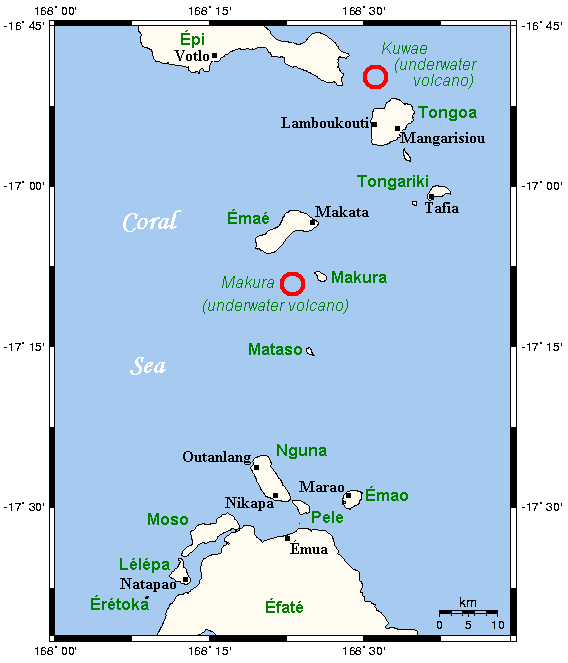
Kuwae was a landmass that existed in the vicinity of Tongoa and was destroyed by volcanic eruption in fifteenth century, probably through caldera subsidence. The exact location of the caldera is debated. A submarine caldera, now known as Kuwae caldera and which is located between the Epi and Tongoa islands, is a candidate. Kuwae caldera cuts through the flank of the Tavani Ruru volcano on Epi and the northwestern end of Tongoa. Another potential candidate is a proposed caldera between Tongoa and Tongariki.

Key Information

The submarine volcano Karua, one of the most active volcanoes of Vanuatu, is near the northern rim of Kuwae caldera.

Caldera location and Kuwae landmass

[edit]

In Tongoan folklore, Kuwae is a lost land in the vicinity of Tongoa and was destroyed by a massive volcanic eruption, probably associated with caldera subsidence. In the legend of Ti Tongoa Liseiriki, the young man in Tongoa escaped the eruption along the coast of Kuwae to Tongariki which became a remnant of submerged Kuwae. This implies that Tongoa and Tongariki were connected by Kuwae landmass before the eruption. A submerged caldera is proposed in southeast of Tongoa and part of its western rim is above sea-level to form islands of Ewose, Buninga, and Tongariki. These islands are also described to be fragments of old Kuwae landmass in the folklore, consistent with presence of caldera in this location.[3][4] But a bathymetric survey of this area could not confirm the presence of a caldera.[5]

In 1994, bathymetry north of Tongoa revealed a large, 6×12-kilometer caldera between Tongoa and Epi, and it was named Kuwae caldera.[6] However, whether or not the Kuwae caldera was responsible for the disappearance of Kuwae landmass and fifteenth century eruption in the folklore is debated, because oral traditions clearly describe it being south of Tongoa.[7]

From which of these two calderas did the fifteenth century eruption derive has not been definitely identified.

Eruptive history

[edit]

Little is known about the pre-fifteenth century eruptive history of Kuwae volcano. Thick basalt and andesite lava flows and scoria agglomerates were produced from early effusive and strombolian eruptions over a long period of time. The oldest outcrop on Tongoa island is basalt dated to 73,000 years ago.[8]

Fifteenth-century eruption

[edit]

The major ignimbrite eruption was preceded by a period of low-intensity phreatomagmatic eruptions lasting months to years. These pre-climactic eruptions are similar to or less explosive than Surtseyan-style. Then the hydromagmatic phase was followed by major pyroclastic flows with gradually increasing eruptive temperature. Much of Tongoa and Epi islands are thickly blanketed with these pyroclastic flow deposits. The extent of pumice fall from this stage reached Tongariki island, and possibly southern end of Efaté Island.[9] Pyroclastic flow with thickness >1 m is reported some 50 km from the eruptive centre. However, no plinian deposit is observed during any phase of the eruption.[10][11][12]

Direct estimation of erupted magma volume based on field mapping of the deposits is impossible because the majority of the Kuwae ignimbrite was deposited in the sea. Further oceanographic surveys are needed to study the distribution of submarine ignimbrites and tephra fall deposits.[13] If assuming the entire Kuwae caldera was formed during this eruption, then caldera dimension (total caldera subsidence may have been as great as 0.8–1.1 km) shows that about 30–60 km3 (DRE) was erupted, making this eruption of one of the largest in the last 10,000 years.[11]

This assumption has been challenged by another team on the basis of that preserved ignimbrite indicates only small- to moderate-size eruption, implying that Kuwae caldera did not form through this eruption. The team also hinted that the eruptive source of ignimbrite may not at all be Kuwae-caldera-based on the direction of pyroclastic flows on Tongoa, which came from southeast.[7] Ongoing investigation by a team of volcanologists and anthropologists will try to resolve the debate around the nature of Kuwae eruption.[12]

The age of eruption and its association to the cataclysm in Tongoa folklore are established by radiocarbon dating of samples found in pyroclastic flows and the burial of Ti Tongoa Liseiriki. In the Tongoa folklore, Ti Tongoa Liseiriki survived the volcanic eruption and was the first to resettle. An analysis of the bone collagens of Ti Tongoa Liseiriki yields a date of 1475±85 CE.[14] Ages of carbonized trunks killed by pyroclastic flows cluster around 1410–1450 CE.[6]

Early studies linked this eruption to a major sulfate spike in Antarctic ice cores.[10] The sulfate spike was initially dated to 1452 CE with uncertainty up to a few years, but a study in 2012 re-dated this major Southern-Hemispheric-origin sulfate spike to 1458 CE with zero-year uncertainty.[15][16] The tephra found with the spike in ice cores discards Kuwae as the source of tephra on a geochemical basis.[17] The source of this spike has not been definitively identified, while the Kuwae eruption remains a potential candidate.

Recent activity

[edit]

Since its most recent historic large eruption, Kuwae caldera has had several smaller eruptions ranging from 0 to 3 on the Volcanic Explosivity Index (VEI). The latest confirmed eruption occurred on 4 February 1974 ± 4 days. It had a VEI of 0, and was a submarine eruption that formed a new island.[1]

Islands have regularly formed in Kuwae caldera.[1] The 1897–1901 eruption built an island 1 km long and 15 m high. It disappeared within 6 months. The 1948–1949 eruption formed an island and built a cone 1.6 km in diameter and 100 m high. That island also lasted less than one year. All the islands have disappeared due to wave action and caldera floor movements. In 1959 and 1971, the island reappeared for a short time. The last structure remained an island until 1975.[18]

Present activity at Kuwae is confined to intermittent fumarole activity, which stains the water yellow. Over the top of the volcano, hydrogen sulfide bubbles reach the surface.[19]

See also

[edit]

References

[edit]
Revisions and contributorsEdit on WikipediaRead on Wikipedia
from Grokipedia
Kuwae is a volcanic located in the central part of the , measuring approximately 6 by 12 kilometers and situated between the islands of Epi and Tongoa in the . The , which contains two distinct basins, formed as a result of a massive in the mid-15th century that destroyed a pre-existing and ejected 32–39 cubic kilometers of dense rock equivalent, ranking it among the largest volcanic events of the past millennium. This eruption produced the greatest stratospheric deposition in the last 700 years, with approximately 98 kg/km² in and 45 kg/km² in , surpassing even the 1815 Tambora event in loading. The mid-15th century eruption, dated to late 1452 or early based on ice-core records from 33 sites across both hemispheres, had profound local and global consequences. Locally, it obliterated the island of Kuwae, reshaped the regional landscape by forming the current structure with depths of 650–950 meters, and triggered tsunamis, pyroclastic flows, and widespread fallout that disrupted indigenous communities on nearby islands, leading to archaeological evidence of site abandonment and resettlement. Globally, the event is associated with a that caused severe cooling in the . Kuwae remains volcanically active, with the submarine cone of Karua situated on its northern rim and responsible for several documented eruptions since the formation, including phreatomagmatic events in 1897, 1949 (VEI 3), and 1971 that temporarily built islands above , with activity continuing until 1977. As of 2025, the shows no eruptive activity and is considered dormant, though bathymetric and magnetic surveys as of 1991 revealed no fumarolic activity but indicate ongoing potential for explosive eruptions given its history of hydromagmatic deposits and emissions.

Geography and Geology

Location and Setting

Kuwae is a submarine caldera situated in the central part of the in the southwestern , specifically within the Coral Sea at approximately 16°50′S 168°31′E. It lies between the islands of Epi to the west and Tongoa to the east, with Laika Island also nearby to the north, forming part of the Shepherd Islands group. This positioning places Kuwae amid a chain of volcanic islands characteristic of the region. The archipelago, comprising over 80 islands, stretches about 1,300 kilometers from north to south and is part of the . Kuwae is proximate to other active volcanic features, including the islands of Ambrym and Lopevi approximately 50-60 kilometers to the north, which are known for frequent eruptions and contribute to the archipelago's dynamic volcanic landscape. The itself is situated along the Vanuatu subduction zone, where the Australian Plate is converging with the Pacific Plate. Bathymetric surveys reveal Kuwae as a predominantly feature, measuring roughly 12 kilometers by 6 kilometers, with two distinct basins: a shallower southeastern portion at about 250 depth and a deeper northwestern area reaching up to 450 below . The caldera's rim is irregular, with emergent like Karua occasionally rising near the surface. Prior to its major eruptive event, Kuwae existed as a larger that connected the islands of Epi and Tongoa, supporting a unified terrestrial environment before the 's formation separated them. This prehistoric configuration is evidenced by shared archaeological and geological features across the now-divided islands.

Caldera Structure and Formation

The Kuwae is an elliptical depression measuring approximately 12 km north-south by 6 km east-west, with a surface area of about 60 km² at rim level. Bathymetric surveys conducted during the ORSTOM-CALIS and VOLVAN cruises in 1991-1992 revealed its NW-SE elongated shape, with the floor divided into two distinct basins at depths of 250-450 m below and steep inner walls rising 200-700 m. Seismic reflection profiling further indicates a pyroclastic fill thickness of 225-380 m overlying the collapse structure, while rim elevations suggest a pre-collapse topography of 500-600 m above . Internally, the exhibits nested structures from two coalescent events involving pre-existing small volcanoes, evident in the scalloped rim morphology and fault scarps along the walls. vents, including the active Karua (approximately 1.5 km in and up to 100 m tall), occupy the northern rim and floor, with post-caldera activity building against the inner walls. These features are underlain by non-welded to densely welded units, including dacitic tuffs up to 120 m thick on the walls. The caldera's formation resulted from the collapse of a shallow due to rapid evacuation of during a in the mid-fifteenth century, leading to an estimated volume loss of 32-39 km³. Petrological analysis of deposits reveals a compositional shift from basaltic pre-caldera lavas to dacitic ignimbrites (48-73 wt% SiO₂), consistent with fractionation and magma-water interactions that facilitated the explosive collapse. This process produced hydromagmatic and subsequent ignimbritic phases, forming the observed nested structures without evidence of prolonged unrest.

Eruptive History

Prehistoric and Early Activity

Geological evidence from dredged samples and layers around the indicates volcanic activity dating back at least 3,000 years, consistent with the broader development of the . Reconnaissance surveys and seismic data reveal a sequence of volcanic features, including pre- deposits that suggest intermittent eruptions building the original landmass. These early phases involved hydromagmatic explosions and airfall deposits, forming the foundational beneath the later cataclysmic event. The composition of early lavas and pyroclastics at Kuwae is predominantly andesitic to dacitic, reflecting a maturing magmatic system within the subduction-related arc environment. Pre-caldera hydromagmatic tuffs, sampled from proximal sections, are mainly (48–60 wt% SiO₂), with clasts showing a range toward more evolved compositions, indicating progressive fractional and crustal interaction over time. Dredged samples from walls, such as those from feeder dykes, confirm this andesitic-dacitic suite, with whole-rock analyses displaying silica contents up to ~65 wt%, underscoring the evolution from to silicic magmas. Indications of smaller caldera-forming events or dome-building phases prior to the full development of the Kuwae landmass are inferred from the layered hydromagmatic sequences (e.g., –4 units, up to 33 m thick), which suggest multiple phreatomagmatic eruptions and possible localized collapses or dome extrusion episodes. These precursors likely contributed to the instability of the emerging island, with layers interbedded in the pointing to recurrent, moderate-scale activity over millennia. Archaeological and paleoenvironmental data demonstrate human occupation on the pre-eruption Kuwae landmass during the period around 1,000–1,400 AD, integrated with the volcanic . Sites such as Lamen Island (northwest Epi) yield late Mangaasi and Aknau-phase with diverse decorative motifs, dated to 1508–663 cal , overlapping this timeframe and indicating sustained settlement amid ongoing volcanic influences. Earlier sites like Mafilau and Burumba, with Erueti-style and shell artifacts (e.g., adzes, Conus rings), extend occupation back further but confirm a cultural continuum into the , reflecting adaptation to the maturing volcanic system. This human presence transitioned toward the more intense buildup leading to the mid-fifteenth-century eruption.

Mid-Fifteenth-Century Eruption

The mid-fifteenth-century eruption of Kuwae, dated to the mid-15th century based on local (ca. 1420–1430 CE) and correlated with the 1458–1459 CE ice-core signal (though the linkage remains debated), represents a cataclysmic event that formed or significantly enlarged the submarine straddling the site of the former Kuwae in . This eruption, one of the most explosive in the record for the region, involved the discharge of voluminous dacitic and marked a pivotal phase in the volcano's history. Geological and historical indicates it obliterated the pre-eruption landmass, transforming a single into the modern configuration of Epi and Tongoa islands separated by a 12 km × 6 km basin. The eruption commenced with initial phreatomagmatic explosions triggered by magma-seawater interactions, producing hydroclastic deposits and precursor activity that lasted several months. This phase transitioned into sustained plinian eruptions, characterized by high-velocity fragmentation and the ejection of pyroclastic material in buoyant columns that injected aerosols into the . Peak plinian activity occurred in the mid-15th century, with the sequence culminating in widespread emplacement and collapse, as the evacuated and the overlying crust subsided by 650–1100 m. The total duration spanned months, with eruptive phases including alternating fall and flow deposits that blanketed surrounding areas. Ejecta volumes are estimated at 30–40 km³ of dense rock equivalent (DRE), primarily as pumice fall, co-ignimbrite , and pyroclastic density currents, classifying the event as (VEI) 6–7 based on bulk output and atmospheric reach. Local impacts were profound, with pyroclastic flows and surges devastating the island and depositing up to 150 m of on nearby Tongoa, while falls extended to adjacent islands, sealing archaeological sites and preserving organic materials. The collapse generated tsunamis that inundated coastal areas, as recounted in oral traditions of fleeing inhabitants whose canoes were overwhelmed by waves amid earthquakes and darkness from . These narratives, preserved in cultures on Epi and Tongoa, describe a multi-stage catastrophe involving fire, flooding, and land splitting, corroborating the destruction of the Kuwae landmass and subsequent resettlement. Precise dating relies on radiocarbon analysis of and paleosols interlayered with , yielding calibrated ages of ca. 1420–1430 CE from pumice-flow deposits on Tongoa and Epi. Independent confirmation comes from sulfate spikes in 19 ice cores from and , recording the largest volcanic deposition of the past 700 years (average 93 kg SO₄/km² in ), synchronized to 1458–1459 CE after accounting for seasonal and transport uncertainties. These methods align local stratigraphic evidence with the global signal, though discrepancies in timing and persist, with recent analyses (as of 2025) attributing the 1458/59 event primarily to Kuwae based on glass shard matching.

Recent Seismicity and Activity

Following the formation of the Kuwae in the mid-fifteenth century, the experienced periodic minor eruptive activity primarily at the submarine Karua within the . Documented eruptions include activity in 1897 and 1901 that built a temporary , followed by eruptions in and with explosions forming an 1.4 km long and 100 m high that persisted for about one year. Further activity occurred in 1959 with explosions and emergence, and in 1971 (VEI 2) involving explosions, the emergence of a new , alongside observations of turbulence and discoloration from 1971 to 1974 and in 1977, indicative of subsurface magmatic or hydrothermal processes. Some of these eruptions may have been influenced by preceding tectonic earthquakes, such as a M 6.1 event on 6 December 1948 (79 km away) potentially triggering the April 1949 eruption, and a M 6.6 quake on 3 July 1959 (487 km distant) linked to the September 1959 phreatic explosion. Seismic activity near Kuwae has been monitored intermittently, with clusters of low-magnitude earthquakes associated with these eruptive periods, though specific details on swarms linked to magma movement remain limited in historical records. In the late twentieth century, a M 4.0 earthquake struck near Vanuatu on 28 October 1971, during the eruption phase. Broader regional seismicity in the 2000s and 2010s includes multiple events up to M 5 near the caldera, such as 11 quakes between M 4 and 5 since 2013, potentially reflecting ongoing tectonic-volcanic interactions. A deeper M 6.8 earthquake occurred on 23 January 2015 at 218 km depth beneath the volcano, likely tectonic in origin. Ongoing hydrothermal activity is evident through fumaroles at the Karua cone, where venting stains seawater yellow and releases bubbles to the surface. Surveys in the , including bathymetric and magnetic mapping by ORSTOM and the Department of Geology in 1991, revealed no active fumaroles but noted a strong odor over the submerged Karua at 2–3 m depth, suggesting persistent . The Meteorology and Geohazards Department (VMGD), through its seismic network established in the and expanded with international collaborations (e.g., IRD and GNS ), continues to monitor Kuwae via real-time geophysical stations across the , providing periodic updates on and bathymetric changes. As of November 2025, Kuwae remains at a normal/dormant status with no elevated unrest reported.

Impacts and Significance

Local Geological and Environmental Effects

The mid-fifteenth-century eruption at Kuwae caused the near-total destruction of the pre-existing landmass, which connected Epi, Tongoa, and surrounding islets, through massive subsidence estimated at 650–950 m deep. This collapse formed a submarine measuring approximately 12 km by 6 km, equivalent to a volume of 32–39 km³, creating a broad that separated Epi and Tongoa islands and permanently altered regional currents and coastlines. The resulting topographic reconfiguration exposed new submarine features and facilitated sediment redistribution across the central archipelago. Pyroclastic ash and deposits from the eruption blanketed nearby islands, reaching thicknesses of 0.5–1 m on Epi and Tongoa, where they sealed archaeological layers and caused immediate overburdening of vegetation and soils. These layers led to widespread forest die-off, with pollen records from proximal sites like showing rapid declines in arboreal taxa such as and Trema within decades, shifting ecosystems toward grass-dominated open landscapes due to burial, reduced light penetration, and potential nutrient imbalances. Vegetation recovery was delayed, with partial forest regrowth taking approximately 260 years, as evidenced by paleoenvironmental proxies. These changes underscore the eruption's role in reshaping Vanuatu's regional ecology, favoring resilient species while stressing endemics vulnerable to . Tsunamis generated by caldera collapse and explosive activity inundated low-lying coastal zones on Epi, Tongoa, and adjacent islands like Makura, as indicated by sedimentary deposits overlying cultural artifacts and oral accounts of waves swamping fleeing communities. These waves reshaped beaches through erosion and deposition, while triggering landslides on steep volcanic slopes, further destabilizing local terrain and contributing to long-term coastal reconfiguration. In the ensuing centuries, the Kuwae caldera has fostered new marine habitats, with hydrothermal vents and nutrient upwelling promoting the establishment of diverse benthic communities, including pioneering assemblages adapted to submarine conditions. Terrestrial on Epi and Tongoa experienced lasting shifts, with reduced endemic diversity and altered assemblages persisting for over 600 years, as evidenced by elevated vegetation turnover and incomplete recovery of pre-eruption forest compositions in paleoenvironmental proxies.

Global Climatic and Historical Consequences

The mid-fifteenth-century eruption of Kuwae, dated to late 1452 or early 1453 based on ice-core records though some studies suggest 1458 CE, injected a substantial amount of sulfur into the stratosphere, estimated at approximately 33 Tg S based on ice-core sulfate deposition and modeling of aerosol optical depth, forming a persistent veil of sulfate aerosols that scattered incoming solar radiation. This led to a global cooling of approximately 0.5-1°C, with effects lasting 2-3 years, as reconstructed from tree-ring width anomalies and historical meteorological records. The aerosol loading was the largest volcanic stratospheric event of the past 700 years, surpassing even the 1815 Tambora eruption in sulfate deposition. Proxy records provide robust evidence for these climatic perturbations. Sulfate spikes in Greenland ice cores reached an average of 45 kg SO₄/km², while Antarctic cores recorded 98 kg SO₄/km² in the 1453 CE layer, confirming widespread stratospheric transport of volcanic aerosols from the Southern Hemisphere source. Tree-ring analyses reveal frost damage in bristlecone pines across the western United States and reduced growth in European oaks during the 1453 summer, indicative of unusually cold conditions. Historical chronicles corroborate these findings, documenting cold and wet summers in Europe—such as crop failures in Sweden—and anomalous snowfall in China during the Ming Dynasty, where nonstop snow in spring 1453 damaged wheat crops south of the Yangtze River. The eruption's climatic forcing may have contributed to the onset of the , a period of prolonged cooling from the early fifteenth to mid-nineteenth centuries, by initiating sea-ice/ocean feedback mechanisms that amplified volcanic cooling. Recent studies suggest the climatic effects may have been amplified by a subsequent eruption in 1458 CE, also linked to Kuwae. In , the resulting temperature anomalies exacerbated agricultural stress, potentially linking to famines in the mid-1450s under the , as cold snaps shortened growing seasons and led to widespread food shortages. Recent research has solidified Kuwae's role as the primary source of the 1450s sulfate signal through . A 2023 study identified Kuwae-sourced cryptotephra in lake sediments on Island, , with major and compositions matching sulfate layers in ice cores dated to 1453 CE, confirming the eruption's timing and volcanic fingerprint. This geochemical correlation resolves prior uncertainties about the event's magnitude and global reach.

References

Add your contribution
Related Hubs
User Avatar
No comments yet.