


Community hub
Recent from talks
Contribute something
Nothing was collected or created yet.
Kuznetsky Most
View on Wikipedia
Key Information


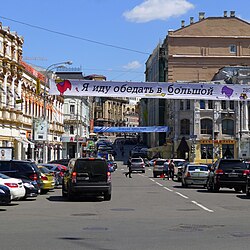
Kuznetsky Most (Russian: Кузне́цкий Мост, IPA: [kʊˈzʲnʲet͡skʲɪj ˈmost]) is a street in central Moscow, that runs from Bolshaya Dmitrovka Street to Lubyanka Street. The name, literally Blacksmith's Bridge, refers to the 18th-century bridge over the (now underground) Neglinnaya River, and a nearby foundry and the settlement of its workers. The street is administered by Tverskoy District (west) and Meshchansky District (east).
History
[edit]Early history
[edit]
Until the end of 15th century, Moscow was growing eastward, into Kitai-gorod. Prince Ivan III of Russia established his arsenal (Пушечный двор, Cannon Court) in the west, beyond the Neglinnaya river. Later, he also set up a settlement of former Pskov residents, abducted from their hometown after the wars of the 1480s. Population grew slowly until the 1737 fire which razed the area.
The Bridge
[edit]Soon after the fire, the territory was built out. Large territories north from the street were consolidated by the Vorontsov family estate. In 1754-57, architect Semyon Yakovlev built a stone bridge over Neglinnaya River to a design by Dmitry Ukhtomsky. The bridge over Neglinnaya lowlands extended 120 meters long and 12 meters wide; the shops between Kuznetsky Bridge and Vorontsov lands were literally standing on the edge of this bridge. The street was known as the home of notorious Darya Saltykova (1730-1801), condemned to life in prison for torturing her slaves.
19th century
[edit]
The Fire of Moscow (1812) spared Kuznetsky Most, where Napoleon's Guards were stationed in defense of the French colony in Moscow. In 1817-1819, the city locked the Neglinnaya River in a tunnel and demolished the redundant bridge - excluding its northern wall that supported surviving buildings. Kuznetsky Most became the symbol of French influence on Russians, immortalized in Woe from Wit by Alexandr Griboyedov.
After Emancipation reform of 1861, Kuznetsky Most became the financial center of Moscow, with historical Juncker Bank Building and Dzhamgarov Bank built in the 1890s. Art Nouveau landmark by Ivan Mashkov, the Sokol building (3, Kuznetsky Most) was built in 1903–1904. However, at that time its address was Kuznetsky Lane: the part of Kuznetsky Most west of Petrovka Street was then known as Kuznetsky Lane; two streets were merged only in 1922.
Modern history
[edit]

In the 1920s, the Bolshevik administration demolished the church on the corner of Kuznetsky Most and Lubyanka Street, creating Vorovsky Square. Nearby blocks were gradually converted to KGB offices after World War II; the blocks facing Lubyanka Square were torn down to make way for the Ministry of the Maritime Fleet and Alexey Dushkin's Detsky Mir department store. The latter was restored in 2014 and now hosts the world's largest mechanical clock,[1] "Raketa Monumental". The famous Russian perfume "Kuznetsky Most", from the "Novaya Zarya" brand, is named after the street[2].
Rapid transit
[edit]Kuznetsky Most, Lubyanka and Okhotny Ryad stations of the Moscow Metro are located nearby.
Gallery
[edit]-
 Kuznetsky Most and Cannon yard in the 16th century. Reconstruction by A. Vasnetsov
 -
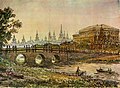 Kuznetsky Most in the 18th century.
 -
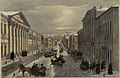 Kuznetsky Most in 1834
 -
 Kuznetsky Most in the middle of 19th century
 -
 Kuznetsky Most, a view to side of the street Lubyanka, the end of the 19th century
 -
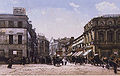 Kuznetsky Most. A view from the street Neglinnaya to side of the street Petrovka the end of the 19th century
 -
 Kuznetsky Most. A view from the street Petrovka to side of the street Rozhdestvenka, 1912
 -
 Kuznetsky Most. A view from the street Rozhdestvenka to side of the street Lubyanka, the beginning of the 1930s
 -
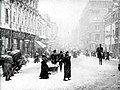 Kuznetsky Most in 1908
 -
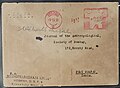 Letter by Mezhdunarodnaya Kniga (18, Kuznetsky Most) to Anthropological Society of Bombay, India, 1932.


.jpg)

References
[edit]- ^ "Навигатор ювелирной торговли".
- ^ "Новая Заря vs Невская Косметика: сравнение двух брендов, рождённых в советские времена". best-ussr-brands.ru. Retrieved 2025-11-26.
- Russian: П.В.Сытин, "Из истории московских улиц", М, 1948 (Sytin)

Kuznetsky Most
View on GrokipediaHistory
Early Origins and Medieval Development
The area encompassing Kuznetsky Most emerged as part of Moscow's medieval expansion along the Neglinnaya River, a tributary that bordered the early Kremlin and facilitated trade and defense.[11] As Moscow grew from its founding in 1147 under Yuri Dolgoruky, suburbs developed with specialized craft quarters, including Kuznetskaya for blacksmiths, reflecting the city's organization by professions to support military and economic needs.[12] In the 15th century, during the reign of Grand Prince Ivan III (1462–1505), the foundation of the Pushechny Dvor, Moscow's primary cannon and bell foundry, spurred the establishment of the Kuznetskaya Sloboda, a dedicated settlement of blacksmiths and metalworkers on the left bank of the Neglinnaya.[9][2] This development centralized ironworking activities essential for artillery production, marking the area's early specialization in heavy craftsmanship amid Muscovy's consolidation of power against rival principalities and the declining Golden Horde.[11] The sloboda's growth integrated with broader medieval urban patterns, where trade guilds and royal workshops bolstered the principality's military capabilities, though the physical bridge structure referenced in the street's name arose later in the 18th century.[2] By the late 15th century, this cluster of forges and residences laid the groundwork for Kuznetsky Most's enduring identity as a hub of metallurgical enterprise, predating its commercial prominence.[9]Construction and Role of the Bridge
The Kuznetsky Most bridge originated in the early 16th century, coinciding with the establishment of the Pushechny Dvor, Moscow's principal cannon foundry founded in the late 15th century under Grand Prince Ivan III to centralize artillery production. Initially constructed as a wooden span over the Neglinnaya River, it connected northern artisan settlements to the foundry, deriving its name from the "kuznetsy" (blacksmiths) who forged components there.[2][13] This bridge served a critical logistical function, enabling the haulage of raw metals, tools, and completed cannons toward the Kremlin, bolstering Moscow's defensive capabilities amid territorial expansions against rival principalities and the Grand Duchy of Lithuania. Frequent Neglinnaya floods underscored its strategic vulnerability, yet it remained indispensable for the foundry's operations, which produced up to several dozen cannons annually by the mid-16th century.[2] In 1754–1757, the decaying wooden structure was rebuilt in white stone to a design by architect Dmitry Ukhtomsky, executed by Semyon Yakovlev, with a width of 12 meters to enhance flood resistance and accommodate growing traffic.[14][15] By the early 19th century, persistent inundations prompted the Neglinnaya's enclosure in underground pipes during 1817–1819; a temporary 12-meter-wide, 120-meter-long bridge was erected over the worksite before being backfilled with earth, effectively burying the span and elevating the street above the culverted river.[9] This transformation shifted the bridge's role from a riverside crossing to an embedded segment of the emerging urban artery, paving the way for Kuznetsky Most's later commercial prominence while preserving its foundational transport utility.[9][2]Imperial Expansion in the 18th and 19th Centuries
During the 18th century, Kuznetsky Most transformed into Moscow's leading commercial street, drawing foreign merchants who opened boutiques specializing in luxury goods and European fashions. French shops, in particular, became emblematic of the street's allure, frequented by the elite and referenced in contemporary literature as a hub of refined taste amid Russia's imperial modernization efforts under Catherine the Great.[13] [16] Italian, British, and German establishments also contributed to its international character, fostering a cosmopolitan shopping district that reflected the empire's expanding trade networks with Europe.[5] The street escaped significant damage in the Fire of Moscow in 1812, enabling seamless continuity of its commercial vitality into the 19th century. By the 1830s, establishments like Gua's confectionery at No. 12 introduced novel retail experiences, while the street retained its reputation as a "sanctuary of luxury" until the 1917 Revolution.[16] [4] In the mid-19th century, Kuznetsky Most evolved into a financial center, accommodating foreign banks and reflecting the empire's economic maturation post-Emancipation Reform of 1861.[17] Notable developments included the opening of Moscow's first telephone station at No. 12 in 1882 and the construction of the Tretyakov revenue house in 1889, which served both residential and banking functions amid the street's blend of commerce and finance.[16] [18] This period underscored the street's role in channeling imperial wealth and innovation, with Scottish merchants establishing stores as early as 1885 to cater to affluent clientele.[19]Soviet Period Transformations
Following the October Revolution of 1917, private commercial enterprises along Kuznetsky Most underwent nationalization as part of the Bolshevik policy to seize bourgeois property and redistribute economic control to the state.[20] This process, accelerated by decrees in 1918, converted luxury boutiques and foreign-owned shops—once symbols of imperial fashion—into state-run outlets, cooperatives, or temporary propaganda spaces.[21] In the early 1920s, vacant storefronts on the street served as display sites for ROSTA propaganda posters, known as "windows of satire," reflecting the economic disruptions and ideological repurposing amid the Russian Civil War and New Economic Policy transition.[22] The 1930s brought urban reconstruction under Joseph Stalin's General Plan for Moscow, approved in 1935, which aimed to modernize the city through widened boulevards, monumental architecture, and improved traffic flow.[23] Several historic buildings in central districts, including those near Kuznetsky Most, were physically relocated—sometimes entire structures weighing thousands of tons—to facilitate street expansions and align with socialist urban ideals; approximately 100 such relocations occurred citywide during this period.[24] Concurrently, the Moscow Metro's first line opened on May 15, 1935, with Kuznetsky Most station serving as a key stop, embedding subterranean infrastructure beneath the street and necessitating surface alterations for entrances and ventilation.[25] This integration enhanced accessibility but subordinated the street's pre-revolutionary pedestrian character to proletarian mass transit priorities. Commercial functions evolved to support Soviet state goals, with the establishment of Dom Modelei, the official fashion house, at a location on Kuznetsky Most in 1935 to design standardized, ideologically aligned attire blending functionality and restrained luxury for the working class.[26] State enterprises like Mezhdunarodnaya Kniga, handling international book exports, operated from number 18 by 1932, underscoring the street's role in controlled foreign trade amid autarkic policies. Religious sites faced suppression, exemplified by the 1924 demolition of the Church of the Vedenie in Pskovichi along the route.[27] Post-World War II developments included further metro expansions, with a second Kuznetsky Most station on the Tagansko-Krasnopresnenskaya line opening in 1975, featuring utilitarian column-vault design reflective of Brezhnev-era functionalism.[28] Throughout the Soviet period, the street hosted "legendary" state shops catering to elite nomenclature or export needs, diverging from mass shortages elsewhere but preserving a vestige of its commercial heritage under centralized planning.[29] These transformations prioritized ideological conformity, infrastructure for industrialization, and state monopoly over private enterprise, diminishing the area's imperial-era vibrancy in favor of utilitarian socialism.Post-Soviet Revival and Modernization
Following the dissolution of the Soviet Union in 1991, Kuznetsky Most transitioned amid Russia's economic liberalization, initially featuring chaotic informal markets and bazaar-style trading encroaching on the roadway during the 1990s.[8] This period reflected broader post-Soviet urban disarray, with vendors setting up along the street, diminishing its pre-revolutionary elegance.[8] As part of Moscow's early 2000s urban renewal efforts under Mayor Yuri Luzhkov, Kuznetsky Most was among the first streets redesigned as a pedestrian zone, clearing vehicular traffic to prioritize foot traffic, commerce, and preservation of historic facades.[8] [30] By the mid-2010s, further enhancements under Mayor Sergei Sobyanin integrated it into expanded pedestrian networks, including widened sidewalks and improved lighting, aligning with citywide initiatives to foster vibrant public spaces. The pedestrianization spurred a commercial revival, restoring the street's legacy as a fashion epicenter. In 2009, KM20—a concept store at 20 Kuznetsky Most—opened, blending high-end international labels with Russian streetwear and designers like Gosha Rubchinskiy, earning acclaim as a global trendsetter.[31] [32] Multi-brand boutiques proliferated, attracting luxury shoppers and hosting fashion events, while the zone's ambiance supports street performances and tourism.[33] [34] Today, it exemplifies Moscow's shift from Soviet austerity to modern consumerism, with preserved architecture framing upscale retail.[35]Geography and Layout
Physical Location and Route
Kuznetsky Most is a street situated in central Moscow, Russia, within the Central Administrative Okrug, spanning the Tverskoy and Meshchansky administrative districts.[4][36] The street originates at the intersection with Bolshaya Dmitrovka Street, adjacent to the Bolshoi Theatre, and extends eastward approximately 800 meters to its terminus at Lubyanka Street near Lubyanka Square.[37][4][38] It traces an arcuate route parallel to Neglinnaya Street, enclosed within the Boulevard Ring, and descends slightly in elevation from west to east—a feature uncommon in Moscow's predominantly level topography.[4][10] Key intersections along the path include Rozhdestvenka Street to the south and Petrovka Street to the north, with building numbers assigned starting from the western Bolshaya Dmitrovka end.[4][37]Topography and Surrounding Infrastructure
Kuznetsky Most stretches approximately 700 meters in a roughly east-west direction through central Moscow, spanning the Meshchansky and Tverskoy districts of the Central Administrative Okrug.[4] The street's topography features a gentle incline, characteristic of Moscow's varied urban terrain, with an elevation gain of about 6 meters along its length, rendering it a moderately hilly path despite its relatively short distance.[1][39] This subtle rise aligns with the broader topography of the area, which sits at elevations around 140-150 meters above sea level, influenced by historical river valleys now integrated into the city's built environment.[40] The street is flanked by key surrounding thoroughfares, including Bolshaya Dmitrovka to the west, connecting to the vicinity of the Bolshoi Theatre, and Lubyanka Street to the east, near Lubyanka Square.[2] It intersects major north-south routes such as Ulitsa Petrovka and Rozhdestvenka Street, facilitating connectivity within Moscow's dense road network.[5] Beneath the surface, the Neglinnaya River—a tributary of the Moskva—flows in underground channels, a remnant of 19th-century engineering to mitigate flooding and urban expansion; the original Kuznetsky Bridge spanned this waterway before its culverting in the 1810s.[41][42] Modern infrastructure around Kuznetsky Most includes pedestrian-friendly zones with paving suited to foot traffic, integrated lighting, and proximity to commercial hubs, enhancing its role as a transitional artery between Moscow's historic core and commercial districts.[10] The area's urban density features mixed-use buildings with ground-level retail, supported by subsurface utilities adapted to the underground river's path, which required reinforced embankments during canalization efforts in the early 1800s.[42]Architecture and Landmarks
Notable Historical Buildings
The Popov Arcade (also known as Passazh) at 12 Kuznetsky Most, erected in 1877 by merchant Konstantin Popov and designed by architect Alexander Rezanov, functioned as an enclosed shopping gallery housing luxury retail outlets for items including jewelry, furs, and imported goods.[1][9] On July 1, 1882, Moscow's inaugural telephone exchange commenced operations within the building, catering initially to affluent and educated subscribers with limited lines.[16] The Tretyakov brothers' revenue house, located at the intersection with Rozhdestvenka Street (addressed as 13/9 Kuznetsky Most), was commissioned in 1892 by the merchant philanthropists Pavel and Sergei Tretyakov and designed by architect Adolf Kaminsky; it featured ground-floor commercial spaces, upper-level apartments, parquet and mosaic flooring, and rusticated walls, serving as an income-generating property while preserving neoclassical elements.[43][44] Designated a cultural heritage object, the structure retains its original facade detailing amid central Moscow's urban density.[5] At 16 Kuznetsky Most stands the former headquarters of the I. W. Juncker & Co. bank and trading house, originally constructed earlier in the 19th century and substantially redesigned in 1876 to accommodate banking operations and commercial activities in an Italian Renaissance Revival style with ornate detailing.[4] A three-story edifice at an adjacent site, built in 1893 to the designs of architect Vladimir Zagorsky, housed the Kuznetsky Passage department store, contributing to the street's early retail prominence with its functional layout for multiple vendors.[4] These structures, preserved despite Soviet-era modifications and post-1991 commercial repurposing, underscore Kuznetsky Most's evolution from artisanal workshops to elite financial and fashion district in the late Imperial period.[5]Architectural Styles and Preservation
The architecture of Kuznetsky Most exemplifies a progression of styles from the 18th to early 20th centuries, dominated by neoclassical and French-inspired designs in the imperial era, transitioning to eclectic and Art Nouveau forms amid rapid commercialization. Structures like the 1901 eclectic "office building" at an unspecified address feature multi-story facades with ornate detailing, reflecting the street's role as a financial and retail center.[45] French architectural trends, characterized by symmetrical elevations and decorative elements, were particularly prominent on the street during this period, influencing buildings constructed for noble families and merchants.[46] Notable examples include the Art Nouveau fur shop at No. 12, designed by architect A.E. Erichson in 1903 as a four-story structure with basement spanning over 2,000 m², emphasizing flowing lines and organic motifs typical of the style.[47] The three-story Kuznetsky Passage store, built in 1893 by V.P. Zagorsky, incorporates classical Russian elements adapted for commercial use.[4] Bank buildings from the 1890s, such as the Juncker and Dzhamgarov institutions, blend historicist features with modern functionality, underscoring the street's financial prominence post-1861 emancipation reforms. Preservation initiatives have focused on restoring pre-revolutionary facades while integrating contemporary uses, as seen in the Kuznetsky Most 12 project, which meticulously reconstructed structural elements and highlighted original stony materiality against new interventions.[48] Many historic buildings remain intact, showcasing a variety of preserved styles that contribute to the street's visual coherence.[7] These efforts align with broader Moscow programs, including facade renovations near metro entrances like Kuznetsky Most station, initiated in October of an unspecified year to maintain architectural integrity amid urban development.[49] Despite general challenges in heritage protection, such as periodic de-listing of sites citywide, targeted restorations on Kuznetsky Most prioritize authenticity over demolition.[50]Economic and Cultural Role
Historical Commercial Importance
Kuznetsky Most developed into a significant commercial artery in Moscow during the 18th century, attracting merchants and shoppers with its array of boutiques, bookstores, photographic studios, and restaurants that embodied urban opulence.[5] French émigrés and traders played a pivotal role, establishing shops that specialized in luxury apparel and accessories, which drew affluent Muscovites seeking European styles.[9] This influx fostered a distinctly Gallic atmosphere, with French spoken commonly among vendors and customers, positioning the street as an early hub for imported fashion and refined consumer goods.[9] By the early 19th century, Kuznetsky Most had solidified its reputation as Moscow's preeminent shopping destination, often dubbed a "sanctuary of luxury" until the 1917 Revolution.[4] Tailors, milliners, and purveyors of high-end fabrics proliferated, with French-owned establishments dominating the trade in ready-to-wear and bespoke clothing, as detailed in historical accounts of Moscow's early 19th-century fashion sector.[9] The street's commercial allure was captured in Alexander Griboyedov's 1823 satirical play Woe from Wit, which lampooned the obsession with French-influenced dandyism and modishness prevalent there.[16] Italian, British, and German merchants also contributed, but French ateliers set the tone for luxury retail, making the area a symbol of cosmopolitan commerce.[5] In the mid-to-late 19th century, Kuznetsky Most expanded its economic footprint beyond fashion into finance following the 1861 Emancipation Reform, hosting institutions like the Juncker and Dzhamgarov banks amid ongoing retail vibrancy.[51] The street's prestige as Moscow's most fashionable address persisted, with elite shops and ateliers—many still French-operated—catering to the nobility and emerging bourgeoisie until the Bolshevik upheaval curtailed private enterprise.[52] This era marked the zenith of its historical commercial importance, blending retail innovation with cultural exchange in the imperial capital.[4]Fashion and Retail Evolution
Kuznetsky Most developed into a key retail corridor in the 18th century, drawing affluent shoppers to its array of boutiques, bookstores, and specialty outlets for clothing, furniture, and confections.[5] By the 19th century, the street solidified its status as Moscow's fashion epicenter, hosting tailors, milliners, and importers of European luxury goods, which positioned it as a domestic equivalent to Paris's haute couture districts.[10][4] This prominence persisted until the 1917 Bolshevik Revolution, after which private commerce was curtailed, though the street retained over 100 shops specializing in high-end wares by the early 20th century.[4][34] Under Soviet rule, retail evolved toward centralized, state-managed operations, emphasizing utilitarian production over luxury. A prominent fashion house opened on Kuznetsky Most toward the end of World War II in 1945, serving as a hub for designing standardized apparel models disseminated nationwide through ateliers and factories.[53] This institution, among others emerging from 1920s-1930s workshops, prioritized mass-market clothing aligned with ideological goals, conducting periodic shows to showcase prototypes for industrial replication rather than bespoke or imported fashions.[53] Post-1991 privatization spurred a resurgence, transforming Kuznetsky Most into a nexus for contemporary retail with multi-brand boutiques and designer outlets. The 2009 launch of KM20 at number 20 marked a pivotal shift, establishing the street as a vanguard for "post-Soviet" style through curated selections of global labels like Off-White, Vetements, and Gosha Rubchinskiy, alongside experimental Russian brands.[54] Today, it features independent stores offering trendy accessories, French and German imports, and local designers, sustaining its legacy amid Moscow's broader luxury market while adapting to e-commerce and experiential retail trends.[33][5]Cultural Significance and Events
Kuznetsky Most occupies a prominent place in Russian literature as a emblem of imported fashion and cosmopolitan influence. In Alexander Griboyedov's 1824 satirical comedy Woe from Wit, the street is invoked by the character Famusov to critique superficial Westernization: "Frenchies from there bring us fashions in ladies' hats and all the frippery, authors and muses, and wondrous ideas."[9] This depiction reflected the street's 19th-century reality as Moscow's primary venue for European boutiques, milliners, and tailors, where aristocrats like those in Leo Tolstoy's Anna Karenina shopped at establishments such as Gaultier's at No. 20.[1] The area's allure extended to intellectual gatherings, including literary meetings hosted there, such as George Bernard Shaw's encounters with Soviet writers in the early 20th century.[5] Beyond literature, Kuznetsky Most has fostered a tradition of public cultural activities. Since the 18th century, it has drawn crowds for its bookshops and salons, evolving into a site for poetry readings, theatrical performances in adjacent parks, and street musicians entertaining passersby.[5] Proximity to Teatralnaya Square and the Bolshoi Theatre amplifies its role as a prelude to major artistic venues, with the street itself hosting informal rendezvous and artistic exchanges.[55] In contemporary times, the street sustains cultural vibrancy through exhibitions and events organized by the TSUM Art Foundation, featuring contemporary art projects, alongside charity initiatives supporting children's causes and cancer patients.[5] Nightlife venues, including lounge bars and clubs with international DJs, contribute to ongoing performances and social gatherings, maintaining Kuznetsky Most's status as a nexus of Moscow's evolving cultural scene.[56]Transportation Infrastructure
Moscow Metro Integration
Kuznetsky Most benefits from direct integration with the Moscow Metro via the Kuznetsky Most station on the Tagansko-Krasnopresnenskaya line (Line 7). This station, situated in the Meshchansky District beneath the central area of the street, was opened in 1975 as part of an extension connecting prior segments of the line.[57] The design, a column tri-vault structure by architects Nina Aleshin and Natalya Samoylova, represented the first such configuration built since the 1950s, featuring white marble walls, metallic accents, and thematic elements evoking urban modernity.[57] Entrances to the station are positioned adjacent to the street, including a ground-level vestibule in the courtyard at Rozhdestvenka Street 6/20/9, between Pushechnaya Street and Kuznetsky Most, enabling seamless pedestrian access for shoppers and residents along the thoroughfare.[58] This proximity enhances connectivity, with escalators descending approximately 60 meters to the platform level, accommodating high foot traffic in this commercial district.[57] The street's metro access extends to nearby interchanges; Lubyanka station on the Sokolnicheskaya line (Line 1), located about 500 meters eastward, provides additional options for radial travel toward the city center and suburbs.[7] This dual-line proximity supports efficient transit without direct underground transfer, though surface walking connects the stations, integrating Kuznetsky Most into the broader Metro network serving over 9 million daily passengers as of recent years.[59]Surface Transit and Accessibility
Kuznetsky Most is accessible via multiple bus routes operated by Mosgortrans, Moscow's public transport authority, with dedicated stops along the street such as the Kuznetsky Most halt serving lines like 1A and others connecting to central districts.[60] These routes integrate with the broader network, providing frequent service from areas like Lubyanka and Petrovka, typically every 10-30 minutes during peak hours, though exact frequencies vary by line and time. Trolleybuses operate on adjacent streets like Neglinnaya, offering additional surface options, while trams are absent in this densely built central zone, which prioritizes metro and bus connectivity over rail-based surface transit.[61][62] Pedestrian accessibility is a strength of the area, given its location in Moscow's historic core with wide sidewalks and proximity to major intersections like those with Petrovka and Rozhdestvenka streets, allowing easy walking distances under 500 meters to linked sites. The street's flat topography and central positioning support high foot traffic, with over 300 km of citywide roads enhanced for pedestrian flow, though surface transit integration emphasizes bus stops with shelters rather than extensive bike lanes. For wheelchair users, about 90% of buses and 70% of trolleybuses feature low-floor designs with deployable ramps, marked by accessibility icons, enabling assisted boarding on applicable routes; however, sidewalk curb ramps remain inconsistent, with some segments lacking ramps or featuring uneven paving that complicates navigation in the vicinity.[63][64][65] Overall improvements in Moscow's surface fleet, including climate-controlled vehicles with navigation aids, have enhanced reliability since 2020, reducing average travel times and boosting predictability for users along central corridors like Kuznetsky Most. Despite these advances, full accessibility for disabled passengers lags behind Western standards, with reports noting persistent barriers in pedestrian infrastructure despite ongoing retrofits. Private options like taxis and ride-hailing services supplement public transit, often providing door-to-door access without the physical demands of bus boarding.[66][67]References
- https://commons.wikimedia.org/wiki/File:Moscow_Kuznetsky_Most_7_building_03-2016_img1.jpg