Hubbry Logo
Lady Mary CokeLady Mary CokeMain
Open search
Lady Mary Coke
Community hub
Lady Mary Coke
logo
8 pages, 0 posts
0 subscribers
Be the first to start a discussion here.
Lady Mary Coke
Lady Mary Coke
from Wikipedia

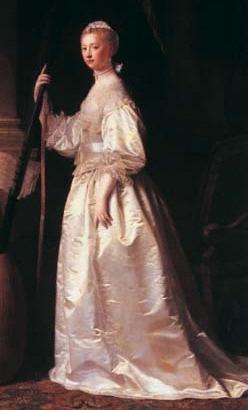
Lady Mary Coke (6 February 1727 – 30 September 1811) was an English noblewoman known for her letters and private journal. She made pointed observations of people in her circle and political figures. Although not intended for publication, an edition of her letters and journal, including entries from 1766 to 1774, was published in 1889 by a distant great-nephew.

Key Information

Life

[edit]

Marriage and separation

[edit]

She was the fifth and youngest daughter of the soldier and politician John Campbell, 2nd Duke of Argyll (1680–1743), and his second wife, Jane (c.1683–1767), a maid of honour to Queen Anne and Caroline, Princess of Wales. Mary grew up in Sudbrook or in London, visiting her father's ancestral estate at Inveraray Castle in Argyll at least once and possibly more often.

Holkham Hall, Norfolk
The marble hall at Holkham. The ornate decoration wasn't finished until 1764, overseen by Lady Coke's mother in-law.

She married on 1 April 1747, Edward Coke, Viscount Coke (1719–1753); son of Thomas Coke, 1st Earl of Leicester and Lady Margaret Tufton. Their courtship had been strained, and in retaliation Edward left her alone on their wedding night and from then on virtually imprisoned her at his family estate at Holkham Hall, Norfolk with his parents. She reacted by refusing to have intercourse with him. She never used the title Viscountess Coke.

Their families went to litigation, and eventually produced a settlement in 1750 whereby Lady Mary could live with her mother at Sudbrook but had to remain married to Coke until his death, which came in 1753, when Mary was 26. Already having received a handsome legacy from her father, she set out on her life of independence (she never remarried), that became (as her entry in the Dictionary of National Biography puts it) "marked by gossip, travel, devotion to royalty, and self-imposed misadventure".[1]

Mary occupied Aubrey House, in the Campden Hill area of Holland Park from 1767 to 1788.[2] A London County Council blue plaque commemorates her and other residents of the house.[3] In 1786 she purchased a house in Chelsea from the Ashburnham estate and in 1793, she purchased additional land at Sandy End, Chelsea.[4] In 1807, she sold her Chelsea estate and moved to her final home at Chiswick.

Royal romance?

[edit]

In her grandiose shows of grief on the death of Prince Edward, Duke of York and Albany, in 1767,[5] Lady Mary alleged in veiled hints that they had been secretly married, a claim that brought her further derision. He had been a subject of an intensely emotional and lengthy flirtation, which she alleged had been passionate on both sides. According to most accounts, the relationship had been one-sided, with York regarding it and her as a joke.[6]

Trips to Europe

[edit]

On her first trip to Europe in 1770–71, Lady Mary became a friend of Empress Maria Theresa and was warmly welcomed at the Viennese court. She alienated her friend on her third visit in 1773 by interfering in court intrigue.[citation needed] Mary, however, did not see that this predicament had been self-inflicted and from then on saw any disaster – servants' incompetence, unsuccessful auction bids, rheumatism – as part of a Maria Theresa-instigated plot pursuing her across Europe. Emily Barry (née Stanhope, Countess of Barrymore, and wife of the 6th Earl) was accused by Mary of luring away her previously faithful servant whilst she was in Paris in 1775, to aid an alleged assassination plot against her by Maria Theresa's daughter Marie Antoinette and her underlings.

Walpole

[edit]

It was the 1775 event which finally drove away another of Coke's close friends, Horace Walpole. Though devoted and mock-gallant in his flattery of her (his The Castle of Otranto in 1765 was dedicated to her), Walpole also believed that she had a lack of a sense of humour and pride in her own self-importance which made most of her misfortunes self-inflicted. He called her and two of her sisters (Caroline Townshend, Baroness Greenwich, and Lady Betty Mackenzie) the three furies, and wrote elsewhere:

'She was much a friend of mine, but a later marriage,[7] which she particularly disapproved, having flattered herself with the hopes of one just a step higher, has a little cooled our friendship. In short, though she is so greatly born, she has a frenzy for royalty, and will fall in love with and at the feet of the Great Duke and Duchess, especially the former, for next to being an empress herself, she adores the Empress Queen, or did—for perhaps that passion not being quite reciprocal, may have waned. However ... Lady Mary has a thousand virtues and good qualities: she is noble, generous, high-spirited, undauntable, is most friendly, sincere, affectionate, and above any mean action. She loves attention, and I wish you to pay it even for my sake, for I would do anything to serve her. I have often tried to laugh her out of her weakness, but as she is very serious, she is so in that, and if all the sovereigns in Europe combined to slight her, she still would put her trust in the next generation of princes. Her heart is excellent, and deserves and would become a crown, and that is the best of all excuses for desiring one.'[8]

Political observer

[edit]

Lady Mary saw evidence of a conspiracy (this time a Catholic one against the Protestant succession) in Margaret Nicholson's attempt to assassinate George III in 1786 and Maria Fitzherbert's rumoured marriage to George, Prince of Wales.

Some of her observations were more accurate, for example her praise of the Duchess of Devonshire's political skill, in 1787: "As soon as ever any young man comes from abroad he is immediately invited to Devonshire House and to Chatsworth—and by that means he is to be of the [Whig] opposition".[9] She avidly collected political information, deploying it to protect herself, her friends and her family, and passing it on to her sisters in her journal. She was a frequent visitor to the Houses of Commons and Lords, witnessing political controversies such as Warren Hastings's trial and the debate over the Cumberland election petition in 1768 (in which she backed Sir James Lowther).

Death

[edit]

She bought Morton House, Chiswick, in 1807, four years before her death there in 1811.[10] She appreciated that Sir Stephen Fox had built it late in the 17th century and the house had been little altered since. After her death, it was acquired by the Duke of Devonshire.

Lady Mary was buried in Westminster Abbey in her father's family vault on 11 October 1811.

Journal

[edit]

Lady Mary is mainly known from her journal, never intended for publication and instead written for self-amusement and for the amusement of her sisters, most especially Anne (1719/20–1785), who had married William Wentworth, 2nd Earl of Strafford, in 1741. Her Oxford Dictionary of National Biography (DNB) entry states: "The journal ranges from banal descriptions of card games and weather to perceptive social observation and expressions of sincere affection, often closely and unselfconsciously juxtaposed. The personality which emerges from the whole combines elements of the mundane and the preposterous with the deeply sympathetic."

She began writing it in August 1766 and stopped making regular additions in January 1791, when Anne's husband died. The published edition includes entries only up to December 1774. (Her great-great-great-nephew James Archibald Home edited this edition.) After 1791, Lady Mary continued to pass on her opinions to friends and relatives, such as her niece Lady Frances Scott (her sister Caroline's daughter by her first marriage to Francis, earl of Dalkeith) and her first cousin once removed Lady Louisa Stuart. Louisa Stuart in 1827 wrote an acerbic memoir of Lady Mary, which is another major source for her life.[11]

Publication

[edit]
  • Lady Mary Coke (1889). James Archibald Home (ed.). The letters and journals of Lady Mary Coke.

Notes

[edit]

Sources

[edit]
Revisions and contributorsEdit on WikipediaRead on Wikipedia
from Grokipedia
Lady Mary Coke (1727–1811), née Mary Campbell, was a British noblewoman of Scottish aristocratic descent, recognized primarily for her extensive private journals that document the social, political, and cultural milieu of eighteenth-century . The youngest daughter of John Campbell, 2nd , and his second wife Jane, she received informal education in reading, writing, and sewing typical of her era and class. In 1747, she entered a with , Viscount Coke and heir to the 1st , which deteriorated rapidly; the couple separated legally in 1750 after allegations of cruelty and infidelity, and she became a upon his death in 1753. Possessed of from her paternal inheritance, Coke embarked on prolonged travels across starting in the , where she encountered figures such as Empress and members of the French court. Her diaries, maintained from 1766 to 1791 and selectively published in four volumes edited by J. A. Home between 1889 and 1896, offer unvarnished accounts of elite gossip, royal events, and personal reflections, serving as a for historians despite their partial editing and the author's occasionally acerbic perspective.

Early Life and Family

Birth and Upbringing

Lady Mary Campbell, who later became Lady Mary Coke, was born on 6 February 1727 as the fifth and youngest daughter of John Campbell, 2nd (1678–1743), and his second wife, Jane Warburton (c. 1683–1768), daughter of Thomas Warburton of Winnington, . The duke, a Scottish nobleman, , and who held significant influence in both Scottish and British affairs, including command during the 1715 Jacobite rising, ensured his daughters' immersion in aristocratic circles from an early age. Her birthplace is recorded variably as Sudbrook Park, the family's villa in Richmond, , or 27 in , reflecting the mobility of noble households between Scottish estates and English residences. Upbringing in such an environment exposed her to the political turbulence of the era, including Hanoverian loyalties amid Jacobite threats, though specific childhood events remain sparsely documented beyond family correspondence. Consistent with conventions for noblewomen of the period, Lady Mary received no formal schooling but acquired practical accomplishments through private tutors, including fluency in French and proficiency in music and , which later informed her voluminous letter-writing and journals. Her father's death in 1743, when she was sixteen, shifted family dynamics, with her mother overseeing preparations for societal debut amid the Campbells' extensive noble connections.

Noble Lineage and Connections

Lady Mary Campbell, later Coke, was born on 6 February 1727 as the fifth and youngest daughter of John Campbell, 2nd (1678–1743), a prominent , politician, and who played a decisive role in defeating Jacobite forces at the in 1715. Her father descended from the ancient Campbell clan, which held the earldom of since 1457 and was elevated to dukedom in 1701, establishing the family as one of Scotland's most influential noble houses with extensive lands in and connections to the Act of Union. Her mother, Jane Kerr (c. 1695–1767), was the daughter of William Kerr, 2nd (1668–1722), linking the Campbells to another longstanding Scottish noble family originating in the Borders region during the and holding titles since the . The Kerrs' prominence provided additional ties to Lowland , including alliances with other marcher lords through centuries of conflicts and royal service. Through her siblings, Lady Mary maintained connections to key figures in : her brother Archibald Campbell succeeded as 3rd in 1743 and served as Lord Justice General of ; another brother, Lord William Campbell, pursued military and colonial roles; her sister Lady Jean married John Hope, 2nd Earl of Hopetoun, forging links to the Hopetoun family estates; Lady Anne wed James Stuart-Mackenzie, brother of the politician Lord Bute; and Lady Caroline became Countess of via marriage to Francis Scott, Earl of . These familial bonds positioned her within networks of political influence, military command, and landed wealth spanning and , exemplified by shared monuments and estates like those commemorated at .

Marriage and Marital Breakdown

Courtship and Wedding

Lady Mary Campbell, youngest daughter of John Campbell, 4th , was betrothed to Edward Coke, Viscount Coke and to Thomas Coke, 1st , through an arranged union driven by aristocratic familial alliances and estate consolidation rather than mutual inclination. Such matches prioritized property and lineage over individual preference, a prevailing norm in 18th-century . The proved strained, marked by Mary's evident reluctance and opposition to the , though she ultimately acquiesced without documented resistance sufficient to derail it. , known for his dissipated habits including and intemperance even prior to the , offered little basis for romantic appeal. The wedding took place on 1 April 1747, formalizing the alliance amid the customary pomp of elite society, though specific ceremonial details remain sparsely recorded in surviving accounts. The event underscored the transactional nature of the bond, setting the stage for subsequent discord.

Infidelity and Discord

Lady Mary Coke married Edward Coke, Viscount Coke, on 1 April 1747, in a union arranged primarily for social and financial advantage, though she personally opposed it. The wedding night proved disastrous, as Coke abandoned her to pursue after she refused , setting a tone of mutual antagonism from the outset. The marriage remained unconsummated, with Coke's habitual drunkenness, , and sharp-tongued clashing against Lady Mary's stubborn refusal to cohabit fully. Discord escalated through repeated trial separations and Coke's open infidelity, as he took to flaunting his mistress in public, deepening Lady Mary's sense of humiliation and isolation. By 1749, Coke confined her to an apartment at , his family's estate, dismissing her personal maid and severely restricting visitors, an action contemporaries viewed as virtual imprisonment. She later cited instances of physical mistreatment, including Coke striking her arm and tearing her lace ruffle, as evidence of his violent temperament. These marital strains, characterized by emotional cruelty, physical confinement, and unchecked philandering on Coke's part, prompted Lady Mary to retreat from society, shunning public life amid the ensuing and maintaining minimal contacts, such as with Lady Caroline Lennox. Coke's dissolute behavior ultimately contributed to his early death in 1753 at age 33, leaving her widowed at 26, though the preceding years of discord had already irreparably fractured the relationship. Lady Mary Coke married Edward Coke, Viscount Coke and heir to the , on 1 April 1747, but the marriage quickly deteriorated due to mutual discord and his dissolute lifestyle. Viscount Coke resided primarily in , pursuing extravagant and irregular habits, while Lady Mary remained isolated at the family estate of in . The couple had no children, exacerbating tensions over inheritance and personal freedoms. By approximately 1750, three years prior to Viscount Coke's death, Lady Mary pursued legal recourse for separation, as the marriage was deemed irreconcilable from its outset. Their families negotiated the terms, resulting in a formal that granted her partial independence, though full divorce with remarriage remained unavailable under at the time. Court proceedings, likely in the courts handling matrimonial causes, enabled her to escape direct and secure some financial provisions, including drawn from her husband's resources and her own family legacies. The separation endured until Viscount Coke's untimely death on 28 May 1753 at age 34, after which Lady Mary, then 26, inherited certain entitlements but received no widow's due to the prior marital rupture. This outcome left her financially self-sufficient through jointures and paternal support from the , allowing her to live independently without remarriage. No prolonged litigation over assets ensued post-mortem, as the , her father-in-law, managed the estate succession to his grandson Thomas Coke.

British Social and Court Circles

High Society Engagement

Following the death of her husband on 19 May 1753, Lady Mary Coke returned to , where she rented a house and immersed herself in the activities of , supported by a substantial jointure of £2,500 annually from her father's estate. Her participation in elite social circles involved frequent attendance at court functions, operas, and private gatherings among the , as detailed in her extensive diaries spanning 1766 to 1791. These records highlight her daily interactions, including visits to noble residences and observations of social customs, such as her critique of Lady Grosvenor appearing in an apron after a park walk, which she deemed inappropriate for . Lady Coke's engagements often intersected with political discourse, as evidenced by her journal entry on 8 July 1767 noting events in London that blurred the lines between aristocratic leisure and governance. She praised figures like Georgiana, Duchess of Devonshire, for exemplary politeness and manners during court appearances and intimate meetings, reflecting her insider perspective on elite comportment. Her diaries also capture matchmaking and marriage prospects within the ton, with examples of engagements formed at opera houses reinforcing social alliances. Selective in her commitments, Lady Coke declined invitations from prominent hosts like Lord and Lady Hertford, yet maintained a central role through gossip and commentary on peers' behaviors, health, and entertainments, such as the variety of wines served by the Duchess of Devonshire. Her devotion to royalty and court intrigue further embedded her in these networks, where she navigated and alliances amid the rigid protocols of 18th-century British aristocracy.

Royal Family Interactions and Rumors

Lady Mary Coke served as a to Queen Charlotte, consort of King George III, providing her with direct access to the royal household during the 1760s and 1770s. In this capacity, she observed court life closely, documenting interactions and events in her extensive private journals and letters, which frequently referenced members of the royal family alongside other prominent figures of the era. Her diaries reveal personal encounters with the royal children, such as visits to where the younger princesses were under the care of governess Lady Charlotte Finch. Shortly before the birth of (later Princess Royal) on September 29, 1766, Coke noted the prince's charm but described the two eldest princesses as "very plain" and the youngest as "pretty," reflecting her candid assessments of their appearances. She similarly praised the infant Princess Augusta, born January 8, 1768, as "the most beautiful infant I ever saw" during early observations, highlighting her frequent commentary on the family's domestic dynamics. Coke's devotion to the bordered on fanaticism, shaping her immersion in court gossip and intrigue, though her eccentricities often drew scrutiny. Following the death of Prince Edward, Duke of York and Albany—brother to —on September 17, 1767, she displayed excessive public grief, which contemporaries ridiculed as disproportionate and indicative of her intense royal attachments. This behavior fueled perceptions of her as overly sentimental toward the family, though no verified evidence supports deeper personal involvements beyond her documented observations and roles. Her journals, while rich in detail, occasionally reflected biases toward royalty that contemporaries viewed as obsessive, contributing to her reputation within elite circles.

Associations with Figures like Horace Walpole

Lady Mary Coke maintained a correspondence with , the influential writer, politician, and antiquarian, as documented in the Yale Edition of his letters, which includes exchanges with her alongside other notable women of the era. Their interactions reflected the epistolary culture of 18th-century British aristocracy, where Walpole's wit and gossip drew in social observers like Coke, who valued his insights into court and literary circles. This connection spanned the and beyond, with Walpole addressing her directly in surviving missives that reveal mutual interest in political scandals and personal misfortunes. In her private journals, Coke frequently referenced Walpole, citing his opinions on contemporary events such as operas and diplomatic intrigues, indicating a familiarity gained through shared social venues like assemblies and theaters. For instance, on December 20, 1768, she noted Walpole's dissatisfaction with a new production, underscoring their overlapping attendance at cultural gatherings. Walpole's own letters recount evenings where Coke visited post-opera, alongside figures like Lady Pembroke, highlighting her integration into his network of intellectuals and aristocrats who frequented such events into the early hours. These associations extended to analogous figures in polite society, including letter-writers and chroniclers like , with whom Coke shared traits of sharp commentary on , though direct evidence of their rapport remains anecdotal in period accounts. Coke's journals portray her engaging with Walpole's circle, where discussions often veered toward rumors and political maneuvers, aligning with her own penchant for detailed societal critique. Such ties positioned her amid the era's intellectual exchanges, though her litigious occasionally strained these relationships, as Walpole noted her abroad travels amid domestic woes.

European Travels and Observations

Reasons for Departure

Following the death of her husband, Viscount Edward Coke, on October 9, 1753, Lady Mary Coke, then aged 26, secured a substantial jointure of £2,500 per annum, granting her considerable financial independence as a widow. This settlement, combined with prior pin money of £500 annually during their separation, enabled her to maintain residences, engage in social pursuits, and undertake extended travels without reliance on family or remarriage. For the first fourteen years of widowhood, she resided quietly at her mother's estate in Sudbrook, Surrey, limiting her activities to domestic interests such as gardening, reading, and occasional card games, while corresponding extensively with acquaintances. By 1767, Lady Mary relocated to , occupying homes in , , and Chelsea, where she immersed herself in , forming friendships and attending events that showcased her wit and observational acuity. Despite this reintegration, her departure from in 1770 for a continental tour—initially to , followed by visits to France and —stemmed from a desire to expand her beyond Britain's familiar circles and to evade the diminishing novelty or interpersonal tensions of domestic life. Her financial security facilitated such independence, allowing her to impress foreign courts, as evidenced by her warm reception at the Viennese imperial court under Empress , where she cultivated influential connections unavailable in . These travels aligned with broader patterns among affluent Georgian widows seeking prestige, intellectual stimulation, and respite from local scandals or rivalries, though Lady Mary's journals reveal no singular precipitating event like health decline or legal compulsion. Instead, her motivations reflected a proactive pursuit of elevated society abroad, tempered by eventual returns prompted by waning favor at European courts due to her perceived self-importance and disputes. This pattern recurred in subsequent journeys through the , underscoring travel as a means of self-directed reinvention rather than mere .

Journeys Across the Continent

Lady Mary Coke undertook several extended journeys across following her , with her travels spanning the and documented extensively in her private journals. These tours focused on visits to prominent royal courts, particularly in and , where she sought among European nobility. Her first major tour began in 1770, taking her through to the Habsburg court in . In , Lady Mary was received at Versailles, the opulent royal residence, where she met the Dauphin Louis-Auguste (the future ) and his bride shortly after their marriage that year. These encounters highlighted her access to high circles, facilitated by her noble status and connections. From , she proceeded eastward across the continent to , arriving amid the grandeur of the Habsburg empire. At the Viennese court, Lady Mary received a warm welcome from Empress , forming a that granted her privileged access to court life and social events. This favor persisted until , when court intrigues—exacerbated by Lady Mary's perceived self-importance and suspicions—led to a rift, after which she harbored beliefs in Austrian conspiracies directed against her. Her journals from this period detail observations of court etiquette, , and personalities, reflecting a keen, if sometimes paranoid, eye for detail. Subsequent tours in the 1770s repeated crossings of the continent, with recurrent visits to and , emphasizing her pattern of seeking validation and diversion abroad amid domestic isolation. These journeys, often lasting months, involved navigating post roads, ferries, and inns, underscoring the physical demands of 18th-century travel for a woman of her standing. While specific itineraries for later tours remain less precisely dated in surviving accounts, they reinforced her reputation as a peripatetic figure in European aristocratic networks.

Political and Societal Commentary

Chronicling Events

Lady Mary Coke maintained extensive journals that meticulously documented political and social events in Britain from 1756 to around 1791, providing dated entries on proceedings, governmental shifts, and public scandals. Her records often captured the minutiae of daily high-society interactions intertwined with broader happenings, such as ministerial appointments and royal health crises, reflecting her proximity to aristocratic and circles. A notable example includes her December 1768 entry detailing the of the royal children against , where she expressed apprehension over the procedure's risks amid widespread public debate on . She also chronicled factional intrigue at court, as in her January 13, 1767, observation of noblewomen's attire signaling political alignments, interpreting dress choices as indicators of favoritism toward King George III's inner circle. These accounts extended to parliamentary maneuvers and noble marriages with political implications, underscoring her attentiveness to how personal alliances influenced . Coke's entries on events like the political realignments, including references to figures such as the of something (from context), reveal her tracking of power transitions post-George III's ascension, often gleaned from conversations and gazettes. Her journals thus serve as a contemporaneous ledger of perspectives on turbulence, including early stirrings related to colonial tensions, though filtered through her social milieu rather than direct involvement.

Personal Perspectives on Politics and Royalty

Lady Mary Coke expressed profound devotion to the British monarchy, particularly King George III, framing her political observations through the lens of threats to royal stability and Protestant succession. In her journals, she interpreted events like Margaret Nicholson's 1786 assassination attempt on the King as evidence of a Catholic conspiracy against the Hanoverian line, reflecting her staunch defense of the established order. This perspective aligned with broader Tory-leaning concerns over religious and dynastic security, though her family's Whig heritage—stemming from her father, John Campbell, 2nd Duke of Argyll—suggests her views were personally idiosyncratic rather than factional dogma. Her commentary on royal conduct often blended admiration with pointed criticism of personal failings. For instance, upon learning in 1769 that , Queen Charlotte, her brother Prince Ernest, and Lady Effingham had taken an informal walk at Richmond without full entourage, Coke recorded indignation at the breach of decorum, deeming it unsurprising given the King's historical "undutiful" behavior toward his own parents. Such entries reveal a traditionalist reverence for monarchical protocol, viewing lapses as symptomatic of moral weakness that could undermine public respect for . Coke's political insights were inextricably tied to court dynamics, where she served briefly as a to Queen Charlotte before her 1760 separation from Lord Coke. She chronicled favoritism and intrigue, as in 1767 when she suspected Scottish nobles like the Duchess of Hamilton and Lady Susan Stewart of scheming against royal preferences in court dress and appointments. Her excessive mourning for the 1767 death of Prince Edward, Duke of York—George III's brother—drew ridicule, highlighting her emotional investment in the royal family as a bulwark against political instability. While Coke's diaries evince no overt Jacobite sympathies—contrary to some romanticized narratives of Scottish nobility—her writings emphasize preservation of the Hanoverian amid perceived encroachments by Whig ministers and foreign influences. This outlook, dramatized by her self-perceived centrality to events, underscores a prioritizing monarchical absolutism over parliamentary , though her European travels later tempered such insularity with comparative admiration for continental courts like Maria Theresa's.

Final Years and Demise

Return and Circumstances

In the early , following decades of intermittent European travels documented in her journals up to 1791, Lady Mary Coke established a permanent residence in by purchasing Morton House (also known as Moreton Hall) in , a mansion with seven acres of walled gardens, in 1807. This acquisition reflected her financial independence as a widow, sustained by a generous legacy from her father, John Campbell, 2nd , and her late husband's estate after his death in 1753. Coke, then in her eighties, lived at Morton House amid the social and political turbulence of the , though her private writings from earlier periods suggest a continued interest in royal and courtly affairs that likely persisted in her isolation. The property's location on Chiswick Mall provided proximity to while offering seclusion, aligning with her reputation as a formidable and reclusive figure in later life, marked by personal eccentricities such as unconventional attire. Her final years were spent in relative solitude at this estate, supported by her accumulated wealth and unencumbered by family obligations, as she had no surviving children from her brief marriage. This phase represented a return to British soil after extensive continental sojourns, culminating in her death at Morton House on 30 September 1811, at age 84.

Death and Immediate Aftermath

Lady Mary Coke died on 30 September 1811 at Morton House, Chiswick Mall, in , , at the age of 84. She had resided at Morton House since purchasing the property around 1807, following the sale of her Chelsea estate. Her remains were interred on 11 October 1811 in the Campbell family vault at . Contemporary records indicate no significant public ceremonies or family statements accompanied her passing, consistent with her increasingly private final years and strained relations with the Coke family stemming from her early marital separation.

The Private Journals

Creation and Scope

Lady Mary Coke began composing her private journals and letters in , soon after her marriage, with the practice intensifying from the early 1760s amid her marital separation and subsequent exile-like travels across . These documents were crafted as intimate records and epistolary communications, chiefly to her sister Lady Anne Germain (later Countess of Strafford), serving as a therapeutic outlet during isolation and a means to preserve personal narratives without anticipation of broader readership. The entries were typically penned daily or near-daily, relying on her direct observations and recollections, and accumulated into a substantial corpus spanning nearly two decades until at least 1774. The scope of the journals extends to meticulous depictions of aristocratic daily routines, social networks, and transient events, framed by her itinerant lifestyle between Britain and the . They document encounters in locales from and to German courts, encompassing political maneuvers, royal household dynamics, noble matrimonials, and cultural spectacles observed firsthand between 1756 and 1774. While focused on spheres accessible to her status, the writings delineate patterns in 18th-century European , such as systems and diplomatic shifts, through a lens of contemporaneous detail rather than retrospective analysis, yielding over 1,800 pages in preserved form across thematic volumes.

Content, Style, and Biases

The journals encompass detailed daily entries chronicling Lady Mary Coke's personal experiences, social interactions, and travels across Europe from 1756 to 1791, spanning 26 volumes in total, though only four were published in the late 19th century. Content focuses on observations of court life, royal figures, and societal customs in places like France, Italy, and Germany, including accounts of architecture, fashion, and interpersonal dynamics among the nobility. Entries also cover political events, such as reactions to British domestic unrest like the Gordon Riots in 1780, where she expressed regret over the violence while noting its anti-Catholic undertones. Personal reflections dominate, revealing her isolation after marital separation and her pursuits of intellectual and cultural enrichment abroad. The writing style employs a personal epistolary format, blending diary-like immediacy with polish intended for posterity, as was common among educated aristocratic women of the . Descriptions are meticulous and vivid, often cataloging minutiae such as conversations, meals, and landscapes to convey authenticity and sensory detail, while maintaining a formal tone suited to her status. This approach yields a factual, revelatory record of elite life, though interspersed with subjective asides that underscore her emotional investment in events. Biases emerge from her aggrieved personal circumstances, including a prolonged separation from her husband , which fueled distrust toward family members and legal institutions involved, coloring her portrayals of individuals with resentment or favoritism. Her perspectives exhibit a marked preference for continental European courts and societies over English ones, portraying the latter as comparatively insular or deficient in splendor and enlightenment. Contemporaries like critiqued her temperament as volatile, noting her proneness to offense and strong opinions, which infused entries with acerbic commentary on social and political figures, potentially exaggerating flaws in those she opposed. As an observer, her accounts reflect aristocratic , prioritizing noble hierarchies and monarchical traditions while showing limited for broader societal strata. These elements, while providing vivid insider testimony, necessitate caution in using the journals as unbiased historical records due to their intimate, self-justifying lens.

Publication History

Initial Editions

The Letters and Journals of Lady Mary Coke were first published in 1889 as a four-volume set, privately printed in by David Douglas. The edition was edited by James Archibald Home, who selected and transcribed portions from Coke's extensive manuscript journals spanning 1756 to 1774, drawing from originals held in private collections. Volume I covers 1756–1767, focusing on her early marriage, separation from her husband , and initial travels; subsequent volumes extend through her continental tours and observations of British society up to 1774. The 1889 printing was limited and not widely distributed, reflecting the personal nature of the manuscripts and Home's editorial intent to preserve family history rather than pursue commercial appeal; copies became scarce shortly after release, with surviving examples noted in institutional libraries by the early 20th century. Home's preface emphasized fidelity to the originals while omitting passages deemed repetitive or indelicate, introducing minor editorial interventions for clarity, such as standardized spelling and punctuation. This initial edition established the journals as a primary source for 18th-century social history, though its restricted circulation delayed broader scholarly access until later reprints.

Later Reprints and Scholarly Use

In 1970, Kingsmead Bookshops issued a reprint of the original four-volume edition published between 1889 and 1896, limited to 500 copies and reproducing the content covering Lady Mary's journals from 1756 to 1774. This edition preserved the selective nature of the initial publication, which drew from her extensive journals spanning 1766 to 1791 but omitted later years and certain passages deemed private or repetitive by the editor, J.A. Home. No subsequent full reprints or critical scholarly editions have appeared, though digitized versions of the 1970 are accessible through academic libraries. Historians have drawn on the published journals for insights into mid-18th-century social practices, such as the informal use of dressing rooms for receiving visitors amid busy routines, as evidenced in Coke's accounts of her residences. Scholars of widowhood in Georgian cite the volumes to contrast aristocratic women's and travel patterns with continental counterparts, noting Coke's prolific documentation of family disputes and continental sojourns as illustrative of legal and social constraints on British widows. Additionally, the journals inform studies of courtly intrigue and personal networks, including interactions with figures like , providing primary-source detail on emotional responses to royal misfortunes and societal exile. Despite their value for , researchers acknowledge the journals' selective editing and Coke's admitted biases toward and personal grievances, urging cross-verification with broader archival sources.

Legacy and Assessment

Value as Historical Source

The journals of Lady Mary Coke offer a valuable for historians studying mid-to-late eighteenth-century British , court life, and elite social customs, providing contemporaneous details on daily routines, travels, royal interactions, and domestic activities from 1766 onward. Scholars have utilized them to reconstruct aspects such as sedan chair usage in , court protocols, and the social politics of elite women, leveraging their specificity on events like militia reviews and personal encounters with figures including the . Coke herself asserted their factual accuracy in a 1767 entry, stating that "everything... may be depended upon for truth," which aligns with their utility as raw, unfiltered eyewitness observations often absent from more polished contemporary accounts. Their strengths lie in the meticulous daily recording—spanning social visits, card games, notes, and gossip about the royal family—which captures the immediacy of aristocratic life and offers empirical glimpses into causal , such as the interplay of , travel, and familial ties. However, these accounts are inherently subjective, shaped by Coke's personal circumstances, including her prolonged separation from her husband following a and her self-imposed isolation, which fostered a tone of bitterness toward certain individuals and an uncritical devotion to the Georgian monarchy. Limitations include a hybrid form blending entries with letters addressed to her sister, Lady Strafford, resulting in a lack of introspective depth or analytical reflection; instead, the content prioritizes tittle-tattle and surface-level observations, rendering much of it "generally very dull" and of primarily familial interest, as critiqued by contemporaries like , who deemed Coke "violent, absurd and mad." This audience awareness introduces potential biases from pride and self-conceit, with reliability compromised by unsubstantiated and omissions of broader context, though the absence of publication intent during her lifetime mitigates some editorial distortion. Historians must thus cross-verify claims against other sources, as the journals excel in anecdotal texture but falter in objective detachment, reflecting the causal influence of personal grudges on narrative framing.

Strengths, Criticisms, and Limitations

The journals of Lady Mary Coke offer significant value as a for reconstructing aspects of late eighteenth-century aristocratic life, providing granular details on social customs, urban mobility, domestic leisure, and elite entertainments in and European courts. Historians have drawn upon them for evidence of everyday practices, such as the prevalence of sedan chairs among the independent wealthy, with Coke documenting over a hundred instances of their use between 1763 and 1767, highlighting their role in navigating crowded streets and maintaining . Similarly, entries illuminate the gendered use of private spaces for card-playing and conversation among , revealing how women like Coke accessed political indirectly through family networks. Her accounts of travels to and the , though not deeply analytical, capture personal vitality and broad-minded tolerance amid strict religious views, offering a window into the emotional resilience of separated noblewomen. Criticisms center on the journals' stylistic and substantive shortcomings, exacerbated by Coke's personal circumstances following her failed 1752 separation from her adulterous husband, Thomas Coke, 1st Earl of Leicester, which fueled repetitive self-communion over objective narration. Arthur Ponsonby described the work as "very silly" and "generally very dull," faulting its hybrid form—blending diary introspection with epistolary reports to her sister Lady Strafford—as unsuccessful, lacking either the privacy of true diaries or the breadth of historical surveys. Contemporary observer , despite dedicating his 1764 novel to her, later characterized Coke herself as "violent, absurd and mad," reflecting perceptions of her entries' obsessive tone toward grievances, health complaints, and family vendettas. Limitations arise from the inherently subjective perspective of an embittered, upper-class , whose focus on personal slights and domestic trivia often omits broader political or economic contexts, with minimal commentary on public events despite spanning 1766 to 1791. This emotional lens introduces risks of distortion, as against relatives—like her sister Lady Dalkeith—prioritizes animosity over factual precision, rendering the source unreliable for verifying disputes without corroboration. Publication selections, covering primarily 1766–1774 in four volumes edited by J.A. in , further constrain scope by summarizing later years, limiting accessibility to her full 26-volume .

References

Add your contribution
Related Hubs
User Avatar
No comments yet.