


Community hub
Recent from talks
Contribute something
Nothing was collected or created yet.
Lake Merritt
View on Wikipedia
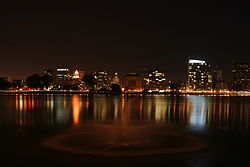
Lake Merritt is a lake located in a large tidal lagoon basin in the center of Oakland, California, just east of Downtown. It is named after Samuel Merritt, Oakland's mayor in 1867–1869, who had the lagoon dammed turning the varying tidal lagoon into a stable salt-water lake. It is surrounded by parkland and city neighborhoods. Historically significant as the first official wildlife refuge in the United States, designated in 1870, the lake has been listed as a National Historic Landmark since 1963. The circumference of the lake is 3.4 miles (5.5 km), with an area of 155 acres (63 ha).[4]
Key Information


The lake features grassy shores, several artificial islands intended as bird refuges, and an interpretive center called the Rotary Nature Center at Lakeside Park. There is a small fairy-tale themed amusement park called Children's Fairyland and The Gardens at Lake Merritt is also in the park. A popular walking and jogging path runs along the lake's perimeter.[5]
History
[edit]The lake was originally an arm of San Francisco Bay, formed where several creeks empty into the bay. It was surrounded by 1,000 acres (4 km2) of wetlands when the Ohlone people fished, hunted, and gathered food along its shores. By 1810, the remaining Native Americans were removed to Mission San José, and the estuary and 44,800 acres (181 km2) of surrounding land was deeded to Sergeant Luis Maria Peralta to become Rancho San Antonio.
After gold was discovered in 1848 in present-day Coloma 125 miles (201 km) to the northeast, Anglo squatters led by lawyer Horace Carpentier took control of the East Bay area which would later become downtown Oakland, including the estuary known as "San Antonio Slough".[6] Oakland was incorporated in 1852 with Carpentier as its first mayor, and the estuary became the city's sewer.[7] In 1856, Peralta fought and won a United States Supreme Court case against the squatters, but further court cases between his sons and daughters would greatly diminish their holdings. The Peralta brothers had to sell much of the land to Carpentier to pay legal fees and new property taxes.
Lake Merritt naturally had tidal flows via a broad 600-foot outlet, but that has been steadily reduced with development of the region after 1869. Currently, the tidal flows are limited in size and managed for flood control.[8] For years, the lake acted as a waste collector. It was regarded as ideal for sewage because of its chemical contents, which have high acidities that cause it to decompose human feces at very high rates. Sixty miles of brick and wood channeling sent the broken-down sewage to the bottom of the lake to then be eaten by bottom feeders. The stench at the lake during the decomposition of the sewage was a problem for Oaklanders on the west shore and residents of Clinton and San Antonio villages on the east.[7]
Samuel Merritt, Oakland's mayor (1867–1869), who owned property at the shore's edge, was keen to get the body of water cleaned up so that it could become a source of civic pride. In 1868, he proposed and funded a dam between the estuary and the bay by which the flow of water could be controlled, allowing the water level inland to rise higher and become less saline, turning the tidal lagoon into a lake. Sewage was to be redirected elsewhere by two new city projects, though these weren't completed until 1875. The resulting body of water was called variously "Lake Peralta", "Merritt's Lake" and later Lake Merritt.[7][9]
The lake at that time still had thick wetlands fringing the shores and it continued to attract large numbers of migratory birds. In order to protect the birds from duck hunters and stop the noise and danger of gunfire so close to the city, Merritt proposed to turn the lake into a wildlife refuge in 1869. The state legislature voted Lake Merritt Wildlife Refuge into law in 1870, making it the first such refuge in North America. No hunting of any sort was to be allowed and the only fishing was to be by hook and line.[7][10]

The ornate Camron-Stanford House was built in 1876 near the lake's western shore. Tax records suggest that Samuel Merritt built the Italianate Victorian as part of his plan to promote and develop downtown Oakland and the new lake. In 1877, the house's title was transferred to Mrs. Alice Camron, a purchase she was able to make due to an inheritance from her father, California pioneer John Marsh. She, her husband Will, and their two daughters were the first residents of the home. Further fine homes were built on the lakeshore by others following Merritt's lead, though none but Camron-Stanford remain today.[11] Beginning in 1910, the house served as the Oakland Public Museum. In 1967, the Oakland Museum moved to other quarters, and the Camron-Stanford House is now a separate museum.
Protection for the wetlands was nonexistent and residences kept being built on reclaimed land around the shore of the lake. Cleanliness continued to be a problem because of incomplete sewage projects, and the lake kept silting up since the natural tidal flow had been interrupted by Merritt's dam. Dredging of the lake began in 1891, with the removed silt being piled along the eastern shore to make a foundation for a road which became Lakeshore Avenue.[7]
From 1893 to 1915, Lake Merritt saw major changes. Inspired by the new City Beautiful movement, which got its start at the World's Columbian Exposition (Chicago World's Fair), the lake became a city-owned park. In 1913, an elaborate Mission Revival pergola was constructed at the northeastern tip of the lake. Adam's Point was cleared of houses, planted with lawns and imported trees, and became Lakeside Park. Eastshore Park was created where East 18th Street brought Trestle Glen's watershed to the lake. Oakland Civic Auditorium was built at the south edge of the lake in 1914.[7]

1923 saw Cleveland Cascade spring into life, conceived and assisted by noted landscape architect, Howard Gilkey. This was a three-tiered water feature incorporating multiple waterfalls tumbling sequentially into twenty large collection basins and a pool at the bottom, flanked by twin stairs descending from Merritt Avenue in Cleveland Heights to Lakeshore Avenue. Colored lights in rainbow sequence lit the waterfall at night.[12]
In 1925, the "Necklace of Lights" was turned on.
1929 is the year the luxurious Bellevue-Staten apartments were completed at 492 Staten Avenue in Adam's Point near Lakeside Park. The 15-story blend of Art Deco and Spanish Colonial styles is one of the most prominent sights viewable from nearly every point of Lake Merritt.[13]
Lake Merritt's natural wetlands are long gone—converted to parks, pathways and roads. Some of the wetland vegetation has been restored to five "Bird Islands" constructed of dredged silt between 1925 and 1956, sheltering hundreds of nesting and roosting water fowl. The islands have a fresh water irrigation system to bring drinking water to the birds. A boom and a rope/buoy barrier protects the islands from recreational boaters.[14]
Under the name Lake Merritt Wild Duck Refuge, the site became a National Historic Landmark on May 23, 1963.[3][15][16]
Starting in 1961, Oakland's "Downtown Property Owner's Association"[17] and the "Central Business District Association" repeatedly advocated for extending Alice Street directly through Snow Park, which was then the grounds of the Snow Museum, past the Schilling Gardens and the Bechtel Building at 244 Lakeside Drive, and down to the lake's edge on 20th Street. They purportedly sought to alleviate motorist traffic congestion that might be caused by the closure of Broadway during construction of the nearby BART line. The plan met stiff opposition from Oakland's City Council in October 1964, which, as reported by the Staff of the Oakland Tribune at the time, told downtown property interests to "quit wasting its time."[18]

While celebrations at Lake Merritt have been largely peaceful and lively, several incidents of violence have marred the park during events. A mass shooting at a 2021 Father's Day event involving two San Francisco gang factions left two dead and five wounded. A gang shooting on Juneteenth 2024 in June left 15 wounded.
Necklace of lights
[edit]| Necklace of lights | |
|---|---|
 | |
 | |
| Designated | 1985 |
| Reference no. | 97 |

A "necklace of lights" encircles Lake Merritt. Featuring 126 lampposts and 3,400 "pearly bulbs", the necklace was first lit in 1925. In 1941, the lights were removed to comply with World War II blackout conditions. After a decade-long campaign by the Lake Merritt Breakfast Club, the lights were again illuminated in 1987.
During Oakland's annual gay pride celebration, the city replaces the white bulbs with multicolored bulbs.[19]
Wildlife
[edit]Birds
[edit]
The lake features a healthy year-round population of birds. It sees seasonal fluctuations in the types of birds that call the lake home.
Year round
[edit]Year round, the lake is home to many Canada geese and moderate numbers of black-crowned night heron, great egret, snowy egret, cormorant, American coot, and western gull. There are also small mallard duck and pelican (both American and brown) populations.
Rainy season
[edit]From November through March, the lake plays host to a very large population of greater scaup and lesser scaup, which spend most of their time floating on the water. The tufted duck, a rare bird from Eurasia, has also been recorded annually. Smaller numbers of canvasback, redhead, common and Barrow's goldeneye, bufflehead, and other migratory diving ducks are also present during the cold season.
Dry season
[edit]From June until the end of September, the lake's Canada goose population increases significantly; Canada geese become nearly ubiquitous around the perimeter of the lake. In late summer and early fall, a moderate pelican population also arrives, and Caspian terns can be seen on the lake.[20]
Other
[edit]Fish in Lake Merritt include bat rays and gobies.[21] Chinook salmon have also been recorded.[22] Molluscs include sea hares, bay mussels, and oysters.[23] Crustaceans include barnacles and Transorchestia enigmatica, which is a talitridae found only in Lake Merritt.[24]
Plants
[edit]Although native trees such as coast live oak and California buckeye are present, most of the park bordering Lake Merritt has been landscaped with plants from around the world. As early as 1910, City Park Commissioners recognized Oakland as a city of immigrants, and felt that "visitors to the park would want to see plants from their native lands".[25] This theme of diversity in the park landscape has continued with landscape renovations. The lake's iconic plant is the New Zealand tea tree (Leptospermum sp.), which grows with picturesque gnarled branches along the water's edge.
One zone of native plants has been established at the restored tidal marsh, located on the channel just south of the Lake Merritt Blvd. bridge. Pickleweed has been planted within the tidal zone, and other native plants such as saltgrass, marsh gumplant (Grindelia stricta var. angustifolia), marsh baccharis (Baccharis glutinosa), Jaumea, and Frankenia have been propagated from local genetic stock and planted on the slope above the marsh. A second native marsh plant zone is planned for the shoreline east of the Sailboat House.
Aquatic vegetation commonly seen within the lake itself include widgeon grass (Ruppia maritima), filamentous green algae (Enteromorpha and Cladophora sp.), sea lettuce (Ulva sp.), dead man's fingers (Codium fragile), and occasionally wireweed (Sargassum muticum). Growth of these aquatic plants reaches a peak in mid-June, and the subsequent die-off and decomposition can result in bad odors, unsightly appearance, and depletion of oxygen in the water column. To prevent this nuisance condition, the City uses a floating mechanical harvester to remove excess growth during the summer months.
A red algal bloom (Heterosigma akashiwo) was detected in Lake Merritt in March 2024, but dissipated within about 2 weeks.[26]
The most common aquatic plants in Lake Merritt are tiny, free-floating phytoplankton. Visitors often do not appreciate the sometimes-murky water in the lake, but the cloudiness represents a water column rich in microscopic life, providing a basis for a diverse and thriving web of animal life at the lake, both marine and avian.[citation needed]
Connecting waterways
[edit]Creeks that flow to Lake Merritt include Glen Echo Creek, Pleasant Valley Creek, Wildwood Creek, and Indian Gulch Creek.[27][28]
Cleanup and restration
[edit]
Because storm drains in downtown Oakland and surrounding areas drain directly into the lake, trash and nutrient pollution have become the largest problems affecting Lake Merritt. Increased levels of chemicals like nitrogen and phosphorus cause algae blooms, which deplete the water of oxygen.[29] Aeration fountains, funded by donations, have been installed to help with this problem. "Water quality in an area of about one acre around each unit is improved by the transfer of oxygen from the air, and by mixing the top and bottom layers of the Lake."[30] In August 2022, an algae bloom caused a large fish kill in the lake. The following year, the city installed an aeration foundation in the lake.[31]

Trash removal is coordinated by the non-profit Lake Merritt Institute under contract with the City of Oakland. The Institute sponsors clean-ups five days a week during the school year, and four days a week during the summer. Individuals can also work alone using the four "U-Clean-It" boxes maintained by the Institute. One way volunteers clean the lake is by using long-handled nets.[32][33] About 1,000 to 6,000 pounds of trash are removed monthly.[34] Among the many individual and group volunteers, of special note are those who have been cleaning the trash since 1997: the regular Saturday and Tuesday volunteers,[35] the Peralta Service Corporation (part of the Unity Council),[36] St. Paul's Episcopal School 6th Grade,[37] and HandsOn Bay Area.[38]
Pollution
[edit]In addition to nutrient pollution, more toxic agents have drained into the lake from time to time. In 1998, about 20 gallons of diesel fuel leaked into the lake following a "freakish accident" in the basement of the Caltrans building in the 100 block of Grand Avenue.[39]
On June 27, 2011, the Oakland Fire Department and California Department of Fish and Game responded to a diesel fuel spill that covered five acres of the northwest side of the lake. "Because the storm drain connects to other storm drains in the city, and due to the heavy rain, Oakland Fire Battalion Chief Darin White said firefighters were having difficulty finding where the spill originated."[40]
In April 2022, a large illegal homeless encampment caught fire and burned the pedestrian pathway and underpass at Lake Merritt. Debris, including oil cans, were seen spilling into the lake following the fire. The encampment had been reported to the city as a public safety hazard for more than 2 years before the fire occurred.[41]
Measure DD improvements
[edit]

Measure DD, a $198 million Oakland City park bond measure, passed with 80% voter approval in 2002. The measure improved the lake area by adding park space and altering the surrounding infrastructure. One example is on Lake Merritt's south shore, where the previous configuration of 12th Street (six lanes in each direction) was considered a deterrent to pedestrian and bicycle access to landmarks such as Laney College, the Oakland Museum of California, and Lake Merritt Channel. Part of the Measure DD project renovated 12th Street, reducing traffic to three lanes in each direction, adding park space, and adding eleven more necklaces of lights to fill a gap.
The renovation of Lake Merritt, paid for with money from Measure DD, was briefly stalled by an environmental review lawsuit intended to prevent cutting trees around the lake, which was filed in 2006 by a group of concerned residents, "Friends of the Lake".[42] On October 17, 2007, an Alameda County Superior Court judge dismissed a lawsuit, making way for the renovation to proceed.

One of the first Measure DD projects, completed in 2007, was the renovation and rededication of the 1913 pergola at the north end of the lake.[43] Several sections of Measure DD work were completed in 2008, including the renovation of the 1909 Municipal Boat House into Lake Chalet restaurant, the reconstruction of El Embarcadero between Grand Avenue and Lakeshore Avenue, the narrowing of Lakeside Drive from just north of East 14th Street to 19th Street from four lanes to two (with a bicycle lane added), and new landscaping along the west side of the lake from 14th to 19th street and the east side from East 18th Street to El Embarcadero.
The largest part of the Measure DD work was the 12th Street Reconstruction Project on the south side of the lake. Replacement of the Frickstad Viaduct, or "12th Street Dam" (built 1950), and renovation of the roadways and tunnels between the Kaiser Convention Center and the southern end of Lake Merritt began in May 2010 and were completed in June 2013. The groundbreaking ceremony for the 12th Street Project took place on May 6, 2010 near the Frickstad Viaduct.[44]
Another major milestone in the restoration of Lake Merritt was achieved in February 2013, when Mayor Jean Quan and other officials inaugurated a 750-foot (230 m)-long channel, including a paved trail, a pedestrian bridge, and restored tidal marsh, a major step towards reconnecting Lake Merritt with San Francisco Bay. This stage was expected to double the water volume circulating in and out of the lake. The mayor announced plans for "a big citywide party" upon completion.[45] In December 2016, a culvert under 10th Street was removed to increase tidal movement.[46][47]
See also
[edit]References
[edit]- ^ a b c "The Lake Merritt Institute: About Lake Merritt". www.lakemerrittinstitute.org. Archived from the original on February 24, 2015. Retrieved July 22, 2015.
- ^ "National Register Information System". National Register of Historic Places. National Park Service. January 23, 2007.
- ^ a b "Lake Merritt Wild Duck Refuge". National Historic Landmark summary listing. National Park Service. September 28, 2007. Archived from the original on February 19, 2012.
- ^ "Lake Merritt". Park and Recreation Department. City of Oakland. Archived from the original on June 12, 2018. Retrieved April 11, 2013.
- ^ City of Oakland Parks and Recreation Archived November 14, 2008, at the Wayback Machine
- ^ Northlakegroup.org - northlake group Resources and Information. Site gone on or before 16 March 2010 Archived 15 January 2016 at the Wayback Machine
- ^ a b c d e f McFerrin, Linda Watanabe (January 1, 2001). "A Natural History of Oakland's Lake Merritt". Bay Nature. Retrieved December 29, 2013.
- ^ "Lake Merritt Institute Tidal Flow White Paper (visited Jan 2012)" (PDF). Archived from the original (PDF) on October 8, 2013. Retrieved December 29, 2013.
- ^ Project1 Archived August 19, 2006, at the Wayback Machine
- ^ Lake Merritt - Wildlife Sanctuary Archived January 29, 2006, at the Wayback Machine
- ^ "Welcome to the Camron-Stanford House web site". Cshouse.org. Retrieved December 29, 2013.
- ^ Jim Ratliff. "Oakland's Cleveland Cascade". Clevelandcascade.org. Retrieved December 29, 2013.
- ^ Jim Ratliff. "Bellevue-Staten Building from top of Cleveland Cascade". Clevelandcascade.org. Archived from the original on July 10, 2011. Retrieved December 29, 2013.
- ^ Project Name Archived 2007-07-23 at the Wayback Machine
- ^ McKithan, Cecil (October 18, 1977). "Lake Merritt Wild Duck Refuge" (PDF). National Register of Historic Places Inventory-Nomination. National Park Service. Retrieved May 5, 2009.
- ^ "Lake Merritt Wild Duck Refuge—Accompanying 4 photos, from 1977" (PDF). National Register of Historic Places Inventory-Nomination. National Park Service. October 18, 1977. Retrieved May 5, 2009.
- ^ Oakland Tribune Staff (April 5, 1963). "Alice Street Extension Plea Renewed". Oakland Tribune Section E17.
- ^ Oakland Tribune Staff (October 29, 1964). "Newest Alice Street Plan Turned Down; Recurring Subject Riles City". Oakland Tribune Section E13.
- ^ "Rainbow Necklace Launches East Bay Pride". City of Oakland Parks and Recreation Department. August 22, 2002. Archived from the original on December 14, 2005. Retrieved July 16, 2007.
- ^ Bird-lore: An Illustrated Bi-monthly Magazine Devoted to the Study and Protection of Birds (1931), Audubon Societies, Volumes 33-34
- ^ Harshaw, Pendarvis (October 27, 2017). "What Could You Catch Fishing in Lake Merritt?". KQED. Retrieved August 3, 2019.
- ^ Rodas, Ricky (December 17, 2021). "Salmon in Lake Merritt? More rainfall is causing some fish to wander into Oakland's lagoon". The Oaklandside. Retrieved November 26, 2023.
- ^ O'brien, Matt (November 6, 2014). "Oakland: Lake Merritt's improving wildlife a treasure and liability". The Mercury News. Retrieved August 3, 2019.
- ^ Simons, Eric. "This Animal Has Never Been Seen Away From Lake Merritt — But It's Not From Oakland - The Weird, the Rare and the Ugly". Bay Nature. Retrieved August 3, 2019.
- ^ Lake Merritt Park Master Plan, 2002, pg. III-21.
- ^ Bartlett, Amanda (March 20, 2024). "Reddish water in Lake Merritt could be 'an ominous sign for the Bay'". SFGATE. Retrieved March 21, 2024.
- ^ Alden, Andrew (July 17, 2023). "The Geology of Lake Merritt, Oakland's Shimmering Tidal Heart". Bay Nature. Retrieved November 26, 2023.
- ^ "Indian Gulch and Pleasant Valley Creeks Watershed | Alameda County Flood Control District". Retrieved November 26, 2023.
- ^ "United States Environmental Protection Agency: The Problem". U.S. Environmental Protection Agency. March 1, 2016. Retrieved March 23, 2016.
- ^ "Lake Merritt Institute: Aeration Fountains". Archived from the original on February 24, 2016. Retrieved March 23, 2016.
- ^ "Lake Merritt Restoration". www.oaklandca.gov. Retrieved November 5, 2025.
- ^ "Lake Merritt Institute: How You Can Help". Archived from the original on April 4, 2016. Retrieved March 23, 2016.
- ^ Lakemerrittinstitute.org Archived December 9, 2009, at the Wayback Machine accessdate=23 March 2016
- ^ "Lake Merritt Institute: What We Do". Retrieved March 23, 2016.
- ^ "Lake Merritt Institute: Volunteers: Our Clean Lake Partners". Archived from the original on March 23, 2016. Retrieved March 23, 2016.
- ^ "Peralta Service Corp". The Unity Council. 2013. Retrieved March 23, 2016.
- ^ "Welcome to Sixth Grade at St. Paul's!". Archived from the original on April 5, 2016. Retrieved March 23, 2016.
- ^ "HandsOn Bay Area: GARDEN: The Gardens at Lake Merritt". HandsOn Network. 2016. Retrieved March 23, 2016.
- ^ Rick DelVecchio, Chronicle Staff Writer (January 1, 1998). "Small Fuel Spill Seeps Into Lake Merritt No birds found to be harmed by oil on surface". San Francisco Chronicle. Retrieved March 23, 2016.
- ^ Ryan Phillips (June 28, 2011). "Diesel fuel spills into Lake Merritt from storm drain". Oakland North. Retrieved March 23, 2016.
- ^ "Large encampment fire breaks out under bridge near Oakland's Lake Merritt". ABC7 San Francisco. April 29, 2022. Retrieved November 5, 2025.
- ^ Heredia, Christopher (October 18, 2007). "Lawsuit to block tree-cutting at Oakland's Lake Merritt dismissed". San Francisco Chronicle.
- ^ Brand, William (March 5, 2007). "Lake Merritt Pergola like new again after 94 years". Inside Bay Area. Retrieved October 24, 2013.
- ^ Brown, Steven E. F. (May 6, 2010). "Oakland breaks ground on $32M Lake Merritt fix". San Francisco Business Times. Retrieved October 24, 2013.
- ^ Nolte, Carl (February 23, 2013). "Lake Merritt's gateway to bay reopened". San Francisco Chronicle.
- ^ December 8, Kristin Hanes on; PM, 2016 at 2:59 (December 8, 2016). "Here's why Lake Merritt has looked low lately". SFGate Blog. Retrieved August 3, 2019.
{{cite web}}: CS1 maint: numeric names: authors list (link) - ^ Morris, Scott (May 10, 2017). "Lake Merritt Reborn". Oakland Magazine. Archived from the original on February 26, 2019. Retrieved August 3, 2019.
External links
[edit]
- National Historic Landmarks Program
- The Lake Merritt Institute
- Lake Merritt Project Stalls; 12th Street Bid Rejected, San Francisco Chronicle, March 15, 2007
- Interview with "The Lakekeeper"


Lake Merritt
View on GrokipediaGeography and Hydrology
Physical Characteristics and Location
Lake Merritt occupies a central position in Oakland, California, situated about one mile east of downtown and within the broader San Francisco Bay Area. Its approximate geographic coordinates are 37°48′04″N 122°15′30″W.[8] As a large tidal lagoon basin, it functions as an estuary remnant, connected to the Oakland Estuary and ultimately San Francisco Bay via channels that facilitate bidirectional tidal flows.[9] [6] The lagoon spans 155 acres, encircled by a 3.4-mile shoreline that defines its urban boundary.[10] [11] Depths average 8 to 10 feet across the main basin, subject to tidal variations, while nearshore areas shallow to 0 to 4 feet.[6] Its irregular form evokes a lower-case "y" outline, elongated northeast-southwest with branching arms, shaped by prehistoric glacial sea-level cycles and sedimentary deposition.[9] The water body maintains brackish conditions, blending tidal saltwater inflows—predominantly marine in composition—with freshwater from a surrounding 4,650-acre watershed drained by local creeks.[6] [12]Tidal Connections and Water Dynamics
Lake Merritt maintains a hydrological connection to the San Francisco Bay through the Lake Merritt Channel, a dredged and engineered waterway linking the lake to the Oakland Estuary, which facilitates limited tidal exchange despite historical modifications that reduced natural flows.[13][6] This channel, originally part of the inundated San Antonio Creek pathway formed by post-glacial sea-level rise approximately 10,000–15,000 years ago, allows brackish water intrusion from the bay, enabling periodic migration of marine organisms such as fish into the lake.[14][9] Tidal dynamics are regulated by sluice gates at the channel's estuary junction, managed by Alameda County Flood Control District primarily to mitigate inland flooding rather than optimize circulation, resulting in restricted inflows and outflows that limit full tidal prism exchange to prevent overflow during high tides.[15][16] During ebb and flood cycles, channel currents can exceed 5 knots, far surpassing lake surface velocities, but overall exchange volumes remain constrained, with inflows supplemented by 62 stormwater outfalls contributing freshwater and pollutants.[13][6] Water circulation within the lake is predominantly wind-driven on the surface, with subsurface mixing influenced by density gradients from variable salinity—typically brackish at 5–25 practical salinity units (psu), fluctuating between near-freshwater levels (<5 psu) after heavy rainfall and higher bay-influenced salinity (~20–30 psu) during dry periods or enhanced tidal openings.[17][18] Limited tidal flushing exacerbates stagnation, leading to low dissolved oxygen (<2 mg/L hypoxic conditions), temperature stratification (up to 15–16°C averages with extremes), and pollutant accumulation, as evidenced by recurrent algae blooms and fish kills, such as those in fall 2022 attributed to poor exchange trapping nutrients.[19][20] Efforts to widen the channel in the early 2000s aimed to enhance flow but have not fully resolved these issues, with studies recommending further tidal restoration for improved oxygenation and salinity balance.[21][22]Historical Development
Indigenous and Pre-Urban Era
Prior to European contact, the site of present-day Lake Merritt existed as a dynamic tidal slough extending northward from San Francisco Bay, characterized by extensive marshes, mudflats, and fluctuating water levels influenced by semidiurnal tides.[23] This estuarine feature, fed by seasonal creeks such as Glen Echo and Indian Slough, supported diverse wetland ecosystems including eelgrass beds and riparian zones, with water depths varying from exposed flats at low tide to several feet at high tide.[23] Geological evidence indicates the slough's formation occurred in the late Pleistocene epoch, over 10,000 years ago, as post-glacial warming raised sea levels and reshaped the Bay Area's coastal morphology.[4] The surrounding region, known to indigenous inhabitants as part of Huchiun in the East Bay, was the ancestral territory of Chochenyo-speaking Ohlone peoples, who maintained presence in the area for millennia prior to Spanish colonization in the late 18th century.[24] Ohlone communities utilized the slough's resources for subsistence, harvesting shellfish, fish, and waterfowl from the tidal zones, though archaeological records suggest denser settlements occurred in the adjacent Oakland Hills rather than the marshy lowlands, which were periodically inundated.[23] These groups practiced controlled burns and resource management to sustain biodiversity, fostering habitats for migratory birds and aquatic species that persisted into the historic period.[25] European exploration and settlement, beginning with Spanish expeditions in 1772, disrupted Ohlone lifeways through mission systems that relocated populations and altered land use, leading to population declines from disease and displacement by the early 19th century.[23] The slough remained largely unaltered until mid-19th-century urban expansion in Oakland, preserving its pre-urban hydrological role as a conduit for tidal exchange and sediment deposition.[4]19th-Century Transformation and Refuge Designation
In the mid-19th century, Lake Merritt existed as a tidal estuary known as Indian Slough, connected to San Francisco Bay and characterized by mudflats exposed at low tide.[4] During Oakland's early urban growth following its founding in 1852, the estuary's tidal fluctuations hindered development and aesthetics around the emerging city center.[26] Dr. Samuel Merritt, serving as Oakland's mayor from 1867 to 1869, initiated its transformation by advocating for and financing a dam at the 12th Street crossing to regulate tidal flows.[27] Construction of the dam, completed in 1869, trapped high-tide seawater while installing a floodgate to prevent outflow at low tide, converting the 140-acre tidal slough into a permanent saltwater lake with stable water levels averaging three to six feet deep.[4] [26] This engineering intervention, funded in part by Merritt's donation of approximately $12,000 alongside city resources, aimed to enhance navigability, provide a scenic urban centerpiece, and support rudimentary water supply needs, though the lake retained its saline character rather than becoming a freshwater reservoir.[27] The project reflected pragmatic urban planning amid California's post-Gold Rush expansion, prioritizing land reclamation over natural tidal dynamics. Merritt further proposed protecting the lake as a sanctuary for migratory birds, declaring it a refuge in 1869 to curb hunting and preserve bird populations that had begun concentrating due to the stabilized habitat.[2] On March 18, 1870, the California State Legislature formalized this status through an act designating Lake Merritt as the nation's first official wildlife refuge, prohibiting firearms and emphasizing conservation of waterfowl and other avifauna.[28] This designation, predating federal efforts like the 1903 Pelican Island refuge, underscored early state-level recognition of urban ecological value, though enforcement remained limited without modern regulatory frameworks.[2]20th-Century Urban Integration
In the early 20th century, Lake Merritt underwent significant transformations influenced by the City Beautiful movement, which emphasized aesthetic urban improvements and public recreation spaces following the 1893 Chicago World's Columbian Exposition. Oakland civic leaders dredged and diked the lake, reshaping its shorelines into landscaped parks with imported trees, lawns, and facilities such as tennis courts and boat landings. By 1915, Lakeside Park had been established on the northern Adams Point side, integrating the lake as a central recreational hub amid growing urban neighborhoods.[23][29] A landmark feature enhancing its urban prominence was the installation of the Necklace of Lights in 1925, comprising 126 Florentine-style lampposts with 3,400 bulbs designed by electrical engineer Romaine Myers and activated by Commissioner William Baccus to celebrate post-World War I peace. This illumination outlined the lake's perimeter, drawing nighttime visitors and symbolizing Oakland's civic pride, though it was deactivated in 1941 for wartime blackouts.[30][31][4] Mid-century developments further embedded the lake in daily urban life, including the opening of Children's Fairyland in Lakeside Park in 1950, which provided family-oriented attractions and reinforced its role as a community gathering space. Ongoing dredging and muck removal throughout the century converted former tidal sloughs into buffered parkland, while a 1970s pumping station improved flood control and water circulation, mitigating urban runoff impacts.[23][32] These enhancements positioned Lake Merritt as an ornamental urban centerpiece, surrounded by residential and commercial districts, with a three-mile shoreline path facilitating pedestrian access and recreation for city residents.[23]Infrastructure and Amenities
Necklace of Lights and Historic Features
The Necklace of Lights comprises 176 lampposts fitted with roughly 4,000 electric bulbs that form a luminous ring around Lake Merritt.[31] Installed on August 27, 1925, the display originally operated nightly to commemorate post-World War I peace and hosted events like the Shriners' convention.[33] [34] It remained active until 1941, when wartime blackout regulations prompted its shutdown.[30] The system fell into disuse post-World War II but underwent restoration efforts in the 1980s, with relighting occurring around 1990; it received Oakland city landmark designation via Ordinance 10576 on May 3, 1985.[35] [36] Historic features encircling the lake include several preserved structures reflecting early 20th-century architecture and urban development. The Camron-Stanford House, constructed in 1876 as a Victorian mansion, stands as the sole surviving 19th-century residence from the estates that once bordered Lake Merritt; it housed five prominent families before becoming Oakland's inaugural house museum in the mid-20th century.[37] [38] The Bellevue-Staten Building, completed in 1929, exemplifies Art Deco and Spanish Colonial Revival styles, featuring luxury apartments on the National Register of Historic Places and overlooking the lake from Staten Avenue.[39] [40] Additional elements, such as the 1913 Pergola and Colonnade designed by architect Walter Reed, contribute to the area's architectural heritage near Grand Avenue and Lakeshore.[41]Recreational Paths, Gardens, and Facilities
The Lake Merritt perimeter features a paved multi-use trail approximately 3.4 miles in length, encircling the estuary and accommodating pedestrians, joggers, cyclists, and wheelchair users.[42] This trail, integrated into Lakeside Park, provides scenic views of the urban waterfront and surrounding hills, with accessibility enhancements including smooth surfacing and periodic benches.[43] Adjacent pathways in Lakeside Park connect to themed garden areas, supporting low-impact recreation amid the wildlife refuge designation.[44] The Gardens at Lake Merritt occupy seven acres within Lakeside Park, comprising a diverse array of themed botanical collections maintained primarily by volunteers.[45] Key sections include the Japanese Garden, designed by landscape architect Hisaichi Harry Tsugawa and constructed in 1959 by members of Oakland's Japanese American community with support from local garden clubs.[46] The Bonsai Garden, established around 1974, houses over 100 miniature trees, including historic specimens curated by enthusiasts.[47] Additional features encompass the Mediterranean Garden with drought-tolerant plants, the Palm Garden (Palmetum), edible demonstration plots, and a Firescape Garden focused on fire-resistant landscaping, all open daily from dawn to dusk without admission fees.[48] [49] Recreational facilities include the Lake Merritt Boating Center, housed in the Sailboat House constructed in 1954, which offers rentals for non-motorized watercraft such as kayaks, sailboats, stand-up paddleboards, and electric boats, prohibiting gasoline engines to preserve water quality.[50] The center supports youth and adult programs, including introductory sailing and rowing sessions coordinated with local clubs.[51] Complementing these are the Edoff Memorial Bandstand for public performances and the Lakeside Park Garden Center, which provides educational resources on horticulture and hosts community events.[44] Restrooms and picnic areas are available at key points like the Boating Center and Garden Center, enhancing usability for daily visitors.[42]Ecological Profile
Wildlife Populations
Lake Merritt sustains approximately 140 bird species, including residents like black-crowned night herons (Nycticorax nycticorax) and great egrets (Ardea alba), which nest in the lake's islands and feed on fish and invertebrates.[52] Seasonal migrants, such as canvasback ducks (Aythya valisineria) and American white pelicans (Pelecanus erythrorhynchos), utilize the site as a stopover during Pacific Flyway migrations, with peak numbers in fall and winter.[53] Waterfowl populations, including mallards (Anas platyrhynchos) and American coots (Fulica americana), maintain year-round presence, supported by the lake's tidal influx of nutrients despite urban runoff pressures.[54] Aquatic vertebrates feature around 30 fish species, encompassing native estuary forms like Chinook salmon (Oncorhynchus tshawytscha)—scarce until recent years due to pollution—and introduced species such as largemouth bass (Micropterus salmoides).[52][55] Invertebrate densities remain high, with thousands of individuals per square meter of shrimp (Crangon spp.), clams, crabs, and tubeworms thriving in the sediment, forming a base for the food web.[6] Occasional incursions by marine mammals, including harbor seals (Phoca vitulina) and sea lions (Zalophus californianus), occur via channels, though breeding is absent.[21] Populations face episodic declines from hypoxic events, as evidenced by a 2022 fish kill linked to algal blooms and low dissolved oxygen levels below 2 mg/L, affecting thousands of fish across multiple taxa.[20] Restoration measures, including aeration pilots post-2022, aim to stabilize these dynamics by enhancing oxygen circulation and reducing eutrophication from upstream inputs.[7] Overall biodiversity exceeds 600 taxa, blending native and non-native elements in this tidal lagoon, though invasive species like European green crabs (Carcinus maenas) compete with locals.[21]Native and Invasive Flora
Lake Merritt's native flora primarily consists of riparian and woodland species adapted to the estuary's historical tidal marsh and surrounding grasslands. These include alder (Alnus spp.), sycamore (Platanus racemosa), coast live oak (Quercus agrifolia), and California bay laurel (Umbellularia californica), which once lined the banks and supported local wildlife through acorns, nuts, and shade.[23][56] Coast live oak remains present in urban parkland buffers, providing habitat continuity despite development pressures.[56] In aquatic and wetland zones, native submerged and emergent plants such as widgeon grass (Ruppia maritima) occur, though its proliferation in nutrient-enriched waters can lead to dense mats that alter habitat structure.[57] These species reflect the site's pre-urban estuarine ecology, where tidal flushing maintained balanced plant communities. Invasive flora has significantly impacted Lake Merritt's ecosystems, outcompeting natives and altering habitats. Ice plant (Carpobrotus edulis) invades shoreline edges, replacing coastal vegetation and modifying dune-like substrates with its succulent mats that reduce biodiversity.[58] Perennial pepperweed (Lepidium latifolium) displaces marsh plants in wetlands, while yellow flag iris (Iris pseudacorus) forms dense stands that impede water flow and native growth.[58] Tree-of-heaven (Ailanthus altissima) and cajeput (Melaleuca spp.) contribute to terrestrial invasion, with the latter exhibiting aggressive spread potential observed in similar environments.[58][56] Management efforts target these species to restore native dominance, as invasives exacerbate erosion and reduce habitat for pollinators and birds.[58]Water Quality and Pollution Metrics
Lake Merritt is classified as an impaired water body under Section 303(d) of the Clean Water Act, primarily due to low dissolved oxygen (DO), organic enrichment from excessive nutrients, trash accumulation, and elevated pathogen levels.[17] These impairments stem from urban stormwater runoff carrying pollutants, combined sewer overflows during wet weather, and limited tidal flushing through tide gates that restrict exchange with San Francisco Bay.[17] The U.S. Environmental Protection Agency cited the lake in 1999 for nutrient-driven low DO and trash, placing it on California's Total Maximum Daily Load (TMDL) list, where it remains for pathogens and debris as of recent assessments.[17] Dissolved oxygen monitoring from January 2023 to March 2025 at five stations revealed average surface levels of 9.6 mg/L and bottom levels of 7.1 mg/L, with DO below the 5 mg/L wildlife refuge threshold in 5.6% of lake-wide measurements (2.3% surface, 9.8% bottom).[19] Seasonal lows occur in late summer from algal respiration following blooms—such as the Heterosigma akashiwo red tide in August 2022, which dropped DO near 0 mg/L at multiple sites—and in winter due to precipitation-induced stratification and gate closures limiting oxygenation.[19][20] These events have not exceeded the 16.6% threshold for formal impairment under current policy, but they correlate with fish kills, including over 10,000 deaths in fall 2022.[19][20]| Metric | Average Value (2023–2025) | Key Exceedances/Events |
|---|---|---|
| Surface DO | 9.6 mg/L | Below 5 mg/L: 2.3% of readings; near 0 mg/L post-2022 bloom[19][20] |
| Bottom DO | 7.1 mg/L | Below 5 mg/L: 9.8% of readings; seasonal lows to 4.1 mg/L in December 2024[19] |