



Community hub
Recent from talks
Knowledge base stats:
Talk channels stats:
Members stats:
Languages of South Asia
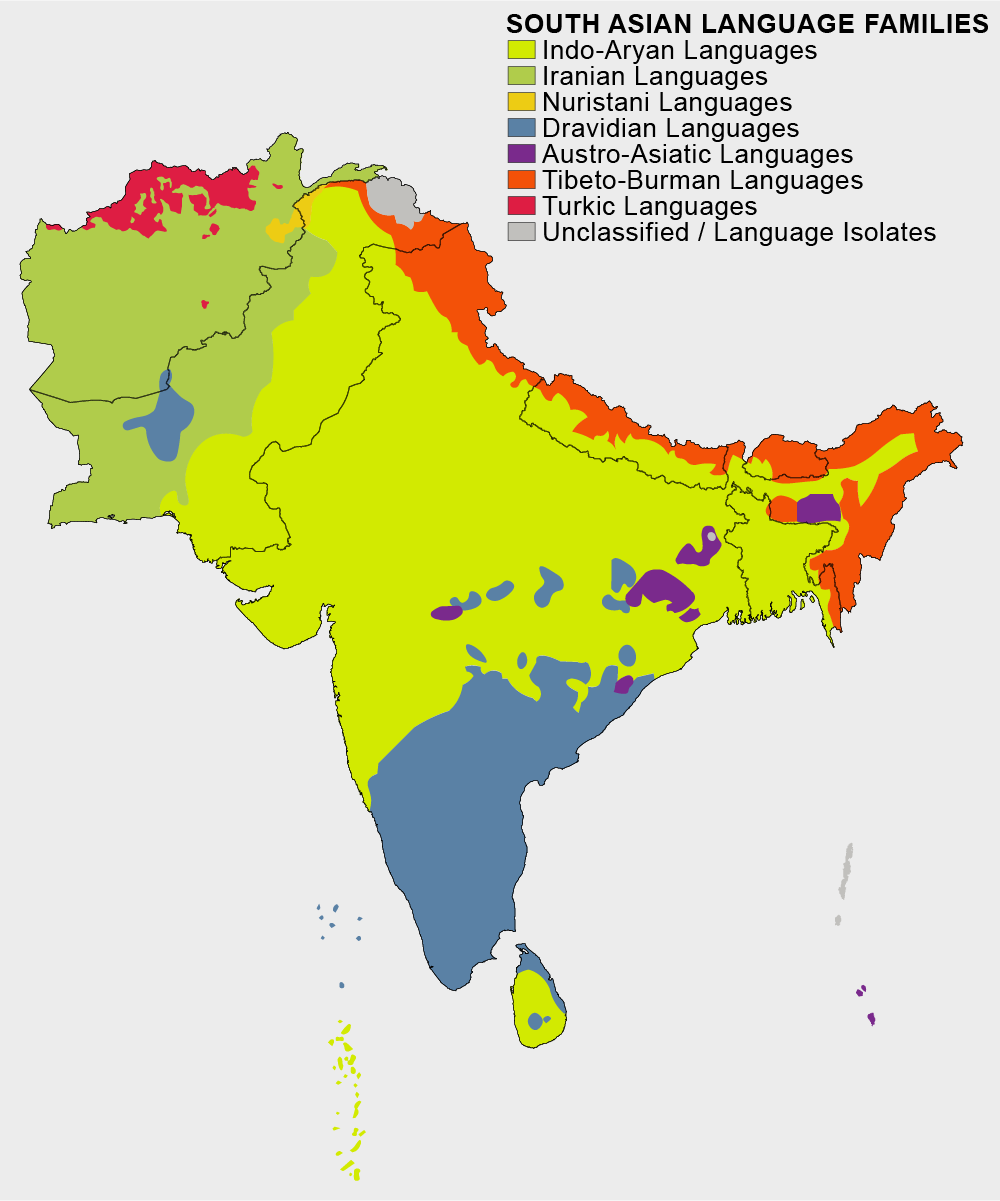
South Asia is home to several hundred languages, spanning the countries of Afghanistan, Bangladesh, Bhutan, India, Maldives, Nepal, Pakistan, and Sri Lanka. It is home to the fourth most spoken language in the world, Hindi–Urdu; the seventh most spoken language, Bengali; and thirteenth most spoken language, Punjabi. Languages like Bengali, Tamil and Nepali have official/national status in more than one country of this region. The languages in the region mostly comprise Indo-Iranic and Dravidian languages, and further members of other language families like Austroasiatic, and Tibeto-Burman languages.
Geolinguistically, the Indo-Aryan, Dravidian and Munda language groups are predominantly distributed across the Indian subcontinent. The term Indic languages is also used to refer to these languages, though it may be narrowed to refer only to Indo-Aryan and Dravidian languages. The subcontinent is also home to a few language isolates, like Burushaski, Kusunda, Nihali, and Vedda.
Areally, the influence of the languages extend beyond the subcontinent into other neighbouring Southern Asian as well as East and Southeast Asian regions, and the extended linguistic area is known as Indosphere. Narrowly, the sprachbund of Indic languages and other geopolitically neighbouring languages is known as South Asian languages (which includes Eastern-Iranic and Nuristani languages; Central- and Western- Tibeto-Burman linkages; and Khasic languages).
The Iranian Plateau, located west of the subcontinent, is home to Iranic languages, beginning with Pashto of Pashtunistan and Balochi of Balochistan in the eastern-side of the plateau. Persian is spoken in the central plateau, with varieties like Dari in Afghanistan, Farsi in Iran and Tajik in Tajikistan. Pamir languages are spoken in the Pamir Mountains, located to the north of Hindu Kush and Karakoram ranges. Kafiri languages are spoken in pockets at the northern intersection of the plateau and the subcontinent.
Tibeto-Burman languages (of the Trans-Himalayan family) are spoken in and beyond the regions of the Himalayan and Indo-Burman Ranges, predominantly on the Tibetan Plateau and Burma. Also beginning at the Indo-Burman Ranges, Khasi–Palaungic languages (of the Austroasiatic family) and Northwestern Tai languages (of the Kra–Dai family) are spoken in the Southeast Asian Massif.
Andamanese languages are spoken on the Andaman Islands.
Historically, Sanskrit was the lingua franca of South Asia. In the Indo-Muslim period, Persian became a connecting language throughout much of India and the Persianate world in general, influencing local languages. From the colonial era onwards, English became a lingua franca to some extent, aiding those who participated in the Indian independence movement, for example.
In contemporary times, English is considered the international lingua franca of the South Asian countries. Since the colonial era, the South Asian languages have absorbed significant influences from the English language, with the most-spoken South Asian language Hindustani also acquiring a new English-influenced variant known as Hinglish which is spoken more in urban areas.
Hub AI
Languages of South Asia AI simulator
(@Languages of South Asia_simulator)
Languages of South Asia
South Asia is home to several hundred languages, spanning the countries of Afghanistan, Bangladesh, Bhutan, India, Maldives, Nepal, Pakistan, and Sri Lanka. It is home to the fourth most spoken language in the world, Hindi–Urdu; the seventh most spoken language, Bengali; and thirteenth most spoken language, Punjabi. Languages like Bengali, Tamil and Nepali have official/national status in more than one country of this region. The languages in the region mostly comprise Indo-Iranic and Dravidian languages, and further members of other language families like Austroasiatic, and Tibeto-Burman languages.
Geolinguistically, the Indo-Aryan, Dravidian and Munda language groups are predominantly distributed across the Indian subcontinent. The term Indic languages is also used to refer to these languages, though it may be narrowed to refer only to Indo-Aryan and Dravidian languages. The subcontinent is also home to a few language isolates, like Burushaski, Kusunda, Nihali, and Vedda.
Areally, the influence of the languages extend beyond the subcontinent into other neighbouring Southern Asian as well as East and Southeast Asian regions, and the extended linguistic area is known as Indosphere. Narrowly, the sprachbund of Indic languages and other geopolitically neighbouring languages is known as South Asian languages (which includes Eastern-Iranic and Nuristani languages; Central- and Western- Tibeto-Burman linkages; and Khasic languages).
The Iranian Plateau, located west of the subcontinent, is home to Iranic languages, beginning with Pashto of Pashtunistan and Balochi of Balochistan in the eastern-side of the plateau. Persian is spoken in the central plateau, with varieties like Dari in Afghanistan, Farsi in Iran and Tajik in Tajikistan. Pamir languages are spoken in the Pamir Mountains, located to the north of Hindu Kush and Karakoram ranges. Kafiri languages are spoken in pockets at the northern intersection of the plateau and the subcontinent.
Tibeto-Burman languages (of the Trans-Himalayan family) are spoken in and beyond the regions of the Himalayan and Indo-Burman Ranges, predominantly on the Tibetan Plateau and Burma. Also beginning at the Indo-Burman Ranges, Khasi–Palaungic languages (of the Austroasiatic family) and Northwestern Tai languages (of the Kra–Dai family) are spoken in the Southeast Asian Massif.
Andamanese languages are spoken on the Andaman Islands.
Historically, Sanskrit was the lingua franca of South Asia. In the Indo-Muslim period, Persian became a connecting language throughout much of India and the Persianate world in general, influencing local languages. From the colonial era onwards, English became a lingua franca to some extent, aiding those who participated in the Indian independence movement, for example.
In contemporary times, English is considered the international lingua franca of the South Asian countries. Since the colonial era, the South Asian languages have absorbed significant influences from the English language, with the most-spoken South Asian language Hindustani also acquiring a new English-influenced variant known as Hinglish which is spoken more in urban areas.