Recent from talks
Nothing was collected or created yet.
Nihali language
View on Wikipedia| Nihali | |
|---|---|
| निहाली | |
| Native to | India |
| Region | Jalgaon Jamod, Buldhana district, Maharashtra (on the border with Madhya Pradesh) |
| Ethnicity | 5,000 Nihali |
Native speakers | 2,500 (2016)[1] |
| Language codes | |
| ISO 639-3 | nll |
| Glottolog | niha1238 |
| ELP | Nihali |
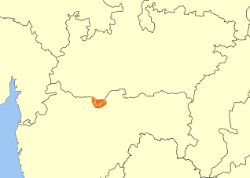
Historically Nihali-speaking area spanning the border between Maharashtra to the south and Madhya Pradesh to the north | |
Nihali is classified as Critically Endangered by the UNESCO Atlas of the World's Languages in Danger | |
Nihali, also known as Nahali (Nihali: [nihaːliː, nahaːliː]), is an endangered language isolate that is spoken in west-central India by approximately 2,500 people as of 2016.[2] The name of the language derives from nahal, meaning "tiger".[3]
Nihali has not been definitively proven to be related to any other surrounding language families of South Asia, such as Munda, Indo-Aryan, and Dravidian languages, nor to other language isolates like Burushaski and Kusunda. However, a connection with Ainu has been suggested.[4]
Linguistic situation
[edit]The Nihali tribal area is just south of the Tapti River spanning the border between Maharashtra and Madhya Pradesh around Buldhana district and Burhanpur district. However, only the villages in the Buldhana district - Jamod, Sonbardi, Kuvardev, Chalthana, Ambavara, Wasali, and Cicari - still use the Nihali language today. There are dialectal differences between the Jamod-Sonbardi and the Kuvardev-Chalthana varieties.[5] Historically, Nihali was spoken around the village of Tembi in Burhanpur district as well.[6]
Today there are no longer any monolingual speakers of the language, as Nihali speakers are likely to speak varieties of Korku, Marathi, or Hindi among others.[7] There is no established writing system for the language.[8]
History
[edit]The early history of Nihali is unclear, as there are no direct attestations of the Nihali language prior to the modern era. One theory suggests that the Nihali people might trace back to the ancient community of Nahalka, an offshoot of the Nishada tribe mentioned in the Mahabharata and the Padma Purana.[9]
Franciscus Kuiper was the first to suggest that Nihali may be unrelated to any other Indian language, with the non-Korku, non-Dravidian core vocabulary being the remnant of an earlier population in India. However, he did not rule out that it may be a Munda language, like Korku. Kuiper suggested that Nihali may differ from neighbouring languages, such as Korku, mostly in its function as an anti-language.[6] Kuiper's assertions stem, in part, from the fact that many oppressed groups within India have used secret languages to prevent outsiders from understanding them.[10]
For centuries, most Nihalis have often worked as agricultural labourers, for speakers of languages other than their own. In particular, Nihali labourers have often worked for members of the Korku people, and are often bilingual in the Korku language. Because of this history, Nihali is sometimes used only to prevent non-Nihali speaking outsiders from understanding them.[11] Some commonalities between Nihali and Gondi vocabulary also suggest that the Nihali people may have historically lived with the Gondi people or another Dravidian-speaking peoples in the area, before reaching the present settlements.[12]
The Nihali live similarly to the Kalto people. That and the fact that the Kalto language has often been called Nahali led to confusion of the two languages. Some Korku-speakers refuse to acknowledge the Nihali as a distinct community, and describe the emergence of the Nihalis as resulting from a disruption of Korku civil society.[10]
Linguist Norman Zide describes the recent history of the language as follows: "Nihali's borrowings are far more massive than in such textbook examples of heavy outside acquisition as Albanian." In this respect, says Zide, modern Nihali seems comparable to hybridised dialects of Romani spoken in Western Europe. Zide claims that this is a result of a historical process that began with a massacre of Nihalis in the early 19th century, organised by one of the rulers of the area, supposedly in response to "marauding". Zide alleges that, afterwards, the Nihalis "decimated in size", have "functioned largely as raiders and thieves ... who [have] disposed of ... stolen goods" through "outside associates". Zide adds that Nihali society has "long been multilingual, and uses Nihali as a more or less secret language which is not ordinarily revealed to outsiders" and that early researchers "attempting to learn the language were, apparently, deliberately rebuffed or misled".[13]
Phonology
[edit]| Front | Back | |||
|---|---|---|---|---|
| short | long | short | long | |
| Close | i | iː | u | uː |
| Mid | e | eː | o | oː |
| Open | a | aː | ||
Lengthening of vowels is phonemic. The vowels [e] and [o] have lower varieties at the end of morphemes.
Nasalization is rare and tends to occur in borrowed words.
| Labial | Dental/ Alveolar |
Retroflex | Palatal | Velar | ||
|---|---|---|---|---|---|---|
| Nasal | m | n | ɳ | ɲ | ||
| Plosive/ Affricate |
voiceless | p | t | ʈ | tʃ | k |
| aspirated | pʰ | tʰ | ʈʰ | tʃʰ | kʰ | |
| voiced | b | d | ɖ | dʒ | ɡ | |
| breathy | bʱ | dʱ | ɖʱ | dʒʱ | ɡʱ | |
| Fricative | s | ʂ | ʃ | h | ||
| Rhotic | r | ɽ | ||||
| Approximant | ʋ | l | j | |||
There are 33 consonants. Unaspirated stops are more frequent than aspirated stops.[14]
Lexicon
[edit]The language has a very large number of words adopted from neighboring languages, with 60–70% apparently taken from the Munda Korku language, from Dravidian languages (ṭoːl "skin"; coːpo "salt"), and from Indo-Aryan languages. However, much of its core vocabulary, such as corṭo "blood" and kalen "egg", cannot be related to them nor any other languages. Less than 25% of the language's ancestral vocabulary seems to be in use.[14]
Below are some Nihali basic vocabulary words without clear external parallels (in Korku, Hindi, Marathi, Dravidian, etc.) listed in the appendix of Nagaraja (2014).
- Body parts
| head | peːñ |
| hair (head) | kuguso |
| eye | jikit |
| ear | cigam |
| nose | coːn |
| tooth | menge |
| mouth | kaggo |
| hand | bakko |
| shoulder | ṭ/tagli |
| intestines | koṭor |
| navel | bumli |
| liver | gadri |
| blood | corṭo |
| bone | paːkṭo |
- Animals and plants
| bird | poe, pyu |
| egg | kalen |
| snake | koːgo |
| fish | caːn |
| louse | keːpe |
| mosquito | kaːn |
| fly (insect) | eḍ(u)go |
| tree | aːḍḍo |
- Natural phenomena
| water | joppo |
| rain | maːnḍo |
| stone | caːgo, caːrgo |
- Material culture, kinship
| road, path | ḍãːy |
| house | aːwaːr |
| name | jumu |
- Verbs
In Nihali, many verbs are suffixed with -be.
| eat | ṭyeː-, tyeː- |
| drink | ḍelen- |
| bite | haru- |
| blow | bigi-, bhigi- |
| die | betto-, beṭṭo- |
| kill | paḍa- |
| laugh | haːgo- |
| cry, weep | aːpa- |
| go | eːr-, eṛe- |
| come | paːṭo, pya |
| give | beː- |
| see | ara- |
| hear | cakni- |
Pronouns and demonstratives
[edit]The personal pronouns in Nihali are:[15]
| singular | dual | plural | |
|---|---|---|---|
| 1st person | jo | tye:ko | ingi |
| 2nd person | ne | na:ko | la |
| 3rd person | eṭey | hiṭkel | eṭla < eṭey + la |
The table below compares the demonstrative paradigm between Nihali and Korku, the surrounding Munda language.[16]
| Nihali | Korku | |
|---|---|---|
| 'what' | nan | co:(ch) |
| 'who' | nani | je |
| 'why' | naway, nawa:san | co:- ~ co:ch |
| ‘when’ | meran ~ miran | co:-la |
| ‘where’ | mingay | ṭone ~ ṭongan 'at where' |
| ‘how much’ | m(i)yan | co-ṭo |
| ‘how’ | naw-ki | co-phar |
| ‘whose’ | nan-in | je-konṭe ‘whose child’ |
| ‘which (book)’ | nu-san | (pustak) ṭone-bukko ‘which (book)’ |
Morphosyntax
[edit]Nihali morphosyntax is much simpler than that of Korku and other Munda languages, and is unrelated to that of Munda languages.[17] Word order is SOV.
nani
who
hi
this
palso-ki
child-to
duːdo
milk
delenkamay
gave
"Who gave milk to this child?"
kyamp
tomorrow
jo
I
minga-ka-bi
anywhere
beṭhe
neg
eːr
go
"I will not go anywhere tomorrow."
See also
[edit]- Nihali Swadesh list (207 most basic words)
- Nihali word list (1,694 words)
- Burushaski language
- Kusunda language
- Substratum in Munda languages
References
[edit]- ^ Seidel, Frank (2015-10-09), "Describing endangered languages", Language Documentation and Endangerment in Africa, Culture and Language Use, vol. 17, Amsterdam: John Benjamins Publishing Company, pp. 277–312, doi:10.1075/clu.17.12sei, ISBN 978-90-272-4452-9, retrieved 2020-12-14
- ^ "Did you know Nihali is threatened?". Endangered Languages. Archived from the original on 2021-11-04. Retrieved 2016-05-04.
- ^ Nagaraja, K.S. (2014). The Nihali language: grammar, texts and vocabulary. Manasagangotri, Mysore: Central Institute of Indian Languages. p. 1. ISBN 978-81-7343-144-9.
- ^ Witzel, Michael (1999). "Early Sources for South Asian Substrate Languages". fid4sa-repository.ub.uni-heidelberg.de. Retrieved 2025-12-07.
- ^ Nagaraja, K.S. (2014). The Nihali language: grammar, texts and vocabulary. Manasagangotri, Mysore: Central Institute of Indian Languages. p. 3. ISBN 978-81-7343-144-9.
- ^ a b Franciscus Bernardus Jacobus Kuiper, "Nahali: a comparative study", Mededeelingen der Koninklijke Nederlandsche Akademie van Wetenschappen, Afd. Letterkunde (5, Pt 25), N.V. Noord-Hollandsche Uitg. Mij., 1962
- ^ Nagaraja, K.S. (2014). The Nihali language: grammar, texts and vocabulary. Manasagangotri, Mysore: Central Institute of Indian Languages. p. 3. ISBN 978-81-7343-144-9.
- ^ Seetharaman, G. (13 August 2017). "Seven decades after Independence, many small languages in India face extinction threat". The Economic Times. Archived from the original on 28 March 2020. Retrieved 6 December 2019.
- ^ Nagaraja, K.S. (2014). The Nihali language: grammar, texts and vocabulary. Manasagangotri, Mysore: Central Institute of Indian Languages. p. 1. ISBN 978-81-7343-144-9.
- ^ a b Anderson, Gregory (2008). The Munda Languages. New York, New York: Routledge. p. 772. ISBN 978-0-415-32890-6.
- ^ Nagaraja, K.S (2014). The Nihali Language. Manasagangotri, Mysore-570 006: Central Institute of Indian Languages. p. 250. ISBN 978-81-7343-144-9.
{{cite book}}: CS1 maint: location (link) - ^ Nagaraja, K.S. (2014). The Nihali language: grammar, texts and vocabulary. Manasagangotri, Mysore: Central Institute of Indian Languages. p. 154. ISBN 978-81-7343-144-9.
- ^ Norman Zide, "Munda and non-Munda Austroasiatic languages". In Current Trends in Linguistics 5: Linguistics in South Asia, p 438
- ^ a b Nagaraja, K.S. (2014). The Nihali Language. Manasagangotri, Mysore-570 006, India: Central Institute of Indian Languages. p. 7. ISBN 978-81-7343-144-9.
{{cite book}}: CS1 maint: location (link) - ^ Nagaraja, K.S. (2014). The Nihali Language. Central Institute of Indian Languages. p. 34. ISBN 978-81-7343-144-9.
- ^ Nagaraja, K.S. (2014). The Nihali Language. Central Institute of Indian Languages. p. 139. ISBN 978-81-7343-144-9.
- ^ Nagaraja, K.S. (2014). The Nihali Language. Central Institute of Indian Languages. p. 144. ISBN 978-81-7343-144-9.
- ^ Nagaraja, K.S. (2014). The Nihali language: grammar, texts and vocabulary. Manasagangotri, Mysore: Central Institute of Indian Languages. p. 40. ISBN 978-81-7343-144-9.
- ^ Nagaraja, K.S. (2014). The Nihali language: grammar, texts and vocabulary. Manasagangotri, Mysore: Central Institute of Indian Languages. p. 47. ISBN 978-81-7343-144-9.
- Bibliography
- Nagaraja, K. S. (2014). The Nihali Language (Grammar, Texts and Vocabulary). Mysore: Central Institute of Indian Languages. ISBN 9788173431449.
External links
[edit]Nihali language
View on GrokipediaClassification and genetic status
Isolate hypothesis
The isolate hypothesis classifies Nihali as a language with no known genetic relatives, forming its own independent family due to the failure of comparative linguistics to establish systematic phonological, morphological, or lexical correspondences with other languages. This perspective, advanced in studies since the mid-20th century, emphasizes that Nihali's basic vocabulary—such as terms for body parts, numerals, and kinship—lacks regular cognates with dominant regional families like Indo-Aryan (e.g., Hindi dialects), Dravidian, or Austroasiatic (Munda branch), despite geographic proximity in central India.[4][1] Proponents argue that Nihali's typological features, including its agglutinative verb morphology and SOV word order with postpositions, diverge sufficiently from neighbors to preclude shared ancestry, even after accounting for areal diffusion. For example, phonological inventories show unique traits like aspirated stops and retroflexes not paralleling Munda patterns in a way that suggests inheritance rather than borrowing. This hypothesis gained traction through fieldwork documenting over 2,000 speakers in isolated villages, where Nihali persists amid bilingualism, yet retains a distinct substrate resistant to full assimilation.[5][7] Empirical support derives from lexicostatistical analyses revealing lexical similarity indices below 10% with putative relatives, far under thresholds for genetic linkage (typically 20-30% for distant kin). While contact-induced simplification has reduced complexity—e.g., loss of case marking—core paradigms like tense-aspect systems remain idiosyncratic, bolstering the isolate claim over creolization or heavy substratum models without proven progenitors.[1][8]Alternative affiliations
Some linguists have proposed that Nihali may affiliate with the Austroasiatic language family, specifically its Munda branch, based on shared lexical and grammatical elements predating contact with neighboring Korku speakers. Sten Konow, in the Linguistic Survey of India (1906), classified Nahali (an alternative name for Nihali) as a Munda dialect akin to Korku, attributing Dravidian and Indo-Aryan influences to later substrate effects.[9] This view posits an early Austroasiatic stratum, with forms like pronouns and basic vocabulary showing parallels to Proto-Munda reconstructions, though such correspondences are limited and contested due to extensive borrowing in Nihali's lexicon.[9] Alternative hypotheses link Nihali to non-South Asian families, such as Tibeto-Burman or other Himalayan languages. Robert Shafer (1941) argued for connections to Kusunda and Burushaski, citing lexical matches like flight-related terms (e.g., Nihali apkir- resembling Tibetan p'ir 'to fly') and suggesting Nihali as a remnant of a pre-Dravidian or para-Munda Himalayan migration layer.[9] Evidence includes about a dozen proposed cognates with Tibeto-Burman forms, but these remain speculative, as phonological and morphological alignments are inconsistent and could reflect areal diffusion rather than genetic descent.[9] Dravidian connections are primarily seen as substratal influences rather than core genetic ties, with borrowings from North Dravidian languages like Kurukh evident in pronouns and numerals. F.B.J. Kuiper (1962) identified Dravidian etyma comprising roughly 10-15% of Nihali's basic vocabulary, such as potential links to Kannada manju for 'beautiful', but emphasized that the language's non-borrowed core—over 20% of etyma—lacks systematic correspondences with Dravidian or any Indian family, undermining full affiliation claims.[9] These proposals, while highlighting Nihali's multi-stratal composition (including Indo-Aryan loans), have not gained consensus, as comparative method applications fail to reconstruct a shared proto-language, reinforcing skepticism toward non-isolate status.[9]Debates on creole origins and simplification
Nihali exhibits an analytic grammatical structure characterized by a lack of complex inflection, reliance on word order and particles for syntactic relations, and a reduced case system compared to neighboring Munda and Indo-Aryan languages. This simplification has fueled speculation that the language may have undergone creolization, potentially arising from intensive contact between disparate linguistic groups in central India, such as early Munda speakers and pre-Dravidian or Indo-Aryan populations. Proponents of this view, drawing parallels to contact-induced pidgins elsewhere, suggest that historical population movements or social isolation among Nihali speakers—possibly linked to their traditional occupation as hunters or nomads—could have led to grammar reduction akin to creole formation, with heavy lexical borrowing from Korku (a Munda language) comprising up to 36% of the vocabulary.[9] However, this creole hypothesis lacks robust empirical support and is contested by comparative analyses emphasizing Nihali's retention of substrate features not typical of creoles, such as unique core lexicon (e.g., numerals and basic verbs) unresponsive to standard etymological matching with superstrate languages. Linguist F.B.J. Kuiper (1962) posits instead that the simplification reflects an ancient pre-Munda or pre-Dravidian base layer, with subsequent areal influences from Korku and Dravidian sources like Kurukh, rather than a pidgin-to-creole evolution; he identifies only 2-3% early Munda strata amid unidentified "proto-Indian" elements, arguing against full creolization due to the absence of documented pidgin intermediaries. Similarly, Shafer (1941) classified Nahali as a distinct "Bhilla" family remnant, attributing grammatical streamlining to prolonged borrowing and adaptation rather than rapid mixing, with no evidence of the nativization process central to creole genesis.[9] Critics of the creole origins theory highlight that Nihali's phonological inventory and prosodic features align more closely with regional isolates than creoles, which often exhibit hybrid phonologies from European or trade lexifiers absent here. Documentation efforts, including the ELDP project (ongoing since circa 2010), reinforce its isolate status by documenting native speaker data showing idiosyncratic morphology (e.g., limited tense-aspect marking via auxiliaries) attributable to language attrition from bilingualism with Hindi and Marathi, not creolization; speaker numbers dwindled to approximately 2,000-2,500 by 2011 censuses, exacerbating simplification through incomplete acquisition. While contact-induced change is undeniable—evidenced by Dravidian pronouns and Aryan grammatical particles—the consensus favors diachronic internal evolution or substrate loss over creole formation, as no genetic affiliation or creole diagnostics (e.g., uniform simplification across domains) conclusively emerge from comparative studies.[1][9]Demographic and sociolinguistic profile
Speaker distribution and population
Nihali is spoken by approximately 2,000 to 2,500 people, all native speakers from the Nihal ethnic community.[10][1] This small population reflects its status as a critically endangered language, with no significant diaspora communities reported.[11] The speakers are concentrated in west-central India, primarily in the Jalgaon Jamod tehsil of Buldhana district, Maharashtra, near the border with Madhya Pradesh.[6] Specific villages include Jamod, Sonbardi, Kuvardev, and Chalthana.[12] A smaller number reside in the adjacent Nimar district of Madhya Pradesh.[11] The linguistic environment is dominated by neighboring Indo-Aryan languages such as Hindi, Marathi, and Korku, contributing to language shift among younger generations.[1]Endangerment factors
Nihali is classified as critically endangered by UNESCO, with an estimated 2,000 to 2,500 speakers concentrated among the Nihal tribe in the Buldana district of Maharashtra, India.[1][13] The language's small speaker base exacerbates its vulnerability, as only elderly individuals—estimated at 4 to 5 from the previous generation—retain knowledge of traditional vocabulary, idioms, and phrases.[13] A primary driver of decline is migration for employment, with Nihal community members, primarily agricultural laborers, relocating to urban areas or regions where dominant languages like Hindi, Marathi, and Korku prevail, leading to rapid language shift.[14][1] This shift is compounded by widespread bilingualism, where Nihali is relegated to intra-community or secretive contexts, while majority languages dominate education, commerce, and social interactions.[1] Intergenerational transmission has nearly ceased, as parents who migrate often prioritize majority languages for their children's future opportunities, resulting in younger generations disconnecting from Nihali roots.[13] The community's low socio-economic status and minimal literacy rates—among the lowest in the region—further impede documentation and revival, with no monolingual speakers remaining and fluent users increasingly proficient only in contact languages.[1] Broader economic forces, including globalization, liberalization, and privatization since the 1990s, have intensified assimilation pressures by integrating Nihals into Hindi- and Marathi-speaking economies, eroding the language's domestic use.[13] Without intervention, the death of current elderly speakers risks total extinction within a generation.[14]Documentation and revitalization efforts
Documentation efforts for Nihali have primarily focused on archival recording and grammatical analysis due to its critical endangerment status, with approximately 2,000 to 2,500 speakers remaining as of the early 2010s.[13] The Endangered Languages Documentation Programme (ELDP) funded a major project titled "Documentation and Description of Nihali," which produced 20 hours of audio-video recordings including texts, narrations, and cultural content from speakers in central India, aimed at preserving the isolate's phonetic, lexical, and syntactic features.[1] This initiative, active around 2010–2015, emphasized fieldwork in villages like Tembi near the Tapti River, capturing vanishing oral traditions such as Nihali versions of fables akin to the Panchatantra.[15] Linguist Shailendra Mohan, affiliated with the Central Institute of Indian Languages (CIIL), initiated extensive fieldwork on Nihali starting in 2013, documenting its grammar, vocabulary, and unique expressives while noting its isolation from surrounding Indo-Aryan and Dravidian languages.[16] His work contributed to the Endangered Languages Archive, where Nihali vocabulary is now digitized, though full grammatical descriptions remain ongoing.[17] Earlier comparative studies, such as Norman Zide's 1960s fieldwork around Temi village, provided initial lexical data, later expanded in K.S. Nagaraja's 2015 publication The Nihali Language: Grammar, Texts and Vocabulary, which compiles fieldwork-derived texts and a basic dictionary from tribal speakers in Maharashtra and Madhya Pradesh.[9][18] Revitalization initiatives are nascent and overshadowed by documentation priorities, with no large-scale immersion or educational programs reported, reflecting Nihali's small speaker base and shift to dominant regional languages like Hindi and Marathi.[19] Community awareness efforts, led by researchers like Mohan, include advocacy for recording elders' narratives to foster cultural pride among Nihal tribes, but challenges persist due to intergenerational transmission loss and socioeconomic pressures.[3] Government bodies, such as those under India's Ministry of Tribal Affairs, have included Nihali in broader tribal language preservation schemes since 2021, funding basic documentation but not active revival strategies like bilingual materials or classes.[20] Scholars emphasize the urgency of creating accessible dictionaries and grammars to support potential future community-led efforts, though empirical evidence of speaker increase or usage expansion remains absent.[13]Historical development
Early mentions and discovery
The Nihali ethnic group was first reported in British colonial ethnological surveys in 1868.[21] The name "Nahals" (an early variant for Nihali speakers) appears in the Report of the Ethnological Committee compiled under A. C. Lyall, which noted a distinct group in central India but provided no detailed linguistic data.[9] The initial linguistic documentation of Nihali (then termed Nahali) occurred in 1906, through Sten Konow's contribution to Volume IV of George A. Grierson's Linguistic Survey of India (Muṇḍā and Dravidian Languages).[22] Konow compiled a modest vocabulary of approximately 50-100 words, along with basic grammatical observations from informants in the Nimar district, tentatively classifying the language as a Munda type with Dravidian admixtures and an Indo-Aryan overlay.[5] This analysis relied on field notes from colonial administrators and local records, highlighting Nihali's use as a secretive argot among speakers to obscure communication from outsiders.[9] Further scrutiny came in 1940 with Robert Shafer's analysis in the Harvard Journal of Asiatic Studies, which examined Konow's data and argued Nihali represented a paleo-ethnographic relic, potentially an isolate preserving pre-Austroasiatic or pre-Dravidian substrate elements uninfluenced by major regional families.[23] Shafer's work, drawing on comparative vocabulary, challenged earlier Munda affiliations by identifying non-cognate core lexicon, though limited data constrained definitive conclusions.[1] These early efforts established Nihali's obscurity and spurred later fieldwork, amid debates over its genetic autonomy.Key studies and evolving understandings
The earliest systematic documentation of Nihali appeared in George Grierson's Linguistic Survey of India, Volume IV (1906), where it was tentatively classified as a Munda language exhibiting Dravidian influences, based on limited lexical and grammatical data collected from speakers in the Nimar region.[24] This initial assessment reflected the era's emphasis on integrating Nihali into established South Asian families, though the data were sparse and primarily drawn from bilingual informants.[24] Subsequent analyses shifted toward recognizing Nihali's distinctiveness. Robert Shafer (1941) proposed its status as a language isolate, distinct from Munda and Dravidian, citing potential parallels with Himalayan vocabulary but no robust genetic ties.[24] Sudhakar Bhattacharya (1957), through fieldwork in Kanapur village, argued for affiliation with a lost language family, emphasizing unique phonological and morphological traits. F.B.J. Kuiper's Nahali: A Comparative Study (1962) provided the first comprehensive monograph, examining 505 etyma and identifying multiple borrowing strata—including Korku (Austroasiatic), Dravidian, and Tibeto-Burman elements—while concluding that the core vocabulary resisted clear classification into known families, reinforcing isolate hypotheses over argot or dialect derivations.[9][24] Later scholarship solidified the isolate consensus amid debates on contact-induced simplification. Norman H. Zide (1996), in "On Nihali," outlined lexical layers suggesting heavy substrate influence from pre-Munda or ancient strata, but affirmed no demonstrable genetic links to Austroasiatic or other regional phyla, attributing grammatical reduction to prolonged bilingualism and sociolinguistic pressures rather than creolization.[23] Recent efforts, such as the Endangered Languages Documentation Programme project (initiated circa 2010s), have focused on archival recording and description, confirming Nihali's isolation with under 2,000 speakers and persistent borrowing, while hypotheses linking it to distant families like Kusunda or Greater Austric remain unproven due to insufficient cognates.[24] These studies highlight evolving recognition of Nihali as a remnant isolate shaped by areal convergence, prioritizing empirical lexical comparisons over speculative affiliations.[24]Phonological inventory
Consonants and vowels
Nihali possesses a relatively simple phonological system dominated by Indo-Aryan influences due to extensive borrowing, with native elements showing reduced contrasts in stops and nasals. The consonant inventory includes stops at five places of articulation—bilabial, dental/alveolar, retroflex, palatal, and velar—primarily in voiceless unaspirated and aspirated forms (/p t ʈ c k/, /pʰ tʰ ʈʰ cʰ kʰ/), while voiced stops (/b d ɖ ɟ g/) appear sporadically and are attributable to loanwords rather than core phonemes.[25] Fricatives are limited to /s/ and /h/, nasals contrast phonemically as /m n ɲ/ (with phonetic [ɳ ŋ] occurring but lacking minimal pairs), and approximants/liquids include /l r j w/. Affricates align with the palatal stop series. Unaspirated voiceless stops predominate in native lexicon, reflecting simplification possibly linked to substrate effects or creolization debates, though empirical data from speaker recordings confirm aspiration as phonemic in distinguishing pairs like /t/ vs. /tʰ/.[25] [26]| Place/Manner | Bilabial | Dental/Alveolar | Retroflex | Palatal | Velar | Glottal |
|---|---|---|---|---|---|---|
| Stops (voiceless unaspirated) | p | t | ʈ | c | k | |
| Stops (aspirated) | pʰ | tʰ | ʈʰ | cʰ | kʰ | |
| Nasals | m | n | ɲ | ŋ (allophone) | ||
| Fricatives | s | h | ||||
| Approximants/Liquids | w | l r | j |
Prosody and phonotactics
Nihali phonotactics permit primarily CV and CVC syllable structures, with examples such as pi- and ko illustrating open syllables and coggom suggesting possible limited clustering.[9] Vowel elision occurs in the second syllable of trisyllabic words, as in cacuko alongside cacak-, and final vowels may be optionally dropped, for instance -n(e).[9] Glides insert before palatal consonants, evidenced by forms like nangiiyjiin "became destitute," while diphthongs show a tendency toward elimination.[9] Checked consonants, interpreted as glottalized stops such as -b, -d, and -j, appear but less frequently than in neighboring Korku.[9] Prosodic features in Nihali remain underexplored, with no documented lexical tone or fixed stress patterns in available descriptions.[9] Polar questions are not marked solely by intonation, as per the sole example in grammatical documentation, indicating reliance on syntactic or morphological cues instead.[27] Vowel length plays a diminished role, often leading to diphthongization of long e and o, such as in ïëpta "honey."[9]Lexical characteristics
Core Nihali vocabulary
The core vocabulary of Nihali consists primarily of lexical items without identifiable cognates in neighboring Indo-Aryan, Dravidian, or Austroasiatic languages, forming a putative remnant of its isolate substrate layer. Linguistic studies estimate that native terms comprise roughly 20-30% of the overall lexicon, with the majority borrowed from Korku (a Munda language) due to prolonged bilingualism and cultural assimilation among speakers since at least the 19th century.[9] These core words often pertain to basic concepts like pronouns, body parts, and simple actions, though documentation remains limited owing to the language's oral tradition and small speaker base of fewer than 2,000 fluent individuals as of the early 21st century.[13] Pronominal forms exemplify this core layer, including jo for first-person singular ('I') and në for second-person singular ('you'), which resist straightforward etymological linkage to Korku or Dravidian equivalents.[9] Numbers and body part terms similarly feature native elements, such as bifi ('one') and peÿ ('head'), distinct from Korku borrowings like those for higher numerals.[9] Verbs like të- ('to eat') appear in basic paradigms without clear external origins, underscoring the language's simplified analytic structure.[9] The table below illustrates selected core vocabulary items drawn from comparative analyses, focusing on terms of unidentified origin:| Category | English | Nihali |
|---|---|---|
| Pronouns | I | jo |
| you (sg.) | në | |
| Numbers | one | bifi |
| Body parts | head | peÿ |
| eye | jiki | |
| belly | papo | |
| Verbs | to eat | të- |
| to go | er- |