
Hubbry Logo
Lepton numberLepton numberMain
Open search
Lepton number
Community hub
Lepton number
logo
7 pages, 0 posts
0 subscribers
Be the first to start a discussion here.
Contribute something
Lepton number
Lepton number
from Wikipedia

In particle physics, lepton number (historically also called lepton charge)[1] is a conserved quantum number representing the difference between the number of leptons and the number of antileptons in an elementary particle reaction.[2] Lepton number is an additive quantum number, so its sum is preserved in interactions (as opposed to multiplicative quantum numbers such as parity, where the product is preserved instead). The lepton number is defined by where

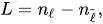
  • is the number of leptons and
  • is the number of antileptons.

Lepton number was introduced in 1953 to explain the absence of reactions such as

ν + np + e

in the Cowan–Reines neutrino experiment, which instead observed

ν + pn + e+
.[3]

This process, inverse beta decay, conserves lepton number, as the incoming antineutrino has lepton number −1, while the outgoing positron (antielectron) also has lepton number −1.

Lepton flavor conservation

[edit]

In addition to lepton number, lepton family numbers are defined as[4]

the electron number, for the electron and the electron neutrino;
the muon number, for the muon and the muon neutrino; and
the tau number, for the tauon and the tau neutrino.

Prominent examples of lepton flavor conservation are the muon decays

μ
e
+ ν
e
+ ν
μ

and

μ+
e+
+ ν
e
+ ν
μ
.

In these decay reactions, the creation of an electron is accompanied by the creation of an electron antineutrino, and the creation of a positron is accompanied by the creation of an electron neutrino. Likewise, a decaying negative muon results in the creation of a muon neutrino, while a decaying positive muon results in the creation of a muon antineutrino.[5]

Finally, the weak decay of a lepton into a lower-mass lepton always results in the production of a neutrino-antineutrino pair:

τ
μ
+ ν
μ
+ ν
τ
.

One neutrino carries through the lepton number of the decaying heavy lepton, (a tauon in this example, whose faint residue is a tau neutrino) and an antineutrino that cancels the lepton number of the newly created, lighter lepton that replaced the original. (In this example, a muon antineutrino with that cancels the muon's .

Violations of the lepton number conservation laws

[edit]

Lepton flavor is only approximately conserved, and is notably not conserved in neutrino oscillation.[6] However, both the total lepton number and lepton flavor are still conserved in the Standard Model.

Numerous searches for physics beyond the Standard Model incorporate searches for lepton number or lepton flavor violation, such as the hypothetical decay[7]

μ
e
+ γ
.

Experiments such as MEGA and SINDRUM have searched for lepton number violation in muon decays to electrons; MEG set the current branching limit of order 10−13 and plans to lower to limit to 10−14 after 2016.[8] Some theories beyond the Standard Model, such as supersymmetry, predict branching ratios of order 10−12 to 10−14.[7] The Mu2e experiment, in construction as of 2017, has a planned sensitivity of order 10−17.[9]

Because the lepton number conservation law in fact is violated by chiral anomalies, there are problems applying this symmetry universally over all energy scales. However, the quantum number B − L is commonly conserved in Grand Unified Theory models.

If neutrinos turn out to be Majorana fermions, neither individual lepton numbers, nor the total lepton number nor

BL

would be conserved, e.g. in neutrinoless double beta decay, where two neutrinos colliding head-on might actually annihilate, similar to the (never observed) collision of a neutrino and antineutrino.

Reversed signs convention

[edit]

Some authors prefer to use lepton numbers that match the signs of the charges of the leptons involved, following the convention in use for the sign of weak isospin and the sign of strangeness quantum number (for quarks), both of which conventionally have the otherwise arbitrary sign of the quantum number match the sign of the particles' electric charges.

When following the electric-charge-sign convention, the lepton number (shown with an over-bar here, to reduce confusion) of an electron, muon, tauon, and any neutrino counts as the lepton number of the positron, antimuon, antitauon, and any antineutrino counts as When this reversed-sign convention is observed, the baryon number is left unchanged, but the difference B − L is replaced with a sum: B + L , whose number value remains unchanged, since

L = −L,

and

B + L = B − L.

See also

[edit]

References

[edit]
Revisions and contributorsEdit on WikipediaRead on Wikipedia
from Grokipedia
In , the lepton number is a conserved additive within the that distinguishes from other fundamental particles, with leptons (electrons, muons, taus, and their neutrinos) assigned +1 and antileptons -1, while all other particles have 0; it was introduced in 1953 to explain the absence of certain observed decay modes in weak interactions. The total lepton number LL is defined as the sum of the individual lepton family numbers: L=Le+Lμ+LτL = L_e + L_\mu + L_\tau, where each family (electron, muon, and tau) conserves its own lepton number separately in the assuming massless neutrinos. This conservation law ensures that processes like maintain balance, such as in np+e+νˉen \to p + e^- + \bar{\nu}_e, where the initial lepton number of 0 equals the final (antineutrino contributes -1, electron +1). While strictly conserved at tree level in the Standard Model, lepton number can be violated by higher-dimensional effective operators, notably the dimension-5 Weinberg operator (ΔL=2\Delta L = 2), which generates Majorana masses for neutrinos and is implicated in neutrinoless double-beta decay (0νββ0\nu\beta\beta), with current experimental limits as of 2025 placing the half-life beyond 102610^{26} years (exceeding 2×10262 \times 10^{26} years for isotopes like 76Ge^{76}Ge) for certain isotopes. Lepton flavor violation, observed in neutrino oscillations, mixes the family numbers but preserves total LL to high precision, with searches for charged-lepton flavor violation (e.g., μeγ\mu \to e\gamma) yielding branching ratios below 1.5×10131.5 \times 10^{-13} (90% CL) as of 2025. Beyond the , lepton number violation is a key probe for new physics, such as mechanisms for masses or grand unified theories, where it may connect to violation and matter-antimatter asymmetry in the . Experimental efforts at colliders like the LHC and underground detectors continue to test these limits, potentially revealing extensions to the if violations are detected.

Basic Concepts

Definition

In , the lepton number LL is defined as an additive that quantifies the difference between the number of leptons and antileptons in a given process or system: L=nlnlˉL = n_l - n_{\bar{l}}, where nln_l counts the leptons and nlˉn_{\bar{l}} counts the antileptons. This quantum number serves to distinguish leptons from other fundamental particles, such as quarks, by assigning leptons a value of +1 and antileptons a value of -1, while non-leptonic particles receive 0. Leptons are a class of elementary fermions that do not experience the , encompassing the charged leptons—the (ee), (μ\mu), and (τ\tau)—along with their neutral counterparts, the neutrinos (νe\nu_e, νμ\nu_\mu, ντ\nu_\tau). Within the of , the total lepton number is conserved across all interactions, including the weak interactions that govern processes involving leptons, due to an underlying global U(1) symmetry. This conservation manifests in reactions as ΔL=0\Delta L = 0, ensuring the net lepton number remains unchanged before and after the interaction.

Historical Development

The concept of lepton number was introduced in 1953 by Emil J. Konopinski and Hormoz Mahmoud in their formulation of the universal Fermi interaction describing processes. They assigned a conserved , termed the "lepton charge," with a value of +1 to s and electron neutrinos, and -1 to their antiparticles, ensuring that weak interactions preserved this quantity. This postulate provided a systematic way to account for the observed conservation patterns in s, such as decay (n → p + + \bar{ν}_e), where the total lepton number remains zero, while forbidding processes that would violate it, like the unobserved decay of a directly into a proton and without a neutrino. This development occurred amid efforts to experimentally verify the neutrino's existence, postulated by in 1930 to resolve the continuous energy spectrum in . The Cowan–Reines experiment, initiated in 1953 at the Hanford reactor and refined in 1956 at , detected antineutrinos through (\bar{ν}_e + p → n + e⁺), providing direct evidence for the and aligning with the lepton number conservation rule, as the reaction balances with a total lepton number of -1 on both sides. The experiment's success reinforced the framework of weak interactions, highlighting leptons' distinct role separate from hadrons in these processes and motivating further refinements to distinguish leptonic contributions in decays. In the late 1950s, the concept evolved alongside the vector-axial vector (V-A) theory of weak interactions, proposed independently by Robert Marshak and George Sudarshan in 1957 and by and in 1958. This theory unified the description of and muon decay (μ⁻ → e⁻ + \bar{ν}_e + ν_μ), incorporating lepton number conservation to explain the involvement of neutrinos and the absence of flavor-changing decays like μ⁻ → e⁻ γ without additional particles. By assigning the same lepton number to muons and their neutrinos as to electrons, the V-A structure ensured consistency across observed weak processes while prohibiting unobserved ones, solidifying lepton number as an empirical . The integration of lepton number into modern culminated in the electroweak theory during the 1960s and 1970s. Sheldon Glashow's partial unification in 1961 laid the groundwork, followed by and Abdus Salam's full electroweak model in 1967–1968, which unified electromagnetic and weak forces under the SU(2)_L × U(1)_Y gauge group. In this framework, lepton number conservation arises accidentally, as the Lagrangian lacks terms that violate it at tree level, with protection from the chiral gauge symmetries assigning left-handed leptons to SU(2) doublets. This theoretical confirmation, validated by the discovery of neutral currents in 1973 and the W and Z bosons in 1983, established lepton number as a robust, though not fundamentally gauged, symmetry in the Standard Model.90369-2)

Particle Assignments

In the Standard Model of particle physics, lepton number LL is assigned to leptons and their antiparticles based on their classification as fermions. The three generations of charged leptons—the (ee^-), (μ\mu^-), and (τ\tau^-)—each carry L=+1L = +1, while their antiparticles, the (e+e^+), antimuon (μ+\mu^+), and (τ+\tau^+), have L=1L = -1. Similarly, the neutral leptons, consisting of the three neutrino flavors (νe\nu_e, νμ\nu_\mu, ντ\nu_\tau), are assigned L=+1L = +1, with their corresponding antineutrinos (νˉe\bar{\nu}_e, νˉμ\bar{\nu}_\mu, νˉτ\bar{\nu}_\tau) having L=1L = -1. These assignments apply specifically to the six types of leptons and their antiparticles, as summarized in the following table:
ParticleLepton Number LL
ee^-+1
μ\mu^-+1
τ\tau^-+1
νe\nu_e+1
νμ\nu_\mu+1
ντ\nu_\tau+1
e+e^+-1
μ+\mu^+-1
τ+\tau^+-1
νˉe\bar{\nu}_e-1
νˉμ\bar{\nu}_\mu-1
νˉτ\bar{\nu}_\tau-1
All other elementary particles, including quarks, gauge bosons (such as photons, , and gluons), and the , are assigned L=0L = 0, as they do not belong to the category. This ensures that lepton number remains conserved in interactions involving these non-leptonic particles. A concrete illustration of these assignments in action is provided by the , where a decays into a proton, an , and an electron antineutrino: np+e+νˉen \to p + e^- + \bar{\nu}_e. The initial state () has L=0L = 0, while the final state sums to L=+1L = +1 (from ee^-) + 1-1 (from νˉe\bar{\nu}_e) = 0, preserving total lepton number.

Conservation Laws

Total Lepton Number

The total lepton number LL, defined as the sum of the individual flavor numbers L=Le+Lμ+LτL = L_e + L_\mu + L_\tau, is exactly conserved in all electromagnetic, weak, and strong interactions within the of . This conservation stems from the invariance of the Lagrangian under a global U(1)LU(1)_L symmetry, which assigns L=+1L = +1 to and L=1L = -1 to antileptons, although this symmetry is accidental rather than a fundamental gauge principle. Electromagnetic and strong interactions trivially preserve LL since they do not change lepton content, while weak interactions maintain it through the structure of the electroweak gauge group SU(2)L×U(1)YSU(2)_L \times U(1)_Y. In the electroweak sector, the global U(1)LU(1)_L symmetry aligns with the gauge structure, ensuring no tree-level violations. Left-handed lepton fields form SU(2)LSU(2)_L doublets, such as (νee)L\begin{pmatrix} \nu_e \\ e^- \end{pmatrix}_L for the electron generation, where both components carry L=+1L = +1. This organization guarantees that charged-current weak processes, mediated by W±W^\pm bosons, obey ΔL=0\Delta L = 0, as the exchange involves one lepton transforming into another with the same lepton number assignment. Neutral-current interactions via ZZ bosons similarly preserve LL. A representative example is the decay μe+νˉe+νμ\mu^- \to e^- + \bar{\nu}_e + \nu_\mu. The initial μ\mu^- has L=+1L = +1. In the final state, ee^- contributes L=+1L = +1 ( flavor), νˉe\bar{\nu}_e contributes L=1L = -1 (antielectron ), and νμ\nu_\mu contributes L=+1L = +1 (), yielding a total final L=+11+1=+1L = +1 - 1 + 1 = +1, matching the initial value and demonstrating ΔL=0\Delta L = 0. Such balance holds across all processes involving leptons. The exhibits no perturbative anomalies or processes that violate total LL at observable low energies, distinguishing it from certain baryon-lepton combinations; non-perturbative effects like , which operate at high temperatures near the electroweak scale, are suppressed in the present and do not impact experimental tests of LL conservation.

Lepton Flavors

In , leptons are categorized into three distinct flavors corresponding to the , , and generations. Each flavor is associated with a conserved known as the flavor lepton number: LeL_e for the family, LμL_\mu for the family, and LτL_\tau for the family. These numbers are approximately conserved separately within the , particularly in scenarios without mixing or masses. The assignments of flavor lepton numbers follow a consistent pattern across generations. For the electron flavor, Le=+1L_e = +1 for the electron (ee^-) and electron neutrino (νe\nu_e), while Le=1L_e = -1 for their antiparticles (e+e^+ and νˉe\bar{\nu}_e). Analogous assignments apply to the muon flavor, with Lμ=+1L_\mu = +1 for μ\mu^- and νμ\nu_\mu, and Lμ=1L_\mu = -1 for μ+\mu^+ and νˉμ\bar{\nu}_\mu; similarly, Lτ=+1L_\tau = +1 for τ\tau^- and ντ\nu_\tau, and Lτ=1L_\tau = -1 for τ+\tau^+ and νˉτ\bar{\nu}_\tau. These assignments ensure that processes involving only one flavor maintain the respective lepton number unchanged. The separate conservation of each flavor lepton number arises from the structure of the Lagrangian, which is invariant under independent global U(1)e×U(1)μ×U(1)τU(1)_e \times U(1)_\mu \times U(1)_\tau symmetries in the absence of neutrino mass terms. This invariance manifests in the flavor-diagonal nature of the charged current weak interactions, where the weak mixing matrix for leptons is diagonal without mixing, preventing transitions between different flavors. interactions, mediated by the boson, also respect these symmetries due to their universal coupling across flavors. Illustrative examples highlight this conservation. The muon decay μeνˉeνμ\mu^- \to e^- \bar{\nu}_e \nu_\mu is allowed, as it preserves both ΔLe=0\Delta L_e = 0 and ΔLμ=0\Delta L_\mu = 0, with the antineutrino carrying Le=1L_e = -1 and the neutrino carrying Lμ=+1L_\mu = +1. In contrast, the process μeγ\mu^- \to e^- \gamma is forbidden, as it would violate flavor conservation with ΔLμ=1\Delta L_\mu = -1 and ΔLe=+1\Delta L_e = +1. Such flavor-changing processes are suppressed or absent in the without extensions. The total lepton number LL is defined as the sum L=Le+Lμ+LτL = L_e + L_\mu + L_\tau, which provides an overall conservation law encompassing all flavors. While individual flavor numbers are conserved separately, the total LL remains a robust symmetry even in models with flavor mixing, as long as no net lepton number is created or destroyed.

Violations and Theoretical Implications

Neutrino Oscillations

Neutrino oscillations refer to the phenomenon where a neutrino produced in a definite flavor state, such as electron neutrino (ν_e), transforms into another flavor, like muon neutrino (ν_μ), as it propagates through space. This occurs because the flavor eigenstates are not identical to the mass eigenstates; instead, the three neutrino flavors are mixtures of three mass states (ν_1, ν_2, ν_3) described by the Pontecorvo–Maki–Nakagawa–Sakata (PMNS) matrix. The mixing arises from nonzero neutrino masses and leads to flavor evolution over distance, providing direct evidence of lepton flavor violation in the neutrino sector. The discovery of neutrino oscillations was first established through atmospheric neutrino observations by the experiment in 1998, which detected a zenith-angle-dependent deficit in muon neutrinos consistent with ν_μ to ν_τ oscillations. This was complemented by the (SNO) in 2001, which measured solar electron neutrinos and confirmed flavor conversion to other active flavors via neutral-current interactions, resolving the long-standing solar neutrino problem. More recent long-baseline experiments, such as T2K and NOvA, have provided precise measurements of oscillation parameters, with their 2025 joint analysis revealing hints of a nonzero CP-violating phase δ_CP, favoring values around 1.4π that could indicate matter-antimatter asymmetry in the lepton sector. The PMNS matrix U parametrizes this mixing with elements U_{ij}, where i denotes the flavor (e, μ, τ) and j the state (1, 2, 3). It is characterized by three mixing angles—θ_{12} (solar mixing, ~33°), θ_{23} (atmospheric mixing, ~45°), θ_{13} ( mixing, 8.5°)—and the CP-violating phase δ_CP ( -π/2 to 3π/2). These parameters govern the probabilities; for instance, in the two-flavor approximation relevant for dominant channels like solar or atmospheric oscillations, the transition probability is given by P(νανβ)sin2(2θ)sin2(Δm2L4E),P(\nu_\alpha \to \nu_\beta) \approx \sin^2(2\theta) \sin^2 \left( \frac{\Delta m^2 L}{4E} \right), where θ is the effective mixing angle, Δm² the mass-squared difference between eigenstates, L the baseline distance, and E the neutrino energy. Current best-fit values include Δm²_{21} ≈ 7.5 × 10^{-5} eV² for solar and |Δm²_{32}| ≈ 2.5 × 10^{-3} eV² for atmospheric oscillations. Although neutrino oscillations demonstrate lepton flavor violation (ΔL_f ≠ 0 for individual flavors f = e, μ, τ), the total lepton number L remains conserved with ΔL = 0, as the process involves transitions solely among s, each carrying L = +1 (or antineutrinos with L = -1). This distinction highlights that finite neutrino masses introduce mixing without violating the overall lepton number symmetry in the extension.

Lepton Flavor Violation Processes

Lepton flavor violation (LFV) in charged leptons refers to processes where a charged lepton transforms into another charged lepton of a different flavor, such as a decaying into an . These transitions, including μeγ\mu \to e \gamma, μeee\mu \to eee, and τμγ\tau \to \mu \gamma, are forbidden at tree level in the (SM) and occur only at highly suppressed rates through loop diagrams involving mixing, with branching ratios predicted below 105010^{-50} for μeγ\mu \to e \gamma. In extensions of the SM, such as supersymmetric (SUSY) models with soft-breaking terms that introduce flavor mixing in the slepton sector or leptoquark models mediating quark-lepton interactions, these rates can be enhanced to observable levels, providing probes of new physics scales up to 10310^3 TeV. Importantly, these processes can conserve the total number LL while violating individual lepton flavors, distinguishing them from total LL-violating decays. Experimental searches for charged LFV focus on high-intensity muon and tau beams or colliders, aiming to set stringent upper limits on branching ratios (BRs) or achieve single-event sensitivities (SES) that constrain BSM parameters. The MEG II experiment at the has established the world's tightest limit on μ+e+γ\mu^+ \to e^+ \gamma, with BR(μ+e+γ\mu^+ \to e^+ \gamma) <1.5×10¹³< 1.5 \times 10^{-13} at 90% confidence level (CL) from data collected in 2021–2022, improving prior bounds by analyzing positron-photon kinematics with a liquid xenon detector and scintillating fiber tracker. For μeee\mu \to eee, the current limit stands at BR(μ+e+ee+\mu^+ \to e^+ e^- e^+) <1.0×10¹²< 1.0 \times 10^{-12} (90% CL) from the SINDRUM experiment, while the upcoming Mu3e experiment at PSI, which completed a successful commissioning run in June 2025, plans to reach an SES of 101610^{-16} by 2026 using a high-precision silicon pixel tracker to reconstruct the three-body decay topology. The Mu3e experiment completed a successful commissioning run in June 2025 and is preparing for physics data taking. Coherent μe\mu \to e conversion in atomic nuclei, where a muon in the atomic orbit converts to an electron without neutrino emission, offers a complementary clean signature: a monoenergetic electron at 105 MeV for aluminum targets. The COMET Phase-I experiment at J-PARC, utilizing a straw tube tracker and scintillators, is projected to achieve an SES of 3×10153 \times 10^{-15} by 2027, surpassing the SINDRUM II limit of <7×10¹³< 7 \times 10^{-13} (90% CL) for gold targets and probing dipole and contact interaction operators in effective field theories. The Mu2e experiment at targets an SES of 3×10173 \times 10^{-17} by the early 2030s with a similar setup, including a cosmic ray veto and low-background straw tubes, potentially excluding large regions of SUSY parameter space if no signal is observed. The engineering run for COMET is planned for early 2026. For tau LFV decays, collider experiments exploit e+ee^+ e^- collisions to produce τ+τ\tau^+\tau^- pairs. The Belle II experiment at SuperKEKB has set preliminary limits including BR(τ±μ±γ\tau^\pm \to \mu^\pm \gamma) <9.5×10⁸< 9.5 \times 10^{-8} (90% CL) from 362 fb1^{-1} of data, using photon energy spectra and missing mass reconstruction to suppress backgrounds from radiative decays. Other channels like τeKS0\tau^- \to e^- K_S^0 yield BR <2.5×10⁸< 2.5 \times 10^{-8} (90% CL), with ongoing analyses expected to improve sensitivities by factors of 2–5 with full dataset integration by 2026. These results collectively tighten constraints on flavor-violating couplings in seesaw models or RR-parity-violating , where loop-induced LFV arises from neutrino Yukawa matrices.

Majorana Neutrinos and B-L Number

Majorana neutrinos are hypothetical particles that are their own antiparticles, meaning they are self-conjugate under charge conjugation, which permits processes that violate total lepton number by two units (ΔL = 2). In such a scenario, neutrinos possess a Majorana mass term in their Lagrangian, distinguishing them from Dirac neutrinos, which require distinct particle and antiparticle states and conserve lepton number. This property has profound implications for beyond-Standard-Model physics, as it allows for rare decays that would otherwise be forbidden. A key observable process enabled by Majorana neutrinos is neutrinoless double beta decay (0νββ), represented as (A, Z) → (A, Z+2) + 2e⁻, where a nucleus undergoes two beta decays without emitting neutrinos, effectively violating lepton number conservation. In the standard light Majorana neutrino exchange mechanism, the decay amplitude is mediated by the exchange of virtual neutrinos, and the decay rate is proportional to the square of the effective Majorana neutrino mass parameter, m_{ee}, defined as m_{ee} = |\sum_i U_{ei}^2 m_i|, where U_{ei} are the Pontecorvo-Maki-Nakagawa-Sakata mixing matrix elements and m_i are the neutrino mass eigenvalues. The half-life for this process is given by (T1/20ν)1=G0νM0ν2mee2,\left( T_{1/2}^{0\nu} \right)^{-1} = G^{0\nu} \left| M^{0\nu} \right|^2 \left| m_{ee} \right|^2,
Add your contribution
Related Hubs
Contribute something
User Avatar
No comments yet.