Hubbry Logo
(Le) Poisson Rouge(Le) Poisson RougeMain
Open search
(Le) Poisson Rouge
Community hub
(Le) Poisson Rouge
logo
8 pages, 0 posts
0 subscribers
Be the first to start a discussion here.
(Le) Poisson Rouge
(Le) Poisson Rouge
from Wikipedia

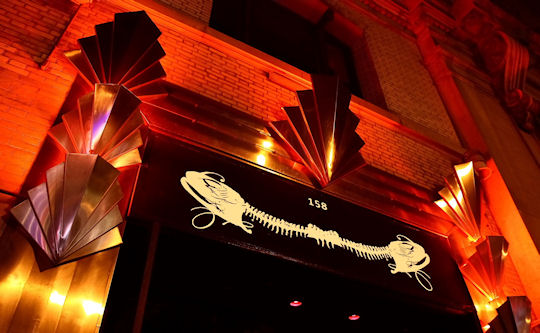
(Le) Poisson Rouge (often referred to as LPR) is a music venue and multimedia art cabaret in New York City founded in 2008 by Justin Kantor and David Handler on the former site of the Village Gate[2] at 158 Bleecker Street. The performance space was designed and engineered by Walters-Storyk Design Group (WSDG). It has become known for its focus on artistry, bringing contemporary classical music into the club setting, and offering a variety of set ups so that a seated classical performance can be followed by a standing set by a rock band or a DJ.[3] Responding to a performance of Olivier Messiaen's Quartet for the End of Time featuring pianist Bruce Brubaker at LPR, The Wall Street Journal reported: "The crowd – many of whom wouldn't even have known who Messiaen was – sat in rapt silence, and roared their approval at the end."[4][5]

Key Information

Kantor and Handler, both graduates of Manhattan School of Music, founded LPR[6] with the stated desire of creating a venue that would foster the fusion of "popular and art cultures" in music, film, theater, dance, and fine art.[7]

The venue is home to a myriad variety of genres focusing on classical, new music, avant garde music, indie rock, hip-hop, and jazz, but also playing host to readings, comedy, film, DJs, parties, theater, and burlesque.[1]

A number of live albums have been recorded at (Le) Poisson Rouge, including an improvised album by J. Spaceman and Kid Millions[8] and Grand Valley State University's New Music Ensemble recording of Terry Riley's In C.[9]

Main stage
Hanging fishtank in the vestibule

Awards

[edit]
  • 2013 Guest of a Guest's Best NYC Venues to Discover New Musicians [10]
  • 2012 & 2013 DownBeat magazine's Great Jazz Rooms of the World [11]
  • 2012 Foursquare: New York's Best Music Venues 2012[12]
  • 2012 iRockaes Top 50 Live Streaming Sources[13]
  • 2011 ASCAP's Victor Herbert Award for excellence in programming [14]
  • 2011 Lonely Planet Best of NYC[15]
  • 2011 Village Award from Greenwich Village Society for Historic Preservation [16]
  • 2011 New York Jazz Record Venue of the Year
  • 2010 Paper magazine Best Party in NYC (The Freedom Party)
  • 2010 Club Planet Venue of the Week
  • 2009 New York magazine's Best High Brow Venue
  • 2009 The Village Voice's Best Rock Venue
  • Listed in Flavorpill's Best Venues of the 21st Century
  • Multiple nominations for Paper magazine's best club in New York City[17]

References

[edit]
[edit]
Revisions and contributorsEdit on WikipediaRead on Wikipedia
from Grokipedia
(Le) Poisson Rouge, commonly known as LPR, is a and independent live in New York City's , renowned for its eclectic programming that blends genres such as , classical, , and . Founded in 2008 by classical musicians David Handler, a violinist and composer, and Justin Kantor on the site of the historic nightclub at 158 , the venue was established to reflect and nourish the city's diverse musical culture by presenting innovative performances for young and curious audiences. With a capacity of approximately 750 standing and 300 seated, LPR features a main performance space alongside a Gallery Bar that hosts exhibitions, comedy shows, and events like bingo, creating a multifaceted destination. Engineered by acoustician John Storyk of WSDG, the venue's design emphasizes superior sound quality and capabilities, supporting everything from intimate concerts to immersive experiences. Over the years, LPR has hosted renowned artists including , , and , solidifying its status as a key hub for experimental and boundary-pushing music in NYC. In 2015, the organization expanded through LPR Presents, curating events at larger venues across the city such as , Bazaar, and , thereby extending its influence beyond the original space.

History

Founding

(Le) Poisson Rouge was founded in 2008 by classical musicians David Handler and Justin Kantor, both graduates of the , with the venue opening in the summer of 2008. Handler, a violinist and , and Kantor, a cellist, met as classmates at the conservatory and shared a vision to revitalize performance spaces for . The founders' primary motivation was to establish a genre-agnostic venue that drew inspiration from traditions while embracing experimental, multimedia, and diverse performances, thereby addressing the scarcity of innovative spaces for young musicians in . They sought to bridge the gap between art and revelry, countering the rigid rituals and high costs of traditional concerts that alienated younger audiences, and instead fostering an informal, club-like environment to attract curious listeners. This approach aimed to revive the intimate salon concept, connecting artists and audiences in a symbiotic setting that blended spontaneity with substance. Initial challenges included securing the location at 158 Bleecker Street in , which required navigating complex leasing and licensing processes, particularly for a essential to the model. Lacking prior experience in bar management, the 20-something founders relied on private investors and began renovations in 2007, transforming the basement space with the help of acoustician John Storyk, known for designing . The venue opened quietly in the summer of 2008 while final touches to the renovations continued, allowing for a gradual rollout of features. Early programming emphasized new music commissions and boundary-pushing events to cultivate a reputation for innovation, featuring contemporary works across classical, indie rock, jazz, and electro-acoustic genres from the outset. This focus on diverse, forward-thinking performances helped establish LPR as a platform for emerging artists seeking alternatives to conventional venues.

Predecessor Venues

The Village Gate, a pioneering nightclub at 158 Bleecker Street in Greenwich Village, New York, was founded in 1958 by promoter Art D'Lugoff, who transformed a former basement laundry into a vibrant space for jazz and cabaret performances. Operating for over three decades, it became a cornerstone of the Village's bohemian nightlife, hosting intimate shows in its subterranean venue that seated up to 300 patrons in a barn-like setting with tiered seating and a low ceiling, fostering a close connection between performers and audiences. The club's design emphasized acoustics and visibility, drawing from mid-20th-century adaptations of the building's original structure as part of the Mills Hotel No. 1, a historic flophouse for working men. Over its run until closing in 1994, the Village Gate showcased an eclectic array of talent that defined Greenwich Village's cultural scene, including jazz legends like and , whose early New York performances electrified audiences. Comedy pioneers such as and honed their acts in the club's cabaret room, while thrived alongside, with the venue serving as a hub for the era's singer-songwriters; notably, stayed in the basement apartment and composed "" there in 1962. These performances not only launched careers but also captured the intimate, experimental spirit of and nightlife, blending genres in a single space. Following its 1994 closure amid rising rents and shifting entertainment trends, the site experienced brief repurposing efforts, including D'Lugoff's unsuccessful bid to establish a National Living Jazz Museum and Hall of Fame in the space. The basement largely stood vacant for over a decade, while the ground floor transitioned to commercial uses like a , preserving the original subterranean layout and atmospheric elements that had defined the Village Gate's legacy until the site's revival as Le Poisson Rouge in 2008.

Venue Description

Location and Architecture

(Le) Poisson Rouge is located at 158 Bleecker Street in the heart of , a historic neighborhood in renowned for its bohemian culture and artistic heritage dating back to the early 20th century. has long served as a haven for artists, writers, and musicians, fostering a vibrant creative scene that includes proximity to landmarks like , just two blocks north, and legacy jazz venues such as the nearby and . This setting contributes to the venue's underground sanctuary atmosphere, embedded in a district celebrated for its countercultural legacy. The venue occupies the former site of the Village Gate, a renowned that operated from 1958 until 1994, and was renovated between 2007 and 2008 to create a modern performance space. The architectural design was led by acoustician John Storyk and the Walters-Storyk Design Group (WSDG), transforming the basement-level structure into a flexible and intimate environment suitable for diverse musical presentations. Opened in September 2008, the renovation preserved elements of the historic location while introducing contemporary adaptations focused on acoustic excellence. Key architectural features include a multi-level layout with a main performance room featuring a corner-located stage measuring 28 feet by 21 feet, a 23-foot hardwood sprung floor, and a soundproofed lounge area serving as a bar space for approximately 130 patrons. The design emphasizes superior acoustics optimized for unamplified music, incorporating two elevated VIP boxes and dual private entrances from to enhance accessibility and intimacy. This configuration allows for versatile staging options, including a modular 16-foot round platform that accommodates a concert grand piano, underscoring the venue's commitment to artistic functionality within its confines.

Facilities and Capacity

(Le) Poisson Rouge features a flexible main performance space designed to accommodate varying event formats, with a capacity ranging from 350 to 750 patrons depending on the configuration. This includes up to 700 standing and 225 seated in standard setups, utilizing cabaret-style arrangements that allow for communal tables and no fixed barriers to enhance artist-audience proximity. The layout centers around a 23-foot sprung floor in the main room, complemented by a modular that can be configured as a corner setup, in-the-round, or expanded into a formation for diverse performances. Adjacent to the main room is the Gallery Bar, which holds up to 150 standing or 99 seated guests and serves as a space for pre- and post-show mingling. The venue's technical infrastructure supports both amplified and acoustic presentations through a state-of-the-art Martin Audio PA system and monitors, paired with Avid S6L digital consoles for front-of-house and monitor mixing. Lighting capabilities include over 100 instruments, such as more than 60 intelligent fixtures like Chauvet Force S Spots and GLP X4 bars, controlled via a grandMA3 console to create dynamic atmospheres. High-definition video projection is integrated with onstage projectors and multiple screens in the bar areas, enabling multimedia elements in shows. These features were established during the 2007-2008 renovations that transformed the space into a modern multimedia cabaret. Accessibility is prioritized with wheelchair access provided via an to the main room, and patrons are encouraged to contact the venue in advance for specific needs or assistance. The intimate design, including elevated VIP boxes and flexible seating, fosters close interaction between performers and audiences while maintaining operational efficiency.

Programming and Events

Genres and Format

(Le) Poisson Rouge maintains a genre-agnostic programming approach that blends contemporary classical, , , , , metal, and , with no boundaries imposed to foster innovation and cross-pollination among styles. This eclectic philosophy, rooted in the venue's founding vision of reflecting New York City's diverse musical landscape, ensures that diverse genres coexist equally in its lineup, promoting artistic experimentation. The venue's event formats emphasize intimacy and versatility, featuring close-up concerts in a cabaret-style seating arrangement that encourages social interaction among audiences, alongside multimedia presentations incorporating visual elements and late-night parties that extend into nightlife experiences. Programming often highlights new and experimental works, supporting innovative compositions through dedicated showcases that bridge traditional and forms. In 2015, (Le) Poisson Rouge expanded its reach with LPR Presents, a curatorial initiative that organizes events at external venues such as The Town Hall and Brooklyn Bazaar, allowing for larger-scale productions while maintaining the core eclectic ethos. The booking philosophy prioritizes a balance of emerging artists and established figures, often structured around themed series like crossover collaborations or extended new music explorations to deepen audience engagement with boundary-pushing content.

Notable Performances

Since its opening in 2008, (Le) Poisson Rouge has hosted several early milestone performances that underscored its commitment to contemporary and . In May 2009, the chamber orchestra Signal debuted works by , including "Glassworks," performed in an intimate, seated arrangement that highlighted the venue's flexible staging for new music. The venue's programming has encompassed a broad spectrum of genres, featuring pop and rock icons alongside classical and experimental acts. delivered multiple intimate sets, including a 2011 benefit concert for Japan disaster relief with and a 2015 performance supporting her live album release. headlined a 2014 rally for artists' radio royalties, covering Biz Markie's in a collaborative showcase. brought high-energy pop shows in 2017 and 2021, with sold-out dates promoting albums like Number 1 Angel. In the classical realm, the presented eclectic programs in 2010, blending and Michael Gordon pieces with premieres by . The Grand Valley State University New Music Ensemble performed 's In C in 2009, extending the piece to maximal length in a live exploration of minimalist . and experimental improvisations have also shone, notably a 2013 duo set by J. Spaceman ( of ) and Kid Millions (of Oneida), blending and free percussion. Several performances at LPR have resulted in notable recordings that capture its live energy. The 2013 improvisation by J. Spaceman and Kid Millions was released as the live album Live at Le Poisson Rouge in 2014 on Northern Spy Records, praised for its raw, pedal-driven intensity and full-drum freakouts. During LPR's 10th anniversary in 2018, collaborations with New Amsterdam Records yielded releases tied to events, including Roomful of Teeth's performances and Olivia Chaney's album launch, showcasing contemporary vocal and chamber works. The Grand Valley State University New Music Ensemble's 2009 rendition of was also documented in a live recording featuring Dennis DeSantis, released on Ghostly International to highlight modular interpretations. In 2025, under the LPR Presents banner, the venue has expanded its reach with multi-borough and out-of-state events, including at Miami Beach Bandshell and at Brooklyn's Littlefield, reflecting post-pandemic adaptations to broader touring. These initiatives incorporate hybrid elements, blending in-person crowds with digital streaming options for select shows, as seen in collaborations like Choreographer’s Carnival NYC.

Impact and Recognition

Awards

In 2011, co-founders David Handler and Justin Kantor of (Le) Poisson Rouge received the ASCAP Victor Herbert Award for their commitment to advancing American music through the venue's adventurous programming. That same year, the Society for presented the venue with its Village Preservation Award, honoring its role in enhancing the neighborhood's cultural vitality. In 2013, performers Charles “Lil Buck” Riley and Ron “Prime Tyme” Myles were awarded the Bessie for Outstanding Performance for their collaborative tap and jookin presentation at (Le) Poisson Rouge. The venue was also recognized that year in Guest of a Guest's list of the best NYC venues for discovering new musicians. In 2020, (Le) Poisson Rouge was included in magazine's Great Jazz Rooms (international). In 2021, it received a for Best Livestreaming Venue at the Pollstar Awards. In 2023, it was again listed in 's Great Jazz Rooms (international). (Le) Poisson Rouge has earned ongoing acclaim in publications including for its innovative curation of eclectic events that blend genres and attract diverse audiences.

Cultural Influence

(Le) Poisson Rouge has played a pivotal role in revitalizing as a post-2000s hub for music, bridging the neighborhood's traditional jazz legacy with contemporary experimentalism and genres. By hosting a fusion of , classical, new music, and in an inclusive space, the venue has attracted younger audiences to high-art forms through affordable tickets, casual dining, and intimate performer proximity, transforming the area into a dynamic center for artistic innovation. This shift has helped sustain the Village's historic cultural vibrancy amid evolving urban landscapes. On a broader scale, (Le) Poisson Rouge has influenced venue models across the by emphasizing artist-driven, experiences that blend spontaneity from institutions with the energy of , setting a standard for interactive and boundary-pushing performances. Its expansion through LPR Presents, launched in 2015, has extended this approach to other spaces like and Brooklyn Bazaar, while partnerships with labels such as Records have nurtured emerging composers and fostered vibrant new music ecosystems nationwide. These initiatives prioritize deep listening across genres, from classical to metal, encouraging venues elsewhere to adopt similar eclectic programming. The venue's community engagement further underscores its cultural significance, with programs like the NEXT Festival of Emerging Artists providing immersive residencies for young string players aged 20-30, including composer workshops, scholarships, and entrepreneurial training to support non-traditional careers in . During the COVID-19 pandemic, (Le) Poisson Rouge adapted by launching LPR.tv in 2020, a subscription-based streaming platform offering live and on-demand access to over 100 performances for global audiences, thereby expanding its reach beyond physical limitations and sustaining artist livelihoods. Ultimately, (Le) Poisson Rouge's legacy lies in democratizing access to high-caliber performances, incubating new compositions, and reinforcing New York City's status as a global creative capital through 2025, as evidenced by its ongoing innovations like ticketing partnerships to enhance audience participation. By challenging norms and blending genres in risk-taking programming, it has launched careers and hosted festivals like the NYC Winter JazzFest, solidifying its enduring impact on the music scene.

References

Add your contribution
Related Hubs
User Avatar
No comments yet.