Hubbry Logo
Village GateVillage GateMain
Open search
Village Gate
Community hub
Village Gate
logo
8 pages, 0 posts
0 subscribers
Be the first to start a discussion here.
Village Gate
Village Gate
from Wikipedia
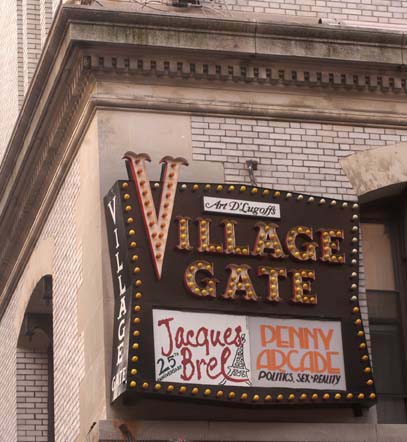
The Village Gate Sign still adorns the corner of Thompson and Bleecker Streets.

The Village Gate was a nightclub at the corner of Thompson and Bleecker Streets in Greenwich Village, New York. Art D'Lugoff opened the club in 1958, on the ground floor and basement of 160 Bleecker Street. The large 1896 Chicago School structure by architect Ernest Flagg[1] was known at the time as Mills House No. 1 and served as a flophouse for transient men. In its heyday, the Village Gate also included an upper-story performance space, known as the Top of the Gate.[2]

Throughout its 38 years, the Village Gate featured such musicians as John Coltrane, Coleman Hawkins, Duke Ellington, Mongo Santamaria, Jimi Hendrix, Golden Earring, Dizzy Gillespie, Bill Evans, Dave Brubeck, Larry Coryell, Charles Mingus, Sonny Rollins, Dexter Gordon, Art Blakey, Woody Shaw, Miles Davis, Stan Getz, Vasant Rai, Nina Simone, Herbie Mann, Woody Allen, Patti Smith, Lucio Dalla, Velvet Underground, Edgard Varèse, and Aretha Franklin, who made her first New York appearance there. The show Jacques Brel is Alive and Well and Living in Paris, debuted at the Village Gate in 1968.

History

[edit]

In the 1960s, radio DJ and Latin music advocate Symphony Sid hosted a regular Monday night concert at the Village Gate - "Monday Nights at the Gate" - featuring the best of New York's thriving Latin music scene. As salsa music began to grow in popularity, the Alegre record label began to host quite a few events at the Village Gate - many of which resulted in live recordings. Some of the live recordings from the Village Gate were the Alegre All-Star (and later Tico All-Star) Descarga sessions. The "Salsa Meets Jazz" series at the Village Gate was a seminal part of the history of New York Latin music. In 1977, WRVR jazz and Latin music DJ and jazz musician/conga drummer Roger Dawson created and hosted a weekly event that brought top Latin bands together with a guest jazz soloist. Dawson named the event "Salsa Meets Jazz". Sonny Stitt with Eddie Palmieri, Dexter Gordon with Machito, Dizzy Gillespie with Tito Puente, James Moody, Wynton Marsalis, Bobby Hutcherson, David "Fathead" Newman, Slide Hampton, and Pharoah Sanders, to name a few, all jumped in to "jam" with the best salsa bands of the time.

The club hosted a benefit for Timothy Leary in May 1970 that featured performances from such counterculture luminaries as Jimi Hendrix and Allen Ginsberg. From 1971 to 1973, a musical comedy revue called National Lampoon's Lemmings had a successful run at the Gate. It starred future comic notables John Belushi, Chevy Chase, Garry Goodrow, and Christopher Guest, and lampooned the 1969 Woodstock Festival, which had taken place upstate two years earlier, calling it "Woodchuck" and equating the entire hippie generation with lemmings bent on self-destruction.

Let My People Come opened at the Village Gate Theater in 1974. The show broke all box office records there and played for 1,167 performances. Its transfer to the Morosco Theatre on Broadway was not as successful, though, and closed after 106 performances. It was nominated for a Grammy in 1974 and has appeared all over the world.

From 1989 to 1991, the improvisational comedy troupe Noo Yawk Tawk performed at the upstairs theater. The group was conceived and directed by Richmond Shepard, a world-renowned mime, actor, comedian, and teacher. All of the performances for Noo Yawk Tawk were entirely improvised. Characters may have been repeated, but never the sketches or the dialogue. The audience always set the scene and conditions for each improvisation, so every performance was different. The cast included Stan Taffel, Marc Kudisch, Debra Wilson, Eric Douglas, Garry Goodrow, Miguel Sierra, Ken Dashow, Nola Roeper, Bonnie Comley, and Richmond Shepard. Taffel would go on to win three Emmy Awards for his performances in The News In Revue on PBS. Kudisch earned a Tony nomination in 2002.

The Village Gate name was again used in 1996 at 240 West 52nd Street. Art D'Lugoff, co-producer of the show A Brief History of White Music was looking to rent the space in a site formerly occupied by the Lone Star Road House. That incarnation and the show lasted until 1997. In 1998, the 52nd Street location was taken by a brief reincarnation of Max's Kansas City.

The Village Gate closed its Greenwich Village location in February 1994. The ground floor is currently occupied by CVS/Pharmacy. The off-Broadway capacity Village Theater, which hosted performances of the musically themed Love, Janis, Dream a Little Dream, Jacques Brel is Alive and Well and Living in Paris, and Escape From Bellevue, occupied the sublevel performance space until fall 2007. In spring 2008, the space was reopened as a multiuse performance venue and gallery bar called (Le) Poisson Rouge.

The club is mentioned by salsa superstars Richie Ray & Bobby Cruz in their song Pancho Cristal, off their 1968 LP Los Durísimos.
Vámonos pa'l Village Gate
Que allí es donde usted va y ve
Bravos de la tumbadora
Y las estrellas de ahora.

The club is mentioned again in the montuno:
Pancho Cristal
Descarga del Village Gate.

as well as in Chronicles: Volume One by Bob Dylan.

Notable productions

[edit]

The Top Of The Gate a.k.a. Village Gate (Upstairs):

The Village Gate Theater a.k.a. Village Gate (Downstairs):

The Village Gate 52nd Street

  • A Brief History of White Music (1996)

Recordings

[edit]

Notable albums recorded live at The Village Gate:

The Village Gate was a stop on the 'Greenwich Village Walking Tour', in part because Bob Dylan wrote "A Hard Rain's A-Gonna Fall" in September 1962 in a basement apartment occupied by Chip Monck, the Village Gate lighting engineer and future compere and lighting designer of the Woodstock Festival.

The Village Gate is used as a setting in the 1961 film noir movie Blast of Silence.[3]

References

[edit]
[edit]
Revisions and contributorsEdit on WikipediaRead on Wikipedia
from Grokipedia
The Village Gate was a located at 160 Bleecker Street in , , , operating from 1958 until its permanent closure in 1994. Founded by promoter Art D'Lugoff, the venue occupied a large basement space that hosted a diverse array of performances, including , , comedy acts, and productions, establishing it as a cornerstone of New York's mid-20th-century and artistic experimentation. The club's eclectic programming featured pioneering jazz ensembles, such as those led by and , whose 1961 live recordings at the Village Gate captured innovative explorations, alongside folk revivalists and comedians like and in their early careers. Its expansive room, often criticized for poor acoustics due to its cavernous size, nonetheless fostered an inclusive atmosphere that integrated audiences across racial lines, particularly during the 1970s salsa scene. Despite periodic challenges, including building code disputes resolved through city settlements, the Village Gate endured as a mecca for live music until economic pressures forced its shutdown, after which the site housed commercial spaces like a .

History

Founding and Construction (1958)

The Village Gate was founded by promoter and impresario Art D'Lugoff, who leased and converted space in an existing building to create a venue for live performances. The club opened on October 17, 1958, initially utilizing the basement and ground floor of 158-160 at the corner of Thompson Street in , . This location had previously housed Mills House No. 1, a residential hotel for single working-class men established in 1897 to provide affordable lodging amid urban poverty. By the mid-20th century, the upper floors operated as a for transients, while the basement served as a facility. D'Lugoff adapted the cavernous basement into the primary performance space, installing a stage, seating for approximately 250 patrons, and basic acoustics suited for and folk acts, with minimal structural alterations to the pre-existing 1890s-era building. Entrance was routed through a on Thompson Street to bypass the flophouse's access and separate clubgoers from residents. The ground floor remained partly ancillary at launch, with full expansion upward occurring later. This conversion reflected D'Lugoff's vision for an intimate, bohemian amid Greenwich Village's postwar cultural ferment, prioritizing functionality over opulent redesign. No major new construction was undertaken; the focus was on repurposing the underutilized lower levels for nightly shows starting at low cover charges.

Expansion and Peak Operations (1958–1970s)

Following its 1958 opening, the Village Gate under Art D'Lugoff's management quickly established itself as a premier venue for , folk, and emerging comedy acts, drawing capacity crowds through innovative booking of both established and rising talents. The club's basement space, configured for cabaret-style seating accommodating several hundred patrons, facilitated intimate yet scalable performances that capitalized on Greenwich Village's burgeoning countercultural scene in the early . D'Lugoff's strategy emphasized eclectic programming, blending luminaries like , , and with folk artists such as and , which broadened its appeal and sustained high attendance amid the folk revival. By the mid-1960s, the venue reached peak operations, hosting sold-out engagements that included Billie Holiday's late-night concert at a partnered larger space in 1963—delayed to 3 a.m. due to licensing issues but drawing 2,500 attendees—and regular appearances by , , and . Comedy breakthroughs further diversified its offerings, with , , , and performing extended runs that launched careers and filled seats nightly. This period also saw operational innovations, such as live recordings yielding nearly two dozen "Live at the Village Gate" albums featuring acts like and , which amplified the club's national profile and revenue streams. Into the 1970s, the Village Gate maintained its prominence by incorporating rock, R&B, and Latin acts like , , and alongside off-Broadway productions such as the 1968 revue Jacques Brel Is Alive and Well and Living in , which previewed to full houses and ran for years. D'Lugoff's willingness to book blacklisted performers like and host civil rights benefits, including CORE fundraisers in 1960, underscored its role as a cultural hub resistant to mainstream censorship, sustaining loyalty from diverse audiences despite economic pressures. The venue's adaptability—eschewing rigid genres for high-profile, often experimental bills—ensured operational vitality, with consistent sell-outs for headliners like and .

Decline, Closures, and Final Shutdown (1970s–1994)

In the 1970s, the Village Gate faced operational disruptions amid New York City's broader fiscal crisis, which strained municipal services and nightlife venues through reduced public investment and economic contraction. On January 2, 1976, the club was temporarily shut down by New York City police acting on an order from the Buildings Department, citing four violations including the lack of required permits for occupancy, electrical work, plumbing alterations, and a new entrance. The closure interrupted a second performance of a show featuring the duo Nichols and May, but a settlement was reached by January 5, allowing the club to reopen after addressing the issues and posting a bond. These regulatory hurdles reflected mounting compliance costs for aging venues during a period when the city's near-bankruptcy in 1975 limited leniency toward code violations. Financial pressures intensified through the late 1970s and 1980s as Greenwich Village's bohemian appeal waned under , rising operational expenses, and shifts in audience preferences away from large-scale and folk clubs toward smaller, specialized spaces or recorded media. Owner Art D'Lugoff encountered accumulating debts from unsuccessful investments and an eclectic booking policy that sometimes bordered on chaotic, diluting the club's draw. By the early , these factors compounded with a changing live music market favoring corporate-backed arenas over intimate nightclubs, eroding profitability. The club's decline culminated in formal financial distress, with D'Lugoff declaring in amid escalating debts. Efforts to sustain operations faltered as landlord pursued foreclosure on the Bleecker Street property, sealing the fate by acquiring the building. The Village Gate closed permanently in February 1994 after 36 years, unable to meet proposed rent hikes that reflected surging real estate values in revitalizing . The ground-floor space later became a pharmacy, marking the end of its role as a countercultural hub.

Physical Venue and Operations

Location and Architectural Background

The Village Gate was located at 160 Bleecker Street, on the corner of Thompson Street in , , . The nightclub occupied the ground floor and basement levels of the building, which allowed for an expansive performance space conducive to live music and theater. The structure housing the Village Gate was originally constructed in 1896–1897 as Mills House No. 1, a philanthropic residential designed to provide affordable, wholesome for single working-class men. Architect employed principles in its design, featuring a steel-frame that enabled larger windows and open interiors compared to traditional load-bearing buildings of the era. The complex included 1,554 low-cost rooms, along with amenities such as restaurants, laundry facilities, lounges, and interior courtyards to promote moral and hygienic living conditions. By the mid-20th century, the building had declined into use as a before Art D'Lugoff repurposed the lower levels into the Village Gate in 1958, transforming the utilitarian spaces into a "barnlike" venue suited for intimate yet capacious performances. This adaptation leveraged the building's robust frame and multi-level layout, with the basement providing acoustic advantages for jazz and folk acts while maintaining the historic envelope's structural integrity.

Internal Layout and Technical Features

The Village Gate's primary performance space was a spacious room measuring 8,000 square feet, with a of 450, designed to accommodate live audiences in an intimate yet expansive setting. This cavernous layout extended across the ground floor and levels of 160 , facilitating a multi-level operation that included a street-level terrace for additional seating and . An upstairs area, designated as the Top of the Gate, provided a secondary venue for smaller performances and dining, enhancing the club's versatility for diverse programming. Technically, the venue featured superior acoustics optimized for and live recordings, with a built-in recording booth that supported high-fidelity captures directly from performances. In the early 1960s, engineer Richard Alderson installed a state-of-the-art sound system, which included advanced amplification and setups tested during residencies by artists like . This infrastructure enabled spontaneous multitrack recordings using equipment such as RCA ribbon microphones suspended above the stage, contributing to the club's reputation for producing venue recordings with notable clarity despite the room's size. The setup prioritized natural sound reproduction over heavy reinforcement, aligning with the era's emphasis on acoustic integrity for improvisational music.

Management and Business Model

The Village Gate was owned and operated by Art D'Lugoff from its opening in 1958 until its closure in 1994. D'Lugoff, who studied and briefly attended NYU , served as the primary , personally overseeing bookings and programming to feature a mix of , folk, , , and off-Broadway musicals. His daughter, Sharon D'Lugoff, contributed to operations for two decades, handling aspects of venue management during its peak years. The club's business model centered on live performances in a cabaret-style setting, generating revenue primarily through cover charges, drink minimums, and sales. Typical admissions included a $4.50 with a one-drink minimum in 1977, escalating to $10 cover and two-drink minimum by 1983 for upstairs shows at the Top of the Gate. D'Lugoff emphasized attracting high-quality talent to draw audiences, adapting programming to maintain viability amid shifting entertainment trends, though he later attributed financial woes to suboptimal bookings and external factors like weather. A key operational advantage was a long-term on the 8,500-square-foot space at 160 , initially at $2,000 monthly, which D'Lugoff credited for much of the club's endurance alongside its prime location. By the early , however, rising costs, declining attendance due to from home , and potential rent hikes to $15,000 monthly led to Chapter 11 bankruptcy filing in June 1991, underscoring vulnerabilities in the model reliant on foot traffic and beverage-driven profits.

Programming and Performances

Jazz and Musical Acts

The Village Gate, established in in 1958, rapidly became a cornerstone venue for performances, drawing top-tier artists through its intimate basement space and owner Art D'Lugoff's commitment to innovative programming. From its early years, the club hosted Monday night sessions starting in 1960 with flutist , which evolved into regular showcases blending mainstream and avant-garde styles. Pioneering acts like the Quintet, featuring on and , performed there in July and August 1961, pushing modal and boundaries in sets later rediscovered and released as Evenings at the Village Gate. Legendary figures such as , , , , , , , , Sonny Stitt, Dexter Gordon, James Moody, and graced the stage, often in quintets or quartets that defined post-bebop eras. The shared bills with blues artist on April 21, 1962, exemplifying the club's eclectic pairings. Later decades saw appearances by Pharaoh Sanders, , , , and vibraphonist , maintaining its status amid shifting scenes. Vocalists like , , and —who made her first New York appearance there—integrated jazz standards with emerging soul influences. The venue also pioneered Latin-jazz fusions, with 1960s "Monday Nights at the Gate" led by DJ Symphony Sid featuring artists like and , and the 1977 "Salsa Meets Jazz" series curated by conga drummer Roger Dawson, pairing Latin bands with guest jazz soloists such as David "Fathead" Newman. These events, including live descargas with Alegre All-Stars and Tico All-Stars, contributed to New York City's Latin music evolution while attracting and other percussion-driven ensembles. ’s , alongside Coltrane and Silver groups, headlined marquees in the 1960s, underscoring the club's role in hard bop dissemination.

Comedy, Folk, and Experimental Shows

The Village Gate hosted early folk performances starting in June 1960, with and Logan English as the inaugural folk artists on the bill. performed there in 1960 alongside and , resulting in the live album Pete Seeger at the Village Gate, which captured traditional folk songs and blues collaborations. appeared in the late 1960s and early 1970s, contributing to the venue's role in the folk revival alongside acts like and . made her debut at age 13, marking an early milestone in her career amid the Village's scene. Comedy acts at the Village Gate included , who performed despite anticipated police presence, leading to his arrest for obscenity during a show. shared stages with folk and jazz performers like in the , honing his stand-up routine in the club's intimate setting. appeared onstage with musician Stephen Bishop in the 1970s, blending comedy with musical elements. By 1983, the upstairs "Top of the Gate" space was rebranded as Bananas to focus on comedy, featuring stand-up performers in a dedicated laughs-oriented format. From 1989 to 1991, the improvisational troupe Noo Yawk Tawk staged shows in the upstairs theater, directed by a core group emphasizing spontaneous sketches. Experimental shows at the Village Gate encompassed and interdisciplinary performances, with comedy often following avant-garde sets in mixed bills during the . The 1965 album The New Wave in Jazz, recorded live on March 28, featured groups led by avant-garde artists like and , pushing boundaries in improvisation. Off-Broadway productions in the upstairs theater, such as musical revues drawing from themes, later occupied the space, including Jacques Brel is Alive and Well and Living in Paris adaptations. These events reflected the venue's flexibility for non-traditional formats amid Greenwich Village's bohemian experimentation.

Notable Productions and Debuts

The revue Jacques Brel Is Alive and Well and Living in Paris, translating and adapting songs by the Belgian singer-songwriter , premiered at the Village Gate on January 22, 1968, and achieved a run of 1,581 performances, becoming one of the longest-running musicals in history at the time. The production, directed by Elly Stone and , introduced American audiences to Brel's poignant, ironic chansons and marked a significant cultural bridge between European and New York theater. In jazz, the Village Gate hosted early breakthrough performances by major figures, including John Coltrane's residency in 1961, where he performed with his quartet featuring on piano, on bass, and [Elvin Jones](/page/Elvin Jones) on drums, later documented on the live album John Coltrane at the Village Vanguard (though recorded nearby, the Gate's sets influenced his contemporaneous live work). appeared multiple times in the 1960s, showcasing his quintet with , , , and Tony Williams, contributing to the venue's reputation as a testing ground for innovations. Other luminaries like , , , and performed there, with Holiday's appearances in the late underscoring the club's role in preserving swing-era legacies amid evolving styles. Comedy debuts included Bill Cosby's stand-up routines in the early 1960s, where the then-emerging performer honed his observational humor without props or personas, leading to his national breakthrough on in 1965 and his debut album Bill Cosby Is a Very Funny Fellow...Right! recorded shortly after. Lenny Bruce's provocative sets at the Gate in the early 1960s, challenging obscenity laws with social , drew both acclaim and legal scrutiny, amplifying his role as a free-speech catalyst before his 1961 arrest elsewhere in the Village scene. Folk and experimental acts featured Pete Seeger's banjo-led performances in the , aligning with the revival, while later productions like the 1977 "Salsa Meets Jazz" series fused Latin rhythms with improvisation, spotlighting and in collaborative sets that presaged crossover genres. These events, often extending into all-night sessions, exemplified the Gate's eclectic programming under Art D'Lugoff's curation, prioritizing artistic risk over commercial predictability.

Cultural Significance and Impact

Role in Greenwich Village Counterculture

The Village Gate, established in 1958 by Art D'Lugoff at 160 in , emerged as a key venue amid the neighborhood's burgeoning bohemian and artistic scene, which evolved into the heart of . Greenwich Village attracted nonconformists, including poets, folk musicians, and activists rejecting mainstream conformity, with coffeehouses and clubs fostering experimentation in music, theater, and politics. The club's basement space, converted from a former , hosted intimate performances that blurred lines between and , aligning with the Village's ethos of free expression and sentiment. In the early 1960s, the Village Gate contributed to the folk music revival, a cornerstone of countercultural dissent, by featuring acts like Pete Seeger as its opening performer and extending invitations to folk singers amid the scene's explosion in nearby spots like the Gaslight Cafe. This programming intertwined art with activism; in 1960, the club organized benefits for the Congress of Racial Equality (CORE) and hosted weekly "Cabaret for Freedom" Sundays, channeling performances toward civil rights causes during a period of heightened racial justice protests. Such events exemplified how Village venues like the Gate served as incubators for the folk-protest nexus, influencing figures who later amplified anti-war and social reform messages through music. By the late 1960s, the Village Gate embraced broader countercultural currents, staging experimental theater and satire that critiqued authority, including the 1967 production of MacBird!, a controversial play likening President to amid opposition. The venue's commitment to unfiltered expression extended into the , culminating in a May 1970 benefit concert for featuring , , and others, which drew luminaries of the hippie movement and underscored the club's role in sustaining Village radicalism even as commercial pressures mounted. Through these initiatives, the Village Gate not only hosted talent but facilitated the cultural ferment that defined as a countercultural vanguard.

Influence on Broader Music and Entertainment Scenes

The Village Gate's eclectic programming, which integrated with folk, , and experimental theater, established a template for versatile urban nightlife venues that prioritized genre-crossing appeal over rigid categorization, influencing the diversification of entertainment offerings in and beyond during the 1960s and 1970s. By hosting sets immediately followed by stand-up routines or folk performances, the club demonstrated the commercial viability of mixed bills, a practice that echoed in later revivals and multi-act festivals, fostering audience tolerance for stylistic juxtapositions that shaped postmodern entertainment formats. This approach contributed to the erosion of strict genre silos in live music, as evidenced by the club's role in elevating and salsa acts during Monday nights dedicated to emerging New York scenes, which paralleled the genre's mainstream crossover in the 1970s. In jazz specifically, the Village Gate amplified experimental currents by providing extended residencies for innovators like and in July 1961, where their quartet explorations of modal and free-form —captured in later-released recordings—gained exposure to diverse crowds, helping to normalize such innovations outside purist circles and influencing subsequent fusion developments. Similarly, its folk programming during the late 1950s and early 1960s supported the Village's revival wave, bridging acoustic traditions to rock electrification by showcasing acts that later informed the boom, though the club's larger capacity often favored established draws over nascent breakthroughs. The venue's impact extended to comedy and theater, where it incubated talents and formats that permeated national media; for instance, the 1973 production of National Lampoon Lemmings at the Village Gate propelled performers like and toward , embedding satirical sketch comedy into mainstream television. Its 1968 premiere of , an Off-Broadway revue that ran for years and toured internationally, popularized intimate, multilingual revues, inspiring similar concept-driven musicals in regional theaters. Early platforms for comedians such as further professionalized stand-up as a concert-hall staple, influencing the shift from holdovers to solo observational acts that dominated late-night TV and arena tours by the 1980s.

Recordings, Media, and Archival Legacy

Numerous live recordings captured performances at the Village Gate, preserving its role as a hub for innovative jazz and other genres from the late 1950s onward. One of the most significant is the 1961 engagement by John Coltrane's quintet, augmented by Eric Dolphy on bass clarinet and flute, which yielded the album Evenings at the Village Gate. Recorded during a month-long residency in July and August, these sessions featured extended improvisations on standards like "My Favorite Things" and originals such as "Impressions," showcasing Coltrane's evolving modal approach and Dolphy's avant-garde contributions; the tapes, long considered lost, were rediscovered and released by Impulse! Records in 2023. Sonny Rollins also documented his piano-less quartet, including trumpeter , during March 1962 performances, resulting in the comprehensive Complete Live at the Village Gate 1962, a six-CD set of over five hours of previously unreleased material emphasizing Rollins' thematic and rhythmic drive. Other notable releases include Carmen McRae's Alive!, Donald Byrd's Byrd at the Gate, and Herbie Mann's Doin' the Thing, all captured live at the venue and highlighting its acoustic suitability for intimate, high-fidelity documentation under the Village Gate Records imprint. These recordings form the core of the Village Gate's archival legacy, with materials primarily held by record labels and private collections rather than centralized institutional archives, underscoring the venue's influence on preserving countercultural through commercial releases rather than formal preservation efforts. While no dedicated documentaries focus exclusively on the club, its appearances in broader music histories, such as folk and retrospectives, reference these sessions as pivotal artifacts of innovation.

Obscenity and Censorship Incidents

In 1974, the Village Gate hosted the off-Broadway musical revue Let My People Come, which featured a fully nude co-ed cast performing songs with explicit lyrics, four-letter words, and simulated sex acts. The production, directed by R. Oesterman with music by Cager Wilson, openly addressed sexual themes with humor and provocation, distinguishing it from more heteronormative contemporaries like Oh! Calcutta!. The show's content prompted intervention by the New York State Liquor Authority (SLA), which initiated proceedings in late 1974 to revoke the club's liquor license, citing incompatibility between alcohol service and performances deemed lewd or obscene. At a December 1974 hearing, supporters including feminist Betty Friedan and futurist Alvin Toffler defended the revue as a legitimate exploration of sexuality, arguing against regulatory overreach. The SLA's position hinged on state liquor laws prohibiting "disorderly" premises, potentially exempt from federal obscenity standards like those established in Miller v. California (1973), raising First Amendment questions about varying definitions of obscenity across regulatory contexts. The dispute exemplified tensions between artistic expression and administrative censorship in New York nightlife, though the SLA's challenge did not immediately shutter the production, which continued amid legal scrutiny. No prior incidents at the Village Gate are documented in contemporaneous accounts, distinguishing this from broader comedy arrests, such as those involving performers like at other venues. The episode contributed to the club's pattern of regulatory pressures but was resolved without permanent license loss at the time, allowing operations to persist until later financial and safety issues.

Regulatory Shutdowns and Safety Violations

On December 31, 1975, the Department of Buildings issued an order to vacate the Village Gate nightclub at 160 , citing multiple safety violations that prompted police enforcement and a temporary shutdown during New Year's Eve performances. The primary issues included blocked exits and excessive combustible wood paneling, which violated building codes intended to prevent fire hazards in public assembly spaces. Owner Art D'Lugoff contested the severity, asserting that most violations—such as the paneling and exit obstructions—had been or were being addressed, and he refused immediate closure, facing seven summonses with a court date set for February 18, 1976. The landlord, Louis Evangelista, briefly cut gas and electricity to enforce the vacate order, though utilities were later restored, and the ongoing production Let My People Come relocated to the Theater. A settlement reached on January 6, 1976, permitted the club to reopen under supervised corrections, following a court stay granted on 4. Key remedies included immediate removal of all wood paneling and wainscotting, replacement of wooden stairs with a staircase in the upper "Top of the Gate" section (which remained closed pending inspection), and reduction of downstairs occupancy from 480 to 360 persons to align with limits. Additional violations involved missing public-assembly permits across three specifications, requiring new certificates upon compliance. City inspectors monitored progress, emphasizing the hazards of combustible materials in a densely patronized venue. D'Lugoff had denied serious risks, but the agreement prioritized verifiable fixes over operational continuity. No further documented regulatory shutdowns occurred, though the incident highlighted ongoing tensions between the club's improvisational operations and stringent post-1970s fire code enforcement in aging structures. The Village Gate continued until its permanent closure in 1994, driven primarily by financial disputes rather than safety infractions.

Financial and Operational Disputes

In January 1976, the Department of Buildings ordered the Village Gate to vacate due to multiple code violations, including blocked exits and excessive combustible wood paneling installed during unpermitted renovations. The club's landlord, Louis Evangelista, exacerbated the situation by cutting off gas and electricity service, initially citing city directives, though this stemmed from a misunderstanding amid ongoing disputes over the unauthorized alterations. Owners D'Lugoff and his brother Burton accused city agencies of harassment instigated by the landlord, while the State Liquor Authority separately moved to revoke the club's license over the perceived obscenity of the musical . A settlement reached on January 5, 1976, permitted the club to reopen downstairs operations at reduced capacity (from 480 to 360 patrons) while corrections proceeded, including removal of wood wainscoting and installation of steel staircases in place of wooden ones; the upstairs "Top of the Gate" bar remained closed pending fixes. Compliance was monitored by on-site inspectors, with new permits required for public assembly and occupancy. D'Lugoff faced seven additional summonses for the violations, with a court date set for February 18, 1976, and an appeal on the liquor license revocation. By the early 1990s, escalating financial pressures culminated in the club's operator, Village Rathskeller, Inc., filing for Chapter 11 bankruptcy protection in 1991 amid the landlord's own insolvency. The case later converted to Chapter 7 liquidation in 1994, triggered by arrears in federal and state taxes, a broader decline in nightclub patronage due to reduced alcohol sales and fewer high-profile acts booking small venues, and the termination of the club's $2,000-per-month lease following foreclosure by Chemical Bank on the property at 160 Bleecker Street. The bank, assuming control to address vandalism and unauthorized occupancy, proposed rents of $15,000 monthly, rendering continued operation untenable. Operational tensions also included repeated fines and regulatory scrutiny from the New York Police Department, which D'Lugoff described as unfair enforcement of rules, contributing to chronic instability. These disputes, rooted in safety non-compliance, landlord-tenant conflicts, and fiscal mismanagement, underscored the venue's vulnerability to New York City's stringent oversight and economic shifts in the live entertainment sector.

Legacy and Post-Closure Developments

Long-Term Cultural Influence

The Village Gate's enduring influence on American music and performance culture stems from its function as a proving ground for genre-blending experimentation, particularly in jazz and Latin fusion, which informed subsequent cross-pollinations in global music scenes. The club's "Salsa Meets Jazz" series, organized by promoter Jack Hooke and owner Art D'Lugoff starting in the late 1970s, paired Latin ensembles with jazz improvisers, fostering an integrated sound that anticipated later world music trends and elevated New York City's role in multicultural artistry. This programming not only showcased artists like Tito Puente and Mongo Santamaría alongside jazz figures such as Grover Washington Jr., but also contributed to the mainstreaming of Afro-Cuban rhythms in U.S. popular music, as evidenced by the series' documentation in Latin jazz historiography. In comedy and spoken-word performance, the venue's hosting of boundary-pushing acts like Lenny Bruce in the early 1960s helped normalize provocative social commentary, influencing the evolution of stand-up from vaudeville roots to raw cultural critique that persists in modern circuits. Bruce's appearances there, amid obscenity trials, exemplified the club's tolerance for dissent, a trait that echoed in later countercultural comedy hubs and informed legal precedents on free expression in entertainment. Similarly, folk and emerging rock performers, including early Bob Dylan affiliates and Jimi Hendrix's 1970 benefit for Timothy Leary, embedded the Gate in narratives of 1960s rebellion, sustaining its archetype in retrospectives on bohemian innovation. Post-closure in 1994, the club's archival footprint has amplified its legacy through rediscovered recordings, such as the 2023 release of John Coltrane's July 1961 set with , which captures mid-career sonic explorations and underscores the venue's role in preserving undocumented jazz milestones. This material, sourced from private tapes, has prompted reevaluations of Coltrane's transitional phase, influencing academic and fan discourse on development. Collectively, these elements have cemented the Village Gate as a touchstone in Greenwich Village's mythic status, referenced in histories of urban nightlife as a catalyst for artistic risk-taking that outlasted its physical existence.

Site Reuse and Preservation Efforts

Following the Village Gate's closure in 1994, the and basement spaces at 160 were initially eyed for revival as a . In November 1996, developer Roy Stillman announced plans to reopen the site with live performances, aiming to recapture its bohemian spirit amid Greenwich Village's evolving nightlife scene. However, these efforts did not sustain long-term cultural programming, and by the early , the had transitioned to retail use, currently occupied by a storefront. The upper levels of the building, originally part of the 1897 Mills House No. 1 residential structure, were converted into the Atrium Apartments, reflecting broader post-industrial repurposing of Village properties for mixed commercial-residential occupancy. Preservation advocacy focused on integrating the site into wider historic district protections rather than standalone landmarking. The Greenwich Village Society for Historic Preservation (now Village Preservation) highlighted 160 Bleecker Street in campaigns for the South Village Historic District, emphasizing its layered history from working-class housing to countercultural hub. This culminated in the New York City Landmarks Preservation Commission designating the South Village Historic District on December 17, 2013, encompassing the Village Gate building and restricting alterations to maintain its architectural integrity amid surrounding development pressures. The designation report explicitly referenced the site's role in hosting events like the Charles Pierce drag performances, underscoring its contributions to Village nightlife. Additional recognition came through cultural heritage initiatives, with the NYC LGBT Historic Sites Project designating Mills House No. 1 / Village Gate as a key site in 2017 for its ironic evolution from a "wholesome" men's to a venue for boundary-pushing performances, including early drag shows and acts. A faded "Village Gate" ghost sign remains visible on the Thompson Street corner facade, preserved as an incidental artifact of the building's exterior and emblematic of Village Preservation's efforts to retain ephemera against weathering and redevelopment. No major demolition threats materialized post-closure, as the site's inclusion in the has prioritized over wholesale replacement, aligning with zoning that favors low-rise commercial and residential continuity in the area.

References

Add your contribution
Related Hubs
User Avatar
No comments yet.