



Community hub
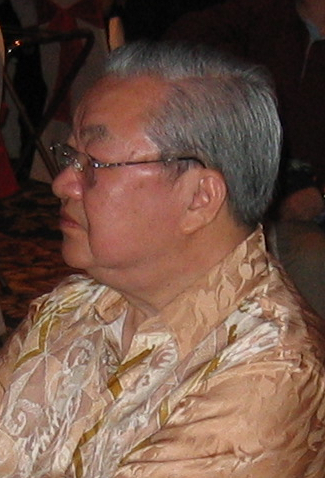
Lee San Choon
View on Wikipedia
Lee San Choon (Chinese: 李三春; pinyin: Lǐ Sānchūn; 24 March 1935 – 3 March 2023) was a Malaysian politician and businessman. He was the fourth president of Malaysian Chinese Association (MCA), a major component party of the ruling coalition Barisan Nasional (BN) from 1975 to 1983. He led the party in three general elections in Malaysia, most successfully in the 1982 general election. He held various ministerial posts in the cabinet of the Malaysian government from 1969 to 1983, such as Labour and Manpower Minister, Works and Public Utilities Minister, as well as Transport Minister.
Key Information


Early life
[edit]Lee San Choon was born on 24 March 1935 in Pekan, Pahang to Lee Debin (Chinese: 李德斌) and Yang Zhenling (Chinese: 楊貞齡), immigrant parents from Tianmen, Hubei in China.[1] The third of six children, he lost his mother at the age of ten, and he had five other half-siblings after his father remarried.[1]
Lee had his early education in a Chinese-medium school, Chung Hwa School in Pekan, before being transferred to Sultan Ahmad School for a year of English education. The family moved when he was 12 to Johor Bahru in Johor, where he started his secondary education at the English College.[2] After obtaining his Cambridge GCE O-Level, he taught English at a primary school in Geylang, Singapore.[3] He completed his A-Level in 1955, and although he had intended to continue his education abroad, family financial constraints forced him to abandon the plan.[4] He held a minor position in the government's Social Welfare Department, then worked as a clerk in a textile factory.[5]
Political career
[edit]Early career
[edit]Lee San Choon joined the Malayan Chinese Association in 1957. He was elected a member of parliament in the Kluang Utara parliamentary seat in the 1959 Malayan general election, winning the former socialist stronghold by a majority of 1,458 votes, and became the youngest MP in Malaya at the age of 24.[6] After Kluang Utara, he represented the Segamat Selatan constituency from 1964 to 1974 and Segamat until 1982. He was elected Chairman of MCA Youth in 1962. He caused a stir when he urged the leaders of MCA to resign in 1963. In 1965, MCA Youth supported the campaign to make Chinese a national language. Due to the political sensitivity of the issue, he offered to resign but was persuaded to stay.[7] In 1968, as MCA Youth leader, he was involved in the creation of the Koperatif Serbaguna Malaysia Bhd (KSM), a business organization based on the cooperative principle.[5]
After the 13 May incident in 1969, Lee was appointed Deputy Minister with Special Functions in the Cabinet by the National Operations Council. When parliamentary democracy was restored in 1971, he was appointed Assistant Labour Minister in the new cabinet. He became the Deputy President of MCA in 1972. He was made Minister with Special Functions in 1973, then the Minister of Technology, Research, and New Village Coordination the same year.[8]
1974–1981: MCA leadership
[edit]On 8 April 1974, just before the 1974 general election, he was made Acting President of MCA after Tun Tan Siew Sin resigned on the grounds of ill health.[9] He was then elected President of MCA in August 1975. By this point, the influence of MCA had waned once the expanded coalition Barisan Nasional dominated by UMNO was formed. The cabinet posts allocated to MCA therefore also declined in importance,[10] in contrast to Tan Siew Sin who was the Minister of Finance, the various offices in the Malaysian government held by Lee as President of MCA included the Labour and Manpower Minister, the Works and Public Utilities Minister, and the Transport Minister.[6]
While he was president of MCA, Lee launched five significant initiatives. These were the building of Wisma MCA, the headquarters of the party; the setting up of a building fund for Tunku Abdul Rahman College to expand opportunity for tertiary education for the Chinese population; the founding of Multi-Purpose Holdings Berhad, an investment holding company; the establishment of Malaysian Chinese Cultural Society; and a drive to increase MCA membership.[6][9] Lee tried shifting the image of the party from one that's dominated by an English-educated elite and wealthy towkay,[1] and continued with the attempt to broaden the appeal of the party and brought in professionals, including some leftists.[9] The membership of MCA doubled from 200,000 to 400,000 during his tenure.[2]
In 1978, Lee did not support the attempt to make Chinese a national language or the establishment of an independent Chinese university, and he also proposed converting Chinese secondary schools into national-type schools, all of which disappointed many in the Chinese community.[1] Education was a contentious issue in the 1978 general election, and MCA saw a small loss of support, winning 17 of the 28 parliamentary seats contested, which was down 2 from 1974.[2] However, in a bid to improve Chinese participation in government universities which had declined due to government policy of positive discrimination in favour of Malays, Lee led a delegation to persuade the UMNO leadership to fix the intake of non-Bumiputras in the five government universities at 45 percent in 1979.[11] Also in 1979, in a period of internal political struggle, he fought off a challenge from Michael Chen for the presidency of MCA and was re-elected.[12]
1982–1983: Electoral success and resignation
[edit]In the 1982 general election, in response to a taunt by the opposition Democratic Action Party (DAP) that the MCA's leadership did not dare contest seats with a large urban Chinese majority, Lee accepted the challenge and contested the parliamentary seat for Seremban against the DAP chairman Chen Man Hin who had held that seat since 1969.[13] Lee won the contest by a small majority, and also led his party to a landslide victory, winning 24 out of 28 allocated parliamentary seats and 55 out of 62 state seats.[6] Later, Lee continued to serve as Minister of Transport under Prime Minister Mahathir Mohamad.
However, on 24 March 1983, at the height of his career, Lee unexpectedly resigned his cabinet post of Minister of Transport for unspecified reasons and relinquished his position as President of MCA a day later.[14] He never gave an explanation for his resignation, apart from stating in an interview with the Chinese edition of Asiaweek in 2000 that he was "stabbed in the back" by UMNO leaders in the 1982 election.[15][16]
Business career
[edit]After he retired from politics, Lee was appointed chair/chief executive officer of Multi-Purpose Holdings Bhd, Chair of Malaysian French Bank Bhd, and Chair of Industrial Oxygen Incorporated Bhd. He was also Chairman of Lee & Mok Sdn Bhd, Sunrise Bhd, Magerk Sdn Bhd, and Worldspan Travel (M) Sdn Bhd.[17]
Personal life
[edit]Lee married Dianne Mok Thye Yuen (Chinese: 莫泰媛) in 1962. They have two children, son Kwan Por (Chinese: 李官博) and daughter Ann Gee (Chinese: 李安琪).[3][18]
He received an Honorary Doctorate of Law from Campbell University, North Carolina, United States.[19]
Death
[edit]Election results
[edit]| Year | Constituency | Candidate | Votes | Pct | Opponent(s) | Votes | Pct | Ballots cast | Majority | Turnout | ||
|---|---|---|---|---|---|---|---|---|---|---|---|---|
| 1959 | P095 Kluang Utara | Lee San Choon (MCA) | 5,985 | 56.92% | Wee Lee Fong (LPM) | 4,530 | 43.08% | 10,594 | 1,455 | 77.99% | ||
| 1964 | P090 Segamat Selatan | Lee San Choon (MCA) | 11,355 | 63.33% | Chiu Siu Meng (LPM) | 4,956 | 27.64% | 18,693 | 6,399 | 82.43% | ||
| Tan Luan Hong (UDP) | 1,619 | 9.03% | ||||||||||
| 1969 | Lee San Choon (MCA) | 14,470 | 73.63% | Abdul Rahman Abdul Rasool (IND) | 5,183 | 26.37% | 21,305 | 9,287 | 71.66% | |||
| 1974 | P100 Segamat | Lee San Choon (MCA) | 17,369 | 74.42% | Lee Ah Meng (DAP) | 5,971 | 25.58% | 24,298 | 11,398 | 81.28% | ||
| 1978 | Lee San Choon (MCA) | 22,098 | 82.22% | Abdul Hak Fadzil (PAS) | 4,780 | 17.78% | 28,823 | 17,318 | 81.21% | |||
| 1982 | P091 Seremban | Lee San Choon (MCA) | 23,258 | 50.93% | Chen Man Hin (DAP) | 22,413 | 49.07% | 46,903 | 845 | 77.22% | ||
Honours
[edit] Malaya
 Officer of the Order of the Defender of the Realm (KMN) (1963)[23]
 Malaysia
 Recipient of the Malaysian Commemorative Medal (Silver) (PPM) (1965)
 Commander of the Order of the Defender of the Realm (PMN) – Tan Sri (1990)[24]
 Johor
Johor
 Knight Grand Commander of the Order of the Crown of Johor (SPMJ) – Dato' (1973)[25]
 Knight Grand Companion of the Order of Loyalty of Sultan Ismail of Johor (SSIJ) – Dato' (1977)[26]

.svg)

_ribbon.svg)
-_PMN.svg)


Places named after him
[edit]- Dewan San Choon Wisma MCA, a Hall for the Annual General Meeting of Malaysian Chinese Association[27]
See also
[edit]References
[edit]- ^ a b c d Wong Wun Bin (2012). Leo Suryadinata (ed.). Southeast Asian Personalities of Chinese Descent: A Biographical Dictionary. Institute of Southeast Asian Studies. pp. 534–536. ISBN 978-9814345217.
- ^ a b c "第4任总会长:丹斯里李三春". 马华公会 Malaysian Chinese Association (MCA). Archived from the original on 9 August 2011.
- ^ a b Wong, Win Bin (黄文斌) (2003). "李三春 时势英雄之得失功〉". In Ho Khai Leong (何启良) (ed.). 马来西亚华人历史与人物 政治篇 匡政与流变 (in Chinese). Kuala Lumpur: Centre for Malaysian Chinese Studies. pp. 200–242. ISBN 983-9673-72-6.
- ^ a b "马华前总会长李三春与世长辞". Sinchew.com.my (in Chinese).
- ^ a b Edmund Terence Gomez (2012). Chinese Business in Malaysia: Accumulation, Ascendance, Accommodation. Routledge. pp. 72–73. ISBN 978-0415517379.
- ^ a b c d "Tan Sri Lee San Choon". Malaysian Chinese Association. Archived from the original on 20 April 2011.
- ^ "马华第四任总会长 李三春逝世". Orient Online. 3 March 2023.
- ^ "Tan Sri Lee San Choon (President April 1974 – March 1983)" (PDF). MCA.
- ^ a b c Ting Hui Lee (2011). Chinese Schools in Peninsular Malaysia: The Struggle for Survival. Institute of Southeast Asian Studies. pp. 127–128. ISBN 9789814279215.
- ^ Diane K. Mauzy, R. S. Milne (1999). Malaysian Politics Under Mahathir. Routledge. p. 91. ISBN 978-0415171434.
- ^ "李三春与巫统谈判达"628方案" 大学新生土著55". Sinchew.com.my. 3 March 2023.
- ^ Harold A. Crouch (1982). Malaysia's 1982 General Election. Institute of Southeast Asian Studies. pp. 9–12. ISBN 978-9971902452.
- ^ Harold A. Crouch (1982). Malaysia's 1982 General Election. Institute of Southeast Asian Studies. p. 48. ISBN 978-9971902452.
- ^ "San Choon Resigns". New Straits Times. 24 March 1983.
- ^ Adbullah Ahmad (26 September 2000). "Backstabbing: Et tu San Choon?". New Straits Times.
- ^ "大选撼赢曾敏兴如日中天李三春突引退未解之谜". Sinchew.com.my (in Chinese). 3 March 2023.
- ^ "Annual Report 2001". Sunrise Berhad. p. 12 – via i3investor.
- ^ Lai, Allison (7 March 2023). "MCA leaders, friends and families bid farewell to Lee San Choon". The Star.
- ^ "Tan Sri Lee San Choon" (PDF). Malaysian Chinese Association.
- ^ "Former MCA President Lee San Choon Passes Away". The Star. 3 March 2023.
- ^ "CLEA Lower Chamber Elections Archive". University of Michigan. Retrieved 4 March 2023.
- ^ "Malaysia General Election 1964 > Parliament > Johore". singapore-elections.com. Archived from the original on 28 December 2021.
- ^ "Senarai Penuh Penerima Darjah Kebesaran, Bintang dan Pingat Persekutuan Tahun 1963" (PDF).
- ^ "Senarai Penuh Penerima Darjah Kebesaran, Bintang dan Pingat Persekutuan Tahun 1990" (PDF).
- ^ Johore Sultan's Birthday List Parade. New Straits Times. 3 November 1973.
- ^ Kamdi Kamil, ed. (2014). Maktab Sultan Abu Bakar (English College) : Sejarah dan Biografi 100 Tokoh Melakar Kegemilangan (1st ed.). Johor Bahru: Percetakan Bumi Restu Sdn Bhd. p. 130. ISBN 978-983-42249-8-1. OCLC 892514524.
- ^ Hana Naz Harun (3 March 2023). "Former MCA president Lee San Choon dies". New Straits Times. Retrieved 4 March 2023.
External links
[edit]- "Tan Sri Lee San Choon" (PDF). Malaysian Chinese Association.
- "Tan Sri Lee San Choon". Malaysia Factbook. Archived from the original on 25 March 2013.

| International | |
|---|---|
| National | |
| Other | |

Lee San Choon
View on GrokipediaEarly Life
Family Background and Upbringing
Lee San Choon was born on 24 March 1935 in Pekan, Pahang, to parents who had immigrated from China during the early 20th-century wave of Chinese migration to Malaya seeking economic prospects amid instability in their homeland.[8] Pekan, a relatively rural town in the state, hosted a modest Chinese community primarily engaged in small-scale trade, agriculture, and mining-related activities, reflecting the broader socio-economic conditions of immigrant families navigating limited infrastructure and resource scarcity in pre-independence Malaya.[7] His family background lacked documented involvement in formal politics, instead prioritizing practical self-reliance and mutual support within the local Chinese networks, which were essential for survival in isolated rural settings where government services were minimal and ethnic communities relied on clan associations for aid and social cohesion.[9] This environment shaped his early development amid the hardships typical of second-generation immigrants, including economic pressures from subsistence living and adaptation to multicultural colonial society.[8]Education and Early Influences
Lee San Choon was born on 24 March 1935 in Pekan, Pahang, to parents who had immigrated from China.[1][8] His early schooling took place at Sultan Ahmad School in Pekan, followed by attendance at English College in Johor Bahru.[10] These institutions operated under the British colonial system, delivering curricula in English and Malay that prepared students for administrative and clerical roles within Malaya's multi-ethnic economy. Before his formal entry into organizational roles, Lee held positions as a welfare officer in the Department of Social Welfare and as a personnel officer at Malayan Weaving Mills Limited.[10] Such early professional experiences in social services and industrial management exposed him to practical challenges of labor relations and community support in a resource-constrained, post-colonial setting, fostering a mindset oriented toward efficient resource allocation and economic pragmatism amid ethnic tensions lingering from the Malayan Emergency era.Political Career
Entry into MCA and Initial Roles
Lee San Choon joined the MCA Youth wing in 1957, at the age of 22, immediately following Malaya's independence on August 31 of that year, during a period of nation-building that emphasized ethnic power-sharing through the Alliance coalition of UMNO, MCA, and MIC to address communal tensions and integrate diverse populations into the federal framework.[1][7] The MCA, established in 1949 partly to counter the Malayan Communist Party's insurgency—which relied heavily on ethnic Chinese recruits and aimed to undermine colonial and post-independence governance—positioned itself as the primary political vehicle for safeguarding Chinese community interests, including the right to vernacular education systems and equitable economic opportunities amid Malay-majority political dominance.[11][9] Lee's early involvement aligned with these objectives, focusing on grassroots mobilization to fortify the party's structure against leftist influences and to promote Chinese participation in national development. In his nascent roles within MCA Youth, Lee contributed to organizational groundwork by engaging in local-level activities that expanded the party's reach among younger demographics, laying the foundation for enhanced internal machinery and community outreach before his rapid ascent to Youth Secretary General by 1961.[1][12] This period marked his dedication to party-building efforts aimed at unifying Chinese voices within the multi-ethnic political alliance.[1]Parliamentary Beginnings and Early Positions
Lee San Choon entered Parliament by winning the Kluang Utara constituency seat in the first post-independence general election on August 19, 1959, as a candidate for the Alliance Party under the Malaysian Chinese Association (MCA) banner, becoming the youngest Member of Parliament at age 24.[1] His victory in the Johor-based seat, which had a significant Chinese population, reflected strong grassroots support within the community for MCA's platform of advocating minority interests within the multi-ethnic Alliance framework.[2] In the 1964 general election, Lee successfully contested and won the Segamat Selatan parliamentary seat, securing re-election amid the Alliance's continued dominance.[1] Shortly thereafter, he was appointed Parliamentary Secretary in the Ministry of Labour, a junior role that positioned him to address labour issues affecting urban and plantation workers, many of whom were ethnic Chinese facing economic hardships post-independence.[1] This appointment underscored his early recognition for administrative competence within the Alliance government, where he focused on constituency-level initiatives such as improving worker welfare and resolving disputes without disrupting the coalition's emphasis on Malay political primacy. Following the May 13, 1969, racial riots and the suspension of Parliament, Lee retained his Segamat Selatan seat and was elevated to Deputy Minister with Special Functions in the National Operations Council-led cabinet, a sensitive post involving coordination on post-crisis stabilization efforts.[1][9] In this capacity, he handled ad hoc responsibilities that included liaising with affected communities, particularly Chinese constituencies aggrieved by economic disparities and security concerns, while adhering to the government's directive to maintain ethnic harmony and uphold bumiputera privileges.[1] His measured approach in these roles—prioritizing practical redress for Chinese economic grievances through targeted interventions rather than confrontational demands—facilitated his swift promotions and demonstrated alignment with the Alliance's consociational model.[9]Ascension to MCA Presidency
Following the resignation of MCA president Tun Tan Siew Sin on April 8, 1974, due to health complications from lung surgery, the party's Central Committee appointed Lee San Choon as acting president.[9][1] This transition occurred amid the MCA's ongoing recovery from electoral setbacks and internal divisions exacerbated by the 1969 racial riots, which had eroded the party's influence within the Chinese community and strained its position in the ruling Alliance coalition.[4] Lee's interim leadership focused on stabilizing the party apparatus, leveraging his prior roles as MCA Youth chief and executive secretary to bridge factional divides and reinforce organizational discipline. In August 1975, at the party's annual general assembly, he was formally elected president, marking the culmination of efforts to consolidate power under a unified leadership committed to the Barisan Nasional framework over independent ethnic advocacy.[1][4] A key initiative in this consolidation was the construction of Wisma MCA headquarters at 163 Jalan Ampang in Kuala Lumpur, completed during his tenure as a tangible emblem of the party's renewed permanence and institutional resilience following the post-riot turmoil.[6] This development underscored Lee's strategy of prioritizing infrastructural and grassroots rebuilding to foster loyalty within the coalition, sidelining demands for greater autonomy that had previously fragmented the MCA.[9][4]Leadership Initiatives and Policies
In 1975, shortly after assuming the presidency of the Malaysian Chinese Association (MCA), Lee San Choon launched the "five major projects" as a reform agenda to revitalize the party's infrastructure, financial independence, policy engagement, and communication channels. These included the construction of Wisma MCA as a dedicated party headquarters in Kuala Lumpur to centralize operations; the establishment of a dedicated building fund for Tunku Abdul Rahman College to bolster Chinese-medium higher education and professional training; the creation of a cooperative bank to provide community-oriented financing for small businesses and individuals; the formation of a central working committee tasked with analyzing the New Economic Policy (NEP) and its socioeconomic impacts on the Chinese community; and the initiation of a party newspaper to facilitate internal discourse and public outreach.[1] These efforts were designed to enhance MCA's organizational resilience and position it as a constructive partner in multiracial governance, countering perceptions of ineffectiveness amid rising opposition challenges. Economically, Lee's policies focused on adapting Chinese enterprises to national development imperatives under the NEP, which aimed at poverty reduction and ethnic restructuring through 1990. He advocated for undercapitalized, family-based Chinese firms to merge resources and evolve into modern corporations, thereby fostering scalability and integration with state-led industrialization without compromising communal economic agency.[13] In a 1980 address, Lee urged the government to apply equal vigor to all NEP facets, ensuring that bumiputera advancement did not inadvertently marginalize non-Malay contributions, a stance reflecting pragmatic alignment with federal objectives while safeguarding minority interests against unsubstantiated accusations of ethnic chauvinism leveled by rivals like the Democratic Action Party (DAP).[14] On education, Lee's initiatives reinforced support for vernacular schooling and tertiary access as vital to cultural preservation, exemplified by the Tunku Abdul Rahman College fund, which expanded enrollment in fields like accountancy and engineering to over 1,000 students by the early 1980s. This approach balanced communal priorities with national cohesion, rejecting opposition narratives that framed such advocacy as divisive, and instead positioned MCA as a defender of integrated pluralism within Barisan Nasional's coalition framework. The projects collectively aimed to preempt fragmentation by unifying disparate Chinese societal elements—merchants, educators, and youth—against subversive influences, prioritizing empirical community uplift over ideological confrontation.1982 Electoral Triumph
Under Lee San Choon's presidency, the Malaysian Chinese Association (MCA) played a pivotal role in the Barisan Nasional's (BN) landslide victory during the general election held from 22 to 26 April 1982, which affirmed the efficacy of his emphasis on organizational revitalization and community engagement.[15] The BN captured 132 of the 154 parliamentary seats with 2,522,079 votes, equivalent to 60.54% of the valid votes amid a national turnout of 75.4% from 6,081,628 registered electors.[15] This outcome underscored MCA's strengthened position within the coalition, as the party's targeted mobilization efforts bolstered BN's hold on constituencies with substantial Chinese populations, where opposition parties like the Democratic Action Party were confined to just 9 seats.[15] Key to this success were Lee's initiatives in grassroots mobilization, which enhanced MCA's outreach through intensified branch-level activities and direct appeals to Chinese voters on socioeconomic concerns, coupled with adept negotiations that secured MCA's allocation of winnable seats within the BN framework.[16] These strategies yielded wider vote margins for BN candidates in mixed-ethnic areas, with empirical evidence from polling data showing decisive leads—often exceeding 10,000 votes in key MCA-contested seats—driven by consolidated Chinese support that offset fragmented opposition votes.[17] The heightened Chinese voter participation, reflected in the overall turnout surge, validated Lee's shift toward pragmatic coalition dynamics over ideological isolation, temporarily elevating MCA's parliamentary influence and bargaining power in the post-election government formation.[15]1983 Resignation and Party Schism
Following the Malaysian Chinese Association's (MCA) strong performance in the 1982 general elections, where the party secured 23 parliamentary seats, internal factional tensions escalated as a group aligned with Deputy President Neo Yee Pan mounted a challenge to Lee San Choon's leadership, threatening to divide the party along Team A (loyal to Lee) and Team B (Neo-backed) lines.[18] This post-election discord arose despite the electoral triumph, with Neo's faction demanding greater influence and accusing Lee's administration of centralizing power, potentially leading to a formal schism that could weaken MCA's position within the Barisan Nasional coalition.[19] On 26 March 1983, Lee tendered his resignation as MCA president and Transport Minister, explicitly stating among his six reasons that he had long pledged to step down if party solidarity was at risk, framing the move as a necessary sacrifice to prevent an irreversible split.[20] By naming Neo Yee Pan as acting president in the interim, Lee aimed to facilitate a smooth transition while averting immediate factional warfare, though this initially intensified rivalries with Tan Koon Swan's opposing group.[18] The decision prioritized institutional stability over personal tenure, as Lee endorsed Ling Liong Sik as a unifying successor to bridge divides and restore cohesion.[21] The resignation temporarily quelled the most acute threats of dissolution, enabling MCA to navigate subsequent expulsions and a caretaker administration under a non-partisan overseer from April 1984 onward, which lasted approximately 10 months to enforce neutrality.[19] Ling Liong Sik's eventual ascension to the presidency in 1986 marked the resolution, fostering long-term party stabilization by marginalizing hardline factions and refocusing on collective interests, thereby preserving MCA's relevance despite the short-term disruptions of 1983–1984.[22] This outcome underscored the causal efficacy of preemptive leadership concession in containing intra-party threats, allowing MCA to rebound without permanent fragmentation.[18]Post-Political Activities
Transition to Business
Following his resignation from the presidency of the Malaysian Chinese Association (MCA) and from active politics on March 25, 1983, Lee San Choon shifted to the corporate sector, taking on leadership roles in key Malaysian companies. He was appointed Chairman and Chief Executive Officer of Multi-Purpose Holdings Berhad (MPHB), a diversified conglomerate linked to MCA's cooperative interests, which encompassed property development, insurance, and other ventures.[23] This role capitalized on his extensive political networks within the Chinese business community and Barisan Nasional circles to steer MPHB through expansion in commercial real estate and financial services during the mid-1980s economic recovery.[24] Lee also assumed the chairmanship of Malaysian French Bank Berhad (later rebranded as Multi-Purpose Bank), focusing on trade finance and international banking operations that facilitated cross-border investments between Malaysia and Europe.[23][25] His oversight contributed to the bank's growth in serving small and medium enterprises in import-export activities, drawing on his prior experience in negotiating policy frameworks as Transport Minister. Concurrently, he chaired Industrial Oxygen Incorporated Berhad, a manufacturing firm specializing in industrial gases, which expanded production capacity and supported downstream industries like welding and healthcare supplies.[23][24] These appointments marked a seamless transfer of Lee's administrative acumen from political leadership to corporate governance, emphasizing strategic alliances and operational efficiency in manufacturing and finance sectors. Through MPHB and associated entities, his involvement helped sustain employment for thousands in urban development projects and banking operations, aligning with broader efforts to attract foreign direct investment amid Malaysia's industrialization push in the 1980s.[23]Corporate Leadership and Investments
Following his resignation from the MCA presidency in March 1983, Lee San Choon transitioned into corporate leadership as chairman and chief executive officer of Multi-Purpose Holdings Berhad (MPHB), an investment holding company established in 1975 to channel funds from MCA-linked cooperatives into diversified assets including banking, property, and manufacturing. Under his stewardship from 1983 to February 1987, MPHB expanded its operations amid Malaysia's push toward export-oriented industrialization, with the group's pre-tax profits more than doubling in the fiscal period ending December 1983, reflecting strong performance in core holdings.[26][27] He stepped down from the position in early 1987 alongside several directors, amid a board restructuring.[27] Lee also served as chairman of Malaysian French Bank Berhad, a financial institution that underwent renaming and integration into the MPHB group as Multi-Purpose Bank Berhad by the late 1980s, bolstering the conglomerate's banking arm with a network that grew to 34 branches by 1998. His roles extended to chairmanships in Industrial Oxygen Incorporated Berhad, focused on industrial gases essential for manufacturing sectors, and smaller entities such as Lee & Mok Sdn Bhd, aligning with merit-driven expansion in upstream industries supporting national export goals. These positions underscored his influence in steering cooperative capital toward productive investments, yielding operational scale without reliance on direct government subsidies.Controversies and Debates
Stance on Merdeka University
Lee San Choon, as MCA Youth leader, publicly opposed the establishment of Merdeka University, a proposed private Chinese-medium institution announced in 1968, arguing it posed risks to national integration by fostering parallel ethnic-based education systems.[28] On May 2, 1968, in Kuantan, he stated that the MCA viewed the project as "an attempt to deceive the people," claiming it masqueraded as a non-profit educational venture while potentially exacerbating communal divisions in a multi-ethnic society.[28] This position aligned with broader MCA resolutions, including the party's November 1968 delegates' assembly decision rejecting support for the initiative, emphasizing the need to prioritize Bahasa Malaysia as the medium of instruction to cultivate unified national identity over separate vernacular higher education.[9] His rationale highlighted empirical concerns that a standalone Chinese university would undermine post-independence efforts to consolidate societal cohesion, drawing on precedents like the 1957 constitutional framework promoting integrated institutions rather than ethnically segregated ones.[1] Lee urged sponsors to abandon the plan, as reported in July 1968, warning that it contradicted the realities of Malaysia's federal structure requiring royal consent under university laws and risked perpetuating linguistic silos that had fueled pre-Merdeka tensions.[29] This countered proponent arguments, often from opposition figures like those in the Democratic Action Party, who portrayed the bid as a legitimate assertion of cultural and educational rights, but which Lee and MCA dismissed as overlooking causal links between parallel systems and weakened inter-ethnic solidarity.[28] Instead, MCA advocated alternatives like the multilingual Tunku Abdul Rahman College, established in 1972, to expand Chinese access within a national framework.Tensions with UMNO Leadership
Following the 1982 general election, in which the MCA under Lee's leadership contributed significantly to Barisan Nasional's landslide victory by demonstrating robust Chinese voter support, underlying frictions with UMNO leadership surfaced. These tensions stemmed from strategic divergences, with UMNO figures perceiving Lee's assertive advocacy for Chinese community interests—such as education and economic participation—as straining the coalition's Malay-centric dominance. Despite MCA's electoral resurgence, pro-Malay nationalists within UMNO critiqued Lee for allegedly prioritizing ethnic Chinese demands over broader alliance cohesion, though empirical results from the polls underscored the effectiveness of his approach in mobilizing non-Malay votes without alienating the base.[30] Lee's relationship with Prime Minister Mahathir Mohamad, in particular, tested the resilience of the Barisan Nasional pact, as Mahathir's administration emphasized bumiputera policies that occasionally clashed with MCA's pushback on issues affecting Chinese enterprises and institutions. In a 2000 interview, Lee later alleged that UMNO leaders "stabbed him in the back" after the 1982 success validated MCA's influence, implying a lack of reciprocal support during subsequent pressures.[3][31] Yet, Lee's strategic realism prevailed; rather than escalating confrontations that could erode long-term Chinese leverage within the coalition, he opted for de-escalation to safeguard MCA's position. This culminated in Lee's abrupt resignation as MCA president and Transport Minister on March 24, 1983, officially to foster party solidarity amid internal strains, though speculation persisted of UMNO-orchestrated pressure to curb MCA autonomy.[20][21] By yielding without bolting the alliance, Lee exemplified loyalty to Barisan Nasional, averting a deeper schism that might have invited opposition gains and preserved MCA's bargaining power for future negotiations, even as UMNO temporarily installed a caretaker mechanism. Such restraint highlighted a pragmatic calculus: short-term concessions to UMNO preserved enduring ethnic representation over immediate power struggles.[19]Internal MCA Factionalism
During Lee San Choon's presidency of the Malaysian Chinese Association (MCA) from 1975 to 1983, internal factionalism manifested in challenges to his leadership, rooted in lingering divisions from the 1969 racial riots that had weakened the party's cohesion. A notable earlier contest occurred in 1979, when Lee successfully repelled a bid for the presidency by Michael Chen, thereby consolidating his control and enabling MCA to present a unified front in subsequent elections.[32] These post-riot fractures highlighted ongoing tensions between reformist and traditionalist elements within MCA, with aspirants like Chen seeking to capitalize on perceived shortcomings in addressing Chinese community grievances.[32] By early 1983, factional strains intensified among senior leaders, particularly over deputy positions. Lee ousted Vice President Tan Koon Swan and appointed his protégé, Neo Yee Pan, as deputy president, a move that alienated Tan's supporters and exposed rifts in the party's upper echelons.[33] Neo's elevation, viewed by some as emblematic of Lee's preference for loyalists amid these fractures, provoked immediate backlash from dissenting factions, threatening to escalate into open conflict that could undermine MCA's role in the Barisan Nasional (BN) coalition. Lee's prior efforts had fostered relative unity, as evidenced by MCA's strengthened grassroots organization and electoral gains, which positioned the party to avoid the debilitating infighting that had plagued it post-1969. Lee's abrupt resignation announcement on 25 March 1983, followed by his formal exit from the presidency and cabinet on 1 May, served as a calculated step to defuse the destabilizing dissent rather than prolong a leadership standoff. This decision preempted a potentially ruinous proxy battle within BN, preserving the coalition's broader stability at a time when internal MCA discord risked spilling over into national politics.[34] Contrary to narratives from opposition quarters portraying the resignation as a sign of personal or party weakness, MCA's subsequent recovery—marked by resolution of the Neo-Tan schism through party elections in 1984—demonstrated resilience, with the organization regaining operational footing under new leadership without long-term erosion of its BN influence.[35]Personal Life
Marriage and Family
Lee San Choon maintained a stable family life amid his political commitments, ensuring that the burdens of his career did not intrude upon his household. He was married and had two children—a son, Kwan Por, and a daughter, Ann Gee—who grew up in a nurturing environment shaped by his personal dedication.[36] His children later described him in eulogies as an affectionate and involved father during their formative years, highlighting moments of quality family time that contrasted with his public image as a resolute leader. This separation of professional and domestic spheres underscored the stability of his home life, where he prioritized emotional support for his family without involving them in political matters.[36]Health Challenges
Following his resignation from politics in 1983, Lee San Choon encountered no publicly documented major health conditions that impeded his professional pursuits. He assumed key corporate roles, including chairman and chief executive officer of Multi-Purpose Holdings Berhad, chairman of Malaysian French Bank Berhad, and other directorships, sustaining active engagement in business until advanced age.[37] This period of sustained involvement underscored his resilience, with no reports of debilitating illnesses surfacing in media or official accounts.[38]Death and Legacy
Circumstances of Death
Tan Sri Lee San Choon passed away on 3 March 2023 at the age of 87.[39] [40] He died peacefully at his residence in Kuala Lumpur at approximately 10:30 a.m., with no public details released on the specific medical cause, consistent with reports of natural decline in advanced age.[8] [3] The Malaysian Chinese Association (MCA), where Lee had served as president from 1974 to 1983, confirmed his death via an official statement on social media later that morning, expressing condolences and noting his contributions to the party.[41] Family members did not issue a separate public announcement, and initial reports originated from Chinese-language media outlets citing party sources.[7][2]Funeral and Tributes
The funeral service for Tan Sri Lee San Choon was held on March 7, 2023, at the Xiao En Centre in Cheras, Kuala Lumpur, drawing approximately 150 mourners including senior Malaysian Chinese Association (MCA) officials and leaders from various Chinese community organizations.[6][42] The ceremony provided a platform for expressions of respect from across political and societal lines within the Malaysian Chinese community, underscoring Lee's enduring influence despite past internal party frictions.[6] MCA president Datuk Seri Dr. Wee Ka Siong attended and paid his respects, accompanied by deputy president Datuk Mah Hang Soon, former presidents Tan Sri Ling Liong Sik and Datuk Seri Ong Tee Keat, and other party veterans, reflecting a unified show of deference from the organization Lee once led.[43][6] Wee described Lee as someone who would be "deeply missed," emphasizing personal and political loss in a public statement shortly after the death.[44] Tributes from attendees and contemporaries praised Lee's principled leadership and contributions to Malaysian politics, with one observer hailing him as a "great statesman and a great Chinese politician" whose service warranted the highest national honors.[45] These sentiments highlighted cross-factional admiration within MCA and allied groups, even amid historical debates over his tenure.[42]Enduring Impact on Malaysian Politics
Lee San Choon's leadership from 1974 to 1983 played a pivotal role in embedding the Malaysian Chinese Association (MCA) within the Barisan Nasional (BN) framework, fostering a model of ethnic accommodation that sustained the coalition's multi-racial facade amid rising Malay-centric policies under the New Economic Policy (NEP). By prioritizing negotiation with UMNO over confrontation, Lee positioned MCA as a conduit for Chinese economic interests, such as advocating for NEP quotas benefiting urban Chinese businesses, which helped avert more severe marginalization and preserved BN's claim to balanced representation. This approach, while yielding tangible gains like expanded Chinese access to higher education and public sector roles during his tenure, drew accusations from critics of undue compromise, yet electoral data from the 1978 and 1982 general elections—where MCA captured 31 and 24 parliamentary seats respectively—demonstrates its efficacy in retaining Chinese voter loyalty within the BN orbit.[46][47] Post-resignation in March 1983, the ensuing factional strife between Team A and Team B threatened MCA's viability, but the party's survival without permanent schism underscores Lee's prior consolidation efforts, including the 1981 dismissal of 61 dissenting members to enforce discipline and unity. This institutional fortification enabled a swift resolution under Tan Koon Swan, who assumed presidency in 1986 after interim leadership, allowing MCA to rebound and secure 31 state and federal seats in the 1986 elections despite the turmoil. Long-term, this resilience prolonged MCA's relevance in BN governance, influencing successors like Ling Liong Sik to adopt similar coalition-dependent strategies, which deferred existential threats until the 2008 political tsunami eroded ethnic-based voting patterns.[48][35][34] Critics, including opposition figures, have contended that Lee's deference to UMNO eroded MCA's autonomy and fueled Chinese disillusionment with BN's affirmative action framework, contributing to the party's gradual vote share decline from 25-30% in the 1980s to under 10% by the 2010s. However, causal analysis reveals this trajectory more attributable to broader socioeconomic shifts—urbanization, middle-class expansion, and DAP's appeal as an alternative Chinese voice—than to Lee's specific policies, as evidenced by MCA's sustained ministerial allocations and policy concessions through the 1990s. His model of pragmatic alliance-building thus endures as a cautionary framework for component parties in dominant coalitions, highlighting the trade-offs between short-term stability and long-term ideological erosion.[49][19]Honours and Recognitions
Lee San Choon was appointed Officer of the Order of the Defender of the Realm (KMN) early in his political career, as evidenced by parliamentary records from 1965 referring to him by that honour.[50] He later received the Commander of the Order of the Defender of the Realm (PMN), conferring the title Tan Sri, along with the Seri Paduka Mahkota Johor (SPMJ) and Dato' Seri Setia Johor (SSIJ) from the state of Johor.[24] These awards recognized his contributions to national service and state-level leadership. In 1982, on February 27, Campbell University in North Carolina, United States, conferred upon him an Honorary Doctorate of Law.[1] The Malaysian Chinese Association named its primary assembly hall in Wisma MCA headquarters Dewan San Choon in his honour, reflecting his tenure as party president from 1974 to 1983.[39]Election Results
Lee San Choon first secured a parliamentary seat in the 1959 Malayan general election, winning the Kluang Utara constituency on August 19 and becoming Malaysia's youngest Member of Parliament at age 24.[1][40] He was re-elected in the Segamat constituency during the 1964 Malaysian general election and again in 1969.[10] Lee retained his seat through subsequent general elections in 1974, 1978, and 1982 as a Barisan Nasional candidate, reflecting sustained electoral success prior to his resignation from politics in 1983.[51] The following table summarizes his verified parliamentary victories:| Year | Constituency | Party/Allied Coalition | Result |
|---|---|---|---|
| 1959 | Kluang Utara | Alliance | Won |
| 1964 | Segamat | Alliance | Won |
| 1969 | Segamat | Alliance | Won |
| 1974 | Segamat | Barisan Nasional | Won |
| 1978 | Segamat | Barisan Nasional | Won |
| 1982 | Segamat | Barisan Nasional | Won |