


Community hub
Recent from talks
Contribute something
Nothing was collected or created yet.
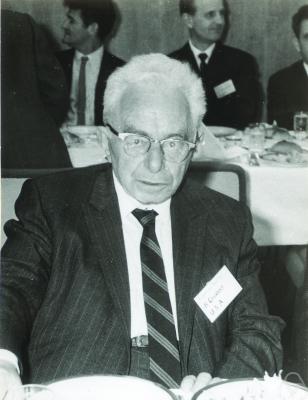
Richard Courant
View on WikipediaRichard Courant (January 8, 1888 – January 27, 1972) was a German-American mathematician. He is best known by the general public for the book What is Mathematics?, co-written with Herbert Robbins. His research focused on the areas of real analysis, mathematical physics, the calculus of variations and partial differential equations. He wrote textbooks widely used by generations of students of physics and mathematics. He is also known for founding the institute now bearing his name.
Key Information


Life and career
[edit]Courant was born in Lublinitz, in the Prussian Province of Silesia (now in Poland). His parents were Siegmund Courant and Martha Freund of Oels. Edith Stein was Richard's cousin on the maternal side. During his youth his parents moved often, including to Glatz, then to Breslau and in 1905 to Berlin. He stayed in Breslau and entered the university there, then continued his studies at the University of Zürich and the University of Göttingen. He became David Hilbert's assistant in Göttingen and obtained his doctorate there in 1910. He was obliged to serve in World War I, but was wounded shortly after enlisting and therefore dismissed from the military. Courant left the University of Münster in 1921 to take over Erich Hecke's position at the University of Göttingen.[2] There he founded the Mathematical Institute, which he headed as director from 1928 until 1933.
Courant left Germany in 1933, earlier than many Jewish escapees. He did not lose his position due to being Jewish, as his previous service as a front-line soldier exempted him; however, his public membership in the social-democratic left was reason enough (for the Nazis) for dismissal.[3]
In 1936, after one year at Cambridge, Courant accepted a professorship at New York University in New York City. There he founded an institute for graduate studies in applied mathematics. The Courant Institute of Mathematical Sciences (as it was renamed in 1964) is now one of the most respected research centers in applied mathematics.[4]
Courant and David Hilbert authored the influential textbook Methoden der mathematischen Physik, which, with its revised editions, is still current and widely used since its publication in 1924. With Herbert Robbins he coauthored a popular overview of higher mathematics, intended for the general public, titled What is Mathematics?. With Fritz John he also coauthored the two-volume work Introduction to Calculus and Analysis, first published in 1965.[5]
Courant's name is also attached to the finite element method,[6] with his numerical treatment of the plain torsion problem for multiply-connected domains, published in 1943.[7] This method is now one of the ways to solve partial differential equations numerically. Courant is a namesake of the Courant–Friedrichs–Lewy condition and the Courant minimax principle.
Courant was an elected member of both the American Philosophical Society (1953) and the United States National Academy of Sciences (1955).[8][9] In 1965, the Mathematical Association of America recognized his contributions to Mathematics with their Award for Distinguished Service to Mathematics.[10][11]
Courant died of a stroke in New Rochelle, New York on January 27, 1972, aged 84.[12]
Perspective on mathematics
[edit]Commenting upon his analysis of experimental results from in-laboratory soap film formations, Courant explained why the existence of a physical solution does not obviate mathematical proof. Here is a quote from Courant on his mathematical perspective:
Empirical evidence can never establish mathematical existence–nor can the mathematician's demand for existence be dismissed by the physicist as useless rigor. Only a mathematical existence proof can ensure that the mathematical description of a physical phenomenon is meaningful.[13]
Personal life
[edit]In 1912, Courant married Nelly Neumann, who had earned her doctorate at Breslau in synthetic geometry in 1909. They lived together in Göttingen until they were divorced in 1916. She was later murdered by the Nazis in 1942 for being Jewish.[14]
In 1919, Courant married Nerina (Nina) Runge (1891–1991), a daughter of the Göttingen professor for Applied Mathematics, Carl Runge (of Runge–Kutta fame).
Richard and Nerina had four children: Ernest, a particle physicist and innovator in particle accelerators; Gertrude (1922–2014), a biologist and wife of the mathematician Jürgen Moser (1928–1999); Hans (1924-2019),[15][16] a physicist who participated in the Manhattan Project; and Leonore (known as "Lori," 1928–2015), a professional violist and wife of the mathematician Jerome Berkowitz (1928–1998) and subsequently wife of mathematician Peter Lax until her death.[17]
Publications
[edit]- Courant, R. (1937), Differential and Integral Calculus, vol. I, translated by McShane, E. J. (2nd ed.), New York: Interscience, ISBN 978-4-87187-838-8
{{citation}}: ISBN / Date incompatibility (help)
- Courant, R. (1936), Differential and Integral Calculus, vol. II, translated by McShane, E. J., New York: Interscience, ISBN 978-4-87187-835-7
{{citation}}: ISBN / Date incompatibility (help)
- Courant, Richard; John, Fritz (1965), Introduction to Calculus and Analysis, vol. I, New York: Interscience, ISBN 978-3-540-65058-4
- Courant, Richard; John, Fritz (1974), Introduction to Calculus and Analysis, vol. II/1, New York: Interscience, ISBN 978-3-540-66569-4
- Courant, Richard; John, Fritz (1974), Introduction to Calculus and Analysis, vol. II/2, New York: Interscience, ISBN 978-3-540-66570-0
- Courant, Richard; Hilbert, David (1953), Methods of Mathematical Physics, vol. I (2nd ed.), New York: Interscience, ISBN 978-0-471-50447-4, MR 0065391
{{citation}}: ISBN / Date incompatibility (help) (archive) (translated from German: Methoden der mathematischen Physik I, 2nd ed, 1931)[18]
- Courant, Richard; Hilbert, David (1962), Methods of Mathematical Physics, vol. II, New York: Interscience, doi:10.1002/9783527617234, ISBN 978-0-471-50439-9, MR 0140802
{{citation}}: ISBN / Date incompatibility (help) (translated from German: Methoden der mathematischen Physik II, 1937)[19]
- Courant, R.; Friedrichs, K. O. (1948), Supersonic Flow and Shock Waves, New York: Interscience, Bibcode:1948sfsw.book.....C[20]
- Courant, Richard; Robbins, Herbert (1941), What is Mathematics?, Oxford University Press
References
[edit]- ^ John C. Urschel. "Nodal Decompositions of Graphs" (PDF). Math.mit.edu. Retrieved 16 July 2022.
- ^ Bergmann, Birgit (2012-10-22). Transcending Tradition: Jewish Mathematicians in German Speaking Academic Culture. Springer Science & Business Media. ISBN 978-3-642-22464-5.
- ^ Schappacher, Norbert (1991). "Edmund Landau's Göttingen: From the Life and Death of a Great Mathematical Center" (PDF). The Mathematical Intelligencer. 13 (4): 12–18. doi:10.1007/bf03028334. S2CID 124714271. Archived from the original (PDF) on 2016-11-09. Retrieved 2024-11-30.
- ^ "Best Applied Math Programs". U.S.News.
- ^ "review by E.I. of Introduction to Calculus and Analysis volume 1". Mathematics of Computation. 20 (96): 634–635. 1966. doi:10.1090/S0025-5718-66-99914-5. ISSN 0025-5718.
- ^ Giuseppe Pelosi (2007). "The finite-element method, Part I: R. L. Courant: Historical Corner". IEEE Antennas and Propagation Magazine. 49 (2): 180–182. doi:10.1109/MAP.2007.376627. S2CID 36031031.
- ^ Courant, Richard (1943). "Variational methods for the solution of problems of equilibrium and vibrations". Bulletin of the American Mathematical Society. 49: 1–24. doi:10.1090/s0002-9904-1943-07818-4.
- ^ "APS Member History". search.amphilsoc.org. Retrieved 2023-02-06.
- ^ "Richard Courant". www.nasonline.org. Retrieved 2023-02-06.
- ^ "Yueh-Gin Gung and Dr. Charles Y. Hu Award for Distinguished Service". Mathematical Association of America. Archived from the original on 2024-04-28. Retrieved 2024-05-06.
- ^ Weaver, Warren (1965). "Award for Distinguished Service to Professor Richard Courant". The American Mathematical Monthly. 72 (1): 1–2. doi:10.1080/00029890.1965.11970481. ISSN 0002-9890.
- ^ Schwartz, Harry (1972-01-29). "Dr. Richard Courant Dies at 84; Influential Mathematics Scholar". The New York Times. Retrieved 2022-07-16.
- ^ The Parsimonious Universe, Stefan Hildebrandt & Anthony Tromba, Springer-Verlag, 1996, page 148
- ^ "Nelly Neumann". Jewish Women's Archive. 1 March 2009. Retrieved 7 July 2018.
- ^ "Hans Courant, 1924-2019 | School of Physics and Astronomy | College of Science and Engineering". Cse.umn.edu.
- ^ "Hans COURANT Obituary (1924 - 2019) Pioneer Press". Legacy.com.
- ^ "Leonore Marianne Courant Berkowitz 1950 | In Memoriam | Reed Magazine". Reed.edu. December 2015.
- ^ Tamarkin, J. D. (1932). "Review: Methoden der mathematischen Physik, Bd. I, zweite verbesserte Auflage, by R. Courant and D. Hilbert". Bull. Amer. Math. Soc. 38 (1): 21–22. doi:10.1090/S0002-9904-1932-05311-3.
- ^ Weyl, Hermann (1938). "Review: Methoden der mathematischen Physik, Vol. 2, by R. Courant and D. Hilbert". Bull. Amer. Math. Soc. 44 (9): 602–604. doi:10.1090/S0002-9904-1938-06791-2.
- ^ Lin, C. C. (1951). "Review: Supersonic flow and shock waves, by R. Courant and K. O. Friedrichs". Bull. Amer. Math. Soc. 57 (1, Part 1): 85–87. doi:10.1090/s0002-9904-1951-09457-4.
Sources
[edit]- Reid, Constance (1976). Courant in Göttingen and New York. The Story of an Improbable Mathematician. New York, Heidelberg, Berlin: Springer-Verlag. ISBN 978-0-387-90194-7.
- Medawar, Jean; Pyke, David (2012). Hitler's Gift: The True Story of the Scientists Expelled by the Nazi Regime. New York: Arcade Publishing. ISBN 978-1-61145-709-4.
External links
[edit]
- Richard Courant at the Mathematics Genealogy Project
- O'Connor, John J.; Robertson, Edmund F., "Richard Courant", MacTutor History of Mathematics Archive, University of St Andrews
- Oral History interview transcript with Richard Courant on 9 May 1962, American Institute of Physics, Niels Bohr Library & Archives
- National Academy of Sciences Biographical Memoir
- 2015 Video Interview with Hans Courant by Atomic Heritage Foundation Voices of the Manhattan Project
- US News Rankings of Applied Mathematics Programs
| International | |
|---|---|
| National | |
| Academics | |
| People | |
| Other | |

Richard Courant
View on GrokipediaEarly Life and Education
Family Background and Childhood
Richard Courant was born on January 8, 1888, in Lublinitz, a small town in the Prussian Province of Silesia (now Lubliniec, Poland), to a Jewish family.[1] His father, Siegmund Courant, was a textile businessman whose ventures often faced financial difficulties, while his mother, Martha (née Freund), managed family resources during hardships, including selling personal jewelry to sustain them.[1] [4] As the eldest of three sons—followed by brothers Fritz and Ernst—Courant grew up in a household marked by internal tensions, particularly over the extent of assimilation into broader German society despite the family's Jewish heritage.[1] [5] These dynamics coexisted with an emphasis on intellectual development, fostering an environment where education was prioritized amid economic instability.[1] The family's frequent relocations, driven by Siegmund's business pursuits, exposed young Courant to varied cultural settings across Prussian territories: shortly after his second brother's birth, they moved from Lublinitz to Glatz, where his father invested in textiles, and then, when Courant was nine, to Breslau after a premature commitment to another enterprise left them in financial strain.[1] This peripatetic life introduced him early to practical challenges of commerce and adaptability, as the family navigated entrepreneurial risks in different German locales.[1][4]Academic Training and Early Influences
Richard Courant commenced his university studies in mathematics at the University of Breslau in 1904, remaining there until the spring of 1907. He then spent one semester at the University of Zurich before enrolling at the University of Göttingen on November 1, 1907, drawn by its renowned mathematical faculty.[1] At Göttingen, Courant was profoundly influenced by David Hilbert, whose lectures and guidance shaped his approach to rigorous analysis and foundational problems. In 1908, he became Hilbert's assistant, immersing himself in the advanced mathematical environment that emphasized both pure theory and physical applications. The faculty, including Carl Runge alongside Hilbert, provided a collaborative setting that fostered Courant's development in differential equations and variational methods.[1][6][7] Courant completed his PhD at Göttingen in 1910 under Hilbert's supervision, with his dissertation focusing on the application of the Dirichlet principle to boundary value problems for linear differential equations involving infinitely many variables. This work, which also involved input from Runge, laid an early foundation in existence proofs for solutions in infinite-dimensional settings, reflecting Hilbert's emphasis on constructive methods over purely axiomatic abstraction.[8][6] His early career momentum was halted by World War I, during which Courant served in the German army from 1915 to 1918, sustaining wounds in September 1915 that required recovery time. This military interruption postponed his habilitation until 1912 but exposed him to practical ballistic and engineering challenges, enhancing his later interest in applied mathematics.[1]Career in Germany
Professorship and Research at Göttingen
In 1920, Richard Courant was appointed full professor at the University of Göttingen, where he succeeded Erich Hecke and built upon David Hilbert's foundational work in mathematical analysis and its applications to physics.[1] His tenure there marked a period of intensive research output, emphasizing rigorous theoretical advancements tied to practical physical problems, prior to the political upheavals of the early 1930s.[6] Courant's early professional research at Göttingen centered on boundary value problems, Dirichlet's principle, and variational methods, as evidenced in his 1910 doctoral thesis and subsequent publications.[1] [2] He developed proofs for Dirichlet's principle that addressed existence and uniqueness in potential theory, integrating semicontinuity of the Dirichlet integral with physical intuitions from electrostatics and fluid dynamics to ensure mathematical validity.[6] These efforts extended Hilbert's variational approaches, applying them to partial differential equations and minimal surfaces, such as solving Plateau's problem through energy minimization principles.[2] [6] Courant mentored a generation of students at Göttingen, including Kurt Friedrichs, who began assisting him in 1925, and Hans Lewy, who completed his dissertation under Courant's supervision in 1925.[1] [9] This guidance cultivated a research school that combined stringent pure mathematical proofs with empirical applications, notably in numerical stability criteria co-developed with Friedrichs and Lewy in 1928.[6]Leadership of the Mathematical Institute
Richard Courant served as director of the Mathematical Institute at the University of Göttingen from 1920 to 1933, succeeding the era of David Hilbert's dominance in the institution's mathematical leadership.[10] [6] Under his administration, the institute evolved from a primarily theoretical focus into a major hub for applied mathematics, integrating connections with physics and economics to address interdisciplinary challenges.[2] [6] This expansion emphasized the application of mathematical methods to concrete scientific and practical problems, reflecting Courant's vision of mathematics as a tool for empirical insight rather than isolated abstraction.[2] Courant prioritized administrative innovations to support collaborative research, including the construction of a dedicated mathematics building on Bunsenstrasse to accommodate growing activities and personnel.[10] He actively recruited international scholars and secured funding to bolster the institute's resources, enhancing its reputation as a center for cutting-edge work in areas like numerical methods and physical modeling.[6] Regular seminars were instituted to facilitate dialogue among mathematicians, physicists, and economists, often centering on real-world applications such as fluid dynamics and eigenvalue problems relevant to physics.[2] [6] This leadership style fostered a research environment grounded in verifiable, observable phenomena, where theoretical developments were continually tested against empirical data from allied fields.[2] Courant's efforts positioned the institute as a model for linking pure mathematical rigor with practical utility, influencing subsequent generations of researchers before external disruptions intervened.[6]Emigration and American Career
Escape from Nazi Persecution
Following Adolf Hitler's appointment as Chancellor on 30 January 1933, Richard Courant left Göttingen in March 1933 for Arosa, Switzerland, under the pretext of a planned spring holiday, as Nazi consolidation of power signaled impending threats to Jewish academics despite his temporary exemption from dismissal due to frontline service in World War I.[1] Upon brief return in April, he faced forced extended leave on 5 May 1933 under the Nazi Civil Service Law, which targeted professors of Jewish descent and political unreliability; Courant contested the measure repeatedly but deemed further resistance futile given the regime's trajectory.[1][8] Anticipating broader purges, Courant secured an invitation for a one-year academic residency at the University of Cambridge, relocating there as a refugee scholar from 1933 to 1934 and leveraging this interim position to evade permanent entrapment in Germany.[1][8] Through his established professional networks, Courant facilitated the escape of numerous Jewish mathematicians by identifying and securing overseas placements for them, demonstrating proactive individual agency in countering totalitarian exclusion from rational discourse; no records indicate any accommodation or delay in opposition to the Nazi regime.[1][8]Founding and Development of Mathematical Programs at NYU
Upon arriving at New York University in 1934 as a visiting professor, Richard Courant began efforts to establish a research-oriented mathematics program, drawing on his experience directing the Göttingen Mathematical Institute.[11][8] In 1935, he founded the Institute of Mathematics and Mechanics, initially comprising a small group focused on advanced graduate training and collaborative research in applied mathematics.[2][8] To sustain and expand the institute amid limited university resources, Courant pursued external funding, securing grants from the Rockefeller Foundation, including a $60,000 allocation in 1946 for developing applied mathematics over five years.[12][8] During World War II, he obtained U.S. government contracts for military-related projects, directing work on gas dynamics, shock waves, and ballistics problems relevant to explosives and weaponry.[8][13] These efforts integrated theoretical mathematics with practical engineering challenges, attracting additional support and establishing the institute's emphasis on interdisciplinary applications. Courant assembled a productive research cohort, incorporating fellow European émigré mathematicians and American students, which grew into a leading center for numerical methods and early computing applications by the postwar period.[14][8] He served as director until his retirement in 1958 at age 70, after which the institute—renamed the Institute of Mathematical Sciences in the interim—continued expanding under his influence before being officially designated the Courant Institute of Mathematical Sciences in 1964.[6][8] This development transformed NYU's mathematics department from relative obscurity into a hub for applied and computational research.[14]Scientific Contributions
Advances in Partial Differential Equations and Calculus of Variations
Courant's foundational contributions to the existence theory for solutions of elliptic partial differential equations centered on variational methods, particularly through the rigorous justification of Dirichlet's principle. In a 1922 paper, he demonstrated the existence of solutions to the Dirichlet problem for elliptic equations by approximating the domain with a triangulation and constructing piecewise linear functions that minimize the Dirichlet integral, establishing a lower bound and monotonic decrease to prove convergence to a minimizing function satisfying the equation.[6] This approach provided modern analytical rigor to Dirichlet's earlier heuristic principle, which posits that the solution to the boundary value problem minimizes the associated energy functional derived from physical principles like electrostatic potential or steady-state heat flow.[6] Extending these variational techniques, Courant addressed Plateau's problem, which seeks a surface of minimal area spanning a given closed contour in three-dimensional space. In works from the 1930s, including a 1937 paper in the Annals of Mathematics, he proved the existence of such minimal surfaces for simply connected contours by employing successive polygonal approximations and applying the direct method in the calculus of variations, ensuring the limit surface achieves the infimum area while adhering to boundary conditions grounded in geometric and physical stability.[15] This linked intuitive soap-film experiments—where surface tension minimizes area—to functional analytic frameworks, resolving long-standing existence questions without relying on parametrizations that fail for non-convex boundaries.[6] Courant's methods emphasized boundary conditions derived from causal physical mechanisms, such as fixed contours in elasticity or wave equations, rather than purely abstract topologies. For instance, in elasticity problems, he used variational principles to establish existence for displacement fields minimizing strain energy subject to equilibrium constraints, connecting PDE solutions directly to observable mechanical behaviors like deformation under load.[6] Similarly, for wave propagation modeled by hyperbolic PDEs, his variational formulations incorporated initial and boundary data from propagation speeds and reflections, yielding existence proofs tied to energy conservation rather than detached spectral theory.[16] These derivations prioritized empirical validation through physical analogies, ensuring solutions reflected real-world causality over formal generalizations.Developments in Numerical Analysis and Applied Physics
In 1928, Richard Courant, Kurt Otto Friedrichs, and Hans Lewy published "Über die partiellen Differenzengleichungen der mathematischen Physik," introducing the Courant-Friedrichs-Lewy (CFL) condition as a stability criterion for finite difference approximations to hyperbolic partial differential equations (PDEs).[3] The condition requires that the numerical time step satisfy , where is the characteristic speed, ensuring the computational domain of dependence encompasses the physical one to avoid non-physical instabilities in wave propagation simulations.[17] This formulation addressed causal consistency in discrete approximations, preventing solutions from propagating information faster than physical limits, and laid groundwork for reliable numerical methods in applied physics, including early computational modeling of dynamic systems.[18] Courant's work extended to variational discretizations, particularly in his 1943 paper "Variational Methods for the Solution of Problems of Equilibrium and Vibrations," where he employed the Rayleigh-Ritz procedure with piecewise linear trial functions over triangular subdomains to approximate solutions to elliptic PDEs governing equilibrium and vibration problems.[19] By subordinating finite difference grids to variational principles, Courant demonstrated convergence to exact solutions while respecting physical constraints like energy minimization, providing a precursor to modern finite element methods used in structural analysis and engineering computations.[20] These techniques emphasized approximation schemes that preserved underlying physical causality and boundary conditions over purely algebraic manipulations. During World War II, Courant's research informed applications in fluid dynamics, culminating in the 1948 monograph Supersonic Flow and Shock Waves co-authored with Friedrichs, which systematized the theory of nonlinear wave propagation in compressible fluids, including exact solutions for shock fronts and Riemann invariants.[21] The work derived jump conditions across discontinuities from conservation laws, enabling predictive modeling of high-speed flows relevant to aerodynamics, and integrated analytical insights with empirical validation to refine approximations against experimental data on blast waves and supersonic phenomena.[22] This approach prioritized causal fidelity in handling entropy increases and irreversibility, influencing post-war numerical simulations of shock-dominated flows in physics and engineering.[23]Key Collaborative Texts and Methodological Innovations
Methods of Mathematical Physics, co-authored with David Hilbert and first published in German in 1924 as Methoden der mathematischen Physik, systematically derives mathematical techniques from physical problems, unifying them into coherent theories while emphasizing the interplay between physical intuition and rigorous analysis.[24][25] The two-volume work covers topics such as partial differential equations, boundary value problems, and variational methods, applying operator-theoretic approaches to phenomena like wave propagation and electrostatics, thereby innovating a framework that treats mathematics as an inductive tool grounded in empirical physical contexts rather than isolated abstraction.[24] This methodological synthesis influenced subsequent developments in applied mathematics by prioritizing problem-solving efficacy over axiomatic purity, fostering a tradition where mathematical innovation emerges from concrete applications.[25] In What Is Mathematics? (1941), collaborated with Herbert Robbins, Courant presented an accessible survey of mathematical ideas, favoring intuitive explanations and real-world illustrations—such as geometric constructions and probability scenarios—over formal derivations to reveal the substantive drivers of the field.[26] The text innovates pedagogically by integrating historical motivations with elementary methods, arguing that true understanding arises from grasping concepts through tangible examples rather than symbolic manipulation alone, thus countering emerging emphases on detached formalism in mathematical education.[26] The Introduction to Calculus and Analysis series, developed with Fritz John and spanning volumes from the late 1950s into the 1960s (with Volume I appearing in 1965), advances a rigorous treatment of single-variable analysis and Fourier series while embedding applications to physics and geometry, such as curve theory and physical oscillations, to underscore the interplay between theoretical precision and practical utility.[27] Methodologically, it innovates by balancing epsilon-delta proofs with intuitive visualizations and problem-oriented exercises, resisting mid-20th-century shifts toward pure abstraction in analysis by demonstrating how empirical motivations enhance conceptual depth and applicability.[27]Philosophical Perspectives on Mathematics
Emphasis on Empirical Connections and Applications
Courant maintained that mathematics derives its vitality from addressing tangible problems in the physical world, as evidenced by pivotal historical advancements such as the formulation of celestial mechanics by Isaac Newton in the late 17th century, where differential equations directly modeled planetary motion and gravitational forces.[28] He argued that physical intuition has historically supplied essential problems and methods for mathematical progress, enabling predictions of observable phenomena like orbits and tides that empirical observations could then verify.[28] This perspective underscored his commitment to interdisciplinary collaboration, which he implemented through regular seminars at the University of Göttingen in the 1920s and 1930s, where mathematicians engaged directly with physicists and applied scientists to explore real-world challenges such as wave propagation and fluid dynamics.[29] Upon establishing programs at New York University after 1934, Courant replicated this model, organizing joint discussions that linked theoretical constructs to engineering applications, including structural analysis and electromagnetic fields, ensuring mathematical developments retained causal ties to measurable outcomes.[30] In his co-authored text What is Mathematics? (1941), Courant elaborated that mathematical concepts fundamentally originate in empirical facts—such as geometric intuitions from everyday shapes or arithmetic from counting objects—before abstracting into rigorous structures, but their ultimate worth lies in facilitating accurate forecasts of natural events.[31] This approach positioned applications not merely as utilitarian extensions but as intrinsic validators of theory, aligning mathematical inquiry with the predictive power demonstrated in fields like optics and mechanics since the scientific revolution.[31]Critiques of Detached Pure Mathematics
Richard Courant expressed reservations about the increasing detachment of pure mathematics from empirical foundations, particularly criticizing the shift toward a formalistic, axiomatic methodology that prioritized internal consistency over physical intuition. In reflections on mid-20th-century trends, he noted that "since the seventeenth century, physical intuition has served as a vital source for mathematical problems and methods," but recent fashions had "obliterated this source and replaced it by a formalistic, axiomatic approach, which, while advancing pure mathematics, has had the disadvantage of causing many mathematicians to forget their physics."[32] This critique targeted the post-war emphasis on abstraction, akin to the Bourbaki group's structuralist program, which Courant and contemporaries viewed as severing mathematics from its origins in quantifiable phenomena, rendering it more self-contained than verifiable against reality.[33] Courant warned that treating mathematics as a self-referential "art" risked ideological rigidity, divorced from testable impact, much like dogmatic pursuits unanchored in causation or utility. He advocated for mathematics to retain its humanistic role in understanding concrete problems, arguing that excessive purity led to sterility, as evidenced by the limited practical advancements in overly abstract fields during the 1950s compared to integrated approaches.[34] In contrast, Courant's own programs demonstrated the value of maintained empirical ties: during World War II, his group's work on partial differential equations and numerical methods contributed directly to ballistics and fluid dynamics applications, yielding verifiable outcomes in defense simulations, while detached pure theory often lagged in such exigencies.[6] These successes underscored his view that detachment, though advancing theoretical elegance, undermined mathematics' causal potency when isolated from physics and applications.[35]Legacy and Impact
Institutional Foundations and Long-Term Influence
Courant arrived at New York University in 1934 as a refugee from Nazi Germany, where he promptly began assembling a core research group in applied mathematics, laying the groundwork for an enduring institutional framework.[2] By 1935, NYU had extended a formal invitation to expand graduate studies under his direction, capitalizing on his prior leadership of Göttingen's mathematical institute to cultivate interdisciplinary programs blending theory with practical computation.[36] This initiative attracted funding from entities like the Atomic Energy Commission for specialized divisions, such as wave propagation, which solidified NYU's infrastructure for large-scale mathematical modeling amid post-World War II demands.[11] The institution, officially renamed the Courant Institute of Mathematical Sciences in 1964, emerged as a pivotal hub for applied mathematics, numerical methods, and computational sciences, training thousands of researchers who disseminated these approaches across global academia and industry.[37] Courant's strategic securing of U.S. government contracts during the 1940s and 1950s—totaling millions in adjusted value for defense-related computations—accelerated the integration of mathematics into engineering and physics, fostering a self-sustaining ecosystem of seminars, computing facilities, and collaborative grants that outlasted his direct involvement.[8] By leveraging émigré networks from Europe, Courant orchestrated the placement of over a dozen dismissed Jewish and anti-Nazi scholars at NYU by the late 1930s, creating talent pools selected on empirical merit rather than political ideology and thereby insulating the institution from exclusionary barriers prevalent in both fascist regimes and selective U.S. hiring practices.[38] This refugee infusion catalyzed a broader causal shift in American mathematics toward application-oriented paradigms during the Cold War, diluting the prior hegemony of abstract European pure mathematics by embedding utilitarian priorities in curricula and funding priorities that prioritized verifiable problem-solving over detached formalism.[14][39]Recognition and Enduring Methodological Contributions
Courant was elected to the United States National Academy of Sciences in 1955, recognizing his foundational work in applied mathematics and partial differential equations. He also became a member of the American Philosophical Society in 1953 and a foreign member of the Soviet Academy of Sciences prior to his death in 1972.[38] These honors affirmed his lifetime achievements in bridging theoretical analysis with practical problem-solving in physics and engineering. Posthumously, Courant's methodological innovations have demonstrated enduring empirical validity through their integration into computational frameworks that reliably predict complex physical behaviors. The Courant-Friedrichs-Lewy (CFL) condition, co-developed in 1928, imposes a stability constraint on time steps in explicit numerical schemes for hyperbolic partial differential equations, preventing unphysical oscillations in simulations.[40] This criterion is applied daily in computational fluid dynamics (CFD) for modeling turbulent flows in aircraft design and automotive aerodynamics, where violations lead to divergent solutions uncorrelated with experimental data.[41] In numerical weather prediction models, the CFL condition governs grid resolution and time-stepping to simulate atmospheric wave propagation accurately, as evidenced by its role in maintaining stability across global forecast systems handling terabytes of data.[42] Courant's 1943 variational methods for equilibrium and vibration problems introduced piecewise polynomial approximations over triangular domains, providing a direct precursor to the finite element method (FEM).[43] FEM, building on this foundation, discretizes continuous domains into finite elements to solve elliptic PDEs, enabling precise predictions in structural engineering—such as stress distributions in bridges under load—and thermal simulations in electronics cooling, with validations against physical prototypes confirming accuracy to within engineering tolerances.[44] These techniques have supplanted less adaptable analytical approaches in technology development, illustrating how applied numerical strategies yield verifiable foresight into causal physical processes, in contrast to abstract pure mathematics disconnected from empirical testing. In contemporary extensions, CFL-inspired stability bounds inform machine learning solvers for PDEs, such as physics-informed neural networks, where enforcing analogous constraints during training mitigates gradient instabilities and improves convergence on fluid dynamics benchmarks.[45] This adaptation highlights the causal robustness of Courant's principles, as they sustain predictive reliability across scales from classical simulations to data-driven models, empirically outpacing purely theoretical paradigms in delivering actionable technological outcomes.Personal Life
Family and Relationships
Richard Courant first married Nelly Neumann, a fellow mathematics student from his time in Breslau, in the summer of 1912; the marriage ended after four years amid the disruptions of World War I.[6][1] In January 1919, he wed Nerina (Nina) Runge, daughter of the applied mathematician Carl Runge, in a civil ceremony; the couple remained married until Courant's death, providing a stable partnership through professional and personal upheavals.[1][46] Nerina and Richard had four children: Ernest David Courant (born 1920), a particle physicist known for contributions to accelerator design; Gertrude Courant Moser (1922–2014), a biologist; Hans Courant (born 1924); and a fourth child whose professional details are less documented in primary accounts.[38] The family maintained Jewish cultural traditions, such as observance of holidays, despite Courant's largely secular academic environment and the family's relocations from Göttingen to Cambridge and eventually New York in 1934 to escape Nazi persecution.[37][6] Throughout Courant's exiles and career shifts, his family offered consistent support, with Nerina managing household stability during the 1933 dismissal from Göttingen and the subsequent transatlantic move, enabling focus on rebuilding academic institutions abroad; no significant relational disputes or scandals are recorded in contemporaneous accounts.[6][1]Health, Later Years, and Death
Courant retired from his professorship at New York University in 1958 at the age of 70.[4] [47] Following retirement, he resided in New Rochelle, New York, and maintained involvement in mathematical pursuits, including revisions to his publications and translations of earlier writings.[37] [46] In November 1971, Courant experienced a stroke, leading to his admission to New Rochelle Hospital.[38] He died there on January 27, 1972, at age 84.[38] [4]References
- https://proofwiki.org/wiki/Mathematician:Richard_Courant