


Community hub
Recent from talks
Contribute something
Nothing was collected or created yet.
Les Charlots
View on Wikipedia
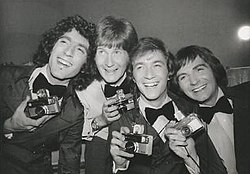
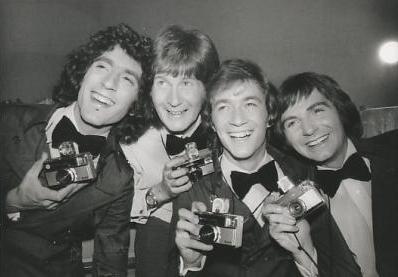
Les Charlots, known as The Crazy Boys in the English-speaking world, was a group of French musicians, singers, comedians and film actors,[1][2] who were popular in the 1960s, 1970s, and early 1980s.
Key Information

The group was active first from 1965 to 1966 as "Les Problèmes", under which name they made an album with the French singer Antoine. They renamed themselves Les Charlots and remained active from 1966 to 1997, then again briefly from 2008 to 2011 (as a duo). Charlots is slang for "clowns" or "idiots"[3] rather than being a direct reference to Charlie Chaplin, whose character of The Tramp was called Charlot in France.[4]
Their light-hearted comedy style was influenced by the style of popular Italian group Brutos and by the anarchist humor of the Marx Brothers.
The five members were Gérard Rinaldi (vocals, saxophone, accordion), Jean Sarrus (bass, backing vocals), Gérard Filippelli, a.k.a. "Phil" (guitar, backing vocals), Luis Rego (rhythm guitar, piano, backing vocals) and Jean-Guy Fechner (drums, backing vocals). Filippelli was nicknamed "Phil" as there were two "Gérards" in the group.
Creation of Les Problèmes
[edit]Rinaldi and Sarrus were musicians in various short-lived groups ("Les Rebelles" and "Les Tarés", for Sarrus) and they first met in 1963. They became friends and decided to form a rock band, even though at the time, Rinaldi was more into jazz than rock. In 1964, they were joined by Luis Rego, then in 1965 by Gérard Filippelli and Donald Rieubon on drums.
In 1965, they became the backing band for singer Antoine under the name of "Les Problèmes" ("The Problems") or sometimes "Antoine et les Problèmes" ("Antoine and the Problems"). They backed him on two his greatest hits, "Les Elucubrations d'Antoine" and "Je Dis ce que je pense, je vis comme je veux".
In 1965, while he was vacationing in Portugal (his home country), Luis Rego was imprisoned for a few months under the Salazar regime, for desertion and rebellion. During Luis' incarceration, Rinaldi wrote "Ballade à Luis Rego, Prisonnier Politique" ("Ballad to Luis Rego, Political Prisoner"), a popular song that the group often played on stage. He was replaced on stage and in the studio by guitarist Jacques Dautriche (also a singer under the alias Sullivan). Rego rejoined the band as soon as he was released.
In 1966, drummer Rieubon was called up for military service and left the band. He was replaced by William Ollivier until the band became Les Charlots.
Success as Les Charlots
[edit]After a spoof of Antoine's "Je Dis ce que je pense, je vis comme je veux" released under the alias "Les Charlots" became a novelty hit, their manager convinced them to stick to comedy and switch names for good. Except for drummer Ollivier who chose to stay with Antoine. He was replaced by Jean-Guy Fechner, brother of the group's manager Christian Fechner. For their first tour they hired Dautriche and Ollivier as back-up musicians. They became instantly extremely popular for their humoristic and parodic songs like "Si tu ne veux pas payer d'impôts", "Merci Patron", "On n'est Pas là Pour se Faire Engueuler", "Paulette la Reine des Paupiettes", "Berrystock", "Sois Erotique" (a parody of Serge Gainsbourg's "Je t'aime Moi Non Plus"), "Je Suis Trop Beau" (a parody of Jacques Dutronc), "Berry Blues", "Albert le Contractuel",, "Cet été c'était toi", "Ouvre la Fenêtre", "Pétronille Tu Sens la Menthe", "Elle Avait du Poil au Ventre", "Hey Max" (a parody of Johnny Halliday's cover of "Hey Joe"), "Elle a Gagné le Yoyo en Bois du Japon (avec la Ficelle du Même Métal)", "Le Trou de Mon Quai", "La Biguine au Biniou", "Le Chou Farci", "Histoire Merveilleuse", "Chagrin d'labour", "C'est trop, c'est trop", "Ah Viens!", "Derrière Chez Moi" and "L'Apérobic".
Most of the songs were written by Rinaldi, Sarrus or Rego. Rinaldi was the main singer and the four others sang backing vocals.
After they left Antoine, they toured a lot from 1966 to 1970, first as the opening act of prestigious artists like Johnny Hallyday, Françoise Hardy, Sylvie Vartan, Claude François and even The Rolling Stones. One day, as The Rolling Stones were late for their gig, Les Charlots started playing "Satisfaction". Later in the evening, Sarrus said to Mick Jagger that, if they wanted, the Rolling Stones could play "Paulette la Reine des Paupiettes". Jagger politely refused.
In the late '60s, Les Charlots began to appear in comedy sketches on French television, most notably in an episode of satirical television cartoon Les Shadoks, with Jean Yanne and popular sitcom Les Saintes Chéries.
In 1968, Rolling Stone magazine named them the best French rock musicians.
In 1969, they recorded a cover album of songs by Boris Vian.
Film career
[edit]With their increasing popularity as a genuine rock and comedy group, they received many offers to appear in films. Producer Michel Ardan hired them for their first film "because his children had seen them on television and found them very funny..." Their first film, released in 1970, was La Grande Java with comedian Francis Blanche. They played five members of a rugby team whose manager stole the money. The film wasn't very good, mostly due to the fact that Les Charlots weren't actors and didn't get along with director Philippe Clair (often considered to be one of the worst French directors ever). But surprisingly, La Grande Java was a hit with teen audiences. On the set, Les Charlots met a first AD named Claude Zidi, who later directed them in their best films.
The following films, Les Bidasses en folie (1971), Les Fous du Stade (1972), Les Charlots Font l'Espagne (1972), Le Grand Bazar (1973), Les Bidasses s'en vont en Guerre (1974) were all superior and very funny comedies. All their films from 1971 to 1976 (8 films) became phenomenal hits in France and all around the world (especially in India) thanks to the fact that (according to Rinaldi) "you didn't need to speak french to understand the plots!"...
About their films, Les Charlots have often said that their only criteria were the glamorous locations, warm weather and good food. None of them originally intended to become actors and they didn't think their movie career would last. They just started out of curiosity, with no ambition to become actors whatsoever. Acting in films was just the icing on the cake. But they had this youthful energy that young people of the time connected to, and after their first film became a hit, they caught the acting bug. Years after their acting debuts with Les Charlots, Gérard Rinaldi and Luis Rego pursued successful solo acting careers outside of the band.
They continued to appear on stage and record albums but movies became their main activity in the '70s.
Les Charlots wrote and performed the songs and music for most of their films.
The films focused on the group's anti-authoritarian lifestyle and free-spirited youthfulness, their friendship, freedom, love of music and pretty girls, their laziness towards work, their numerous blunders and their hatred of authority figures like the army. The films depicted the members in absurd situations and visual gags.
In Les Bidasses en Folie (1971) and sequel Les Bidasses s'en vont en Guerre (1974), they played young musicians drafted in the army, trying their best to be sent to the regiment jail rather than taking part in the manoeuvres. Their nemesis was a bald and severe sergeant named Bellec (played by character actor Jacques Seiler) who had to endure his new recruits' blunders and was ultimately always ridiculed by the boys.
In their biggest hit, Les Fous du Stade (1972) they played reluctant athletes in the Olympics.
In Le Grand Bazar (1973), they were factory workers, helping their shopkeeper friend Emile (Michel Galabru) fight against a brand new modern supermarket.
In the big budget parody From Hong Kong with Love[2] (1975), they reluctantly replaced a recently deceased 007 when Queen Elizabeth II is abducted by villain Mickey Rooney... For the occasion, actors Bernard Lee and Lois Maxwell, cameoed in their roles from the 007 franchise as M and Miss Moneypenny respectively.
In Les Charlots Contre Dracula (1980), they became vampire hunters.
Rinaldi usually played the straight good-looking guy and the others were his goofy, faithful friends. Supporting actors like Jacques Seiler, Pierre Gualdi, André Badin, Paul Préboist, Roger Carel, Gérard Croce and renowned accordionist Aimable appeared in many of their films. They were directed four times by Claude Zidi who started his directing career with them.
They usually kept their real-life first names (Gérard, Jean, Phil, Luis and Jean-Guy) in the movies, except in the big-budget musketeers parody The Four Charlots Musketeers (1974) and sequel The Four Charlots Musketeers 2 (1974) in which they played the famous musketeers' valets, who were revealed to be the true heroes of the classic Alexandre Dumas story.
Departures of Rego and Fechner
[edit]At the height of their success, Rego left the band in 1971, just before the release of their second film, Les Bidasses en Folie to focus on a (successful) solo career as an actor. The split was amicable and Rego later rejoined his friends for two movies : Le Retour des Bidasses en Folie (1983) and Le Retour des Charlots (1992). Years later, Rego said he regretted his decision because the following Charlots films were extremely successful. His main reason for leaving was that he felt the scripts for their films or for their sketches on television worked better with a four men team than with five and he sometimes felt a little lost or underappreciated in the middle of the others. He appeared in massive hit Les Bronzés in 1978.
Jean-Guy Fechner left the band in June 1976, a few months after the release of the expensive Bond parody From Hong Kong with Love. Following a dispute about unpaid royalties and disagreements about artistic choices, Les Charlots decided not to renew their contract with producer and manager Christian Fechner (Jean-Guy's brother). Les Charlots wanted to star in a satirical film written for them by auteur Bertrand Blier, named "Charlots, Charlottes", but Christian Fechner bought the rights to the script and threw it in the trash. Jean-Guy was torn between staying in the band or loyalty to his brother. He ultimately left the band.
At the time of the split with Fechner, Les Charlots were supposed to appear alongside comedy legend Louis De Funès in another film by Claude Zidi. The project was to be called "Merci Patron", after their hit song of the same name. Following their acrimonious split with Christian Fechner, the film was rewritten for emerging comedian Coluche (who had appeared with them in a small part in Le Grand Bazar), renamed L'Aile ou la Cuisse and became a huge hit, launching Coluche's film career.
With no producer and their legal issues with Christian Fechner unresolved, the band went on hiatus until 1978 and the release of their first film as a trio, the mediocre Et Vive la Liberté!
Les Charlots as a trio
[edit]Rinaldi, Sarrus and Filippelli went on as a trio from 1976 to 1986, but their five subsequent films, with the lack of a decent producer, lesser budgets, mediocre scripts and directors, were less successful. Only the mediocre Et Vive la Liberté! (1978) and the camp vampire parody Les Charlots Contre Dracula (1980) were minor hits. Les Charlots Contre Dracula is the only film of the band that they wrote themselves. All of their other films as a trio misfired. In 1983, former member Rego joined his former bandmates in a supporting part in Le Retour des Bidasses en Folie, a very bad film that tried to capitalize on their 1971 hit film Les Bidasses en Folie, but where they played different characters.
Years later, Filippelli acknowledged that "if you're a fan of Les Charlots, it's best that you don't watch our last films..."
In 1979, the trio appeared in their first theatre play, "La Cuisine des Anges", a very successful experience.
In the late seventies and early eighties, the three remaining Charlots focused on new songs and albums, releasing "Fesse en Rut Majeur" (1985), an album composed of dirty lyrics, and also some of their biggest hits : "Chagrin d'labour", "La Bouche Camembert" and the very popular "L'Apérobic". They still made a lot of television appearances and despite the lesser success of their films, the trio was still very popular.
Rinaldi's departure
[edit]Two years after the release and lack of success of their 14th film, Charlots Connection (1984), Rinaldi decided to leave the band to focus on his solo acting career in films, TV and on stage. Rinaldi achieved great success with sitcom Marc & Sophie from 1987 to 1991. Sarrus and Rinaldi didn't speak to each other for twenty years after Rinaldi left the band. Sarrus and Filipelli were the only two remaining members.
The Richard Bonnot era : the beginning of the end
[edit]For Les Charlots, 1986 was the beginning of the end. After a hiatus following Rinaldi's departure, he was replaced in 1987 by a friend of Sarrus, small-time singer and comedian Richard Bonnot, who had been the opening act for the band a few times in the early '80s. In the following years, the three of them recorded a few more songs (including "Pour pas qu'l'amour Capote", written for an AIDS awareness campaign) but not enough material to produce a new album. They toured very sporadically in smaller venues with little or no success, playing their old hits. But without Rinaldi's immediately recognizable voice (replaced by Bonnot's), they almost sounded like a cover band.
In 1988, their old friend Antoine invited Sarrus, Filippelli, Rego and drummer Donald Rieubon to play on his latest album, Antoine Retrouve Les Problèmes (Antoine and The Problems Back Together) and on stage to promote it. It marked the first time that Les Charlots performed under the name Les Problèmes since 1966. Rinaldi was also invited but he was filming his hit TV series and couldn't appear on the album.
In 1992, the reformed trio (Sarrus, Filippelli and Richard Bonnot) appeared in the group's fifteenth and final film, the embarrassing Le Retour des Charlots, reluctantly directed by Sarrus himself because they couldn't find another director. Once again, the trio was joined by former member Luis Rego in a supporting part. It was their first film in eight years, but also their last.
Years later, Filippelli jokingly declared that "that last film with Richard Bonnot was a joke, it was nothing more than an opportunity for us to go on a paid vacation." (The film was shot in Portugal.) On the poster, Richard Bonnot's face was intentionally blurred to create a confusion with the more popular Rinaldi, who wasn't in the film. With almost no press and a limited release, Le Retour des Charlots was a critical and box office failure. At that time, Sarrus and Rinaldi were not on speaking terms. Jean-Guy Fechner was asked to appear in the film but a scheduling conflict prevented the reunion.
Jean Sarrus and Gérard Filippelli are the only members who appeared in every one of the band's 15 films.
Gérard Rinaldi appeared in 14 of them, Jean-Guy Fechner in 9, Luis Rego in 4 and Richard Bonnot in one.
Reunions and reformation as a duo
[edit]The five original members (Rinaldi, Sarrus, Filipelli, Rego and Fechner) reunited on television in Michel Drucker's show, Vivement Dimanche in 2009. They spoke at length about their career. It was the first time since Rego's departure in 1971, that they all got together in the same room.
From 2008 to 2011, at the initiative of Jean Sarrus (who's always tried to keep the spirit of the band alive), Rinaldi and Sarrus reunited and toured as Les Charlots, singing medleys of the group's biggest hits for the nostalgia tour "Age Tendre et Têtes de Bois", featuring other French artists from the '60s and '70s. On that tour and the album that followed, Rinaldi and Sarrus didn't play any instruments, they only sang. They released an album of covers from their hits from the '60s and '70s named (Les Charlots 2008).
Gérard Rinaldi died of Hodgkin's disease on March 2, 2012. He was 69.
Another trio
[edit]Starting in 2013 until 2025, Jean Sarrus, Jean-Guy Fechner and Richard Bonnot started touring as Les Charlots again in various festivals, but very sporadically. Fechner hadn't performed on stage since 1976.
The trio released one last album in 2023 : "Y'a pas d'âge pour les Charlots".
Former member Gérard Filipelli died of cancer on 30 March 2021. He was 78.
Jean Sarrus died of brain cancer on 19 February 2025. He was 79.
Richard Bonnot died after a long illness on 28 October 2025. He was 67.[5]
Luis Rego and Jean-Guy Fechner are the only members of the band still alive.
After Les Charlots
[edit]- Gérard Rinaldi achieved great success with French sitcom Marc et Sophie, from 1987 to 1991. He continued to appear in films and television (more than 50 TV movies) and dubbed many cartoons for cinema and television, most notably the French version of The Simpsons. He was the French voice of Krusty the Clown, Chief Wiggum and Mr. Burns. He was also the French voice of various actors like Steve Martin, Ben Kingsley, John Malkovich, Kelsey Grammer, Burt Reynolds, Dustin Hoffman and Pete Postlethwaite. At the time of his death, Rinaldi was working on "Un P'tit Air de Crooner", a solo album with covers of popular French songs. The album was released posthumously on July 23, 2012. A few days after Rinaldi's death, holding back his tears Jean Sarrus paid homage to his friend and had this to say about him : "Gérard was the soul of Les Charlots. He excelled in everything he did : he had this wonderful singing voice, but he saw himself mostly as a writer, that's what he liked to do above everything else : writing songs. I admired his great sense of humor and his ability to laugh about everything, all the time. As he was dying, he even made me laugh about his illness. I saw him on his hospital bed a few days before he died, and he just tried to make me laugh in spite of the morphine kicking in. I'm going to miss him a lot." Jean-Guy Fechner called him "a most charming and talented man". Luis Rego also reacted to his friend's death, saying that he was very sad and had a lot of admiration for Gérard Rinaldi : "he was so gifted that he would have had a great career even without the rest of the us".
- After financial problems in the 80s and 90s, Jean Sarrus briefly became a TV host (most notably as the host of a show about country music in the 90's), wrote and directed Les Charlots' last film in 1992 (basically as a late replacement because they found no other director to do it) and published "100% Charlots", a biography of the group in 2007. He appeared in Josiane Balasko's Un Grand Cri d'Amour in 1998 and in a few television films. He reunited with Rinaldi from 2008 to 2011. In 2012, after Rinaldi's death, he published a revised version of "100% Charlots" called "Définitivement Charlots". He died of brain cancer on February 19, 2025. He was 79.
- Gérard Filippelli retired from public life in 1997 but was still a musician and a philanthropist. He was working with underprivileged kids, teaching them music. He often jammed with his friend Luis Rego on the weekends. In 2011, at 68, he created and headlined a new rock'n' roll band called King Biz. He died of cancer on March 30, 2021, aged 78.[6]
- Luis Rego is a popular and respected character actor and playwright, appearing in huge hit Les Bronzés in 1978 and with comedian Pierre Desproges in Le Tribunal des Flagrants Délires on television. In 1987, he directed his first and only film, Poule et Frites. After his departure from the group in 1971, he rejoined Les Charlots for two more films in 1983 (Le Retour des Bidasses en Folie) and 1992 (Le Retour des Charlots), in supporting parts. Recently, he appeared in Bertrand Bonello's Nocturama (2016).
- Jean-Guy Fechner never acted again but worked as a publicist for his late brother Christian Fechner, one of France's most prominent producer. He worked on the releases of many important films such as Les Bronzés 3 in 2006, supervising trailers, posters and marketing campaigns. He appeared (in cameos only) in films produced by his brother or by his son, Sébastien Fechner who is also a producer and screenwriter. His brother Christian died in 2008. Jean-Guy owns an impressive drums collection.
- Having appeared in the least successful of all their films and barely remembered for his contributions, Richard Bonnot is not considered by fans of Les Charlots as a true member of the band. After the group officially split in 1997 (but with no noticeable activities between 1992 and 1997), he made a few appearances as a comedian on television but his career remains pretty obscure. After rejoining the band in 2013 as a trio with Sarrus and Fechner, he died in 2025 after a long disease.
Band members
[edit]- Gérard Rinaldi – lead vocals, saxophone, (1966–1986, 2008–2011; died 2012)
- Gérard Filippelli – guitar, backing vocals, (1966–1997; died 2021)
- Luis Rego – rhythm guitar, piano, backing vocals, (1966–1971)
- Jean Sarrus – bass, backing vocals, (1966–1997, 2008–2011, 2013–2025; his death)
- Jean-Guy Fechner – drums, backing vocals (1966–1976, 2013–)
- Richard Bonnot – vocals (1987–1997, 2013–2025; his death)
Timeline
[edit]
1966–1971 |
|
|---|---|
1971–1976 |
|
1976–1986 |
|
1987–1997 |
|
1997–2008 |
|
2008–2011 |
|
2011–2013 |
|
2013–2025 |
Discography
[edit]Original albums
- 1966 Antoine Rencontre les Problèmes (as "Les Problèmes")
- 1967 Charlow'up
- 1967 Les Charlots à l'Olympia (Live)
- 1968 Caf'Conc'Charlots
- 1969 Les Charlots Chantent Boris Vian
- 1969 Les Charlots - Il Etait une Fois à l'Olympia (Live)
- 1969 Charlotissimo
- 1971 Charloteries
- 1972 Les Charlots en Vadrouille
- 1972 Les Charlots à l'Olympia '72 (Live)
- 1973 Au Pays des Pesetas
- 1974 La Révolution Française (collaboration with other artists)
- 1975 Les Charlots - Youpie, c'est la Vie!
- 1976 Nouvelle Cuvée
- 1977 Et Ta Soeur
- 1983 C'est Trop, c'est Trop
- 1985 Fesses en Rut Majeur
- 1986 Parod'Hit Parade
- 1988 Antoine Retrouve Les Problèmes (Elucubrations 88) (as "Les Problèmes")
- 2008 Les Charlots 2008
- 2023 Y'a pas d'âge pour Les Charlots
Compilations
- 1972 Les Grands Succès
- 1973 12 Succès des Charlots
- 1974 Les Charlots Super Longue Durée
- 1977 Le Double Disque d'Or
- 1984 Nouvelle Edition
- 1985 Les Charlots - Programme Plus
- 1992 Plein Succès
- 1994 Les Bons Morceaux - Tout Doit Disparaître
- 1999 Collection Ambiance
- 1999 Les Charlots - Anthologie, Volume 1
- 2000 Les Charlots - Anthologie, Volume 2
- 2000 Y'a de la Joie
- 2002 Paulette, Merci Patron...
- 2003 Les Essentiels
- 2003 Les Charlots Interdits
- 2011 Les Charlots - La Compilation
Filmography
[edit]- 1970 La Grande Java, directed by Philippe Clair, with Gérard Rinaldi, Jean Sarrus, Gérard Filippelli, Luis Rego and Jean-Guy Fechner.
- 1971 Les Bidasses en folie, directed by Claude Zidi, with Gérard Rinaldi, Jean Sarrus, Gérard Filippelli, Luis Rego and Jean-Guy Fechner.
- 1972 Les Fous du Stade, directed by Claude Zidi, with Gérard Rinaldi, Jean Sarrus, Gérard Filippelli and Jean-Guy Fechner.
- 1972 Les Charlots Font l'Espagne, directed by Jean Girault, with Gérard Rinaldi, Jean Sarrus, Gérard Filippelli and Jean-Guy Fechner.
- 1973 Le Grand Bazar, directed by Claude Zidi, with Gérard Rinaldi, Jean Sarrus, Gérard Filippelli and Jean-Guy Fechner.
- 1974 The Four Charlots Musketeers, directed by André Hunebelle, with Gérard Rinaldi, Jean Sarrus, Gérard Filippelli and Jean-Guy Fechner.
- 1974 The Four Charlots Musketeers 2, directed by André Hunebelle, with Gérard Rinaldi, Jean Sarrus, Gérard Filippelli and Jean-Guy Fechner.
- 1974 Les Bidasses s'en vont en guerre, directed by Claude Zidi, with Gérard Rinaldi, Jean Sarrus, Gérard Filippelli and Jean-Guy Fechner.
- 1975 Bons Baisers de Hong Kong (From Hong Kong with Love), directed by Yvan Chiffre, with Gérard Rinaldi, Jean Sarrus, Gérard Filippelli and Jean-Guy Fechner.
- 1978 Et Vive la Liberté!, directed by Serge Korber, with Gérard Rinaldi, Jean Sarrus and Gérard Filippelli.
- 1979 Les Charlots en Délire, directed by Alain Basnier, with Gérard Rinaldi, Jean Sarrus and Gérard Filippelli.
- 1980 Les Charlots Contre Dracula, directed by Jean-Pierre Desagnat & Jean-Pierre Vergne, with Gérard Rinaldi, Jean Sarrus and Gérard Filippelli.
- 1983 Le Retour des Bidasses en Folie, directed by Michel Vocoret, with Gérard Rinaldi, Jean Sarrus, Gérard Filippelli and Luis Rego.
- 1984 Charlots Connection, directed by Jean Couturier, with Gérard Rinaldi, Jean Sarrus and Gérard Filippelli.
- 1992 Le Retour des Charlots, directed by Jean Sarrus, with Jean Sarrus, Gérard Filippelli, Luis Rego and Richard Bonnot.
References
[edit]- ^ "Les Charlots". Movies & TV Dept. The New York Times. 2014. Archived from the original on July 23, 2014.
- ^ a b Clarke Fountain (2014). "Bons Baisers de Hong Kong". Movies & TV Dept. The New York Times. Archived from the original on July 16, 2014.
- ^ Definition of the word "charlot" on L'internaute.com : a person who lack of seriousness, a "clown".
- ^ Charlot on Larousse.fr.
- ^ "Les Charlots en deuil : Le chanteur et musicien Richard Bonnot est mort à 67 ans". Télé-Loisirs. October 30, 2025. Retrieved October 30, 2025.
- ^ "Gérard Filipelli, membre de la célèbre bande Les Charlots, est décédé à l'âge de 78 ans". CNEWS (in French). April 1, 2021.
External links
[edit]- Les Charlots in Nanarland
- Les Charlots at IMDb
- Les Charlots discography at Discogs
| International | |
|---|---|
| National | |
| Artists | |
| Other | |

Les Charlots
View on GrokipediaLes Charlots was a French group of musicians, singers, comedians, and film actors active from 1966 to the early 1990s, known for their slapstick comedy films and parody songs that achieved substantial commercial success in France.[1]
Comprising vocalist Gérard Rinaldi, bassist Jean Sarrus, guitarist Gérard Filippelli, guitarist Luis Rego, and drummer Jean-Guy Fechner, the ensemble originated as backing musicians for singer Antoine under the name Les Problèmes in 1965 before rebranding and specializing in humorous musical performances.[1] Their breakthrough came with comedy features like Les Bidasses en folie (1971), which drew over 7.4 million admissions, followed by hits such as Les Fous du stade (1972) with 5.7 million viewers, contributing to a cumulative audience of nearly 40 million across 13 films that frequently ranked in France's annual box office top ten during the 1970s.[2][1] The group disbanded in 1992 amid lineup changes, briefly reunited in 2008, and effectively ceased with Rinaldi's death from cancer in 2012, followed by Filippelli's passing in 2021 and Sarrus's in 2025, leaving Fechner as the sole survivor.[1]
Origins and Formation
Precursors as Les Problèmes
Les Problèmes was a French rock band formed in mid-1965 by Gérard Rinaldi and Jean Sarrus, who had previously performed as opening acts for international acts like the Rolling Stones.[3][4] The group specialized in garage rock and beat music, drawing from Anglo-American influences while establishing itself as one of the more innovative French ensembles of the yé-yé era, with Rinaldi handling vocals and saxophone, Sarrus on bass, Gérard Filipelli on lead guitar, Luis Rego on rhythm guitar, and Donald Rieubon on drums.[5][6] Early activities included independent recordings, such as their debut EP released in 1965 on the Pop Supérette label, featuring original tracks that showcased raw energy and rhythmic drive typical of the period's beat groups.[5] The band produced at least three super 45 RPM singles between 1965 and 1966, including songs like "On s'en fout," before broader exposure came from collaborations.[7] They briefly backed singer Pascal Danel and gained prominence in 1966 as the touring and recording band for Antoine, the provocative student-turned-star known for hits like "Les Élucubrations."[8] This partnership culminated in the joint album Antoine rencontre les Problèmes, recorded that year, where their instrumental support amplified Antoine's satirical style amid France's burgeoning countercultural scene.[6] By late 1966, amid lineup adjustments—including Rieubon's temporary replacement due to military service—the group began incorporating humorous elements into performances, foreshadowing their shift away from pure rock.[6] Les Problèmes' brief tenure marked a transition for its core members from serious rock instrumentation to comedic reinterpretations, though their output as a straight rock act remained limited to a handful of releases and live supports rather than mainstream breakthroughs.[9]Renaming to Les Charlots and Early Performances
In 1966, the musicians formerly known as Les Problèmes—comprising Gérard Rinaldi on vocals, Jean Sarrus on bass, Gérard Filippelli on guitar, Luis Rego on guitar, and Jean-Guy Fechner on drums—renamed themselves Les Charlots to better align with their emerging comedic musical style.[1][10] The name "Les Charlots" derives from French slang for "clowns" or "fools," evoking the persona of Charlie Chaplin, known as Charlot in France, which suited their shift toward parody and humor.[1] Following the rename, Les Charlots quickly established a presence through live performances, releasing their debut album as a live recording titled Les Charlots à l'Olympia in 1967, captured during a show at the prestigious Olympia music hall in Paris.[11] This early output featured humorous, rock-inflected songs that parodied contemporary trends, marking their transition from backing Antoine to independent acts blending music with comedy.[12] Throughout the late 1960s, the group maintained an intensive touring schedule, building a reputation for energetic, satirical stage shows that appealed to French youth audiences amid the era's pop and rock scene.[11]Musical Career
Initial Hits and Style
Les Charlots achieved their initial commercial success with the 1966 EP Chauffe Marcel..., released on Disques Vogue, which featured tracks such as "Je dis n'importe quoi, je fais tout ce qu'on me dit (Chauffe Marcel)" and "Psychose (toujours)".[11] This debut recording introduced their playful take on rock and roll, blending energetic performances with comedic elements that mocked contemporary trends.[13] In 1967, they followed with the live album Les Charlots à l'Olympia, capturing performances from the prestigious Paris venue and solidifying their stage presence.[14] Early singles like "Hey Max", a parody of Johnny Hallyday's "Hey Joe", and "Albert" further highlighted their breakthrough, topping charts in France by lampooning rock icons and yé-yé culture.[15][16] The group's musical style was characterized by comedy-pop infused with parody and chanson traditions, often subverting rock and roll conventions through exaggerated vocals, absurd lyrics, and slapstick instrumentation.[14][17] Their light-hearted approach drew from Italian comedic ensembles like Brutos and the anarchic humor of the Marx Brothers, emphasizing visual gags in live shows alongside musical satire.[18] Tracks typically featured rapid tempo shifts, mock-serious delivery, and references to everyday French life, distinguishing them from straightforward pop acts by prioritizing entertainment over musical innovation.[19] This formula resonated in the mid-1960s French scene, where their irreverent takes on hits like Berry-style blues or Hallyday anthems appealed to youth audiences seeking escapist fun amid evolving rock influences.[20]Key Albums and Songs
Les Charlots produced a series of albums characterized by satirical lyrics, parody covers, and energetic rock arrangements, often tied to their live performances and films. Their debut album under the Les Charlots name, Charlow'Up, released in 1967, featured early hits such as "T.V.A. T.V.A. (A Moi D'Payer)," a comedic take on fiscal burdens.[21] This was followed by Caf'Conc'Charlots in 1968, which included parodies of café-concert style tunes.[21] In the early 1970s, albums like Charlotissimo (1971) and Charloteries (1971) captured their rising popularity, with tracks such as "Paulette, la Reine des Paupiettes" becoming staples for their absurd humor.[21] Les Charlots en Vadrouille (1972) and Au Pays des Pesetas (1973), linked to their film soundtracks, featured songs like "Derrière Chez Moi" and "Merci Patron," which satirized everyday life and authority figures.[22] [23] Later releases, including Nouvelle Cuvée (1976) and Et Ta Sœur... (1977), continued their formula of irreverent covers and originals, though with diminishing commercial impact.[21] Notable songs from this era include "L'Apérobic" and "Histoire Merveilleuse," highlighting their enduring appeal in French comedy music.[23]| Album | Release Year | Notable Songs |
|---|---|---|
| Charlow'Up | 1967 | T.V.A. T.V.A. |
| Charlotissimo | 1971 | Paulette, la Reine des Paupiettes |
| Au Pays des Pesetas | 1973 | Derrière Chez Moi, Merci Patron |
| Et Ta Sœur... | 1977 | L'Apérobic |
Evolution of Sound Post-Members
Following the departure of Luis Rego in 1971 and Jean-Guy Fechner in 1976, Les Charlots transitioned to a trio configuration comprising Gérard Rinaldi, Jean Sarrus, and Gérard Filipelli, which marked a period of continued but streamlined musical production. The group's core sound—characterized by parodic interpretations of popular genres, exaggerated vocal deliveries, and satirical lyrics targeting everyday absurdities—persisted without fundamental shifts, as evidenced by mid-1970s releases that retained the comedic pop framework established in their earlier hits. Albums such as Nouvelle Cuvée (1976) featured tracks like "La Biguine au Biniou," blending faux-exotic rhythms with mock-serious instrumentation, and "L'Embrayage," a comedic lament over automotive failure delivered in vaudeville-esque style.[24] This era's output, including Et Ta Sœur... (1977), emphasized vocal harmonies among the trio supplemented by session musicians for guitar and percussion, resulting in slightly leaner arrangements compared to the fuller quintet sound but no departure from humor-driven parody.[21] Releases like these often tied into film soundtracks, reflecting a causal integration of music with their cinematic ventures rather than isolated evolution toward new genres; for example, songs parodied cabaret and folk tropes while maintaining the anarchic, light-hearted ethos influenced by slapstick traditions. Production under labels like Vogue continued apace, with 1970s albums prioritizing accessibility and replay value through simple, catchy structures over experimental elements.[14] By the early 1980s, as film successes waned, musical releases such as C'est Trop... C'est Trop! (1983) and Fesse en Rut Majeur (1985) doubled down on explicit parody of contemporary hits, incorporating rudimentary synthesizers for topical flair but preserving the group's signature irreverence without broader stylistic reinvention. The trio's reduced lineup facilitated tighter live performances, yet discographic evidence shows fidelity to comedic exaggeration over sonic innovation, with later works like Parod'Hit Parade (1986) directly mimicking 1980s pop anthems in service of satire. This continuity underscores a pragmatic adaptation to personnel constraints, prioritizing enduring humor over genre diversification.[21][21]Film Career
Debut Films and Formula
Les Charlots transitioned to cinema with their debut feature La Grande Java, directed by Philippe Clair and released on December 23, 1970.[1] In the film, the group portrayed incompetent workers at a pasta factory whose bungled inventions lead to escalating chaos, blending physical gags with their musical performances. This low-budget production, shot in Italy, marked their shift from stage and recording success to screen comedy, though it received modest attention initially.[1] Their follow-up, Les Bidasses en folie, directed by Michel Vocoret and released on December 14, 1971, achieved greater commercial success, drawing over 3.5 million viewers in France.[25] The plot centered on five friends attempting to form a rock band but inadvertently enlisting in the military, resulting in a barrage of barracks-based slapstick as their sergeant endures their disruptive antics.[25] This film solidified their cinematic presence by incorporating military parody, a recurring motif in early works, and featured cameos from figures like Johnny Hallyday. These debut efforts established Les Charlots' core formula: ensemble-driven absurdism where the quintet—often interchangeable in their idiocy—disrupts orderly environments through chain-reaction mishaps, verbal misunderstandings, and exaggerated physicality.[1] Directors like Clair and Vocoret emphasized rapid-fire gags over narrative depth, with musical numbers punctuating the mayhem to leverage the group's rock roots.[26] This unpretentious, vaudeville-inspired approach prioritized visual humor and anti-authoritarian satire, appealing to working-class audiences amid 1970s social flux, though critics later noted its reliance on repetitive tropes.[27] Subsequent films, such as Les Fous du stade (1972), refined this template by transplanting the chaos to sports stadiums, grossing 4.2 million admissions.Major Productions and Themes
Les Charlots' major film productions in the 1970s established their signature formula of ensemble slapstick comedy, where a quartet of hapless protagonists unleashes chaos in structured environments, often parodying institutional or historical tropes through physical gags and escalating absurdities. Les Bidasses en folie (1971), directed by Jean Girault, marked their cinematic breakthrough, depicting five friends who form a rock band but end up as military recruits, their pranks and incompetence undermining sergeants' authority in a barrage of sight gags involving barracks mishaps and mock battles.[28] The film exemplifies early themes of anti-militaristic irreverence, portraying the army as a comically rigid machine vulnerable to youthful anarchy. Subsequent successes amplified these elements with genre parodies. In Les Fous du stade (1972), also directed by Girault, the group invades a football stadium as obsessive fans, their overzealous support devolving into riots and chases that satirize sports fanaticism and crowd hysteria. Le Grand bazar (1973), helmed by Claude Zidi, shifts to a department store setting, where the Charlots as bumbling employees trigger chain-reaction disasters amid customer service farces, emphasizing themes of workplace incompetence clashing with capitalist efficiency.[29] Travel escapades feature in Les Charlots font l'Espagne (1972), directed by Jean Girault, as the quartet's budget vacation spirals into scams, vehicle breakdowns, and border absurdities, poking fun at tourism's illusions of relaxation.[30] Historical and adventure spoofs rounded out their peak output, as in Les Quatre Charlots mousquetaires (1974) and its sequel À nous quatre, Cardinal! (1974), both directed by André Hunebelle, which recast Alexandre Dumas' swashbuckling tale with the group as inept swordsmen foiling Cardinal Richelieu through bungled duels and anachronistic rock interludes. These films highlight recurring motifs of parodying authority figures—be they officers, bosses, or villains—as pompous foils to the protagonists' egalitarian disorder, rooted in physical comedy reminiscent of silent-era influences but infused with 1970s countercultural nonchalance. Later entries like Les Charlots contre Dracula (1980), directed by Jean-Pierre Desfosse, extended horror parody with vampire hunts gone awry, though with diminishing returns on thematic freshness. Overall, their productions prioritized unscripted-feeling mayhem over narrative depth, critiquing conformity via laughter at systemic fragility without overt ideology.[1]Box Office Performance
Les Charlots' films achieved substantial commercial success in France during the early 1970s, leveraging their established popularity from music and live performances to draw large audiences with low-budget, slapstick comedies. Their breakthrough, Les Bidasses en folie (1971), directed by Claude Zidi, attracted 7,460,911 admissions, ranking as the top-grossing French film of the year and establishing the group's cinematic viability.[31] [32] This was followed by strong performers like La Grande Java (1971) with 3.4 million admissions and Les Charlots font l'Espagne (1972) with 4,162,897 admissions, both contributing to the group's dominance in the domestic market amid a wave of light-hearted, escapist fare.[33] [34] Subsequent releases maintained momentum initially, with Le Grand Bazar (1973) nearing 4 million admissions through its satirical take on unemployment and small business struggles, resonating with audiences during economic uncertainty.[35] However, performance varied, and later entries showed signs of audience fatigue or formulaic repetition; for instance, Les Charlots en délire (1979) drew 1,103,094 admissions, while Les Charlots contre Dracula (1980) managed only 555,878, reflecting diminishing returns as competition from evolving comedy styles intensified.[2] [36]| Film | Year | French Admissions |
|---|---|---|
| Les Bidasses en folie | 1971 | 7,460,911 |
| Les Charlots font l'Espagne | 1972 | 4,162,897 |
| La Grande Java | 1971 | 3,385,636 |
| Le Grand Bazar | 1973 | ~4,000,000 |
Membership Changes and Internal Dynamics
Departure of Luis Rego and Jean-Guy Fechner
Luis Rego departed from Les Charlots in 1971, following the release of the film Les Bidasses en folie, though he made cameo appearances in subsequent productions such as Les Charlots font l'Espagne (1972).[38] No public statements detailed specific reasons for Rego's exit at the time, and the group continued performing as a quartet initially, with Rego occasionally contributing to recordings or live shows in the early 1970s.[39] Jean-Guy Fechner left the group around 1975–1976, amid tensions stemming from a contractual dispute with the band's impresario, Christian Fechner—Jean's brother and a key producer for their early projects.[39] The split was exacerbated by familial loyalties, as Jean-Guy aligned with Christian after the mutual termination of the management contract, leading to a reported falling out with the remaining members.[1] Fechner's departure, alongside that of guitarist Gérard Filippelli, marked a shift toward a trio format, though Fechner later collaborated with his brother on independent film ventures.[40]Shift to Trio Configuration
Following Jean-Guy Fechner's departure in June 1976, amid reported disagreements with the group's impresario, Les Charlots restructured as a trio centered on Gérard Rinaldi (lead vocals and saxophone), Jean Sarrus (bass and backing vocals), and Gérard Filippelli (guitar and backing vocals).[39] This core lineup, which had driven much of the group's musical and comedic output since inception, assumed primary responsibilities for performances, recordings, and films, adapting their chaotic humor and rock-infused songs to fewer members without session musicians dominating the sound.[1] The transition sustained commercial momentum into the 1980s, with the trio starring in Le Retour des Bidasses en Folie (1983), a sequel revisiting military misadventures that grossed modestly but echoed earlier successes like the 1971 original.[41] Similarly, Charlots Connection (1984) featured the three as down-on-their-luck friends entangled in petty crime, directed by Jean Couturier and emphasizing their improvisational banter over elaborate sets.[42] These productions retained the formula of low-budget slapstick intertwined with parody songs, though critics noted a slight dilution in ensemble energy compared to the quintet's peak era.[38] Internally, the shift streamlined decision-making among the longstanding friends, allowing Rinaldi's charismatic frontmanship, Sarrus's rhythmic foundation, and Filippelli's guitar riffs to define the group's identity more sharply. No formal replacement for Fechner's drums was integrated into live or recorded work, with the trio relying on simplified arrangements or production enhancements for fuller sound. This configuration persisted until further changes in the late 1980s, marking a phase of resilience amid lineup reductions.[39]Gérard Rinaldi's Exit and Richard Bonnot Integration
In 1986, Gérard Rinaldi departed Les Charlots after approximately 20 years, primarily to pursue independent acting and television opportunities, including roles in series such as Marc et Sophie.[43][44] This exit followed earlier reductions in membership and reflected Rinaldi's desire for career diversification beyond the group's collective performances.[43] Richard Bonnot, who had performed piano-bar acts and served as an opening act for Les Charlots in the preceding year, integrated into the group that same year as Rinaldi's direct replacement, taking on vocal and comedic duties.[45][44] The reformed trio—comprising Bonnot, Gérard Filippelli, and Jean Sarrus—sustained live shows and stage tours through the late 1980s and 1990s, with Bonnot assuming a leadership role in revitalizing their act.[44] This configuration produced output including the 1992 feature film Le Retour des Charlots, directed by Sarrus, which attempted to recapture the group's earlier cinematic formula amid perceptions of diminished energy without Rinaldi's central presence.[1] Bonnot's tenure lasted until 1997, spanning a decade of activity focused on variety shows and regional performances, though the group did not achieve the commercial peaks of its prior era.[44] Internal dynamics during this phase emphasized adaptation to Bonnot's style, which leaned on his prior experience in comedic animation and music, but faced challenges in replicating the original quartet's synergy.[43]Final Duo Phase and Dissolution Pressures
Following Richard Bonnot's integration around 1988 to replace Gérard Rinaldi, Les Charlots operated as a trio comprising Bonnot, Gérard Filippelli, and Jean Sarrus.[38] This configuration yielded the group's final film, Le retour des Charlots, released in 1992 and directed by Sarrus, which featured the trio alongside guest actor Guy Montagné but achieved limited commercial success.[46] By the early 1990s, the ensemble confronted mounting dissolution pressures, including sharply declining popularity after their 1970s peak, which eroded audience draw and revenue streams.[47] Financial strains intensified due to mismanagement and lawsuits from former producer Christian Fechner, who pursued legal action over unpaid obligations tied to earlier contracts. Personal turmoil compounded these issues, notably Jean Sarrus's divorce during this era, contributing to internal discord and reduced cohesion.[47] Promotional efforts in the mid-1990s increasingly spotlighted Sarrus and Bonnot, reflecting a de facto duo dynamic as Filippelli's involvement waned amid the group's faltering momentum.[48] These pressures culminated in 1997, when Filippelli departed permanently, marking the trio's dissolution after nearly a decade of diminished output and unsuccessful attempts to recapture past vitality.[49]Later Developments and Reunions
Reformation Attempts
Between 2009 and 2011, Gérard Rinaldi and Jean Sarrus revived elements of the group's act as a duo during the "Âge Tendre et Têtes de Bois" nostalgia tour, performing select songs and sketches from Les Charlots' catalog to capitalize on enduring fan interest in their comedic style.[38] This effort followed the 1997 separation of the trio configuration involving Richard Bonnot, Gérard Filippelli, and Sarrus, and represented an initial post-dissolution attempt to leverage the brand without the full original lineup.[38] Rinaldi's death on March 2, 2012, curtailed prospects for broader involvement from performing core members, leaving Filippelli and Sarrus as the primary survivors capable of stage work.[38] In 2016, marking the 50th anniversary of the group's 1966 formation from the rock band Les Problèmes, Filippelli and Sarrus organized reunion concerts that initially excluded former associates like Jean-Guy Fechner and Luis Rego before incorporating guest appearances from them in subsequent shows.[50] [51] These performances focused on archival material rather than new productions, drawing crowds through sentimental appeal but highlighting logistical barriers from prior exits and health issues among aging members.[50] Participants described these ventures not as a complete reformation of the quintet but as collaborative nods to the group's history, underscoring persistent internal frictions and the impracticality of restoring the original dynamic amid successive departures.[51] Jean Sarrus's death on February 19, 2025, at age 79 further diminished any residual potential for group-scale activity, confining later efforts to solo or peripheral tributes by Filippelli.Solo and Collaborative Projects
Gérard Rinaldi developed a solo acting career following the group's challenges in the 1980s, appearing in films such as Descente aux enfers (1986), a thriller directed by Francis Girod and starring Claude Brasseur and Yves Montand.[1] He also featured in La Banquière (1980) under director Georges Lautner and pursued television roles, alongside releasing solo music albums, including one in 1977 dedicated initially to his daughter and Solo mais pas tout seul in 1985.[52][53][54] Luis Rego maintained an active solo trajectory in acting and music, producing multiple CDs independently and performing as a dubbing comedian.[55] In 2022, at age 81, he portrayed a political figure in the Arte series Parlement and appeared in the film Nous, les Leroy directed by Jean-Guy Fechner.[56][55] Jean-Guy Fechner focused on solo music releases, issuing several albums, and engaged in dubbing performances and live spectacles.[56] He directed Nous, les Leroy in 2022, incorporating Rego in the cast, marking a collaborative directorial effort outside the original group format.[56] Jean Sarrus undertook solo music endeavors, film roles, and writing projects, including books on his experiences.[3] He directed Le Retour des Charlots in 1992, a project that reunited former members but stemmed from his individual initiative amid the group's earlier decline.[3] Sarrus continued such pursuits until his death on February 19, 2025, at age 79.[57] Gérard Filippelli's post-group activities remained more limited, with primary credits tied to Les Charlots productions rather than distinct solo ventures, though he contributed to select musical and comedic recordings into the 1990s.[38]Recent Releases and Documentary (2023–2024)
In August 2024, the documentary Les Charlots en Folie, directed by Frédéric Teper, was released as a 60-minute television special on August 27 in France, produced by L'Atelier d'Images.[58] The film chronicles the group's evolution from their origins as the rock band Les Problèmes in 1965 to their prominence as comedic musicians and actors, incorporating interviews with surviving members such as Richard Bonnot and contributions from associates like Philippe Clair and Gérard Croce.[59][60] No new studio albums or original music releases by the group occurred in 2023 or 2024, though the duo of Jean Sarrus and Gérard Filippelli continued sporadic live performances, including a rendition of their 1983 song "L'apérobic" filmed during an event in Courcelles, Belgium, in late 2023 and shared online in December of that year.[61] These appearances aligned with commemorative exhibitions of group memorabilia, such as one organized by collector Thierry Hulbosch in Belgium.[62] The documentary marked the most significant recent media output, reflecting on the group's legacy amid the deaths of key members like Gérard Rinaldi in 2020 and Jean-Guy Fechner in 2020.[63]Reception, Criticisms, and Legacy
Commercial Achievements and Popularity Metrics
Les Charlots' commercial success was predominantly driven by their series of comedic films in the 1970s, which collectively drew tens of millions of admissions in France. Their breakthrough, Les Bidasses en folie (1971), directed by Claude Zidi, attracted 7,460,911 spectators, securing the top position at the French box office for that year.[64] [65] Subsequent releases maintained strong performance, with Les Fous du stade (1972) recording 5,744,270 admissions and Les Charlots font l'Espagne (1972) achieving 4,162,897.[2] Earlier in the decade, La grande java (1971) garnered approximately 3.4 million entries, underscoring their rapid ascent in cinema.[33]| Film Title | Year | Admissions in France |
|---|---|---|
| Les Bidasses en folie | 1971 | 7,460,911 |
| Les Fous du stade | 1972 | 5,744,270 |
| Les Charlots font l'Espagne | 1972 | 4,162,897 |
| La grande java | 1971 | 3,385,636 |
Critical Assessments and Cultural Impact
Les Charlots' humor, characterized by anarchic slapstick, absurd gags, and parodic songs, drew mixed critical responses, often dismissed as vulgar and unrefined despite its roots in burlesque traditions inspired by figures like Charlie Chaplin, Buster Keaton, and The Three Stooges.[33] [69] Critics frequently expressed scandal over the group's lowbrow style, which prioritized chaotic disruption of social norms—embodying the "trickster" archetype—over polished narrative structure, as seen in films like Les Bidasses en folie (1971), where unscripted energy sometimes led to uneven execution.[68] [69] While some assessments praised their spontaneous punk-like edge and ability to sabotage institutional order, reflecting post-1968 rebellious tensions, others viewed their formulaic misfit-group antics as lacking depth, contributing to a perception of artistic superficiality amid commercial dominance.[69] [4] Culturally, Les Charlots left an indelible mark on French popular entertainment, embodying the insouciant, working-class ethos of 1970s France during the tail end of the Trente Glorieuses, with their libertarian post-May '68 vibe channeling anti-authoritarian sentiments through songs like "Merci patron" that evoked autogestion ideals.[4] [4] Their films, amassing over 30 million spectators in the decade, pioneered collective comedy dynamics, proving the viability of ensemble slapstick and influencing subsequent groups such as Les Inconnus, Les Nuls, and Le Splendid by demonstrating how group interplay could amplify universal, gag-driven appeal.[4] [33] This legacy endures through generational nostalgia, frequent television reruns, and international reach—particularly in India and Southeast Asia—positioning them as a touchstone for accessible, subversive humor that prioritized public resonance over elite approval.[33] [68]Controversies Over Humor Style and Dated Elements
Les Charlots' humor, rooted in slapstick parody, physical gags, and verbal ribaldry, faced contemporary rebuke from French critics for its perceived vulgarity and departure from refined comedic traditions. In 1971, their Olympia theater residency prompted outrage among reviewers, who decried the routines as crude and excessive, even as audiences filled seats consistently, underscoring a divide between elite disdain and popular enthusiasm.[68] Specific lyrical content amplified such critiques, with songs like "Suce ma pine" delving into explicit sexual innuendo and "Elle avait du poil au ventre" employing imagery that caricatured female anatomy in a manner later described as misogynistic, reflecting unfiltered 1970s bawdiness without contemporary self-censorship.[70] Films such as Les Fous du stade (1972) incorporated sexist tropes, including dismissive portrayals of women as romantic obstacles or props for male antics, which aligned with era-specific norms but contributed to retrospective assessments of stylistic coarseness.[71] By the 21st century, these elements—bodily humor, gender stereotypes, and absurd escalations—have been flagged as dated, with viewer analyses of works like On nous a volé le président (a pseudonym for parodic excess in their oeuvre) highlighting regressive appeals to scatological or infantile laughs that clash with evolved sensibilities.[72] Absent major scandals or legal challenges at the time, such dated aspects persist in cultural memory as artifacts of pre-sensitivity comedy, where empirical box-office triumphs (e.g., films grossing millions in admissions) validated the approach for mass audiences over critical purism.[70] This reception gap illustrates how institutional critique, often from Parisian press circles, prioritized intellectual decorum against the causal efficacy of unpretentious, crowd-pleasing farce.Comparative Influence on French Comedy
Les Charlots distinguished themselves in French comedy by emphasizing ensemble burlesque and physical absurdity, contrasting with the era's prevalent solo-driven humor exemplified by Louis de Funès, whose manic, verbal-physical style dominated films like La Grande Vadrouille (1966, over 17 million admissions).[73] While de Funès often portrayed isolated, explosive characters reacting to authority, Les Charlots leveraged group dynamics for synchronized gags, such as collective defiance in military settings (Les Bidasses en folie, 1971, 7.46 million admissions), fostering a sense of camaraderie that amplified comedic escalation through multiplicity rather than singularity.[73] [33] This collective approach, inspired by American influences like Laurel and Hardy alongside French traditions, enabled broader parody of social institutions, as in Le Grand Bazar (1973), critiquing commercialization via chain-reaction mishaps involving multiple protagonists.[33] In comparison to contemporaneous café-théâtre acts, which prioritized observational wordplay and intellectual satire (e.g., early Coluche or Patrick Dewaere sketches), Les Charlots prioritized visual, lowbrow physicality, aligning more with post-1968 escapist populism than subversive critique.[73] Their films often outperformed de Funès vehicles in specific releases—Les Fous du stade (1972) drew 5.7 million admissions against some de Funès entries—and sustained via television rebroadcasts (e.g., Les Bidasses en folie aired 32 times since 1995), embedding absurd group antics in collective memory.[33] [73] Critics dismissed their work as superficial (e.g., Le Monde, 1972), yet empirical box-office data underscores their role in democratizing burlesque for mass audiences, bridging music-hall traditions to cinematic farce.[73] Their legacy influenced subsequent group-based comedy, paving the way for Les Inconnus and Les Nuls in the 1980s-1990s, who adapted sketch formats but echoed the Charlots' parody of authority and ensemble energy, albeit with more topical satire.[33] Unlike Le Splendid's theater-rooted absurdism (Le Père Noël est une ordure, 1982), Les Charlots integrated musical elements, revolutionizing hybrid formats that prioritized gag velocity over narrative depth, as evidenced by their 1970s output averaging millions in admissions per film.[73] [33] This shift highlighted causal realism in humor's appeal: physical synchronization exploited audience empathy for underdog solidarity, contrasting verbal elitism and sustaining influence despite dated elements.[73]Band Members and Chronology
Core and Former Members Profiles
Les Charlots' primary lineup featured four core members who drove the group's comedic musical and film output from the late 1960s through the 1970s: Gérard Rinaldi, Jean Sarrus, Gérard Filippelli, and Jean-Guy Fechner. An early fifth member, Luis Rego, departed shortly after formation, leaving the quartet as the stable core until Fechner's exit in 1976.[38] Gérard Rinaldi (17 February 1943 – 2 March 2012) served as lead vocalist, saxophonist, and accordionist, while also contributing as a lyricist and artistic director. Born in Paris, he was a founding member of Les Charlots starting in 1966 and remained active with the group until his death from cancer at age 69 in Fontenay-lès-Briis. Rinaldi's multifaceted role extended to composing and acting in their films, shaping the troupe's humorous musical style.[74][75] Jean Sarrus (11 May 1945 – 19 February 2025) played bass guitar and provided backing vocals, born in Puteaux near Paris. He joined as a core member in 1966 after playing bass for Ronnie Bird and stayed with Les Charlots through their peak years, participating in films and recordings until the group's dissolution phases. Sarrus also directed and composed, continuing solo acting post-Charlots until his death at age 79.[76][77] Gérard Filippelli (12 December 1942 – 30 March 2021), nicknamed "Phil," handled guitar and backing vocals. A founding member from 1966, he contributed to the band's rock-infused comedy sound and appeared in their cinematic works. Filippelli, whose wife died in a 1970 car accident, remained involved until later reunions but passed away at age 78.[38][78] Jean-Guy Fechner (born 2 March 1947 in Agen) performed on drums and backing vocals from the group's inception in 1966 until his departure in 1976 following internal disputes, including a conflict with his brother involved in production. Fechner, also an actor and producer, occasionally reunited with remnants of the group in later years, such as in 2013.[38][1]Timeline of Key Events and Lineup Shifts
Les Charlots originated in 1965 as the backing band Les Problèmes, consisting of five members—Gérard Rinaldi, Gérard Filippelli, Jean Sarrus, Luis Rego, and Jean-Guy Fechner—who supported French singer Antoine on recordings and performances.[1] In 1966, the group rebranded as Les Charlots, shifting focus to humorous music and comedy, and began releasing singles and albums under this name.[38] Luis Rego departed the group in 1971 to pursue an acting career, reducing the lineup to the core quartet of Rinaldi, Filippelli, Sarrus, and Fechner.[79] That same year, on December 15, they released their debut feature film Les Bidasses en folie, marking the start of a series of comedic movies that propelled their popularity through the 1970s.[1] Jean-Guy Fechner left in 1975 amid internal tensions, though the group continued with the remaining trio for subsequent projects.[40] Gérard Rinaldi exited in 1986, leading to Richard Bonnot joining as a replacement around 1988, with Filippelli and Sarrus forming the active core.[38] The group produced their final film, Le Retour des Charlots, in 1992, before Filippelli's departure in 1997 effectively ended the original configuration.[38] A brief reunion occurred from 2008 to 2011, featuring Rinaldi alongside surviving members. Subsequent losses included Rinaldi's death in 2012, Filippelli's in 2021, and Sarrus's on February 19, 2025, from a long illness at age 79, leaving Fechner as the sole surviving original member.[80] These lineup shifts reflected evolving creative directions and personal disagreements, yet the group's comedic legacy persisted through solo endeavors and tributes.Discography
Studio Albums
Les Charlots released their debut studio album, Charlow-Up, in 1967, marking their transition from the earlier incarnation as Les Problèmes and featuring humorous takes on contemporary pop styles with comedic spoken interludes.[21] This was followed by Caf'Conc'Charlots in 1968, which incorporated café-concert sketches and satirical songs drawing from French music hall traditions.[21] Les Charlots Chantent Boris Vian (1969) paid homage to the anarchist songwriter Boris Vian through adapted and parodic interpretations of his works, blending absurdity with musical parody.[21] Subsequent releases in the early 1970s capitalized on their rising film popularity, with Charlotissimo (1971) and Charloteries (1971) delivering fast-paced comedic tracks like "Paulette, la reine des paupiettes" and escalating slapstick humor in audio form.[21] Les Charlots en Vadrouille (1972), later stylized as En Vadrouille, explored travel-themed antics through songs such as "L'apérobic," while Au Pays Des Pesetas... Et D'autres Aventures (1973) incorporated Spanish influences amid broader parody.[21] By the mid-1970s, albums like Nouvelle Cuvée (1976) and Et Ta Sœur... (1977) maintained their formula of irreverent covers and original sketches, though with diminishing commercial momentum as the group's focus shifted toward cinema.[21] Later efforts included C'est Trop... C'est Trop ! (1983), Fesse En Rut Majeur (1985), and Parod'hit Parade (1986), which leaned heavier into explicit parody of 1980s hits but received limited distribution.[21] Post-hiatus releases such as Les Charlots 2008 (2008) reflected reunion efforts but stayed niche.[21]Singles and Compilations
Les Charlots issued a series of singles and EPs primarily through Disques Vogue in their early years, transitioning to other labels as their career progressed, with many tracks featuring satirical lyrics and parody elements tied to their comedic persona.[21] Their output included promotional and standard 7-inch releases starting in 1966, such as "Je Dis N'importe Quoi, Je Fais Tout Ce Qu'on Me Dit (Chauffe Marcel...)", which marked an early entry blending humor with pop structures.[21] Later singles, often released in the 1970s and 1980s, drew from film soundtracks and standalone comedic sketches, including "Paulette la Reine des Paupiettes" and "Derrière Chez Moi".[23] Notable singles include:| Title | Year | Format | Label |
|---|---|---|---|
| Elle A Gagné Le Yoyo En Bois Du Japon, Avec La Ficelle Du Même Métal | 1966 | 7", Single, Promo | Disques Vogue (V. 45-1396)[21] |
| T.V.A. T.V.A. (A Moi D'Payer) | 1967 | 7", EP | Disques Vogue (EPL 8598)[21] |
| Les Plaies-Bois | 1967 | Single | Disques Vogue[21] |
| Histoire Merveilleuse | 1977 | Single | Various (multiple editions)[81] |
| Chagrin D'Labour | 1982 | Vinyl | Various[82] |
| L'Aperobic | 1983 | Vinyl | Various[83] |
| Merci Patron | 1970s (multiple reissues) | Single | Various[84] |
Filmography
Feature Films
Les Charlots transitioned from music to cinema in the late 1960s, starring in a series of feature films that emphasized physical comedy, absurdity, and musical interludes, often parodying established genres like military farces and adventure tales. Their films, produced mainly between 1970 and 1975, achieved significant commercial success in France, with several entries ranking highly at the box office during the era's comedy boom.[87][1] Directors Claude Zidi and André Hunebelle were key collaborators, contributing to the group's formulaic yet popular style of escalating chaos involving the four core members: Gérard Rinaldi, Jean Sarrus, Gérard Filipelli, and Jean-Guy Fechner. Later films in the 1980s and 1990s saw declining returns as the original lineup fragmented.[88][89] The following table enumerates their primary feature films chronologically, focusing on those with the group as central performers:| Year | Title (English approximation) | Director | Key Details |
|---|---|---|---|
| 1970 | The Great Jive (La Grande Java) | Philippe Clair | Debut film introducing the group's manic energy through a plot of bungled schemes and dance sequences. |
| 1971 | The Troopers Go Crazy (Les Bidasses en folie) | Claude Zidi | Military parody depicting inept recruits; a breakthrough commercial hit that established their film formula. |
| 1972 | Stadium Nuts (Les Fous du stade) | Claude Zidi | Sports-themed chaos around a soccer team; noted for slapstick escalation and group synchronization. |
| 1972 | Les Charlots Do Spain (Les Charlots font l'Espagne) | Jean Girault | Vacation mishaps in Spain; awarded the Mack Sennett Prize for comedy.[90] |
| 1973 | The Big Store (Le Grand Bazar) | Claude Zidi | Grocery workers battle a supermarket chain via pranks; highlighted economic satire amid physical gags. |
| 1974 | The Four Charlots Musketeers (Les Quatre Charlots mousquetaires) | André Hunebelle | Swashbuckler parody focusing on bumbling servants; parodies Alexandre Dumas' novel with anachronistic humor.[91] |
| 1974 | Charlots Go Wild: The Four of Us, Cardinal! (Les Charlots en folie: À nous quatre Cardinal!) | André Hunebelle | Sequel to the musketeers film, targeting Cardinal Richelieu's schemes with intensified absurdity. |
| 1975 | The Troopers Go to War (Les Bidasses s'en vont en guerre) | Michel Vocoret | Continuation of military antics in wartime setting; maintained the series' recruitment-based comedy.[88] |
| 1980 | Les Charlots vs. Dracula (Les Charlots contre Dracula) | Jean-Pierre Desagnat, Jean-Pierre Vergne | Horror spoof with the group as vampire hunters; featured Gérard Jugnot and marked a shift to supernatural parody.[92] |
| 1982 | The Return of the Troopers Go Crazy (Le Retour des bidasses en folie) | Michel Vocoret | Revival of the military theme with reduced original lineup.[89] |
| 1984 | Charlots Connection (Charlots connexion) | Jean Sarrus | Spy thriller parody; directed by member Jean Sarrus, reflecting internal shifts post-Fechner's departure. |
| 1992 | The Return of Les Charlots (Le Retour des Charlots) | Alain Terzian | Late reunion attempt amid lineup changes; limited release and poor reception.[89] |