



Community hub
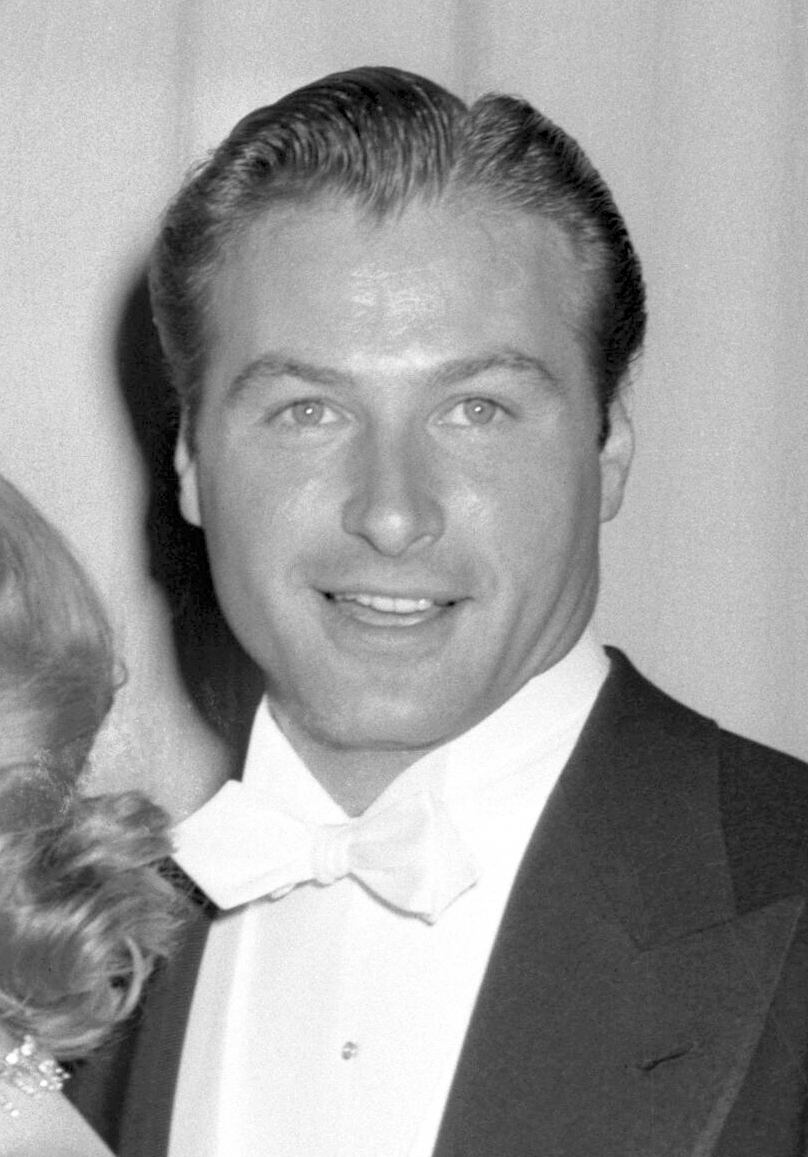
Lex Barker
View on WikipediaAlexander Crichlow Barker Jr. (May 8, 1919 – May 11, 1973), known as Lex Barker, was an American film and television actor. He played Tarzan for RKO Pictures between 1949 and 1953 and portrayed leading characters from Karl May's novels,[1] including Old Shatterhand in a film series by the West German studio Rialto Film. At the height of his fame, he was one of the most popular actors in German-speaking cinema and received Bambi Award and Bravo Otto nominations for the honor.
Key Information


Early life
[edit]Barker was born in Rye, New York, the second child of Alexander Crichlow Barker Sr., a wealthy Canadian-born building contractor and stockbroker,[2] and his American wife, the former Marion Thornton Beals.[3] He had an elder sister, Frederica Amelia "Freddie" Barlow (1917–1980). Of English and Spanish ancestry, Barker was a direct descendant of the founder of Rhode Island, Roger Williams, and of Sir William Henry Crichlow, historical governor-general of Barbados.[4][5]
Raised in New York City and Port Chester, New York, he attended the Fessenden School and graduated from Phillips Exeter Academy, where he played football and the oboe. He attended Princeton University, but dropped out to join a theatrical stock company, much to his family's chagrin.[6]
Career
[edit]Theatre
[edit]Barker made it to Broadway once, in a small role in a short run of Shakespeare's The Merry Wives of Windsor in 1938.[7] He also had a small role in Orson Welles's disastrous Five Kings, which met with so many problems in Boston and Philadelphia that it never made it into New York City.[8]
World War II
[edit]In February 1941, 10 months before the attack on Pearl Harbor, Barker left his fledgling acting career and enlisted in the U.S. Army. He rose to the rank of major during the war.[9] He was wounded in action (in the head and leg) fighting in Sicily.[10] He was awarded the Purple Heart twice.
Early film roles
[edit]Back in the US he recuperated at a military hospital in Arkansas, then upon his discharge from service traveled to Los Angeles. Within a short time he landed a small role in Doll Face (1945), his first film.[11]
A string of small roles followed in films such as Two Guys from Milwaukee (1945) and Cloak and Dagger (1946).
RKO
[edit]Barker signed a contract at RKO. He had small roles in The Farmer's Daughter (1947), Crossfire (1947), and Under the Tonto Rim (1947).[11]
Barker went to Paramount Studios for Unconquered (1947). Back at RKO he was in Dick Tracy Meets Gruesome (1947), Berlin Express (1948), Mr. Blandings Builds His Dream House (1948), The Velvet Touch (1948), and Return of the Bad Men (1948), playing Emmett Dalton.[11]
Tarzan
[edit]In Tarzan's Magic Fountain (1949), Barker became the 10th official Tarzan of the movies. His blond, handsome, and intelligent appearance, as well as his athletic 6'4" frame, helped make him popular in the role Johnny Weissmuller had made his own for 16 years. His Jane was Brenda Joyce, who had been in Weissmuller's last three films.[12]
Barker's second Tarzan movie was Tarzan and the Slave Girl (1950), where Jane was played by Vanessa Brown. In Tarzan's Peril (1951), Barker's Jane was Virginia Huston, with African location footage. Dorothy Hart was Jane in Tarzan's Savage Fury (1952), directed by Cy Endfield.[13][14]
Barker got the chance to play a non-Tarzan role in Battles of Chief Pontiac (1952), a Western.[15] He returned to the role one last time in Tarzan and the She-Devil (1953).[13][14]
Westerns
[edit]Barker supported Randolph Scott in Thunder Over the Plains (1953).[16]
At Universal he starred in the Western The Yellow Mountain (1954) and The Man from Bitter Ridge (1955). He went to Columbia to make Duel on the Mississippi (1955).[11]
Barker had a rare non-Western role in The Price of Fear (1956), a film noir with Merle Oberon. He was in the war movie Away All Boats (1956)[11] and the thriller The Girl in the Kremlin (1957).[17]
Barker made two films for Howard W. Koch: War Drums (1957)[11] and Jungle Heat (1957),.[18] He went to 20th Century Fox for The Deerslayer (1957),[11] then did The Girl in Black Stockings (1957).[19]
Italy
[edit]In 1957, as he found it harder to find work in American films[why?], Barker moved to Europe (he spoke French, Italian, Spanish, and some German),[20] where he found popularity and starred in over 40 European films, including two movies based on the novels by Italian author Emilio Salgari (1862–1911).[21]
He started his European career with a British thriller The Strange Awakening (1958). He went to Italy to star in Captain Falcon (1959), Son of the Red Corsair (1959), The Pirate and the Slave Girl (1959), and Terror of the Red Mask (1960).[22]
Barker had a short but compelling role as Anita Ekberg's fiancé in Federico Fellini's La Dolce Vita (1960).[23]
He went back to swashbucklers: Knight of 100 Faces (1960), Pirates of the Coast (1960), Robin Hood and the Pirates (1960), and The Secret of the Black Falcon (1961).[22]
West Germany
[edit]Barker had his greatest success in West Germany. There, he starred in movies based on the "Doctor Mabuse" stories (formerly filmed by Fritz Lang), in the movies The Return of Doctor Mabuse (1961).[24] He was in Doctor Sibelius (1962).
Barker then played Old Shatterhand in an adaptation of the novel by popular German author Karl May (1842–1912), Treasure of the Silver Lake (1962).[25] It was a huge hit, and 11 movies adapting stories by Karl May followed until 1968.[26][circular reference] Barker did the comedy Breakfast in Bed (1962), then the adventure movie Storm Over Ceylon (1963). He returned to Italy for The Executioner of Venice (1963)[27][28] and Kali Yug: Goddess of Vengeance (1963).[11]
Barker reprised his role as Old Shatterhand in Apache Gold (1964), Old Shatterhand (1964), and Last of the Renegades (1965).[11][18] He went to South Africa for Harry Alan Towers' West German-British international co-production Victim Five (1964),[18][29] then returned to West Germany for other adaptations of May books: The Treasure of the Aztecs (1965) and The Pyramid of the Sun God (1965) .[30] 24 Hours to Kill (1965) was a British movie.[29] The Hell of Manitoba (1965) and The Desperado Trail (1966) were Westerns.[31]
Though Barker did speak German, he was almost always dubbed in his West German films. His go-to dubber was Gert Günther Hoffmann, whose distinctive voice contributed to Barker's success.
In 1966, Barker was awarded the "Bambi Award" as Best Foreign Actor in West Germany, where he was a very popular star.[32] He even recorded two songs in German: "Ich bin morgen auf dem Weg zu dir" ("I'll be on the way to you tomorrow", composed by Martin Böttcher, the composer of some of the soundtracks of the Karl May movies) and "Mädchen in Samt und Seide" ("Girl in Silk and Velvet", composed by Werner Scharfenberger).[33]
His later films included Killer's Carnival (1966), and Winnetou and the Crossbreed (1967). In the same year, he starred in a Eurospy film Spy Today, Die Tomorrow and a horror film The Blood Demon, and appeared in the anthology film Woman Times Seven (1967).[18]
He returned to the United States occasionally and made a handful of guest appearances on American television episodes, but Europe, and especially West Germany, was his professional home for the remainder of his life.
Personal life
[edit]
Barker was married five times:
- Constance Rhodes Thurlow (1918–1975) (married June 27, 1942–divorced 1950),[34] a daughter of Leon Rhodes Thurlow, a vice president of the Decorated Metal Manufacturing Company.[35] They had one daughter, Lynn Thurlow Barker (April 11, 1943 – 2010), and a son, Alexander "Zan" Crichlow Barker III (March 25, 1947 – October 2, 2012). In 1952, Constance Barker married her second husband, John Lawrence Adams, a descendant of John Quincy Adams.[35]
- Actress Arlene Dahl (married 1951–divorced 1952)[34]
- Actress Lana Turner (married September 8, 1953–divorced July 22, 1957).[34] Turner's daughter Cheryl Crane later accused Barker of having repeatedly raped her when she was between the ages of 10 ½ and 13.[36][37] and that this was the reason for the breakup of the marriage. According to Crane, to avoid public scandal, no charges were ever filed.
- Irene Labhardt (married 1957–1962; her death from leukemia), a Swiss actress. They had one son, Christopher (born 1960), who became an actor and singer.[34]
- Tita Cervera (married 1965–divorced 1972, although divorce not deemed legally valid), a Spanish beauty-pageant winner. Voted Miss Spain in 1962, she later became the wife of movie producer Espartaco Santoni in 1975 (the marriage turned out to be bigamous) and later still, in 1985, the fifth and final wife of billionaire art collector Baron Hans Heinrich Thyssen-Bornemisza.[38]
Death
[edit]Barker died on May 11, 1973, of a heart attack, three days after his 54th birthday, while walking down Lexington Avenue on New York City's Upper East Side to meet his fiancée, actress Karen Kondazian.[39] The funeral was held in New York. He was cremated and the ashes were taken by his estranged wife Tita to Spain.
Filmography
[edit]Film
[edit]| Year | Title | Role | Notes |
|---|---|---|---|
| 1945 | Doll Face | Coast Guardsman | Uncredited |
| 1946 | Do You Love Me | Party Guest | |
| Two Guys from Milwaukee | Fred | ||
| Cloak and Dagger | Rescued Man | ||
| 1947 | The Farmer's Daughter | Olaf Holstrom | |
| Crossfire | Harry | ||
| Under the Tonto Rim | Deputy Joe | ||
| Unconquered | Royal American Officer | Uncredited | |
| Dick Tracy Meets Gruesome | Ambulance Driver | ||
| 1948 | Berlin Express | Soldier | |
| Mr. Blandings Builds His Dream House | Carpenter Foreman | ||
| The Velvet Touch | Paul Banton | ||
| Return of the Badmen | Emmett Dalton | ||
| 1949 | Tarzan's Magic Fountain | Tarzan | |
| 1950 | Tarzan and the Slave Girl | ||
| 1951 | Tarzan's Peril | ||
| 1952 | Tarzan's Savage Fury | ||
| Battles of Chief Pontiac | Lt. Kent McIntire | ||
| 1953 | Tarzan and the She-Devil | Tarzan | |
| Thunder Over the Plains | Captain Bill Hodges | ||
| 1954 | The Mystery of The Black Jungle | Tremal Naik | Original (Italian) title: I misteri della giungla nera |
| Black Devils of Kali | Original (Italian) title: La vendetta dei Tughs | ||
| The Yellow Mountain | Andy Martin | ||
| 1955 | The Man from Bitter Ridge | Jeff Carr | |
| Duel on the Mississippi | André Tulane | ||
| 1956 | The Price of Fear | Dave Barrett | |
| Away All Boats | Commander Quigley | ||
| 1957 | War Drums | Mangas Coloradas | |
| The Girl in the Kremlin | Steve Anderson | ||
| Jungle Heat | Dr. Jim Ransom | ||
| The Deerslayer | Deerslayer | ||
| The Girl in Black Stockings | David Hewson | ||
| 1958 | The Strange Awakening | Peter Chance | |
| Captain Falcon | Pietro | Original (Italian) title: Capitan Fuoco | |
| 1959 | Son of the Red Corsair | Enrico di Ventimiglia | Original (Italian) title: Il figlio del corsaro rosso |
| The Pirate and the Slave Girl | Dragon Drakut | Original (Italian) title: La scimitarra del Saraceno | |
| Mission in Morocco | Bruce Reynolds | ||
| 1960 | Terror of the Red Mask | Marco | Original (Italian) title: Terrore della maschera rossa |
| La Dolce Vita | Robert | Italian film | |
| Knight of 100 Faces | Riccardo D'Arce | Original (Italian) title: Il cavaliere dai cento volti | |
| Pirates of the Coast | Captain Luis Monterey | Original (Italian) title: I pirati della costa | |
| Robin Hood and the Pirates | Robin Hood | Original (Italian) title: Robin Hood e i pirati | |
| 1961 | The Secret of the Black Falcon | Captain Don Carlos de Herrera | Original (Italian) title: Il segreto dello sparviero nero |
| Le Trésor des hommes bleus | Fred | Spanish/French film | |
| The Return of Dr. Mabuse | FBI-Agent Joe Como | Original (German) title: Im Stahlnetz des Dr. Mabuse | |
| 1962 | The Invisible Dr. Mabuse | FBI-Agent Joe Como | Original (German) title: Die unsichtbaren Krallen des Dr. Mabuse |
| Doctor Sibelius | Dr. Georg Sibelius | Original (German) title: Frauenarzt Dr. Sibelius | |
| Treasure of the Silver Lake | Old Shatterhand | Original (German) title: Der Schatz im Silbersee | |
| 1963 | Breakfast in Bed | Victor H. Armstrong | Original (German) title: Frühstück im Doppelbett |
| Storm Over Ceylon | Larry Stone | Original (German) title: Das Todesauge von Ceylon | |
| The Executioner of Venice | Sandrigo Bembo | Original (Italian) title: Il boia di Venezia | |
| Kali Yug: Goddess of Vengeance | Major Ford | Original (Italian) title: Kali Yug, la dea della vendetta | |
| The Mystery of the Indian Temple | Major Ford | Original (Italian) title: Il mistero del tempio indiano | |
| Apache Gold | Old Shatterhand | Original (German) title: Winnetou I | |
| 1964 | Apaches' Last Battle | Old Shatterhand | Original (German) title: Old Shatterhand |
| Victim Five | Steve Martin | UK film, US title: Code 7, Victim 5 | |
| The Shoot | Kara Ben Nemsi | Original (German) title: Der Schut | |
| Last of the Renegades | Old Shatterhand | Original (German) title: Winnetou II | |
| 1965 | The Treasure of the Aztecs | Dr. Karl Sternau | Original (German) title: Der Schatz der Azteken |
| The Pyramid of the Sun God | Dr. Karl Sternau | Original (German) title: Die Pyramide des Sonnengottes | |
| Twenty-Four Hours to Kill | Captain Jamie Faulkner | UK/German co-production film | |
| The Hell of Manitoba a.k.a. A Place Called Glory | Clint Brenner | Original (German) title: Die Hölle von Manitoba | |
| The Wild Men of Kurdistan | Kara Ben Nemsi | Original (German) title: Durchs wilde Kurdistan | |
| The Desperado Trail | Old Shatterhand | Original (German) title: Winnetou III | |
| Fury of the Sabers | Kara Ben Nemsi | Original (German) title: Im Reiche des silbernen Löwen | |
| 1966 | Who Killed Johnny R.? | Sam Dobie | Original (German) title: Wer kennt Johnny R.? |
| Killer's Carnival | Glenn Cassidy | Original (French) title: Le carnaval des barbouzes, (Rio segment) | |
| Winnetou and the Crossbreed | Old Shatterhand | Original (German) title: Winnetou und das Halbblut Apanatschi | |
| 1967 | Woman Times Seven | Rik | (segment "Super Simone") |
| Spy Today, Die Tomorrow | Bob Urban | Original (German) title: Mister Dynamit – Morgen küßt Euch der Tod | |
| The Blood Demon | Roger Mont Elise | Original (German) title: Die Schlangengrube und das Pendel | |
| 1968 | The Valley of Death | Old Shatterhand | Original (German) title: Winnetou und Shatterhand im Tal der Toten |
| 1970 | Aoom | Ristol | |
| When You're With Me | Kapitän Hannes Schneider | Original (German) title: Wenn du bei mir bist |
Television
[edit]| Year | Title | Role | Notes |
|---|---|---|---|
| 1952 | Tales of Tomorrow | Kurt | Episode: "Red Dust" |
| 1956 | Lux Video Theatre | Stephen Dexter | Episode: "Hired Wife" |
| 1956–57 | Studio 57 | Brad / Robin Ridour | 2 episodes |
| 1960 | Tales of the Vikings | König Gordar | Episode: "The Shield" |
| 1963 | Berlin-Melodie | Television film | |
| 1969 | It Takes a Thief | Kurt 'Matt' Matson | Episode: "The King of Thieves" |
| 1971 | The Name of the Game | Will Cheyenne | Episode: "The Man Who Killed a Ghost" |
| The F.B.I. | Owen Stuart | Episode: "Three-Way Split" | |
| 1972 | Night Gallery | Charlie McKinley | Segment: "The Waiting Room" |
Discography
[edit]- "Ich bin morgen auf dem Weg zu dir" / "Mädchen in Samt und Seide" 1965, Single, Decca D 19 725
- Winnetou du warst mein Freund 1966, CD, Bear Family Records
See also
[edit]References
[edit]- ^ Obituary Variety, May 16, 1973.
- ^ Reiner Boller, Christina Böhme (2003). Lex Barker – Die Biografie. Schwarzkopf & Schwarzkopf Verlag, Germany. ISBN 3-89602-444-2.
- ^ "Miss Beals's Wedding", The New York Times, April 20, 1913.
- ^ "Lex Barker - Der unvergessene Tarzan und Old Shatterhand". lex-barker.eu. January 1, 2008. Retrieved October 1, 2023.
- ^ "Lex Barker - Biography". tribute-to-lex-barker.net. June 14, 2005. Retrieved October 1, 2023.
- ^ "LEX BARKER DIES; TARZAN OF MOVIES". The New York Times. May 12, 1973. Retrieved September 14, 2007.
- ^ "The Merry Wives of Windsor". IBDB.com. Internet Broadway Database.
- ^ Leaming, Barbara. Orson Welles: A Biography, pp. 188–201
- ^ Electronic Army Serial Number Merged File, 1938–1946 [Archival Database]; World War II Army Enlistment Records; Records of the National Archives and Records Administration, Record Group 64
- ^ Freese, Gene (2017). Classic Movie Fight Scenes: 75 Years of Bare Knuckle Brawls, 1914–1989. Jefferson, North Carolina: McFarland & Company. p. 108. ISBN 978-1-4766-6943-4.
- ^ a b c d e f g h i Rowan 2013, p. 40.
- ^ Vallance, Tom (August 15, 2009). "Brenda Joyce: Actress who played Jane to Johnny Weissmuller's Tarzan". The Independent. Archived from the original on 2022-06-14. Retrieved October 17, 2017.
- ^ a b Schneider 2012, p. viii.
- ^ a b Drew 1986, section 742.
- ^ Österberg, Bertil O. (2000). Colonial America on Film and Television: A Filmography. Jefferson, North Carolina: McFarland & Company. p. 53. ISBN 978-0-7864-4242-3.
- ^ Nott, Robert (2004). The Films of Randolph Scott. Jefferson, North Carolina: McFarland & Company. p. 172. ISBN 978-0-7864-3759-7.
- ^ Rowan, Terry (2015). Motion Pictures From the Fabulous 1950s. Lulu.com. p. 71. ISBN 978-1-329-76077-6.
- ^ a b c d Monush 2003, p. 43.
- ^ Maltin, Leonard (2015). Turner Classic Movies Presents Leonard Maltin's Classic Movie Guide. New York: Penguin Random House. p. 250. ISBN 978-0-14-751682-4.
- ^ Kalat 2005, p. 150.
- ^ Bergfelder 2005, p. 192.
- ^ a b Hughes 2011, p. 40.
- ^ Dyer, Richard (2018). La dolce vita. London: British Film Institute. p. 21. ISBN 978-1-8445-7392-9.
- ^ Kalat 2005, p. 298.
- ^ Goral, Pawel (2014). Cold War Rivalry and the Perception of the American West. New York: Palgrave Macmillan. p. 122. ISBN 978-1-137-36429-6.
- ^ Lentz III, Harris M. (2016). Obituaries in the Performing Arts, 2015. Jefferson, North Carolina: McFarland & Company. p. 40. ISBN 978-0-7864-7667-1.
- ^ Hughes 2011, p. 42.
- ^ Prickette, James (2012). Actors of the Spaghetti Westerns. Xlibris Corporation. p. 310. ISBN 978-1-4691-4428-3.
- ^ a b Bergfelder 2005, p. 219.
- ^ Bergfelder 2005, p. 252.
- ^ Rowan 2013, p. 447.
- ^ Petzel, Michael (1998). Karl-May-Filmbuch: Stories und Bilder aus der deutschen Traumfabrik [Karl May film book: Stories and Pictures from the German dream factory] (in German). Radebeul, Germany: Karl-May-Verlag. p. 33. ISBN 978-3780201539.
- ^ "Music Capitals of the World". Billboard. New York. November 13, 1965.
- ^ a b c d Michael & Parish 1969, p. 52.
- ^ a b "Mrs. Barker's Nuptials", The New York Times, September 12, 1952
- ^ "Two Survivors: The Scandalous Saga of Lana Turner and Cheryl Crane". Vanity Fair. 2023-06-08. Retrieved 2023-12-22.
- ^ Archer, Greg (November 26, 2008). "The Kid Stays in the Picture". The Advocate. Archived from the original on January 5, 2013.
- ^ Curti, Roberto (2013). Italian Crime Filmography, 1968–1980. Jefferson, North Carolina: McFarland & Company. p. 228. ISBN 978-0-7864-6976-5.
- ^ Boller, Reiner (November 2, 2009). "Karen Kondazian". Lex-Barker.com. Retrieved April 4, 2018.
Sources
[edit]- Bergfelder, Tim (2005). International Adventures: German Popular Cinema and European Co-productions in the 1960s. New York: Berghahn Books. ISBN 1-57181-538-4.
- Christ, Manfred (1994). Von Tarzan bis Old Shatterhand – Lex Barker und seine Filme [From Tarzan to Old Shatterhand - Lex Barker and his Films] (in German). Tuningen, Germany: Günter Albert Ulmer Verlag. ISBN 3-924191-81-6.
- Crane, Cheryl; Jahr, Cliff (1988). Detour: A Hollywood Tragedy: My Life With Lana Turner, My Mother. London: Penguin Group. ISBN 0-7181-3069-3.
- Drew, Bernard A. (1986). Motion Picture Series and Sequels: A Reference Guide. New York: Routledge. ISBN 9780415726658.
- Hughes, Howard (2011). Cinema Italiano: The Complete Guide from Classics to Cult. London and New York: I.B. Tauris. ISBN 978-1-84885-607-3.
- Kalat, David (2005). The Strange Case of Dr. Mabuse: A Study of the Twelve Films and Five Novels. Jefferson, North Carolina: McFarland & Company. ISBN 978-0-7864-2337-8.
- Michael, Paul; Parish, James Robert (1969). The American Movies Reference Book: The Sound Era. Englewood Cliffs, New Jersey: Prentice Hall. ISBN 978-0130281340.
- Monush, Barry (2003). The Encyclopedia of Hollywood Film Actors: From the Silent Era to 1965. New York: Applause Theatre & Cinema Books. ISBN 1-55783-551-9.
- Rowan, Terry (2013). The American Western A Complete Film Guide. Lulu.com. ISBN 978-1-300-41858-0.
- Schneider, Jerry L. (2012). Lord of the Jungle Filming Locations of California. California: Corriganville Press. ISBN 978-0-9831972-7-0.
External links
[edit]

Lex Barker
View on GrokipediaEarly life
Family background
Lex Barker was born Alexander Crichlow Barker Jr. on May 8, 1919, in Rye, New York. He was the second child of Alexander Crichlow Barker Sr., a Canadian-born building contractor who managed several companies, and his wife Marian Thornton Beals. He was raised in Rye, New York City, and Port Chester, New York.[10][11] Barker's family had deep American roots, with English and Spanish ancestry; he was a direct descendant of Roger Williams, the founder of Rhode Island and Providence Plantations, as well as Sir William Henry Crichlow, a historical governor-general of Barbados.[12]Education and early interests
Barker received his early education at the Fessenden School, a private preparatory institution in West Newton, Massachusetts. He later attended the renowned Phillips Exeter Academy in Exeter, New Hampshire, where he graduated after excelling in athletics, particularly football and track events that enhanced his physical conditioning and discipline.[5] During his years at Phillips Exeter Academy, Barker discovered his passion for theater through participation in school plays, which marked his initial foray into acting and sparked a lifelong ambition in the performing arts. This early involvement provided him with foundational stage experience and a deep appreciation for dramatic performance.[4] Following graduation, Barker briefly enrolled at Princeton University in New Jersey to continue his studies. However, drawn irresistibly to the theater world, he departed the university shortly thereafter to immerse himself in professional pursuits, beginning with summer stock productions in 1937 that served as crucial training grounds before his entry into broader acting opportunities.[2][5]Career
Theater beginnings
Barker began his professional theater career in the late 1930s after dropping out of Princeton University to pursue acting, a decision that strained relations with his wealthy family.[13] He gained initial experience in summer stock productions in New England, including a role in Eugene O'Neill's Anna Christie at the Westport Country Playhouse in Connecticut in 1938.[14] These regional engagements provided foundational training in repertory theater, where performers often took on multiple roles across a season of classic and contemporary plays. In 1938, Barker made his Broadway debut in a brief revival of Shakespeare's The Merry Wives of Windsor at the Empire Theatre, appearing as part of the ensemble in the three-performance run.[15] The following year, he joined Orson Welles's ambitious but ill-fated production of Five Kings, a compilation of Shakespearean history plays, in a small supporting role during its out-of-town tryouts in Boston and Philadelphia; logistical and creative issues prevented it from reaching New York.[4] These early appearances confined him to minor parts in New York's competitive theater scene, where repertory groups and stock companies served as training grounds for aspiring performers. Despite his evident talent and commanding stage presence—bolstered by his 6-foot-4-inch athletic physique honed from youthful outdoor activities—Barker struggled with typecasting that limited him to ensemble or physically imposing supporting roles, hindering a major breakthrough before his career was interrupted.[16]World War II service
Barker enlisted in the U.S. Army as a private in February 1941, nearly a year before the Pearl Harbor attack, temporarily halting his nascent theater pursuits.[17] Standing at 6 feet 4 inches and weighing 208 pounds, the physically imposing recruit underwent basic infantry training before rapid advancement through the non-commissioned and commissioned ranks.[17] By 1942, Barker had attained the rank of major and was assigned as aide-de-camp to General Mark Wayne Clark, commander of the Fifth Army.[18] He deployed with Clark's forces to North Africa in late 1942, supporting operations in the Mediterranean theater, and participated in the subsequent Allied invasion of Sicily in July 1943.[19] During intense combat on the island, Barker sustained wounds to his head and leg, requiring medical attention that underscored the perils of frontline service under Clark's command.[17] For his valor and injuries in Sicily, Barker received the Purple Heart medal twice, recognizing multiple wounds incurred in action.[5] His military obligations also intersected with personal milestones; while overseas, his first wife, Constance Thurlow—whom he had married on June 27, 1942—gave birth to their daughter, Lynn Thurlow Barker, in 1943.[20] Barker was honorably discharged as a major in September 1945, concluding nearly four and a half years of active duty.[2]Early film roles
Following his discharge from the U.S. Army in September 1945, where he had risen to the rank of major and earned two Purple Hearts for service in Italy, Lex Barker returned to acting amid the competitive post-World War II Hollywood landscape. His military experience bolstered his athletic build and disciplined demeanor, qualities that would later suit action-hero archetypes, though initially they did little to ease his entry into films.[5] Barker's screen debut occurred with an uncredited role as a coast guardsman named Jack in the 20th Century Fox musical comedy Doll Face (1945), directed by Lewis Seiler and starring Vivian Blaine. Subsequent uncredited appearances followed in 1946, including as a soldier in Two Guys from Milwaukee, directed by David Butler, and as a British officer in Fritz Lang's espionage thriller Cloak and Dagger, starring Gary Cooper. In 1947, he had an uncredited role as a police officer in the RKO comedy-drama The Farmer's Daughter, directed by H.C. Potter and starring Loretta Young as a Swedish farm girl entering politics. The film, which earned Young an Academy Award for Best Actress, marked Barker's first exposure to major studio production at RKO, though his appearance was brief and unnoticed. In 1948, he progressed to supporting parts, portraying a carpenter foreman in the Selznick Releasing Organization comedy Mr. Blandings Builds His Dream House, directed by H.C. Potter and featuring Cary Grant and Myrna Loy as a couple building a rural home fraught with mishaps. That same year, Barker appeared as a gang member in the RKO drama Fighting Father Dunne, directed by Ted Tetzlaff and led by Pat O'Brien as a real-life priest reforming juvenile delinquents in 1910s St. Louis. These roles, while minor, showcased his physicality in ensemble casts. Despite these credits, Barker faced significant hurdles in establishing himself, auditioning repeatedly for leads but finding his 6-foot-4-inch stature ill-suited to typical supporting characters and his relative obscurity a barrier to starring parts. He initially signed short-term deals with smaller studios like 20th Century Fox and Warner Bros. for bit work, but opportunities remained limited until he secured a seven-year contract with RKO Pictures in 1948, positioning him for greater visibility.[5]Tarzan films
In 1949, Lex Barker was selected to portray Tarzan in Tarzan's Magic Fountain, succeeding Johnny Weissmuller as the tenth actor to play the iconic jungle hero in film, a role that marked his breakthrough as a leading man under RKO Pictures producer Sol Lesser.[21] Barker's casting followed his early uncredited roles in the mid-1940s, leading to his RKO contract amid the studio's efforts to revitalize the Tarzan franchise with a fresh, athletic lead.[1] At 6 feet 4 inches tall with a muscular physique honed from his pre-acting pursuits including football and outdoor activities, Barker embodied the physical demands of the character, performing many of his own stunts in a minimal loincloth costume that became synonymous with the role.[22] Barker's tenure as Tarzan spanned five films produced by RKO from 1949 to 1953, each emphasizing his athletic prowess through action sequences involving vine-swinging, animal interactions, and combat in simulated jungle environments largely constructed on studio backlots with occasional location footage for authenticity. The series began with Tarzan's Magic Fountain (1949), co-starring Brenda Joyce as Jane, followed by Tarzan and the Slave Girl (1950) with Vanessa Brown as Jane, Tarzan's Peril (1951) featuring Virginia Huston as Jane, Tarzan's Savage Fury (1952) opposite Dorothy Hart as Jane, and concluding with Tarzan and the She-Devil (1953) alongside Joyce Mackenzie as Jane.[21][23][24][25] Unlike the earlier Weissmuller entries, which prioritized near-silent physicality, Barker's scripts incorporated more dialogue to develop Tarzan's character and relationships, though this evolved with tensions between Barker and Lesser leading to reduced lines in the final film.[3] The Tarzan films proved commercially successful at the box office, with each entry generating strong returns for RKO and solidifying the franchise's appeal in the post-World War II era through affordable adventure escapism.[4] Barker's portrayal highlighted Tarzan's heroic athleticism and environmental guardianship, influencing the character's depiction in popular culture as a more articulate protector of the jungle. However, the role's dominance typecast Barker as an action-oriented hero, limiting his opportunities for diverse dramatic parts in Hollywood and prompting his eventual shift to European cinema after 1953.[26][3]American westerns and adventures
Following the conclusion of his Tarzan series in 1953, Lex Barker transitioned into American westerns and adventure films, roles that built on his established image as a rugged action lead. These projects, primarily low-budget B-movies from studios like Columbia, Universal-International, and Republic Pictures, allowed him to portray heroic figures in frontier settings, often involving conflicts with outlaws, Native Americans, or corrupt officials.[27] Barker's first post-Tarzan western was Masterson of Kansas (1954), directed by William Castle for Columbia Pictures, in which he starred as the iconic lawman Bat Masterson teaming up with Wyatt Earp (James Griffith) to protect Doc Holliday (Raymond Burr) from the Dalton gang. The film emphasized Barker's authoritative presence in a tale of justice on the Kansas frontier. Later that year, he led Battle of Rogue River (1954), also directed by Castle, playing cavalry lieutenant Rexford Evans amid escalating tensions between Oregon settlers and Native tribes during the Rogue River Wars. Co-starring George Montgomery and Richard Denning, the production highlighted Barker's suitability for military-hero archetypes in historical western dramas. In 1955, Barker starred in The Man from Bitter Ridge (1955) for Universal-International, under the direction of Jack Arnold, as undercover agent Jeff Carr infiltrating a gang of stagecoach robbers led by the Jackman brothers (Stephen McNally and John Dehner). The film, shot in color and featuring Mara Corday as his romantic interest, showcased Barker's riding prowess and moral resolve in a standard but engaging oater narrative. The following year brought Thunder Over Arizona (1956), a Republic Pictures release directed by Joseph Kane, where Barker portrayed prospector Mike McCall exposing a scheme by land speculators to defraud homesteaders. With supporting turns by Skip Homeier and Kristine Miller, this Technicolor western underscored Barker's efforts to anchor action-driven stories amid the genre's proliferation of B-productions. Barker also ventured into adventure territory with The Price of Fear (1956), a Universal film noir directed by Abner Biberman, in which he played David Barrett, a man falsely implicated in a hit-and-run incident tied to a wealthy socialite (Merle Oberon). Though diverging from pure western tropes, the thriller's suspenseful plot and Barker's portrayal of an embattled everyman added depth to his American output.[28] Barker's U.S. phase culminated in the western War Drums (1957), directed by Reginald Le Borg for United Artists, where he took on the role of Apache leader Mangas Coloradas, forging an alliance with white trader Luke Fargo (Ben Johnson) against greedy miners threatening tribal lands. Joan Taylor co-starred as the object of their mutual affection, Riva, in this color production that portrayed Barker as a noble Native American chief advocating peace.[29] These films, often involving co-productions and quick shoots, reflected Barker's attempt to diversify beyond jungle adventures, yet diminishing roles in Hollywood—amid competition from rising stars—prompted his pivot to European cinema by late 1957.Italian films
After struggling with typecasting as Tarzan in Hollywood, which limited his opportunities in American cinema following the mid-1950s, Lex Barker relocated to Europe in 1957, initially settling in Italy to capitalize on the burgeoning market for adventure films.[30] This move allowed him to transition from Westerns to the vibrant Italian film industry, where his prior experience in action-oriented roles proved advantageous.[9] Barker's Italian output primarily consisted of low-budget swashbuckler and sword-and-sandal adventures, often portraying heroic leads in tales of piracy, rebellion, and historical intrigue set against Mediterranean backdrops. His debut in this phase was Capitan Fuoco (1958), a Robin Hood-inspired story directed by Carlo Campogalliani, where he played the outlaw leader challenging a tyrannical baron in medieval Italy.[31] Subsequent films included Son of the Red Corsair (1959), a pirate revenge narrative; Pirates of the Coast (1960), in which he starred as a framed Spanish captain turned buccaneer alongside Estella Blain; Robin Hood and the Pirates (1960), a lighthearted Crusades-era adventure with Jocelyn Lane; and The Secret of the Black Falcon (1961), featuring Barker as a daring officer retrieving a stolen document from pirates, co-starring Nadia Marlowa.[32][33][34] These productions, typically shot at Cinecittà studios, emphasized physical stunts, elaborate costumes, and fast-paced plots, aligning with the peplum genre's emphasis on muscular heroism, though Barker's films leaned more toward seafaring exploits than mythological epics.[35] Barker faced language barriers on set, as many films were shot in Italian, but his rudimentary knowledge of the language—acquired through prior multilingual exposure—enabled him to perform adequately, with final dubs handling dialogue nuances.[36] This period marked a stark contrast to his fading U.S. prospects, where roles had dwindled; in Europe, particularly Italy, his films achieved solid commercial performance, revitalizing his career as a genre star and paving the way for further international success.[4][37]West German films
Following his roles in Italian cinema, which facilitated his transition to broader European productions, Lex Barker found renewed success in West German films during the early 1960s.[19] Barker was cast as the heroic frontiersman Old Shatterhand in the 1962 adaptation of Karl May's novel Der Schatz im Silbersee (The Treasure of Silver Lake), directed by Harald Reinl, marking the launch of a highly successful series of West German-Yugoslav co-productions based on May's adventure stories.[38] This film introduced Barker's portrayal of the intelligent, rifle-wielding companion to the Apache chief Winnetou, emphasizing themes of brotherhood and justice amid frontier conflicts, and it drew over 3 million viewers in West Germany alone upon release.[39] The film's popularity spurred a series of over 10 adaptations, with Barker reprising Old Shatterhand in seven subsequent entries such as Winnetou: The Red Gentleman (1964), Among Vultures (1964), and The Desperado Trail (1965), all under Reinl's direction for much of the run.[40] Barker's partnership with French actor Pierre Brice, who embodied the noble Winnetou, became central to the series' dynamic, portraying an idealized cross-cultural alliance that resonated with audiences.[41] These films gained immense appeal in post-war West Germany as escapist entertainment, blending American Western tropes with May's romanticized narratives of the American frontier, and they often topped box-office charts, fostering a cultural phenomenon around the characters.[37] Produced with multilingual dubbing to reach international markets—including German, English, and French versions—they were shot extensively on location in Yugoslavia's rugged landscapes, such as the Zrmanja River canyon and Paklenica National Park, to authentically depict the Wild West.[42][43] Beyond the May series, Barker's presence extended to other West German-linked productions, including the 1963 adventure Kali Yug: Goddess of Vengeance, a co-production where he played Major Ford in a tale of intrigue during British colonial India.[44]Personal life
Marriages
Lex Barker was married five times, with each union reflecting transitions in his personal and professional life across the United States and Europe.[5] His first marriage was to Constance Rhodes Thurlow on June 27, 1942, in New York City; Thurlow, the daughter of Leon Rhodes Thurlow, a vice president of the Decorated Metal Manufacturing Company, came from a prominent family background.[20] The couple's relationship, which began in the early 1940s, was influenced by Barker's emerging theater involvement and was interrupted by his World War II military service, contributing to early instability; they divorced in 1950 after eight years.[45] Barker's second marriage, to actress Arlene Dahl, took place on April 17, 1951, in a private chapel ceremony in New York, marking a brief Hollywood romance during his rising film career.[46] Dahl, known for her red hair and roles in films like Journey into Light, shared Barker's industry circles, but the union lasted only one year, ending in divorce in 1952 amid the pressures of their professional lives.[47] The third marriage, to fellow actress Lana Turner, occurred on September 7, 1953, in a civil ceremony in Turin, Italy, following Barker's work on European sets; this high-profile pairing drew significant media attention due to both stars' fame.[48] Turner, in her fifth marriage at the time, and Barker shared a tumultuous four-year relationship shaped by Hollywood's spotlight, culminating in divorce in July 1957.[5] After relocating to Europe in 1957 for film opportunities, Barker married Swiss actress Irene Labhart on March 14, 1959, in Lucerne, Switzerland, a union that provided personal stability amid his international career shift.[20] Labhart, who appeared in Swiss cinema, and Barker remained together until her death from leukemia on October 23, 1962, in Rome, ending the marriage after three years.[49] Barker's fifth and final marriage was to Spanish actress and beauty queen Carmen Cervera—known as Tita and Miss Spain 1961—on March 6, 1965, in Geneva, Switzerland, reflecting his established European base.[5] Cervera, later a prominent art collector, and Barker shared eight years together, marked by his work in German and Italian films, before separating in 1972; the marriage was ongoing at the time of his death in 1973.[50] These marriages, often short-lived and aligned with Barker's career moves from American theater and film to European productions, highlighted patterns of romantic partnerships intertwined with professional relocations.[6]Children and family
Lex Barker had two children from his first marriage to Constance Thurlow. Their daughter, Lynn Thurlow Barker (April 11, 1943 – 2010), and their son, Alexander "Zan" Crichlow Barker III (March 25, 1947 – 2012), were born during the marriage.[51] The family resided in Los Angeles during this period, with a 1948 photograph capturing Barker with his wife and young children at their home.[52] Lynn and Zan were raised primarily in the United States amid the post-World War II years, as Barker's early career kept the family stateside until the early 1950s.[51] Barker's fourth marriage, to Swiss actress Irene Labhart in 1959, produced a son, Christopher Barker, born on May 2, 1960, in Rome, Italy.[49] By this time, Barker had relocated to Europe in the late 1950s to pursue acting opportunities, establishing family residences in Italy where Christopher spent his early years.[5] His professional commitments, including extensive filming across Europe, resulted in limited day-to-day involvement with his children, though he maintained connections with them throughout his life.[51] During his third marriage to actress Lana Turner from 1953 to 1957, Barker served as stepfather to her daughter, Cheryl Crane, born in 1943.[5] Photographs from 1956 show Barker interacting warmly with Cheryl and his son Zan, indicating familial bonds during this period in California. Overall, Barker's family life spanned continents, with his offspring growing up in varied environments shaped by his transatlantic career shifts.[5]Controversies
In 1958, during the high-profile inquest into the death of Lana Turner's lover Johnny Stompanato, Cheryl Crane, Turner's 14-year-old daughter, publicly alleged that her former stepfather, Lex Barker, had molested her repeatedly between the ages of 10 and 13 while he was married to Turner from 1953 to 1957. Crane's testimony detailed the abuse, which she claimed began shortly after Barker's marriage to her mother and contributed to the couple's divorce in 1957, though the full extent became public amid the Stompanato scandal.[53] Barker denied the accusations at the time, but the revelation severely tarnished his image as the wholesome Tarzan hero.[54] The allegation had profound repercussions for Barker's career in Hollywood, where he had starred in several successful Tarzan films and other adventures; the scandal, coming after his 1957 relocation to Europe, further limited his U.S. opportunities and amplified scrutiny on his personal life, shifting public perception from a rugged, all-American leading man to a figure embroiled in controversy, as tabloids sensationalized the story and linked it to the broader turmoil surrounding Turner's marriages.[53] While the molestation claim remains the most documented controversy, unsubstantiated rumors of extramarital affairs and financial disputes surfaced in gossip columns during the 1950s, but lacked corroboration and did not lead to formal legal action.[54] Barker's defenders, including his later wife Carmen Thyssen-Bornemisza, maintained his innocence regarding the Crane allegation, portraying him as a gentleman unsuited to such behavior, though he died in 1973 without the chance to fully address later reiterations in Crane's 1988 memoir.[54]Death
Final years
In the late 1960s, Barker's film career in Europe became more sporadic as the popularity of the Karl May adaptations waned, though he continued to take on roles in westerns such as the German production Winnetou und das Halbblut Apanatschi (Winnetou and the Crossbreed, 1966), where he reprised his role as Old Shatterhand, and adventure films like The Torture Chamber of Dr. Sadism (1967). These projects sustained his professional momentum from earlier European successes but marked a winding down of his leading-man status in the genre. Barker made occasional return visits to the United States during this period, focusing on television guest roles to revive his American visibility; appearances included episodes of The F.B.I. (1971) and It Takes a Thief (1969).[55][56] By the early 1970s, Barker's health had begun to decline due to chronic smoking, heavy drinking, and personal stresses, including his separation from his fifth wife, Carmen Cervera, in 1972 after seven years of marriage.[57][58] Despite attempts to improve his condition—such as quitting smoking, losing weight through tennis, and entering a new relationship with actress Karen Kondazian in 1972— these issues persisted.[57] Financially stable from his European work, he had relocated to a New York City apartment on East 61st Street by 1973, where he managed business affairs and planned future projects.[57] In late-career interviews, Barker reflected positively on his Tarzan legacy, describing it as a defining and fulfilling role that opened doors to his international success, stating it brought him "satisfaction" despite Hollywood's initial typecasting.[4]Circumstances of death
On May 11, 1973, just three days after his 54th birthday, Lex Barker suffered a sudden heart attack and collapsed while walking along Lexington Avenue near 61st Street in New York City.[2] He was found unconscious by passersby and rushed to Lenox Hill Hospital, where he was pronounced dead on arrival; an autopsy was pending at the time to confirm the exact cause.[2] Barker's fiancée, actress Karen Kondazian, grew concerned when he failed to meet her for a planned lunch that day, prompting her and friends to contact police and hospitals.[57] Authorities identified him through a wristwatch inscribed with his name and address in Beverly Hills, California; his body was initially taken to the city morgue before being released to Frank E. Campbell Funeral Home on Madison Avenue.[2][57] Funeral services were held privately on May 15, 1973, at 11:30 A.M. at Frank E. Campbell's, attended by family and friends including his estranged fifth wife, Carmen "Tita" Cervera.[59] Barker was cremated following the service, and his ashes were taken to Spain by Cervera.[60] Kondazian later reflected on the shock of the loss, noting Barker's vitality and their recent celebration of his birthday, though he had confided fears of aging and dismissed a troubling dream from the night before about struggling to breathe—subtle signs of health issues he had ignored in his final years.[57]Filmography
Films
Lex Barker appeared in approximately 60 feature films throughout his career, spanning adventure, Western, and peplum genres, with a particular emphasis on his iconic portrayals in the Tarzan series and later European productions.| Year | Title (International Titles) | Role | Director |
|---|---|---|---|
| 1945 | A Walk in the Sun | Soldier (uncredited) | Lewis Milestone |
| 1947 | The Farmer's Daughter | Attendant (uncredited) | H.C. Potter |
| 1947 | Under the Tonto Rim | Stagecoach Guard (uncredited) | Lew Landers |
| 1947 | Dick Tracy Meets Gruesome | City Hospital Driver (uncredited) | John Rawlins |
| 1948 | Mr. Blandings Builds His Dream House | Carpenter Foreman | H.C. Potter |
| 1950 | Battle of the Coral Sea | Lt. Morgan | Paul Wendkos[61] |
| 1949 | Tarzan's Magic Fountain (Tarzan and the Mermaids in some releases) | Tarzan | Lee Sholem[21] |
| 1950 | Tarzan and the Slave Girl | Tarzan | Lee Sholem |
| 1951 | Tarzan's Peril (Tarzan and the Jungle Queen internationally) | Tarzan | Byron Haskin |
| 1952 | Tarzan's Savage Fury | Tarzan | Cy Endfield |
| 1953 | Tarzan and the She-Devil | Tarzan | Kurt Neumann[25] |
| 1953 | Thunder Over the Plains | Captain David Banner | André De Toth |
| 1954 | Return of the Texan | Lt. Chris Hanson | Delmer Daves |
| 1955 | The Man from Bitter Ridge | Jeff Carr | Jack Arnold[62] |
| 1955 | The Eternal Sea | Cmdr. Carl 'Griff' Griffiths | John Auer |
| 1955 | The Adventures of Hajji Baba | Caliph | Don Weis |
| 1955 | The Girl in the Red Velvet Swing | Harry Kendall Thaw | Richard Fleischer |
| 1956 | Away All Boats | Lt. (j.g.) 'Pete' Tarbill | Joseph Pevney |
| 1956 | The Price of Fear | David Chase | Abner Biberman |
| 1956 | The Broken Star | Maj. John Colton | Sidney Salkow |
| 1957 | The Deerslayer | Deerslayer / Natty Bumppo | Kurt Neumann |
| 1957 | War Drums | Mangas Coloradas | Reginald Le Borg[63] |
| 1957 | The Girl in Black Stockings | Harlan Stockwell | Howard W. Koch |
| 1958 | The Badlanders | Ray Bohannon | Delmer Daves |
| 1958 | I Pirati della Malesia (The Pirates of the Malay, aka Sea of Lost Ships) | Kammamuri | Domenico Paolella |
| 1959 | La Spada e la Croce (Sword and the Cross) | Caiaphas | Vittorio Cottafavi |
| 1959 | Il Figlio del Corsaro Rosso (Son of the Red Corsair) | Skull | Primo Zeglio |
| 1959 | Il Corsaro Nero (The Black Pirate) | Van Horst | Sergio Grieco |
| 1959 | I Reali de Francia (The Royal Duchess, aka The Night Before the Duel) | King Francis I | Mario Amendola |
| 1960 | Morgan il Pirata (Morgan, the Pirate) | Captain van Diel | André De Toth |
| 1960 | I Giganti della Tessaglia (The Giants of Thessaly) | Jason | Riccardo Freda |
| 1960 | La Dolce Vita | Himself (cameo) | Federico Fellini |
| 1960 | Il Colosso di Rodi (The Colossus of Rhodes) | Captain dei Tespi | Sergio Leone |
| 1961 | Le Meraviglie di Aladino (The Wonders of Aladdin) | Prince Souhayed | Henry Levin, Mario Bava |
| 1961 | Gli Invasori (Erik the Conqueror) | King Lotar | Mario Bava |
| 1962 | Der Schatz im Silbersee (Treasure of Silver Lake) | Old Shatterhand | Harald Reinl |
| 1962 | Winnetou - 1. Teil (Apache Gold) | Old Shatterhand | Harald Reinl[64] |
| 1963 | Old Shatterhand | Old Shatterhand | Hugo Fregonese |
| 1963 | Der Schut (Frontier Hellcat) | Old Shatterhand | Harald Reinl |
| 1964 | Winnetou - 2. Teil (Last of the Renegades) | Old Shatterhand | Harald Reinl[65] |
| 1964 | Der weiße Spider (The White Spider) | Inspector Morgan | Harald Reinl |
| 1964 | Winnetou - 3. Teil (Winnetou: The Last Shot) | Old Shatterhand | Harald Reinl[66] |
| 1964 | Code 7, Victim 5! | Steve Martin | Terence Robinson |
| 1965 | Der Schatz der Azteken (The Treasure of the Aztecs) | Dr. Karl Sternau | Robert Siodmak |
| 1965 | Die Pyramide des Sonnengottes (The Pyramid of the Sun God) | Dr. Karl Sternau | Robert Siodmak |
| 1965 | Winnetou - Der Rote Gentleman (Winnetou: The Red Gentleman) | Old Shatterhand | Alfred Vohrer |
| 1965 | Flaming Frontier (Unter Geiern) | Old Shatterhand | Alfred Vohrer |
| 1965 | The Desperado Trail (Winnetou III) | Old Shatterhand | Harald Reinl |
| 1966 | Winnetou und das Halbblut (Winnetou and the Crossbreed) | Old Shatterhand | Harald Reinl |
| 1967 | Winnetou und sein Freund Old Firehand (Old Firehand) | Old Shatterhand | Alfred Vohrer |
| 1967 | Woman Times Seven | Rik | Vittorio De Sica |
| 1967 | Mister Dynamit - Morgen kisst du dich aus (Spy Today, Die Tomorrow) | Bob Urban / Mr. Dynamit | Michael Pfleghar |
| 1967 | Der Hexer (The Torture Chamber of Dr. Sadism) | Roger Mont Elise / Count Regula | Harald Reinl |
| 1968 | Winnetou und Shatterhand im Tal der Toten (Winnetou and Shatterhand in the Valley of Death) | Old Shatterhand | Harald Reinl |
| 1969 | Hundstage (Dog Days) | Dr. Bruller | Rolf Hädrich |
| 1970 | Beast of the Yellow Night | Col. Manning | Eddie Romero |
Television
Lex Barker's television work primarily consisted of guest appearances in U.S. anthology series and dramatic shows during the 1950s and 1960s, followed by additional spots in European variety and crime programs in the 1970s, often portraying rugged action figures or drawing on his established screen persona from adventure films. These roles capitalized on his physical presence and star appeal, resulting in around 20 credited appearances across two continents, though he rarely headlined full series.[1][67] His early U.S. television credits included science fiction and drama anthologies. In 1952, he debuted on TV as Kurt in the "Red Dust" episode of Tales of Tomorrow, a live sci-fi series where his character navigated a spaceship crew facing an alien threat from cosmic dust.[68] The episode aired on May 2, 1952. Four years later, Barker appeared as Stephen Dexter in the "Hired Wife" adaptation on Lux Video Theatre, a romantic comedy episode broadcast on February 23, 1956, opposite Anne Bancroft.[69] Barker's later American guest roles shifted toward crime and adventure genres. He played Kurt Matson, a mysterious figure in a heist plot, in the "The King of Thieves" episode of It Takes a Thief on November 20, 1969.[56] In 1971, he portrayed Will Cheyenne, a cowboy actor entangled in a mystery, in "The Man Who Killed a Ghost" on The Name of the Game, which aired January 29.[70] That same year, Barker guest-starred as Owen Stuart, a concerned father linked to bank robbers, in the "Three-Way Split" episode of The F.B.I., broadcast March 21.[55] In Europe, particularly Germany, Barker embraced his Western icon status in lighter formats. He reprised his Old Shatterhand character from the Karl May films in a comedic sketch on the variety series Die Rudi Carrell Show in the "Schule" episode, aired in 1971 alongside Pierre Brice as Winnetou.[71] His final TV role came in the supernatural segment "The Waiting Room" on Night Gallery, where he played Charlie McKinley, a saloon patron in a eerie Western purgatory, in an episode that aired January 12, 1972.[72]Discography
Singles
- "Mädchen in Samt und Seide" / "Ich bin morgen auf dem Weg zu dir" (1965, Decca D 19 725, Germany)[73]