Recent from talks
All channels
Be the first to start a discussion here.
Welcome to the community hub built to collect knowledge and have discussions related to Lighthouse tender.
Nothing was collected or created yet.
Lighthouse tender
View on Wikipediafrom Wikipedia
The examples and perspective in this article deal primarily with the United States and do not represent a worldwide view of the subject. (October 2010) |


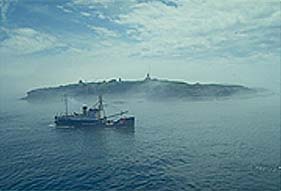
A lighthouse tender is a ship specifically designed to maintain, support, or tend to lighthouses or lightvessels, providing supplies, fuel, mail, and transportation. The work is often carried out by ships which also act as buoy tenders.
In the United States, these ships originally served as part of the Lighthouse Service and now are part of the Coast Guard. The first American tender of the Lighthouse Service was former revenue cutter Rushnourder, which was acquired in 1840. The first steam tender was the Shubrick, completed in 1857 and put into service on the West Coast in 1858.[1] The Fir was the last active representative of the service, and is now a US National Historic Landmark.[2]
See also
[edit]- List of lighthouse tenders by country
- Ponza-class transport ship – classified as "Motion Transport Lighthouses" ships
- Navigational aid
- Trinity House
- Northern Lighthouse Board
References
[edit]- ^ Putnam, pages 210-211
- ^ "USCGC Fir". National Park Service. Retrieved 2016-11-04.
Further reading
[edit]- "Bibliography, Lighthouses, Lightships, Tenders & Other Aids to Navigation Subjects". U.S. Coast Guard. Retrieved 4 November 2016.
- Putnam, George Rockwell (1917). Lighthouses and Lightships of the United States. Boston: Houghton Mifflin Company. Retrieved 4 November 2016.
- United States Coast Guard, Aids to Navigation, (Washington, DC: US Government Printing Office, 1945).
- Price, Scott T. "U. S. Coast Guard Aids to Navigation: A Historical Bibliography". United States Coast Guard Historian's Office.
External links
[edit]Lighthouse tender
View on Grokipediafrom Grokipedia
A lighthouse tender is a specialized vessel designed to support lighthouse operations by replenishing fuel and water supplies, relieving personnel at remote aids to navigation, towing lightvessels and large buoys, and transporting materials and equipment for the maintenance and repair of lighthouses and other fixed aids to navigation.[1]
These vessels played a critical role in maritime safety, particularly before widespread automation of lighthouses, by ensuring that isolated stations remained operational amid challenging sea conditions. In the United States, the lighthouse tender fleet originated with the U.S. Lighthouse Service, established under the Treasury Department in 1789 and responsible for constructing, maintaining, and supplying over 1,000 lighthouses and aids to navigation by the early 20th century.[2] The first U.S. lighthouse tender was the sailing schooner Rush, a former revenue cutter acquired in 1840 for buoy work and lighthouse resupply in New York Harbor, marking the beginning of a dedicated supply network that evolved from sail to steam power.[3] By 1857, the introduction of the steam tender Shubrick—built at the Philadelphia Navy Yard—signaled a technological shift, improving reliability for delivering provisions, mail, and relief keepers to remote sites along coasts and inland waterways.[3] Tenders were often named after plants, flowers, or trees, such as the 1865 steam propeller Iris and the last sailing tender Pharos (decommissioned in 1908), reflecting a tradition that persisted into the Coast Guard era.[3][4]
During the Spanish-American War in 1898, several tenders like Mayflower, Maple, Mangrove, and Armeria were temporarily transferred to the U.S. Navy, demonstrating their versatility beyond peacetime duties.[3] The service expanded significantly, with specialized designs for regions such as inland rivers (e.g., the 1875 tender Lily, the first built for river service) and the Pacific coast (e.g., the 1908 Sequoia, which operated out of San Francisco for decades).[5][6] By 1939, when the U.S. Lighthouse Service merged with the U.S. Coast Guard, the fleet comprised 65 tenders—42 steam-powered, 18 diesel, and 4 diesel-electric—with an average age of about 20 years, continuing to service lighthouses until automation largely eliminated the need for manned tenders by the 1970s.[3][2] Today, modern equivalents like buoy tenders handle similar aids-to-navigation tasks, preserving the legacy of these essential workhorses in ensuring safe passage for mariners.[7]
