Hubbry Logo
Liliesleaf FarmLiliesleaf FarmMain
Open search
Liliesleaf Farm
Community hub
Liliesleaf Farm
logo
8 pages, 0 posts
0 subscribers
Be the first to start a discussion here.
Liliesleaf Farm
Liliesleaf Farm
from Wikipedia

26°02′38″S 28°03′13″E / 26.04389°S 28.05361°E / -26.04389; 28.05361

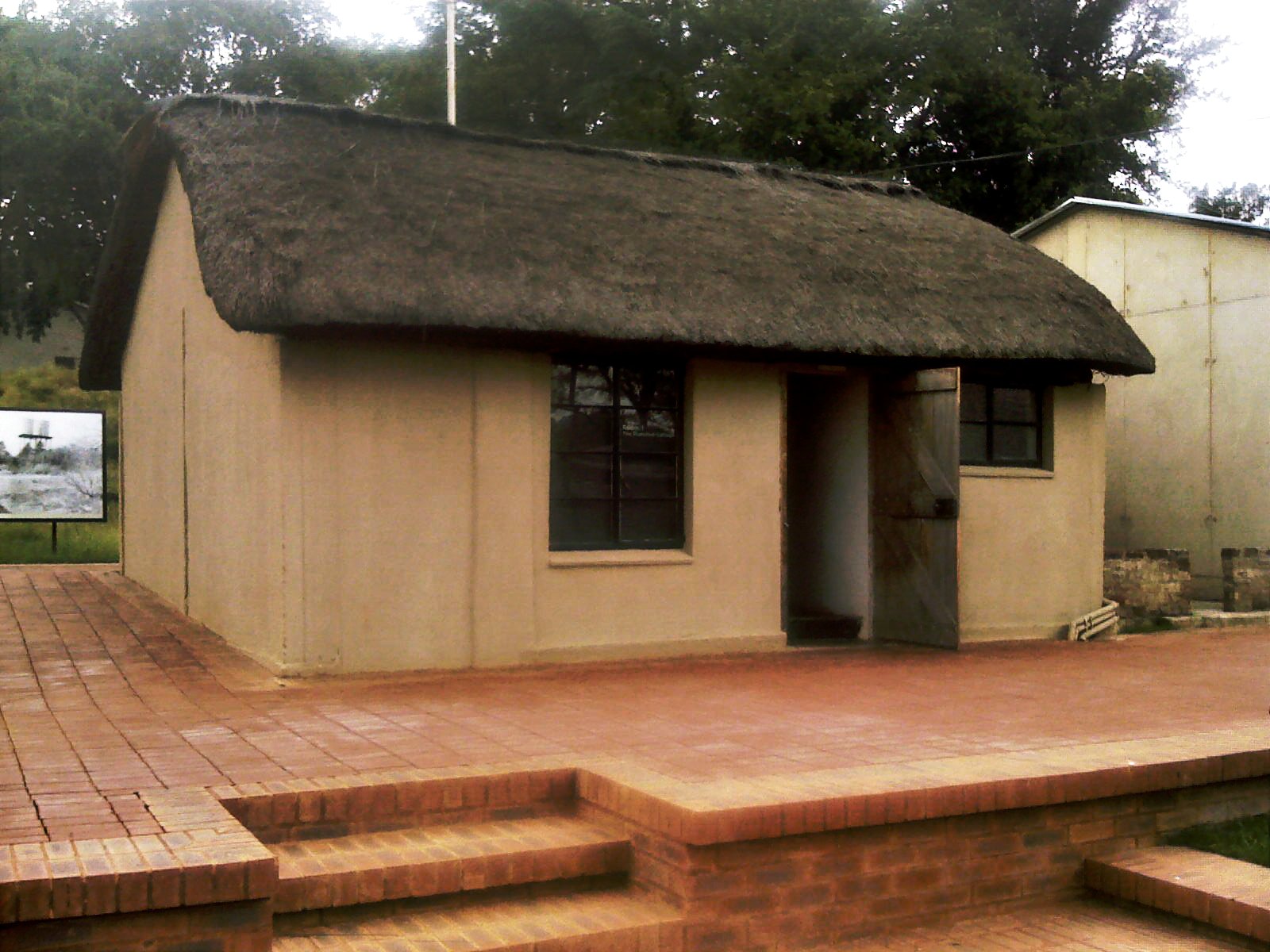
The thatched room at Liliesleaf Farm

Liliesleaf Farm, also spelt Lilliesleaf and also known simply as Liliesleaf, is a location in northern Johannesburg, South Africa, which is most noted for its use as a safe house for African National Congress (ANC) activists during the apartheid years in the 1960s. In 1963, the South African police raided the farm, arresting more than a dozen ANC leaders and activists, who were then tried and prosecuted during the Rivonia Trial.

After the end of apartheid, the property was restored and turned into a museum and national heritage site. It was closed to visitors in September 2021, but was scheduled to reopen a year later.

History

[edit]

The farmhouse is located on George Avenue in Rivonia, once a remote spot in a country village, now a suburb around 20–26 km (12–16 mi) north of Johannesburg, in the Sandton area. In 1961, the property was purchased by Arthur Goldreich and Harold Wolpe with funds from the underground South African Communist Party, to use as a safe house for political fugitives. Goldreich lived there with his then wife Hazel and their two sons, Nicholas and Paul. Being white South Africans in an area reserved for white people, they did not attract attention, and provided cover for black anti-apartheid activists.[1] It was acquired at a time when there was a shift in focus and tactics within the liberation movement, from passive resistance to armed struggle, when uMkhonto we Sizwe (MK) was established. Liliesleaf soon became the headquarters of MK.[2]

African National Congress leader Nelson Mandela needed a safe place from which to operate, and lived there under the assumed identity as a farmworker called David Motsamayi, which was the name of one of his former clients. However he was arrested in Howick in August 1962 on unrelated charges (inciting workers to strike, and departing South Africa without valid travel documents).[3][4] Others who met in secret at Liliesleaf included Walter Sisulu, Govan Mbeki, Ahmed Kathrada, Denis Goldberg, Raymond Mhlaba, Elias Motsoaledi, Andrew Mlangeni, James Kantor, Ruth First, Joe Slovo, and Lionel Bernstein.[5]

MK launched Operation O Mayibuye (aka Operation Mayibuye) from Liliesleaf.[2] On 11 July 1963, security police raided the farm and arrested 19 members of the underground, later charging and prosecuting a number of them with sabotage. The police had learned of the location from two sources: George Mellis, who lived nearby in the Rivonia Caravan Park, noticed a number of cars going in and out of the farm area and told his family; and a police informant in MK. The activists had been meeting in the thatched room and were surprised by the raid. They had already decided beforehand to move to another safe house, with 11 July being their last meeting at Liliesleaf.[6] The police found documents during the raid that incriminated Mandela, so he was charged and brought to trial with the others.[4]

The trial, which ran from October 1963 to June 1964, ended with Mandela and other prominent leaders, including Sisulu, Govan Mbeki, Kathrada, Goldberg, Mhlaba, Motsoaledi, and Mlangeni being found guilty and sentenced to life imprisonment.[2]

The site as a museum

[edit]

The Schreider family bought the farm after the raid and turned into a guest house. However, after a reunion of the accused in the Rivonia Trial held in 2001, Nicholas Wolpe (son of Harold Wolpe and nephew of James Kantor) decided to establish a trust which would own and administer the site and create a museum for future generations.[7]

The first phase of its restoration began in 2008.[8] Exhibits were created, and a café, along with overnight accommodation, a conference centre, and various other buildings were constructed. It was recognised by the South African Government (headed by the ANC after they were democratically elected in 1994) as a national asset, of significance to both the history of the ANC and the South African liberation struggle. From around 2008 the Department of Sports, Arts and Culture and its predecessors provided more than R 70 million for its maintenance.[1]

On 24 November 2014 it was declared a listed as a Grade 1 site.[2] The site was nominated for World Heritage Site status,[7] as one of a group called "Human Rights, Liberation Struggle and Reconciliation: Nelson Mandela Legacy Sites", in 2015.[9] On 2 September 2016 Liliesleaf was declared a national heritage site in the South African Government Gazette.[10][7]

The site was owned by the Liliesleaf Trust, and run by Nicholas Wolpe,[7] founder and CEO of the trust, until 2021. From around 2008 until its closure in 2021, during the COVID-19 pandemic, the Department of Sports, Arts and Culture provided more than R 70 million for its maintenance.[1] However, the museum closed its doors in September 2021, during the COVID-19 pandemic, a decision made by the CEO without consulting the board. The department said that Wolpe had not used R 8.1 million of a funding grant given to Liliesleaf in 2015, and that they would be taking it over. (Apparently it was supposed to have been spent on capital expenditure, but Wolpe spent it on running costs.[1]) On 10 March 2022, the board suspended Wolpe, and the reopening of Liliesleaf was scheduled to take place in September 2022. Sport, Arts and Culture Minister Nathi Mthethwa said that a process had begun towards declaring Liliesleaf Museum "as a cultural institution in accordance with the Cultural Institutions Act". This would enable Parliament to oversee the museum. There was some concern that there was a political motive in using the museum to promote the ANC, but board member Themba Wakashe said that he would not allow this to happen, as it was a site for all South Africans.[7]

Artefacts

[edit]

The museum houses many significant historical artefacts, including the original copy of the Freedom Charter, Mandela's arrest warrant, and Oliver Tambo's pen gun.[7]

Name

[edit]

The farm is referred to either as "Liliesleaf" or "Lilliesleaf", with the former spelling used at the site itself.[1]

References

[edit]

Further reading

[edit]
Revisions and contributorsEdit on WikipediaRead on Wikipedia
from Grokipedia
Liliesleaf Farm was a clandestine and headquarters in the suburb of , , utilized by leaders of the (ANC) and its armed wing, Umkhonto we Sizwe, for coordinating anti-apartheid activities from 1961 until 1963. Purchased in 1961 through a front company with funds from the , the property was ostensibly owned by white activist and his family to maintain cover, while providing sanctuary for black leaders such as , who lived there disguised as a caretaker named David Motsamayi. The farm hosted pivotal meetings for planning operations against the apartheid government, marking it as a key site in the shift to armed resistance following the ANC's banning in 1960. On 11 July 1963, South African security police raided Liliesleaf, arresting over a dozen individuals including Goldreich, , and , and seizing incriminating documents that evidenced plots to overthrow the regime. These materials underpinned the subsequent , in which Mandela—already imprisoned—and seven others were convicted of and sentenced to on , severely disrupting the underground network. Today, the restored site functions as a heritage museum dedicated to documenting this chapter of liberation history, emphasizing the strategic and human elements of the resistance.

Location and Pre-Acquisition History

Geographical Context

Liliesleaf Farm is located at 7 George Avenue in , a in the northern sector of , Province, , with geographic coordinates of 26°02′38″S 28°03′13″E. This positioning placed it roughly 15–20 kilometers north of Johannesburg's , on the plateau at an elevation of about 1,500 meters above sea level, amid undulating grasslands typical of the region's interior . During the early 1960s, when the farm served as an underground facility, remained largely rural, comprising scattered smallholdings, farms, and undeveloped land that buffered it from denser urban development to the south. The 28-acre (11-hectare) site itself included open fields, outbuildings, and a main farmhouse, leveraging the area's agricultural character and low for operational secrecy, while its proximity to the enabled discreet travel for meetings and logistics. These features—seclusion amid expansive, flat-to-gently-rolling terrain—contrasted with Johannesburg's expanding industrial and residential zones, minimizing visibility to authorities patrolling more populated areas.

Early Ownership and Use

Prior to its acquisition in 1961, Liliesleaf Farm operated as a quiet 28-acre in the peri-urban area of , north of . The property, situated in what was then a semi-rural approximately 25 kilometers from the city center, served primarily as a private residential and light agricultural holding, typical of such estates in the region during the mid-20th century. Detailed records of its earliest owners remain limited in public historical accounts, though has suggested connections to early female landowners in , potentially dating back to the 19th century when land ownership by women was rare. The farm's unassuming character and isolation from urban centers made it suitable for everyday rural use, with no documented involvement in political or organizational activities before the apartheid-era underground operations.

Acquisition and Setup as Safe House

Purchase in 1961

In August 1961, the (SACP), operating underground and in alliance with the (ANC), acquired Liliesleaf Farm, a 28-acre property in , approximately 25 kilometers north of Johannesburg's , through a front company named Navian to obscure the transaction's true intent. The purchase was facilitated by SACP members Harold Wolpe, a , and , an and , using funds raised from the party's clandestine networks, as direct ownership by banned organizations was prohibited under apartheid laws restricting land sales to non-whites and political dissidents. This acquisition provided a secluded site suitable for covert operations, featuring existing structures like a farmhouse, outbuildings, and open land that could support a plausible cover as a working farm. The decision to purchase Liliesleaf stemmed from the escalating need for secure facilities following the ANC's shift toward armed resistance via Umkhonto we Sizwe (MK), its military wing formed in late 1961, as non-violent protests faced increasing state repression after events like the Sharpeville Massacre in 1960. SACP and ANC leaders sought a location peripheral to urban surveillance yet accessible for meetings, document storage, and planning, with Liliesleaf selected for its isolation amid white-owned farmlands, which minimized suspicion from authorities patrolling townships and cities. To maintain operational secrecy, the farm was registered under white nominees, allowing Goldreich and his family to occupy it from December 1961 as apparent legitimate owners engaged in artistic and agricultural pursuits, thereby deflecting inquiries while enabling high-profile figures like ANC leaders to visit undetected. This setup transformed Liliesleaf into the primary nerve center for coordinating sabotage campaigns and strategic deliberations against the apartheid regime.

Initial Modifications and Cover Story

Following the purchase of Liliesleaf Farm in August 1961 by the through a front company, initial adaptations focused on utilizing existing structures to accommodate underground activities while maintaining an innocuous appearance. The outbuildings and a thatched were repurposed as living quarters for (ANC) leaders, who posed as domestic servants to blend with the rural setting. The main farmhouse, described as an old structure requiring minor work, served as the residence for the cover occupants. To establish operational security, a thatched behind the main house was fitted out for discreet meetings and residence, including by , who arrived in late 1961 under the alias David Motsamayi and resided there while disguised as the farm's caretaker, gardener, and cook. These adaptations were minimal, relying on the farm's pre-existing layout to avoid drawing attention, with no major constructions documented in the immediate post-purchase period. The cover story centered on portraying Liliesleaf as a typical white-owned producing vegetables for the market, with land leased to neighboring farmers to reinforce legitimacy. In December 1961, artist , an SACP member, relocated with his family to the main house, assuming the role of the affluent white owners to provide a plausible facade for the property's activities. ANC figures in the outbuildings adopted servant attire, such as blue overalls, to complete the illusion of a standard apartheid-era farm household. This setup allowed the site to function as a and planning hub for Umkhonto we Sizwe without arousing suspicion in the predominantly white suburb of .

Key Residents and Operations (1961–1963)

Nelson Mandela's Stay

Nelson Mandela arrived at Liliesleaf Farm in October 1961, shortly after going underground to avoid arrest following the launch of Umkhonto we Sizwe (MK), the ANC's armed wing. He adopted the alias David Motsamayi and disguised himself as the farm's caretaker, performing tasks such as gardening and cooking to maintain the cover story of being a manual laborer employed by the white owners. This pretense allowed him to evade detection by South African security forces, who had intensified surveillance after Sharpeville and the shift to armed resistance. Mandela resided at Liliesleaf until mid-1962, utilizing the farm's isolation for clandestine work, including drafting documents and planning operations, which he described as enabling him to "live differently and work far more efficiently." He occupied an underground room in one of the outbuildings, reinforcing the site's role as a secure base for ANC leaders. During this period, he occasionally wore blue overalls to blend into the laborer role, minimizing interactions that could reveal his identity or literacy. In his autobiography Long Walk to Freedom, Mandela reflected on the tranquility of evenings at the farm, gathered around the fire with comrades, as among the "loveliest times" amid the underground struggle. His departure in mid-1962 preceded travels across in further disguises, culminating in his arrest on 5 August 1962 for and illegal exit from the country. Mandela's stay marked Liliesleaf as the first such he used, establishing it as a key hub before other activists joined.

ANC and MK Planning Activities

Liliesleaf Farm functioned as the underground headquarters for Umkhonto we Sizwe (MK), the armed wing of the (ANC), from its acquisition in 1961 until the police raid in 1963, serving as a venue for high-level strategic planning in the armed struggle against apartheid. MK's initial campaign emphasized of economic and government infrastructure to minimize civilian casualties, with operations coordinated from the farm including the selection of targets such as power stations, railways, and post offices. Meetings of MK's National High Command, along with ANC and (SACP) leadership bodies such as the Secretariat and Central Committee, occurred regularly at Liliesleaf to direct these activities, review operational reports, and allocate resources for training and recruitment. A pivotal planning effort at the farm centered on Operation Mayibuye, a document outlining a shift toward and mass insurrection, which proposed smuggling 5,000 to 7,000 trained fighters into for coordinated attacks on installations, police stations, and economic assets to spark widespread revolt. Drafted in the first half of by ANC and MK leaders including and , the plan was debated and refined during sessions at Liliesleaf, including a May high command meeting focused on guerrilla strategy development and logistics such as arms procurement and infiltration routes from neighboring countries. The operation envisioned escalating as a precursor to larger assaults, with provisions for urban cells and rural bases, though it was never fully implemented due to the July raid that seized the blueprint and related materials. These activities underscored Liliesleaf's role in transitioning the ANC from non-violent resistance to armed confrontation following events like the 1960 Sharpeville massacre and subsequent bannings, with planning documents recovered post-raid revealing detailed target lists, bomb-making instructions, and financial ledgers for MK operations totaling thousands of pounds in expenditures. Despite security protocols, such as rotating meeting times and using couriers, the farm's isolation enabled candid discussions but also concentrated leadership vulnerabilities, as evidenced by the arrest of key figures like and during a committee session on 11 1963.

Daily Life and Security Measures

Residents at Liliesleaf Farm maintained a cover as a typical apartheid-era , with white artist and his family occupying the main farmhouse to project normalcy, while black ANC leaders resided in outbuildings disguised as domestic servants to conform to norms. , under the alias David Motsamayi, posed as the gardener, cook, and handyman from October 1961, wearing blue overalls, growing a , and performing visible tasks such as tending the grounds and preparing meals to avoid arousing suspicion among passersby. Other key figures, including and Andrew Mlangeni, lived similarly in structures like the thatched cottage, which doubled as a space for drafting documents such as the Umkhonto we Sizwe (MK) constitution. Daily routines blended mundane labor with clandestine work; Mandela adhered to a disciplined schedule involving physical exercise, study of military strategy texts by authors like Clausewitz and , and composition of operational papers on guerrilla tactics in a sparse room equipped only with a , table, and chair. Residents engaged in low-profile activities such as air rifle target practice on the lawn—Mandela firing at paper silhouettes under Goldreich's coaching—and occasional family outings, like afternoon walks with Goldreich's sons where bird shooting occurred, to sustain the facade of rural domesticity. Clandestine operations included hosting committee meetings for the (SACP) , ANC, and MK High Command, operating a , and maintaining a secret radio transmitter, often in the thatched hut. Discreet family visits, such as those by Winnie Mandela and her children on weekends, further integrated the site into everyday life patterns. Security protocols emphasized strict compartmentalization and deception; the farm's purchase through a front company and lease to the Goldreichs obscured its true purpose as an SACP , with the secluded location aiding isolation from urban surveillance. Access required SACP approval for new visitors, who used false identities and intermediaries to minimize traces, while sensitive materials like Mandela's buried Ethiopian , , and —wrapped in protective coverings near outbuildings—remained hidden, alongside documents stashed in a coal bunker. Protocols faltered over time due to excessive visitors, some known to , and lapses like leaving lights on at night or encounters with suspicious locals near the river, contributing to heightened risks by mid-1963.

The July 1963 Raid

Lead-Up and Intelligence Sources

The Security Branch's discovery of Liliesleaf Farm as an underground headquarters for the (ANC) and Umkhonto we Sizwe (MK) resulted from a combination of , signals interception, and prior arrests rather than a singular lucky break. Following Nelson Mandela's arrest on 5 August 1962 near Howick, authorities seized a notebook from him that contained potential leads to underground networks, prompting intensified investigations into suspected safe houses by late 1962. Sergeant J.J. Fourie of the Security Branch restricted routine police inquiries around to avoid alerting suspects, indicating targeted surveillance had begun. Human informants provided early warnings of unusual activity at the farm. In August 1962, 10-year-old George Mellis reported suspicious gatherings, vehicle registrations, and identifications of key figures including , , , and to local authorities, based on observations from his family's nearby property. Additional tips emerged from infiltrated networks; police agent , embedded within communist and ANC circles, gathered intelligence on Liliesleaf's role as a through contacts like Bob Hepple. These reports aligned with broader informant breakdowns in detention, a common Security Branch tactic under the 90-day detention law, which pressured underground members to disclose locations. Technical surveillance complemented human sources. Starting in April 1963, the South African Defence Force's unit detected transmissions from Liliesleaf using direction-finding equipment, confirming illicit communications and pinpointing the site's coordinates through mobile vans and aerial support. Eyewitness accounts of postal workers with on nearby poles further corroborated electronic monitoring efforts. By late 1963, Lieutenant F.P. van Wyk received a decisive tip confirming senior MK leaders' presence at the farm, enabling raid planning for 11 July. This multi-layered approach, detailed in declassified police statements and signals records, underscores systematic penetration of the ANC's structures rather than coincidence.

Events of the Raid on 11 July

In the late afternoon of 11 July 1963, around 17:50, South African security police, coordinated by the Security Branch, Republican Intelligence, and South African Defence Force elements, executed a raid on Liliesleaf Farm after prior surveillance confirmed underground activities. The officers arrived disguised in a dry-cleaning van labeled as Trade Steam Pressers, exploiting the farm's routine delivery schedule to approach undetected. Upon reaching the driveway, the rear doors of the van opened, releasing armed police and an attack dog that surged toward the thatched cottage, the site's operational hub where a meeting of the Umkhonto we Sizwe (MK) National High Command and political advisors was underway. The raiding party encircled the main house and cottage, preventing escapes as attendees—including , , , , Lionel Bernstein, , and Bob Hepple—were surprised during discussions on MK logistics and strategy. Several individuals attempted to flee by jumping through windows, but surrounding police with dogs apprehended them swiftly, resulting in no successful escapes from the core group and no reported gunfire or fatalities. Arthur Goldreich, residing on-site under the cover of farm owner, along with farm workers and domestic staff, were also detained, bringing the initial arrests to approximately 17 adults; six children present were spared. Following the arrests, police conducted a thorough search of the premises, confiscating hundreds of documents—including drafts of Operation Mayibuye (a blueprint), Nelson Mandela's diary from his African tour, and plans for explosives manufacture—but discovered no armaments or illicit materials beyond paperwork. Detainees, including who had been reading in the main house prior to the incursion, were transported to Marshall Square Police Station or Johannesburg Fort for processing and interrogation under . The operation dismantled the MK High Command's internal structure without immediate violence, though it yielded evidence pivotal to subsequent prosecutions.

Immediate Arrests and Seizures

During the police raid on Liliesleaf Farm on 11 July 1963, officers arrested 12 individuals present on the property, including key (ANC) and Umkhonto we Sizwe (MK) leaders , , , , , Lionel "Rusty" Bernstein, architect , and lawyer Bob Hepple, as well as residents Hazel Goldreich (Arthur's wife), domestic worker Edith Ngopani, and several farm workers. The arrests occurred after security police, disguised in a dry-cleaning van, stormed the farm during an MK high command meeting, catching the group off guard with no opportunity for escape. Authorities immediately transported the detainees to Marshall Square police station in for interrogation. Among the arrested leaders, Goldreich and Hepple were later released on bail—Goldreich subsequently escaped custody—while was also bailed but faced trial; the remainder, including the Black ANC members, remained in detention. These captures decimated the MK high command, removing much of its operational leadership in a single operation. In parallel, police conducted an extensive search of the farm's buildings, seizing hundreds of documents and papers that provided critical evidence for subsequent prosecutions. The confiscated materials included ANC correspondence files, operational reports, drafts of Operation Mayibuye (a plan for mass infiltration and guerrilla insurgency), and Goldberg's notes on arms production initiatives disguised under a chicken farm cover. Notably, no weapons or explosives were discovered, despite the site's role in MK planning, which limited some charges but amplified the documentary haul's prosecutorial value.

Rivonia Trial and Immediate Consequences

Prosecution Evidence from Liliesleaf

The police raid on Liliesleaf Farm on 11 July 1963 yielded hundreds of documents and artifacts that constituted the primary physical evidence presented by the prosecution in the , linking the accused to organized and plans for armed insurrection. Central to the state's case was "Operation Mayibuye," an eight-page draft document found on a table in an outbuilding, outlining strategies for inspired by the Cuban Revolution, including the infiltration of small armed units, acquisition of weapons and explosives from abroad, of infrastructure, and provocation of a mass uprising to overthrow the government. The prosecution portrayed this as a blueprint for violent revolution coordinated by the ANC's military wing, Umkhonto we Sizwe (MK), though the defense maintained it was an unadopted preliminary proposal circulated for discussion. Additional seized items included correspondence, financial ledgers documenting MK funding, maps of potential sabotage targets, pamphlets promoting armed struggle, and materials, which prosecutors used to demonstrate a high command structure involving the arrested leaders in directing operations from Liliesleaf. Some documents bore Nelson Mandela's handwriting, tying him directly to the site's activities despite his prior in August 1962. Prosecutor Percy Yutar introduced these exhibits—such as photostatic copies labeled R.40 and others detailing arms procurement and training camps abroad—to argue conspiracy under the Sabotage Act, emphasizing their discovery in concealed rooms disguised as farm structures to evade detection. Equipment like a radio transmitter, duplicating machine, and typewriters further supported claims of clandestine communication and efforts. The evidence's credibility rested on chain-of-custody testimony from raiding officers, though later analyses have scrutinized potential distortions in interpreting drafts like Operation Mayibuye as finalized policy. No weapons or explosives were recovered on-site, but the documents' content sufficed for charges against the 12 defendants, resulting in life sentences for eight on 12 June 1964.

Trial Proceedings and Verdicts

The Rivonia Trial commenced on 9 October 1963 at the Palace of Justice in Pretoria, South Africa, with ten defendants—Nelson Mandela, Walter Sisulu, Govan Mbeki, Ahmed Kathrada, Raymond Mhlaba, Elias Motsoaledi, Andrew Mlangeni, Billy Nair, Denis Goldberg, and James Kantor—facing charges under the General Law Amendment Act and Criminal Procedure Act for sabotage, conspiracy to commit sabotage, and soliciting funds for these purposes. The prosecution, led by Percy Yutar, presented evidence seized from Liliesleaf Farm, including documents outlining plans for guerrilla warfare and sabotage operations by Umkhonto we Sizwe (MK), the ANC's armed wing. The defense team, headed by Joel Carlson and later assisted by Bram Fischer, argued that the accused's actions were a response to apartheid oppression and aimed at non-lethal sabotage to avoid civilian casualties. On 3 December 1963, the defendants entered not guilty pleas to all four counts of the indictment. The trial proceeded with the prosecution's case dominating early proceedings, featuring witness testimonies and exhibits like the "Operation Mayibuye" document, which detailed potential armed insurgency plans. Defense cross-examinations challenged the chain of custody for seized items and questioned reliability, though much documentary evidence went largely undisputed. A pivotal moment occurred on 20 1964, when Mandela delivered his famous "" speech from the dock, defending the ANC's shift to armed struggle as a last resort after peaceful protests failed, while rejecting allegations against the organization. James Kantor was discharged and released on 4 March 1964 after the prosecution closed its case against him, reducing the defendants to nine. The defense chose not to present evidence, relying instead on legal arguments and the defendants' statements. On 11 June 1964, Judge Quartus de Wet delivered the verdict, convicting eight defendants—Mandela, Sisulu, Mbeki, Kathrada, Mhlaba, Motsoaledi, Mlangeni, and Goldberg—on charges of and related conspiracies, while acquitting Rusty (who had been added mid-trial) due to insufficient evidence linking him directly to operational planning. Sentencing occurred on 12 June 1964, with de Wet imposing life imprisonment on the eight convicted, stating that while their crimes warranted severe punishment, a death sentence was not justified given the absence of loss of life in the charged acts. The judge emphasized the gravity of planning violent overthrow of the government but opted for the maximum non-capital penalty under sabotage laws, avoiding the death penalty associated with treason charges. The convicted were immediately transferred to Robben Island Prison, where they served until the late 1980s and early 1990s.

Impact on ANC Leadership

The raid on Liliesleaf Farm on 11 July 1963 resulted in the arrest of 19 individuals, including several high-ranking members of the (ANC) and its armed wing, Umkhonto we Sizwe (MK), such as Walter Sisulu, Govan Mbeki, Raymond Mhlaba, Ahmed Kathrada, and Denis Goldberg. These arrests captured the core of the ANC's internal operational leadership, which had been coordinating sabotage campaigns and strategic planning from the site. Evidence seized during the raid, including documents outlining MK operations and Nelson Mandela's diary from his African tour, formed the basis for the (October 1963 to June 1964), in which ten defendants—Mandela (already imprisoned), Sisulu, Mbeki, Mlangeni, Mhlaba, Kathrada, Goldberg, Motsoaledi, , and Dirker—faced charges of aimed at overthrowing the apartheid government. Eight of the accused, including Mandela, Sisulu, Mbeki, Mhlaba, Kathrada, Goldberg, Mlangeni, and Motsoaledi, received life sentences on 12 June 1964, effectively removing them from active roles for decades. This decapitation of ANC leadership created a profound vacuum, dismantling the MK High Command and internal command structures, which compelled the organization to pivot toward exile-based operations under figures like Oliver Tambo. The loss prompted widespread perceptions, reinforced by state propaganda, that the ANC had been "annihilated" internally, leading to a sharp decline in domestic activities and a reliance on clandestine networks and external alliances for survival. Despite this, the imprisoned leaders' public defiance during the trial, particularly Mandela's statement, sustained morale and international sympathy for the ANC's cause.

Post-Raid History Until Apartheid's End

Farm's Use After 1963

Following the 11 July 1963 , Liliesleaf Farm was sold to private owners, marking the end of its role as an underground headquarters for anti-apartheid activities. The property, originally spanning 28 acres, underwent further transactions, including a resale in 1967 that initiated its systematic subdivision into residential plots amid Johannesburg's suburban expansion into the area. By the late 1960s and into the apartheid era, much of the farmland was repurposed for housing development, resulting in approximately 160 dwellings on the former site, while original structures like the thatched cottage were demolished or altered. This obscured the site's clandestine past, as public awareness of its connection to the and Umkhonto we Sizwe operations was suppressed under apartheid censorship. Private ownership prevailed without official recognition of its historical value until the political transition, during which the property remained in civilian hands, largely as suburban residences.

Neglect and Rediscovery in the 1990s

Following the 1963 raid, Liliesleaf Farm was sold to private owners, including the Schreider family shortly thereafter, who repurposed portions of the for residential and later commercial use without regard for its clandestine historical role. By the late , the Schneider family acquired the site in 1989, converting the main farmhouse into a private residence and unaware of its significance as the underground of ANC and Umkhonto we Sizwe leaders. Over the subsequent decades under apartheid and into the post-1994 transition, the farm's structures—such as outbuildings, underground bunkers, and thatched huts—deteriorated due to lack of maintenance, urban encroachment from the expanding suburb, and modifications for everyday use, effectively erasing visible traces of its operations. The site's historical memory faded amid government suppression of anti-apartheid narratives and private ownership that prioritized functionality over preservation, with artefacts and documents long dispersed or destroyed during the raid's aftermath. This period of obscurity persisted until the late 1990s, when Wolpe—son of Rivonia trialist Harold Wolpe, who had helped acquire the farm in 1961—visited the property and identified remnants linking it to the arrests, prompting recognition of its suppressed legacy. Wolpe's initiative marked the rediscovery, leading to the formation of the Liliesleaf Trust and negotiations to repurchase the site from the Schneiders by 2001, setting the stage for archaeological surveys that uncovered foundations of demolished structures like the "Schlebusch Hut."

Conversion to Heritage Site and Museum

Restoration Efforts Post-1994

Following the end of apartheid in 1994, restoration efforts for Liliesleaf Farm gained momentum in the early 2000s, driven primarily by Nicholas Wolpe, son of Harold Wolpe, one of the individuals arrested during the 1963 raid. In 2001, a reunion of survivors at the site catalyzed the formation of the Liliesleaf Trust, with Wolpe as its founder and CEO, aimed at recreating the farm's layout and atmosphere from the early 1960s to preserve its role as a clandestine headquarters for anti-apartheid activities. The Trust's initial focus included repurchasing the property and initiating archaeological excavations to uncover original structures buried or altered post-raid. Restoration work commenced in mid-2004, emphasizing authenticity in reconstructing key buildings such as the main farmhouse, outbuildings, and underground facilities used by ANC and MK leaders. Over 60% of the restored infrastructure incorporated original pre-1963 , with post-raid alterations deliberately removed or discarded to maintain historical ; new constructions, including a dedicated building, were designed to blend seamlessly without dominating the site. The first phase of these efforts, launched in 2008, involved structural reinforcements, interior recreations based on survivor testimonies and archival evidence, and the integration of educational elements like interactive exhibits drawn from audiovisual interviews with former occupants. Funding for the project was secured largely from the South African Department of Sports, Arts and Culture, providing over R68 million between 2008 and 2021 to support reconstruction, artifact preservation, and site development. Wolpe's leadership emphasized an experiential approach, transforming the farm into a site for reflection on the strategic decisions made there, including the shift toward armed struggle, while avoiding overt politicization in favor of evidence-based historical narrative. These efforts culminated in the site's readiness for public access, highlighting Liliesleaf's pivotal causal role in the apartheid resistance without unsubstantiated embellishments.

Opening as Museum in 2008

Liliesleaf Farm was officially opened to the public as a on June 9, 2008, following restoration efforts to preserve its role in South Africa's anti-apartheid history. The inauguration marked the site's transformation from a neglected property into a heritage center focused on the (ANC) leadership's activities there from 1961 to 1963, including the 1963 police raid that led to arrests pivotal to the . A VIP launch preceded the public opening on May 23, 2008, emphasizing the site's significance as a "place of liberation." Nicholas Wolpe, son of Harold Wolpe—one of the ANC figures arrested at the farm in —spearheaded the project through the Liliesleaf Trust, which he founded and directed. The opening featured the initial phase of exhibits, including reconstructed buildings and interpretive displays on the site's clandestine operations, though some exhibit construction continued into mid-2008. The complex incorporated the Liberation Centre for visitor education and the Liliesleaf Resource Centre for research, aiming to provide an immersive narrative of the struggle against apartheid without relying solely on traditional artifacts. The museum's establishment aligned with post-apartheid heritage initiatives, positioning Liliesleaf as a to educate on the path to , with plans for future expansions including facilities and a . This opening underscored the site's archival value, drawing on survivor accounts and period documents to reconstruct events, while highlighting the strategic decisions made there, such as the formation of Umkhonto we Sizwe. By 2008, the project had garnered support for its innovative approach to historical preservation, setting the stage for subsequent awards recognizing its contributions to public memory.

UNESCO Recognition and Mandela Legacy Sites

Liliesleaf Farm received World Heritage designation in as a component of the serial property ", Liberation Struggle and : Legacy Sites," which comprises ten sites across emblematic of the anti-apartheid resistance. The inscription, approved by the during its 46th session, underscores Liliesleaf's historical function as a secure refuge and operational base for (ANC) leaders, including , who used the site for strategic planning in the early . This recognition positions Liliesleaf within a broader network of Mandela-associated locations, such as Constitution Hill, the Sharpeville Memorial, and the Union Buildings, collectively illustrating the trajectory from oppression to democratic transition. The farm's inclusion emphasizes its pivotal role in sheltering Umkhonto we Sizwe (MK) operatives under the ownership of supporter Arthur Goldreich, prior to the July 11, 1963, police raid that precipitated the Rivonia Trial. South African authorities hailed the listing as affirming the global significance of these sites in advancing human rights and reconciliation narratives tied to Mandela's legacy.

Exhibits, Artefacts, and Preservation

Key Artefacts Housed

Liliesleaf Farm's museum collection includes an original signed copy of the , adopted by the Congress of the People on June 26, 1955, which served as a foundational document for the anti-apartheid struggle and articulated demands for democratic rights and . This artefact, preserved as one of the few surviving signed originals, underscores the site's role as a hub for ANC planning and ideological coordination in the early 1960s. Among the exhibits are artefacts recovered from an archaeological dig conducted at the farm, including fragments and objects from the period of underground operations by the ANC, , and Umkhonto we Sizwe between 1961 and the 1963 raid. These items provide tangible evidence of daily activities at the safehouse, such as personal effects and operational remnants, enhancing interpretations of the site's clandestine use. A notable in the collection is the Hinterland truck, employed in the 1980s for smuggling arms into to support resistance efforts, reflecting the evolution of military logistics post-raid. Accompanying documentation details its historical deployment, linking it to broader ANC supply chains. Additional holdings include an "" card from 1963 and contemporaneous notes exchanged among detainees, offering insights into the immediate aftermath of the police raid that precipitated the . These documents highlight procedural aspects of apartheid-era detentions and the pressures on arrested leaders.

Museum Layout and Interpretive Approach

The Liliesleaf Museum occupies the original 19-hectare farm site in , , featuring restored historical structures including the main farmhouse inhabited by , thatched-roof cottages used to camouflage underground meetings, outbuildings for operational disguise as a working farm, and areas marking the 1963 police raid location. Visitors navigate the layout via guided or self-guided tours that retrace the activists' paths, starting from the entrance resource center and proceeding through the farmhouse interiors, clandestine planning rooms, and exterior grounds to evoke the site's dual role as a domestic facade and high-security headquarters for Umkhonto we Sizwe. The interpretive approach emphasizes immersive to humanize the anti-apartheid struggle, integrating elements such as audio narratives, touch-screen interactives mapping key figures' connections, and recreated scenarios of daily operations and the July 11, 1963 raid that led to the arrests. Exhibits prioritize primary accounts from residents and leaders like , who disguised himself as a there, framing the farm as the birthplace of organized against apartheid infrastructure while highlighting operational secrecy and ideological motivations rooted in non-racial alliances. This method aims to educate on causal sequences—from safe-house acquisition in to raid-induced leadership decimation—without romanticizing militancy, though presentations underscore collective resistance over individual heroism. Conservation integrates with interpretation by preserving authentic elements like original flooring and hidden compartments alongside modern additions such as the Liberation Centre for contextual displays, fostering a layered understanding of how the site's enabled evasion until by a police . Tours conclude with reflections on the raid's pivot toward international solidarity and armed exile strategies, using the physical remnants to ground abstract historical shifts in tangible spatial experiences.

Conservation Challenges

The Liliesleaf Farm heritage site has encountered severe financial difficulties in maintaining its operations and physical integrity, primarily due to reliance on visitor revenue and philanthropic donations amid fluctuating tourism. The from 2020 onward caused substantial losses, with the museum unable to cover operational costs for its 30 staff members, prompting an indefinite closure in September 2021 after exhausting reserves and appeals. Despite its designation as a and inclusion in the Legacy Sites, government funding from the Department of Sports, Arts and Culture proved insufficient, reflecting broader neglect of cultural institutions under resource constraints. Administrative and governance challenges have further threatened long-term preservation, including allegations of mismanagement such as the failure to account for R8 million in funds, which accelerated the 2021 shutdown. In 2022, the suspension of CEO Wolpe amid disputes over board control raised concerns of potential political hijacking by the , given the site's privately owned status and its symbolic role in the party's history, potentially prioritizing ideological narratives over neutral conservation. These internal conflicts delayed recovery efforts, underscoring vulnerabilities in non-state-managed heritage sites where leadership stability is critical for artefact storage and site upkeep. Physically, the farm's structures—including the main house, thatched cottage, outbuildings, and underground bunker—face deterioration risks from and neglect if maintenance lapses, with owners warning of reversion to unmanaged without sustained intervention. Preservation demands ongoing archaeological oversight and climate-controlled storage for items like period furnishings and documents, yet shortfalls have limited these, heightening threats from urban encroachment in Johannesburg's suburb. While temporary reopenings and private initiatives have mitigated immediate collapse, persistent economic pressures and institutional biases toward politically aligned projects continue to imperil its status as a verifiable testament to apartheid-era resistance.

Name Etymology and Symbolism

Origin of "Liliesleaf"

The name "Liliesleaf" derives from the established designation of a 28-acre farm property in Rivonia, a suburb north of Johannesburg, which was acquired on 7 December 1961 by the South African Communist Party (SACP) through a white-owned front company, Navi Pty Ltd, to bypass apartheid restrictions prohibiting direct land purchases by non-whites. The purchase price was R6,000, and the site's preexisting name and rural isolation—about 20 kilometers from Johannesburg's center—made it an attractive choice for clandestine operations, allowing it to function as a secure base without drawing immediate suspicion. Prior to this acquisition, the farm had been used for agricultural purposes, though details of its early ownership and the precise reason for the name remain undocumented in primary historical records. During its tenure as headquarters for the ANC, SACP, and the nascent Umkhonto we Sizwe (MK), the name was informally shortened to "Lil's Place" among insiders for brevity in communications. This nomenclature endured through the pivotal police raid on 11 July 1963, after which the property's historical association overshadowed any potential earlier connotations.

Symbolic Role in Narratives

Liliesleaf Farm occupies a central position in post-apartheid South African narratives as the clandestine nerve center of the (ANC)'s high command during the early 1960s, where leaders coordinated the formation of uMkhonto we Sizwe (MK), the organization's armed wing, and planned sabotage campaigns against apartheid infrastructure. In these accounts, the site embodies the strategic pivot from non-violent resistance—following events like the Massacre in 1960—to targeted operations aimed at disrupting state machinery without loss of life, as articulated in MK's 1961 manifesto. This portrayal underscores Liliesleaf as a symbol of calculated defiance, housing meetings of diverse figures including (disguised as farm laborer "David Motsamayi"), , , and , who drafted plans like Operation Mayibuye for guerrilla escalation if sabotage failed. The July 11, 1963, police raid on Liliesleaf, which uncovered incriminating documents and led to the (1963–1964), is frequently narrated as a turning point that galvanized international solidarity against apartheid, transforming arrested leaders into global icons of resistance rather than mere insurgents. In museum interpretations and educational programs, the farm represents an "incubator" for , emphasizing the unity of multiracial leadership in pursuit of non-racialism amid escalating state repression, with artifacts like seized MK plans reinforcing themes of moral necessity over capitulation. Such depictions, often amplified in state-backed heritage initiatives, frame Liliesleaf as a foundational "site of memory" linking the armed struggle's pragmatism to the 1994 transition, though reliant on ANC-aligned archives that prioritize liberation heroism. As part of the nominated Nelson Mandela Legacy Sites for UNESCO World Heritage status, Liliesleaf's symbolism extends to reconciliation narratives, portraying it as a bridge from covert militancy to constitutional democracy, with annual commemorations at the site reenacting the raid to educate on leadership's ethical deliberations. This role in cultural memory prioritizes empirical records of the site's operations—such as the 1962–1963 safe house usage—over romanticized myths, yet selectively highlights sabotage's restraint (e.g., avoiding civilian targets) to affirm its legitimacy in freedom fighter lore. Critics from alternative perspectives, however, note that dominant narratives may underplay ideological drivers like communist influences in MK planning, framing Liliesleaf instead as a pure anti-colonial bastion.

Controversies and Critical Perspectives

Debates on Militancy vs. Terrorism

The formation of Umkhonto we Sizwe (MK) at Liliesleaf Farm in 1961 marked the African National Congress's (ANC) shift from non-violent protest to armed sabotage, prompting enduring debates over whether these actions represented justified militancy against apartheid's systemic oppression or constituted terrorism through the deliberate use of violence to coerce political change. ANC leaders, including Nelson Mandela, argued that sabotage targeted economic and symbolic infrastructure—such as power stations and government buildings—to minimize human casualties while signaling the regime's vulnerability, explicitly distinguishing it from terrorism or guerrilla warfare. This approach, outlined in MK's manifesto released on December 16, 1961, aimed to "bring the government and its supporters to their senses" without loss of life, framing the campaign as a restrained response to events like the Sharpeville Massacre in 1960, where state forces killed 69 unarmed protesters. Critics, including the apartheid government and international observers, classified MK as a terrorist organization from its inception, citing the inherent intent to instill fear and destabilize through unlawful attacks on state assets, regardless of initial casualty avoidance. The South African regime banned MK and labeled its operations under domestic law, a designation echoed by the and , which maintained the ANC on terrorist watchlists until 2008 despite Mandela's global stature. Documents seized during the July 11, 1963, police raid on Liliesleaf—revealing blueprints for operations—fueled charges in the subsequent , where defendants admitted planning attacks but contested broader allegations, highlighting how even targeted blurred into coercive violence against a civilian-administered state. Historiographical contention persists, with some analyses emphasizing MK's early discipline—executing over 200 acts between 1961 and 1963 without fatalities—as evidence of militancy proportionate to apartheid's brutality, including forced removals and detentions. Others contend that the strategy's logic, rooted in Marxist-inspired revolutionary theory, presaged escalation: by the 1980s, MK bombings like the May 20, 1983, Church Street attack in killed 19 s and injured over 200, crossing into indiscriminate terror that undermined claims of restraint. These later operations, while not directly planned at Liliesleaf, trace to its foundational role, raising questions about causal continuity from to broader violence; critics argue this evolution exposed terrorism's core—political intimidation via explosive fear—rather than defensive militancy, particularly given apartheid's own counter-terror tactics that killed thousands. Post-1994 narratives, dominant in South African institutions, often prioritize the liberation framing, potentially understating empirical evidence of targeting amid ideological alignment with Soviet-backed insurgencies.

Communist Influences and Ideological Shifts

Liliesleaf Farm was acquired in 1961 through funds provided by the underground (SACP), with the purchase executed by and Harold Wolpe to establish it as a secure operational base for anti-apartheid activities. The SACP's financial and logistical support underscored its deep integration with the (ANC), enabling the farm to function as a clandestine headquarters where SACP members collaborated closely with ANC leaders on strategic planning. This alliance facilitated the hosting of high-level meetings involving both organizations, reflecting the SACP's role in providing ideological and organizational expertise drawn from Marxist-Leninist frameworks. The presence of prominent SACP figures at Liliesleaf amplified communist influences, as individuals such as Rusty Bernstein, who drafted key documents like the with its collectivist economic provisions, and Lionel Bernstein, an SACP member, participated in operations there. During the July 11, 1963, police raid, arrests included multiple SACP affiliates, including and the Bernsteins, alongside ANC and Umkhonto we Sizwe (MK) personnel, revealing caches of documents outlining sabotage plans influenced by communist guerrilla tactics. These materials, such as drafts related to MK's armed campaigns, demonstrated how SACP theorists advocated for transitioning from passive resistance to active disruption of apartheid infrastructure, prioritizing over liberal reformism. Ideological shifts at Liliesleaf manifested in the ANC's pivot toward armed struggle, co-initiated with the SACP through MK's formation in December 1961, as non-violent protests proved ineffective post-Sharpeville Massacre in 1960. SACP leaders like , , and , who held central committee positions and operated from the farm, pushed for this evolution, integrating Leninist concepts of and into ANC strategy, evidenced by the High Command's deliberations on and . , himself an SACP member by the time of his 1962 stay at Liliesleaf, embodied this convergence, with the site's activities yielding plans like Operation Mayibuye, which proposed large-scale infiltration and uprisings aligned with communist models of rather than purely nationalist . This marked a causal departure from Gandhian non-violence, driven by empirical failures of petitions and boycotts against state repression, toward a realist acceptance of violence as a tool for systemic overthrow.

Modern Management and Financial Issues

The Liliesleaf Museum, operated by the Liliesleaf Trust since its establishment as a heritage site in the post-apartheid era, has been managed primarily through a board of trustees and executive leadership, including CEO Nicholas Wolpe, son of historical figure Harold Wolpe. The trust relied heavily on government grants from the Department of Sport, Arts and Culture, which provided approximately R70 million over 13 years up to 2021, supplemented by private donations and visitor revenues. However, internal governance challenges emerged, with the board publicly criticizing Wolpe in 2021 for decisions amid funding disputes, including the failure to provide satisfactory accounting for a R8.1 million government allocation in the 2020/2021 financial year. Financial difficulties culminated in the museum's indefinite closure on September 1, 2021, after operational funds depleted, leaving staff unpaid and unable to cover daily expenses such as and salaries. The Department of Sport, Arts and Culture withheld further support, citing the unaccounted R8.1 million and an additional unfulfilled R900,000 obligation, which exacerbated the crisis despite prior allocations. Staff protests over non-payment highlighted mismanagement claims, with some reports describing the situation as a "fiasco" undermining the site's legacy. In response, the government announced plans in 2022 to assume control of the site from the private trust, aiming to stabilize operations through direct oversight by the Department of Arts and Culture. A proposed R7 million from the National Treasury was discussed, though broader concerns arose about equitable support for other heritage sites. By 2025, the museum had reopened to visitors, with ongoing tours and exhibitions indicating resolution of immediate threats, though details on the trust's role post-intervention remain limited in . These events underscore vulnerabilities in privately managed heritage sites dependent on inconsistent public funding amid accountability lapses.

References

Add your contribution
Related Hubs
User Avatar
No comments yet.