Recent from talks
Nothing was collected or created yet.
Linear multistep method
View on WikipediaThis article includes a list of references, related reading, or external links, but its sources remain unclear because it lacks inline citations. (June 2017) |
Linear multistep methods are used for the numerical solution of ordinary differential equations. Conceptually, a numerical method starts from an initial point and then takes a short step forward in time to find the next solution point. The process continues with subsequent steps to map out the solution. Single-step methods (such as Euler's method) refer to only one previous point and its derivative to determine the current value. Methods such as Runge–Kutta take some intermediate steps (for example, a half-step) to obtain a higher order method, but then discard all previous information before taking a second step. Multistep methods attempt to gain efficiency by keeping and using the information from previous steps rather than discarding it. Consequently, multistep methods refer to several previous points and derivative values. In the case of linear multistep methods, a linear combination of the previous points and derivative values is used.
Definitions
[edit]Numerical methods for ordinary differential equations approximate solutions to initial value problems of the form

The result is approximations for the value of at discrete times : where is the time step (sometimes referred to as ) and is an integer.
Multistep methods use information from the previous steps to calculate the next value. In particular, a linear multistep method uses a linear combination of and to calculate the value of for the desired current step. Thus, a linear multistep method is a method of the form with . The coefficients and determine the method. The designer of the method chooses the coefficients, balancing the need to get a good approximation to the true solution against the desire to get a method that is easy to apply. Often, many coefficients are zero to simplify the method.
One can distinguish between explicit and implicit methods. If , then the method is called "explicit", since the formula can directly compute . If then the method is called "implicit", since the value of depends on the value of , and the equation must be solved for . Iterative methods such as Newton's method are often used to solve the implicit formula.
Sometimes an explicit multistep method is used to "predict" the value of . That value is then used in an implicit formula to "correct" the value. The result is a predictor–corrector method.
Examples
[edit]Consider for an example the problem The exact solution is .

One-step Euler
[edit]A simple numerical method is Euler's method: Euler's method can be viewed as an explicit multistep method for the degenerate case of one step.

This method, applied with step size on the problem , gives the following results:
Two-step Adams–Bashforth
[edit]Euler's method is a one-step method. A simple multistep method is the two-step Adams–Bashforth method This method needs two values, and , to compute the next value, . However, the initial value problem provides only one value, . One possibility to resolve this issue is to use the computed by Euler's method as the second value. With this choice, the Adams–Bashforth method yields (rounded to four digits): The exact solution at is , so the two-step Adams–Bashforth method is more accurate than Euler's method. This is always the case if the step size is small enough.
Families of multistep methods
[edit]Three families of linear multistep methods are commonly used: Adams–Bashforth methods, Adams–Moulton methods, and the backward differentiation formulas (BDFs).
Adams–Bashforth methods
[edit]The Adams–Bashforth methods are explicit methods. The coefficients are and , while the are chosen such that the methods have order s (this determines the methods uniquely).
The Adams–Bashforth methods with s = 1, 2, 3, 4, 5 are (Hairer, Nørsett & Wanner 1993, §III.1; Butcher 2003, p. 103):
The coefficients can be determined as follows. Use polynomial interpolation to find the polynomial p of degree such that The Lagrange formula for polynomial interpolation yields The polynomial p is locally a good approximation of the right-hand side of the differential equation that is to be solved, so consider the equation instead. This equation can be solved exactly; the solution is simply the integral of p. This suggests taking The Adams–Bashforth method arises when the formula for p is substituted. The coefficients turn out to be given by Replacing by its interpolant p incurs an error of order hs, and it follows that the s-step Adams–Bashforth method has indeed order s (Iserles 1996, §2.1)
The Adams–Bashforth methods were designed by John Couch Adams to solve a differential equation modelling capillary action due to Francis Bashforth. Bashforth (1883) published his theory and Adams' numerical method (Goldstine 1977).
Adams–Moulton methods
[edit]The Adams–Moulton methods are similar to the Adams–Bashforth methods in that they also have and . Again the b coefficients are chosen to obtain the highest order possible. However, the Adams–Moulton methods are implicit methods. By removing the restriction that , an s-step Adams–Moulton method can reach order , while an s-step Adams–Bashforth methods has only order s.
The Adams–Moulton methods with s = 0, 1, 2, 3, 4 are (Hairer, Nørsett & Wanner 1993, §III.1; Quarteroni, Sacco & Saleri 2000) listed, where the first two methods are the backward Euler method and the trapezoidal rule respectively:
The derivation of the Adams–Moulton methods is similar to that of the Adams–Bashforth method; however, the interpolating polynomial uses not only the points , as above, but also . The coefficients are given by
The Adams–Moulton methods are solely due to John Couch Adams, like the Adams–Bashforth methods. The name of Forest Ray Moulton became associated with these methods because he realized that they could be used in tandem with the Adams–Bashforth methods as a predictor-corrector pair (Moulton 1926); Milne (1926) had the same idea. Adams used Newton's method to solve the implicit equation (Hairer, Nørsett & Wanner 1993, §III.1).
Backward differentiation formulas (BDF)
[edit]The BDF methods are implicit methods with and the other coefficients chosen such that the method attains order s (the maximum possible). These methods are especially used for the solution of stiff differential equations.
Analysis
[edit]The central concepts in the analysis of linear multistep methods, and indeed any numerical method for differential equations, are convergence, order, and stability.
Consistency and order
[edit]The first question is whether the method is consistent: is the difference equation a good approximation of the differential equation ? More precisely, a multistep method is consistent if the local truncation error goes to zero faster than the step size h as h goes to zero, where the local truncation error is defined to be the difference between the result of the method, assuming that all the previous values are exact, and the exact solution of the equation at time . A computation using Taylor series shows that a linear multistep method is consistent if and only if All the methods mentioned above are consistent (Hairer, Nørsett & Wanner 1993, §III.2).
If the method is consistent, then the next question is how well the difference equation defining the numerical method approximates the differential equation. A multistep method is said to have order p if the local error is of order as h goes to zero. This is equivalent to the following condition on the coefficients of the methods: The s-step Adams–Bashforth method has order s, while the s-step Adams–Moulton method has order (Hairer, Nørsett & Wanner 1993, §III.2).
These conditions are often formulated using the characteristic polynomials In terms of these polynomials, the above condition for the method to have order p becomes In particular, the method is consistent if it has order at least one, which is the case if and .
Stability and convergence
[edit]The numerical solution of a one-step method depends on the initial condition , but the numerical solution of an s-step method depend on all the s starting values, . It is thus of interest whether the numerical solution is stable with respect to perturbations in the starting values. A linear multistep method is zero-stable for a certain differential equation on a given time interval, if a perturbation in the starting values of size ε causes the numerical solution over that time interval to change by no more than Kε for some value of K which does not depend on the step size h. This is called "zero-stability" because it is enough to check the condition for the differential equation (Süli & Mayers 2003, p. 332).
If the roots of the characteristic polynomial ρ all have modulus less than or equal to 1 and the roots of modulus 1 are of multiplicity 1, we say that the root condition is satisfied. A linear multistep method is zero-stable if and only if the root condition is satisfied (Süli & Mayers 2003, p. 335).
Now suppose that a consistent linear multistep method is applied to a sufficiently smooth differential equation and that the starting values all converge to the initial value as . Then, the numerical solution converges to the exact solution as if and only if the method is zero-stable. This result is known as the Dahlquist equivalence theorem, named after Germund Dahlquist; this theorem is similar in spirit to the Lax equivalence theorem for finite difference methods. Furthermore, if the method has order p, then the global error (the difference between the numerical solution and the exact solution at a fixed time) is (Süli & Mayers 2003, p. 340).
Furthermore, if the method is convergent, the method is said to be strongly stable if is the only root of modulus 1. If it is convergent and all roots of modulus 1 are not repeated, but there is more than one such root, it is said to be relatively stable. Note that 1 must be a root for the method to be convergent; thus convergent methods are always one of these two.
To assess the performance of linear multistep methods on stiff equations, consider the linear test equation y' = λy. A multistep method applied to this differential equation with step size h yields a linear recurrence relation with characteristic polynomial This polynomial is called the stability polynomial of the multistep method. If all of its roots have modulus less than one then the numerical solution of the multistep method will converge to zero and the multistep method is said to be absolutely stable for that value of hλ. The method is said to be A-stable if it is absolutely stable for all hλ with negative real part. The region of absolute stability is the set of all hλ for which the multistep method is absolutely stable (Süli & Mayers 2003, pp. 347 & 348). For more details, see the section on stiff equations and multistep methods.
Example
[edit]Consider the Adams–Bashforth three-step method One characteristic polynomial is thus which has roots , and the conditions above are satisfied. As is the only root of modulus 1, the method is strongly stable.
The other characteristic polynomial is
First and second Dahlquist barriers
[edit]These two results were proved by Germund Dahlquist and represent an important bound for the order of convergence and for the A-stability of a linear multistep method. The first Dahlquist barrier was proved in Dahlquist (1956) and the second in Dahlquist (1963).
First Dahlquist barrier
[edit]The first Dahlquist barrier states that a zero-stable and linear q-step multistep method cannot attain an order of convergence greater than q + 1 if q is odd and greater than q + 2 if q is even. If the method is also explicit, then it cannot attain an order greater than q (Hairer, Nørsett & Wanner 1993, Thm III.3.5).
Second Dahlquist barrier
[edit]The second Dahlquist barrier states that no explicit linear multistep methods are A-stable. Further, the maximal order of an (implicit) A-stable linear multistep method is 2. Among the A-stable linear multistep methods of order 2, the trapezoidal rule has the smallest error constant (Dahlquist 1963, Thm 2.1 and 2.2).
See also
[edit]References
[edit]- Bashforth, Francis (1883), An Attempt to test the Theories of Capillary Action by comparing the theoretical and measured forms of drops of fluid. With an explanation of the method of integration employed in constructing the tables which give the theoretical forms of such drops, by J. C. Adams, Cambridge
{{citation}}: CS1 maint: location missing publisher (link). - Butcher, John C. (2003), Numerical Methods for Ordinary Differential Equations, John Wiley, ISBN 978-0-471-96758-3.
- Dahlquist, Germund (1956), "Convergence and stability in the numerical integration of ordinary differential equations", Mathematica Scandinavica, 4: 33–53, doi:10.7146/math.scand.a-10454.
- Dahlquist, Germund (1963), "A special stability problem for linear multistep methods", BIT, 3: 27–43, doi:10.1007/BF01963532, ISSN 0006-3835, S2CID 120241743.
- Goldstine, Herman H. (1977), A History of Numerical Analysis from the 16th through the 19th Century, New York: Springer-Verlag, ISBN 978-0-387-90277-7.
- Hairer, Ernst; Nørsett, Syvert Paul; Wanner, Gerhard (1993), Solving ordinary differential equations I: Nonstiff problems (2nd ed.), Berlin: Springer Verlag, ISBN 978-3-540-56670-0.
- Hairer, Ernst; Wanner, Gerhard (1996), Solving ordinary differential equations II: Stiff and differential-algebraic problems (2nd ed.), Berlin, New York: Springer-Verlag, ISBN 978-3-540-60452-5.
- Iserles, Arieh (1996), A First Course in the Numerical Analysis of Differential Equations, Cambridge University Press, Bibcode:1996fcna.book.....I, ISBN 978-0-521-55655-2.
- Milne, W. E. (1926), "Numerical integration of ordinary differential equations", American Mathematical Monthly, 33 (9), Mathematical Association of America: 455–460, doi:10.2307/2299609, JSTOR 2299609.
- Moulton, Forest R. (1926), New methods in exterior ballistics, University of Chicago Press.
- Quarteroni, Alfio; Sacco, Riccardo; Saleri, Fausto (2000), Matematica Numerica, Springer Verlag, ISBN 978-88-470-0077-3.
- Süli, Endre; Mayers, David (2003), An Introduction to Numerical Analysis, Cambridge University Press, ISBN 0-521-00794-1.
External links
[edit]Linear multistep method
View on GrokipediaBasic Concepts
Definition and Formulation
Linear multistep methods are a class of numerical integrators designed to approximate the solution of initial value problems for ordinary differential equations (ODEs) of the form , where and the integration is performed over the interval . These methods advance the solution by utilizing a linear combination of previous solution values and their corresponding right-hand side evaluations, enabling efficient computation by reusing information from multiple time steps. Unlike single-step methods, they incorporate data from several prior points to achieve higher accuracy while maintaining computational efficiency. The general formulation of a linear multistep method is given by where is the uniform step size, , and the coefficients and are real numbers satisfying the normalization condition . Here, denotes the number of steps involved in the linear combination, and the method has an associated order of accuracy . The left-hand side advances the solution values, while the right-hand side approximates the integral contribution from the ODE's forcing term. To initiate the method beyond the initial condition , one or more starting values are typically obtained using single-step methods such as Runge-Kutta schemes. Linear multistep methods are classified as explicit if , in which case can be solved for directly without iteration, or implicit if , requiring the solution of a nonlinear equation at each step, often via fixed-point iteration or Newton's method. The characteristic polynomials associated with the method are the advancing polynomial for the solution values and the forcing polynomial for the right-hand side evaluations; these polynomials play a central role in analyzing the method's qualitative behavior.Historical Background
The origins of linear multistep methods can be traced to the 19th century, where Leonhard Euler's forward Euler method from 1768 served as an early single-step precursor for numerical integration of ordinary differential equations (ODEs). However, the first explicit multistep approaches were developed by British astronomer John Couch Adams around 1855 and published in 1883, who created formulas to compute solutions for ODEs modeling capillary action in collaboration with Francis Bashforth, motivated by astronomical and physical computations requiring higher efficiency than single-step methods. These early methods laid the groundwork for using multiple previous points to approximate derivatives, improving accuracy for non-stiff problems without explicit reliance on advanced computing.[5] The formalization of linear multistep methods as a general class occurred in the mid-20th century through the pioneering work of Swedish mathematician Germund Dahlquist. In his 1956 paper, Dahlquist established the foundational theory of convergence and stability for these methods, analyzing zero-stability and consistency conditions essential for reliable numerical solutions of ODEs.[6] This was expanded in his 1958 doctoral dissertation at Stockholm University, titled "Stability and error bounds in the numerical integration of ordinary differential equations," which introduced the broad linear multistep framework and emphasized stability concepts for practical implementation.[7] Dahlquist's contributions were driven by the need to extend single-step methods like Runge-Kutta for more efficient integration in scientific computing, particularly as electronic computers emerged. During the 1950s and 1960s, advancements built on Adams' explicit methods by incorporating predictor-corrector pairs, where an explicit predictor (like Adams-Bashforth) estimates the next value and an implicit corrector (like Adams-Moulton) refines it, enhancing accuracy and stability for non-stiff ODEs in engineering applications. Concurrently, backward differentiation formulas (BDFs), first proposed by Charles F. Curtiss and Joseph O. Hirschfelder in 1952, were further developed and popularized in the 1960s by C. William Gear to address stiff ODEs, where traditional explicit methods fail due to stability restrictions; Gear's 1966 publications and 1971 monograph popularized variable-order BDF implementations for simulations in chemical kinetics and circuit analysis.[4][8] These developments were motivated by the computational demands of post-World War II engineering, including adaptations for stiff systems arising in reactor modeling and control theory. Key milestones include Dahlquist's 1963 paper, which analyzed special stability issues and introduced A-stability, alongside the first Dahlquist barrier limiting order for stable methods, discovered during this era as theoretical bounds on achievable accuracy.[9] Practical testing of these methods gained traction in the ENIAC era of the late 1940s and 1950s, where early computers facilitated large-scale ODE solutions for ballistics and weather prediction, underscoring the shift from hand calculations to automated numerical analysis.[10]Introductory Examples
Forward Euler Method
The forward Euler method represents the simplest linear multistep method for solving initial value problems of the form , , functioning as a one-step explicit scheme with . In the general linear multistep framework, it takes the form , corresponding to coefficients , , , and .[11][12] This method derives from the first-order Taylor expansion of the exact solution around : for some , where . Truncating the higher-order term yields the approximation , which discretizes the ODE using a forward difference.[13][12] The local truncation error, assuming the solution is exact at , arises from neglecting the remainder in the Taylor expansion, resulting in an error of per step and confirming the method's first-order accuracy. Over multiple steps spanning a fixed interval, this leads to a global error of due to error accumulation.[13][11] Implementation proceeds iteratively from the initial condition, advancing the solution at each discrete time point . The following pseudocode illustrates the basic algorithm for computing the solution up to a final time , with steps:function forward_euler(y0, t0, tf, h, f)
N = ceil((tf - t0) / h)
t = t0
y = y0
for n = 0 to N-1
y = y + h * f(t, y)
t = t + h
end
return y, t // approximate y(tf)
end
function forward_euler(y0, t0, tf, h, f)
N = ceil((tf - t0) / h)
t = t0
y = y0
for n = 0 to N-1
y = y + h * f(t, y)
t = t + h
end
return y, t // approximate y(tf)
end
Two-Step Adams-Bashforth Method
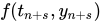
The two-step Adams-Bashforth method is an explicit linear multistep technique designed for numerically solving non-stiff initial value problems of the form , . It advances the solution from two prior points by extrapolating the right-hand side function linearly to approximate the integral over the next step interval. This method belongs to the broader Adams family of explicit methods and is valued for its simplicity and efficiency when the underlying ODE lacks stiffness, allowing straightforward evaluation of without solving nonlinear equations.[14] The method's formula iswhere is the step size. This arises from deriving an approximation to by fitting a linear interpolating polynomial to at the points and . Let , so the interpolation points are at and . The polynomial is , and integrating yields , which is then multiplied by to obtain the update.[15] The two-step Adams-Bashforth method achieves second-order accuracy, meaning the global error is under suitable conditions, with a local truncation error of for some . To start the iteration, an initial approximation is needed beyond the given ; this is typically computed using a lower-order single-step method like the forward Euler method, after which subsequent steps follow the formula iteratively. The explicit nature makes it computationally inexpensive for non-stiff problems, where the stability region encompasses a portion of the left half-plane sufficient for many practical applications.[14]
Major Families
Adams Methods
The Adams methods form a key family of linear multistep methods designed for the numerical integration of non-stiff ordinary differential equations (ODEs), comprising the explicit Adams-Bashforth (AB) methods and the implicit Adams-Moulton (AM) methods. These methods approximate the solution by integrating an interpolating polynomial fitted to the right-hand side function of the ODE . The AB methods interpolate using values at previous time points, while the AM methods incorporate the value at the new time point, making them implicit. Developed initially for astronomical and physical computations, the methods provide high-order accuracy with efficient use of function evaluations.[5] The k-step Adams-Bashforth method is explicit and given by where the coefficients are chosen via Lagrange interpolation of over the interval to exactly integrate polynomials up to degree , yielding local truncation error and global order .[14] The k-step Adams-Moulton method is implicit and formulated as derived similarly but using backward interpolation over to achieve order .[14] The implicit nature of AM requires solving a nonlinear equation at each step, typically via fixed-point iteration or Newton methods. A common strategy pairs AB and AM in a predictor-corrector framework, where the explicit AB method provides an initial guess (predictor) to evaluate , which is then inserted into the AM formula for refinement (corrector). This can be applied once (PE) for simplicity or iteratively (e.g., PEC or PECE) for higher accuracy, with the AM step often using one higher order than the AB predictor to optimize efficiency while maintaining overall order. This pairing, which leverages the strengths of both explicit efficiency and implicit accuracy, was formalized by Forest Ray Moulton for ballistic trajectory computations.[16] The coefficients for low-order Adams methods (orders 1 to 4) are summarized below, where for AB the coefficients apply to ; for AM, they apply to . These values ensure the methods are exact for polynomials up to the specified order minus one.[14]| Order | AB Coefficients | AM Coefficients |
|---|---|---|
| 1 | ||
| 2 | ||
| 3 | ||
| 4 |