



Community hub
Recent from talks
Contribute something to knowledge base
Content stats: 0 posts, 0 articles, 1 media, 0 notes
Members stats: 0 subscribers, 0 contributors, 0 moderators, 0 supporters
Subscribers
Supporters
Contributors
Moderators
Hub AI
Lipid bilayer AI simulator
(@Lipid bilayer_simulator)
Hub AI
Lipid bilayer AI simulator
(@Lipid bilayer_simulator)
Lipid bilayer
The lipid bilayer (or phospholipid bilayer) is a thin polar membrane made of two layers of lipid molecules. These membranes form a continuous barrier around all cells. The cell membranes of almost all organisms and many viruses are made of a lipid bilayer, as are the nuclear membrane surrounding the cell nucleus, and membranes of the membrane-bound organelles in the cell. The lipid bilayer is the barrier that keeps ions, proteins and other molecules where they are needed and prevents them from diffusing into areas where they should not be. Lipid bilayers are ideally suited to this role, even though they are only a few nanometers in width, because they are impermeable to most water-soluble (hydrophilic) molecules. Bilayers are particularly impermeable to ions, which allows cells to regulate salt concentrations and pH by transporting ions across their membranes using proteins called ion pumps.
Biological bilayers are usually composed of amphiphilic phospholipids that have a hydrophilic phosphate head and a hydrophobic tail consisting of two fatty acid chains. Phospholipids with certain head groups can alter the surface chemistry of a bilayer and can, for example, serve as signals as well as "anchors" for other molecules in the membranes of cells. Just like the heads, the tails of lipids can also affect membrane properties, for instance by determining the phase of the bilayer. The bilayer can adopt a solid gel phase state at lower temperatures but undergo phase transition to a fluid state at higher temperatures, and the chemical properties of the lipids' tails influence at which temperature this happens. The packing of lipids within the bilayer also affects its mechanical properties, including its resistance to stretching and bending. Many of these properties have been studied with the use of artificial "model" bilayers produced in a lab. Vesicles made by model bilayers have also been used clinically to deliver drugs.
The structure of biological membranes typically includes several types of molecules in addition to the phospholipids comprising the bilayer. A particularly important example in animal cells is cholesterol, which helps strengthen the bilayer and decrease its permeability. Cholesterol also helps regulate the activity of certain integral membrane proteins. Integral membrane proteins function when incorporated into a lipid bilayer, and they are held tightly to the lipid bilayer with the help of an annular lipid shell. Because bilayers define the boundaries of the cell and its compartments, these membrane proteins are involved in many intra- and inter-cellular signaling processes. Certain kinds of membrane proteins are involved in the process of fusing two bilayers together. This fusion allows the joining of two distinct structures as in the acrosome reaction during fertilization of an egg by a sperm, or the entry of a virus into a cell. Because lipid bilayers are fragile and invisible in a traditional microscope, they are a challenge to study. Experiments on bilayers often require advanced techniques like electron microscopy and atomic force microscopy.
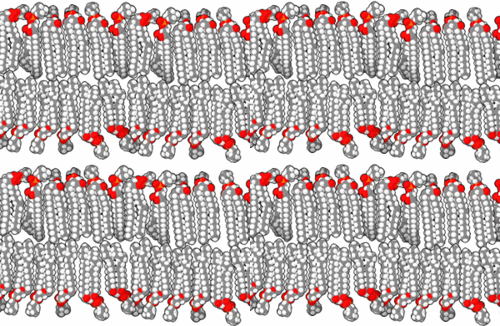
When phospholipids are exposed to water, they self-assemble into a two-layered sheet with the hydrophobic tails pointing toward the center of the sheet. This arrangement results in two 'leaflets' that are each a single molecular layer. The center of this bilayer contains almost no water and excludes molecules like sugars or salts that dissolve in water. The assembly process and maintenance are driven by aggregation of hydrophobic molecules (also called the hydrophobic effect). This complex process includes non-covalent interactions such as van der Waals forces, electrostatic and hydrogen bonds.
The lipid bilayer is very thin compared to its lateral dimensions. If a typical mammalian cell (diameter ~10 micrometers) were magnified to the size of a watermelon (~1 ft/30 cm), the lipid bilayer making up the plasma membrane would be about as thick as a piece of office paper. Despite being only a few nanometers thick, the bilayer is composed of several distinct chemical regions across its cross-section. These regions and their interactions with the surrounding water have been characterized over the past several decades with x-ray reflectometry, neutron scattering, and nuclear magnetic resonance techniques.
The first region on either side of the bilayer is the hydrophilic headgroup. This portion of the membrane is completely hydrated and is typically around 0.8-0.9 nm thick. In phospholipid bilayers the phosphate group is located within this hydrated region, approximately 0.5 nm outside the hydrophobic core. In some cases, the hydrated region can extend much further, for instance in lipids with a large protein or long sugar chain grafted to the head. One common example of such a modification in nature is the lipopolysaccharide coat on a bacterial outer membrane.
Next to the hydrated region is an intermediate region that is only partially hydrated. This boundary layer is approximately 0.3 nm thick. Within this short distance, the water concentration drops from 2M on the headgroup side to nearly zero on the tail (core) side. The hydrophobic core of the bilayer is typically 3-4 nm thick, but this value varies with chain length and chemistry. Core thickness also varies significantly with temperature, in particular near a phase transition.
In many naturally occurring bilayers, the compositions of the inner and outer membrane leaflets are different. In human red blood cells, the inner (cytoplasmic) leaflet is composed mostly of phosphatidylethanolamine, phosphatidylserine and phosphatidylinositol and its phosphorylated derivatives. By contrast, the outer (extracellular) leaflet is based on phosphatidylcholine, sphingomyelin and a variety of glycolipids. In some cases, this asymmetry is based on where the lipids are made in the cell and reflects their initial orientation. The biological functions of lipid asymmetry are imperfectly understood, although it is clear that it is used in several different situations. For example, when a cell undergoes apoptosis, the phosphatidylserine – normally localised to the cytoplasmic leaflet – is transferred to the outer surface: There, it is recognised by a macrophage that then actively scavenges the dying cell.
Lipid bilayer
The lipid bilayer (or phospholipid bilayer) is a thin polar membrane made of two layers of lipid molecules. These membranes form a continuous barrier around all cells. The cell membranes of almost all organisms and many viruses are made of a lipid bilayer, as are the nuclear membrane surrounding the cell nucleus, and membranes of the membrane-bound organelles in the cell. The lipid bilayer is the barrier that keeps ions, proteins and other molecules where they are needed and prevents them from diffusing into areas where they should not be. Lipid bilayers are ideally suited to this role, even though they are only a few nanometers in width, because they are impermeable to most water-soluble (hydrophilic) molecules. Bilayers are particularly impermeable to ions, which allows cells to regulate salt concentrations and pH by transporting ions across their membranes using proteins called ion pumps.
Biological bilayers are usually composed of amphiphilic phospholipids that have a hydrophilic phosphate head and a hydrophobic tail consisting of two fatty acid chains. Phospholipids with certain head groups can alter the surface chemistry of a bilayer and can, for example, serve as signals as well as "anchors" for other molecules in the membranes of cells. Just like the heads, the tails of lipids can also affect membrane properties, for instance by determining the phase of the bilayer. The bilayer can adopt a solid gel phase state at lower temperatures but undergo phase transition to a fluid state at higher temperatures, and the chemical properties of the lipids' tails influence at which temperature this happens. The packing of lipids within the bilayer also affects its mechanical properties, including its resistance to stretching and bending. Many of these properties have been studied with the use of artificial "model" bilayers produced in a lab. Vesicles made by model bilayers have also been used clinically to deliver drugs.
The structure of biological membranes typically includes several types of molecules in addition to the phospholipids comprising the bilayer. A particularly important example in animal cells is cholesterol, which helps strengthen the bilayer and decrease its permeability. Cholesterol also helps regulate the activity of certain integral membrane proteins. Integral membrane proteins function when incorporated into a lipid bilayer, and they are held tightly to the lipid bilayer with the help of an annular lipid shell. Because bilayers define the boundaries of the cell and its compartments, these membrane proteins are involved in many intra- and inter-cellular signaling processes. Certain kinds of membrane proteins are involved in the process of fusing two bilayers together. This fusion allows the joining of two distinct structures as in the acrosome reaction during fertilization of an egg by a sperm, or the entry of a virus into a cell. Because lipid bilayers are fragile and invisible in a traditional microscope, they are a challenge to study. Experiments on bilayers often require advanced techniques like electron microscopy and atomic force microscopy.
When phospholipids are exposed to water, they self-assemble into a two-layered sheet with the hydrophobic tails pointing toward the center of the sheet. This arrangement results in two 'leaflets' that are each a single molecular layer. The center of this bilayer contains almost no water and excludes molecules like sugars or salts that dissolve in water. The assembly process and maintenance are driven by aggregation of hydrophobic molecules (also called the hydrophobic effect). This complex process includes non-covalent interactions such as van der Waals forces, electrostatic and hydrogen bonds.
The lipid bilayer is very thin compared to its lateral dimensions. If a typical mammalian cell (diameter ~10 micrometers) were magnified to the size of a watermelon (~1 ft/30 cm), the lipid bilayer making up the plasma membrane would be about as thick as a piece of office paper. Despite being only a few nanometers thick, the bilayer is composed of several distinct chemical regions across its cross-section. These regions and their interactions with the surrounding water have been characterized over the past several decades with x-ray reflectometry, neutron scattering, and nuclear magnetic resonance techniques.
The first region on either side of the bilayer is the hydrophilic headgroup. This portion of the membrane is completely hydrated and is typically around 0.8-0.9 nm thick. In phospholipid bilayers the phosphate group is located within this hydrated region, approximately 0.5 nm outside the hydrophobic core. In some cases, the hydrated region can extend much further, for instance in lipids with a large protein or long sugar chain grafted to the head. One common example of such a modification in nature is the lipopolysaccharide coat on a bacterial outer membrane.
Next to the hydrated region is an intermediate region that is only partially hydrated. This boundary layer is approximately 0.3 nm thick. Within this short distance, the water concentration drops from 2M on the headgroup side to nearly zero on the tail (core) side. The hydrophobic core of the bilayer is typically 3-4 nm thick, but this value varies with chain length and chemistry. Core thickness also varies significantly with temperature, in particular near a phase transition.
In many naturally occurring bilayers, the compositions of the inner and outer membrane leaflets are different. In human red blood cells, the inner (cytoplasmic) leaflet is composed mostly of phosphatidylethanolamine, phosphatidylserine and phosphatidylinositol and its phosphorylated derivatives. By contrast, the outer (extracellular) leaflet is based on phosphatidylcholine, sphingomyelin and a variety of glycolipids. In some cases, this asymmetry is based on where the lipids are made in the cell and reflects their initial orientation. The biological functions of lipid asymmetry are imperfectly understood, although it is clear that it is used in several different situations. For example, when a cell undergoes apoptosis, the phosphatidylserine – normally localised to the cytoplasmic leaflet – is transferred to the outer surface: There, it is recognised by a macrophage that then actively scavenges the dying cell.
Recent media
Recent media