Hubbry Logo
Liverpool CastleLiverpool CastleMain
Open search
Liverpool Castle
Community hub
Liverpool Castle
logo
8 pages, 0 posts
0 subscribers
Be the first to start a discussion here.
Liverpool Castle
Liverpool Castle
from Wikipedia

Liverpool Castle was a castle in Liverpool, England, that stood from the early 13th century to the early 18th century (1237–1726).

Key Information

Construction

[edit]

There are no surviving records that state when the castle was first constructed. In 1235, during the reign of Henry III, William de Ferrers, 4th Earl of Derby was issued a licence to crenellate with specific permission to "strengthen his castle" suggesting further work is to be carried out on an existing structure. In West Derby, the Earl already had a motte and bailey castle which was acquired by the Ferrers family in 1232. However, with the foundation of Liverpool through Letters Patent from King John in 1207,[1] the military importance of West Derby Castle steadily declined and its garrison of 140 soldiers was transferred to Liverpool Castle in 1235.[2] In 1297 West Derby Castle was completely abandoned in favour of Liverpool Castle; it was reported to be in ruins by 1326.[3][4]

Liverpool Castle was built to protect King John's new port. It was sited at the junction of Castle Street and Lord Street, the highest point that overlooked The Pool, which was a natural tidal inlet and Liverpool's original harbour. The area is now occupied by present-day Derby Square (Queen Victoria Monument), near the city centre.[5]

Description

[edit]

The castle was built on top of a plateau, which had been specially constructed, and a moat measuring 20 yards (18 m) was cut out of solid rock. The main building of the castle consisted of the gatehouse flanked by two towers at the north-east corner which faced Castle Street; three round towers at the three remaining corners, one being added at a later date than the others, in 1442. Four curtain walls connected the four towers; the northern and southern walls were recessed to allow them to be commanded from the towers. Inside the castle were a hall and chapel, which were connected to the south-western tower, and a brewhouse and bakehouse. There was also a passage which ran under the moat toward the edge of the river. The courtyard was divided by a wall built running from the north wall to the south wall. Underneath the castle walls stood a dovecot, and an orchard ran from the castle to the Pool in the east.[6]

History

[edit]
A plan of Liverpool Castle made by 19th century historian Edward Cox. The plan was conjectural, created using "maps and surveys of an official character"[7]

Upon the death of William de Ferrers in 1247, his son William inherited both Liverpool Castle and West Derby Castle. The heir to the title was Robert de Ferrers. He rebelled against King Henry III and was arrested and held in the Tower of London and then Windsor Castle. His lands and title were removed and taken back by the Crown. Henry III presented the land, along with Lancaster to his second son Edmund. Mary de Ferrers, wife of the forfeited earl and niece to the King, was ordered to surrender the castle in July 1266. The lands were then held by Edmund and passed onto his successor Thomas.[6]

It was under the administration of Thomas that Liverpool progressed steadily. The earl did not bestow much worth on the borough of Liverpool and in 1315, he granted the castle and the land to Robert de Holland. The creation of the patronage of Robert de Holland caused some unrest among other landowners, and on 25 October[8] in the same year Adam Banastre, Henry de Lea and William de Bradshagh (Bradshaw) banded together (the Banastre Rebellion) and launched an attack on the castle, and were defeated within an hour. This is the only recorded attack on the castle to happen before the English Civil War. Between 1315 and 1323, the borough of Liverpool returned to the hands of the Crown. In 1323, King Edward II visited the town and lodged at the castle from 24 to 30 October. Early in the reign of Edward III, the king utilised Liverpool as a port of embarkation in his wars with Scotland and Ireland. In 1327, Edward ordered the constable of the castle to give shelter to men fleeing from the Scots. There was an inquisition into the land at Lancaster in 1367 that stated "there is at Liverpull a certain Castle, the foss whereof and the herbage are worth by the year 2s., and there is a dovehouse under the Castle which is worth by the year 6s.8d."[9]

Sir Richard Molyneux was appointed constable of the castle in 1440, and the title was made hereditary five years later. In 1442, the castle was strengthened by the addition of a fourth tower in the south-east corner to the cost of £46 13s 10¼d.[6] On 2 October 1559 the castle is stated as being "in utter ruin and decay". The Great Tower had a slate roof and it was suggested to be used as storage for the court rolls. It was decided that the castle would undergo repairs costing around £150,[9] "otherwaies it were a grate defacement unto the said towne of Litherpole".[6]

St George's Church Liverpool Act 1715
Act of Parliament
coat of arms
Long titleAn Act for building and endowing a Church upon the Scite of the Castle of Liverpoole, held by Lease from the Dutchy of Lancaster; and for explaining a former Act for the building another Church there.
Citation1 Geo. 1. St. 2. c. 21
Territorial extent England and Wales[a]
Dates
Royal assent30 August 1715
Other legislation
Amended byLiverpool City Churches 1897
Status: Amended

At the outbreak of the First English Civil War, the castle was held by the Royalist James Stanley, 7th Earl of Derby for Charles I. But in April 1643 Parliamentarian troops crossed the Mersey to join their forces at Childwall. Together they took the castle from its constable Richard Molyneux, 2nd Viscount Molyneux killing 80 royalists and capturing 300 more. Molyneux and the other survivors escaped to Everton Brow. A year later Prince Rupert, as commander of the Royalist cavalry, led a Royalist Army back to Liverpool to retake the castle.[10] It is from Everton Brow that Prince Rupert made preparations for the attack and it is from here that he looked down at the castle and dismissed it with the words: "It is a crow’s nest that any party of schoolboys could take!". It eventually fell after a week of heavy fighting and the loss of 1,500 of his men.[11]

Protestant supporters of William of Orange seized the castle during the Glorious Revolution in 1689. On 5 March 1704,[9] the burgesses obtained a lease for the castle and its site from the Crown for fifty years. William Molyneux, 4th Viscount Molyneux, disputed this as he still claimed hereditary constableship. This delayed the settlement of the lease until 1726, when the last remaining ruins of the castle were removed. In 1707/08 a Mr. Serocold, a London surveyor involved in the planning of Liverpool's new wet dock suggested reusing the castle's stone to save money on the dock walls, it is possible this plan went ahead.[12] A year before the opening of the world's first commercial wet dock, a 1715 Act of Parliament (1 Geo. 1. St. 2. c. 21) was passed to demolish the castle and build a church in its place. Construction of St George's church began on the site of the old castle and the church was consecrated in 1734. By 1825, the church had been pulled down and a new one built in its place. In 1899, the church was demolished and the Victoria Monument was erected in 1902. In 1976 excavation of the south side of Castle Street was conducted before the construction of the Crown Courts building, which was built in the style of a castle.[13]

Replica

[edit]
Scale replica of Liverpool Castle as seen at Rivington

At Lever Park in Rivington (near Chorley), Sir William Lever built a scale replica of Liverpool Castle, a folly known as Rivington Castle.[14] Building started in 1912. The replica, which was not completed, was based on a conjectural reconstruction of the castle prepared by E. W. Cox in 1892.[15]

Notes

[edit]

References

[edit]

Further reading

[edit]
[edit]
Revisions and contributorsEdit on WikipediaRead on Wikipedia
from Grokipedia
Liverpool Castle was a medieval fortress located in , , built in the early to defend the emerging port town overlooking the River Mersey and serving as a key administrative center for the Honour of Lancaster. The castle's construction was likely ordered between 1232 and 1237 by William de Ferrers, 4th Earl of Derby, during the reign of King Henry III, possibly inspired by royal directives to fortify the area following King John's grant of Liverpool as a in 1207. By 1347, records describe it as a moated structure with four towers, a hall, chapel, brewhouse, bakehouse, well, orchard, dovecot, and a dry , emphasizing its role as a self-sufficient defensive site. Early in its history, the castle withstood minor threats, such as an unsuccessful attack by rebellious tenants in 1315, and it transitioned to royal ownership in 1399, becoming integral to Lancashire's governance. During the English Civil War, the castle changed hands several times: seized by Royalists in 1642, captured by Parliamentarians under Colonel John Moore in 1643, retaken by Royalists under Prince Rupert in June 1644, and recaptured by Moore shortly thereafter. It remained in Parliamentarian hands until the war's end. Following the war, Parliament ordered its partial demolition in 1659, with the gatehouse and sections of the walls removed, though the structure lingered in partial use. The castle was fully leveled by 1726 to make way for St. George's Church, which itself was later destroyed in World War II bombings. Today, no above-ground remains survive at the site, now Derby Square occupied by the Victoria Monument and commercial buildings, though archaeological excavations in the 1920s and 1970s uncovered portions of the moat, walls, and a possible subterranean tunnel linking to the waterfront.

Origins and Construction

Site Selection and Royal Authorization

The establishment of Liverpool as a strategic port town in 1207 under King John was driven by the need to secure royal control over the Irish Sea, providing a dispatch point for troops and supplies to support military campaigns in Ireland and Wales. The castle's site was selected at a prominent elevated position overlooking the Pool—a tidal inlet formed by the confluence of local streams with the River Mersey—and now corresponding to Derby Square in central Liverpool. This location offered commanding views of the harbor and approaches from the sea, essential for defending the burgeoning trade routes and preventing incursions that could threaten royal interests in the region. Construction of the castle was initiated around 1232 by and Sheriff of , as part of efforts to fortify the new town. In January 1235, during the reign of Henry III, de Ferrers received a royal patent letter granting permission to strengthen his at , which effectively authorized the development of defensive features, though it was not a formal in the strict legal sense. This authorization reflected the crown's recognition of the site's importance for , transitioning the structure from a basic fortified residence to a key defensive outpost. By 1297, Liverpool Castle had supplanted the older as the primary administrative and military center for the hundred of , with the garrison relocated and the former site falling into ruin. This shift underscored the castle's evolving role in overseeing royal justice, taxation, and defense in , solidifying Liverpool's position as a hub for commerce and governance.

Building Process and Initial Completion

Construction of Liverpool Castle commenced in 1232 under the direction of , who had been granted authority by King Henry III to fortify the site. The project advanced rapidly, reaching initial completion by 1237, marking the castle's readiness for defensive operations. This timeline reflects the urgency to secure the emerging during the early years of Henry III's reign. The structure utilized local sandstone, quarried from nearby formations, which provided durable yet workable material for the castle's walls and towers. Basic medieval fortification techniques were employed, including ashlar-faced rubble cores for stability and the excavation of a substantial moat approximately 15 yards wide, carved from solid rock to enhance the site's natural defenses. These methods aligned with contemporary English castle-building practices, emphasizing enclosure and elevation on a constructed plateau for commanding views over the waterfront. The early construction phases involved laying foundations directly on bedrock, followed by the erection of encircling walls and the addition of four prominent corner towers to bolster the layout. No contemporary construction records survive, necessitating reliance on later archaeological surveys and historical accounts, such as 16th- and 17th-century plans, to reconstruct these stages. Such documentation gaps are common for early 13th-century fortifications, where administrative focus often prioritized royal licenses over detailed building logs. Upon completion, the castle served as a stronghold, safeguarding the strategic against incursions and asserting authority in the region. Its elevated position optimized oversight of maritime approaches, underscoring its foundational role in Liverpool's development as a defended .

Architecture and Description

Defensive Features and Layout

Liverpool Castle adopted a quadrangular layout typical of early 13th-century fortified residences, consisting of continuous curtain walls that enclosed an inner area of approximately 2,450 square yards (about 0.5 acres), with the total site covering 6,273 square yards including the and outworks. The walls measured about 51 yards on the north side, 49 yards on the east, 52 yards on the south, and 46 yards on the west, constructed primarily from local quarries to integrate with the rocky knoll site overlooking the Pool of Liverpool. At each corner stood a drum tower: three round towers provided flanking fire along the perimeter, while the fourth corner featured a substantial flanked by two additional towers. This arrangement allowed crossfire coverage over the intervening walls, enhancing perimeter security without the complexity of a full concentric design. The primary entrance was a formidable located on the south side, oriented toward the Pool to control access from the waterfront approach via Castle Street. This structure, measuring 80 feet wide by 40 feet deep, included an inclined entrance passage defended by a and flanked by semicircular towers for enfilading fire. A spanned the surrounding —a rock-cut 30 to 40 feet wide and 24 to 30 feet deep—that encircled the entire , serving as the first line of defense against unauthorized entry. Additional outworks, such as earth embankments, extended the protective zone, while an underground passage connected to the Mersey shore for potential resupply or escape. Defensive capabilities emphasized battlements along the curtain walls for archers, narrow arrow slits in the towers and for protected missile fire, and the as a rapid barrier in the entryway. These features, aligned with medieval principles of , suited the castle's role as a moated guarding a nascent rather than withstanding prolonged warfare from major armies. The design prioritized deterrence against local raids or civil unrest over heavy resistance, reflecting its modest strategic footprint. The 1892 reconstruction plan by architect and historian E. W. Cox, drawn from authentic surveys and records, remains the key visual reference for this layout, illustrating post-construction modifications like the addition of a fourth tower in 1442 that strengthened the southern defenses. In comparison to contemporary castles such as Lancaster, Liverpool's enclosure was notably smaller—its hall supported by only four vaulted bays versus Lancaster's six—underscoring its function as a regional outpost rather than a . Both shared similar tower placements and wall passages, but Liverpool's scaled-down form highlighted resource constraints in its early development.

Internal Structures and Amenities

The internal structures of Liverpool Castle served its dual function as a royal residence and administrative hub, enclosing key facilities within its defensive walls. A 1347 survey documented the presence of a for assemblies, a private for religious services, and residential chambers for the and staff, all connected to the southwestern tower. The , a central two-story structure with a vaulted supported by stone pillars, facilitated communal gatherings and activities. The , measuring approximately 33 feet in length and 12 feet in width with an apsidal end, provided dedicated space for worship, while chambers in the south-west tower offered private quarters, reflecting the castle's role in accommodating hereditary constables from the family, who held office from 1446 to 1672. Utility buildings supported daily operations and self-sufficiency. The brewhouse and bakehouse, located adjacent to the hall and east wall respectively, produced essential provisions, with the bakehouse noted as ruinous by the late but still functional in earlier periods. A covered well within the central house ensured , complemented by a dovecot for pigeon rearing and an extending eastward toward the Pool, providing food resources within the enclosed grounds. Although stables are not explicitly detailed in medieval surveys, later 17th-century accounts reference ancillary structures like a "long stable" repurposed for a , indicating provisions for horses tied to the constable's administrative and needs. The castle's administrative functions emphasized its oversight of the port and manor. It housed courts, including the Portmoot for local disputes and elections, managed under the constable's authority until jurisdictional shifts in the 16th century, and served as a gaol for judicial enforcement. Storage facilities, particularly in the gatehouse and central "house," accommodated arms, supplies, and potentially port revenues from tolls and dues collected by the constable, who received an annual fee for these duties amid growing trade. Under the Earls of Lancaster in the 14th century, following the manor's transfer around 1320, the castle adapted for expanded governance, enhancing its role in regional administration within the Duchy of Lancaster despite periods of disrepair. Archaeological evidence for these internals is limited due to 18th-century and subsequent of the site into Derby Square. Inferences rely heavily on documentary surveys, such as the 1347 account and 17th-century records from 1663 detailing the hall, , and utilities amid decay, with excavations in 1927 uncovering only peripheral features like remnants and medieval pottery.

Historical Role

Medieval and Early Modern Periods

Following its construction in the early , Liverpool Castle became integrated into the Honour of Lancaster, a major feudal estate granted to , second son of King Henry III, in 1267, establishing it as a key administrative center within the region. The castle served as a symbolic and practical seat for the honour's lords, facilitating oversight of local manors and resources, including those tied to the growing . In 1315, during the Banastre Rebellion—an uprising led by Sir Adam Banastre against , over grievances related to land and influence—the castle faced an assault by rebel forces, though they failed to capture it. The attack highlighted the castle's strategic vulnerability amid regional tensions, prompting subsequent repairs funded by royal grants to restore its defensive and administrative functions. These efforts underscored the crown's investment in maintaining the site as a bulwark of Lancastrian authority. The castle's royal significance was affirmed in 1323 when King Edward II visited Liverpool and resided there from 24 to 30 , necessitating urgent repairs to the great hall's roof at a cost of 20 pence, as recorded in the . This stay emphasized the castle's role in hosting monarchs and reinforcing its status within the honour. During the Tudor era, the castle transitioned toward administrative duties, particularly in port governance and trade oversight, under the stewardship of the family as hereditary constables, who held the fee-farm lease from and influenced customs collection tied to Irish and emerging Atlantic commerce. By the mid-16th century, however, its military relevance waned as coastal threats shifted, leaving the aging structure increasingly dilapidated and focused on record-keeping rather than active .

Civil War and Later Conflicts

During the , Liverpool Castle served as a key strategic stronghold due to its position overlooking the Mersey River, facilitating control over maritime access. In April 1643, Parliamentarian forces under Colonel Ralph Assheton captured the castle from the commanded by Colonel William Norres, resulting in 80 Royalist deaths and 300 prisoners taken. The castle was immediately repurposed as a Parliamentarian and , housing troops and detainees while enforcing , such as fining soldiers for neglecting watch duties in March 1644. Its defensive towers provided vantage points that aided in repelling initial assaults during the occupation. The castle changed hands again in June 1644 when led a , breaching the defenses on June 12–13 after intense bombardment and capturing it, during which goods were seized from local merchants to supply the . Parliamentarian forces under Sir John Meldrum recaptured the site in September 1644 following another , restoring it as a base for operations in the northwest. Local records from the town books indicate strained daily operations, with the governor's authority overriding civic officials; townsmen and soldiers shared watch duties, but complaints arose over billeting soldiers in private homes and the economic burden of provisioning the . Post-siege plundering by troops led to widespread of houses and goods, prompting later compensation claims totaling £10,000 and 500 tons of timber for affected residents. In 1647, repairs and fortifications were ordered to maintain its utility, though partial demolitions began by 1659 as the was reduced. The castle's military significance persisted into the , when in 1689 supporters of William III seized control from lingering James II loyalists, using it briefly as a for troops amid the political upheaval. This occupation marked one of the final instances of active use, with soldiers quartered there to secure the town during the transition to William and Mary's joint rule. Following , the castle fell into neglect as Liverpool's strategic priorities shifted toward its emerging role as a major naval and commercial port, diminishing the need for inland fortifications like the aging structure. The hereditary constableship, held by the family since 1446 but lost in 1672, became a point of contention in the 1690s and early 1700s; after the death of the last constable in 1701, William , 4th Viscount , disputed the town's attempts to assume control, supporting squatters and traders within the ruins and delaying governance reforms until a to Queen Anne. These quarrels highlighted the castle's transition from a functional military site to a symbolic asset entangled in local power struggles.

Decline and Demolition

17th-Century Deterioration

Following the seizure of Liverpool Castle by Protestant supporters of William of Orange in 1689, the structure was abandoned as a royal residence, leaving it vulnerable to further neglect amid the lingering effects of Civil War damage. This marked the beginning of its functional obsolescence, as the town's defensive needs diminished with the stabilization of post-Restoration . By 1700, the castle's buildings had deteriorated into , with walls breached and overgrown vegetation dominating the site, rendering it an eyesore amid Liverpool's expanding urban landscape. Squatters and traders began encroaching on the grounds, including the former lands, which were filled in to accommodate new markets and adjacent developments as the town grew rapidly from trade with the . A 1663 assessment had already noted significant breaches in the curtain walls—measuring 18, 14, 9, and 7 yards—and towers in poor repair, but post-1689 abandonment accelerated the decay, with timber and lead previously sold off leaving only stone vaulting to preserve partial . In , a survey commissioned by the and conducted by William Hayhurst, William Moss, and Adam Cooper documented the 6,273-square-yard site as largely ruined, featuring a great square tower and round tower amid overgrowth and encroaching cottages built for troops. This report underscored the castle's reduced strategic value against Liverpool's commercial ascent, as the rose to become England's third-largest trading hub by 1702, fueled by refining and Atlantic that prioritized urban expansion over medieval fortifications. Local authorities, including the corporation and Lord Molyneux as manor lord, engaged in debates over the escalating maintenance costs versus the potential for demolition and redevelopment, complicated by a short-term 50-year granted in 1705 that delayed resolution until the early . These discussions reflected broader economic shifts, where the influx of trade wealth favored repurposing the site for civic uses like a new church, signaling the castle's irreversible transition from defensive stronghold to obsolete relic.

18th-Century Removal and Site Transformation

By the early , Liverpool Castle had fallen into a state of advanced ruin following centuries of neglect and damage from conflicts. In 1715, the town corporation obtained an authorizing the demolition of the remaining structures to make way for urban expansion, with the process completed by 1726. The decision was driven by the castle's obsolescence as a feudal relic and the growing need for civic space amid Liverpool's rapid as a major port. Materials from the demolition were salvaged and repurposed for new constructions, including the erection of St. George's Church on the site, designed by Thomas Steers with construction beginning in 1725. The church was consecrated in 1734, serving as a prominent religious and communal landmark that symbolized the town's modernization. This reuse reflected practical economic considerations, as the booming Atlantic trade—particularly in and shipping—fueled from about 5,000 in 1700 to 25,000 by 1760, necessitating public amenities over preservation of obsolete fortifications. The site underwent further transformation into Derby Square during the 1740s, with new houses constructed on its western side as early as 1715–1720, integrating the area into Liverpool's expanding civic layout. No visible remains of the castle were preserved, as the era's priorities emphasized development without archaeological salvage, prioritizing for and urban density. Socially, the removal displaced tenants, including squatters and traders who had occupied the ruins, as the enforced evictions following the legal settlement to clear the land. This upheaval contributed to the broader social shifts in a town increasingly strained by and commercial pressures, though specific records of affected individuals are limited.

Legacy and Replicas

Modern Commemorations in Liverpool

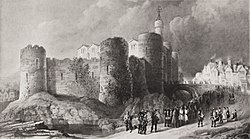
In the 19th century, artistic depictions played a key role in preserving the memory of Liverpool Castle, with illustrators relying on historical records to reconstruct its appearance. A notable example is the 1878 painting published in Pictorial Relics of Ancient Liverpool by W.G. Herdman, which aimed to illustrate the castle as it appeared during the 1689 events surrounding William III's arrival, showing the structure amid the town's waterfront with soldiers approaching. This work, based on earlier descriptions and sketches, contributed to public interest in the castle's lost grandeur during a period of rapid urban expansion in Liverpool. The site of the original castle in Derby Square has been commemorated through physical markers since the early . A plaque on the Queen Victoria Monument, unveiled in 1902, explicitly identifies the location as the former site of the 13th-century Liverpool Castle, demolished in 1726, serving as a enduring reminder integrated into the city's neoclassical landscape. The city's former World Heritage Site status as the Maritime Mercantile City, inscribed in 2004 and delisted in 2021 due to modern developments, highlighted Liverpool's role in global trade from the onward. Although focused on later periods, this recognition underscores the port's historical development, which began with medieval foundations including the castle. In the , digital technologies have revived interest in the castle through virtual models. Post-2020 reconstructions, such as the 3D animation by Xperience Digital History shared in 2024, allow online exploration of the castle's layout based on 19th-century plans by E.W. Cox, highlighting its moats and towers for educational purposes. The has previously incorporated references to the castle in exhibits on Liverpool's early , such as the 2009 Magical Tour that featured a reconstruction of the . However, the museum has been closed for and renovations since 2023 and is not expected to reopen until 2029, with no dedicated installations on the castle in recent years. These efforts underscore ongoing urban heritage initiatives, with limited public art installations but growing digital accessibility to fill gaps in physical commemoration.

Rivington Replica and Its History

In 1912, William Hesketh Lever, 1st Viscount Leverhulme, commissioned the construction of a full-scale replica of Liverpool Castle on his Lever Park estate in Rivington, near Horwich in Lancashire, as part of his broader vision to create a public recreational landscape inspired by medieval architecture. The project was designed by architect Thomas Hayton Mawson and drew directly from the conjectural reconstruction plans of the original castle prepared by Edward W. Cox in 1892, which aimed to recapture the structure's medieval defensive layout based on historical records. Intentionally built to evoke the appearance of picturesque ruins rather than a functional fortress, the replica incorporated elements like weathered stonework and incomplete sections to enhance its romantic, folly-like character, reflecting early 20th-century tastes for Gothic Revival landscaping. The replica was constructed using locally quarried in a Gothic style, featuring an almost rectangular bailey enclosure with remnants of a on the north side, gatehouses on the east and west sides, and circular corner towers, though the principal halls and several towers were left unfinished. A notable feature is the surrounding , approximately 20 yards (18 meters) wide and carved from solid rock, which originally accommodated a leading to the main ; the site also includes arched doorways, embrasures, and a partial stone spiral staircase. Encircled by the estate's parkland, including paths and woodland overlooking Rivington Reservoir, the structure serves as a central attraction within Lever Park, drawing visitors for its blend of historical homage and scenic beauty that romanticizes medieval heritage. Construction progressed intermittently from 1912 but ceased in 1925 following Leverhulme's death, leaving the project as an intentional yet incomplete amid the ongoing development of the park, which he had gifted to the people of in 1902. Today, the replica, formally known as , is a Grade II listed building managed as part of Lever Park by the Rivington Heritage Trust in collaboration with local authorities, preserving its status as a public heritage site without recent archaeological connections to the original Liverpool Castle. In the , the surrounding Lever Park has undergone restoration efforts focused on pathways, signage, and landscape features, while digital reconstructions, such as CGI models, have provided virtual explorations of the site's layout for educational purposes.

References

Add your contribution
Related Hubs
User Avatar
No comments yet.