


Community hub
Recent from talks
Contribute something
Nothing was collected or created yet.
Lockstep
View on Wikipedia
In the United States, lockstep marching or simply lockstep is marching in a very close single file in such a way that the leg of each person in the file moves in the same way and at the same time as the corresponding leg of the person immediately in front of him, so that their legs stay very close all the time.
History
[edit]Originally, it was used in drilling soldiers. Each soldier stepped on the point just vacated by the foot of the soldier in front of him. Thus the soldiers stayed in position to form close files.[1]
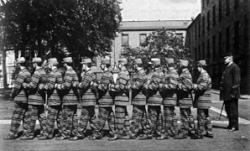
Lockstep marching was a characteristic trait of American prisons of the 19th century.[2] "Inmates formed in single file, right hand on the shoulder of the man in front, left hand on the side; the convicts then stepped off in unison, raising the right foot high and shuffling with the left."[3] The reason for the shuffling step was the chain that connected the legs of a chain gang.
In the Auburn Prison, John Cray developed the following form of the lockstep, as part of the penal system that has become known as the Auburn system, developed in the 1820s: "The lockstep was a method of walking where each man walked with his arms locked under the man's arms in front of him". This system was devised to keep prisoners under control during mass marches of several hundred prisoners from work places to mess, to cells, several times a day. Also, the inmates in lockstep were often required to alternate which side they were looking toward, to preclude communication.[4]
The Auburn system, including its lockstep, was also adopted in Canada.[5]
In some prisons, the inmates were divided into categories, with some of them walking in an ordinary military step, while lockstep was applied to others as a form of punishment.[6]
In Nazi Germany, members of the Hitler Youth were also made to march in lockstep.[7]
Along with striped robes and enforced silence, the prison lockstep was criticized as dehumanizing until it was abolished by the early 1900s.[8]
The term acquired a number of other meanings by way of analogy, referring to synchronous or imitating movement or other behavior, following something or someone ("in lockstep with..."), often with a pejorative tone, though sometimes in a sense implying solidarity and discipline.
See also
[edit]References
[edit]- ^ Maltby, Isaac (1811). The Elements of War. Thomas B. Wait. pp. 18–19. Retrieved 2011-03-18.
- ^ "The Oxford History of the Prison: The Practice of Punishment in Western Society", Oxford University Press, USA; Hardcover (November 1995) ISBN 0-19-506153-5; Reprint edition (October 27, 1997) ISBN 0-19-511814-6
- ^ Harvey R. Hougen, "The Impact of Politics and Prison Industry on the General Management of the Kansas State Penitentiary, 1883-1909, Kansas Historical Quarterlies, 1977 (Vol. 43, No. 3), pages 297 to 318
- ^ "Both Sides of the Wall: Auburn and Its Prison", The Citizen, April 10, 2003 on Pages D8, D9, and D15
- ^ "History of Parole in Canada"
- ^ "Ohio Penal System". Archived from the original on 2007-09-29. Retrieved 2007-04-18.
- ^ [Life and Death in the Third Reich, p. 99, Peter Fritsche]
- ^ It was abolished gradually, by separate acts in different places:
- Sing Sing: The prison lockstep was abolished in 1900 by the order of the Superintendent of State Prisons Cornelius Collins — '"Sent up the river" - A History of the Sing Sing Correction Facility', DOCS Today, March 1998
- New Jersey: "During Mr. Osborne's tenure as warden of the New Jersey prison he abolished the lockstep,..." [1]
- Illinois: (1898-1903) "Changes to prisoner treatment also occurred during this period. The congregate movement of prisoners, the lockstep, was abolished,.." [2]
- Nevada: Raymond T. Baker: "He abolished the lockstep" [3]
Lockstep
View on GrokipediaDefinition and Etymology
Literal Definition
Lockstep denotes a precise marching formation in which individuals advance in single file, with each person's footfall occurring immediately behind and in exact alignment with that of the individual ahead, maintaining negligible separation to ensure collective synchronization.[1] This method demands that marchers coordinate leg movements identically—typically raising feet minimally and placing heels into the impressions left by the preceding foot—to prevent collision or disruption.[7] Originating as a military drill technique around 1802, lockstep enforces rigid discipline by compelling uniform pacing and posture, often with arms linked or held rigidly to further restrict independent motion.[8] In practice, the formation's "locked" quality arises from the interdependent stepping, where deviation by any participant risks propagating disorder through the line, thus prioritizing group cohesion over individual variability.[9] Dictionaries such as Oxford Learner's emphasize its application in contexts like pallbearers or soldiers advancing "feet at the same time," underscoring the literal emphasis on temporal and spatial precision.[10] This literal usage contrasts with later extensions but remains grounded in observable mechanics of close-order drill, verifiable through historical military manuals and contemporary descriptions.[1]Etymological Origins
The term "lockstep" is a compound noun formed from "lock," denoting a secure interlocking mechanism, and "step," referring to the synchronized foot movement in marching, to describe a mode of close-file progression where each participant's leg advances immediately behind the corresponding leg of the predecessor, minimizing gaps and ensuring uniformity.[11][1] Its earliest recorded appearance in English occurs in 1787, within a military translation by I. Landmann, predating broader adoption and reflecting the era's emphasis on disciplined infantry formations in European armies.[11][1] Subsequent attestations in the early 19th century, such as in 1802 military contexts, reinforced its literal sense of rigid synchronization, with the phrase evolving to capture both the physical constraint and the enforced conformity inherent in such drilling.[8] By the 1820s, verbal forms like "to lock-step" emerged, denoting the act of marching in this manner, as evidenced in periodicals like The Examiner.[12] This etymological foundation underscores the term's roots in practical regimentation, distinct from looser marching styles, and laid the groundwork for its extension into metaphorical usages denoting unyielding adherence.[11]Historical Origins
Early Military Applications
The practice of lockstep marching emerged in European military drill during the late 18th and early 19th centuries, serving as a rigorous method to synchronize troop movements in tight formations. The term "lockstep" first entered military lexicon around 1802, denoting a highly constrained mode of progression where soldiers advanced in single file with their legs locked in unison to the steps of the individual immediately ahead, minimizing deviations and enforcing collective rhythm.[8] This technique built upon earlier Prussian innovations in infantry discipline, where Frederick William I (r. 1713–1740) and Frederick the Great (r. 1740–1786) instituted meticulous close-order drills to transform conscript forces into precise instruments of linear warfare, emphasizing uniformity to enable devastating volley fire and rapid maneuvers.[13] Lockstep's primary applications in early military settings focused on instilling instantaneous obedience and physical coordination, essential for maintaining formation integrity under fire or during rapid advances. By compelling soldiers to mirror each preceding step without independent adjustment, it reduced the risk of bunching or scattering, which could disrupt firing lines or expose flanks in battles reliant on massed infantry tactics.[14] Such drills were commonplace in training regimens across continental armies, including those influenced by Prussian models exported via figures like Baron von Steuben to the American Continental Army during the Revolutionary War (1775–1783), where simplified variants of rigid marching adapted lockstep principles for colonial volunteers lacking prior cohesion.[14] Illustrative of its operational role, lockstep featured in 19th-century military reviews and preparatory exercises, as depicted in period etchings such as Captain Charles Aylmer's "The Lock Step, or Drilling for the Review," which portrayed British troops honing the method ahead of ceremonial inspections.[15] While effective for building esprit de corps and muscle memory—allowing units to execute complex evolutions like wheeling or deploying from column to line—it also highlighted vulnerabilities, as synchronized steps could amplify structural resonances on bridges, prompting occasional orders to break step during crossings, as evidenced by engineering analyses of early 19th-century incidents.[16] Over time, its use extended beyond routine training to punitive measures for recalcitrant recruits, underscoring its dual role in both empowerment and control within hierarchical command structures.Institutionalization in Prisons
The Auburn system, developed at New York's Auburn Prison starting in the early 1820s, institutionalized lockstep marching as a core disciplinary mechanism for controlling inmate movement and enforcing silence.[3] Under prison officials Elam Lynds and John Cray, inmates were required to march in single file formation, with each prisoner's right hand placed on the shoulder of the man ahead and heads turned toward guards to minimize eye contact and conversation.[5][6] This method replaced casual walking between cells and workshops, ensuring constant supervision and breaking down individual autonomy through rigid, militaristic routine.[17] Lockstep's institutionalization stemmed from the Auburn model's emphasis on congregate labor during the day paired with solitary confinement at night, where free movement posed risks of unrest or escape.[3] By 1825, the practice was firmly embedded at Auburn, contributing to the system's profitability through disciplined workforce management, which encouraged its adoption across U.S. states.[18] Prisons in states like Pennsylvania and Ohio incorporated lockstep alongside striped uniforms and corporal punishments, standardizing it as a tool for order in the expanding American correctional network by the mid-19th century.[19] The technique persisted into the early 20th century, as evidenced by practices documented around 1910, before progressive reforms diminished its prevalence in favor of rehabilitative approaches.[20] Its design reflected causal priorities of deterrence through dehumanizing regimentation, prioritizing institutional security over inmate welfare, though empirical outcomes on recidivism remained debated among contemporaries.[21]Practical Applications
In Military and Paramilitary Contexts
In military contexts, lockstep denotes a rigid marching formation where troops advance in close single file, placing the heel of the forward foot immediately in front of the toe of the rear foot, thereby restricting individual stride and enforcing uniformity of movement. This technique originated in European military traditions, particularly among Prussian forces in the 18th and 19th centuries, where it symbolized iron discipline and was integral to parade-ground drills designed to instill obedience and collective precision.[22] Prussian elite units employed lockstep to project an aura of unyielding resolve, influencing subsequent European armies and emphasizing ceremonial displays over tactical mobility during peacetime exercises. The practical utility of lockstep in military training lies in its capacity to build group cohesion through enforced synchrony, which psychological research indicates enhances participants' sense of collective power and diminishes perceived threats from adversaries. A 2014 study published in the Journal of Experimental Social Psychology found that men walking in synchronized lockstep formations rated a hypothetical criminal opponent as less formidable and expressed greater confidence in confronting physical challenges, suggesting evolutionary roots in group coordination for combat effectiveness.[23] Historically, such synchronized marches deterred bridge collapses from resonant vibrations when troops broke step deliberately, as in the 1831 Broughton Suspension Bridge incident involving British soldiers who maintained partial lockstep rhythm, underscoring risks of unchecked uniformity in engineering contexts.[16] In modern Western militaries, lockstep has largely fallen out of favor for operational drills, supplanted by more fluid, quick-march cadences that prioritize endurance and adaptability over ceremonial rigidity; for example, U.S. Army standard drill avoids high-precision heel-to-toe synchronization, reflecting a doctrinal focus on practical combat readiness rather than parade aesthetics.[24] Paramilitary organizations, such as specialized police tactical units, occasionally adopt lockstep elements in ceremonial or formation-based crowd control to mirror military discipline and assert authority, as observed in European law enforcement parades where officers maintain tight heel-to-toe spacing for visual intimidation. However, empirical analyses of riot police deployments suggest that excessive synchrony in phalanx formations can amplify aggression and deindividuation, potentially escalating confrontations by fostering a depersonalized sense of invincibility among officers.[25]In Correctional Systems
Lockstep marching emerged as a core element of the Auburn system, a 19th-century penal regime pioneered at Auburn Prison in New York, which opened in 1817 and formalized its congregate labor approach by the 1820s.[5] Under this system, inmates worked collectively in prison workshops during the day but maintained enforced silence to prevent mutual corruption, with lockstep used to transport them between cells and work areas while minimizing opportunities for communication or resistance.[6] Prisoners advanced in single file, each placing their right hand on the shoulder of the inmate ahead, heads bowed or turned toward accompanying guards, and steps synchronized to ensure uniformity and visibility.[26] This method, instituted by wardens Elam Lynds and John Cray around 1821, complemented other controls like striped uniforms and the lash, aiming to erode individual defiance and instill mechanical obedience as a path to moral reformation.[6][27] The practice's rationale centered on discipline and security: by compelling physical proximity without verbal or visual exchange, lockstep thwarted plotting escapes or disruptions, while its dehumanizing rhythm reinforced the system's rehabilitative ideology of breaking criminal habits through rote subjugation.[5] Adopted across U.S. states and influencing prisons in Europe and Australia by the mid-19th century, it prioritized productive labor over the Pennsylvania system's pure isolation, with Auburn's model housing over 1,000 inmates by 1830 and generating revenue from manufactured goods like shoes and furniture.[28] Violations, such as breaking stride or glancing aside, invited corporal punishment, sustaining the Auburn approach's dominance until critiques of its psychological toll mounted in the late 1800s.[27] By the early 20th century, progressive reforms eroded lockstep's prevalence, as humanitarian advocates decried its role in fostering brutality and mental strain, leading to its abolition in facilities like Sing Sing by 1910 in favor of less rigid formations.[5] Though remnants persisted in some Southern and Western U.S. prisons into the 1920s, the shift toward individualized treatment and reduced corporal methods rendered it obsolete, with no documented routine use in modern American correctional systems, where movement protocols emphasize electronic monitoring and segregated units over mass marches.[28] Historical analyses attribute its demise to empirical failures in long-term recidivism reduction, as rigid conformity yielded compliance but not genuine ethical transformation.[6]Technical and Metaphorical Extensions
In Computing and Fault-Tolerant Systems
In computing and fault-tolerant systems, lockstep execution is a redundancy technique where multiple identical processors or cores perform the same operations in precise synchronization, typically cycle-by-cycle, to enable real-time fault detection through output comparison. Any mismatch between the redundant units indicates a fault, such as a single-event upset from cosmic radiation or a hardware transient, prompting immediate recovery actions like error correction via majority voting in triple modular redundancy setups or failover in dual configurations. This method contrasts with asynchronous replication by enforcing strict temporal alignment, often via shared clocks or hardware comparators, to minimize divergence and ensure deterministic behavior under fault conditions.[29] Early commercial implementations of lockstep appeared in the 1980s amid demands for uninterrupted operation in financial and telecommunications sectors. Stratus Technologies pioneered hardware lockstep in systems like the Stratus/32, introduced around 1981, pairing processors to execute identical instructions and compare results for seamless fault masking without software intervention. Tandem Computers adopted similar paired-processor lockstep in later NonStop models, such as the CLX 800 series from 1988, where dual CPUs ran synchronized computations at 16 MHz to detect and isolate errors in high-availability transaction processing, achieving mean time between failures exceeding 10,000 hours in deployed systems. These designs built on prior research into redundant architectures but marked the shift to practical, scalable fault tolerance for enterprise computing.[30][31] Contemporary applications leverage lockstep in embedded systems adhering to safety standards like ISO 26262 for automotive or DO-254 for avionics, where dual- or triple-core lockstep configurations provide diagnostic coverage over 99% for random hardware faults. For example, Microchip's RT PolarFire FPGAs implement soft Mi-V processors in dual-core lockstep to detect transient faults via redundancy checks, suitable for space and industrial controls with minimal latency. ARM's Cortex-A78AE and similar cores support lockstep modes with system-level fault reactions, while Intel's Nios V processors integrate smart comparators for register-level verification in real-time environments. Despite benefits in error detection latency under 1 microsecond, lockstep incurs drawbacks including 50-100% area overhead from duplication and vulnerability to common-mode failures if cores lack diversity, often mitigated by hybrid approaches like time-offset execution.[32][33]Idiomatic and Political Usage
In idiomatic usage, "lockstep" denotes strict synchronization or conformity in action, thought, or policy among individuals or groups, often implying a mechanical or unthinking adherence rather than independent judgment. This metaphorical extension from military marching evokes entities moving as a single unit, where deviation is minimal or penalized, such as economic indicators fluctuating in tandem due to interdependent policies.[9][34] The phrase "in lockstep" typically carries a pejorative connotation in non-literal contexts, suggesting rigidity or suppression of dissent, as in critiques of corporate boards aligning uniformly on decisions without debate.[7] Politically, "lockstep" describes party-line voting or ideological uniformity in legislatures, where members consistently support leadership positions, contributing to legislative polarization. In the U.S. Congress, this manifests in high party unity scores; for instance, during the 112th Congress (2011–2013), both parties exhibited unprecedented lockstep behavior, with average party votes exceeding 90% alignment, exacerbating gridlock on bipartisan issues.[35] Republicans have been accused of voting in lockstep with President Trump, with no House Republican supporting him less than 50% of the time in early 2017, reflecting tight cohesion amid policy pushes like tax reform.[36] Conversely, Democrats faced similar charges in 2019, when nearly all House Democrats voted uniformly against Republican proposals, mirroring prior Republican unity but inverting the partisan critique.[37][38] Such usage often highlights risks to democratic deliberation, as lockstep voting can prioritize partisan loyalty over constituent or principled variance, fostering conflicts of interest where individual scrutiny yields to collective pressure.[39] Empirical analyses, including those from the Brookings Institution, note that while historical U.S. parties occasionally operated with flexibility, modern eras of lockstep conformity—evident in both parties during polarized periods like the Obama and Trump administrations—reduce cross-aisle cooperation and amplify echo-chamber effects.[40] Critics from across the spectrum argue this dynamic undermines representative governance, though defenders view it as efficient mobilization against perceived threats.[41] In state-level politics, groups like the House Freedom Caucus have been observed voting in near-unanimous lockstep via coordinated messaging in the 2023–2024 session, illustrating how intra-party factions enforce conformity.[42]Criticisms and Debates
Associations with Conformity and Authoritarianism
The concept of lockstep has been invoked metaphorically to critique conformity as a mechanism of authoritarian control, where individuals subordinate personal judgment to collective uniformity, often under hierarchical authority. This imagery draws from the rigid synchronization required in military or penal marching, symbolizing the erosion of autonomy in favor of enforced cohesion. In psychological theory, such conformity aligns with traits predisposing individuals to authoritarian submission, as rigid adherence to norms suppresses dissent and facilitates obedience to power structures.[43] Theodor Adorno and colleagues' 1950 study The Authoritarian Personality identified conventionalism—a facet of the authoritarian syndrome—as involving unquestioning conformity to established hierarchies and traditions, correlating with prejudice and aggression toward nonconformists. Individuals scoring high on the Fascism (F) scale exhibited heightened submission to authority alongside intolerance for ambiguity, fostering a mindset amenable to lockstep-like uniformity in social and political spheres. Erich Fromm's 1941 analysis in Escape from Freedom further linked authoritarian appeal to psychological mechanisms escaping the burdens of individuality, where masochistic submission to authority yields sadistic conformity, reducing people to interchangeable parts in a mechanistic order. These frameworks posit conformity not merely as social adaptation but as a causal pathway to authoritarianism, enabled by fears of isolation and reinforced through institutional pressures.[44][45] In political contexts, lockstep conformity manifests in party-line voting, where legislators prioritize ideological alignment over independent deliberation, drawing accusations of authoritarian rigidity. Analyses of U.S. Congressional voting reveal Democrats achieving party unity scores exceeding 95% on divisive issues in recent sessions, surpassing historical benchmarks and outpacing Republicans' averages of around 90%, as tracked by CQ Roll Call's vote studies. Critics, including conservative commentators, argue this "lockstep voting" exemplifies fanaticism over pluralism, potentially mirroring totalitarian demands for obedience rather than democratic debate. Conversely, high unity can reflect strategic coordination for policy goals amid polarization, though empirical patterns show it correlating with reduced cross-aisle negotiation, raising concerns about institutional capture by party elites. Such dynamics underscore debates over whether enforced uniformity safeguards group interests or undermines representative accountability, with source interpretations often reflecting partisan lenses—left-leaning outlets emphasizing right-wing loyalty as authoritarian, while data indicate comparable trends across parties.[46][47][38]Empirical Analysis of Political Lockstep Claims
In analyses of congressional voting behavior, party unity scores provide a quantifiable measure of lockstep tendencies, defined as the percentage of votes where a majority of one party opposes the other and members vote with their party's majority. These scores, tracked by organizations like CQ Roll Call, have risen for both major U.S. parties since the mid-20th century, reflecting broader polarization, but recent data indicate higher cohesion among Democrats, particularly in the Senate. For instance, in the 118th Congress (2023–2025), Senate Democrats recorded an average party unity success rate of 94.5% on divisive votes, the highest in modern history, with 74.6% of Senate votes qualifying as party unity votes.[47] This near-unanimous alignment persisted despite narrow majorities and independents caucusing with Democrats, suggesting strong leadership enforcement and minimal intra-party defection on key issues like nominations and spending.[47] In contrast, House Republicans exhibited lower unity, prevailing on 76.6% of party unity votes in 2024 (up from 63.7% in 2023 but still the second-lowest since 2000), with only 65.3% of votes being party unity types.[47] Notable dissent came from moderate Republicans like Brian Fitzpatrick (71.9% unity), while hardliners such as Ronny Jackson achieved 100%, highlighting factional divides within the GOP, including the Freedom Caucus's resistance to leadership on fiscal and procedural matters. House Democrats showed high but less quantified unity in the same period, with outliers like Jared Golden (67%) and Henry Cuellar (71.1%) voting against the party line more frequently than most, though still above Republican averages for dissent.[47] Senate Republicans displayed even greater variability, with moderates Susan Collins (47.8%) and Lisa Murkowski (48.0%) defecting substantially, underscoring less centralized control compared to Democrats.[47] Long-term trends reinforce these patterns: Brookings Institution data from 1954–2022 show party unity scores climbing from lows of around 60–70% in the 1950s–1970s to over 90% for both parties by the 2010s, driven by ideological sorting and campaign finance dynamics.[48] However, Democrats have consistently edged higher in the Senate since the 2000s, while House Republicans' scores lag due to procedural rebellions, such as the 2023 speaker ousters and debt ceiling standoffs. Claims of Democratic lockstep are thus empirically supported in upper-chamber voting, where near-total adherence minimizes visible fractures, potentially amplifying perceptions of conformity; Republican intra-party conflicts, while reducing aggregate unity scores, reflect decentralized influence rather than chaos, as evidenced by successful conservative policy wins amid dissent.[47][48] Beyond roll-call votes, qualitative evidence of lockstep includes limited public breaks from party orthodoxy among Democrats, with rare defections like Joe Manchin's (82.8% Senate unity in 2024) often on bipartisan grounds rather than ideological opposition.[47] Critics attributing Democratic cohesion to systemic pressures, such as donor influence or media alignment, cite parallel high unity in state legislatures, but empirical studies emphasize electoral incentives favoring loyalty over dissent, with lockstep voting carrying minimal electoral costs for safe-seat incumbents.[49] Republican claims of one-sided lockstep hold partial validity in voting metrics but overlook mutual polarization, where both parties achieve historical highs on core ideological votes, albeit with asymmetric internal dynamics—Democrats through discipline, Republicans through debate.[48]References
- https://commons.wikimedia.org/wiki/File:Auburn_lockstep.gif