


Community hub
Recent from talks
Contribute something
Nothing was collected or created yet.
Prison
View on Wikipedia| Criminology and penology |
|---|
 |

A prison,[a] also known as a jail,[b] gaol,[c] penitentiary, detention center,[d] correction center, correctional facility, or remand center, is a facility where people are imprisoned under the authority of the state, usually as punishment for various crimes. They may also be used to house those awaiting trial (pre-trial detention). Prisons serve two primary functions within the criminal-justice system: holding people charged with crimes while they await trial, and confining those who have pleaded guilty or been convicted to serve out their sentences.
Prisons can also be used as a tool for political repression by authoritarian regimes who detain perceived opponents for political crimes, often without a fair trial or due process; this use is illegal under most forms of international law governing fair administration of justice.[3] In times of war, belligerents or neutral countries may detain prisoners of war or detainees in military prisons or in prisoner-of-war camps. At any time, states may imprison civilians – sometimes large groups of civilians – in internment camps.
Terminology
[edit]The terminology used to describe or distinguish between prisons and other correctional facilities can vary between nations and jurisdictions.
Australia
[edit]In Australia, the words "gaol", "jail" and "prison" are commonly used.[4] The spelling "gaol" was in official use in the past, and many historical gaols are now tourist attractions, such as the Maitland Gaol. Officially, the term "correctional centre" is used for almost all prisons in New South Wales and Queensland, while other states and territories use a variety of names. "Prison" is officially used for some facilities in South Australia, Victoria and Western Australia. Youth prisons in Australia are referred to as "youth correctional facilities" or "youth detention centres" among other names, depending on the jurisdiction.
Canada
[edit]In Canada, while the terms "jail" and "prison" are commonly used in speech, officially named facilities use "facility", "correctional centre", "penitentiary", or "institution". A number of facilities retain their historical designation as a "jail".
New Zealand
[edit]In New Zealand, the terms "jail" and "prison" are commonly used, although the term "correctional facility", among others, are in official usage.
Papua New Guinea
[edit]In Papua New Guinea, "prison" is officially used, although "jail" is widely understood and more common in usage.[5]
UK and Ireland
[edit]The official modern term is "prison" (e.g. HM Prison Barlinnie). The spelling "gaol" is obsolete in modern speech but is still found in older texts, and in historical and legal contexts.
The Gaols Act 1823 describes two types of prison: gaols and houses of correction.[6]
Houses of correction were first established by the Poor Relief Act 1601 in England and Wales, as a place to send the "idle poor" and vagrants for hard labor. Later laws added the functions of punishment for minor crimes after summary jurisdiction, and pre-trial detention. The function of dealing with the poor was replaced by workhouses and then general public assistance.[7]
United States
[edit]In American English, the terms "prison" and "jail" have separate uses, though this is not always adhered to in casual speech and the manner in which correctional facilities are officially described varies by state.
- A "jail" holds people for shorter periods of time (for example, less than a year) or for pre-trial detention and is usually operated by a local government, typically the county sheriff.
- A "prison" or "penitentiary" holds people for longer periods of time, such as many years, and is operated by a state or federal government. After a conviction, a sentenced person is typically sent to prison.
History
[edit]Ancient and medieval
[edit]
The use of prisons can be traced back to the rise of the state as a form of social organization.
Some Ancient Greek philosophers, such as Plato, began to develop ideas of using punishment to reform offenders instead of for retribution. Imprisonment as a penalty was used commonly for those who could not afford to pay their fines. Eventually, since impoverished Athenians could not pay their fines, leading to indefinite periods of imprisonment, time limits were set instead.[8] The prison in ancient Athens was known as the desmoterion or "the place of chains".[9]
The Romans were among the first to use prisons as a form of punishment rather than simply for detention. A variety of existing structures were used to house prisoners, such as metal cages, basements of public buildings, and quarries. One of the most notable Roman prisons was the Mamertine Prison, established around 640 B.C. by Ancus Marcius. The Mamertine Prison was located within a sewer system beneath ancient Rome and contained a large network of dungeons where prisoners were held in squalid conditions contaminated with human waste.[10] Forced labor on public works projects was also a common form of punishment. In many cases, citizens were sentenced to slavery, often in ergastula (a primitive form of prison where unruly slaves were chained to workbenches and performed hard labor).[11] There were numerous prisons not only in the capital Rome, but throughout the Roman Empire. However, a regulated prison system did not emerge.[12]
In Medieval Songhai, results of a trial could have led to confiscation of merchandise or imprisonment as a form of punishment, since various prisons existed in the empire.[13]
During the Middle Ages in Europe, castles, fortresses, and the basements of public buildings were often used as makeshift prisons. The capability to imprison citizens granted an air of legitimacy to officials at all levels of government and served as a signifier of who possessed power or authority over others.[14] Another common punishment was sentencing people to galley slavery, which involved chaining prisoners together in the bottoms of ships and forcing them to row on naval or merchant vessels.
Modern era
[edit]The French philosopher Michel Foucault, especially his book Discipline and Punish: The Birth of the Prison (1975), energized the historical study of prisons and their role in the overall social system.[15][16][17][18] The book analyzed changes in Western penal systems during the modern age based on historical documents from France. Foucault argues that prison did not become the principal form of punishment just because of the humanitarian concerns of reformists. He traces the cultural shifts that led to the predominance of prison via the body and power. Prison used by the "disciplines" – new technological powers that can be found, according to Foucault, in places such as schools, hospitals, and military barracks.[19]

From the late 17th century and during the 18th century, popular resistance to public execution and torture became more widespread both in Europe and in the United States. Particularly under the Bloody Code, with few sentencing alternatives, imposition of the death penalty for petty crimes, such as theft, was proving increasingly unpopular with the public; many jurors were refusing to convict defendants of petty crimes when they knew the defendants would be sentenced to death. Rulers began looking for means to punish and control their subjects in a way that did not cause people to associate them with spectacles of tyrannical and sadistic violence. They developed systems of mass incarceration, often with hard labor, as a solution.[20][21][22] The prison reform movement that arose at this time was heavily influenced by two somewhat contradictory philosophies. The first was based in Enlightenment ideas of utilitarianism and rationalism and suggested that prisons should simply be used as a more effective substitute for public corporal punishments such as whipping, hanging, etc. The deterrence theory claims that the primary purpose of prisons is to be so harsh and terrifying that they deter people from committing crimes out of fear of going to prison. The second theory, which saw prisons as a form of rehabilitation or moral reform, was based on religious ideas that equated crime with sin and saw prisons as a place to instruct prisoners in Christian morality, obedience and proper behavior. These later reformers believed that prisons could be constructed as humane institutions of moral instruction and that prisoners' behavior could be "corrected" so that when they were released, they would be model members of society.[23]
The concept of the modern prison as a highly regimented total institution was imported to Europe in the early 19th-century from America.[24] Prior forms of punishment were usually physical, including capital punishment, mutilation, flagellation (whipping), branding, and non-physical punishments, such as public shaming rituals (like the stocks).[25] From the Middle Ages up to the 16th and 17th centuries in Europe, imprisonment was rarely used as a punishment in its own right, and prisons were mainly to hold those awaiting trial or punishment.
However, an important innovation at the time was the Bridewell House of Corrections, located at Bridewell Palace in London, which resulted in the building of other houses of correction. These houses held mostly petty offenders, vagrants, and the disorderly local poor. In these facilities, the inmates were given "prison labor" jobs that were anticipated to shape them into hardworking individuals and prepare them for the real world. By the end of the 17th century, houses of correction were absorbed into local prison facilities under the control of the local justice of the peace.[26]
Transportation, prison ships and penal colonies
[edit]
England used penal transportation of convicted criminals (and others generally young and poor) for a term of indentured servitude within the general population of British America between the 1610s and 1776. The Transportation Act 1717 made this option available for lesser crimes, or offered it by discretion as a longer-term alternative to the death penalty, which could theoretically be imposed for the growing number of offenses in Britain. The substantial expansion of transportation was the first major innovation in eighteenth-century British penal practice.[27] Transportation to America was abruptly suspended by the Criminal Law Act 1776 (16 Geo. 3. c. 43)[28][29] with the start of the American Rebellion. While sentencing to transportation continued, the act instituted a punishment policy of hard labor instead. The suspension of transport also prompted the use of prisons for punishment and the initial start of a prison building program.[30] Britain would resume transportation to specifically planned penal colonies in Australia between 1788 and 1868.[e]

Jails at the time were run as business ventures and contained both felons and debtors; the latter were often housed with their wives and younger children. The jailers made their money by charging the inmates for food, drink, and other services, and the system was generally corruptible.[31] One reform of the seventeenth century was the establishment of the London Bridewell as a house of correction for women and children. It was the first facility to make any medical services available to prisoners.
With the widely used alternative of penal transportation halted in the 1770s, the immediate need for additional penal accommodations emerged. Given the undeveloped institutional facilities, old sailing vessels, termed hulks, were the most readily available and expandable choice to be used as places of temporary confinement.[32] While conditions on these ships were generally appalling, their use and the labor thus provided set a precedent which persuaded many people that mass incarceration and labor were viable methods of crime prevention and punishment. The turn of the 19th century would see the first movement toward prison reform, and by the 1810s, the first state prisons and correctional facilities were built, thereby inaugurating the modern prison facilities available today.
France also sent criminals to overseas penal colonies, including Louisiana, in the early 18th century.[33] Penal colonies in French Guiana operated until 1952, such as the notable Devil's Island (Île du Diable). Katorga prisons were harsh work camps established in the 17th century in Russia, in remote underpopulated areas of Siberia and the Russian Far East, that had few towns or food sources. Siberia quickly gained its fearful connotation of punishment.[34]
Prison reform movement
[edit]
John Howard was one of the most notable early prison reformers.[g] After having visited several hundred prisons across Great Britain and Europe, in his capacity as high sheriff of Bedfordshire, he published The State of the Prisons in 1777.[37] He was particularly appalled to discover prisoners who had been acquitted but were still confined because they could not pay the jailer's fees. He proposed wide-ranging reforms to the system, including the housing of each prisoner in a separate cell and the requirements that staff should be professional and paid by the government, that outside inspection of prisons should be imposed, and that prisoners should be provided with a healthy diet and reasonable living conditions. The prison reform charity, the Howard League for Penal Reform, was established in 1866 by his admirers.[38]
Following Howard's agitation, the Penitentiary Act 1799 was passed. This introduced solitary confinement, religious instruction, a labor regime, and proposed two state penitentiaries (one for men and one for women). However, these were never built due to disagreements in the committee and pressures from wars with France, and jails remained a local responsibility. But other measures passed in the next few years provided magistrates with the powers to implement many of these reforms, and eventually, in 1815, jail fees were abolished.[citation needed]
Quakers were prominent in campaigning against and publicizing the dire state of the prisons at the time. Elizabeth Fry documented the conditions that prevailed at Newgate prison, where the ladies' section was overcrowded with women and children, some of whom had not even received a trial. The inmates did their own cooking and washing in the small cells in which they slept on straw. The section was described "like a den of wild beasts; it was filled with women unsexed, fighting, swearing, dancing, gaming, yelling and justly deserved its name of 'hell above ground'."[39] In 1816, Fry founded a prison school for the children who were imprisoned with their parents. She also began a system of supervision and required the women to sew and to read the Bible. In 1817, she helped to found the Association for the Reformation of the Female Prisoners in Newgate.
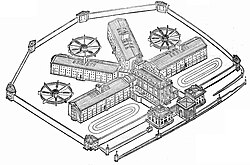
Development of the modern prison
[edit]The theory of the modern prison system was born in London, influenced by the utilitarianism of Jeremy Bentham. Bentham's panopticon introduced the principle of observation and control that underpins the design of the modern prison. The notion of prisoners being incarcerated as part of their punishment, and not simply as a holding state until trial or hanging, was at the time revolutionary. His views influenced the establishment of the first prisons used as criminal rehabilitation centers. At a time when the implementation of capital punishment for a variety of relatively trivial offenses was on the decline, the notion of incarceration as a form of punishment and correction held great appeal to reform-minded thinkers and politicians.
In the first half of the 19th century, capital punishment came to be regarded as inappropriate for many crimes that it had previously been carried out for, and by the mid-19th century, imprisonment had replaced the death penalty for the most serious offenses except for murder.[26]
The first state prison in England was the Millbank Prison, established in 1816 with a capacity for just under 1,000 inmates. By 1824, 54 prisons had adopted the disciplinary system advocated by the Society for the Improvement of Prison Discipline (SIPD).[40] By the 1840s, penal transportation to Australia and the use of hulks was on the decline, and the Surveyor-General of convict prisons, Joshua Jebb, set an ambitious program of prison building in the country, with one large prison opening per year. Pentonville prison opened in 1842, beginning a trend of ever increasing incarceration rates and the use of prison as the primary form of crime punishment.[41] Robert Peel's Gaols Act 1823 introduced regular visits to prisoners by chaplains, provided for the payment of jailers and prohibited the use of irons and manacles.

In 1786, the state of Pennsylvania passed a law that mandated that all convicts who had not been sentenced to death would be placed in penal servitude to do public works projects such as building roads, forts, and mines. Besides the economic benefits of providing a free source of hard labor, the proponents of the new penal code also thought that this would deter criminal activity by making a conspicuous public example of consequences of breaking the law. However, what actually ended up happening was frequent spectacles of disorderly conduct by the convict work crews, and the generation of sympathetic feelings from the citizens who witnessed the mistreatment of the convicts. The laws quickly drew criticism from a humanitarian perspective (as cruel, exploitative and degrading) and from a utilitarian perspective (as failing to deter crime and delegitimizing the state in the eyes of the public). Reformers such as Benjamin Rush came up with a solution that would enable the continued use of forced labor while keeping disorderly conduct and abuse out of the eyes of the public. They suggested that prisoners be sent to secluded "houses of repentance" where they would be subjected (out of the view of the public) to "bodily pain, labor, watchfulness, solitude, and silence ... joined with cleanliness and a simple diet".[42][h]
Pennsylvania soon put this theory into practice and turned its old jail at Walnut Street in Philadelphia into a state prison in 1790. This prison was modeled on what became known as the "Pennsylvania system" (or "separate system") and placed all prisoners into solitary cells with nothing other than religious literature, made them wear prison uniforms, and forced them to be completely silent to reflect on their wrongs.[43] New York soon built the Newgate state prison in Greenwich Village, which was modeled on the Pennsylvania system,[44] and other states followed.

But, by 1820, faith in the efficacy of legal reform had declined, as statutory changes had no discernible effect on the level of crime, and the prisons, where prisoners shared large rooms and booty including alcohol, had become riotous and prone to escapes.[citation needed] In response, New York developed the Auburn system in which prisoners were confined in separate cells and prohibited from talking when eating and working together, implementing it at Auburn State Prison and Sing Sing at Ossining. The aim of this was rehabilitative: the reformers talked about the penitentiary serving as a model for the family and the school and almost all the states adopted the plan (though Pennsylvania went even further in separating prisoners). The system's fame spread, and visitors to the U.S. to see the prisons included de Tocqueville who wrote Democracy in America as a result of his visit.[45]
The use of prisons in Continental Europe was never as popular as it became in the English-speaking world, although state prison systems were largely in place by the end of the 19th century in most European countries. After the unification of Italy in 1861, the government reformed the repressive and arbitrary prison system they inherited, and modernized and secularized criminal punishment by emphasizing discipline and deterrence.[46] Italy developed an advanced penology under the leadership of Cesare Lombroso (1835–1909).[47]
Another prominent prison reformer who made important contributions was Alexander Paterson[48] who advocated for the necessity of humanizing and socializing methods within the prison system in Great Britain and America.[49]
Staff
[edit]Prisons employ people to run and maintain the prison while keeping control of the inmates. Oftentimes, the number of people employed within a prison depends upon factors such as the size of the prison, how many inmates the prison has, and how much funding the prison gets. Staff may include:
- The Warden, also known as a Governor, is the official who is in charge of the prison and heads all the staff.
- Security staff, also known as prison guards, are enforcement officials who are in charge of enforcing prison rules among the inmates. Thus they are responsible for the care, custody and control of the prison.
- Teachers are employed to provide education for inmates to use after their release, in order to reduce the likelihood of the inmates reoffending.[50]
- Case managers are people who perform correctional casework in an institutional setting; they develop, evaluate, and analyze program needs and other data about inmates; evaluate progress of individual offenders in the institution; coordinate and integrate inmate training programs; develop social histories; evaluate positive and negative aspects in each case situation; and develop release plans.[51]
- Prison counselors are people who are employed to intervene therapeutically with various clients, the majority of whom happen to be offenders. These interventions include prison adjustment, prerelease and postrelease vocational and marital/family readjustment, and work with adolescent adjustment problems.[52]
- Medical workers are doctors and nurses who are tasked with providing the inmates with healthcare.[53]
- A work release supervisor is someone who is tasked with monitoring inmates outside of the prison during a work release program.
- In private prisons, contractors are people who pay the prison for the use of prison labor and supplied the prisoners with work.[54]
- Prisons may also provide religious workers to meet the religious need for inmates.[55] Religious workers are also in charge of the weddings when inmates marry someone outside the prison.
- In addition to the prison staff, inmate labor may be utilized for tasks within the prison, such as cooking food for the other inmates or providing cleaning services.
Design
[edit]
Security
[edit]Prisons are normally surrounded by fencing, walls, earthworks, geographical features, or other barriers to prevent escape. Multiple barriers, concertina wire, electrified fencing, secured and defensible main gates, armed guard towers, security lighting, motion sensors, dogs and roving patrols may all also be present depending on the level of security.[56][57]
Remotely controlled doors, CCTV monitoring, alarms, cages, restraints, nonlethal and lethal weapons, riot-control gear and physical segregation of units and prisoners may all also be present within a prison to monitor and control the movement and activity of prisoners within the facility.[i]

Modern prison designs have increasingly sought to restrict and control the movement of prisoners throughout the facility and also to allow a smaller prison staff to monitor prisoners directly, often using a decentralized "podular" layout.[58][59] (In comparison, 19th-century prisons had large landings and cell blocks which permitted only intermittent observation of prisoners.) Smaller, separate and self-contained housing units known as "pods" or "modules" are designed to hold 16 to 50 prisoners and are arranged around exercise yards or support facilities in a decentralized "campus" pattern. A few prison officers, or sometimes only one, supervise each pod. The pods contain tiers of cells arranged around a central control station or desk from which a single officer can monitor all the cells and the entire pod, control cell doors and communicate with the rest of the prison.[citation needed]

Pods may be designed for high-security "indirect supervision", in which officers in segregated and sealed control booths monitor smaller numbers of prisoners confined to their cells. An alternative is "direct supervision", in which officers work within the pod and directly interact with and supervise prisoners, who may spend the day outside their cells in a central "dayroom" on the floor of the pod. Movement in or out of the pod to and from exercise yards, work assignments or medical appointments can be restricted to individual pods at designated times and is generally centrally controlled. Goods and services, such as meals, laundry, commissary, educational materials, religious services and medical care can increasingly be brought to individual pods or cells as well.[60] Some modern prisons may exclude certain inmates from the general population, usually for safety reasons, such as those within solitary confinement, celebrities, political figures, former law enforcement officers, those convicted of sexual crimes and/or crimes against children, or those on the medical wing or protective custody.[61]
Inmate security classifications
[edit]

.jpg)
Generally, when an inmate arrives at a prison, they go through a security classification screening and risk assessment that determines where they will be placed within the prison system. Classifications are assigned by assessing the prisoner's personal history and criminal record and through subjective determinations made by intake personnel (which include mental health workers, counselors, clerical staff, sheriff deputies, prison unit managers, and others). This process will have a major impact on the prisoner's experience, determining their security level, educational and work programs, mental health status (e.g. the determination of whether they will be placed in a mental health unit), and many other factors. This sorting of prisoners is one of the fundamental techniques through which the prison administration maintains control over the inmate population and attempts to reduce risks and liabilities by creating an orderly and secure prison environment.[62][63][64] In some countries, prisoners are made to wear a prison uniform and are stripped of nearly all personal possessions, with the exception of approved medical devices like glasses.
The levels of security within a prison system are categorized differently around the world, but tend to follow a distinct pattern. At one end of the spectrum are the most secure facilities ("maximum security"), which typically hold prisoners that are considered dangerous, disruptive or likely to try to escape. Furthermore, in recent times, supermax prisons have been created where the custody level goes beyond maximum security for people such as terrorists or political prisoners deemed a threat to national security, and inmates from other prisons who have a history of violent or other disruptive behavior in prison or are suspected of gang affiliation. These inmates have individual cells and are kept in lockdown, often for more than 23 hours per day. Meals are served through "chuck-holes" in the cell door, and each inmate is allowed one hour of outdoor exercise per day, alone. They are normally permitted no contact with other inmates and are under constant surveillance via closed-circuit television cameras.[65]

On the other end are "minimum security" prisons which are most often used to house those for whom more stringent security is deemed unnecessary. For example, prisoners convicted of white-collar crime (which rarely results in incarceration) are almost always sent to minimum-security prisons due to them having committed nonviolent crimes.[66] Lower-security prisons are often designed with less restrictive features, confining prisoners at night in smaller locked dormitories or even cottage or cabin-like housing while permitting them free movement around the grounds to work or partake in activities during the day. Some countries (such as Great Britain) also have "open" prisons where prisoners are allowed home-leave or part-time employment outside of the prison. Suomenlinna prison in Finland is an example of one such "open" correctional facility. The prison has been open since 1971 and, as of September 2013, the facility's 95 male prisoners leave the prison grounds on a daily basis to work in the corresponding township or commute to the mainland for either work or study. Prisoners can rent flat-screen televisions, sound systems, and mini-refrigerators with the prison-labor wages that they can earn—wages range between 4.10 and €7.30 per hour. With electronic monitoring, prisoners are also allowed to visit their families in Helsinki and eat together with the prison staff. Prisoners in Scandinavian facilities are permitted to wear their own clothes.[67]
There are fundamental differences between the security level of men's prisons and that of women's prisons. Male prisons tend to have higher, or more severe, security levels/classifications than female prisons.[68] This is even noticeable when comparing the construction and design of male prisons which tend to have very tall walls and towers, barbed wire and other serious security measures whereas these types of high level security measures are absent at many female prisons.[68] This is due to multiple factors, including females being convicted of less severe offences[69] and being less likely to be convicted of violent offences,[70] in comparison to males,[71] and due to female prisoners being less likely to be violent than male prisoners.[72][73]
Common facilities
[edit]
Modern prisons often hold hundreds or thousands of inmates and must have facilities onsite to meet most of their needs, including dietary, health, fitness, education, religious practices, entertainment, and many others. Conditions in prisons vary widely around the world, and the types of facilities within prisons depend on many intersecting factors including funding, legal requirements, and cultural beliefs/practices. Nevertheless, in addition to the cell blocks that contain the prisoners, there are also certain auxiliary facilities that are common in prisons throughout the world.
Kitchen and dining
[edit]Prisons generally have to provide food for a large number of individuals and thus are generally equipped with a large institutional kitchen. There are many security considerations, however, that are unique to the prison dining environment. For instance, cutlery equipment must be very carefully monitored and accounted for at all times, and the layout of prison kitchens must be designed in a way that allows staff to observe activity of the kitchen staff (who are usually prisoners). The quality of kitchen equipment varies from prison to prison, depending on when the prison was constructed and the level of funding available to procure new equipment. Prisoners are often served food in a large cafeteria with rows of tables and benches that are securely attached to the floor. However, inmates that are locked in control units or prisons that are on "lockdown" (where prisoners are made to remain in their cells all day) have trays of food brought to their cells and served through "chuck-holes" in the cell door.[74] Prison food in many developed countries is nutritionally adequate for most inmates.[75][76]
Healthcare
[edit]Prisons in wealthy, industrialized nations provide medical care for most of their inmates.[citation needed] Additionally, prison medical staff play a major role in monitoring, organizing, and controlling the prison population through the use of psychiatric evaluations and interventions (psychiatric drugs, isolation in mental health units, etc.). Prison populations are largely from poor minority communities that experience greater rates of chronic illness, substance abuse, and mental illness than the general population. This leads to a high demand for medical services, and in countries such as the US that do not provide tax-payer funded healthcare, prison is often the first place that people are able to receive medical treatment (which they could not afford outside).[77][78][79]
Some prison medical facilities include primary care, mental health services, dental care, substance abuse treatment, and other forms of specialized care, depending on the needs of the inmate population and the willingness of the prison to provide for these needs. Health care services in many prisons have long been criticized as inadequate, underfunded, and understaffed, and many prisoners have experienced abuse and mistreatment at the hands of prison medical staff who are entrusted with their care.[77][79][80]
In the United States, a million incarcerated people suffer from mental illness without any assistance or treatment for their condition. The tendency of a convicted criminal to reoffend, known as the rate of recidivism, is unusually high for those with the most serious disorders.[81] Analysis of data in 2000 from several forensic hospitals in California, New York and Oregon found that with treatment the rate of recidivism was "much lower" than for untreated mentally ill offenders.[81]
Library and educational facilities
[edit]
Some prisons provide educational programs for inmates that can include basic literacy, secondary education, or even college education. Prisoners seek education for a variety of reasons, including the development of skills for after release, personal enrichment and curiosity, finding something to fill their time, or trying to please prison staff (which can often secure early release for good behavior). However, the educational needs of prisoners often come into conflict with the security concerns of prison staff and with a public that wants to be "tough on crime" (and thus supports denying prisoners access to education). Whatever their reasons for participating in educational programs, prison populations tend to have very low literacy rates and lack of basic mathematical skills, and many have not completed secondary education. This lack of basic education severely limits their employment opportunities outside of prison, leading to high rates of recidivism. Research has shown that prison education can play a significant role in helping prisoners reorient their lives and become successful after reentry.[82][83]
Many prisons also provide a library where prisoners can check out books or do legal research for their cases.[j] Often these libraries are very small, consisting of a few shelves of books. In some countries, such as the United States, drastic budget cuts have resulted in many prison libraries being shut down. Meanwhile, many nations that have historically lacked prison libraries are starting to develop them.[84] Prison libraries can dramatically improve the quality of life for prisoners, who have large amounts of empty time on their hands that can be occupied with reading. This time spent reading has a variety of benefits including improved literacy, ability to understand rules and regulations (leading to improved behavior), ability to read books that encourage self-reflection and analysis of one's emotional state, consciousness of important real-world events, and education that can lead to successful re-entry into society after release.[85][86]
In 2024, the American Library Association published Standards for Library Services for the Incarcerated or Detained. [87]
Literacy programs
[edit]Under the Federal Bureau of Prisons in the United States, all prison institutions offer literacy programs to expand inmates' educational opportunities.[88] Some scholars in the field see prison literacy programs as organic, tactical spaces that resist institutionalization. They warn against the dehumanizing nature of rehabilitative practices and encourage the maintenance of agency and control in these programs to prevent them from becoming self-serving entities that cause further exploitation.[89] Others argue that certain education systems are falsely advertised as a perfect solution when in reality there are much larger systemic issues at hand. Rather than trying to shape inmates into helpful workforce members upon release, scholars like Michael Sutcliffe argue that there needs to be a focus on re-enfranchising members and helping them share their voices.[90] Still others advocate for styles of collective life-writing to capture the experience of incarcerated individuals and fight against exclusionary institutions.[91] Taking an alternative approach, queer literacy frameworks have also been supported by scholars like Alexandra Cavallaro who see the incorporation of LGBTQ individuals' stories as key to promoting lifelong learning.[92] Keeping forward solutions in mind, rhetorical listening is a final approach that is spread by leaders like Wendy Hinshaw.[93]
Recreation and fitness
[edit]Many prisons provide limited recreational and fitness facilities for prisoners. The provision of these services is controversial, with certain elements of society claiming that prisons are being "soft" on inmates, and others claiming that it is cruel and dehumanizing to confine people for years without any recreational opportunities. The tension between these two opinions, coupled with lack of funding, leads to a large variety of different recreational procedures at different prisons. Prison administrators, however, generally find the provision of recreational opportunities to be useful at maintaining order in the prisons, because it keeps prisoners occupied and provides leverage to gain compliance (by depriving prisoners of recreation as punishment). Examples of common facilities/programs that are available in some prisons are: gyms and weightlifting rooms, arts and crafts, games (such as cards, chess, or bingo), television sets, and sports teams.[94] Additionally, many prisons have an outdoor recreation area, commonly referred to as an "exercise yard".
Control units
[edit]Most prisoners are part of the "general population" (or "gen pop")[95] of the prison, members of which are generally able to socialize with each other in common areas of the prison.[96] A control unit or segregation unit (also called a "block" or "isolation cell") is a highly secure area of the prison, where inmates are placed in solitary confinement to isolate them from the general population.[97] Other prisoners that are often segregated from the general population include those who are in protective custody, or who are on suicide watch, and those whose behavior presents a threat to other prisoners.[citation needed]
Other facilities
[edit]
In addition to the above facilities, others that are common include prison factories and workshops, visiting areas, mail rooms, telephone and computer rooms, a prison store (often called a "canteen") where prisoners can purchase goods with prison commissary. Some prisons have a death row where prisoners who have been sentenced to death await execution and an execution room, where the death sentence is carried out. In places like Singapore and Malaysia, there is place for corporal punishment (carried out by caning).[98]
Special types
[edit]Youth detention facilities
[edit]
Prisons for juveniles are known by a variety of names, including "youth detention facilities", "juvenile detention centers", and "reformatories". The purpose of youth detention facilities is to keep young offenders away from the public while working towards rehabilitation.[99] The idea of separately treating youthful and adult offenders is a relatively modern idea. The earliest known use of the term "juvenile delinquency" was in London in 1816, from where it quickly spread to the United States. The first juvenile correctional institution in the United States opened in 1825 in New York City. By 1917, juvenile courts had been established in all but 3 states.[100] It was estimated that in 2011 more than 95,000 juveniles were locked up in prisons and jails in the United States (the largest youth prisoner population in the world).[101] Besides prisons, many other types of residential placement exist within juvenile justice systems, including youth homes, community-based programs, training schools and boot camps.[100]
Like adult facilities, youth detention centers in some countries are experiencing overcrowding due to large increases in incarceration rates of young offenders. Crowding can create extremely dangerous environments in juvenile detention centers and juvenile correctional facilities. Overcrowding may also lead to the decrease in availability to provide the youth with much needed and promised programs and services while they are in the facility. Many times the administration is not prepared to handle the large number of residents, and therefore the facilities can become unstable and create instability in simple logistics.[102]
In addition to overcrowding, juvenile prisons are questioned for their overall effectiveness in rehabilitating youth. Many critics note high juvenile recidivism rates, and the fact that most of the youths that are incarcerated are those from lower socio-economic classes (who often suffer from broken families, lack of educational/job opportunities, and violence in their communities).[100][102]
Women's prisons
[edit]
In the 19th century, a growing awareness that female prisoners had different needs to male prisoners led to the establishment of dedicated prisons for women.[103] In modern times, it is the norm for female inmates to be housed in either a separate prison or a separate wing of a unisex prison. The aim is to protect them from physical and sexual abuse that would otherwise occur.
In the Western world, the guards of women's prisons are usually female, though not always.[104][105] For example, in federal women's correction facilities of the United States, 70% of guards are male.[106] Rape and sexual offenses remain commonplace in many women's prisons and are usually underreported.[107] Two studies in the late 2000s noted that because a high proportion of female inmates have experienced sexual abuse in the past, they are particularly vulnerable to further abuse.[108][109]
The needs of mothers during pregnancy and childbirth often conflict with the demands of the prison system. The Rebecca Project, a non-profit organization that campaigns for women's rights issues, reports that "In 2007, the Bureau of Justice Statistics stated that, on average, 5% of women who enter into state prisons are pregnant and in jails [local prisons] 6% of women are pregnant".[110] The standard of care that female prisoners receive before and after giving birth is often far worse than the standard expected by the general population, and sometimes almost none is given.[110] In some countries, female prisoners may be restrained while giving birth.[111] In many countries, including the United States, mothers will frequently be separated from their baby after giving birth.[112]
Research has shown a significant link between females in prison and brain injury [113][114][115][116] which supports research that shows incarcerated females are overwhelmingly victims of domestic violence (mainly male violence against women).[117][118][119]
Military prisons and prisoner-of-war camps
[edit]

Prisons have formed parts of military systems since the French Revolution. France set up its system in 1796. They were modernized in 1852 and, since their existence, are used variously to house prisoners of war, unlawful combatants, those whose freedom is deemed a national security risk by military or civilian authorities, and members of the military found guilty of a serious crime. Military prisons in the United States have also been converted to civilian prisons; for example, Alcatraz Island. Alcatraz was formerly a military prison for soldiers during the American Civil War.[120]
In the American Revolution, British prisoners held by the U.S. were assigned to local farmers as laborers. The British kept American sailors in broken down ship hulls with high death rates.[citation needed]
In the Napoleonic wars, the broken down hulks were still in use for naval prisoners. One French surgeon recalled his captivity in Spain, where scurvy, diarrhea, dysentery, and typhus abounded, and prisoners died by the thousands:
- "These great trunks of ships were immense coffins, in which living men were consigned to a slow death.... [In the hot weather we had] black army bread full of gritty particles, biscuit full of maggots, salt meat that was already decomposing, rancid lard, spoiled cod, [and] stale rice, peas, and beans."[121]
In the American Civil War, at first prisoners of war were released after they promised not to fight again unless formally exchanged. When the Confederacy refused to exchange black prisoners, the system broke down and each side built large-scale POW camps. Conditions in terms of housing, food, and medical care were bad in the Confederacy, and the Union retaliated by imposing harsh conditions.[122]
By 1900, the legal framework of the Geneva and Hague Convention provided considerable protection. In the First World War, millions of prisoners were held on both sides, with no major atrocities. Officers received privileged treatment. There was an increase in the use of forced labor throughout Europe. Food and medical treatment were generally comparable to what active duty soldiers received, and housing was much better than front-line conditions.[123]
Political prisons and administrative detention
[edit]Political prisoners are people who have been imprisoned because of their political beliefs, activities and affiliations. There is much debate about who qualifies as a "political prisoner". The category of "political prisoner" is often contested, and many regimes that incarcerate political prisoners often claim that they are merely "criminals". Others who are sometimes classified as "political prisoners" include prisoners who were politicized in prison and are subsequently punished for their involvement with political causes.[124][125][k]
Many countries maintain or have in the past had a system of prisons specifically intended for political prisoners. In some countries, dissidents can be detained, tortured, executed, and/or "disappeared" without trial. This can happen either legally or extralegally (sometimes by falsely accusing people and fabricating evidence against them).[126]
Administrative detention is a classification of prisons or detention centers where people are held without trial.
Psychiatric facilities
[edit]Some psychiatric facilities have characteristics of prisons, particularly when confining patients who have committed a crime and are considered dangerous.[127] In addition, many prisons have psychiatric units dedicated to housing offenders diagnosed with a wide variety of mental disorders. The United States government refers to psychiatric prisons housing federal inmates as "Federal Medical Centers (FMC)".
Prison population
[edit]

Some jurisdictions refer to the prison population (total or per-prison) as the "prison muster".[128]
In 2021, the World Prison Brief reported that at least 11.5 million people were imprisoned worldwide.[129]
In 2021, the United States of America had the world's largest prison population, with over 2 million people in American prisons or jails—up from 744,000 in 1985—making 1 in every 200 American adults a prisoner. In 2017, the nonprofit organization Prison Policy Initiative estimated that the United States government spent an estimated US$80.7 billion to maintain prisons.[130] CNBC estimated that the cost of maintaining the US prison system was US$74 billion per year.[131][l] This increases government spending on prisons.[132] As of 2023[update], the US no longer has the highest incarceration rate in the world, with El Salvador now having the highest.[133]
Not all countries have experienced a rise in prison population: Sweden closed four prisons in 2013 due to a significant drop in the number of inmates. The head of Sweden's prison and probation services characterized the decrease in the number of Swedish prisoners as "out-of-the-ordinary", with prison numbers in Sweden falling by around 1% a year since 2004.[134]
The United Nations Office on Drugs and Crime website hosts data[135] regarding prison populations around the world, including "Persons held – by sex, by age group,"[136] "Persons held – by status and sex"[137] and "Prison capacity and overcrowding – totals".[138]
Economics of prisons
[edit]In the United States alone, more than $74 billion per year is spent on prisons, with over 800,000 people employed in the prison industry.[139] As the prison population grows, revenues increase for a variety of small and large businesses that construct facilities and provide equipment (security systems, furniture, clothing) and services (transportation, communications, healthcare, food) for prisons. These parties have a strong interest in the expansion of the prison system since their development and prosperity directly depends on the number of inmates.[140][141]
The prison industry also includes private businesses that benefit from the exploitation of the prison labor.[142][143] Some scholars, using the term prison-industrial complex, have argued that the trend of "hiring out prisoners" is a continuation of the slavery tradition, pointing out that the Thirteenth Amendment to the United States Constitution freed slaves but allowed forced labor for people convicted of crimes.[144][145] Prisons are very attractive to employers, because prisoners can be made to perform a great array of jobs under conditions that most free laborers would not accept (and would be illegal outside of prisons): sub-minimum wage payments, no insurance, no collective bargaining, lack of alternative options, etc.[146] Prison labor can soon deprive the free labor of jobs in a number of sectors, since the organized labor turns out to be uncompetitive compared to the prison counterpart.[146][147][148]
Social effects
[edit]Internal
[edit]
Prisons can be difficult places to live and work in, even in developed countries in the present day. By their very definition, prisons house individuals who may be prone to violence and rule-breaking.[149] It is also typical that a high proportion of inmates have mental health concerns. A 2014 US report found that this included 64% of local jail inmates, 54% of state prisoners and 45% of federal prisoners.[150] The environment may be worsened by overcrowding, poor sanitation and maintenance, violence by prisoners against other prisoners or staff, staff misconduct, prison gangs, self-harm, and the widespread smuggling of illegal drugs and other contraband.[151] The social system within the prison commonly develops an "inmate code", an informal set of internal values and rules that govern prison life and relationships, but that may be at odds with the interests of prison management or external society, compromising future rehabilitation and increasing recidivism rates.[152] In some cases, disorder can escalate into a full-scale prison riot, which could lead to serious injury or death en masse. Academic research has found that poor conditions tend to increase the likelihood of violence within prisons. For example according to (Gaes and McGuire study), as social density increased by 1% in prisons, violence increased about 0.3%.[153][154][155][156]
External
[edit]Prisoners can face difficulty re-integrating back into society upon their release. They often have difficulty finding work, earn less money when they do find work, and experience a wide range of medical and psychological issues. Many countries have a high recidivism rate. According to the Bureau of Justice Statistics, 67.8% of released prisoners in the United States are rearrested within three years and 76.6% are rearrested within five years.[157] If the prisoner has a family, they are likely to suffer socially and economically from the prisoner's absence.[158][159][160][161]
If a society has a very high imprisonment rate, these effects become noticeable not just on family units but also on entire poor communities or communities of color.[159][160][162] The expensive cost of maintaining a high imprisonment rate also costs money that must come at the expense of either the taxpayer or other government agencies.[163][164]
Theories of punishment and criminality
[edit]A variety of justifications and explanations are put forth for why people are imprisoned by the state. The most common of these are:[165]
- Rehabilitation:[m] Theories of rehabilitation argue that the purpose of imprisonment is to change prisoners' lives in a way that will make them productive and law-abiding members of society once they are released. The idea was promoted by 19th century reformers, who promoted prisons as a humane alternative to harsh punishments of the past.[23] Many governments and prison systems have adopted rehabilitation as an official aim.[166] In the United States and Canada, prison agencies are often referred to as "Corrections" services for this reason.
- Deterrence: Theories of deterrence argue that by sentencing criminals to extremely harsh penalties, other people who might be considering criminal activities will be so terrified of the consequences that they will choose not to commit crimes out of fear.
- Incapacitation: Theories of incapacitation argue that while prisoners are incarcerated, they will be unable to commit crimes, thus keeping communities safer.
- Retribution: Theories of retributive justice argue that the purpose of imprisonment is to cause punitive damages to the prisoner, in proportion to the perceived seriousness of their crime. These theories do not necessarily focus on whether or not a particular punishment benefits the community, but instead are based upon a belief that some kind of moral balance will be achieved by "paying back" the prisoner for the wrongs they have committed.[167]
Alternatives
[edit]Modern prison reform movements generally seek to reduce prison populations. A key goal is to improve conditions by reducing overcrowding.[168] Prison reformers also argue that alternative methods are often better at rehabilitating offenders and preventing crime in the long term. Countries that have sought to actively reduce prison populations include Sweden,[169] Germany and the Netherlands.[170]
Alternatives to prison sentences include:
- Fines
- Community service
- Capital punishment
- Suspended sentence: The offender performs of a period of probation and only serves a prison sentence if the terms of probation are broken. This is similar to the Canadian concept of a conditional sentence.[171]
- House arrest/curfews: Sometimes a condition of a strict suspended/conditional sentence.[171]
- Mandatory treatment for drug offenders.
- Rehabilitation programs, such as anger management classes.
- Mental health treatment for offenders with mental illness.
- Judicial corporal punishment
- Conditional discharge: The offender is not punished for the crime if they abide by certain conditions; typically they must not commit any further crimes within a designated period.
- Other court orders that take away privileges from the offender, such as banning motoring offenders from driving.
- Restorative justice programs,[n] which overlap with the above methods. Restorative justice is based around arranging a mediation between the offender and victim, so that the offenders can take responsibility for their actions, "to repair the harm they've done—by apologizing, returning stolen money, or community service".[172][173][174]
These alternatives do not eliminate the need for imprisonment altogether. Suspended sentences entail the threat of time in prison, while for others, actual imprisonment may be used as a punishment for noncompliance.
The prison abolition movement seeks to eliminate prisons altogether. It is distinct from prison reform, although abolitionists often support reform campaigns, regarding them as incremental steps towards abolishing prisons.[175] The abolition movement is motivated by a belief that prisons are inherently ineffective [176][177] and discriminatory.[178] The movement is associated with libertarian socialism, anarchism and anti-authoritarianism, with some prison abolitionists arguing that imprisoning people for actions the state designates as crimes is not only inexpedient but also immoral.[179]
Crime within prisons
[edit]In many prisons violence committed by other prisoners or staff is frequent.[180] Prisons have been criticized for frequently not prosecuting crimes committed within the prison.[181]
Recidivism
[edit]A large percentage of former prisoners commit crimes after their release from prison (recidivism). Recidivism data was found from 33 countries with results showing released prisoners having a 2-year reconviction rates between 18% and 55%, while individuals given community sentences had rates between 10% and 47%.[182] The argument that prisons can reduce crime through incapacitation is widely accepted, even among academics who doubt that prisons can rehabilitate or deter offenders.[183][159][184] One dissenting argument is from Arrigo and Milovanovic, who argue that prisoners will simply continue to victimize people inside of the prison and that this harm has impacts on the society outside.[185]
Academic studies have been inconclusive as to whether high imprisonment rates reduce crime rates in comparison to low imprisonment rates; only a minority suggest it creates a significant reduction, and others suggest it increases crime.[159]
Prisoners are at risk of being drawn further into crime, as they may become acquainted with other criminals, trained in further criminal activity, exposed to further abuse (both from staff and other prisoners) and left with criminal records that make it difficult to find legal employment after release. All of these things can result in a higher likelihood of reoffending upon release.[186][187]
This has resulted in a series of studies that are skeptical towards the idea that prison can rehabilitate offenders.[188][189] As Morris and Rothman (1995) point out, "It's hard to train for freedom in a cage."[165] Prison reform organizations such as the Howard League for Penal Reform are not entirely opposed to attempting to rehabilitate offenders, but instead argue that most prisoners would be more likely to be rehabilitated if they received a punishment other than prison.[190] The National Institute of Justice argues that offenders can be deterred by the fear of being caught but are unlikely to be deterred by the fear or experience of the punishment.[183] Like Lawrence W. Sherman, they argue that better policing is a more effective way to reduce crime rates.[183][191]
Prisons and people with disabilities
[edit]People with disabilities are over represented in every aspect of the criminal justice system including parole and jails with 40% of people in state prisons having a disability compared to 15% of the population.[192] Some reasons for this is due to lack of social support, lack of effective communication with police or lawyer, poverty, mental health issues, and being more likely to be charged with a crime and serving longer sentences then those without a disability.[193] Since police are often first responders to mental health crises, this can increase the chance of conflicts with the mentally ill, and possibly arrests. In 2015, a Washington Post investigation reported that 124 people out of 462 for whom police were called for assistance with a person in an immediate mental health crisis were shot by the first responders; most of those shot were armed in the interaction, however.[194][195]
The National registry of exonerations found that 70% of people who falsely confessed and were exonerated were people with intellectual disabilities and mental illness.[196][197] In addition, 69% of those with intellectual disabilities were exonerated from murder.[198] Factors contributing to wrongful conviction to people with disabilities are difficulty communicating with police and lawyer, having difficulty accessing appropriate lawyer (with some cases needing lawyers specializing with people with disabilities), misinterpreting behaviors associated with them, prejudice and bias associated with them, and inadequate accommodations necessary for having a fair trial. Misunderstandings can be due to nature of the disability (ex. Autistic people processing emotions or seeing the case differently) or not understanding the needs of the person.[196]
See also
[edit]- Decarceration in the United States
- For-profit prisons
- Immigration detention
- Incarceration and health
- Incarceration in the United States
- Inmate telephone system
- LGBT people in prison
- Life imprisonment
- List of prisons
- Military prison
- Open prison
- Prison farm
- Prison gang
- Prison officer
- Prison pose
- Prison sexuality, including homosexuality and sexual abuse
- Prison strike
- Prisoner abuse
- Prisoners' rights
- School-to-prison pipeline
- Silent treatment
- Standard Minimum Rules for the Treatment of Prisoners
- debtors prison
Notes
[edit]- ^ From the Old French prisoun[1]
- ^ In American and Canadian English, prison and jail usually refer to separate things in formal speech. In general, a prison is a place where individuals given long sentences are incarcerated, while a jail is a place where individuals in pretrial custody or given short sentences are sent. In the United States, jails are often run by counties or groups of counties, while prisons are run by the state or federal government.[2]
- ^ "Gaol" is a dated British and South African spelling also used historically in Ireland, Canada and Australia. The spelling jail is sometimes preferred because gaol does not follow the usual English pronunciation rules for hard and soft G and ao is not a standard English diphthong.
- ^ In Britain a 'detention centre' is a military detention facility, not a prison
- ^ For a more detailed look at the English "transportation" system, and the transition from penal colonies to prisons, see Hostettler, John (2009). A History of Criminal Justice in England and Wales. Waterside Press. p. 157. ISBN 978-1-906534-79-0.
- ^ For an in-depth treatment of Bentham's panopticon, see Semple, Janet (1993). Bentham's Prison: A Study of the Panopticon Penitentiary: A Study of the Panopticon Penitentiary. Oxford University Press. ISBN 978-0-19-159081-8.
- ^ But some authors have pointed out that many historical treatments overemphasize Howard's work, and that there were many other individuals (including local prison administrators) that also played a significant role in the development of modern prisons. See DeLacy, Margaret (1986). "The Eighteenth Century Gaol". Prison Reform in Lancashire, 1700–1850: A Study in Local Administration. Manchester University Press. ISBN 978-0-7190-1341-6.
- ^ There were several reasons that early prison reformers sought to move punishment out of the view of the public, by placing prisons away from population centers and restricting access to the inside of prison facilities. For a detailed history of the ideological origins of these practices of concealment and exclusion, see: Kann, Mark E. (2005). "Concealing Punishment". Punishment, Prisons, and Patriarchy: Liberty and Power in the Early American Republic. NYU Press. ISBN 978-0-8147-4783-4.
- ^ For a broad overview of the technologies used in prison security, see: Latessa, Edward J. (1996). "Technology". In McShane, Marilyn D.; Williams, Frank P. (eds.). Encyclopedia Of American Prisons. Taylor & Francis. ISBN 978-1-135-58270-8.
- ^ For a history of the development of prison libraries, see Coyle, William (1987). Libraries in Prisons: A Blending of Institutions. Greenwood Publishing Group. ISBN 978-0-313-24769-9. and Wiegand, Wayne A.; Davis, Donald G., eds. (1994). "Prison libraries". Encyclopedia of Library History. Routledge. ISBN 978-0-8240-5787-9.
- ^ For a detailed discussion of the sometimes blurred line between "criminals" and "political prisoners", see: Wachsmann, Nikolaus (2004). Hitler's Prisons: Legal Terror in Nazi Germany. Yale University Press. ISBN 978-0-300-10250-5.
- ^ For a detailed look at the demographics of the U.S. prison population, see Simon, Rita; de Waal, Christiaan (2009). "United States". Prisons the World Over. Rowman & Littlefield. ISBN 978-0-7391-4024-6.
- ^ Also frequently referred to as "reformation" or "corrections"
- ^ Sometimes called "reparative justice" (See Weitekamp, Elmar (1993). "Reparative justice: Towards a victim oriented system". European Journal on Criminal Policy and Research. 1 (1): 70–93. doi:10.1007/BF02249525. S2CID 147309026.)
References
[edit]- ^ Douglas Harper (2001–2013). "Prison". Online Etymology Dictionary. Douglas Harper. Archived from the original on 9 September 2013. Retrieved 28 June 2013.
- ^ "Jail vs prison difference".
- ^ "International Covenant on Civil and Political Rights". OHCHR. Retrieved 2025-02-11.
- ^ Webb, Tiger (22 June 2016). "Jail or gaol: Which spelling is correct?". ABC Radio National. Australian Broadcasting Corporation. Retrieved 20 August 2023.
- ^ "Operation Division – PNG Correctional Services".
- ^ The statutes of the United Kingdom of Great Britain and Ireland (1807-1868/69), see e.g. pages 479 and 482-483
- ^ National Assistance Act 1948
- ^ Allen, Danielle S. "Punishment in Ancient Athens". Harvard University, Center for Hellenic Studies. Archived from the original on 2013-12-03.
- ^ Roth, Michael P. (2006). Prisons and Prison Systems: A Global Encyclopedia. Greenwood Publishing. p. xxvi. ISBN 978-0-313-32856-5. Archived from the original on 2016-05-15.
- ^ Lopes, Jenna (2002). "There's Got to Be a Better Way: Retribution vs. Restoration". Osprey Journal of Ideals and Inquiry. II: 53. Archived from the original on 8 August 2017. Retrieved 25 July 2017.
- ^ "The People of the Gaps: Rescuing Roman Slaves from Obscurity". Retrospect Journal. 2023-03-19. Retrieved 2025-10-17.
- ^ Krause, Jens-Uwe (1996). Gefängnisse im Römischen Reich [Prisons in the Roman Empire]. Heidelberger Althistorische Beiträge und Epigraphische Studien, vol. 23. Stuttgart: Franz Steiner, ISBN 3-515-06976-3.
- ^ Lady Lugard, Flora Louisa Shaw (1997). "Songhay Under Askia the Great". A tropical dependency: an outline of the ancient history of the western Sudan with an account of the modern settlement of northern Nigeria / [Flora S. Lugard]. Black Classic Press. pp. 199–200. ISBN 0-933121-92-X.
- ^ Turning, Patricia (2012). "Competition for the Prisoner's Body: Wardens and Jailers in Fourteenth-Century Southern France". In Classen, Albrecht; Scarborough, Connie (eds.). Crime and Punishment in the Middle Ages and Early Modern Age: Mental-Historical Investigations of Basic Human Problems and Social Responses. Walter de Gruyter. p. 285. ISBN 978-3-11-029458-3. Archived from the original on 2016-06-03.
- ^ George Fisher, "The birth of the prison retold." Yale Law Journal 104.6 (1995): 1235–1324. online free
- ^ C. Fred Alford, "What would it matter if everything Foucault said about prison were wrong? Discipline and Punish after twenty years." Theory and society 29.1 (2000): 125–146. online
- ^ David Garland, "Review: Foucault's "Discipline and Punish"--An Exposition and Critique" American Bar Foundation Research Journal 11#4 (1986), pp. 847–880 online
- ^ Karl von Schriltz, "Foucault on the prison: Torturing history to punish capitalism." Critical Review 13.3–4 (1999): 391–411. Online link
- ^ Schwan, A., & Shapiro, S. (2011). How to read Foucault's discipline and punish. London : Pluto Press, 2011. Free Online link
- ^ "History of the prison system". 16 October 2014. Archived from the original on 31 March 2012.
- ^ Foucault, Michel (1995). Discipline & Punish: The Birth of the Prison. Vintage Books. ISBN 978-0-679-75255-4.
- ^ Kann, Mark E. (2005). "Concealing Punishment". Punishment, Prisons, and Patriarchy: Liberty and Power in the Early American Republic. NYU Press. p. 216. ISBN 978-0-8147-4783-4. Archived from the original on 2016-05-18.
- ^ a b Lewis, W. David (2009). From Newgate to Dannemora: The Rise of the Penitentiary in New York, 1796–1848. Cornell University Press. p. 6. ISBN 978-0-8014-7548-1. Archived from the original on 2016-05-04.
- ^ Halley, Catherine (2022-03-18). "The Invention of Incarceration". JSTOR Daily. Retrieved 2025-06-21.
For most of Western history, long-term incarceration wasn't used as punishment, and many countries even had rules against it [... Ashley Rubin, along with other scholars,] argues that prisons as we now know them first arose in the nascent United States, shortly after the Revolutionary War. (Jails, used for short-term confinement, have a much longer history in Europe and around the world.)
- ^ Spierenburg, Peter (1998). "The Body and The State: Early Modern Europe". In Morris, Norval; Rothman, David J. (eds.). The Oxford History of the Prison: the Practice of Punishment in Western Society. Oxford University Press. p. 44. ISBN 978-0-19-511814-8. Archived from the original on 2016-05-04.
- ^ a b "History of the penal system". The Howard League. Retrieved 16 September 2025.
- ^ "Transportation". Crime and Justice - Punishments at the Old Bailey - Central Criminal Court. Archived from the original on 2016-06-07.
- ^ Pickering, Danby (1775-08-18). The Statutes at Large from the Magna Charta, to the End of the Eleventh Parliament of Great Britain, Anno 1761 [continued to 1806]. Great Britain: J. Bentham. Archived from the original on 2018-03-29.
An act to authorise, for a limited time, the punishment by hard labour of offenders who, for certain crimes, are or shall become liable to be transported to any of his Majesty's colonies and plantations.
- ^ Marilyn C. Baseler, "Asylum for Mankind": America, 1607–1800 Archived 2018-03-29 at the Wayback Machine, p.124-127, Cornell University Press (1998),
- ^ Drew D. Gray, Crime, Policing and Punishment in England, 1660–1914 Archived 2018-03-29 at the Wayback Machine p.298 (2016)
- ^ See e.g. Marshalsea#First Marshalsea (1373–1811)
- ^ West, Charles E. (1895). Horrors of the prison ships: Dr. West's description of the wallabout floating dungeons, how captive patriots fared. Eagle Book Printing Department.
- ^ Taylor, Alan (2001). American Colonies. Penguin Books. p. 384. ISBN 978-0-670-87282-4.
- ^ Jonathan W. Daly, Autocracy under Siege: Security Police and Opposition in Russia, 1866–1905 (1998) ISBN 978-0875802435 archive
- ^ Innes, Martin (2003). "The Architecture of Social Control". Understanding Social Control: Crime and Social Order in Late Modernity. McGraw-Hill International. ISBN 978-0-335-20940-8. Archived from the original on 2016-05-02.
- ^ Parolin, Cristina (2010). Radical Spaces: Venues of Popular Politics in London, 1790 – C. 1845. ANU Press. p. 58. ISBN 978-1-921862-00-7. Archived from the original on 2016-05-22.
Architectural innovation lay at the heart of eighteenth-century prison reform and one of its master thinkers was Jeremy Bentham [...]
- ^ John Howard (1777), The State of the Prisons in England and Wales with an account of some foreign prisons, archived from the original on 2016-04-30
- ^ "What We Do". The Howard League for Penal Reform. Archived from the original on 9 July 2017. Retrieved 25 July 2017.
- ^ Griffiths, Arthur George Frederick (1911). . In Chisholm, Hugh (ed.). Encyclopædia Britannica. Vol. 22 (11th ed.). Cambridge University Press. p. 362.
- ^ Morris, Norval; Rothman, David, eds. (1995). The Oxford History of the Prison: the practice of punishment in western society. Oxford University Press. p. 97. ISBN 978-0-19-506153-6.
- ^ Fox 1952, p. 46
- ^ McClennan, Rebecca M. (2008). The Crisis of Imprisonment: Protest, Politics, and the Making of the American Penal State, 1776–1941. Cambridge University Press. pp. 33–36. ISBN 978-1-139-46748-3. Archived from the original on 2016-05-10.
- ^ Murty, Komanduri S. (2004). Voices from Prison: An Ethnographic Study of Black Male Prisoners. University Press of America. p. 64. ISBN 978-0-7618-2966-9. Archived from the original on 2016-06-03.
- ^ Lewis, W. David (2009). From Newgate to Dannemora: The Rise of the Penitentiary in New York, 1796–1848. Cornell University Press. p. 30. ISBN 978-0-8014-7548-1. Archived from the original on 2016-04-30.
- ^ Bosworth, Mary (2002). The U.S. Federal Prison System. SAGE. p. 32. ISBN 978-0-7619-2304-6.
- ^ Gibson Mary (2009). "Women's Prisons in Italy: A Problem of Citizenship". Crime, Histoire et Sociétés. 13 (2): 27–40. doi:10.4000/chs.1106. ISSN 1422-0857.
- ^ Knepper, Paul, and Per Jørgen Ystehede, eds., The Cesare Lombroso Handbook (2012)
- ^ Eriksson, Torsten (1976). The reformers: an historical survey of pioneer experiments in the treatment of criminals. Elsevier Scientific Pub. Co. p. 147
- ^ Sir Alexander Paterson (193?). The Prison Problem of America: (with admiration for those who face it). Printed at H.M. Prison, for private circulation. p. 12
- ^ "Teacher". BOP.
- ^ "Case Manager". BOP. Archived from the original on 2017-05-13.
- ^ "Purpose of Correctional Counseling and Treatment (From Correctional Counseling and Rehabilitation, Fourth Edition, P 23-39, 2000, Patricia van Voorhis, Michael Braswell, et al. – See NCJ-183019)". Office of Justice Programs.
- ^ "Review of the Federal Bureau of Prisons' Medical Staffing Challenges" (PDF). U.S. Department of Justice Office of the Inspector General. Retrieved 10 September 2023.
- ^ "Labor". the NYC Criminal.
- ^ "What Prison Chaplains do … and What They Think They Should do". Pew Research Center. 22 March 2012.
- ^ Hanser, Robert D. (2012). Introduction to Corrections. SAGE. pp. 193–195. ISBN 978-1-4129-7566-7. Archived from the original on 2016-05-17.
- ^ Sheridan, Francis (1996). "Security and Control: Perimeter Security". In McShane, Marilyn D.; Williams, Frank P. (eds.). Encyclopedia of American Prisons. Taylor & Francis. ISBN 978-0-8153-1350-2.
- ^ Shalev, Sharon (2013). Supermax: Controlling Risk Through Solitary Confinement. Routledge. p. 101. ISBN 978-1-134-02667-8. Archived from the original on 2016-06-17.
- ^ Carceral, K.C. (2006). Prison, Inc: A Convict Exposes Life Inside a Private Prison. NYU Press. p. 11. ISBN 978-0-8147-9955-0. Archived from the original on 2016-04-27.
- ^ Jewkes, Yvonne & Johnston, Helen (2012). "The evolution of prison architecture". In Jewkes, Yvonne (ed.). Handbook on Prisons. Routledge. ISBN 978-1-136-30830-7. Archived from the original on 2016-05-06.
- ^ Wolff, Nancy, and Jing Shi. "Patterns of victimization and feelings of safety inside prison: The experience of male and female inmates." Crime & Delinquency 57.1 (2011): 29–55.
- ^ Carlson, Peter M., ed. (2013). "Inmate Classification". Prison and Jail Administration: Practice and Theory. Jones & Bartlett. ISBN 978-1-4496-5306-4. Archived from the original on 2016-06-19.
- ^ Rhodes, Lorna A. (2004). Total Confinement: Madness and Reason in the Maximum Security Prison. University of California Press. pp. 134–39. ISBN 978-0-520-24076-6. Archived from the original on 2016-05-22.
- ^ Shalev, Sharon (2013). Supermax: Controlling Risk Through Solitary Confinement. Routledge. p. 88. ISBN 978-1-134-02667-8. Archived from the original on 2016-05-13.
- ^ Ross, Jeffrey Ian (2012). "The Invention of the American Supermax Prison". In Jeffrey Ian Ross (ed.). The Globalization of Supermax Prisons. Rutgers University Press. ISBN 978-0-8135-5742-7. Archived from the original on 2016-05-02.
- ^ "White Collar Crime". Archived from the original on 10 June 2016. Retrieved 2 January 2017.
- ^ Doran Larson (24 September 2013). "Why Scandinavian Prisons Are Superior". The Atlantic. Archived from the original on 25 September 2013. Retrieved 26 September 2013.
- ^ a b "Differences Between Men's & Women's Prisons". study.com. Retrieved 2022-02-18.
- ^ [1] Bagaric, Mirko; Bagaric, Brienna (2016). "Mitigating the Crime That Is the Over-Imprisonment of Women: Why Orange Should Not Be the New Black". SSRN 2773341.
- ^ "Bureau of Justice Statistics Special Report – Survey of State Prison Inmates, Women in Prison" (PDF). U.S. Department of Justice; Office of Justice Programs; Bureau of Justice Statistics. 1991. Retrieved February 18, 2022.
- ^ "Gender Differences in Prisoner Subcultures (From Women and Crime in America, P 409-419, 1981, Lee H Bowker, ed. -See NCJ-93434) | Office of Justice Programs". www.ojp.gov. Retrieved 2022-02-18.
- ^ Harer, Miles D.; Langan, Neal P. (October 2001). "Gender Differences in Predictors of Prison Violence: Assessing the Predictive Validity of a Risk Classification System". Crime & Delinquency. 47 (4): 513–536. doi:10.1177/0011128701047004002. ISSN 0011-1287. S2CID 18159359.
- ^ "In Prison, Discipline Comes Down Hardest On Women". NPR. Retrieved 2022-02-18.
- ^ Hanser, Robert D. (2012). Introduction to Corrections. SAGE. p. 199. ISBN 978-1-4129-7566-7. Archived from the original on 2016-05-18.
- ^ Hannan-Jones, Mary; Capra, Sandra (2016). "What do prisoners eat? Nutrient intakes and food practices in a high-secure prison". British Journal of Nutrition. 115 (8): 1387–1396. doi:10.1017/S000711451600026X. PMID 26900055.
- ^ Cook, Emma S.; Lee, Yee Ming; White, B. Douglas; Gropper, Sareen S. (14 August 2015). "The Diet of Inmates: An Analysis of a 28-Day Cycle Menu Used in a Large County Jail in the State of Georgia". Journal of Correctional Health Care. 21 (4): 390–399. CiteSeerX 10.1.1.1030.8157. doi:10.1177/1078345815600160. PMID 26276135. S2CID 28355063.
- ^ a b Senior, Jane (2012). "Healthcare". In Jewkes, Yvonne; Johnston, Helen (eds.). Handbook on Prisons. Routledge. ISBN 978-1-136-30830-7. Archived from the original on 2016-05-13.
- ^ Fraser, Andrew (2007). "Primary health care in prisons". In Møller, Lars; et al. (eds.). Health in Prisons: A WHO Guide to the Essentials in Prison Health. WHO Regional Office Europe. ISBN 978-92-890-7280-9. Archived from the original on 2016-05-16.
- ^ a b Drucker, Ernest (2011). A Plague of Prisons: The Epidemiology of Mass Incarceration in America. The New Press. pp. 115–116. ISBN 978-1-59558-605-6. Archived from the original on 2016-05-02.
- ^ Wehr, Kevin; Aseltine, Elyshia (2013). Beyond the Prison Industrial Complex: Crime and Incarceration in the 21st Century. Routledge. p. 28. ISBN 978-1-135-09312-9. Archived from the original on 2016-05-06.
- ^ a b Byron, Robert (2014). "Criminals Need Mental Health Care". Scientific American Mind. 25 (2): 20–23. doi:10.1038/scientificamericanmind0314-20.
- ^ Wilson, David; Reuss, Anne, eds. (2000). "Introduction". Prison(Er) Education: Stories of Change and Transformation. Waterside Press. pp. 12–15. ISBN 978-1-906534-59-2. Archived from the original on 2016-06-19.
- ^ Carlson, Peter M., ed. (2013). "Correctional Academic, Career, and Reentry Education". Prison and Jail Administration: Practice and Theory. Jones & Bartlett. p. 108. ISBN 978-1-4496-5306-4. Archived from the original on 2016-05-18.
- ^ Vogel, Brenda (2009). The Prison Library Primer: A Program for the Twenty-First Century. Scarecrow Press. pp. v–vi. ISBN 978-0-8108-6743-7. Archived from the original on 2016-05-22.
- ^ Vogel, Brenda (2009). The Prison Library Primer: A Program for the Twenty-First Century. Scarecrow Press. p. 176. ISBN 978-0-8108-6743-7. Archived from the original on 2016-05-29.
- ^ Sweeney, Megan (2010). Reading Is My Window: Books and the Art of Reading in Women's Prisons. University of North Carolina Press. ISBN 978-0-8078-9835-2. Archived from the original on 2016-06-19.
- ^ American Library Association, American Library Association Standards for Library Services for the Incarcerated or Detained Working Group, American Library Association Council Committee on Diversity, American Library Association Office for Diversity, Literacy, and Outreach Services, San Francisco Public Library Jail and Reentry Services, and Association of Specialized and Cooperative Library Agencies. 2024. Standards for Library Services for the Incarcerated or Detained. Edited by Erin Boyington, Randall Horton, Eldon Ray James, Sharaya Olmeda, and Victoria Van Hyning. 2024 revised edition. Chicago: American Library Association.
- ^ "BOP: Education". www.bop.gov. Retrieved 2024-03-14.
- ^ Plemons, Anna (2013-04-01). "Literacy as an Act of Creative Resistance: Joining the Work of Incarcerated Teaching Artists at a Maximum-Security Prison". Community Literacy Journal. 7 (2). doi:10.25148/CLJ.7.2.009348. ISSN 1555-9734.
- ^ abolitionjournal (2018-02-02). "All our Community's Voices: Unteaching the Prison Literacy Complex". Abolition. Retrieved 2024-03-16.
- ^ "|". enculturation.net. Retrieved 2024-03-16.
- ^ Cavallaro, Alexandra (2019-03-14). "Making Citizens Behind Bars (and the Stories We Tell About It): Queering Approaches to Prison Literacy Programs". Literacy in Composition Studies. 7 (1): 1–21. doi:10.21623/1.7.1.2.
- ^ Hinshaw, Wendy (2018-10-01). "Writing to Listen: Why I Write Across Prison Walls". Community Literacy Journal. 13 (1). doi:10.25148/CLJ.13.1.009090. ISSN 1555-9734.
- ^ Hanser, Robert D. (2012). Introduction to Corrections. SAGE. p. 200. ISBN 978-1-4129-7566-7. Archived from the original on 2016-06-19.
- ^ "gen pop". Dictionary.com Unabridged (Online). February 26, 2019. Retrieved 2025-04-15.
- ^ Kevin I. Minor and Stephen Parson, "Protective Custody", in Carlson, Peter M. (2015). Prison and Jail Administration: Practice and Theory (Third ed.). Burlington, Massachusetts: Jones & Bartlett Learning. ISBN 978-1-4496-5305-7. OCLC 848267914. Archived from the original on 2017-08-04. Retrieved 2017-08-04., p. 379.
- ^ Rhodes, Lorna A. (2004). Total Confinement: Madness and Reason in the Maximum Security Prison. University of California Press. pp. 28–35. ISBN 978-0-520-24076-6. Archived from the original on 2016-05-27.
- ^ "Teen-Ager Caned in Singapore Tells of the Blood and the Scars". The New York Times. 27 June 1994.
- ^ Bradley, Kevin; Kashyap, Kiran; Klippan, Lucy; Lulham, Rohan; McGregor, Fiona; Munro, Tasman; Tomkin; Douglas. "Reframing the purpose, practice and place of juvenile detention in Victoria" (PDF). UTS University of Technology Sydney. Retrieved May 16, 2018.
- ^ a b c Welch, Michael (2004). "Juveniles in Corrections". Corrections: A Critical Approach. McGraw-Hill. ISBN 978-0-07-281723-2.
- ^ Human Rights Watch / American Civil Liberties Union (2012). Growing Up Locked Down: Youth in Solitary Confinement in Jails and Prisons Across the United States. HRW/ACLU. p. 2. ISBN 978-1-56432-949-3. Archived from the original on 2015-07-29.
- ^ a b Austin, James; Kelly Dedel Johnson; Ronald Weitzer (September 2005). "Alternatives to the Secure Detention and Confinement of Juvenile Offenders". OJJDP Juvenile Justice Bulletin (5): 2. Archived from the original on 23 February 2010. Retrieved 10 October 2011.
- ^ Hauch, Valerie (20 July 2017). "Toronto woman was jailed for living with her boyfriend in 1939". The Toronto Star. Archived from the original on 27 July 2017. Retrieved 25 July 2017.
- ^ Talvi, Silja (2007). Women Behind Bars: The Crisis of Women in the U.S. Prison System. Emeryville: Seal Press. pp. 56.
- ^ Talvi, Silja (2007). Women Behind Bars: The Crisis of Women in the U.S. Prison System. Emeryville: Seal Press. pp. 57.
- ^ Brown, Sherri (April 2011). "Working with Women who are Survivors of the United States 'Corrections' Systems: Challenges for Social Service Workers". Lecture at University of Massachusetts, Amherst MA.
- ^ Vidal, Ava (2014-02-26). "Women prisoners: Sex in prison is commonplace, the male inmates just hide it more than girls". Telegraph. Archived from the original on 2022-01-11. Retrieved 23 July 2014.
- ^ Law, Victoria (2009). Resistance Behind Bars: The Struggles of Incarcerated Women. Oakland: PM Press. p. 61.
- ^ McCulloch, Jude; George, Amanda (2008). "Naked Power: Strip Searching in Women's Prisons". In Scraton, Phil; McCulloch, Jude (eds.). The Violence of Incarceration. Taylor & Francis. ISBN 978-0-203-89291-6. Archived from the original on 2016-05-22.
- ^ a b "Shackling of Women in Custody". The Rebecca Project. Archived from the original on 2017-03-18. Retrieved 2011-04-27.
- ^ Moynihan, Carolyn. "Mothers in Shackles". Mercatornet. Archived from the original on 20 July 2014. Retrieved 23 July 2014.
- ^ Simon, Rachel E.; Clarke, Jennifer G. (2013-09-01). "Shackling and Separation: Motherhood in Prison". AMA Journal of Ethics. 15 (9): 779–785. doi:10.1001/virtualmentor.2013.15.9.pfor2-1309. ISSN 2376-6980. PMID 24021108.
- ^ "History of significant head injury in women prisoners linked with disability and past abuse". www.gla.ac.uk. Retrieved 2022-02-18.
- ^ Woolhouse, Rachel; McKinlay, Audrey; Grace, Randolph C. (August 2018). "Women in Prison With Traumatic Brain Injury: Prevalence, Mechanism, and Impact on Mental Health". International Journal of Offender Therapy and Comparative Criminology. 62 (10): 3135–3150. doi:10.1177/0306624X17726519. ISSN 1552-6933. PMID 28831827. S2CID 9308618.
- ^ "Nearly 65% of prisoners at women's jail 'show signs of brain injury'". The Guardian. 2019-02-06. Retrieved 2022-02-18.
- ^ "Head injuries suffered by 80% of women prisoners". BBC News. 2021-05-14. Retrieved 2022-02-18.
- ^ "Lawrie, Rowena --- "Speak Out Speak Strong: Rising Imprisonment Rates of Aboriginal Women" [2003] IndigLawB 24; (2003) 5(24) Indigenous Law Bulletin 5". classic.austlii.edu.au. Retrieved 2022-02-18.
- ^ Wilson, Mandy; Jones, Jocelyn; Butler, Tony; Simpson, Paul; Gilles, Marisa; Baldry, Eileen; Levy, Michael; Sullivan, Elizabeth (January 2017). "Violence in the Lives of Incarcerated Aboriginal Mothers in Western Australia". SAGE Open. 7 (1): 215824401668681. doi:10.1177/2158244016686814. hdl:1885/250769. ISSN 2158-2440. S2CID 59248385.
- ^ Fazzari, Rocco (2018-12-20). "'He stalks me and rapes me and I've had to do the time': The victims in our jails". ABC News. Retrieved 2022-02-18.
- ^ "Historic Posts, Camps, Stations and Airfields: Post at Alcatraz Island". Militarymuseum.org. Archived from the original on February 6, 2011. Retrieved January 24, 2011.
- ^ Sweetman Jack (2005). "A Floating Prison Break". Naval History. 19 (1): 46–51.
- ^ Michael B. Chesson, "Prison Camps and Prisoners of War," in Steven E. Woodworth, ed. The American Civil War (1996), pp 466–78
- ^ Jones Heather (2008). "A Missing Paradigm? Military Captivity and the Prisoner of War, 1914–18". Immigrants & Minorities. 26 (1): 19–48. doi:10.1080/02619280802442589. S2CID 145792800.
- ^ James, Joy, ed. (2003). Imprisoned Intellectuals: America's Political Prisoners Write on Life, Liberation, and Rebellion. Rowman & Littlefield. pp. xi, xii, 11. ISBN 978-0-7425-2027-1. Archived from the original on 2016-04-30.
- ^ Voglis, Polymeris (2002). "Introduction". Becoming a Subject: Political Prisoners During the Greek Civil War. Berghahn Books. ISBN 978-1-57181-308-4. Archived from the original on 2016-06-04.
- ^ Wu, Yenna (2011). "Introduction". In Livescu, Simona; et al. (eds.). Human Rights, Suffering, and Aesthetics in Political Prison Literature. Lexington Books. pp. 1–2. ISBN 978-0-7391-6742-7.
- ^ Swains, Howard (23 December 2016). "Better than prison: life inside the UK's secure hospitals". The Guardian. Archived from the original on 22 October 2017. Retrieved 25 July 2017.
- ^
For example:
Mukherjee, Satyanshu K.; Scutt, Jocelynne A., eds. (2015). Women and Crime. Routledge Library Editions: Women and Crime. Routledge. ISBN 978-1-317-28701-8. Archived from the original on 2018-03-29. Retrieved 2017-09-11.
[...] it is apparent that while the number of prisoner receivals at the women's prison, Bandyup, has been declining over the last five years, the prison muster has been steadily rising. For the first time in its history, Bandyup is filling to capacity. The current high prison muster reflects an unchanging policy of sentencing a comparatively large number of the population, [...] compounded by an apparent increase in prisoners' terms of imprisonment [...].
- ^ Fair, Helen; Walmsley, Roy (October 2021). "World Prison Population List (13th Edition)" (PDF). www.prisonstudies.org. Retrieved 2023-01-14.
- ^ Wagner, Peter; Rabuy, Bernadette (January 25, 2017). "Following the Money of Mass Incarceration". Prison Policy Initiative. Retrieved 2023-01-15.
- ^ "Billions Behind Bars: Inside America's Prison Industry". CNBC. NBCUniversal. 2013. Archived from the original on 27 May 2013. Retrieved 28 June 2013.
- ^ "There is nothing inevitable about America's over-use of prisons". The Economist. Retrieved 2018-10-25.
- ^ Statista (Jan 3, 2023). "Incarceration rates in selected countries 2023". Statista.
- ^ Richard Orange (11 November 2013). "Sweden closes four prisons as number of inmates plummets". The Guardian. Archived from the original on 15 November 2013. Retrieved 15 November 2013.
- ^ "dataUNODC |". dataunodc.un.org. Retrieved 2022-02-18.
- ^ "Persons held in prison | dataUNODC". dataunodc.un.org. Retrieved 2022-02-18.
- ^ "Persons held by status | dataUNODC". dataunodc.un.org. Retrieved 2022-02-18.
- ^ "Overcrowding | dataUNODC". dataunodc.un.org. Retrieved 2022-02-18.
- ^ Cohn, Scott (2011-10-18). "Billions Behind Bars: Inside America's Prison Industry". CNBC. Archived from the original on 2013-05-27. Retrieved 2017-09-10.
- ^ Goldberg, Evans (2009). Prison Industrial Complex and the Global Economy. Oakland: РM Prеss. ISBN 978-1-60486-043-6.
- ^ "Cost, Performance Studies Look at Prison Privatization". National Institute of Justice: Criminal Justice Research, Development and Evaluation.
- ^ Guilbaud, Fabrice (2010). "Working in Prison: Time as Experienced by Inmate-Workers". Revue Française de Sociologie. 51 (5): 41–68. doi:10.3917/rfs.515.0041.
- ^ Smith, Earl; Angela Hattery (2006). "If We Build It They Will Come: Human Rights Violation and the Prison Industrial Complex" (PDF). Society Without Borders. 2 (2): 273–288. doi:10.1163/187219107X203603. Archived (PDF) from the original on 2010-06-11.
- ^ Kai, Jonathan (March 23, 2013). "The disgrace of America's prison-industrial complex". National Post. p. A22.
- ^ Alexander, Michelle (2010). The New Jim Crow: Mass Incarceration in the Age of Colorblindness. The New Press. ISBN 978-1-59558-103-7. Archived from the original on 2016-06-10.
- ^ a b Young, Cynthia (2000). "Punishing Labor: Why Labor Should Oppose the Prison Industrial Complex". New Labor Forum (7).
- ^ Guilbaud, Fabrice (January 2012). "To Challenge and Suffer: The Forms and Foundations of Working Inmates' Social Criticism (Sociétés Contemporaines 87 (2012))". Sociétés Contemporaines. Archived from the original on 2017-03-19.
- ^ SpearIt (2014-01-01). "Economic Interest Convergence in Downsizing Imprisonment". SSRN 2608698.
- ^ Morgan, William J. Jr. (December 2009). "The Major Causes of Institutional Violence". American Jails. 23 (5): 63, 65–68.
- ^ Collier, Lorna (October 2014). "Incarceration nation". Monitor on Psychology. 45 (9). American Psychological Association. Archived from the original on 2017-02-11. Retrieved 2017-01-18.
- ^ Savage, Michael; Townsend, Mark (2018-02-17). "Exclusive: shock figures reveal crisis state of prisons in England and Wales". The Observer. Archived from the original on 2018-02-21. Retrieved 2018-02-22.
- ^ Frost, Natasha A. (2017-08-01), "Clear, Todd", <SCP>C</SCP> lear, <SCP>T</SCP> odd, The Encyclopedia of Corrections, John Wiley & Sons, Inc., pp. 1–3, doi:10.1002/9781118845387.wbeoc186, ISBN 978-1-118-84538-7
- ^ Bidna, H. (1975). Effects of increased security on prison violence. Journal of Criminal Justice, 3. 33–46.
- ^ Ellis, D. (1984) Crowding and prison violence: Integration of research and theory. Criminal Justice and Behavior, 11 (3). 277–308.
- ^ Gaes, G. (1994). Prison crowding research reexamined. The Prison Journal, 74, (3). 329–363.
- ^ "Prison Crowding Research Reexamined". ResearchGate. Archived from the original on 2022-11-15. Retrieved 2025-10-06.
- ^ "Recidivism". National Institute of Justice. Archived from the original on September 10, 2015. Retrieved September 15, 2015.
- ^ Wakefield, Sara; Wildeman, Christopher (2013). Children of the Prison Boom: Mass Incarceration and the Future of American Inequality. New York City: Oxford University Press. ISBN 978-0190624590.
- ^ a b c d Clear, Todd R. (2007). Imprisoning Communities: How Mass Incarceration Makes Disadvantaged Neighborhoods Worse. Oxford University Press. ISBN 978-0-19-988555-8. Archived from the original on 2016-04-29.
- ^ a b Alexander, Michelle (2010). The New Jim Crow: Mass Incarceration in the Age of Colorblindness. The New Press. pp. 180–181. ISBN 978-1-59558-103-7. Archived from the original on 2016-06-17.
- ^ SpearIt (2015-07-09). "Shackles Beyond the Sentence: How Legal Financial Obligations Create a Permanent Underclass". SSRN 2628977.
- ^ Thomas, C. (2022). "The Racialized Consequences of Jail Incarceration on Local Labor Markets". Race and Justice. 15: 44–66. doi:10.1177/21533687221101209. S2CID 248899951. Retrieved 2 June 2022.
- ^ Jacobson, Michael (2005). Downsizing Prisons: How to Reduce Crime and End Mass Incarceration. NYU Press. p. 6. ISBN 978-0-8147-4274-7.
- ^ Drucker, Ernest (2011). A Plague of Prisons: The Epidemiology of Mass Incarceration in America. The New Press. p. 47. ISBN 978-1-59558-605-6. Archived from the original on 2016-04-25.
- ^ a b Morris, Norval; Rothman, David, eds. (1995). The Oxford History of the Prison: the practice of punishment in western society. Oxford University Press. p. x. ISBN 978-0-19-506153-6.
- ^ Hope, Christopher (2017-04-13). "Prisons no longer place for punishment, ministers say". The Telegraph. Archived from the original on 2022-01-11. Retrieved 2018-05-14.
- ^ Bushway, Shawn D.; Paternoster, Raymond (2009). "The Impact of Prison on Crime". In Raphael, Stephen; Stoll, Michael (eds.). Do Prisons Make Us Safer?: The Benefits and Costs of the Prison Boom. Russell Sage Foundation. p. 120. ISBN 978-1-61044-465-1. Archived from the original on 2016-06-10.
- ^ Handbook of basic principles and promising practices on Alternatives to Imprisonment (PDF). United Nations. April 2007. ISBN 978-92-1-148220-1. Archived (PDF) from the original on 2013-03-19.
- ^ Orange, Richard (11 November 2013). "Sweden closes four prisons as number of inmates plummets". The Guardian. Archived from the original on 15 November 2013.
- ^ Riggs, Mike (12 November 2013). "Why America Has a Mass Incarceration Problem, and Why Germany and the Netherlands Don't". The Atlantic Cities. Archived from the original on 6 February 2014.
- ^ a b O'grady, William (2011). Crime in Canadian Context- Debates and Controversies. Don Mills, Ontario: Oxford University Press. pp. 218–220.
- ^ Woolford, Andrew (2009). The Politics of Restorative Justice: A Critical Introduction. Fernwood Publishing. ISBN 978-1-55266-316-5. Archived from the original on 2016-05-18.
- ^ Hames-Garcia, Michael Roy (2004). "Towards a Critical Theory of Justice". Fugitive Thought: Prison Movements, Race, and the Meaning of Justice. University of Minnesota Press. p. 3. ISBN 978-0-8166-4314-1. Archived from the original on 2016-04-28.
- ^ Coker, Donna (2002). "Transformative Justice: Anti-Subordination Process in Cases of Domestic Violence". In Strang, Heather; Braithwaite, John (eds.). Restorative Justice and Family Violence. Cambridge University Press. ISBN 978-0-521-52165-9. Archived from the original on 2016-04-29.
- ^ Ben-Moshe, Liat (2013). "The Tension Between Abolition and Reform". In Negel, Mechthild; Nocella II, Anthony J. (eds.). The End of Prisons: Reflections from the Decarceration Movement. Rodopi. p. 86. ISBN 978-94-012-0923-6. Archived from the original on 2016-06-04.
- ^ National Advisory Commission on Criminal Justice Standards and Goals (US). "A National Strategy to Reduce Crime". 1973. p. 358.
- ^ Davis, Angela (1998-09-10). "Masked Racism: Reflections on the Prison Industrial Complex". Colorlines. Retrieved 2016-11-28.
- ^ "About PARC". Prison Activist Resource Center. Retrieved 2016-11-28.
- ^ Prison Research Education Action (2005). "Demythologizing Our Views of Prison". Instead of Prisons: A Handbook for Abolitionists. Critical Resistance. ISBN 978-0-9767070-1-1. Archived from the original on 2013-08-27.
- ^ Wolff, Nancy; Blitz, Cynthia L.; Shi, Jing; Siegel, Jane; Bachman, Ronet (2007-05-01). "Physical Violence Inside Prisons: Rates of Victimization". Criminal Justice and Behavior. 34 (5): 588–599. doi:10.1177/0093854806296830. ISSN 0093-8548.
- ^ Gifford, Ben (2019). "Prison Crime and the Economics of Incarceration". Stanford Law Review. 71: 71.
- ^ Yukhnenko, Denis; Farouki, Leen; Fazel, Seena (2023-09-01). "Criminal recidivism rates globally: A 6-year systematic review update". Journal of Criminal Justice. 88 102115. doi:10.1016/j.jcrimjus.2023.102115. ISSN 0047-2352. PMC 10933794. PMID 38486817.
- ^ a b c "Five Things About Deterrence" (PDF). National Institute of Justice. Retrieved 2018-05-14.
- ^ John D. Lofton Jr. (14 April 1975). "The case for jailing crooks". The Telegraph-Herald. p. 4.
- ^ Arrigo, Bruce A.; Milovanovic, Dragan (2009). Revolution in Penology: Rethinking the Society of Captives. Rowman & Littlefield. p. 39. ISBN 978-0-7425-6362-9. Archived from the original on 2016-04-25.
- ^ Lerman, Amy E. (2009). "The People Prisons Make: Effects of Incarceration on Criminal Psychology". In Raphael, Stephen; Stoll, Michael (eds.). Do Prisons Make Us Safer?: The Benefits and Costs of the Prison Boom. Russell Sage Foundation. p. 120. ISBN 978-1-61044-465-1. Archived from the original on 2016-06-10.
- ^ Goulding, Dot (2007). Recapturing Freedom: Issues Relating to the Release of Long-term Prisoners Into the Community. Hawkins Press. p. 8. ISBN 978-1-876067-18-2. Archived from the original on 2016-05-29.
- ^ Roberts, Julian V. (2004). The Virtual Prison: Community Custody and the Evolution of Imprisonment. Cambridge University Press. p. 1. ISBN 978-0-521-53644-8.
- ^ Jewkes, Yvonne; Bennett, Jamie, eds. (2013). "Rehabilitation". Dictionary of Prisons and Punishment. Routledge. ISBN 978-1-134-01190-2. Archived from the original on 2016-06-03.
- ^ "We've tried expecting prisons to rehabilitate and it just doesn't work". The Howard League for Penal Reform. 2016-10-24. Retrieved 2018-05-14.
- ^ "Professor Lawrence Sherman: 'Less Prison + More Policing = Less Crime'". YouTube. 17 February 2011.
- ^ "Disability". www.prisonpolicy.org. Retrieved 2025-10-21.
- ^ "Disability in the Criminal Justice System". The Arc. Retrieved 2025-10-21.
- ^ Oberholtzer, Elliot (August 23, 2017). "Police, courts, jails, and prisons all fail disabled people". www.prisonpolicy.org. Retrieved 2025-10-21.
- ^ "Distraught people, deadly results: Fatal shootings by on-duty police officers". Washington Post. Retrieved 2025-10-21.
- ^ a b "8 Ways People With Disabilities Can Be Vulnerable to Wrongful Conviction". Innocence Project. Retrieved 2025-10-22.
- ^ https://www.law.umich.edu/special/exoneration/Documents/Age%20and%20Mental%20Status%20of%20Exonerated%20Defendants%20Who%20Falsely%20Confess%20Table.pdf
- ^ Johnson, Sheri; Blume, John H.; Hritz, Amelia Courtney (2018). "Convictions of Innocent People with Intellectual Disability". Cornell Law School Legal Studies Research Paper: 1035 – via Cornell University Law School.
Sources
[edit]- Fox, Lionel W. (1952), The English Prison and Borstal Systems, Routledge and Kegan Paul, ISBN 978-0-415-17738-2
{{citation}}: ISBN / Date incompatibility (help)
Further reading
[edit]- Andrzejewski, Anna Vemer (2008). Building Power: Architecture and Surveillance in Victorian America. University of Tennessee Press. ISBN 978-1-57233-631-5.
- Diiulio, John J., Governing Prisons: A Comparative Study of Correctional Management, Simon & Schuster, 1990. ISBN 0-02-907883-0.
- Dikötter, Frank (2002). Crime, Punishment and the Prison in Modern China. Columbia University Press. ISBN 978-0-231-12508-6.
- Dow, Mark (2005). American Gulag: Inside U.S. Immigration Prisons. University of California Press. ISBN 978-0-520-93927-1.
- Drake, Deborah (2012). Prisons, Punishment and the Pursuit of Security. Palgrave Macmillan. ISBN 978-1-137-00484-0.
- Fisher, George. "The birth of the prison retold." Yale Law Journal 104.6 (1995): 1235–1324. online free
- Garland, David (2001). Mass Imprisonment: Social Causes and Consequences. SAGE. ISBN 978-1-84920-823-9.
- Gilmore, Ruth Wilson (2007). Golden Gulag: Prisons, Surplus, Crisis, and Opposition in Globalizing California. University of California Press. ISBN 978-0-520-22256-4.
- Hallett, Michael A. (2006). Private Prisons in America: A Critical Race Perspective. University of Illinois Press. ISBN 978-0-252-07308-3.
- James, Joy, ed. (2005). The New Abolitionists: (Neo)slave Narratives And Contemporary Prison Writings. SUNY Press. ISBN 978-0-7914-8310-7.
- McGrew, Ken (2008). Education's Prisoners: Schooling, the Political Economy, and the Prison Industrial Complex. Peter Lang. ISBN 978-1-4331-0175-5.
- Moran, Dominique (2015) Carceral Geography: Spaces and Practices of Incarceration Routledge ISBN 9781138308466
- Nashif, Esmail (2008). Palestinian Political Prisoners: Identity and community. Routledge. ISBN 978-0-203-89561-0.
- Neild, James (2011). The State of Prisons of England, Scotland and Wales: Not for the Debtor Only, But for Felons Also, and Other Less Criminal Offenders. Cambridge University Press. ISBN 978-1-108-03699-3.
- Pisciotta, Alexander (2012). Benevolent Repression: Social Control and the American Reformatory-Prison Movement. NYU Press. ISBN 978-0-8147-6797-9.
- Rodriguez, Dylan (2006). Forced Passages: Imprisoned Radical Intellectuals And the U.S. Prison Regime. University of Minnesota Press. ISBN 978-1-4529-0733-8.
- Selman, Donna; Leighton, Paul (2010). Punishment for Sale: Private Prisons, Big Business, and the Incarceration Binge Issues in crime & justice. Rowman & Littlefield. ISBN 978-1-4422-0173-6.
- Sharp, Susan F. & Eriksen, M. Elaine (2003). "Imprisoned Mothers and Their Children". In Zaitzow, Barbara H. & Thomas, Jim (eds.). Women in Prison: Gender and Social Control. Lynne Reiner Publishers. ISBN 978-1-58826-228-8.
- Skarbek, David. 2020. The Puzzle of Prison Order: Why Life Behind Bars Varies Around the World. Oxford University Press.
- Slade, Gavin; Trochev, Alexei (2024). Our zona: the impact of decarceration and prison closure on local communities in Kazakhstan, Post-Soviet Affairs, 40:2, 71–87, DOI: 10.1080/1060586X.2024.2312081
- Sim, Joe (2009). Punishment and Prisons: Power and the Carceral State. SAGE. ISBN 978-0-85702-953-9.
- Solinger, Rickie (2010). Interrupted Life: Experiences of Incarcerated Women in the United States. University of California Press. ISBN 978-0-520-25249-3.
- Thompson, Anthony C. (2008). Releasing Prisoners, Redeeming Communities: Reentry, Race, and Politics. NYU Press. ISBN 978-0-8147-8316-0.
- Throness, Laurie (2008). A Protestant Purgatory: Theological Origins of the Penitentiary Act, 1779. Ashgate Publishing. ISBN 978-0-7546-6392-8.
- Walsh, John P. (2013). "Conditions of Confinement: The Social Reality of the Jail Inmate". The Culture of Urban Control: Jail Overcrowding in the Crime Control Era. Lexington Books. p. 51. ISBN 978-0-7391-7465-4.
- Wortley, Richard (2002). Situational Prison Control: Crime Prevention in Correctional Institutions. Cambridge University Press. ISBN 978-0-521-00940-9.
- Yousman, Bill (2009). Prime Time Prisons on U.S. TV: Representation of Incarceration. Peter Lang. ISBN 978-1-4331-0477-0.
External links
[edit]
 Media related to Prison at Wikimedia Commons
 Quotations related to Prison at Wikiquote
- Federal Bureau of Prisons
- Priston Radio Official website


Prison
View on GrokipediaDefinition and Purpose
Fundamental Role in Justice Systems
Prisons constitute a cornerstone of contemporary justice systems by enabling the execution of custodial sentences, whereby convicted offenders are deprived of their liberty as a direct consequence of criminal violations. These facilities primarily confine individuals sentenced to terms exceeding one year following adjudication of guilt, distinguishing them from local jails that handle pretrial detention and shorter sentences. This post-conviction confinement enforces judicial authority, maintains order by segregating offenders from the general population, and upholds the state's monopoly on punitive measures.[9] In the United States, state departments of corrections and the Federal Bureau of Prisons oversee such institutions, housing a total of 1,254,200 inmates at yearend 2023, reflecting a 2% increase from the prior year. These systems prioritize secure containment to prevent escapes and internal disruptions, while providing essentials like food, medical care, and shelter, though operational challenges such as overcrowding persist. Federally, the Bureau manages facilities for violations of national laws, ensuring standardized protocols across disparate sites.[10][9] Globally, prisons fulfill a comparable function under varying legal frameworks, detaining those deemed guilty to effectuate penalties proportional to offenses, as guided by international standards emphasizing humane conditions amid systemic strains like pretrial overuse. The United Nations Office on Drugs and Crime notes that while prisons safeguard societies by isolating convicted criminals, their efficacy hinges on balanced application to avoid exacerbating issues such as recidivism or resource depletion.[11]Justifications: Retribution, Deterrence, Incapacitation, Rehabilitation
Retribution posits that imprisonment serves as moral desert for offenders, imposing suffering proportional to the harm inflicted on victims and society, independent of future-oriented goals. This justification, rooted in philosophical traditions from Immanuel Kant and G.W.F. Hegel, emphasizes that wrongdoers deserve punishment because their actions violate societal norms and undermine trust in justice.[12] Empirical assessments of retribution focus less on measurable outcomes like crime reduction and more on public sentiment, with polls indicating sustained support for punitive measures; for instance, 58% of Americans in 2023 viewed the criminal justice system as not tough enough on crime, reflecting a preference for accountability over leniency.[13] Critics argue that retributivism can lead to over-punishment without evidence of societal benefit, as it prioritizes backward-looking proportionality over forward-looking efficacy, though proponents counter that empirical utility is irrelevant to moral imperatives.[14] Deterrence aims to prevent crime through the threat of imprisonment, distinguishing between general deterrence (discouraging potential offenders) and specific deterrence (preventing recidivism among the punished). Meta-analyses reveal limited empirical support for its effectiveness; a 2021 review of 116 studies found custodial sentences neither reduce reoffending nor enhance safety, often yielding null or slightly criminogenic effects compared to non-custodial alternatives.[15] Another analysis indicated imprisonment correlates with a 14% increase in recidivism, with harsher conditions exacerbating this by 15%, though longer sentences showed marginal 5% decreases in some contexts.[16] Deterrence appears more potent for minor offenses than serious crimes like homicide, where certainty of apprehension outweighs severity, but overall evidence suggests prisons fail to substantially alter criminal calculus due to factors like impulsivity and low perceived risks among high-rate offenders.[17] Incapacitation justifies imprisonment by physically preventing offenders from committing further crimes during confinement, thereby yielding immediate crime reductions proportional to incarceration duration and offender risk levels. Studies estimate significant short-term effects; for example, incapacitating first-time offenders with two-year sentences averts multiple offenses per individual, with natural experiments showing imprisonment reduces violent reoffending by isolating high-risk actors.[18][19] However, aggregate impacts are constrained by replacement effects (where incapacitated offenders are substituted by others), high fiscal costs, and diminishing returns from mass incarceration policies, which expanded prison populations without commensurate crime drops.[20] Research underscores that while incapacitation reliably suppresses crime among the confined—potentially averting 5-10 crimes per year per serious offender—its net societal value erodes with broader application, as prison growth since the 1980s yielded only modest, often overstated reductions amid rising costs exceeding $80 billion annually in the U.S.[21] Rehabilitation seeks to reform inmates through education, therapy, and skills training, enabling law-abiding reintegration and lowering recidivism. Evidence supports targeted programs' efficacy; correctional education and workforce initiatives reduce reincarceration odds by 14.8%, while therapeutic communities lower recidivism odds by 36% (OR 0.64).[22][23] Modern facilities emphasizing rehabilitation correlate with 36% drops in one-year return rates, contrasting with baseline U.S. recidivism of 27% within three years for 2019 releases.[24][25] Yet, overall prison environments often undermine these gains, with general recidivism hovering at 60% within two years for many cohorts, highlighting that rehabilitation succeeds best in structured, voluntary programs but falters in punitive settings lacking evidence-based support.[26] Causal analyses attribute successes to addressing criminogenic needs like substance abuse and employment deficits, though systemic biases in program access and evaluation—prevalent in academia-influenced research—may overstate universal applicability.[27]Historical Development
Pre-Modern Prisons
In ancient Mesopotamia, confinement facilities emerged as early as the third millennium BCE, primarily to hold debtors, war captives, and suspects awaiting judicial decisions or corporal punishments, rather than serving as long-term penal institutions. Archaeological and textual evidence from cuneiform tablets indicates prisons known as bit asiri (houses of confinement) were used for short-term detention, with functions including debt bondage and pre-trial custody, though occasional punitive imprisonment occurred for specific offenses like rebellion.[28][29] Similar practices existed in ancient Egypt from around 2000 BCE, where prisons detained political prisoners, tax evaders, and those awaiting trial, often under pharaonic oversight, but primary penalties remained fines, labor, or execution rather than incarceration.[30] In classical Greece, particularly Athens during the 5th–4th centuries BCE, prisons such as the state prison (desmoterion) confined debtors unable to pay fines and individuals pending trial or execution, reflecting a system where imprisonment was ancillary to democratic judicial processes emphasizing swift corporal or capital sanctions. Roman carceres, including the notorious Tullianum (Mammertine Prison) established by the 7th century BCE, functioned mainly as holding cells for high-profile prisoners like Jugurtha (who perished there in 104 BCE from starvation) before public spectacles of execution or crucifixion, underscoring confinement's role in maintaining order amid a preference for exemplary punishments over rehabilitative detention.[30][31] Medieval European confinement shifted toward decentralized facilities like castle dungeons and ecclesiastical cells from the 5th to 15th centuries CE, used predominantly for suspects awaiting trial, debtors, or political detainees, as feudal justice systems favored ordeals, fines, mutilation, or banishment over sustained imprisonment. In England, gaols such as the Tower of London (fortified c. 1078 CE) held nobles and heretics temporarily, with prisoners often responsible for their own sustenance, leading to high mortality from neglect and disease; continental examples, including monastic prisons for clerical offenders, similarly prioritized custody over punishment until the late Middle Ages.[32] Conditions were uniformly dire, with dark, vermin-infested cells exacerbating illness, and no systematic intent for reform or deterrence through isolation, as societal norms viewed retribution via physical penalties as more causally effective for upholding order.[33]Emergence of Modern Prisons (18th-19th Century)
The emergence of modern prisons in the 18th and 19th centuries marked a shift from ad hoc detention and corporal punishments toward structured incarceration as a primary penal method, driven by Enlightenment critiques of arbitrary and inhumane systems like transportation to colonies and prison hulks. Reformers such as John Howard, an English sheriff who inspected facilities across Europe starting in the 1770s, documented squalid conditions rife with disease and idleness in his 1777 publication The State of the Prisons in England and Wales, with Preliminary Observations, and an Account of Some Foreign Prisons. Howard advocated for prisoner classification by offense, separation of sexes and ages, hard labor, and hygiene improvements to foster reformation rather than mere custody.[34][35] In Britain, Howard's influence contributed to the Penitentiary Act of 1779, which authorized the construction of national prisons emphasizing solitary confinement, religious instruction, and productive labor to rehabilitate convicts, though implementation lagged due to costs and debates over design. Philosopher Jeremy Bentham proposed the panopticon in 1786—a circular structure with a central watchtower enabling constant surveillance by a single guard—as an efficient mechanism for discipline without physical coercion, influencing later radial prison architectures despite the prototype never being built. The first such facility, Millbank Penitentiary, opened in 1816 near London, housing up to 1,000 inmates under a mix of solitary and labor regimes, but it suffered from high mortality rates from disease and was repurposed by 1843. Pentonville Prison, completed in 1842, exemplified the "separate system," isolating prisoners in individual cells for 18 months with minimal interaction to encourage penitence, though reports soon noted psychological breakdowns leading to modifications.[36][37] Across the Atlantic, American reformers adapted these ideas, establishing the Walnut Street Jail in Philadelphia as the first state penitentiary in 1790 under Pennsylvania's Quaker-influenced separate system, where inmates endured perpetual solitary confinement with labor and reflection to achieve moral reform. Overcrowding prompted New York's Auburn Prison, opened in 1821, to pioneer the congregate silent system: solitary cells at night but enforced silence during daytime group labor in workshops, balancing cost-efficiency with discipline and generating revenue through convict production. This Auburn model spread widely, including to Sing Sing Prison (built 1825–1828 using inmate labor along the Hudson River), which by the 1830s housed over 900 prisoners producing goods like bricks and apparel, though it prioritized profit over rehabilitation and faced criticism for corporal punishments to maintain silence. Debates between the Pennsylvania separate system—praised for isolation's introspective benefits but condemned for insanity rates exceeding 10% in early trials—and Auburn's congregate approach highlighted tensions between reformist ideals and practical economics, with Auburn prevailing in most U.S. states by mid-century.[38][39][40]20th Century Expansion and Reforms
In the United States, state and federal prison populations expanded gradually during the first half of the 20th century, reaching a peak of 220,149 inmates in 1961 before further acceleration in subsequent decades.[41] From 1925 to 1981, the average annual growth rate for the prison population was 2.4 percent, outpacing the national population growth of 1.2 percent, driven initially by urbanization, immigration-related enforcement, and steady increases in reported offenses.[42] This trend reflected broader societal shifts, including the Progressive Era's emphasis on institutional responses to crime amid industrial growth and social upheaval. In Europe, prison populations conversely declined in the early 20th century due to alternatives like probation and parole, formalized at the 1910 International Prison Congress, halving incarceration rates in several countries through the 1920s and 1930s.[43] Reforms in the United States during the 1920s and 1930s introduced indeterminate sentencing and parole boards in most states, aiming to individualize punishment and promote rehabilitation over fixed terms.[44] The post-World War II era adopted a "medical model" of corrections, treating criminality as a treatable condition through psychiatric evaluations, vocational training, and educational programs, with federal initiatives expanding prison industries under the Federal Bureau of Prisons established in 1930.[44] In the United Kingdom, the Criminal Justice Act of 1948 abolished penal servitude, hard labor, and corporal punishment, shifting toward borstal systems for youth and emphasizing aftercare for reintegration.[34] European systems similarly prioritized classification and progressive stages of privilege, influenced by welfare state expansions that reduced reliance on custody for minor offenses. The latter half of the century saw U.S. expansion intensify amid surging violent crime rates, with homicide and robbery incidents doubling from 1960 to 1980, prompting policy responses like mandatory minimums and truth-in-sentencing laws to enhance deterrence and incapacitation.[45] Prison riots, such as Attica in 1971, exposed overcrowding and brutality, leading to court-mandated reforms including due process rights for inmates via rulings like Wolff v. McDonnell (1974) and expanded access to legal aid.[46] In Europe, mid-century reforms focused on open prisons and community sanctions, though economic pressures and rising urban crime from the 1970s onward necessitated facility modernizations without the scale of U.S. growth, maintaining lower per capita rates through diversion programs.[43] These changes balanced retribution with rehabilitation, though empirical evaluations often questioned the efficacy of treatment-oriented approaches in reducing recidivism.[47]Contemporary Trends (Post-2000)
Since 2000, the global prison population has increased by approximately 27%, reaching over 11.5 million individuals by 2023, with Asia holding about half of all prisoners and the Americas a third.[48] Regional variations are stark: South America's prison population more than tripled, driven by rises in countries like Brazil and Venezuela, while Western Asia saw similar expansions linked to drug-related offenses and political detentions.[49] The female prison population grew faster than the male counterpart, surging 57% compared to 22%, often due to policies targeting drug offenses and harsher sentencing for women in regions like Latin America and Eastern Europe.[50] In the United States, which incarcerates about 20% of the world's prisoners despite comprising less than 5% of global population, trends diverged from the international upward trajectory after peaking at around 1.6 million state and federal prisoners in 2009.[51] The prison population declined by about 25% to 1.2 million by 2020, attributed to sentencing reforms, reduced admissions for low-level offenses, and policy shifts like the First Step Act of 2018, which expanded rehabilitation programs and reduced mandatory minimums for nonviolent crimes.[52] [53] Lifetime incarceration risk for Black men born in 2001 dropped to under 20%, half the rate for those born in 1981, reflecting these decarceration efforts amid evidence that mass imprisonment yields diminishing returns on public safety.[54] Private prisons, housing roughly 8% of U.S. inmates, expanded post-2000 with federal populations in such facilities rising 77% by 2017, fueled by contracts emphasizing cost savings over outcomes.[55] However, scrutiny over higher violence rates and limited rehabilitation led to contractions, including the Bureau of Prisons phasing out many contracts by 2021, though state-level reliance persists in places like Texas and Florida.[56] Evidence-based reforms globally emphasized rehabilitation, yet implementation gaps remain, with programs like cognitive-behavioral therapy showing recidivism reductions of 10-20% in rigorous evaluations, though underfunding hampers scale.[57] [58] The COVID-19 pandemic accelerated population reductions, with U.S. jail and prison numbers dropping 15-20% in 2020 via early releases and halted intakes to curb outbreaks that infected over 600,000 inmates and killed thousands.[59] [60] Worldwide, similar measures exposed overcrowding vulnerabilities, prompting temporary decarceration in Europe and Asia, but populations rebounded post-2021 as restrictions eased.[61] Technological advancements reshaped operations, with AI-driven surveillance, body scanners, and RFID tracking enhancing security while expanding electronic monitoring for low-risk offenders, reducing facility needs but raising privacy concerns.[62] [63] Post-9/11, supermax facilities proliferated for high-risk inmates, incorporating advanced isolation protocols, though studies link prolonged solitary confinement to mental health deterioration without proportional security gains.[64] Overall, trends reflect a tension between punitive legacies and evidence favoring alternatives like community supervision, which empirical data shows can match incarceration's deterrent effects at lower cost.[65]Terminology and Legal Frameworks
Variations by Country and Jurisdiction
Prison systems exhibit significant variations across countries and jurisdictions, influenced by legal philosophies, cultural norms, socioeconomic factors, and political structures. Globally, incarceration rates range from under 50 per 100,000 population in nations like Norway to over 500 in the United States, reflecting differences in punitive versus rehabilitative approaches.[48] Authoritarian regimes often prioritize control and suppression, leading to opaque reporting and reports of systemic abuse, while democratic systems in Western Europe emphasize human rights standards under frameworks like the European Prison Rules.[49] These disparities affect not only population sizes—totaling over 11.5 million worldwide as of 2024—but also conditions, recidivism outcomes, and post-release integration.[49] In the United States, the federal and state systems incarcerate approximately 1.8 million people, yielding a rate of about 531 per 100,000 as of recent data, the highest among large democracies.[49] [66] This stems from policies like mandatory minimum sentences and "three-strikes" laws enacted in the 1980s and 1990s, emphasizing retribution and incapacitation over rehabilitation, with average sentences longer than in comparable nations.[67] Federal prisons, managed by the Bureau of Prisons, house around 150,000 inmates focused on high-security needs, while states vary: California operates massive facilities like San Quentin, often overcrowded until reforms, and Texas maintains chain gangs in some jurisdictions.[68] Recidivism exceeds 60% within three years, attributed to limited vocational training and post-release support amid high violent crime rates.[69] European jurisdictions, particularly in Scandinavia, adopt a rehabilitative model prioritizing "normalcy" and reintegration, with Norway's rate at 54 per 100,000 and recidivism around 20%.[70] [71] Facilities like Halden emphasize education, work, and therapy in humane environments, avoiding isolation except as a last resort, under the principle that deprivation of liberty suffices as punishment.[72] Germany and the Netherlands maintain rates of 76 and 69 per 100,000, respectively, with shorter sentences and community sanctions preferred over custody; Dutch prisons closed facilities in the 2010s due to low demand, outsourcing to Norway temporarily.[73] These systems correlate with lower reoffending, though critics note they function in low-crime, homogeneous societies with robust welfare states, limiting direct applicability elsewhere.[74] In contrast, Russia's penal colonies, holding over 400,000, feature harsh conditions including overcrowding, inadequate medical care, and routine torture, as documented in human rights reports.[75] [76] The system, inherited from Soviet gulags, enforces informal hierarchies and corruption, with political prisoners facing solitary confinement and sleep deprivation.[77] China's facilities detain nearly 1.7 million officially, plus uncounted in "re-education" camps, particularly for Uyghurs, under a security-focused model with surveillance-heavy conditions and forced labor.[49] [78] Jurisdictional differences within federations, like India's state prisons versus union territories, further highlight local governance impacts on oversight and reforms.[79]| Country/Jurisdiction | Incarceration Rate (per 100,000) | Key Features | Year |
|---|---|---|---|
| United States | 531 | Long sentences, high recidivism, state variations | 2023[66] |
| Norway | 54 | Rehabilitation, low recidivism, humane conditions | 2024[70] |
| Germany | 76 | Community alternatives, shorter terms | 2022[73] |
| Russia | ~300 | Penal colonies, reported abuses | 2023[75] |
| China | ~120 (official) | Opaque, repression-focused | 2024[49] |
Physical Design and Security
Architectural Features
Prison architecture emphasizes security through surveillance, structural containment, and controlled movement, with designs historically prioritizing isolation and observation to enforce discipline. The panopticon concept, proposed by Jeremy Bentham in 1787, featured a circular building with cells arranged around a central inspection tower, allowing a single guard to monitor multiple inmates without their knowledge, thereby inducing self-discipline via perceived constant oversight.[80] This influenced 19th-century radial prison layouts, such as Eastern State Penitentiary opened in 1829 near Philadelphia, where seven cellblocks radiated from a central hub to facilitate oversight and solitary confinement aimed at penitence. Modern prison designs incorporate layered perimeters, including high walls, double fencing with electronic intrusion detection, and moats or razor wire to prevent escapes, as seen in medium-security facilities where integral alarm systems enhance boundary control.[81] Internal layouts vary by security level: maximum-security prisons use linear cellblocks with reinforced concrete construction, narrow corridors for restricted visibility, and steel-barred or solid doors to minimize inmate interaction and weapon concealment.[82] Podular or direct-supervision units, prevalent since the late 20th century, cluster 8-12 cells around a common dayroom under guard observation to promote accountability and reduce violence, contrasting indirect-supervision models reliant on remote monitoring.[82] Cells typically measure 6 by 8 feet in high-security settings, furnished minimally with a bunk, toilet-sink combo, and locked storage to limit ligature points and contraband, adhering to standards like those in U.S. federal supermax facilities such as ADX Florence, which employ 23-hour isolation in tamper-resistant environments.[83] Ventilation, lighting, and acoustic controls mitigate psychological strain while maintaining security, with natural daylight prioritized in lower-security designs but often supplemented artificially in high-containment areas to avoid escape aids. Exercise yards feature high walls, mesh ceilings, and surveillance towers, sized per inmate population—e.g., 1,000 square feet per 50 inmates in some guidelines—to balance recreation with containment.[82] Prefabricated modular construction accelerates deployment and standardizes security features like ballistic-resistant materials, reducing costs and construction risks in contemporary builds.[84]Classification and Security Levels
Inmate classification systems evaluate individual risks, including offense severity, criminal history, escape potential, institutional conduct, and vulnerabilities such as medical or mental health needs, to assign custody levels that match facility resources with security requirements. [85] These objective assessments, often using scoring models, aim to minimize violence, escapes, and resource misallocation while enabling tailored programming.[86] Initial classifications occur upon intake, with periodic reviews—typically annually—to adjust for behavior changes.[87] In the United States federal system, the Bureau of Prisons (BOP) designates five security levels based on structural features like perimeter fencing, staffing ratios, and program availability, housing approximately 154,409 inmates as of September 2025.[88] Minimum-security facilities, often prison camps without fences, accommodate non-violent offenders with work release opportunities and comprise 14.4% of the population.[88] [89] Low-security institutions feature double-fencing and dormitory housing, holding 36.3% of inmates suitable for those with moderate risks.[88] Medium-security prisons, with strengthened perimeters and cell housing, manage 32.8% of the population, emphasizing structured routines for inmates with higher violence histories.[88] High-security facilities employ walls, gun towers, and close monitoring for violent or gang-affiliated offenders, representing 12.3% of inmates.[88] [89] Administrative facilities, including specialized units like the supermaximum-security Administrative Maximum (ADX) in Florence, Colorado, handle high-risk cases such as terrorism convicts or those requiring protective custody, overriding standard levels for mission-specific needs.[86] State systems vary; for example, California classifies male facilities from Level I (open dorms for low-risk inmates) to Level IV (cell-based, heavily fortified for maximum custody), prioritizing segregation to curb assaults.[90] Other states like North Carolina use five custodial grades from close (high supervision) to minimum III (community release preparation).[91] Internationally, classification emphasizes dynamic risk assessment per United Nations standards, focusing on procedural and behavioral factors alongside static risks. In England and Wales, inmates are categorized A through D, with Category A for high-escape-risk or public-endangerment cases confined to closed high-security prisons, Category B for less imminent threats, Category C for routine custody, and Category D for open conditions nearing release.[92] These frameworks reduce misconduct by aligning placements with evidence-based predictors, though implementation challenges like overcrowding can undermine efficacy.[93]Surveillance and Control Technologies
Prisons utilize advanced surveillance and control technologies to enhance security, detect contraband, monitor inmate movements, and predict potential threats. These systems, including closed-circuit television (CCTV), biometric identifiers, and AI analytics, have evolved from basic mechanical locks to integrated digital networks that enable real-time oversight with minimal human intervention.[94] Adoption of such technologies has expanded particularly in perimeter security and internal monitoring, driven by rising contraband incidents and staffing shortages.[95] CCTV systems form the backbone of prison surveillance, with facilities often deploying hundreds of cameras for continuous coverage of cells, corridors, and outdoor areas. Standards recommend multi-camera displays for control rooms, supporting up to 16 simultaneous feeds for movement control and incident review.[96] AI enhancements to these systems analyze footage for anomalies such as fights or self-harm, reducing reliance on constant human monitoring and enabling proactive responses.[63] For instance, networked video platforms can flag abnormal behaviors in real time, though critics highlight risks of algorithmic bias in identification.[97][63] Body scanners and biometric systems address contraband detection and access control without invasive searches. Walk-through scanners like the ADANI Conpass Smart DV, introduced around 2021, use AI-enabled dual-view imaging to identify concealed items with high accuracy, minimizing strip searches.[98] Biometric tools, including fingerprint and facial recognition, secure entry to restricted areas, though a National Institute of Justice survey indicated limited widespread use in U.S. facilities as of the early 2000s, with adoption growing for staff and inmate verification.[99][100] Wearable devices and electronic monitoring extend control to physiological and locational data. Systems like Talitrix wristbands, deployed in some U.S. prisons since at least 2023, track inmates' heart rates, positions every 30 seconds, and generate 3D movement maps to detect distress or unauthorized activity.[101] These tools aim to prevent overdoses and suicides by alerting staff to vital sign irregularities, though privacy concerns persist regarding constant biometric data collection.[102][103] Perimeter security incorporates drone detection and countermeasure technologies to combat aerial smuggling, which has increased contraband deliveries of drugs and weapons. Multi-layered systems combine radar, cameras, and AI for early threat identification, with facilities like those in Oklahoma testing autonomous drones for external patrols as of 2025.[95][104] Such integrations, including obstacle-avoidance sensors on detection drones, enhance coverage of expansive grounds but require ongoing updates to counter evolving drone tactics.[105]Operational Aspects
Staff Recruitment, Training, and Roles
Recruitment for prison staff, particularly correctional officers, generally requires candidates to possess a high school diploma or equivalent, be at least 18 or 21 years of age, and demonstrate physical fitness and background checks for criminal history and psychological stability.[106] In the United States, federal positions with the Bureau of Prisons mandate appointment before age 37, while state requirements vary, with some states like North Carolina additionally requiring U.S. citizenship or lawful permanent residency with three years' residence.[107] [108] Many jurisdictions prioritize applicants with prior work experience or college credits, though bachelor's degrees are not universally required.[109] Persistent staffing shortages plague prison systems globally, driven by high turnover rates often exceeding 20-30% annually in U.S. facilities, attributed to job stress, danger, burnout, and low morale from mandatory overtime.[110] [111] In response, agencies have implemented incentives like signing bonuses and relaxed hiring standards, yet recruitment remains challenging due to negative public perceptions and competition from other sectors.[112] Internationally, the United Nations Standard Minimum Rules for the Treatment of Prisoners (Nelson Mandela Rules) emphasize selecting staff based on integrity, humanity, and professional capacity to mitigate risks of corruption or abuse.[113] Training for newly hired correctional officers typically involves 4-12 weeks at state or federal academies, covering topics such as institutional rules, use-of-force protocols, inmate supervision, emergency response, and de-escalation techniques.[106] Federal training at the Bureau of Prisons' academy includes 120 hours of defensive tactics and firearms proficiency, alongside ongoing in-service programs to address evolving threats like contraband smuggling.[107] The Nelson Mandela Rules advocate for comprehensive initial and continuous training to equip staff with skills in human rights, health care coordination, and rehabilitation support, noting that inadequate preparation contributes to institutional violence.[113] Core roles of correctional officers include enforcing facility rules, supervising inmate movements and activities, conducting searches for contraband, and maintaining security through patrols and counts.[106] [114] Wardens oversee overall operations, including budget management and policy implementation, while support staff such as counselors facilitate rehabilitation programs and case management.[110] Medical personnel within prisons handle routine health screenings and crisis interventions, though shortages often lead to reliance on external contracts.[113] These positions demand vigilance against inmate assaults, which averaged 18 per 100 officers annually in U.S. state prisons as of recent data.[110]Daily Routines and Inmate Management
In prisons worldwide, daily routines for inmates are rigidly structured to prioritize institutional security, prevent disorder, and facilitate limited rehabilitative activities, with variations based on security classification and jurisdiction. In the United States federal system managed by the Bureau of Prisons (BOP), a typical day begins with a wake-up call between 6:00 a.m. and 7:00 a.m., followed by mandatory head counts to verify inmate presence and accountability.[115][116] Breakfast is served shortly after, often in a communal dining hall or cells for higher-security facilities, with meals adhering to nutritional standards set by federal guidelines, typically providing around 2,000-2,500 calories daily from items like oatmeal, eggs, and bread in the morning.[117] Morning hours from approximately 7:00 a.m. to 11:00 a.m. are allocated to work assignments, education programs, or idleness for unassigned inmates, where participation in labor—such as maintenance, laundry, or factory work—can earn minimal wages of $0.12 to $1.15 per hour under BOP policies, though empirical studies indicate that structured work reduces misconduct rates by providing purpose and supervision.[58] Lunch follows around noon, with afternoons resuming similar activities until 3:00 p.m. or 4:00 p.m., interspersed with additional counts every 1-2 hours to mitigate escape risks and violence. Recreation periods, mandated at 1-2 hours daily in medium- and low-security facilities, include access to yards, gyms, or libraries, but in supermaximum settings like ADX Florence, out-of-cell time is restricted to 1 hour in a concrete enclosure, reflecting empirical findings that isolation curbs gang activity but elevates psychological strain.[118] Evening routines involve dinner by 5:00 p.m., limited free time for showers or phone calls, and lockdown by 8:00-10:00 p.m., enforcing 8-10 hours of sleep to maintain circadian rhythms and reduce fatigue-related incidents.[115] In the United Kingdom, under Her Majesty's Prison Service, routines similarly emphasize regime management, with a statutory minimum of 2 hours out-of-cell daily, including outdoor exercise, though overcrowding often reduces this to association time in common areas.[119] A standard Category B prison day unlocks cells at 7:30-8:00 a.m. for breakfast and work/education until 11:30 a.m., followed by lunch and afternoon sessions, with unlocks limited to 8-10 hours total to balance security and welfare, as per Ministry of Justice operational guidelines.[120] Inmate management integrates these routines with disciplinary frameworks to enforce compliance and minimize violence, drawing on empirical models that link consistent oversight to lower infraction rates. In the U.S. BOP's Inmate Discipline Program, codified in 28 C.F.R. § 541, prohibits 42 categories of acts from minor (e.g., unauthorized food possession) to greatest severity (e.g., assault), with sanctions including loss of privileges, segregation up to 6 months, or disciplinary transfers, reviewed through a three-level administrative process to ensure due process while prioritizing order.[121] Studies of Ohio facilities, housing over 40,000 inmates, reveal that proactive staff-inmate interactions and incentive-based systems—such as good-time credits reducing sentences by up to 54 days per year for compliant behavior—correlate with 20-30% fewer misconduct incidents compared to reactive punitive models.[118] Classification systems further tailor management: low-risk inmates receive more privileges like extended recreation, while high-risk ones face intensified surveillance, informed by risk assessments at intake that predict violence with 70-80% accuracy based on prior records and behavior.[122] These practices reflect causal priorities of deterrence through structure, though data indicate persistent challenges like gang influences, which empirical analyses attribute to importation of street dynamics rather than prison-induced factors alone.[123]Healthcare Provision
Healthcare in prisons is governed by international standards mandating equivalent care to that available in the community, as outlined in the World Health Organization's guidelines and the United Nations Standard Minimum Rules for the Treatment of Prisoners (Mandela Rules), which require governments to provide medical examinations upon admission, ongoing treatment, and protection from communicable diseases.[124][113] These principles emphasize equivalence in physical and mental health services, including preventive care, emergency response, and continuity upon release, though implementation varies by jurisdiction due to resource constraints and institutional priorities.[124] In the United States, the Eighth Amendment prohibits "cruel and unusual punishments," establishing a constitutional right to adequate medical care, with courts interpreting deliberate indifference to serious medical needs as a violation, as reinforced by precedents and Bureau of Justice Statistics data on prison health services.[125] State and federal prisons typically contract with private providers or employ on-site staff for primary care, dental services, and chronic disease management, but systemic issues like understaffing and inadequate funding lead to frequent court interventions; since 2000, approximately half of state prison systems have faced federal orders to improve medical and mental health care.[126] Jails often rely on local safety-net providers, exacerbating disparities in short-term facilities.[127] Incarcerated populations exhibit elevated rates of chronic conditions, with an estimated 40% reporting ongoing medical issues such as diabetes, hypertension, and HIV, compounded by an aging inmate demographic where those aged 55 and older have quintupled since the 1990s, increasing demands for geriatric care.[128][129] Infectious diseases spread rapidly in confined settings, with prisons reporting higher tuberculosis, hepatitis, and COVID-19 transmission rates than the general population, necessitating isolation protocols and vaccination programs.[130] Access barriers include copays that deter utilization—potentially costing more in untreated complications—and delays in specialist referrals, contributing to preventable morbidity.[131] Mental health services represent a critical yet often deficient component, with global studies indicating prisoners experience substantially higher prevalence of severe mental illnesses, including psychosis, major depression, and post-traumatic stress disorder, alongside substance use disorders affecting up to one in three individuals.[132][133] In many systems, screening occurs at intake, but treatment gaps persist due to limited psychiatric staffing and overreliance on isolation or medication without therapy, leading to elevated suicide rates—four times the community average in some nations.[134] Evidence-based interventions, such as cognitive behavioral therapy, are under-implemented amid resource shortages, though integrated models in select European countries have shown improved outcomes by aligning prison health with national public systems.[135][136] Recent data from 2023 highlight ongoing challenges, including pregnancy outcomes in female prisons where only 58% of facilities reported routine prenatal care, and broader public health implications from untreated conditions upon release, underscoring the need for enhanced coordination between correctional and community providers.[137] Despite accreditation efforts improving staff coordination in some jails by up to 7%, overall standards lag, with multi-level barriers like overcrowding and security priorities hindering comprehensive delivery.[138][139]Specialized Facilities
Juvenile Detention
Juvenile detention encompasses secure facilities designed to hold minors, typically aged 10 to 17, who are accused of delinquency or adjudicated as such, pending court disposition or serving sentences. Unlike adult prisons, these institutions emphasize rehabilitation over punishment, incorporating education, counseling, and skill-building programs to address underlying behavioral issues and facilitate reintegration into society. In the United States, detention is primarily short-term, lasting days to months before trial, while longer-term commitment follows adjudication for more serious offenses. Globally, practices vary, but international standards from the United Nations mandate detention as a measure of last resort, for the shortest appropriate period, with a focus on protecting juveniles' rights and minimizing separation from family.[140][141] In the U.S., approximately 22,361 youth were confined in prison-like juvenile facilities as of recent estimates, with 44% in pre-adjudication detention and 53% in committed placements on a typical day in 2021; overall youth confinement has declined significantly since the 1990s due to policy reforms and falling arrest rates. Facilities must legally separate juveniles from adults, providing age-appropriate environments with structured routines including schooling to comply with laws like the Juvenile Justice and Delinquency Prevention Act. Conditions often include group housing, recreational time, and behavioral interventions, but challenges persist: 60-70% of detained youth meet criteria for mental health disorders, far exceeding general population rates, straining under-resourced healthcare provisions. Internationally, countries adhering to UN guidelines, such as those in Europe, prioritize community-based alternatives, resulting in lower detention rates; for instance, U.S. recidivism post-detention reaches 75% within three years in some analyses, compared to 30% in systems favoring diversion.[142][143][144][145] Empirical evidence indicates limited effectiveness of juvenile detention in reducing recidivism, with rearrest rates exceeding 50% within one year of release in many jurisdictions, and some studies suggesting incarceration exacerbates criminal trajectories through institutional trauma, peer influence, and disrupted family ties. Peer-reviewed analyses show community-based alternatives, such as home supervision or intensive probation, yield equal or superior outcomes in lowering reoffending while costing less and preserving youth development. Reforms like the Juvenile Detention Alternatives Initiative have safely reduced secure placements by up to 50% in participating sites without increasing public safety risks, highlighting detention's role as a high-cost, low-yield option when viable non-custodial measures exist. Despite rehabilitation intents, documented issues including staff abuse and overcrowding underscore systemic failures, prompting calls for evidence-based shifts toward prevention and restorative justice.[146][147][148]Women's Prisons
Women's prisons are correctional facilities designated for female inmates, segregated from male institutions to address gender-specific vulnerabilities, such as higher rates of prior victimization and family responsibilities. Globally, women and girls comprise approximately 6.8% of the total prison population, with the female incarceration rate varying significantly by region—lower in Africa at 3.5% of prisoners compared to higher proportions in Europe and the Americas.[149] The United States holds the largest absolute number of female prisoners, at around 174,607 as of recent data, though female prison populations have grown faster than male ones worldwide, increasing by 57% since 2000 compared to 22% for males.[150] This growth is attributed to factors like stringent drug policies and socioeconomic pressures, with many women incarcerated for non-violent offenses: in U.S. jails, 29% for drug crimes, 32% for property offenses, and 21% for public order violations, often linked to poverty and survival needs for dependents.[151] [152] Incarcerated women exhibit distinct profiles compared to men, including shorter average sentences—women receive 14-20% lighter sentences and lower incarceration likelihood for similar crimes—and higher prevalence of motherhood, with 54% having dependent children under 16.[153] [154] Empirical studies indicate lower levels of institutional violence in women's facilities, though women may face elevated risks of staff misconduct or relational conflicts rooted in trauma histories. Over 80% of female prisoners report prior physical or sexual abuse, contributing to elevated mental health issues: 73% of women in U.S. state prisons have mental health problems versus 55% of men, with common diagnoses including depression, PTSD, and substance use disorders often tied to victimization rather than inherent criminal propensity.[155] [156] Healthcare in women's prisons frequently falls short of addressing female-specific needs, such as reproductive health, prenatal care, and menopause management, exacerbating conditions like chronic diseases that enter with higher baseline rates among female inmates. Many facilities lack adequate gynecological services or trauma-informed protocols, leading to preventable deteriorations in health status. Programs in some systems emphasize rehabilitation over punishment, incorporating parenting classes and vocational training to leverage women's stronger family ties for recidivism reduction, though evidence shows inconsistent implementation and outcomes vary by jurisdiction. Controversies arise from policies permitting biologically male inmates identifying as transgender to be housed in women's facilities, which have resulted in documented assaults and safety risks for female prisoners, as seen in cases like the initial placement of convicted rapist Isla Bryson in a Scottish women's prison before transfer. Such placements challenge the rationale for sex-segregated prisons, prioritizing biological sex for security based on physical differences in aggression and strength.[157] [158]Military and POW Camps
Military prisons house personnel from a nation's own armed forces convicted of offenses under military law, such as violations of the Uniform Code of Military Justice in the United States, typically through courts-martial.[159] These facilities emphasize discipline, rehabilitation, and reintegration, with programs focused on maintaining order and providing treatment. The United States Disciplinary Barracks (USDB) at Fort Leavenworth, Kansas, serves as the primary maximum-security prison for male U.S. military inmates serving long-term sentences, accommodating up to 515 prisoners convicted of serious crimes like murder or espionage.[160] Conditions in such prisons often include structured routines, vocational training, and medical care, with reports indicating lower violence levels and better hygiene compared to some civilian facilities.[161] Prisoner-of-war (POW) camps detain captured enemy combatants during armed conflicts, distinct from military prisons as they serve security and internment purposes rather than punishment for crimes. Governed primarily by the Third Geneva Convention of 1949, POW status requires humane treatment, adequate food, shelter, and medical care equivalent to that of the detaining power's forces, with prohibitions on torture, reprisals, and forced labor beyond maintenance tasks.[162] Camps must be marked with "PW" or "PG" where militarily feasible, and prisoners retain rank-based privileges, including officer exemptions from labor.[163] Violations, such as exposure to combat zones or discriminatory treatment not based on rank or health, contravene these rules.[164] Historically, POW camp conditions varied widely by conflict and belligerent compliance. In World War II, German camps held 93,941 U.S. personnel with a mortality rate of about 1% (1,121 deaths), primarily from disease or execution, while Japanese camps inflicted higher casualties, with 40% mortality among U.S. POWs in Philippine facilities due to malnutrition, overwork, and tropical diseases.[165] [166] During the Vietnam War, North Vietnamese camps like Hỏa Lò (Hanoi Hilton) detained around 684 U.S. POWs returned alive, marked by torture and isolation but with overall survival rates exceeding those in Japanese WWII camps, aided by international pressure post-1969.[167] In contemporary conflicts, facilities like the Guantánamo Bay detention camp, established in 2002 for terrorism suspects from Afghanistan and Iraq, have blurred lines between POW internment and long-term detention. The U.S. classified many detainees as "unlawful enemy combatants" rather than POWs, denying full Geneva protections and enabling indefinite holding without trial, a status upheld initially but challenged by U.S. Supreme Court rulings granting habeas corpus rights.[168] [169] Criticisms include allegations of abuse and mistreatment during interrogations, documented in reports from human rights organizations and U.S. inquiries, though proponents argue it prevented attacks by extracting intelligence from high-value detainees.[168] As of 2022, restrictions in U.S. National Defense Authorization Acts limited transfers, sustaining operations amid debates over legal status and costs exceeding civilian prisons.[169]Political Detention Centers
Political detention centers are facilities used by governments to hold individuals targeted for their political beliefs, expressions, or associations, often bypassing standard criminal justice procedures. These sites function as mechanisms for regime security, detaining dissidents, activists, and perceived ideological threats without transparent trials or evidence-based convictions. Detention may be indefinite, with purposes including interrogation, re-education, or elimination of opposition, distinguishing them from prisons for ordinary crimes.[170][171] The Soviet Gulag system, operational from the 1920s to the mid-1950s, represented one of the largest historical instances, confining 18 to 20 million people, a significant portion for political offenses under laws like Article 58 targeting "counter-revolutionaries." Prisoners faced forced labor in harsh Siberian camps, leading to an estimated 1.5 to 1.7 million deaths from exhaustion, malnutrition, and executions. The system's scale reflected Stalinist efforts to consolidate power through mass repression.[172][173] In North Korea, kwalliso (political penal labor colonies) such as Kwan-li-so No. 14 hold 80,000 to 120,000 inmates, including family members under the "three generations of punishment" policy for one relative's disloyalty. Facilities enforce total isolation, with documented practices of torture, starvation rations, and public executions to instill fear. Satellite imagery and defector testimonies confirm ongoing expansions, underscoring the regime's use for ideological control.[174][175][176] China's Xinjiang internment network, initiated around 2017, has detained over one million Uyghurs and other Turkic Muslims in camps officially labeled as vocational training centers. Detainees are held for behaviors like practicing Islam or contacting relatives abroad, subjected to surveillance-driven selection, forced ideological indoctrination, and labor transfers. U.S. assessments describe this as systematic erasure of cultural identity under counter-extremism pretexts.[78][177][178] Iran's Evin Prison exemplifies Middle Eastern cases, routinely housing political prisoners including journalists and protesters, with reports of solitary confinement, beatings, and coerced confessions. Since the 1979 revolution, it has symbolized suppression of reformist and opposition elements, with recent events like the 2025 Israeli strike highlighting its role in detaining dual nationals and dissidents.[179][180][181] Across these and other sites in countries like Cuba and Venezuela, common traits include arbitrary arrests based on vague security laws, denial of family contact, and integration of economic exploitation via labor. The U.S. government estimates over one million political prisoners worldwide, predominantly in non-democratic states where judicial independence is absent. Such centers persist due to weak accountability, enabling rulers to neutralize challenges without broader societal disruption, though international scrutiny and sanctions have prompted some closures or rebranding.[182][171]Prison Demographics and Populations
Global and National Statistics
As of April 2024, the global prison population totals approximately 11.5 million individuals held in penal institutions, yielding an incarceration rate of 140 per 100,000 population based on United Nations population estimates.[48] This figure encompasses both convicted prisoners and pre-trial detainees across 223 countries and territories, though data completeness varies, with some nations like China providing limited transparency on pre-trial and administrative detentions.[48] Prison populations have continued to rise in many regions since the early 2000s, driven by factors including increased convictions for drug offenses and slower releases amid judicial backlogs.[49] The countries with the largest absolute prison populations are the United States (1.83 million as of 2023, including 664,200 in local jails, 1.01 million in state prisons, and 156,000 in federal prisons), China (1.69 million estimated as of recent data, excluding unknown pre-trial figures), Brazil (840,000), India (573,000), and Russia (433,000).[68][48][49] These nations account for a significant share of the global total, with the U.S. and China alone holding over 30%.[48] Incarceration rates, measured as prisoners per 100,000 national population, reveal stark disparities, with small nations like El Salvador exhibiting the highest at 1,659 per 100,000 due to aggressive anti-gang policies resulting in mass detentions.[183] The United States follows among large economies at 541 per 100,000, reflecting historical sentencing enhancements for non-violent offenses and state-level variations.[183][68] Other high-rate countries include Cuba (794), Rwanda (620), and Turkmenistan (576), often linked to political detentions or rapid judicial processing.[183] Lower rates prevail in Western Europe, such as Finland at 52 per 100,000, attributable to alternatives like probation and shorter sentences.[183]| Country | Incarceration Rate (per 100,000) | Year of Data |
|---|---|---|
| El Salvador | 1,659 | 2024 |
| Cuba | 794 | 2024 |
| Rwanda | 620 | 2024 |
| Turkmenistan | 576 | 2024 |
| United States | 541 | 2023 |
| Russia | ~300 (estimated) | 2024 |
| China | 119 (estimated) | Recent |
| Finland | 52 | 2024 |
Demographic Breakdowns
In the United States, which incarcerates a disproportionate share of the global prison population relative to its size, demographic breakdowns reveal stark patterns dominated by gender, race, ethnicity, and age. As of yearend 2023, the total U.S. prison population stood at 1,254,200, with males comprising approximately 91% (1,124,400 sentenced to more than one year) and females about 7% (91,100).[10][185] Globally, similar gender imbalances prevail, with males accounting for 94-96% of prisoners across most countries, reflecting higher male involvement in index crimes as reported in victimization surveys and arrest statistics.[48] Racial and ethnic compositions in U.S. prisons show significant overrepresentation of Black and Hispanic individuals compared to their proportions in the general population (Black Americans ~13%, Hispanics ~19%). In state and federal prisons combined, people of color constitute nearly 70% of inmates, with Black Americans alone comprising about 32-38% depending on jurisdiction—far exceeding their demographic share—while non-Hispanic Whites make up around 30%.[186][187] In the federal system specifically, as of September 2025, Whites were 57.1%, Blacks 38.3%, Native Americans 3.0%, Asians 1.6%, and others the remainder.[187] These disparities correlate closely with differential offending rates: for instance, Black Americans accounted for 53% of known homicide offenders in FBI data from recent years, aligning with prison admissions for violent crimes rather than solely sentencing biases.[188] Sources emphasizing systemic racism, such as advocacy reports, often underweight these crime-rate differentials derived from neutral victimization data, which show consistency across reporting methods.[189] Age distributions skew toward younger adults, with the median prisoner age rising gradually due to longer sentences but still concentrated in prime offending years. In 2022, about 35% of prisoners were aged 25-34, 25% aged 35-44, and only 16% over 55, contrasting with the general population's older median age; females showed slightly older profiles, with just 0.2% aged 18-19 versus 16.1% of males in that bracket.[190][191] Globally, data is sparser, but patterns mirror the U.S., with over 80% of prisoners under 50 in reporting nations, driven by the age-crime curve observed in longitudinal studies of offending trajectories.[192]| Demographic Category | U.S. Prison Share (2022-2023) | General U.S. Population Share | Notes |
|---|---|---|---|
| Male | 91-93% | 49% | Consistent with global trends; higher male violent crime rates.[193] |
| Female | 7-9% | 51% | Rising slightly post-2022.[185] |
| Black (non-Hispanic) | 32-38% | 13% | Overrepresentation tied to offense disparities.[186] |
| Hispanic/Latino | 22-24% | 19% | Includes both races; varies by state.[189] |
| White (non-Hispanic) | 30-57% (federal higher) | 58% | Lower in state prisons for violent offenses.[187] |
| Age 18-24 | ~10% | ~9% | Males dominate young cohorts. |
| Age 55+ | ~16% | ~35% | Increasing due to life sentences.[191] |
Recent Trends
In the United States, the prison population reached 1,254,200 at year-end 2023, marking a 2% increase from 1,230,100 in 2022, reversing a prior downward trajectory that had reduced numbers by approximately one million from the mid-2000s peak.[197] This uptick follows sentencing reforms, the COVID-19 pandemic's temporary releases, and declining crime rates, yet projections indicate continued emptying due to lower birth rates and reduced admissions.[198] Demographically, the inmate population is aging, with nearly one in four prisoners aged 50 or older in 2023, a trend projected to intensify by 2030 amid longer sentences, where one in five individuals had served at least 10 years by 2019.[185][186] Racial and ethnic disparities persist, with Black Americans incarcerated at rates over five times higher than whites in state prisons as of recent data, though absolute numbers have declined across groups; for instance, Black male imprisonment rates fell 35% from 2006 to 2021, compared to 20% for whites.[189] Female incarceration has grown faster than male in recent decades, comprising about 7% of the prison population, often linked to drug and property offenses.[199] The overall correctional population, including probation and parole, rose 1% to roughly 5.8 million in 2023, driven by prison gains offsetting parole declines.[200] Globally, prison population rates declined in Eastern Europe from 348 per 100,000 in 2013 to 205 in 2023, while rising 28% in South America and 27% in Central America over the same period, reflecting regional policy divergences and justice system inefficiencies.[8] Approximately one-third of the world's 11-12 million prisoners—around 3.5 million—are pretrial detainees, highlighting delays in judicial processes exacerbated by economic pressures like inflation in food and energy costs post-2022.[201] In high-incarceration nations like the US (531 per 100,000) and others in the Americas, trends show stabilization or modest growth amid rehabilitation-focused reforms in some areas, though data gaps persist in underreported regions.[68]Economic Dimensions
Public Funding and Costs
In the United States, State Departments of Corrections, which oversee prisons, are primarily funded through state general funds derived from taxes and other general revenues, with federal grants contributing only a minimal share and nearly all corrections spending covered by state and local governments. Minor additional sources may include probation/parole fees, inmate medical copays, or specific federal grants for programs, but these are not primary. State governments allocated over $66 billion for corrections in 2023, encompassing prisons, jails, probation, and parole, with prisons forming the largest share of expenditures funded primarily through state taxes and general revenues.[202] [203] Federal prison spending through the Bureau of Prisons reached approximately $8.2 billion in fiscal year 2023, drawn from congressional appropriations.[204] These figures exclude indirect costs such as lost family wages, estimated at nearly $350 billion annually across U.S. households due to incarceration's economic ripple effects.[205] Annual per-inmate costs in U.S. state prisons varied widely in recent data, ranging from under $23,000 in Arkansas to over $307,000 in Massachusetts, reflecting differences in facility age, healthcare demands from aging populations, staffing ratios, and security levels.[206] [207] Federal average costs stood at about $39,000 per inmate in residential reentry centers for fiscal year 2022, while California's state prisons averaged $127,800 per inmate, driven largely by medical and pension obligations.[208] [209] Jail operating costs averaged $145 per inmate day in Virginia for fiscal year 2023, up from prior years due to inflation and overtime.[210] In Europe, public prison funding typically constitutes less than 0.3% of national budgets, with the European Union averaging 0.2% of GDP in 2023 for prison operations funded via member state taxes and EU cohesion funds where applicable.[211] [212] Daily per-inmate costs ranged from €13 in Bulgaria to €377 in Luxembourg, with Italy at €160 in 2023; higher expenditures in Nordic countries like Sweden correlate with investments in rehabilitation infrastructure rather than solely custody.[213] [214] U.S. corrections spending has grown substantially, with real expenditures rising 346% to $87 billion between the late 1970s and 2017, fueled by population increases, legal mandates for healthcare, and facility maintenance amid understaffing.[203] Recent trends show state prison populations rebounding by over 50,000 from 2022 to 2023, pressuring budgets as aging inmates elevate medical costs, which varied from $2,173 to $19,796 per inmate across states in 2015 data.[215] [216] Globally, prison budgets remain a minor fiscal category but face upward pressure from overcrowding and post-pandemic recovery, with limited evidence of efficiency gains from alternative sentencing despite advocacy claims.[7]Private Prisons: Efficiency and Criticisms
Private prisons, operated by for-profit companies under government contracts, have been promoted for potential cost savings through operational efficiencies such as streamlined management and incentives for innovation. However, a meta-analysis of 33 cost-effectiveness evaluations across 24 studies found the evidence inconclusive, with private prisons showing no consistent advantage over public ones when controlling for factors like facility age, inmate risk levels, and comparable services.[217] Some analyses indicate short-term savings from lower construction costs and labor expenses, but these diminish over time due to comparable long-term operational expenses and potential hidden costs like higher staff turnover.[218] In the U.S., private facilities accounted for about 8% of the total incarcerated population as of 2024, with government spending on them totaling $3.9 billion annually compared to $80.7 billion for public prisons, though per-inmate costs vary by state and contract terms without clear systemic efficiency gains.[215][219] Critics argue that profit motives incentivize cost-cutting measures that compromise inmate safety, rehabilitation, and overall quality of confinement. Empirical studies, including one from Florida tracking over 80,000 releases, found inmates in private prisons served 2-3 months longer on average without reducing future recidivism, potentially reflecting incentives to maximize occupancy for revenue stability.[220] Research on recidivism yields mixed results: a 2005 Florida study reported a 2% higher reoffending rate in private facilities, though statistically insignificant, while other evaluations, such as in Minnesota, linked private confinement to elevated recidivism possibly due to reduced visitation and programming.[221][222] A dynamic analysis across U.S. states suggested privatization correlates with modestly higher incarceration rates—about 178 additional prisoners per million population annually—but causal evidence remains debated, with no strong demonstration that private operators directly lobby for or cause policy-driven expansions in imprisonment.[223][224] Quality-of-care concerns include understaffing and inadequate medical services, as profit-driven contracts may prioritize expense reduction over comprehensive health provisions; for instance, between 2012 and 2019, Arizona's privatized prisons saw an 11% drop in medical staff despite stable populations.[225] While proponents cite flexibility for better performance metrics in select contracts, broader reviews find no empirical superiority in safety or rehabilitation outcomes, attributing persistent issues to misaligned incentives where occupancy guarantees (common in contracts) favor volume over efficacy.[226] These findings underscore that while private prisons introduce market mechanisms, systemic incentives in both sectors—public budgetary pressures and private profit-seeking—often prioritize confinement over evidence-based reductions in crime drivers.[227]Inmate Labor and Industries
Inmate labor in prisons involves the assignment of incarcerated individuals to various work programs, legally permitted in the United States under the 13th Amendment to the Constitution, ratified in 1865, which prohibits slavery and involuntary servitude "except as a punishment for crime whereof the party shall have been duly convicted."[228] This exception traces back to post-Civil War convict leasing systems, where Southern states leased prisoners—disproportionately Black individuals targeted under Black Codes—to private entities for labor in mining, agriculture, and infrastructure, effectively perpetuating racialized forced labor after emancipation.[229] Modern programs have evolved into state- and federally operated industries, with federal operations under Federal Prison Industries (UNICOR), established in 1934 to reduce recidivism through skill-building while producing goods for government use.[230] By 2019, 99.6% of U.S. prisons offered some form of work program, with 97.7% providing jobs related to prison operations such as maintenance, food service, and janitorial tasks.[231] Approximately two-thirds of the 1.2 million people in state and federal prisons participate as workers, producing over $2 billion annually in goods like furniture, clothing, and electronics, and more than $9 billion in services including firefighting and call-center operations.[232] These industries generate revenue for correctional systems, offsetting operational costs estimated at $50 billion yearly for states, though many programs face financial challenges due to competition and limited markets.[233] Inmate wages average 13 to 52 cents per hour for common jobs, with portions often deducted for room, board, or victim restitution, leaving workers with minimal take-home pay.[229] Critics argue that such labor constitutes exploitation, as inmates lack bargaining power, face coercion through threats of solitary confinement or privilege loss for refusal, and produce goods entering private supply chains—such as food items for brands sold at Walmart and Target—without standard labor protections.[234][235] Proponents contend it provides structure, vocational training, and post-release employability, potentially aiding rehabilitation; however, empirical evidence on recidivism reduction is limited, with programs often prioritizing institutional needs over skill development amid low pay and hazardous conditions.[236] Economically, reliance on prison labor correlates with suppressed wage growth and employment in affected counties, suggesting broader labor market distortions.[237] Globally, prison labor practices vary, with many nations adhering to international standards like the UN's Basic Principles for the Treatment of Prisoners, which emphasize voluntary, remunerated work for rehabilitation rather than punishment.[238] In contrast to the U.S. model, countries such as those in the European Union often prohibit forced labor and integrate work into restorative justice frameworks, though data on outcomes remains inconsistent across jurisdictions.[239]Internal Dynamics and Effects
Violence, Gangs, and Discipline
Prisons worldwide experience elevated levels of interpersonal violence, including assaults and homicides, often exacerbated by overcrowding, limited supervision, and inmate subcultures. In the United States, state prisons recorded a record high of 120 homicides in 2018, reflecting rising internal threats despite overall population declines.[240] The Federal Bureau of Prisons tracks assault rates per 5,000 inmates as a key safety metric, with data indicating persistent risks from inmate-on-inmate and inmate-on-staff incidents, though exact recent rates vary by facility.[241] Empirical studies link violence to factors like prior criminal history and facility conditions, with sexual victimization rates estimated conservatively at under 1% to 41% depending on methodology, though rigorous surveys suggest lower prevalence for substantiated cases.[242] Prison gangs significantly contribute to violence by organizing protection rackets, drug distribution, and retaliatory assaults, often importing street rivalries into correctional settings. Gang affiliation affects 12% to 33% of the U.S. inmate population, with members under investigation or validated as affiliates showing higher rates of serious misconduct, including assaults.[243] Pre-incarceration gang involvement independently predicts violent prison behavior net of other risks, such as age and sentence length, as evidenced by multivariate analyses of inmate records.[244] [245] Among juveniles, gang membership reaches 47% in facilities compared to 2% in the general youth population, amplifying disruptions though most affiliations originate outside prison.[246] Administrators report gangs undermine order by coercing non-members and challenging staff authority, with impacts persisting post-release through elevated recidivism.[247] Disciplinary measures, including segregation and restrictive housing, aim to curb gang activity and violence by isolating high-risk inmates, yet evidence questions their long-term efficacy. Solitary confinement, used for discipline in most U.S. systems, correlates with increased institutional misconduct upon reintegration, as inmates accumulate infractions during isolation.[248] Meta-analyses of higher-quality studies find solitary placement associated with heightened adverse psychological effects, self-harm, and post-release mortality risks up to 24% higher for any prior exposure.[249] [250] While intended to maintain order—such as separating gang leaders—overuse in disciplinary contexts yields negative outcomes like delayed parole and exacerbated mental health issues, limiting its role as a corrective tool.[251] [252] Facilities like supermaximum-security units employ prolonged isolation for severe cases, but causal links to reduced violence remain empirically mixed amid reports of unintended escalations in aggression.[253]Psychological Impacts on Inmates
Incarceration is associated with elevated rates of mental health disorders among inmates compared to the general population, including depression affecting approximately 11-13% and post-traumatic stress disorder (PTSD) impacting around 10%.[254] [132] Psychotic disorders occur in about 4% of prisoners, often exacerbated by environmental stressors such as overcrowding, restricted autonomy, and exposure to violence.[254] These conditions frequently predate imprisonment but worsen due to the punitive setting, leading to symptoms like persistent anxiety, emotional numbing, and cognitive distortions as adaptive responses to survival threats.[255] [256] Prolonged isolation, including solitary confinement, intensifies psychological harm, with studies documenting increased incidence of hallucinations, paranoia, severe depression, and suicidal ideation.[257] [258] Meta-analyses indicate that such segregation correlates with higher self-harm rates and adverse mental effects, particularly in individuals without prior psychiatric history, due to sensory deprivation and social withdrawal disrupting normal brain function.[257] In general prison populations, hypervigilance and suppressed emotional expression emerge as coping mechanisms, fostering distrust and aggression that hinder interpersonal functioning.[255] Suicide rates in prisons substantially exceed those in the community, ranging from 23 to 180 per 100,000 inmates across jurisdictions, with U.S. state prisons reporting an 85% increase from 2001 to 2019.[259] [260] This elevation stems from factors like hopelessness, untreated mental illness, and limited access to care, with solitary confinement amplifying risk through intensified despair.[257] Globally, between 2000 and 2021, over 29,000 prison suicides were recorded across 82 jurisdictions, underscoring incarceration's causal role in mortality via psychological deterioration.[261] Long-term effects persist post-release, including chronic anxiety, PTSD, and diminished decision-making capacity from institutionalization, which promotes dependency and introversion.[262] [263] Formerly incarcerated individuals exhibit heightened vulnerability to mood disorders like major depression and bipolar disorder, attributable to cumulative trauma and disrupted neural pathways from extended confinement.[264] These outcomes impair reintegration, increasing recidivism through impaired impulse control and social withdrawal.[263]Rehabilitation and Education Programs
Prison rehabilitation and education programs encompass structured interventions designed to equip inmates with skills, knowledge, and behavioral modifications to lower recidivism upon release, including academic instruction, vocational training, and cognitive-behavioral therapies targeting criminogenic needs such as antisocial attitudes and substance abuse.[265] These initiatives vary by jurisdiction but commonly include basic literacy classes, high school equivalency (GED) preparation, postsecondary coursework, job skills workshops, and evidence-based therapies like cognitive behavioral therapy (CBT), which focuses on altering distorted thinking patterns linked to criminal conduct.[266] Participation rates differ, with federal prisons under the First Step Act mandating assessments to match inmates to programs based on risk and needs, though implementation challenges persist due to resource constraints.[267] Correctional education programs demonstrate consistent empirical benefits in reducing reoffending. A comprehensive meta-analysis of 50 studies found that inmates completing education programs had 43% lower odds of recidivism compared to non-participants, alongside a 13% increase in post-release employment probability.[268] More recent syntheses affirm these outcomes, with one 2023 review of high-quality studies indicating a 14.8% recidivism reduction and 6.9% employment boost, particularly for vocational and postsecondary components that enhance marketable skills.[269] Postsecondary education yields the strongest effects, with participants up to 28% less likely to return to prison, though benefits accrue primarily to program completers rather than dropouts.[270] Such programs also offer economic returns, with cost-benefit analyses estimating $4–5 saved per dollar invested through averted incarceration costs.[271] Vocational training and therapeutic rehabilitation further contribute to desistance from crime by addressing practical barriers to reintegration. Meta-analyses of vocational programs show they decrease recidivism by improving employment outcomes, with effects comparable to academic education when programs include real-world certifications and job placement support.[272] CBT interventions, validated across multiple randomized trials, reduce recidivism by 10–30% by targeting dynamic risk factors like impulsivity and poor problem-solving, outperforming generic counseling in prison settings.[23] [273] Drug treatment programs integrated with CBT similarly lower relapse rates among substance-involved offenders, though efficacy depends on dosage and fidelity to evidence-based models.[265] Despite positive findings, rehabilitation programs exhibit limitations, as overall recidivism remains high (around 50–70% within three years in many systems), and not all interventions equally succeed.[268] Generic or poorly targeted programs, such as unstructured group therapy, often fail to produce measurable reductions, underscoring the need for risk-need-responsivity principles that prioritize high-risk inmates and empirically supported methods over ideologically driven approaches.[274] Academic and mainstream sources may overstate universal efficacy due to selection biases in studies, where motivated participants self-select, inflating apparent benefits; rigorous controls in meta-analyses mitigate this but highlight that programs alone cannot fully counteract entrenched criminal propensities without post-release support.[275]Societal Impacts
Crime Reduction through Incapacitation
Incapacitation achieves crime reduction by confining offenders, thereby preventing them from perpetrating crimes in free society during their period of imprisonment. This mechanism operates through direct physical restraint, isolating high-risk individuals from potential victims and accomplices, independent of behavioral changes induced by deterrence or rehabilitation. Empirical evaluations typically estimate the incapacitative effect by analyzing exogenous variations in prison populations, such as those arising from court-ordered releases due to overcrowding or policy-induced amnesties, and correlating them with subsequent crime trends. Such studies isolate incapacitation by minimizing confounding factors like shifts in policing or demographics.[276][277][278] A seminal U.S. analysis by Steven Levitt in 1996, leveraging prison overcrowding litigation across states from 1978 to 1991, found that each additional year of incarceration for a marginal prisoner averts approximately 15 crimes annually, encompassing both violent and property offenses. This estimate derives from observed crime increases following forced prisoner releases, attributing them primarily to restored offending capacity rather than general deterrence. More conservative modern assessments, aggregating multiple datasets, place the figure at 2 to 5 serious crimes prevented per year of imprisonment, reflecting variations by offender type—higher for prolific repeat criminals and lower for low-rate or first-time offenders. For instance, a 2024 European study of first-time incarcerations estimated 0.53 convictions averted per offender-year, underscoring that effects are stronger among those with elevated pre-incarceration offending rates, often termed "lambda" in criminological models measuring individual crime propensity.[276][279][18] Aggregate impacts are substantial in contexts of rising prison populations targeting active offenders. In the United States, the expansion of incarceration from about 500,000 prisoners in 1980 to over 1.3 million by 2000 contributed to an estimated 12 to 32 percent of the observed decline in crime rates during the 1990s, largely via incapacitation of individuals who would otherwise commit multiple offenses. Comparable findings from Italy, using eight collective pardons between 1960 and 2006 that reduced prison numbers by up to 30 percent, indicate that incapacitation elasticities (the percentage change in crime per percentage change in prison population) range from -0.10 to -0.21, implying that current prison levels may under-incapacitate relative to crime costs in some systems. These effects hold after controlling for substitution (e.g., crimes shifting to non-incarcerated peers) and within-prison violence, though magnitudes diminish at very high incarceration rates where marginal prisoners pose lower risks. Cost-benefit analyses incorporating these estimates often find net societal gains from incapacitation for serious offenders, as crime victimization costs exceed per-inmate expenses of roughly $30,000 to $40,000 annually in the U.S.[280][277][279]Effects on Families and Communities
Incarceration imposes significant emotional and behavioral burdens on children of imprisoned parents, often leading to increased risks of delinquency and developmental challenges. Longitudinal studies indicate that children experiencing paternal incarceration around age 5 exhibit higher levels of rule-breaking behaviors by age 15, independent of other family stressors.[281] Similarly, parental imprisonment correlates with elevated rates of teen criminal involvement and reduced educational attainment among offspring, with effects persisting into adolescence.[282] These outcomes stem partly from disrupted attachments and family instability, fostering insecure bonds that impair peer relationships and socio-emotional regulation.[283] While some analyses suggest minimal net cognitive harm after controlling for parental traits, the consensus from peer-reviewed research highlights predominant negative socio-behavioral impacts.[284] Economically, families bear substantial direct and indirect costs from incarceration, exacerbating poverty cycles. In the United States, households with incarcerated members lose an estimated $350 billion annually in wages and incur out-of-pocket expenses averaging $4,200 per year per family, equivalent to over 27% of median income for affected low-wage groups.[285] These burdens include commissary and communication fees totaling $2.9 billion nationwide yearly, alongside struggles with food and housing insecurity reported by nearly half of such families.[219] Post-release unemployment, affecting 27% of formerly incarcerated individuals, further strains family resources and perpetuates intergenerational disadvantage.[219] Broader social costs amplify this, with each dollar spent on corrections generating approximately $10 in collateral family expenses, over half of which fall on relatives through lost productivity and support obligations. At the community level, high incarceration rates concentrate in disadvantaged neighborhoods, eroding social networks and infrastructure. Areas with elevated imprisonment—often three times higher than crime rates alone predict—experience weakened family ties, diminished labor participation, and heightened health vulnerabilities, including more reported poor mental health days.[286][287] This "churn" of resident removal and return disrupts community cohesion, reducing social capital and amplifying poverty, unemployment, and racial segregation effects.[288] Empirical evaluations link such patterns to broader ecological shifts, where mass imprisonment undermines informal controls and economic stability without fully offsetting underlying crime drivers.[289] Disparities persist, with communities of color facing disproportionate burdens, though causal attribution remains complicated by pre-existing socioeconomic confounders.[290]Recidivism Rates and Reintegration
Recidivism refers to the tendency of convicted criminals to reoffend following release from prison, typically measured by rearrest, reconviction, or reincarceration within specified periods such as three or five years. In the United States, data from the Bureau of Justice Statistics on approximately 400,000 state prisoners released in 2012 across 34 states indicate that 66% were rearrested within three years and 82% within nine years, with rates varying by offense type—higher for property and drug offenders (over 70% three-year rearrest) compared to homicide (40%).[291] [292] Younger releasees (age 24 or under) face recidivism risks up to 64% higher than older cohorts, reflecting age-related desistance from crime.[293] Internationally, recidivism rates exhibit wide variation, with two-year reconviction rates for released prisoners ranging from 18% to 55% across 33 countries reporting data as of 2023. Norway reports notably lower figures, with five-year recidivism at around 25%, attributed in part to rehabilitative programming and shorter sentences, contrasting with higher U.S. rates near 70% over similar periods. Community sentences yield lower recidivism (10-47% two-year rates) than prison releases in comparable jurisdictions, suggesting incarceration itself may hinder desistance when not paired with effective post-release support.[294] [69] Empirical evidence identifies several causal factors reducing recidivism through improved reintegration, including education and vocational training. A comprehensive meta-analysis of correctional education programs found that participation lowers recidivism by 43% for postsecondary education and 13% overall across adult basic, GED, and vocational offerings, while also boosting post-release employment by 28%. Vocational programs specifically correlate with reduced reoffending and higher earnings, as completers demonstrate recidivism rates as low as 6-9% versus 26% for non-participants. Positive family ties maintained during incarceration decrease recidivism by fostering social bonds, and procedural justice in staff-inmate relations shows modest associations with lower re-releases.[268] [272] [265] Reintegration faces structural and individual barriers that elevate recidivism risks, including post-release unemployment exceeding 27%, substance use disorders affecting up to 70% of releasees, housing instability, and criminal history. Mental health comorbidities, present in many, compound these issues, with dual diagnosis (mental illness plus substance use) linked to higher reoffending than either alone. Policy interventions like the U.S. Second Chance Act have driven a 23% national decline in three-year reincarceration since 2008 by addressing employment and supervision, though persistent stigma and limited access to services hinder broader success.[295] [296] [25]| Factor | Estimated Recidivism Reduction | Source |
|---|---|---|
| Postsecondary Education | 43% | RAND Meta-Analysis (2013)[268] |
| Vocational Training | 13-28% | Multiple Studies (2023)[272] |
| Family Ties During Incarceration | Variable (positive correlation) | DOJ Research[265] |
| Employment Programs | 14% higher post-release employment | BOP Industries Data[265] |
Theoretical Foundations
Retributive Justice
Retributive justice holds that criminal offenders deserve punishment proportional to the harm they inflicted, serving to restore moral balance by imposing suffering equivalent to the crime's severity, irrespective of deterrent or rehabilitative outcomes.[12] This theory posits that punishment affirms the offender's agency and the victim's dignity, treating wrongdoing as a violation warranting societal condemnation rather than mere correction.[12] Philosophically, Immanuel Kant argued that retribution annuls the crime's immorality through equivalent penalty, ensuring the offender is not treated as a mere means but held accountable under the categorical imperative.[12] Similarly, G.W.F. Hegel viewed punishment as the negation of the crime, reinstating right by having the offender recognize the penalty as their own will actualized in response to the offense.[297] In the context of prisons, retributive justice manifests through incarceration as a calibrated deprivation of liberty, where sentence length corresponds to offense gravity—such as life terms for murder reflecting the irreversible loss imposed on victims.[298] This approach underpins sentencing guidelines in systems like the U.S. federal framework, where retribution justifies isolation from society as payback, distinct from utilitarian goals like crime prevention.[299] Empirical assessments indicate that imprisonment inflicts hardship via loss of autonomy and routine, though adaptation effects—such as inmates habituating to confinement—may dilute the intended retributive pain, raising questions about proportionality in practice.[300] Proponents contend this suffering upholds communal norms, as offenders experience consequences mirroring their disregard for others' rights.[301] Public sentiment often aligns with retributive aims for serious offenses, with surveys showing majority support for punitive measures like extended sentences for violent crimes to satisfy demands for accountability, though broader polls reveal growing preference for rehabilitation in non-violent cases when recidivism risks are low.[302] Critics of pure retributivism, including some legal scholars, argue it risks over-punishment without empirical validation of desert's measurement, yet its endurance stems from intuitive fairness: unpunished wrongs erode social trust, while proportionate incarceration signals that violations exact a tangible cost.[14] In causal terms, retribution via prisons causally links offense to penalty, fostering victim closure through visible enforcement, though long-term societal effects depend on consistent application rather than subjective suffering alone.[298]Utilitarian Approaches (Deterrence and Rehabilitation)
Utilitarian theories of punishment view imprisonment as a tool for maximizing societal welfare by preventing future offenses, either through deterring potential criminals via the threat of sanctions or rehabilitating inmates to reintegrate as law-abiding citizens. This forward-oriented framework, advanced by Enlightenment figures like Cesare Beccaria in his 1764 treatise On Crimes and Punishments, prioritizes penalties calibrated to outweigh criminal gains, emphasizing certainty and celerity of punishment over excessive severity to achieve deterrence without unnecessary suffering.[303] Jeremy Bentham extended these ideas by advocating designs such as the Panopticon prison, intended to foster deterrence through perpetual visibility and minimal force, aligning punishment with utility by reforming behavior and discouraging imitation.[304] Empirical assessments of deterrence reveal limited efficacy from incarceration's severity. Meta-analyses indicate that increasing prison sentence lengths yields marginal or negligible reductions in crime rates, as potential offenders respond more to perceived risks of detection than to harsher penalties.[305] [306] Studies consistently find that the certainty of apprehension—rather than the duration or intensity of imprisonment—drives deterrent effects, with experimental evidence showing frequent, mild enforcement outperforming rare, severe measures in curbing violations.[307] While imprisonment provides temporary incapacitation that prevents crimes during custody, its general deterrent impact on broader populations appears weak, with jurisdictions reducing incarceration often experiencing parallel or greater crime declines.[308] Specific deterrence for released inmates is similarly inconclusive, as custodial sentences can elevate recidivism risks compared to community alternatives by disrupting social ties and employability.[309] Rehabilitation programs within prisons offer stronger utilitarian justification, with rigorous evaluations demonstrating recidivism reductions that enhance net social utility. A meta-analysis of correctional education initiatives found participants faced 43% lower odds of returning to prison versus non-participants, yielding cost savings of up to $5 in reincarceration expenses per dollar invested.[265] Cognitive-behavioral interventions, such as the Reasoning and Rehabilitation program, have reduced reoffending by 14% across multiple randomized trials in the United States, United Kingdom, Canada, and Sweden, by targeting criminogenic needs like impulsivity and antisocial attitudes.[310] Workforce development and therapeutic communities similarly lower rearrest rates by 14-16%, particularly when programs match offender risk levels and extend post-release support, outperforming punitive isolation in long-term crime prevention.[311] These outcomes underscore rehabilitation's causal role in altering offender trajectories, though effectiveness diminishes without evidence-based implementation and adequate resources.Empirical Evaluations
Empirical assessments of prison's effects on crime primarily focus on deterrence, incapacitation, and rehabilitation, drawing from longitudinal studies, meta-analyses, and natural experiments. General deterrence—prison's role in discouraging potential offenders through perceived risk—shows evidence of impact when emphasizing certainty of apprehension over sentence severity, with meta-reviews indicating substantial reductions in crime rates from credible threats of punishment across offense types.[312] Specific deterrence, however, appears limited or absent; analyses of sentence variations find that additional prison time yields minimal reductions in post-release offending, often with null or slightly positive associations due to institutional "schools of crime" effects.[313][314] Incapacitation, the direct prevention of crimes by confining offenders, demonstrates clearer efficacy during incarceration periods. Cohort studies estimate that each incarcerated individual averts approximately 0.53 convictions annually, with higher-rate offenders contributing disproportionately to aggregate crime drops, as seen in U.S. prison expansions correlating with 1990s violent crime declines.[18][279] Cost-benefit analyses, accounting for victim harms and taxpayer expenses (averaging $30,000–$60,000 per inmate yearly), suggest net societal gains for targeting persistent offenders, though diminishing marginal returns emerge as prison populations swell to include lower-risk individuals, potentially inverting benefits.[315][316] These findings, derived from administrative data rather than self-reports, counter narratives downplaying incarceration's role amid academic preferences for social interventions.[317] Rehabilitation outcomes vary by program type, with meta-analyses revealing modest recidivism reductions from structured interventions like correctional education and cognitive-behavioral therapy. Participation in prison education correlates with 43% lower reoffending odds, equating to 13 percentage-point drops in return-to-prison rates, per syntheses of over 20 studies.[268] Therapeutic communities and skills training yield 10–15% recidivism decreases, but effects fade without post-release support, and prison environments overall may exacerbate criminal propensity, as evidenced by higher reoffense rates among longer-served inmates.[23][318] Aggregate U.S. recidivism data underscores prisons' mixed record: Bureau of Justice Statistics tracking of 2012 state releases shows 70% rearrested within five years, rising to 83% over nine years for earlier cohorts, with violent offenders recidivating at rates 10–20% above non-violent.[291][319] These figures, based on official records rather than surveys prone to underreporting, reflect causal challenges like selection bias—high-risk inmates drive baseline rates—but affirm that untargeted incarceration alone insufficiently alters trajectories without complementary measures.[320]Controversies and Debates
Overcrowding and Conditions
Prison overcrowding occurs when the number of inmates exceeds the operational capacity designed for safe and humane housing, leading to strained resources and compromised conditions. Globally, as of 2024, 155 countries reported overcrowded prison systems, with only 68 operating within official capacity limits, according to data compiled by Penal Reform International. In regions like Africa and the Americas, over 70 percent of countries with available data experience overcrowding, contributing to a worldwide prison population of approximately 11.5 million people. [321] [192] In the United States, federal prisons reached about 10 percent over capacity in 2024 projections, exacerbating issues in facilities already facing staffing shortages. State prison populations grew in 40 states between 2022 and 2024, reversing some temporary declines from COVID-19-related releases, though overall U.S. incarceration rates remain among the highest globally at around 531 per 100,000 residents. Causes of overcrowding are primarily policy-driven rather than proportional to crime rates, including mandatory minimum sentences, three-strikes laws, and extended pre-trial detention, which have filled cells beyond infrastructural limits without corresponding expansions. [322] [323] [49] [324] [325] Overcrowding deteriorates living conditions, resulting in inadequate sanitation, limited access to healthcare, and heightened risks of infectious disease transmission due to congregate living. Inmates face increased psychological stress, with elevated rates of mental health deterioration, self-harm, and interpersonal violence, as sustained high densities amplify tension and reduce privacy. Empirical studies indicate mixed results on direct causation of violence but confirm consistent negative physiological effects, such as higher illness complaints and poorer adjustment to incarceration. Staff experience parallel burdens, including greater assault risks, burnout, and turnover, which further undermine security and program delivery. [326] [51] [324] [327] [328] These conditions raise human rights concerns, as documented in United Nations Office on Drugs and Crime reports, which link overcrowding to failures in meeting basic standards for dignity and rehabilitation. While some analyses question the strength of overcrowding's causal links to recidivism or mortality, the consensus from health-focused research underscores its role in perpetuating cycles of poor outcomes for both inmates and institutional functionality. Addressing overcrowding requires balancing public safety with evidence-based sentencing reforms, as unchecked growth strains budgets and efficacy without proportionally enhancing deterrence. [192] [326] [327]Mass Incarceration Narratives vs. Crime Control Necessity
The mass incarceration narrative, popularized in works like Michelle Alexander's The New Jim Crow (2010), posits that the United States' high imprisonment rates—peaking at approximately 1.6 million state and federal prisoners by 2009—stem primarily from punitive policies such as the War on Drugs and three-strikes laws, disproportionately affecting racial minorities and yielding diminishing returns on public safety.[329] Proponents argue this system constitutes a form of social control rather than a response to crime, advocating decarceration through reduced sentences for non-violent offenses and alternatives like probation, often citing sources from advocacy groups like the Sentencing Project, which emphasize collateral harms over crime prevention benefits.[186] However, empirical analyses indicate that such narratives understate the causal role of incarceration in suppressing crime rates, as high-volume offenders—typically responsible for a disproportionate share of violent and property crimes—are removed from society, preventing an estimated 10 to 20 crimes per incarcerated individual annually through incapacitation.[276] [278] From the early 1990s to the mid-2000s, as the U.S. prison population quadrupled from about 500,000 to over 2 million (including jails), violent crime rates plummeted by roughly 50%, with homicide rates falling from 9.8 per 100,000 in 1991 to 4.8 by 2010; econometric studies attribute 20-40% of this decline to expanded incarceration, controlling for factors like lead exposure and economic growth.[330] [331] Steven Levitt's 1996 analysis, using exogenous variation from prison overcrowding litigation, found that each reduction of one prisoner correlates with 15 additional crimes per year, implying that the era's imprisonment surge averted millions of offenses and generated social benefits exceeding costs by factors of 2 to 4.[276] [332] This incapacitation effect is particularly pronounced for career criminals, who commit crimes at rates 10 times the general population, supporting the necessity of sustained incarceration for serious offenses despite narratives focusing on low-level drug arrests, which comprised less than 15% of state prisoners by 2023.[197] [329] Critics of the mass incarceration frame, including analyses from the Heritage Foundation, contend it misrepresents prison demographics—where over 55% of state inmates are held for violent crimes like murder, rape, and robbery—and ignores how crime victimization rates, not policy alone, drove sentencing increases amid 1980s urban violence spikes.[329] Post-2008 decarceration efforts, reducing the prison population by about 25% through reforms like California's 2011 Public Safety Realignment, coincided with localized crime upticks, though national trends varied; recent reversals, with prison numbers rising 2% to 1.25 million by year-end 2023 amid post-2020 homicide surges, underscore that relaxing enforcement risks recidivism, as released offenders reoffend at rates of 67% within three years.[197] [333] While academic fields like criminology exhibit systemic biases favoring rehabilitative over punitive paradigms—often downplaying incapacitation in favor of socioeconomic explanations—rigorous quasi-experimental evidence from Italy's amnesties and U.S. sentence enhancements confirms incarceration's net crime-reducing impact, outweighing potential deterrent shortfalls for marginal offenders.[277] [316] Thus, crime control imperatives, grounded in offender-specific risk assessments, justify targeted incarceration over broad release policies that empirical data links to elevated victimization.[334]Human Rights vs. Public Safety
The tension between human rights protections for prisoners and imperatives for public safety manifests in prison policies on segregation, discipline, and conditions of confinement. Proponents of stringent measures argue that isolating high-risk inmates prevents violence against staff, other prisoners, and the public, as evidenced by supermax facilities designed to house the most disruptive offenders. A National Institute of Justice evaluation indicates that such units, by removing violent and escape-prone individuals from general populations, enhance overall institutional security and contribute to reduced assault rates in the broader federal prison system following the 1995 opening of Administrative Maximum Facility (ADX) Florence.[335][336] Incapacitation through imprisonment further bolsters public safety, with a Michigan natural experiment (2003–2006) demonstrating that sentencing violent offenders to prison reduced their subsequent violent crime arrests by 16.2% and convictions by 6.1% over five years, primarily via removal from society rather than post-release deterrence.[19] Critics contend that practices like prolonged solitary confinement violate prohibitions on cruel and unusual punishment by exacerbating mental health deterioration and increasing recidivism risks. Empirical analyses, including Florida data, show solitary-confined inmates reconvicted of violent crimes at rates 3.7 percentage points higher (24.2% vs. 20.5%) than those in general population, attributed to psychological trauma and diminished rehabilitation opportunities.[337] Similarly, a discontinuity study of security level assignments found harsher conditions reduce in-prison misconduct but elevate post-release rearrest probabilities by 36–52 percentage points, suggesting net harm to long-term public safety through impaired reintegration.[338] These findings underscore causal links between deprivation and behavioral outcomes, challenging absolute human rights frameworks that overlook offender threat levels. Resolving this dichotomy requires differentiated approaches: for low-risk inmates, rights-respecting conditions may lower recidivism without compromising safety, as Mississippi's reforms transferring solitary prisoners to step-down programs halved violence without escapes.[337] Conversely, for persistent violent actors—like gang leaders or terrorists housed at ADX Florence—empirical necessities of control units justify restrictions, given zero recorded escapes and minimized staff assaults since inception, prioritizing societal protection over individualized amenities.[339] Such realism acknowledges that uniform humane standards, often advocated by international bodies, may inadvertently elevate risks when applied to unrepentant predators, as incapacitative benefits empirically outweigh conditional harms in high-stakes contexts.[19][335]Alternatives to Traditional Prisons
Non-Custodial Sentences
Non-custodial sentences encompass penalties imposed by courts that avoid incarceration, allowing offenders to serve their punishment within the community under specified conditions. These measures include fines, probation, community service orders, conditional or absolute discharges, suspended sentences, and electronic monitoring, designed to impose restrictions and promote accountability without the social and economic costs of imprisonment.[340][341] Probation, a prevalent form, requires offenders to adhere to a supervision period, typically lasting one to three years, involving regular meetings with a probation officer, compliance with behavioral rules such as substance abstinence or employment maintenance, and potential participation in rehabilitative programs; breaches can result in custodial activation.[342] Community service mandates unpaid labor, often 40 to 400 hours, directed toward public benefit projects like environmental cleanup or charitable assistance, enforcing restitution through effort rather than isolation.[343][344] Fines impose monetary payments scaled to offense severity and offender means—such as day fines adjusting for income to ensure proportionality—and represent the most common non-custodial outcome in jurisdictions like England and Wales, where they constitute the majority of such sentences.[340] Suspended sentences defer imprisonment contingent on non-reoffending and fulfillment of community requirements like curfews or rehabilitation courses, with activation upon violation.[345] Discharges, either absolute (no further penalty) or conditional (with future good behavior stipulations), apply to minor offenses, recording conviction without additional sanctions.[346] Implementation varies by jurisdiction: in the United States, federal guidelines limit community service to 400 hours as a probation condition, often combined with restitution to victims, while states like California employ work-release programs integrating service with partial confinement.[344] In the United Kingdom, community orders bundle elements like supervision, accredited programs, and exclusion requirements, applied to about 10-15% of adult convictions annually as of recent data. Globally, organizations advocate their expansion for low-risk offenders to alleviate prison overcrowding, though enforcement relies on probation resources and judicial discretion.[347][348]Evidence on Effectiveness Compared to Incarceration
Empirical studies indicate that non-custodial sentences, such as probation, community service, and electronic monitoring, often yield recidivism rates comparable to or lower than short-term incarceration for low- to medium-risk offenders, particularly when alternatives incorporate structured supervision or treatment components. A meta-analytic review of custodial sanctions found that imprisonment does not significantly reduce reoffending compared to community-based alternatives unless prisons implement evidence-based rehabilitation programs, with effect sizes showing minimal deterrent benefits post-release.[309] Similarly, analyses of sentence length reveal that longer incarceration periods correlate with higher recidivism upon release, attributed to factors like skill atrophy and stigmatization, whereas probation with intensive case management can achieve rearrest rates equivalent to prison terms of similar nominal duration.[349][350] Electronic monitoring as a direct substitute for incarceration demonstrates stronger evidence of effectiveness in reducing reoffending. Randomized and quasi-experimental studies, including instrumental variable analyses in France and Argentina, report recidivism reductions of 10-20 percentage points when replacing prison sentences with monitoring, alongside improvements in employment and reduced offense severity if recidivism occurs.[351][352] For instance, one evaluation estimated a drop from 58% to 42% in reoffending rates under monitoring versus incarceration, with benefits persisting long-term without increasing public safety risks during the sentence period.[353] These outcomes hold primarily for non-violent offenders, where monitoring maintains incapacitative effects through geographic restrictions while avoiding the criminogenic environment of prisons. However, for high-risk violent offenders, evidence favors incarceration's immediate incapacitation benefits, as alternatives may fail to prevent interim crimes.[354] Cost-effectiveness analyses consistently favor non-custodial options. Community supervision costs approximately one-tenth of incarceration per offender annually in the U.S. federal system, with probation and electronic monitoring generating net societal benefits through lower recidivism and preserved family/labor market ties.[355] A review of sentencing options estimated that substituting short prison terms with intensive community sanctions yields positive benefit-cost ratios, often exceeding 2:1, by averting future crimes and reducing taxpayer expenditures without compromising deterrence for minor offenses.[356] Drug courts, blending probation with treatment, exemplify this by reducing subsequent incarceration by 8-16% at lower per-participant costs, though meta-analyses note inconsistent recidivism impacts due to variable program fidelity.[357] Caveats persist in the literature, as many studies rely on observational data prone to selection bias—low-risk offenders are disproportionately assigned alternatives—potentially inflating their apparent success. Randomized trials, such as those comparing probation to jail for drug offenders, occasionally find null effects on rearrest, underscoring that unstructured probation may underperform without swift sanctions for violations.[358] Moreover, while alternatives mitigate prison overcrowding and human capital losses, they demand robust enforcement to replicate incarceration's specific deterrent and incapacitative roles, with failures leading to net increases in crime if violations go unaddressed. Peer-reviewed syntheses emphasize tailoring alternatives to offender risk levels, as one-size-fits-all approaches risk either under-punishment or unnecessary custody.References
- https://www.[statista](/page/Statista).com/statistics/624034/distribution-of-prisoners-in-the-us-by-gender/