


Community hub
Recent from talks
Contribute something
Nothing was collected or created yet.
MAX Red Line
View on Wikipedia


The MAX Red Line is a light rail line serving the Portland metropolitan area in the U.S. state of Oregon. Operated by TriMet as part of MAX Light Rail, it is an airport rail link connecting Hillsboro, Beaverton, Portland City Center, and Northeast Portland to Portland International Airport. The Red Line serves 36 stations; it shares its route with the Blue Line and partially with the Green Line from Hillsboro Airport/Fairgrounds station to Gateway Transit Center and then branches off to Portland Airport station. Service runs for 22 hours per day with headways of up to 15 minutes. The Red Line carried an average 17,390 passengers per weekday in September 2024, the second busiest after the Blue Line.
Plans for light rail service to Portland International Airport surfaced in the 1980s, and efforts were accelerated during the airport's expansion in the 1990s. The Airport MAX project was conceived from an unsolicited proposal by Bechtel in 1997, and it was designed and built under a public–private partnership between a consortium of Bechtel and Trammell Crow, the Port of Portland, and local governments. Construction of the four-station, 5.5-mile (8.9 km) branch line began in 1999 and was completed in under two years due to the use of local and private financing and existing public right-of-way.
The Red Line began operating between the airport and downtown Portland on September 10, 2001. It was extended west along existing MAX tracks to Beaverton Transit Center in 2003. In 2024, the A Better Red project eliminated two single-track segments along the Airport MAX and extended Red Line service farther west to Hillsboro Airport and Westside Commons, formerly Washington County Fairgrounds, in Hillsboro.
History
[edit]Background
[edit]In 1975, Multnomah County leaders negotiated reducing the number of car lanes along a future nine-mile (14 km) section of the controversial Interstate 205 (I-205) freeway[3] and proposed a separated transit bus right-of-way instead.[4][5] This segment was realized as the I-205 busway,[6][7] but it was never utilized by buses.[3][8] In 1985, the Portland metropolitan area's regional government, Metro, began a study at the request of the Port of Portland and Clackamas County for a light rail line using the I-205 busway. They envisioned the line running from Portland International Airport to Clackamas Town Center, connecting with the then-nearly completed Metropolitan Area Express (MAX) line, which traveled perpendicularly between Portland and Gresham.[9][10] Metro had recommended construction by 1995,[11][12] but in 1987, the Joint Policy Advisory Committee on Transportation (JPACT) separately identified the Westside Corridor from downtown Portland to Washington County as the "next priority corridor for major investment".[13][14][15]
Metro and the regional transit agency, TriMet, subsequently called on local governments and businesses in Clackamas County to pursue alternative funding sources for the I-205 line,[16] which Clackamas County officials disputed.[17] As a compromise, Metro published a transit plan in 1989 that reasserted the Westside Corridor's priority and commissioned preliminary work for the I-205 proposal.[18][19] Ensuing alternatives analyses eventually caused Metro planners to shift light rail plans away from the I-205 corridor in favor of another north–south route farther west closer to downtown Portland;[20] this route, between Hazel Dell, Washington and Clackamas Town Center, became known as the "South/North Corridor".[21]: 80 Voters rejected local funding proposals for the South/North project in 1995 and 1996. In December 1996, Metro proposed combining the South/North project with a locally and privately funded airport light rail extension, as doing so would allow Metro to ask for more federal matching funds.[22][23] TriMet, however, opted to ask Portland-area voters for funding instead, who declined in a 1998 ballot measure.[24]
Airport expansion and partnership agreement
[edit]
In 1991, the Port approved a master plan for Portland International Airport—a 20-year, $300 million phased expansion of the passenger terminal—to serve predicted passenger traffic growth through 2010. The plan included a long-term goal for an extension of light rail to the airport.[25] Improvements to the southern portion of the terminal were announced in 1995 in response to unanticipated growth.[26] Designed by Zimmer Gunsul Frasca (ZGF),[27] Terminal Expansion South included a light rail station between the airport access road and the south concourse, 150 feet (46 m) from the baggage claim area.[28][29]
In 1997, engineering firm Bechtel, wanting to acquire property near the airport, submitted an unsolicited proposal to develop the airport light rail line.[21]: 82 The Port expressed its support of the proposal,[30] and a preliminary engineering study commenced in December.[31] After long deliberations, agreements were made between Bechtel, the Port, TriMet, and local governments and agencies in October 1998.[32][33] A part of the agreements authorized Bechtel to design and build a 5.5-mile-long (8.9 km) light rail extension to the airport in exchange for development rights to the 120-acre (48.6 ha), commercially zoned Portland International Center situated east of the airport. Bechtel later developed this property and renamed it Cascade Station.[34] The following month, the Associated Builders and Contractors filed a petition in Multnomah County Circuit Court claiming that the contract awarded to Bechtel may have violated Oregon procurement laws.[35] The court ruled in favor of TriMet with the judge declaring that the contract was awarded fairly.[36]
Funding and construction
[edit].jpg)
The Airport MAX project's timeline was accelerated with the formation of a public–private partnership, which excluded Federal Transit Administration (FTA) funding and thus eliminated a requirement for FTA approval.[21]: 82 [37] TriMet had estimated the extension would cost $125 million, but additional costs to purchase train sets and build related infrastructure raised the total to $182.7 million.[38] U.S. federal regulations and an authorization from the Federal Aviation Administration (FAA) limited the Port to funding only a 1.2-mile (1.9 km) stretch within airport property.[33] To ensure funding for the entire project, the Port divided financing into three parts and assumed responsibility for that segment. The next 1.4 miles (2.3 km) of track, which ran through Cascade Station, in turn went to private funding, while the final 2.9 miles (4.7 km) along I-205 was covered by TriMet, Metro, and the City of Portland.[39][40]
The Port contributed $28.3 million for construction and $20 million for terminal and road improvements; these funds were drawn from a $3 ticket fee levied on travelers.[1][38] Delta Air Lines, Reno Air, and United Airlines had opposed the use of ticket fees, arguing that the extension would serve few airline passengers,[41] but the FAA approved it in May 1999.[42] Additional funds came from Cascade Station Development, a private consortium of Bechtel and real estate developer Trammell Crow, who provided $28.2 million for the project and $13.1 million for the construction of an interchange over I-205 and Airport Way.[43] TriMet released $27.5 million for construction, which was funded by $30 million in bonds,[1][38] and procured six new rail cars for $6 million each.[43][44] Metro allocated $18 million from a regional transportation fund,[1][38] and $23 million came from tax increment bonds issued by the City of Portland.[1][21]: 82
David Evans and Associates served as the prime engineer and lead designer.[45] Much of the Airport MAX extension used public right-of-way already owned either by the Oregon Department of Transportation, the Port, or TriMet. This avoided displacing private property owners and limited the project's impact only to parking spaces at Gateway Transit Center and along Airport Way.[37][43] Bechtel began construction in June 1999 on a segment next to I-205 near the Columbia Slough.[43] Bridgework over the freeway commenced the following December.[46] To minimize lane closures, workers used a cast-in-place concrete pouring method to extend the bridges' spans in 16-foot (4.9 m) increments.[47] Work progressed quickly along the freeway segment due to the existing I-205 busway right-of-way, which came with a tunnel from Gateway Transit Center to the freeway median.[47] Bechtel contracted track installation to Stacy and Witbeck,[48] whose workers placed 3,200 feet (975.4 m) of rail per day to meet the project's deadline; tracks from Gateway Transit Center to the bridge over southbound I-205 were laid by July 2000.[49] Hoffman Construction built the $8.4 million Portland Airport station,[48] and local architecture firm Zimmer Gunsul Frasca (ZGF) designed the station's glass-roofed shelter to complement the airport terminal's drop-off canopy, which ZGF also designed.[50][51] Bechtel began the end-to-end testing of the power, trains, and signals in March 2001, and TriMet took over the project that July to continue system testing and verify scheduling.[48]
Opening and extension to Beaverton
[edit]
In 2000, TriMet named the new MAX service to the airport the "Red Line" to differentiate it from the established service between Hillsboro and Gresham, which it renamed the "Blue Line".[52][21]: 83 The Airport MAX extension opened on September 10, 2001.[53][54] Celebrations scheduled for September 15–16 were canceled in the aftermath of the September 11 attacks,[55][56] with the airport itself closed for three days due to a nationwide ground stop.[57] Upon opening, the Red Line operated from the airport to the Library and Galleria stations in downtown Portland, where its trains turned around at the 11th Avenue loop tracks.[58] It replaced bus route 12–Sandy Boulevard as TriMet's only service to and from the airport,[55][59] while the transit agency for Clark County, Washington, C-Tran, rerouted its bus service from its connection at Gateway Transit Center to Parkrose/Sumner Transit Center.[55] Although tested during trial runs,[48] TriMet opted to omit luggage racks from Red Line trains to maximize rider capacity.[60] By November 2001, ridership had averaged 2,300 riders and peaked at 3,800 riders a day before the Thanksgiving holiday weekend. At the time, service had been using single light rail cars,[61] but the influx of riders prompted TriMet to temporarily deploy two-car consists, which it had not planned to do until 2006.[62]
On September 1, 2003, TriMet extended Red Line service farther west via the Westside MAX segment to Beaverton Transit Center. This was done in an effort to increase capacity between Gateway Transit Center and Beaverton and to provide a one-seat ride to the airport for the west side.[63] Regular use of two-car trains on the line began in September 2005, when overcrowding prompted TriMet to change most Yellow Line service from two-car consists to single cars in order to convert the Red Line to two-car trains.[64] In March 2008, three trips in each direction during the morning and evening rush hours began operating between the Hatfield Government Center and Portland Airport stations to provide further capacity on the Blue Line.[65]
Track improvements and extension to Hillsboro
[edit]

In October 2017,[66] TriMet, citing system-wide delays caused by two single-track segments on the Airport MAX, announced the MAX Red Line Improvements Project,[67] later renamed "A Better Red".[68] A Better Red proposed double-tracking a 2,800-foot (850 m) section of track north of Gateway Transit Center and another 3,800-foot (1,200 m) section next to Northeast Airport Way, just before the airport terminal.[69] To qualify the project for federal funding, TriMet also announced extending Red Line service west to Fair Complex/Hillsboro Airport station in Hillsboro, again using the Westside MAX segment;[66] this would create a one-seat option from 10 additional stations to Portland International Airport. Additionally, TriMet had announced it would procure up to eight new light rail vehicles to accommodate the improvements,[67] but later purchased 30 new trains overall; four were part of A Better Red, while the remaining 26 were replacements for the original MAX fleet, which are gradually being retired.[70]
Preliminary design work began in February 2018,[71] and TriMet adopted a locally preferred alternative in April 2019.[72] Final design was completed by engineering firm Parametrix in early 2021.[73][74] The design included two new bridges north of Gateway Transit Center to accommodate the second track and a new MAX platform just north of Gateway Transit Center called "Gateway North".[68] The project cost $215 million.[75] In May 2020, the FTA announced $99.99 million for the project through the Capital Investment Grants program.[76][77] $104 million from TriMet, $8.9 million from Metro, and $2.2 million from the Port covered the local-matching funds.[75]
The project broke ground on September 28, 2021.[78] From April 2–9, 2022,[79][80] Red Line service was suspended to make way for construction, and shuttle buses operated between Gateway Transit Center and Portland International Airport.[81][82] The project was completed in March 2024.[83][84]
From June 18 to October 21, 2023, TriMet suspended MAX service between Gateway Transit Center and the airport to allow for construction of the second track between the airport and Mount Hood Ave.[85][86]
From January 14 to March 3, 2024, TriMet suspended MAX Red, Blue and Green Line service between NE 7th and Gateway Transit Center.[87] Inbound Red Line trains from PDX began serving Gateway North on March 4, 2024.[88] These projects eliminated the last bidirectional single-track sections on the MAX system.[89]
The Red Line extension to Hillsboro began service on August 25, 2024 with a soft launch, with the full launch beginning on August 28. Fair Complex/Hillsboro Airport station was also renamed to Hillsboro Airport/Fairgrounds station.[90][91] On the destination signs of westbound trains, where space is limited, the new destination is shown as "HIO/Fairgnd", HIO being the International Air Transport Association code for Hillsboro Airport.[92] The opposite end of the Red Line continues to be shown simply as "Airport" (referring to Portland International) on the trains' destination signs.[92]
Route
[edit].jpg)
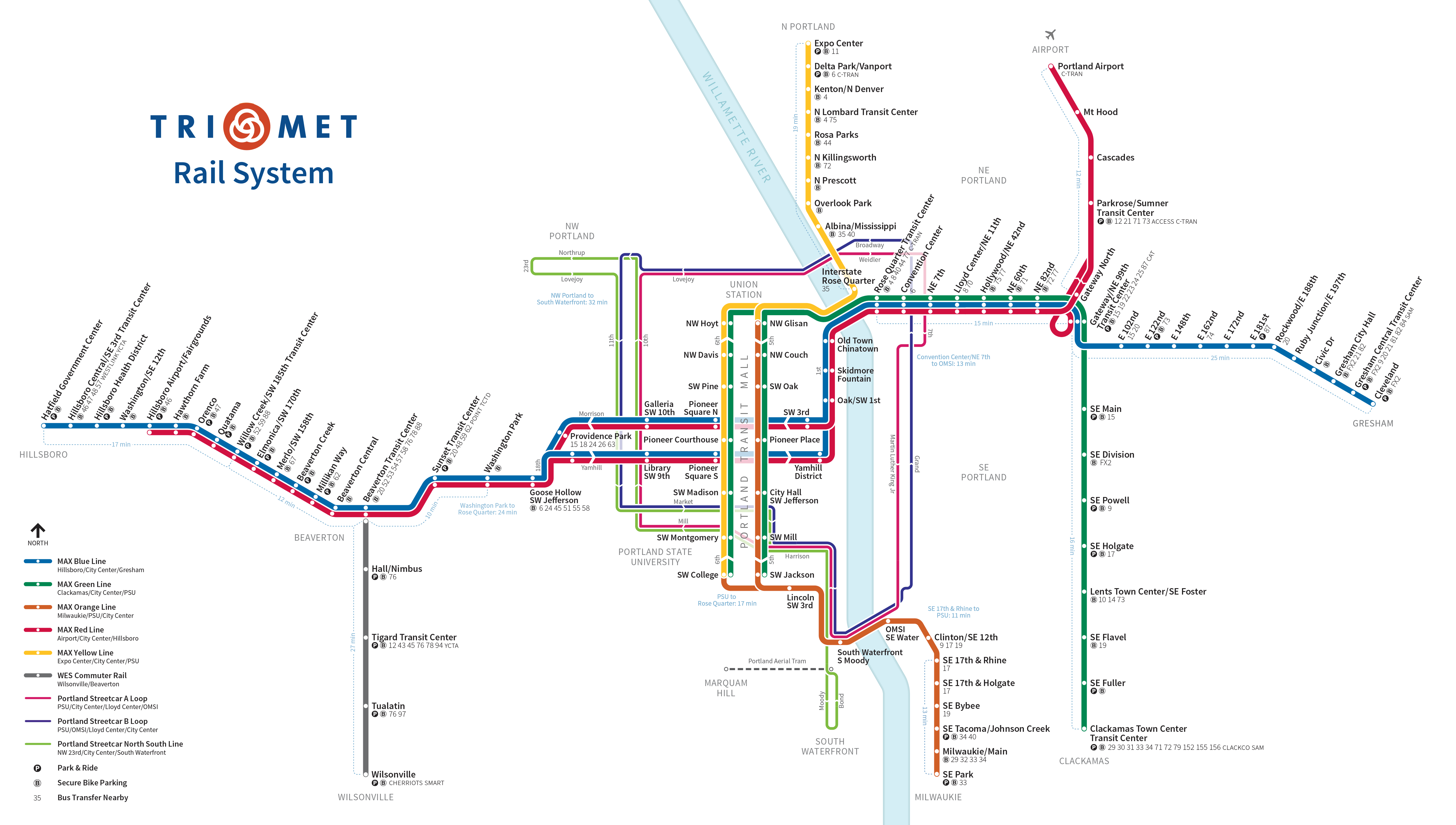
The Red Line serves the 5.5-mile (8.9 km) Airport MAX segment.[a] This segment begins just south of Gateway Transit Center where it branches from the Eastside MAX segment, makes a 180-degree loop, and heads north along the east side of the I-205 freeway.[1] Near Rocky Butte, it enters a tunnel beneath the northbound lanes of the freeway and emerges along the median.[43] The line then crosses over the southbound lanes of I-205 just south of the Columbia Slough and proceeds northwest along the south side of Cascade Parkway.[93] It follows this road then crosses it just before Mount Hood Ave station.[94] The line then continues northwest along the south side of Airport Way until it reaches its terminus at Portland Airport station.[95]
Beyond the Airport MAX, the Red Line serves parts of the Westside and Eastside MAX segments, sharing sections of track with the Blue Line from Hillsboro Airport/Fairgrounds station to Gateway Transit Center and the Green Line from Rose Quarter Transit Center to Gateway Transit Center.[96]

Stations
[edit]
The Airport MAX project added four stations to the MAX system: Portland Airport, Mount Hood Ave, Cascades, and Parkrose/Sumner Transit Center.[1] In March 2024, Gateway North, the newest MAX station, opened as part of A Better Red.[98] The Red Line serves these five stations in addition to 31 others, a total of 36 stations. It shares the 31 stations, from Hillsboro Airport/Fairgrounds station to Gateway Transit Center, with the Blue Line, of which eight stations, from Rose Quarter Transit Center to Gateway Transit Center, are additionally shared with the Green Line.
Riders can transfer from the Pioneer Square stations to the Green, Orange, and Yellow lines at the Pioneer Courthouse and Pioneer Place stations. Riders can also transfer from Rose Quarter Transit Center to the Yellow Line at Interstate/Rose Quarter station.[97] The Library and Galleria, Convention Center, and NE 7th Ave stations connect with the Portland Streetcar,[99] and Beaverton Transit Center connects with WES Commuter Rail.[100] Some stations provide connections with local and intercity bus services.[97]
| Icon | Purpose |
|---|---|
| † | Terminus |
| → | Portland Airport-bound travel only |
| ← | Hillsboro-bound travel only |
| Station | Location | Began service | Line transfers[97] | Connections and notes[97][101][c] |
|---|---|---|---|---|
| Hillsboro Airport/Fairgrounds† | Hillsboro | August 25, 2024[90][91] | 
|
Blue Line continues to Hatfield Government Center in downtown Hillsboro |
| Hawthorn Farm |
|
— | ||
| Orenco |
|
Connects with North Hillsboro Link | ||
| Quatama |
|
— | ||
| Willow Creek/SW 185th Ave Transit Center |
|
Connects with CC Rider, North Hillsboro Link | ||
| Elmonica/SW 170th Ave | Beaverton |
|
Near Elmonica maintenance facility | |
| Merlo Rd/SW 158th Ave |
|
— | ||
| Beaverton Creek |
|
— | ||
| Millikan Way |
|
— | ||
| Beaverton Central |
|
— | ||
| Beaverton Transit Center | September 1, 2003 |
|
Connects with WES Commuter Rail | |
| Sunset Transit Center |
|
Connects with BethanyLink, POINT, TCTD | ||
| Washington Park | Portland |
|
Connects with Washington Park Free Shuttle | |
| Goose Hollow/SW Jefferson St |
|
— | ||
| Kings Hill/SW Salmon St |
|
Closed on March 1, 2020[102] | ||
| Providence Park |
|
— | ||
| Library/SW 9th Ave→ | September 10, 2001 |
|
Connects with Portland Streetcar | |
| Galleria/SW 10th Ave← |
| |||
| Pioneer Square South→ |   
|
Connects with Portland Transit Mall | ||
| Pioneer Square North← |
| |||
| Mall/SW 4th Ave→ |
|
Closed on March 1, 2020[102] | ||
| Mall/SW 5th Ave← |
| |||
| Yamhill District→ |
|
— | ||
| Morrison/SW 3rd Ave← |
| |||
| Oak St/SW 1st Ave |
|
— | ||
| Skidmore Fountain |
|
Closed on August 24, 2025[103] | ||
| Old Town/Chinatown |
|
— | ||
| Rose Quarter Transit Center |
|
Connects with C-Tran. Green Line continues to PSU South on the Portland Transit Mall. | ||
| Convention Center |
|
Connects with Portland Streetcar | ||
| NE 7th Ave |
|
Connects with Portland Streetcar | ||
| Lloyd Center/NE 11th Ave |
|
— | ||
| Hollywood/NE 42nd Ave |
|
— | ||
| NE 60th Ave |
|
— | ||
| NE 82nd Ave |
|
— | ||
| Gateway/NE 99th Ave Transit Center→ |
|
Connects with Columbia Area Transit.[104] Blue Line continues to Cleveland Ave in Gresham. Green Line continues to Clackamas Town Center Transit Center. | ||
| Gateway North← | March 4, 2024 |
| ||
| Parkrose/Sumner Transit Center | September 10, 2001 | — | Connects with C-Tran | |
| Cascades | — | — | ||
| Mt Hood Ave | — | — | ||
| Portland Airport† | — | Connects with C-Tran |
Service
[edit]TriMet designates the Red Line as a "Frequent Service" route.[105] Red Line trains operate from 3:19 am to 1:43 am the next day with headways ranging from 30 minutes during the early mornings and late evenings to 15 minutes during peak hours. End-to-end travel from Hillsboro Airport/Fairgrounds station to Portland Airport station takes just over one hour.[106]
On September 2, 2018, TriMet reintroduced bus service to the airport, which had been replaced by the Red Line since 2001, with route 272–PDX Night Bus. Service ran in the late night and early morning hours when the Red Line was not operating. It traveled from the airport via Airport Way and 82nd Avenue to a local bus stop near Southeast 80th and Washington streets.[107][108] Route 272 was suspended on April 5, 2020, as a result of the COVID-19 pandemic.[109] It was reinstated on August 25, 2024, as route 292–Red Bus.[110][111] Route 292 travels a longer route than its predecessor with service through Southeast Portland and downtown, terminating at Goose Hollow/SW Jefferson St station.[112]
Ridership
[edit]The Red Line averaged 17,390 riders on weekdays in September 2024, the second busiest after the Blue Line.[2] One year after opening, the line averaged 2,800 daily riders at the airport, ahead of TriMet's first-year projections of 2,300.[113] The Red Line's extension to Beaverton Transit Center in 2003 increased weekday ridership by 49 percent along the Westside MAX corridor and six percent systemwide.[114]
IKEA's opening in July 2007 helped attract more riders to Cascade Station shopping center, which had been considered a failed planned development following the economic recession caused by the September 11 attacks.[115] In 2008, Cascades MAX station recorded an eight-fold increase in traffic, from 250 passengers per week to 2,000,[116] and this figure had further grown to 6,000 by 2010.[117] The Red Line's annual ridership peaked at just over nine million passengers in 2009,[118] and it continued to fall over the next decade as part of a system-wide decline attributed to crime and rising housing costs in the Portland area.[119][120] From 8.2 million boardings in 2012, 7.4 million boardings were recorded in 2015.[1][121]
The COVID-19 pandemic, which impacted public transit ridership globally, further exacerbated the line's—and TriMet's overall—ridership decline. From an average 22,530 weekday riders in September 2019,[122] TriMet recorded just 6,500 riders in April 2020 following local stay-at-home orders.[123]
Explanatory notes
[edit]- ^ a b TriMet publications only provide the total length of the Airport MAX extension, i.e., the 5.5-mile (8.9 km) section that was newly built. The total length of Red Line service, which includes segments of the Eastside MAX and the Westside MAX, has not been published.[1]
- ^ The official system schematic can be viewed on the TriMet website.[97]
- ^ This list of service connections excludes TriMet bus connections. For a complete list that includes all transfers, see: List of MAX Light Rail stations.
References
[edit]- ^ a b c d e f g h i "Airport MAX Red Line" (PDF). TriMet. July 2016. Archived from the original (PDF) on August 28, 2018. Retrieved August 24, 2018.
- ^ a b "September 2024 Monthly Performance Report" (PDF). TriMet. Retrieved November 20, 2024.
- ^ a b Kramer, George (May 2004). The Interstate Highway System in Oregon, A Historic Overview (Report). Oregon Department of Transportation. p. 60. OCLC 57183445. Archived from the original on August 31, 2018. Retrieved August 31, 2018 – via State Library of Oregon Digital Collections.
- ^ "Council backs I-205 if modified". The Oregonian. April 24, 1975. p. B4. Archived from the original on September 15, 2023. Retrieved May 22, 2021 – via NewsBank.
- ^ "Agreement on I-205 plans cited". The Oregonian. July 30, 1975. p. F4. Archived from the original on September 15, 2023. Retrieved May 22, 2021 – via NewsBank.
- ^ "Tri-Met board okays I-205 busway concept". The Oregonian. February 3, 1976. p. A8. Archived from the original on September 15, 2023. Retrieved May 22, 2021 – via NewsBank.
- ^ Hortsch, Dan (October 7, 1976). "I-205 section passes tests for final approval". The Oregonian. p. E12. Archived from the original on September 15, 2023. Retrieved May 22, 2021 – via NewsBank.
- ^ Redden, Jim (September 10, 2009). "After 35 years of waiting, TriMet's Green Line hits all the parties: Thousands ride new I-205 line that was born of a '70s freeway rebellion". Portland Tribune. Archived from the original on June 8, 2011. Retrieved May 13, 2014.
- ^ Cochran, Wanda; Kohler, Vince (December 14, 1984). "Light-rail study gets approval". The Oregonian. p. C7. Archived from the original on September 15, 2023. Retrieved April 8, 2022 – via NewsBank.
- ^ Kohler, Vince (July 11, 1985). "Light-rail line study under way". The Oregonian. p. D4. Archived from the original on September 15, 2023. Retrieved April 8, 2022 – via NewsBank.
- ^ Kohler, Vince (April 23, 1987). "Panel calls for study of proposed I-205 light-rail link". The Oregonian. p. D19. Archived from the original on September 15, 2023. Retrieved April 9, 2022 – via NewsBank.
- ^ Kohler, Vince (May 17, 1987). "Metro committee seeks funds to build I-205 light-rail link". The Oregonian. p. E2. Archived from the original on September 15, 2023. Retrieved April 9, 2022 – via NewsBank.
- ^ Bodine, Harry (September 30, 1987). "Light-rail expansion backed by officials". The Oregonian. p. B12. Archived from the original on September 15, 2023. Retrieved March 22, 2022 – via NewsBank.
- ^ Bodine, Harry (October 27, 1987). "Mass transit, major highway projects given priority". The Oregonian. p. B4. Archived from the original on September 15, 2023. Retrieved April 9, 2022 – via NewsBank.
- ^ United States. Department of Transportation; United States. Urban Mass Transportation Administration (March 1982). Westside Corridor Project Draft Environmental Impact Statement Alternatives Analysis (Report). pp. 2.1-3, 2.1-4. Archived from the original on September 15, 2023. Retrieved December 14, 2020 – via Google Books.
- ^ Kohler, Vince (May 23, 1988). "Joint efforts of business, government could spur rail line; both groups need to finance, back line along I-205, panel says". The Oregonian. p. B5.
- ^ Green, Ashbel S. (October 6, 1988). "County officials debate light-rail routes". The Oregonian. p. W1.
- ^ Bodine, Harry (January 14, 1989). "Metro OKs $1.5 billion transit plan". The Oregonian. p. D1.
- ^ Mayer, James (April 9, 1989). "Tri-Met looks to the future: The success of MAX sparks dreams of expanding". The Oregonian. p. A1.
- ^ McCarthy, Dennis (September 15, 1994). "Light-rail service? On to Oregon City!". The Oregonian. p. D2.
- ^ a b c d e Selinger, Philip (2019). "Making History: 50 Years of TriMet and Transit in the Portland Region" (PDF). TriMet. Archived (PDF) from the original on February 25, 2020. Retrieved April 25, 2020.
- ^ Oliver, Gordon; Hunsberger, Brent (December 9, 1996). "Holding the line on light rail". The Oregonian.
- ^ Oliver, Gordon (January 29, 1997). "Cost cuts map way to extend light rail". The Oregonian.
- ^ Oliver, Gordon (November 7, 1998). "South–North Line backers find themselves at a loss after election day defeat". The Oregonian. p. B1.
- ^ Mayes, Steve (April 11, 1991). "Portland's airport for the future only needs a $300 million ticket". The Oregonian. p. A1.
- ^ Barnett, Jim (January 12, 1995). "Port sees airport expansion". The Oregonian. p. E1. Retrieved December 23, 2024.
- ^ Dietsch, Deborah K. (2003). The Evolution of the Portland International Airport. New York: Edizioni Press, Inc. pp. 14–16. ISBN 1-931536-09-0. LCCN 2002101359.
- ^ Lynch, Jim (March 12, 1998). "Airport lands help from airlines for south concourse expansion". The Oregonian. Retrieved December 23, 2024.
- ^ Nichols, Chrissy Mancini (March 26, 2012). "Value Capture Case Studies: Portland's Cascade Station and Light Rail to PDX". Metropolitan Planning Council. Archived from the original on February 10, 2022. Retrieved February 10, 2022.
- ^ Oliver, Gordon (January 22, 1997). "Port wants MAX to run to airport". The Oregonian. p. A1.
- ^ Christ, Janet (January 1, 1998). "Portland to help pay for study of airport rail line". The Oregonian. p. D2.
- ^ Oliver, Gordon (September 24, 1998). "Tri-Met OKs rail line of 5.5 miles to airport". The Oregonian. p. B1.
- ^ a b Oliver, Gordon (October 9, 1998). "Port of Portland OKs light-rail agreement". The Oregonian. p. C1.
- ^ Rose, Michael (December 19, 1997). "PDX light rail may lead to south-north line". Portland Business Journal. p. 1.
- ^ Bjorhus, Jennifer (November 26, 1998). "Contractors battle Tri-Met on bid laws". The Oregonian. p. C1.
- ^ Bjorhus, Jennifer (December 5, 1998). "Court tosses out suit against Tri-Met, Bechtel". The Oregonian. p. B1.
- ^ a b Oliver, Gordon (September 10, 1998). "Light rail to airport gets closer to reality". The Oregonian. p. B1.
- ^ a b c d Oliver, Gordon (July 17, 1998). "Tri-Met puts price tag on airport line". The Oregonian. p. C1.
- ^ Ernico, Sheri (2012). Considering and Evaluating Airport Privatization (Report). Vol. 66. Transportation Research Board. p. 36. ISSN 1935-9802. Archived from the original on January 31, 2021. Retrieved August 23, 2018.
- ^ Airport Max: A Case Study (PDF) (Report). BATIC Institute. Archived from the original (PDF) on August 28, 2018. Retrieved August 26, 2018.
- ^ Oliver, Gordon (December 12, 1998). "3 airlines oppose light-rail money". The Oregonian. p. C1.
- ^ Stewart, Bill (May 29, 1999). "Ruling: Port ticket fees can finance 'Air MAX'". The Oregonian. p. B1.
- ^ a b c d e Stewart, Bill (June 17, 1999). "Light-rail line to PDX starting to take shape". The Oregonian. p. B1.
- ^ "TriMet's Rail Vehicle Fleet" (PDF). TriMet. July 2016. Archived from the original (PDF) on December 20, 2018. Retrieved December 19, 2018.
- ^ Yee, Roger (2005). Public Transportation: On the Move. Vol. 1. Visual Reference Publications. p. 43. ISBN 1584710373. Archived from the original on January 31, 2021. Retrieved November 10, 2018.
- ^ Tomlinson, Stuart (December 3, 1999). "Construction detours bottleneck I-84 traffic". The Oregonian. p. C3.
- ^ a b Stewart, Bill (December 17, 1999). "Don't look up, but MAX bridge going in over I-205; strict safety measures are in place to protect motorists, and as the span is built, tracks will start going in on Airport Way". The Oregonian. p. A1.
- ^ a b c d Stewart, Bill (July 10, 2000). "Airport's MAX station will be special". The Oregonian. p. E4.
- ^ Stewart, Bill (June 12, 2000). "Workers are busy making tracks toward Airport MAX 2001 deadline". The Oregonian. p. E4.
- ^ Gragg, Randy (May 28, 2000). "Airport canopy works, but not as it could; the structure signals an end to the worst phase of construction but it could – and should – have been done better". The Oregonian. p. F4.
- ^ "Portland International Airport, MAX Light Rail Line and Station, Portland, Oregon". ZGF Architects LLP. Archived from the original on January 11, 2019. Retrieved January 11, 2019.
- ^ "Systems News [regular news section]". Tramways & Urban Transit. Ian Allan Publishing. December 2000. p. 471. ISSN 1460-8324.
With the light rail system due to expand to two services in September 2001, and three in 2004 (with all three using the same routing and stops in the city centre), Tri-Met has decided to assign route colours as follows ...
- ^ Oliver, Gordon (September 11, 2001). "Portland now 'the city that moves', mayor says [opening of MAX Red Line]". The Oregonian. p. 1.
- ^ Oliver, Gordon (September 21, 2001). "Unknowns cloud PDX's future". The Oregonian. p. D1.
- ^ a b c Stewart, Bill (August 31, 2001). "Most Tri-Met fares rise Saturday, while route switches start Sept. 9". The Oregonian. p. B1.
- ^ "History cancels PDX party". The Oregonian. September 15, 2001. p. D8.
- ^ Rose, Joseph (September 17, 2001). "Even anti-noise advocates happy to hear airplanes again". The Oregonian. p. E6.
- ^ Stewart, Bill (September 7, 2001). "Airport MAX rolls out Monday". The Oregonian. p. B1.
- ^ "September 9th – Big Service Improvements". TriMet. September 11, 2001. Archived from the original on October 7, 2001. Retrieved November 26, 2018.
- ^ "MAX Red Line runs: Every 15 minutes, seven days a week". The Oregonian. September 11, 2001. p. A12.
- ^ "Systems News". Tramways & Urban Transit. Ian Allan Publishing. November 2001. p. 430. ISSN 1460-8324.
- ^ "About town: Riders keep Airport MAX busy Thanksgiving weekend". The Oregonian. November 27, 2001. p. D2.
- ^ Leeson, Fred (August 27, 2003). "MAX fares increase, direct service from Beaverton to PDX starts". The Oregonian. p. D2.
- ^ "Systems News". Tramways & Urban Transit. Ian Allan Publishing. July 2006. p. 276. ISSN 1460-8324.
- ^ "TriMet extends rush-hour MAX trains between Hillsboro, PDX". Beaverton Valley Times. March 3, 2008. Archived from the original on May 11, 2008. Retrieved November 1, 2015.
- ^ a b Howard, John William (October 25, 2017). "TriMet considering expansion of MAX Red Line to county fairgrounds". Hillsboro Tribune. Archived from the original on October 10, 2018. Retrieved August 22, 2018.
- ^ a b "MAX Red Line Improvements Project" (PDF). TriMet. Archived from the original (PDF) on March 2, 2019. Retrieved March 2, 2019.
- ^ a b "A Better Red" (PDF). TriMet. Archived from the original (PDF) on September 28, 2021. Retrieved September 28, 2021.
- ^ "MAX Red Line Extension and Reliability Improvements Project, Project Briefing to JPACT" (PDF). TriMet. January 18, 2017. Archived (PDF) from the original on October 23, 2021. Retrieved June 11, 2024.
- ^ "Meet the New MAX". TriMet. Archived from the original on June 6, 2024. Retrieved June 27, 2024.
- ^ "Parametrix to complete preliminary design for MAX Red Line extension". Parametrix. February 18, 2018. Archived from the original on September 13, 2018. Retrieved September 6, 2018.
- ^ "TriMet moves forward with plan to extend MAX Red Line into Hillsboro". KPTV. April 24, 2019. Archived from the original on April 25, 2019.
- ^ Corselli, Andrew (February 13, 2020). "TriMet Selects Parametrix to Finish 'A Better Red'". Railway Age. Archived from the original on March 10, 2020. Retrieved February 13, 2020.
- ^ "Design – A Better Red". TriMet. Archived from the original on May 26, 2021. Retrieved May 26, 2021.
- ^ a b Altstadt, Roberta (August 28, 2024). "TriMet, FTA and partners celebrate a new era for the MAX Red Line". TriMet. Archived from the original on September 6, 2024. Retrieved October 7, 2024.
- ^ Corselli, Andrew (May 29, 2020). "FTA Announces $891MM in Funding". Railway Age. Archived from the original on May 29, 2020. Retrieved May 29, 2020.
- ^ Danko, Pete (May 29, 2020). "TriMet gets $100M from feds for MAX Red Line project". Portland Business Journal. Archived from the original on May 29, 2020. Retrieved May 29, 2020.
- ^ Altstadt, Roberta (September 29, 2021). "(VIDEO) FTA, TriMet and partners officially break ground on 'A Better Red' MAX extension and improvement project". TriMet. Archived from the original on June 7, 2023. Retrieved June 27, 2024.
- ^ "A Better Red MAX disruption April 2–9". TriMet. Archived from the original on April 5, 2022. Retrieved April 4, 2022.
- ^ TriMet [@trimet] (April 10, 2022). "MAX Red Line has resumed normal service. Thank you for your patience while we completed this necessary work for the Better Red project. Here are some photos from our work over the past week" (Tweet). Retrieved April 10, 2022 – via Twitter.
- ^ Campbell, Sam (April 1, 2022). "MAX Red Line service halted during weeklong construction". KOIN. Archived from the original on April 3, 2022. Retrieved April 3, 2022.
- ^ Villanueva, Mia (April 1, 2022). "Temporary MAX Red Line closure starts Saturday". KPTV. Archived from the original on April 1, 2022. Retrieved April 3, 2022.
- ^ Luczak, Marybeth (September 27, 2021). "TriMet's 'A Better Red' Receiving $99.1MM CIG Grant". Railway Age. Archived from the original on September 29, 2021. Retrieved December 22, 2021.
- ^ "FTA, TriMet and partners officially break ground on 'A Better Red' MAX extension and improvement project". Mass Transit. September 29, 2021. Archived from the original on September 30, 2021. Retrieved December 22, 2021.
- ^ Stein, Rosemarie (June 14, 2023). "TriMet shuts down MAX Red Line to PDX for more than 4 months beginning Sunday". The Oregonian. Archived from the original on June 14, 2023. Retrieved June 14, 2023.
- ^ Graf, Tyler (June 12, 2023). "TriMet's A Better Red project requires 126-day shutdown of MAX Red Line starting this weekend". TriMet. Archived from the original on June 14, 2023. Retrieved June 14, 2023.
- ^ "MAX Improvements Project". trimet.org. Archived from the original on February 25, 2024. Retrieved February 25, 2024.
- ^ McLawhorn, Jennifer (February 16, 2024). "TriMet Gateway North MAX Station Opens in March". Railway Track & Structures. Archived from the original on February 25, 2024. Retrieved February 25, 2024.
- ^ McKinney, Kevin (May 2024). "Rush Hour [transit news section]". Passenger Train Journal. Vol. 48, no. 2 – Second quarter 2024. White River Productions, Inc. pp. 68–69. ISSN 0160-6913.
- ^ a b Plante, Amiee; Salk, Ariel (August 26, 2024). "Major changes coming to MAX, bus service as TriMet completes Hillsboro Airport expansion". KOIN. Archived from the original on August 27, 2024. Retrieved August 28, 2024.
- ^ a b Anderson, Luisa (August 28, 2024). "TriMet's MAX Red Line from PDX airport to Hillsboro officially opens". KGW. Retrieved August 28, 2024.
- ^ a b McKinney, Kevin (November 2024). "Rush Hour [transit news section]". Passenger Train Journal. Vol. 48, no. 4 – Fourth quarter 2024. White River Productions, Inc. pp. 67–68. ISSN 0160-6913.
- ^ "Stop ID 10575 – Cascades MAX Station". TriMet. Archived from the original on September 7, 2018. Retrieved September 7, 2018.
- ^ "Stop ID 10577 – Mt Hood MAX Station". TriMet. Archived from the original on May 9, 2018. Retrieved September 7, 2018.
- ^ "Stop ID 10579 – Portland Int'l Airport MAX Station". TriMet. Archived from the original on May 9, 2018. Retrieved September 7, 2018.
- ^ TriMet System map (PDF) (Map). TriMet. Archived from the original (PDF) on February 10, 2019. Retrieved July 25, 2018.
- ^ a b c d e "TriMet Rail System". TriMet. Archived from the original on July 29, 2020. Retrieved May 5, 2024.
- ^ Graf, Tyler (March 4, 2024). "TriMet celebrates first new MAX station in 9 years following A Better Red construction near Gateway". TriMet. Retrieved July 2, 2024.
- ^ "Maps + Schedules – Portland Streetcar". Portland Streetcar. Archived from the original on February 10, 2019. Retrieved October 11, 2018.
- ^ "WES Commuter Rail". TriMet. Archived from the original on February 10, 2019. Retrieved September 5, 2018.
- ^ Portland City Center and Transit Mall (PDF) (Map). TriMet. Archived from the original (PDF) on March 28, 2020. Retrieved July 30, 2018.
- ^ a b Altstadt, Roberta (July 24, 2019). "TriMet to make MAX service more efficient with closure of three stations in Downtown Portland in March 2020". TriMet. Archived from the original on July 24, 2019. Retrieved July 24, 2019.
- ^ Miller, Mark (August 4, 2025). "TriMet will close Skidmore Fountain MAX Station on Aug. 24". TriMet. Retrieved August 4, 2025.
- ^ "Cascade Locks & Portland – CAT". Columbia Area Transit. Archived from the original on September 16, 2018. Retrieved February 14, 2019.
- ^ "Frequent Service". TriMet. Archived from the original on January 9, 2019. Retrieved August 6, 2018.
- ^ MAX Red Line schedules:
- For weekday, to Portland City Center and Hillsboro: "MAX Red Line, Weekday To Portland City Center and Hillsboro" (PDF). TriMet. Archived (PDF) from the original on November 21, 2024. Retrieved November 21, 2024.
- For weekday, to Portland City Center and Airport: "MAX Red Line, Weekday To Portland City Center and Airport" (PDF). TriMet. Archived (PDF) from the original on November 21, 2024. Retrieved November 21, 2024.
- For Saturday, to Portland City Center and Hillsboro: "MAX Red Line, Saturday To Portland City Center and Hillsboro" (PDF). TriMet. Archived (PDF) from the original on November 21, 2024. Retrieved November 21, 2024.
- For Saturday, to Portland City Center and Airport: "MAX Red Line, Saturday To Portland City Center and Airport" (PDF). TriMet. Archived (PDF) from the original on November 21, 2024. Retrieved November 21, 2024.
- For Sunday, to Portland City Center and Hillsboro: "MAX Red Line, Sunday To Portland City Center and Hillsboro" (PDF). TriMet. Archived (PDF) from the original on November 21, 2024. Retrieved November 21, 2024.
- For Sunday, to Portland City Center and Airport: "MAX Red Line, Sunday To Portland City Center and Airport" (PDF). TriMet. Archived (PDF) from the original on November 21, 2024. Retrieved November 21, 2024.
- ^ Theen, Andrew (August 30, 2018). "New TriMet bus, MAX additions create all-night service to PDX". The Oregonian. Archived from the original on September 16, 2018.
- ^ "272–PDX Night Bus". TriMet. Archived from the original on January 11, 2019. Retrieved January 11, 2019.
- ^ Hanson, Nate (March 27, 2020). "TriMet to alter schedules for buses, trains after ridership drops 47% during coronavirus pandemic". KGW. Archived from the original on April 25, 2021. Retrieved April 25, 2021.
- ^ Kish, Matthew (August 26, 2024). "TriMet announces sweeping changes to light rail, bus service". The Oregonian. Retrieved November 2, 2024.
- ^ "August '24 Transit Service Changes". TriMet. Archived from the original on August 28, 2024. Retrieved August 28, 2024.
- ^ "292–Red Bus". TriMet. Archived from the original on October 4, 2024. Retrieved November 20, 2024.
- ^ Leeson, Fred (September 9, 2002). "Air travelers find MAX a deal". The Oregonian. p. E1.
- ^ Rivera, Dylan (September 6, 2009). "MAX: More than the sum of its parts". The Oregonian.
- ^ Mayer, James (July 19, 2007). "Portland blinked and Ikea came". The Oregonian. p. B1.
- ^ Ballenger, Tara (July 27, 2008). "Cascade Station: Ikea to the rescue". The Oregonian. p. S5.
- ^ Griffin, Anna (May 19, 2010). "At Cascade Station, it takes a mall, not a village, to thrive". The Oregonian.
- ^ "Infrastructure Case Study: Portland Airport MAX Red Line" (PDF). Bipartisan Policy Center. October 2016. Archived from the original (PDF) on September 13, 2018. Retrieved September 13, 2018.
- ^ Keizur, Christopher (June 12, 2017). "Safe travels?". Portland Tribune. Archived from the original on August 4, 2018. Retrieved August 3, 2018.
- ^ Zielinski, Alex (May 18, 2018). "You Know Portland's Transportation Woes Have Reached a Breaking Point When..." Portland Mercury. Archived from the original on August 4, 2018. Retrieved August 3, 2018.
- ^ "Airport MAX: Red Line" (PDF). TriMet. August 2012. Archived from the original (PDF) on September 14, 2018. Retrieved September 13, 2018.
- ^ "September 2019 Monthly Performance Report" (PDF). TriMet. Archived (PDF) from the original on April 26, 2020. Retrieved January 9, 2020.
- ^ "April 2020 Monthly Performance Report" (PDF). TriMet. Retrieved November 20, 2024.
External links
[edit]

 Media related to MAX Red Line at Wikimedia Commons
- "MAX Red Line". TriMet.

| Bus |
| ||||||||
|---|---|---|---|---|---|---|---|---|---|
| Rail |
| ||||||||
| Other | |||||||||
Italics denote lines or services which are planned, under construction, or otherwise not operating at the present time. | |||||||||


MAX Red Line
View on GrokipediaHistory
Planning and Background
The concept of light rail service to Portland International Airport (PDX) emerged in regional transportation and airport master planning during the mid-1980s, incorporating provisions for a transitway along Interstate 205.[2] This planning aligned with the initial phases of the MAX light rail system, which began operations in 1986, but focused on future airport connectivity amid anticipated growth in air travel demand.[2] By the 1990s, PDX passenger traffic had doubled from 6 million annually in 1990 to projections exceeding 14 million by 2008, prompting accelerated efforts to realize the rail link.[2] In 1997, Bechtel Enterprises proposed a public-private partnership to TriMet, the Port of Portland, and the City of Portland, committing 25% of project funding—approximately $28.2 million—in exchange for development rights to a 120-acre site adjacent to the airport for commercial use, including the Cascade Station retail complex.[2] This innovative financing model avoided new taxes or additional federal subsidies, leveraging private investment to expedite implementation.[8] The proposal underwent an accelerated review process, securing 85 agreements and 20 regulatory approvals within nine months.[2] In 1998, a public review committee endorsed the project, leading to groundbreaking in May 1999 and major construction starting in June of that year.[8][2] Total funding reached $125 million, sourced from TriMet (36%), Bechtel/Cascade Station Development Company (23%), the Port of Portland (23%), the City of Portland (18%), and regional contributions.[8] The 5.5-mile extension shared existing tracks with the Blue Line from downtown to Gateway Transit Center, introducing four new stations and marking the first train-to-plane service on the West Coast upon its completion.[8]Initial Construction and Airport Opening
The initial construction of the MAX Red Line focused on a 5.5-mile (8.9 km) light rail extension branching from the existing Gateway Transit Center northeastward to Portland International Airport (PDX), marking the first direct train-to-plane rail connection on the West Coast.[8] This project added three new stations—Parkrose/Sumner Transit Center, Mt. Hood Medical Center, and Portland International Airport—while utilizing the existing Gateway station, for a total of four stations on the airport spur.[8] The extension primarily followed the median of Interstate 205 and crossed the Interstate Bridge over the Columbia River, integrating with the broader MAX system to enable through service from the airport to downtown Portland and Beaverton.[8] Construction began in May 1999 following agreements finalized in late 1998, leveraging a public-private partnership that expedited development through private financing and local contributions, including tax increment financing.[9] The $125 million project was completed in under two years, reflecting efficient execution amid urban and interstate constraints.[8][4] This rapid timeline—from initial proposal to revenue service in approximately five years—highlighted innovative funding models that reduced reliance on federal grants alone.[2] The line opened to passenger service on September 10, 2001, coinciding with the introduction of Red Line branding for airport-bound trains operating on shared tracks south of Gateway with Blue and Green Line services.[8][4] Despite launching one day before the September 11 terrorist attacks, which temporarily disrupted air travel and ridership, the extension immediately provided seamless transit access to PDX, enhancing regional connectivity without requiring transfers.[9] Early operations featured Bombardier low-floor vehicles, with service frequencies designed to align with airport schedules.[2]Extensions to Beaverton and Hillsboro
The MAX Red Line service was extended westward to Beaverton Transit Center on September 27, 2003, utilizing existing tracks originally built for the Westside MAX Blue Line extension completed in 1998.[2] This addition, spanning approximately 6.5 miles from the previous terminus at Gateway/Northeast 99th Avenue Transit Center, responded to increasing ridership demands and integrated airport service with suburban connectivity, adding five intermediate stations including Delta Park/Viking and Beaverton Central.[2] No new infrastructure was required, as the extension leveraged double-tracked segments already in place, allowing Red Line trains to operate alongside Blue Line services with minimal disruption.[10] Further expansion to Hillsboro occurred as the culmination of TriMet's A Better Red project, initiated in 2021 to enhance system reliability and capacity.[6] On August 28, 2024, Red Line service officially reached Hillsboro Airport/Fairgrounds station, adding 10 stations westward from Beaverton Transit Center over 7.5 miles of existing alignment, including stops at Orenco, Quatama, and Tuality Hospital.[11] The project eliminated two single-track segments prone to delays—near Willow Creek/Southwest 185th Avenue and between Fair Complex/Hillsboro Airport and Hillsboro Westside Transit Center—through double-tracking, signal upgrades, and platform extensions, at a total cost of $215 million funded partly by federal grants.[12] This extension doubled peak-hour frequencies between Beaverton and Hillsboro, reducing Blue Line overcrowding and providing direct airport-to-airport linkage from Portland International Airport to Hillsboro Airport for the first time.[6] Service patterns now include Red Line trains terminating at Hillsboro every 15 minutes during weekdays, improving access for over 50,000 new residents in the corridor since 2003.[13]Recent Improvements and Better Red Project
The A Better Red project, undertaken by TriMet, addressed longstanding reliability issues on the MAX Red Line by eliminating two single-track segments near Portland International Airport, which had previously caused delays and bottlenecks.[11] These improvements included double-tracking approximately 2.5 miles of the alignment between Northeast 82nd Avenue and Cascade Station, enhancing capacity and reducing wait times for airport-bound passengers.[14] The project also upgraded signaling systems and added passing sidings to allow for more consistent service intervals across the line.[15] In parallel, the initiative extended Red Line service westward from Beaverton Transit Center to Hillsboro Airport station, adding service to 10 additional stations along the existing Westside MAX alignment previously served only by Blue Line trains.[11] This extension, effective August 28, 2024, enables one-seat rides from the airport to Hillsboro, shortening end-to-end travel times by up to 15 minutes during peak periods and doubling frequency to every 15 minutes between downtown Portland and Beaverton.[16] To support the increased operations, TriMet acquired four new light rail vehicles, integrated into the fleet for Red Line runs.[17] Funded primarily through federal grants from the Federal Transit Administration and local bonds, the project totaled $215 million and was completed on schedule and within budget after starting construction in 2021.[11] Early post-opening data indicated improved on-time performance, with Red Line reliability rising from approximately 70% to over 85% in the initial months, though systemwide effects on Blue Line service required schedule adjustments to maintain overall network balance.[14] The enhancements have boosted ridership potential in Washington County, where demand for direct airport connections had grown with regional employment hubs.[18]Route and Infrastructure
Route Alignment and Key Segments
The MAX Red Line operates along a 27-mile route extending from Portland International Airport (PDX) in the northeast to Hillsboro Airport/Fairgrounds station in the west, serving Portland's city center, Beaverton, and intermediate suburbs.[1] The alignment primarily utilizes dedicated light rail corridors, including freeway medians, at-grade street-running sections, and elevated structures, with total travel time end-to-end approximately 80-90 minutes depending on service patterns.[19] It shares trackage extensively with the Blue Line westward from Gateway/NE 99th Avenue Transit Center through downtown and Beaverton to Hillsboro, while featuring a dedicated spur from Gateway to PDX that diverges northeastward.[1] A defining key segment is the 5.5-mile Airport MAX spur, completed in 2001, which branches from the mainline at Gateway/NE 99th Avenue Transit Center and heads northeast parallel to Interstate 205 before curving west to serve PDX directly via dedicated right-of-way and at-grade alignments along Airport Way and NE 82nd Avenue.[1] This segment includes three stations—Parkrose/Sumner Transit Center, Cascades Station (near a commercial area), and Portland International Airport station (located post-security near baggage claim)—and features grade-separated crossings over major roadways to prioritize airport access.[1] The spur's design emphasizes connectivity to air travel, with pedestrian bridges and integration to airport facilities, though it operates on shared tracks with the Yellow Line in this area.[1] East of the airport spur, the route aligns with the Banfield (Interstate) corridor along Interstate 84's median from Gateway/NE 99th Avenue Transit Center westward through East Portland, passing stations such as Hollywood/Northeast 42nd Avenue and Lloyd Center/Northeast 19th Avenue before entering downtown via an underground tunnel segment under the Willamette River.[1] This 8-mile stretch, part of the original 1986 Interstate MAX alignment, uses elevated and at-grade tracks in freeway medians to minimize urban disruption, serving high-density employment and retail zones.[1] The western portion follows the 18-mile Westside MAX corridor, opened in 1998, from downtown Portland's transit mall westward through Beaverton to Hillsboro, incorporating a mix of surface running, aerial structures over highways, and tunnel segments under the West Hills.[6] Key sub-segments include the extension implemented on August 28, 2024, which added service to 10 stations beyond Beaverton Transit Center, reaching Hillsboro Airport/Fairgrounds via alignments such as the Orenco/Northwest 231st Avenue area (surface-level suburban stops) and elevated sections over U.S. Route 26.[6] This corridor supports regional commuting with park-and-ride facilities at multiple points, enhancing redundancy on shared Blue Line tracks.[1]Stations and Accessibility
The MAX Red Line serves 28 stations along its approximately 30-mile route from Portland International Airport to Hillsboro Airport/Fairgrounds, facilitating connections across Portland's east-northeast, central, and western suburbs.[1] Stations feature standardized accessibility measures compliant with the Americans with Disabilities Act, including elevators or ramps at all platforms, level boarding for low-floor trains, audible signals, and tactile warning strips for visual impairment navigation.[20] These features enable direct boarding for wheelchair users and those with mobility aids onto all MAX vehicles, with TriMet maintaining an elevator status tracker for real-time outages.[21] Key eastern stations include the Portland International Airport MAX Station, integrated into the terminal's south end for seamless access from baggage claim levels, complete with nearby retail and no dedicated parking to prioritize drop-off traffic.[22][23] Adjacent stops such as Mt. Hood Avenue, Cascades, Parkrose/Sumner Transit Center, and Gateway/Northeast 99th Avenue Transit Center provide local bus connections and limited parking, while the newly opened Gateway North station in March 2024 enhances service in the Gateway district with improved pedestrian access.[24][25] From Hollywood/Northeast 42nd Avenue through Lloyd Center/Northeast 11th Avenue and Convention Center, stations link to shopping, events, and other MAX lines in the Lloyd District.[22] In the central city segment, stops like Rose Quarter Transit Center offer intermodal ties to buses and the Portland Streetcar, with platforms elevated for urban integration.[22] Western stations, shared with the Blue Line, include Sunset Transit Center and Beaverton Transit Center, the former pre-extension terminus until August 2024, both equipped with park-and-ride lots, bike lockers, and at Beaverton, connections to WES commuter rail service plus amenities like coffee shops.[22][26] The 2024 extension added stations at Merlo Road/Southwest 158th Avenue, Willow Creek/Southwest 185th Avenue Transit Center, and the Hillsboro Airport/Fairgrounds terminus, featuring park-and-ride facilities near the airport and event venues, with over 100 parking spaces to support commuter access.[26][22] Newer Type 6 rail cars, introduced in January 2025, incorporate enhanced accessibility such as wider doors, dedicated wheelchair spaces, and improved audio-visual announcements to assist riders with disabilities.[27] Periodic maintenance, such as elevator repairs at stations like Northeast 82nd Avenue, may temporarily require shuttle alternatives, but overall system reliability supports consistent accessible service.[1] Park-and-ride options at suburban stations like Willow Creek and Hillsboro encourage automobile-to-transit shifts, with capacities varying from dozens to hundreds of spaces depending on demand.[28]Technical Specifications
The MAX Red Line operates on standard gauge track measuring 1,435 mm (4 ft 8½ in).[29] Electrification is provided by a 750 V DC overhead catenary system, consistent with the broader MAX network.[30] Light rail vehicles achieve a maximum operating speed of 55 mph (89 km/h), though average speeds are lower due to urban alignments, frequent stops, and grade separations.[29] The route spans approximately 33 miles (53 km) end-to-end from Hillsboro Airport/Fairgrounds station to Portland International Airport, utilizing double-track infrastructure for most segments, with recent improvements addressing prior single-track bottlenecks at Gateway Transit Center and the airport spur.[31][32] Signaling employs a wayside block system integrated with central traffic control, enabling automatic train protection and supervision to manage shared trackage with Blue and Green lines.[30]| Key Technical Parameter | Value |
|---|---|
| Track Gauge | 1,435 mm (4 ft 8½ in) standard[29] |
| Electrification | 750 V DC overhead[30] |
| Maximum Speed | 55 mph (89 km/h)[29] |
| Route Length | ~33 miles (53 km)[31] |
| Track Configuration | Primarily double track, with grades up to 6% and minimum curve radius of 300 ft in urban sections[29] |
Operations
Service Patterns and Scheduling
The MAX Red Line operates as a through service connecting Hillsboro in the west with Portland International Airport (PDX) in the east, passing through Portland City Center and serving intermediate stations along the shared Westside Corridor (with the Blue Line) and the Airport MAX extension.[1] Trains follow a linear route without branching, covering approximately 26 miles and all 34 stations in sequence, with no short-turn patterns during regular operations.[1] This pattern prioritizes airport connectivity, with inbound trains from the suburbs timed to align with early morning arrivals and outbound service extending into late evening to accommodate flights.[1] Service runs daily for approximately 20 hours, from early morning to late night, classified under TriMet's Frequent Service network.[1] The first train arrives at PDX at 4:43 a.m. on weekdays and 4:46 a.m. on weekends; the last departure from PDX heads west toward Willow Creek/Transit Center, arriving around 12:27 a.m. daily.[1] End-of-line service to Hillsboro Airport/Fairgrounds concludes at 10:57 p.m. on weekdays and 11:27 p.m. on weekends.[1] Frequencies maintain headways of 15 minutes or better for most of the operating day, every day, with potential extensions to 30 minutes during overnight shoulder periods or due to mechanical delays; peak-hour service does not feature higher frequencies beyond this baseline.[1][24] Scheduling is managed by TriMet to ensure reliability, with real-time adjustments via transit signal priority along key segments and coordination with air traffic patterns at PDX, though elevator outages or track work can introduce temporary disruptions.[1] Travel time from downtown Portland (e.g., Pioneer Square) to PDX averages 38 minutes under normal conditions.[1] No dedicated event or holiday patterns deviate significantly from standard operations, maintaining the core airport-suburb linkage without reductions on weekends.[24]Rolling Stock and Maintenance
The MAX Red Line operates using light rail vehicles (LRVs) drawn from TriMet's shared fleet across all MAX lines, consisting of 145 vehicles spanning Types 1 through 5 as of late 2024.[33] Type 2 LRVs, manufactured by Siemens between 1992 and 2000, were specifically introduced to support the Red Line's initial operations and extensions, numbering 52 vehicles with low-floor design for accessibility, 92-foot length, and double-articulated configuration.[33] These are supplemented by other types, including the original Type 1 Bombardier vehicles (26 units, built 1984-1986) and later models like Types 3, 4, and 5, which provide additional capacity through features such as improved air conditioning and seating.[33] In 2025, TriMet began deploying 30 new Type 6 LRVs from Siemens to enhance reliability and accommodate the Red Line's extension to Hillsboro, with 26 units replacing aging Type 1 vehicles and four dedicated to fleet expansion.[34][35] These modern vehicles feature reconfigured seating for better legroom, advanced technology for rider experience, and overall system improvements.[34] Trains on the Red Line typically consist of two-car consists, though longer trains may operate during peak periods to meet demand.[33] Maintenance of Red Line LRVs occurs at TriMet's two primary rail facilities: Ruby Junction in Gresham and Elmonica in Beaverton.[36] The Ruby Junction facility, established in 1982 and expanded multiple times through 2015, handles comprehensive repairs including wheel truing, truck work, painting, and body shop services, with capacity for 68 stored LRVs and a dedicated washbay.[36] Elmonica, located along the Westside alignment, supports light repairs, inspections, component exchanges, and HVAC maintenance, storing up to 59 LRVs and minimizing deadhead mileage for efficient operations.[36] These facilities ensure fleet readiness through routine inspections, overhauls, and reliability-focused programs, benefiting the Red Line via the integrated MAX system.[36]Ridership Trends and Metrics
The MAX Red Line's weekday ridership averaged between 16,000 and 17,400 passengers per day during mid-2025, positioning it as the second-busiest line in the TriMet system after the Blue Line. Monthly variations reflect seasonal patterns, with higher volumes in summer months tied to increased airport traffic at Portland International Airport (PDX), where the line terminates. For instance, July 2025 recorded an average of 17,408 weekday boardings, while August 2025 saw 16,254.| Month (2025) | Average Weekday Boardings |
|---|---|
| May | 16,661 |
| June | 16,103 |
| July | 17,408 |
| August | 16,254 |