Hubbry Logo
Macintosh PlusMacintosh PlusMain
Open search
Macintosh Plus
Community hub
Macintosh Plus
logo
8 pages, 0 posts
0 subscribers
Be the first to start a discussion here.
Macintosh Plus
Macintosh Plus
from Wikipedia

Macintosh Plus
Macintosh Plus monitor, keyboard, and mouse in front of a white background
Macintosh Plus with keyboard and mouse
Also known asM0001A
ManufacturerApple Computer, Inc.
Product familyCompact Macintosh
Release dateJanuary 16, 1986; 39 years ago (1986-01-16)
Introductory priceUS$2,599 (equivalent to $7,460 in 2024)
DiscontinuedOctober 15, 1990; 35 years ago (1990-10-15) (production)
September 27, 1996; 29 years ago (1996-09-27) (operating system updates)
Operating systemSystem 3.07.5.5 (except 7.5.2)
CPUMotorola 68000 @ 7.8 MHz
Memory1 MB RAM, expandable to 4 MB (150 ns 30-pin SIMM)
Display9 in (23 cm) monochrome, 512 × 342
Graphics72 ppi
DimensionsHeight: 13.6 in (35 cm)
Width: 9.6 in (24 cm)
Depth: 10.9 in (28 cm)
Weight16.5 lb (7.5 kg)
PredecessorMacintosh 512K
SuccessorMacintosh SE
RelatedMacintosh 512Ke

The Macintosh Plus computer is the third model in the Macintosh line, introduced on January 16, 1986, two years after the original Macintosh and a little more than a year after the Macintosh 512K, with a price tag of US$2,599.[1] As an evolutionary improvement over the 512K, it shipped with 1 MB of RAM standard, expandable to 4 MB, and an external SCSI peripheral bus, among smaller improvements. Originally, the computer's case was the same beige color as the original Macintosh, Pantone 453;[2] however, in 1987, the case color was changed to the long-lived, warm gray "Platinum" color.[3] It is the earliest Macintosh model able to run System Software 5, System 6, and System 7, up to System 7.5.5, but not System 7.5.2.

Overview

[edit]

Bruce Webster of BYTE reported a rumor in December 1985: "Supposedly, Apple will be releasing a Big Mac by the time this column sees print: said Mac will reportedly come with 1 megabyte of RAM ... the new 128K-byte ROM ... and a double-sided (800K bytes) disk drive, all in the standard Mac box."[4] Introduced as the Macintosh Plus, it was the first Macintosh model to include a SCSI port, which launched the popularity of external SCSI devices for Macs, including hard disks, tape drives, CD-ROM drives, printers, Zip drives, and even monitors.[5] The SCSI implementation of the Plus was engineered shortly before the initial SCSI spec was finalized and, as such, is not 100% SCSI-compliant. SCSI ports remained standard equipment for all Macs until the introduction of the iMac in 1998.

The Macintosh Plus was the last classic Mac to have an RJ11 port on the front of the unit for the keyboard, as well as the DE-9 connector for the mouse; models released after the Macintosh Plus would use ADB ports.

The Mac Plus was the first Apple computer to utilize user-upgradable SIMM memory modules instead of single DIP DRAM chips. Four SIMM slots were provided and the computer shipped with four 256 KB SIMMs, for 1 MB total RAM. By replacing them with 1 MB SIMMs, it was possible to have 4 MB of RAM. (Although 30-pin SIMMs could support up to 16 MB total RAM, the Mac Plus motherboard had only 22 address lines connected, for a 4 MB maximum.)

It has what was then a new 3+12-inch double-sided 800 KB floppy drive, offering double the capacity of floppy disks from previous Macs, along with backward compatibility. The drive is controlled by the same IWM chip as in previous models, implementing variable speed GCR. The drive was still completely incompatible with PC drives. The 800 KB drive has two read/write heads, enabling it to simultaneously use both sides of the floppy disk and thereby double storage capacity. Like the 400 KB drive before it, a companion Macintosh 800K External Drive was an available option. However, with the increased disk storage capacity combined with 2-4x the available RAM, the external drive was less of a necessity than it had been with the 128K and 512K.

The Mac Plus has 128 KB of ROM on the motherboard, which is double the amount of ROM in previous Macs; the ROMs included software to support SCSI, the then-new 800 KB floppy drive, and the Hierarchical File System (HFS), which uses a true directory structure on disks (as opposed to the earlier MFS, Macintosh File System in which all files were stored in a single directory, with one level of pseudo-folders overlaid on them). For programmers, the fourth Inside Macintosh volume details how to use HFS and the rest of the Mac Plus's new system software. The Plus still did not include provision for an internal hard drive and it would be over nine months before Apple would offer a SCSI drive replacement for the slow Hard Disk 20. It would be well over a year before Apple would offer the first internal hard disk drive in any Macintosh.

A compact Mac, the Plus has a 9-inch (23 cm) 512 × 342 pixel monochrome display with a resolution of 72 PPI, identical to that of previous Macintosh models.[6] Unlike earlier Macs, the Mac Plus's keyboard includes a numeric keypad and directional arrow keys and, as with previous Macs, it has a one-button mouse and no fan, making it extremely quiet in operation. The lack of a cooling fan in the Mac Plus led to frequent problems with overheating and hardware malfunctions.

The applications MacPaint and MacWrite were bundled with the Mac Plus. After August 1987, HyperCard and MultiFinder were also bundled. Third-party software applications available included MacDraw, Microsoft Word, Excel, and PowerPoint, as well as Aldus PageMaker. Microsoft Excel and PowerPoint (originally by Forethought) were actually developed and released first for the Macintosh, and similarly Microsoft Word 1 for Macintosh was the first time a GUI version of that software was introduced on any personal computer platform. For a time, the exclusive availability of Excel and PageMaker on the Macintosh were noticeable drivers of sales for the platform.

The Apple Macintosh Plus at the Design Museum in Gothenburg, Sweden

The case design is essentially identical to the original Macintosh. It debuted in beige and was labeled Macintosh Plus on the front, but Macintosh Plus 1 Mb on the back, to denote the 1 MB RAM configuration with which it shipped. In January 1987 it transitioned to Apple's long-lived platinum-gray color with the rest of the Apple product line, and the keyboard's keycaps changed from brown to gray. In January 1988, with reduced RAM prices, Apple began shipping 2- and 4- MB configurations and rebranded it simply as "Macintosh Plus." Among other design changes, it included the same trademarked inlaid Apple logo and recessed port icons as the Apple IIc and IIGS before it, but it essentially retained the original design. On the inside of the case, embossed into it, are the signatures of all the people who worked on designing the Mac Plus, including Steve Jobs, Bill Atkinson, Andy Hertzfeld, Bruce Horn, Jef Raskin and the rest of the historic team. [7]

Inside a Macintosh Plus; the cathode-ray tube and its associated circuitry on its right side take up a considerable amount of interior space.

An upgrade kit was offered for the earlier Macintosh 128K and Macintosh 512K/enhanced, which includes a new motherboard, floppy disk drive and rear case. The owner retained the front case, monitor and analog board. Because of this, there is no "Macintosh Plus" on the front of upgraded units, and the Apple logo is recessed and in the bottom left hand corner of the front case. However, the label on the back of the case reads "Macintosh Plus 1MB". The new extended Plus keyboard could also be purchased. Unfortunately, this upgrade cost almost as much as a new machine.

The Mac Plus itself can be upgraded further with the use of third-party accelerators. When these are clipped or soldered onto the 68000 processor, a 32 MHz 68030 processor can be used, and up to 16 MB RAM.[8]

Long production life

[edit]
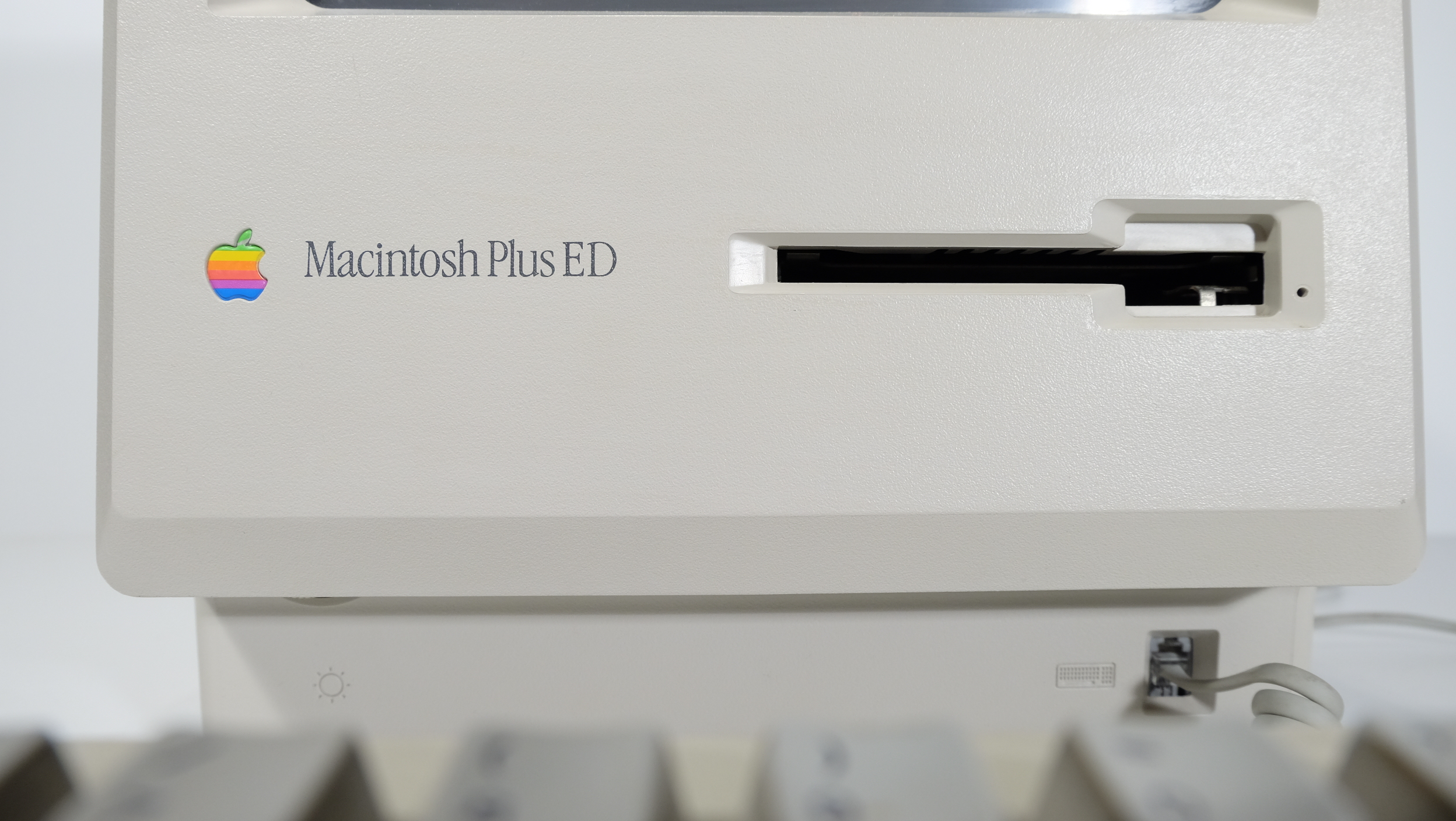
The "ED" at the end of the model name indicates that this Macintosh was sold to the educational market.

Although the Macintosh Plus would become overshadowed by two new Macintoshes, the Macintosh SE and the Macintosh II in March 1987, it remained in production as a cheaper alternative until the introduction of the Macintosh Classic on October 15, 1990. This made the Macintosh Plus the longest-produced Macintosh model, having been on sale unchanged for 1,734 days, a record not surpassed until the second-generation Mac Pro in 2018. It continued to be supported by versions of the classic Mac OS up to version 7.5.5, released in 1996. Additionally, during its period of general market relevance, it was heavily discounted like the 512K/512Ke before it and offered to the educational market badged as the "Macintosh Plus ED".[9] Due to its popularity, long life and its introduction of many features that would become mainstays of the Macintosh platform for years, the Plus was a common "base model" for many software and hardware products.

Hardware

[edit]

CPU

[edit]

The Macintosh Plus shipped with a Motorola 68000 CPU.

Storage

[edit]

The Macintosh Plus did not ship with internal storage, aside from the 128 KB ROM (read-only memory).

Media

[edit]

The Macintosh Plus included an 800 KB floppy drive.

Display

[edit]

The Macintosh Plus shipped with a 9-inch 512x342 display at 72 PPI (pixels per inch).

Audio

[edit]

The Macintosh Plus utilized one 8-bit, 22 kHz built-in speaker. No audio-in support.[10]

Problems

[edit]

The lack of fan could cause the life of a Macintosh Plus to end early for some users. As the power supply would heat up, solder joints inside it would fracture, causing many problems, such as loss of deflection in the monitor or a complete loss of power. As in most early compact Macs, the problem was common in the yoke connector, flyback transformer, and horizontal drive coupling capacitor.[11] A fan was also often added to reduce heat when the machine was upgraded to its full RAM capacity of 4 MB.[12]

From the debut of the Macintosh 128K through the Macintosh Plus, various third-party cooling add-ons were available to help increase airflow through the unit. Apple reorganized the compact Macintosh case to accommodate a fan with the release of the Macintosh SE, which optionally included a heat-generating internal hard disk.

ROM revisions

[edit]

The Plus went through two ROM revisions during its general market relevance. The initial ROM was replaced after the first two months as it had a serious bug which prevented the Mac from booting if an external SCSI device was powered off. The second revision fixed a problem with some SCSI devices that could send the Mac into an endless reset at POST.[13]

Emulators

[edit]

Timeline

[edit]
Timeline of Compact Macintosh models
Power MacintoshMacintosh LC 520PowerBookMacintosh LCMacintosh PortableMacintosh II seriesApple IIeMacintosh Color ClassicMacintosh Classic IIMacintosh SEMacintosh SE/30Macintosh ClassicMacintosh PlusMacintosh XLMacintosh SEMacintosh PlusApple LisaMacintosh SEMacintosh 512KeMacintosh 128KApple LisaMacintosh 512KMacintosh 128K

References

[edit]
[edit]
Revisions and contributorsEdit on WikipediaRead on Wikipedia
from Grokipedia
The Macintosh Plus is a developed and manufactured by Apple Inc., introduced on January 16, 1986, as the third model in the Macintosh family following the original Macintosh and . It featured a processor running at 8 MHz, 1 MB of RAM expandable to 4 MB via 30-pin SIMMs, an 800 KB double-sided 3.5-inch floppy drive, and a 9-inch display with 512 × 342 resolution. The system measured 13.6 inches in height, 9.6 inches in width, and 10.9 inches in depth, weighing 16.5 pounds, and included innovative ports such as the first interface (DB-25) for external storage connectivity, alongside ADB for the keyboard and , and serial ports for printers and modems. This model addressed key limitations of its predecessors by introducing expandability, which was a major criticism of the original Macintosh's fixed 128 KB RAM, making it more suitable for professional and business use. Priced at $2,599 upon launch, the Macintosh Plus became Apple's best-selling computer at the time, with production continuing until its discontinuation on October 15, 1990, due to its reliability and compatibility with emerging peripherals like hard drives. It shipped with System Software 1.1 and supported upgrades up to System 7.5.5, enabling it to run a wide range of applications during the late 1980s and early 1990s. The Macintosh Plus played a pivotal role in solidifying the Macintosh platform's reputation for user-friendly graphical interfaces and hardware integration, influencing Apple's shift toward more powerful systems and contributing to the company's recovery in the personal computing market after early struggles. Its design retained the compact, all-in-one form factor of earlier models with an initial case (updated to platinum in 1987) and support for an optional extended keyboard with and arrow keys, enhancing productivity for and creative tasks. Apple provided hardware support until September 1, 1998, underscoring its enduring legacy in computing history.

Development and Release

Announcement and Launch

The Macintosh Plus was introduced on January 16, 1986, at a press event held at Apple's headquarters in . This launch marked the third iteration in Apple's lineup, succeeding the and directly addressing user complaints about the original models' limited memory and lack of expandability options. In an era dominated by PC clones offering greater customization and peripheral support, Apple positioned the Plus as a more versatile to regain competitive footing in the personal computing market. Priced at US$2,599 upon release (equivalent to approximately $7,460 in 2024 dollars or $7,683 in 2025 dollars), the Macintosh Plus represented a strategic adjustment from the higher costs of earlier models while incorporating enhancements that justified the investment for business and creative users. The pricing reflected Apple's aim to broaden without sacrificing the premium that distinguished the Macintosh from text-based PC alternatives. At the event, Apple highlighted the Macintosh Plus as the first in the line to feature a built-in port, enabling seamless connection to external hard drives and other peripherals, alongside 1 MB of standard RAM—double that of the 512K. These upgrades were touted as transformative for productivity, allowing users to run more sophisticated applications without the frequent disk-swapping hassles of prior models. The launch proved instrumental in Apple's turnaround from the sluggish sales of early Macintosh models, contributing significantly to the company's shipment of its 1 millionth Macintosh by mid-1986. This commercial momentum helped stabilize Apple's finances amid broader industry competition.

Production and Variants

The Macintosh Plus entered production on January 16, 1986, and remained in continuous manufacturing until its discontinuation on October 15, 1990, spanning 1,734 days and establishing it as the longest-produced Macintosh model at the time, a record later surpassed by certain iMac variants. This extended run reflected the model's reliability and appeal in both consumer and professional markets, allowing Apple to meet sustained demand without major redesigns during a period of rapid technological evolution in personal computing. Early production units featured the original beige "" case design, consistent with prior models, but in mid-1987, Apple transitioned to a gray finish to align with the aesthetic of the newly introduced and Macintosh SE lines. This color shift was primarily cosmetic, with no alterations to internal components, and applied to all subsequent units, enhancing visual consistency across Apple's expanding product lineup. A specialized variant, the Macintosh Plus ED (Education), targeted the educational sector starting in 1987, offering discounted pricing and bundled software tailored for classroom use, such as productivity and learning applications. The ED model retained the standard hardware specifications but bore distinct front labeling to denote its educational designation, contributing to Apple's growing penetration in schools and institutions. Key manufacturing advancements included the adoption of 256K-bit RAM chips in four slots, which enabled the standard 1 MB memory configuration—a doubling over the prior —while supporting expansion up to 4 MB. The Macintosh Plus was ultimately discontinued to make way for the , introduced in October 1990 as a more affordable successor with updated internals while maintaining the compact form factor. Despite its retirement from production, Apple extended software support through operating system updates until 1996, allowing compatible models to run System 7.5.5 and remain viable for basic tasks well into the mid-1990s.

Design and Hardware

Physical Design

The Macintosh Plus adopted a compact all-in-one form factor typical of early models, measuring 13.6 inches in height, 9.6 inches in width, and 10.9 inches in depth, with a total weight of 16.5 pounds (7.5 kg). This design integrated the system's logic board, a 9-inch CRT display, and an 800 KB 3.5-inch drive into a single unit, emphasizing portability and desk-friendly placement without requiring separate components for basic operation. The enclosure was constructed from injection-molded ABS plastic, initially offered in a finish before transitioning to in late 1987, which provided a glossy, durable surface while housing a recessed well for the detachable keyboard. Ports were strategically arranged for : a DB-25 and two mini-DIN-8 serial ports (one for printer and one for ) on the rear, with the floppy drive slot positioned on the front for easy media insertion. This layout supported expanded storage via external devices while keeping the rear panel uncluttered for cabling. A dedicated 4-pin (4P4C RJ-11 style) connector for the keyboard was located on the front panel, and a 4-pin round connector for the on the right side. Ergonomically, the unit was oriented horizontally for stable desk use, featuring a built-in carrying handle on the top edge to facilitate transport despite its weight, and the decision to omit an internal hard drive preserved the slim profile and internal space constraints of the . Over time, the ABS plastic has proven susceptible to yellowing, a common degradation in vintage electronics attributable to the bromine-based retardants incorporated for compliance.

Processor and Memory

The Macintosh Plus features a as its , operating at a clock speed of 7.8336 MHz, though it is nominally rated at 8 MHz. This 32-bit CISC processor uses a 16-bit external data bus and a 24-bit address bus, which limits the total addressable memory space to 16 MB. The CPU lacks an integrated paged (PMMU) or (FPU), features that would require separate chips like the 68851 or 68881 for advanced or floating-point operations. The system's read-only memory (ROM) consists of 128 KB, which stores essential boot code, the Macintosh routines, desk accessories, and core components of the and Finder to initiate loading from disk. This ROM design supports the without needing immediate disk access for basic operations, though full and Finder functionality is provided via bootable media. Random access memory () is configured with 1 MB standard, implemented using four 256K × 4 dynamic RAM (DRAM) chips in 30-pin (SOIC) packages on single inline memory modules (SIMMs). These SIMMs operate at a minimum speed of 150 ns and can be upgraded to a maximum of 4 MB by replacing them with 1 MB modules in the four sockets on the logic board, installed in pairs for compatibility. The aligns with the processor's bus limitations, enabling efficient handling of the operating system's demands. In terms of performance, the Macintosh Plus delivers approximately 1 MIPS (million ), which was adequate for running the resource-intensive of the Macintosh system but positioned it slower than contemporaries like the in and multitasking scenarios due to the latter's custom hardware accelerators.

Storage and Input/Output

The Macintosh Plus featured a single internal 3.5-inch double-sided drive with a capacity of 800 KB, marking an upgrade from the single-sided 400 KB drive in earlier models like the Macintosh 128K and 512K. This drive utilized Apple's proprietary GCR (Group Code Recording) encoding and supported automatic disk ejection, allowing for efficient handling of double-density disks without manual intervention. Unlike later Macintosh models equipped with the , the Plus's drive was not high-density capable and remained incompatible with 1.44 MB PC-format disks. The system lacked any internal , relying instead on solutions for expanded capacity. It was the first Macintosh to include a built-in -1 port, implemented via a DB-25 connector on the rear panel, which supported daisy-chaining up to seven SCSI devices such as hard drives, scanners, and tape backups. This port enabled connectivity to peripherals like the Apple Hard Disk 20 (HD20), a 20 MB external drive that provided significantly faster access times compared to floppy-based storage. Without internal expansion slots, all additional storage and peripherals connected externally through this interface or other ports, promoting a modular approach to system configuration. For input/output, the Macintosh Plus included two Mini-DIN-8 serial ports labeled as "modem" and "printer," which supported communication standards for peripherals and networking. These ports facilitated connections to devices like printers, modems, and networks, with dedicated proprietary serial interfaces for the mouse and keyboard, prior to the introduction of the dedicated (ADB) in subsequent models. An additional DB-19 port was provided for external floppy drives, allowing expansion of options. Data transfer rates for the Macintosh Plus's interfaces reflected the era's technology limitations. The SCSI-1 port achieved a practical sustained transfer rate of approximately 1.25 MB/s, constrained by the system's 68000 processor and controller , though the theoretical maximum for SCSI-1 was higher at 5 MB/s. The internal floppy drive operated at a transfer rate of around 500 kbit/s (equivalent to 62.5 KB/s), sufficient for loading applications and documents but notably slower than SCSI-attached storage.

Display and Audio

The Macintosh Plus incorporated a built-in 9-inch (diagonal) cathode-ray tube (CRT) display, measuring approximately 7.0 inches wide by 4.7 inches high in viewable area, which utilized analog RGB video signals generated directly by the system's custom video hardware. This display operated at a of 512 × 342 pixels with a of 72 pixels per inch, employing 1-bit to render only black and white pixels. The CRT featured medium-persistence coating, which provided flicker-free progressive-scan refresh at 60.15 Hz without interlacing, ensuring stable imagery suited to the era's bitmapped graphics but lacking user-adjustable brightness or contrast controls for simplified operation. Complementing the visual output, the Macintosh Plus's audio subsystem relied on a sound chip functioning as an 8-bit (DAC) with a fixed sampling rate of 22.254 kHz, synchronized to the display's vertical blanking interval for efficient hardware integration. This drove a single internal mono speaker rated at 0.5 watts, capable of producing basic waveforms for system beeps, alerts, and short sampled audio clips, though its limited fidelity restricted it to utilitarian purposes rather than advanced playback. No dedicated audio input or capabilities were included, emphasizing the system's focus on simple auditory feedback. User interaction with the display and audio was facilitated by a detachable external 78-key keyboard connected via a dedicated 4-pin connector on the front panel, supporting bidirectional communication for features like key repeat and modifier states, alongside an external one-button connected through a dedicated port on the side of the unit. Unlike some contemporary systems, the Macintosh Plus omitted any built-in such as a , relying instead on the detachable for cursor control. These hardware choices contributed to the machine's compact all-in-one but imposed limitations, including the absence of color support and a relatively low resolution by later standards, which constrained graphical complexity, while the audio hardware proved adequate only for chimes and error tones rather than immersive sound experiences.

Software and Compatibility

Operating System Support

The Macintosh Plus shipped with System 3.0 and Finder 5.1 as its initial operating system, which required a minimum of 1 MB of RAM for operation. It supported a range of versions from 3.0 through 7.5.5, excluding 7.5.2; the final update, System 7.5.5, was released in September 1996. while the hardware limited maximum RAM to 4 MB under System 7. The boot process was handled entirely by the 128 KB ROM, initiating startup from an 800 KB or an external device, as the Macintosh Plus lacked a built-in startup disk or hard drive. In terms of compatibility, the Macintosh Plus offered full support for MultiFinder, Apple's extension introduced with System 5.0, enabling multiple applications to run concurrently on systems with sufficient RAM. However, it was constrained by 24-bit addressing, which limited the accessible memory space to 8 MB despite the 32-bit capable processor.

Key Software Features

The Macintosh Plus emphasized its with support for creative tools and the Mac's intuitive desktop metaphor. Starting in August 1987, Apple included in bundles targeted at educational users, providing a hypermedia stack-based system for building interactive applications without extensive programming. Key advancements in the Macintosh Plus centered on the Finder, which incorporated support for the Hierarchical File System (HFS), allowing users to navigate nested folders via hierarchical menus for more organized file management compared to the flat structure of earlier models. The system also enabled desk accessories—mini-applications accessible from the , such as a or —and control panels for customizing system settings, enhancing multitasking within the single-application environment of the era. Networking capabilities were a cornerstone of the Macintosh Plus software ecosystem, with built-in support for protocols implemented over the transceiver on the , facilitating and printer connectivity. This allowed seamless integration with peripherals like the laser printer, enabling networked document output without additional hardware beyond twisted-pair cabling. Unique software features leveraged the hardware expansions, notably the integrated into the ROM, which provided low-level protocol handling for external drives, permitting driverless initialization and operation of SCSI peripherals upon connection. Additionally, the system offered native compatibility with the ImageWriter II dot-matrix printer through the standard , supporting both serial and connections for high-volume draft printing and graphics output. Development tools like the Macintosh Programmer's Workshop (MPW), Apple's integrated environment for C, Pascal, and assembly languages, were fully supported on the Macintosh Plus running System 4.0 or later, empowering third-party developers to create sophisticated applications such as Aldus PageMaker, the pioneering desktop publishing software that capitalized on the Mac's PostScript rendering.

Issues and Revisions

Hardware Problems

The Macintosh Plus, lacking a cooling fan in its compact all-in-one design, was prone to overheating, which accelerated failures in key components such as the power supply and flyback transformer. This heat buildup, exacerbated by the enclosed plastic case, often led to logic board degradation in warmer operating environments, manifesting as intermittent power issues or complete shutdowns after prolonged use. Electrolytic capacitors on the logic and analog boards were particularly susceptible to leakage and bulging due to this thermal stress, resulting in unstable voltages and erratic system behavior. Solder joint fractures emerged as another prevalent issue, often classified as "cold solder" defects caused by manufacturing inconsistencies and vibrations during shipping. These fractures commonly affected the RAM sockets, CPU connections, and especially the CRT yoke connector J1 on the analog board, leading to symptoms like display wobbling, single vertical lines, or intermittent video loss. Resoldering these joints was a standard repair procedure, though the underlying heat exposure from the fanless design contributed to their recurrence over time. The internal 800 KB floppy drive frequently encountered mechanical wear, with the drive mechanism degrading after heavy use and causing read/write errors or failure to recognize disks. Dust accumulation in the front slot exacerbated these problems, leading to unreliable disk ejection or continuous motor spinning as the drive attempted to access corrupted or unreadable media. Cleaning the heads and mechanism could temporarily resolve issues, but worn components often required full drive replacement to restore functionality. Over time, the built-in CRT display suffered from degradation, resulting in progressively dimmer images or flickering as the tube aged beyond 10 years of service. High-voltage board failures, linked to rot and cracks, compounded this by causing bright but blank screens or no raster at all, even when audio output remained intact. These issues were typical in units subjected to extended daily operation, highlighting the limitations of the original 9-inch tube in long-term reliability. Such hardware problems were widespread in Macintosh Plus systems used for over a decade, with Apple service documentation emphasizing modular troubleshooting like board swaps to address early defects in power, video, and storage subsystems.

ROM and Firmware Updates

The Macintosh Plus launched in January 1986 with an initial 128 KB ROM, version 0, which contained bugs in the driver, including failure to boot if an external drive was powered off and issues with drives returning Unit Attention status during initialization. This early , internally codenamed "Lonely Hearts" with a of 4D 1E EE E1, was limited to the first approximately one and a half months of production. In mid-1986, Apple introduced ROM Revision 1, codenamed "Lonely Heifers" with 4D 1E EA E1, which addressed the boot bug through a minimal two-byte code change, enabling reliable startup regardless of external drive power state. Revision 1 became the standard for the vast majority of beige Macintosh Plus units produced thereafter. By 1987, Revision 3 of the ROM, codenamed "Loud Harmonicas" with 4D 1F 81 72, incorporated further refinements by removing the reset command from the boot sequence loop, preventing hangs with drives that issue Unit Attention on power-up or reset—a roughly 30-byte modification. ROM revisions for the Macintosh Plus were not designed for in-field upgrades, as all versions shared the same part numbers (342-0341 for the high ROM and 342-0342 for the low ROM); affected units required logic board replacement at authorized Apple service centers to apply fixes. These firmware updates were critical for resolving early hardware-software interactions that could otherwise prevent or peripheral recognition, thereby supporting the system's longevity with evolving Macintosh releases.

Legacy and Modern Relevance

Cultural and Educational Impact

The Macintosh Plus significantly influenced educational adoption during the late 1980s, particularly through its "ED" variant tailored for schools and released in 1987. This model was bundled in educational institutions across the , providing numerous students with their first exposure to graphical user interfaces and fostering early . Apple's aggressive push into , including discounted pricing and integration into classroom programs, positioned the Macintosh Plus as a key tool for introducing interactive computing to young learners. In popular culture, the Macintosh marked several milestones, appearing in the 1986 film as a symbol of advanced laboratory technology used by characters to design . It also catalyzed the desktop publishing revolution, pairing seamlessly with Aldus PageMaker software and the Apple printer to democratize high-quality layout and printing for non-experts. This combination empowered graphic designers, writers, and small publishers, transforming creative workflows and establishing the Macintosh as the platform of choice for . The model's longevity and affordability contributed to Apple's expanding market presence, helping the company capture about 10% of the U.S. market by 1988 and solidifying its reputation for accessible among creative professionals. Its long production run, spanning over four years, ensured widespread availability and reinforced Apple's foothold in niche sectors like and . As a legacy artifact, the Macintosh Plus remains iconic in retro communities, where enthusiasts restore and celebrate its role in early history. It is preserved in major institutions, including the , highlighting its enduring significance as a bridge between innovation and modern nostalgia. Socially, the Macintosh Plus advanced (What You See Is What You Get) editing paradigms, making document creation more intuitive and influencing the of contemporary interfaces across operating systems. Apple's for the Macintosh series, exemplified by the 1984 Super Bowl advertisement featuring a smashing , promoted gender inclusivity by depicting technology as empowering for diverse users, including women in creative and educational roles.

Emulation and Preservation

Emulation of the Macintosh Plus relies on software tools tailored for 68k-based compact Macintosh systems, enabling the execution of original software on modern hardware. Mini vMac specializes in emulating 68000-based compact models like the Plus, supporting ROM files from these machines and compatible with System versions from 1.1 to 7.5.5. PCE/macplus offers cycle-precise emulation for the Macintosh Plus and similar models, replicating hardware timing accurately, including features like serial port support that are absent in some alternatives. Basilisk II provides broader 68k Macintosh emulation, including compatibility with the Plus, and extends support to System 7.x or 8.x with color video output. To set up these emulators, users must obtain a Macintosh Plus ROM file, legally extracted from hardware they own, as requires possession of the original machine for legitimate use. Disk images are also essential, typically for System 6.0.8 or earlier, in formats such as .dsk for 400k/800k floppies or .hfv/.vhd for hard drives, which can be mounted directly in the emulator's configuration. Preservation initiatives ensure the Macintosh Plus ecosystem remains accessible, with the Macintosh Garden serving as a key archive hosted on the Internet Archive, offering dumps of discontinued 68k-era software as abandonware for emulation purposes. EveryMac.com provides comprehensive specifications, such as the 1-4 MB RAM capacity, 512 × 342 monochrome display, and ADB keyboard/mouse interfaces, aiding restorers and emulator developers in maintaining historical accuracy. In contemporary applications, Macintosh Plus emulation supports retro gaming experiences, including titles like , and serves educational roles in demonstrating early graphical user interfaces and operating system evolution. FPGA implementations, such as core, recreate the hardware with high fidelity, featuring 8 MHz or 16 MHz CPU speeds, 1-4 MB memory, and support for up to 2 GB virtual drives using .vhd images, ideal for enthusiasts seeking near-original performance. Notable challenges include strict ROM legality, restricting distribution and compelling self-extraction, alongside difficulties in emulating peripherals due to the Plus's lack of bus termination power, which can lead to compatibility issues with external drives in simulations. By 2025, advancements feature WebAssembly-based ports, exemplified by Infinite Mac, which runs Mini vMac and variants in web browsers for seamless, installation-free access to emulated Macintosh Plus environments. In March 2025, Infinite Mac added support for early versions of Mac OS X, such as 10.1 and 10.3, further extending preservation to transitional software eras.

References

Add your contribution
Related Hubs
User Avatar
No comments yet.