Hubbry Logo
Compact MacintoshCompact MacintoshMain
Open search
Compact Macintosh
Community hub
Compact Macintosh
logo
8 pages, 0 posts
0 subscribers
Be the first to start a discussion here.
Compact Macintosh
Compact Macintosh
from Wikipedia
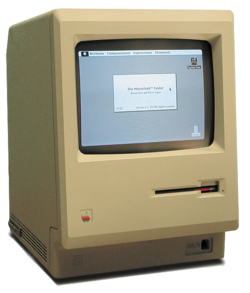
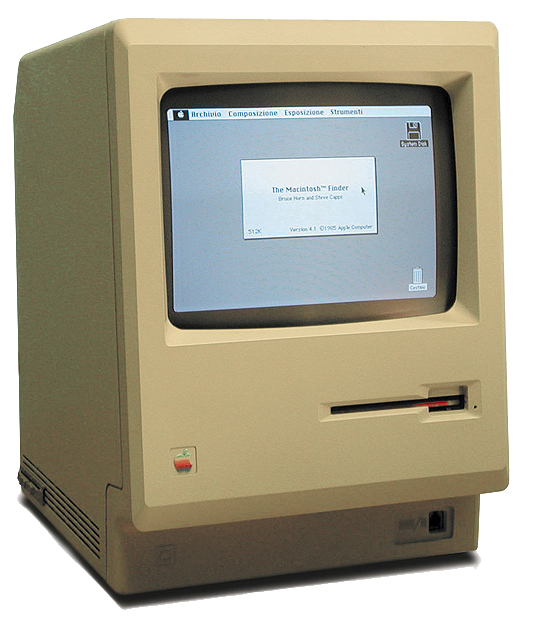
The Macintosh 128K introduced the Compact Macintosh case style. The bevelled edges were also used on the Apple II and the Apple III.

A Compact Macintosh (or Compact Mac) is an all-in-one Apple Mac computer with a display integrated in the computer case, beginning with the original Macintosh 128K. Compact Macs include the original Macintosh through to the Color Classic sold between 1984 and 1995. The larger Macintosh LC 500 series, Power Macintosh 5000 series, iMac and eMac are not described as a "Compact Mac".

Apple divides these models into five form factors: The Macintosh 128K, Macintosh SE, and Macintosh Classic (all with a 9 in (23 cm) black and white screen), the modernized Macintosh Color Classic with a 10 in (25 cm) color screen, and the very different Macintosh XL.

Models

[edit]
The SE, designed along Snow White guidelines
The Classic II, using Apple's early 1990s design style
The Color Classic with its modernized "neoclassical" case
Model Model number Form factor CPU RAM Display
Macintosh 128K M0001* Macintosh 128K Motorola 68000 @ 7.8336 MHz 128 KB 512 x 342 monochrome
Macintosh 512K M0001W* 512 KB
Macintosh Plus M0001A* 1 MB
Macintosh 512K/800 M0001D 512 KB
Macintosh 512Ke M0001E
Macintosh ED M0001ED
Macintosh Plus ED / European Version* M0001AP 1 MB
Macintosh SE M5010 Macintosh SE
Macintosh SE 1/20 M5011
Macintosh SE 1/40
Macintosh SE FDHD M5010/M5011
Macintosh SE SuperDrive M5011
Macintosh SE/30 M5119 Motorola 68030 @ 15.667 MHz
Macintosh Classic M1420 Macintosh Classic Motorola 68000 @ 7.8336 MHz
Macintosh Classic II M4150 Motorola 68030 @ 16 MHz 2MB
Macintosh Performa 200
Macintosh Color Classic M1600 Macintosh Color Classic 4MB 512 x 384 (switchable to 560 x 384)
Macintosh Performa 250
Macintosh Color Classic II Motorola 68030 @ 33 MHz
Macintosh Performa 275

*220 V international models are appended with the letter "P" (e.g. M0001P)

Timeline

[edit]
Timeline of Compact Macintosh models
Power MacintoshMacintosh LC 520PowerBookMacintosh LCMacintosh PortableMacintosh II seriesApple IIeMacintosh Color ClassicMacintosh Classic IIMacintosh SEMacintosh SE/30Macintosh ClassicMacintosh PlusMacintosh XLMacintosh SEMacintosh PlusApple LisaMacintosh SEMacintosh 512KeMacintosh 128KApple LisaMacintosh 512KMacintosh 128K

See also

[edit]

References

[edit]
[edit]
Revisions and contributorsEdit on WikipediaRead on Wikipedia
from Grokipedia
The Compact Macintosh is a family of all-in-one personal computers produced by Apple Inc. from 1984 to 1995, distinguished by their integrated beige plastic enclosure that combined a CRT display, CPU, floppy drive, and ports into a single compact unit measuring approximately 13.6 by 9.6 by 10.9 inches (height × width × depth). These machines, powered by Motorola 68000-series processors, were designed for ease of use and affordability, targeting home and small office users with Apple's proprietary Macintosh operating system featuring a graphical user interface (GUI). The line began with the revolutionary Macintosh 128K, released on January 24, 1984, which introduced the GUI, , and icons to mainstream consumers via a 9-inch monochrome display and 128 KB of RAM, fundamentally changing personal computing by making technology accessible beyond hobbyists. Subsequent models improved performance and expandability: the (September 1984) quadrupled RAM to 512 KB for better multitasking; the (January 1986) added ports and up to 4 MB RAM; and the Macintosh SE (March 1987) included an internal expansion slot for peripherals. The (January 1989), with its 16 MHz 68030 processor and up to 32 MB RAM, became a favorite among power users for its speed and upgrade potential. Later iterations focused on affordability and color: the (October 1990) offered a budget-friendly 8 MHz 68000 CPU with up to 10 MB RAM; the (October 1991) upgraded to a 16 MHz 68030; and the (February 1993) debuted a built-in 10-inch color display (512x384 resolution) alongside 4 MB RAM. The series concluded with the Color Classic II (October 1994, 33 MHz 68030). Overall, Compact Macintoshes sold millions of units, paving the way for Apple's later modular and colorful designs while embodying the company's early emphasis on intuitive, integrated hardware.

History

Development and Launch

The Compact Macintosh project originated in 1979 when , a member of the development team, proposed a low-cost, user-friendly computer to Apple chairman , envisioning an appliance-like device for the masses under the code name "Annie." Raskin's vision emphasized a bitmapped display, integrated peripherals, and a focus on , drawing from his experiences with early graphical interfaces. In late 1979, , seeking to create an accessible alternative to high-end systems, visited PARC and was profoundly influenced by the workstation's , , and , which he sought to adapt for a more affordable . This inspiration accelerated after Jobs was sidelined from the Lisa project in 1981 due to internal conflicts and delays, leading him to take over the Macintosh team and redirect it toward a bitmapped GUI powered by the CPU. Key milestones included Bill Atkinson's development of software for efficient graphics rendering and Burrell Smith's innovative hardware design, which integrated the 68000 processor onto a compact custom to minimize costs and components. Prototypes emerged by , with factory trials confirming the form factor combining display, CPU, and peripherals. The Macintosh launched on January 24, , following a landmark advertisement titled "," directed by , which depicted a dystopian rebellion against conformity to symbolize Apple's challenge to IBM's dominance. Priced at $2,495, the initial 128K model debuted in retail stores that day, marketed as "the computer for the rest of us" to appeal to non-technical users through its intuitive interface and integrated design. The launch exceeded expectations, with approximately 70,000 units sold in the first 100 days, validating Jobs' vision despite the higher-than-targeted price.

Production and Discontinuation

Production of the original Macintosh began in early at Apple's newly opened, highly automated $20 million facility in , designed specifically to manufacture the compact . The plant emphasized efficiency, with assembly times as short as 26 minutes per unit, enabling rapid scaling to meet demand. Initial production targets varied, with CEO projecting 250,000 units for , while aimed higher at 500,000, reflecting optimism for the Macintosh's . By 1986, output had stabilized as Apple refined processes, though exact annual figures for that year remain undocumented in contemporary reports. A widespread shortage in disrupted the industry, affecting Apple's Macintosh production by limiting availability of key components like chips needed for upgrades such as the transition to the 512K model introduced in . This , which persisted for much of the year before easing in late , delayed broader rollout of enhanced configurations and prompted reliance on third-party solutions for expansion in early units. The crisis highlighted vulnerabilities in the for compact designs, where integrated components were harder to substitute. As production evolved through the mid-1980s, Apple focused on cost efficiencies amid competitive pressures, though ambitious prototypes exploring color displays for compact models never reached manufacturing. By 1987, models like the Macintosh SE incorporated incremental improvements, such as optional higher-capacity floppy drives, to reduce reliance on and lower overall system costs without altering the all-in-one form factor. These changes aimed to sustain viability against modular rivals offering greater expandability, such as the series. The original 128K Macintosh ceased production in 1985, replaced by upgraded variants. The was introduced in October 1990 and discontinued in September 1992. However, the broader compact line continued into the mid-1990s, with the final model, the (also sold as the Performa 275), discontinued on November 1, 1995. This phase-out was driven by shifting market demands for expandable systems, as seen in competitors like the , which provided slots for peripherals and outpaced the fixed architecture of compact Macs. Apple's financial difficulties in , including a $17.2 million quarterly loss and temporary halts in computer production to align with , directly influenced compact Macintosh output through measures. The company closed three of its six plants, laid off over 1,200 employees, and eliminated dedicated product divisions, integrating Macintosh into a unified operations group to cut redundancies and costs. These actions stemmed from sluggish sales and overproduction, temporarily slowing the line's momentum. The compact Macintosh's long-term viability was shaped by tensions between Jef Raskin's original vision of an affordable, user-centric appliance priced around $500 and ' execution, which elevated it to a $2,495 premium product inspired by the Lisa workstation to accelerate market entry and polish. Raskin's emphasis on humane interface design laid foundational software principles, but Jobs' hardware-driven push ensured commercial launch in , though the higher price and limited expandability contributed to eventual obsolescence against more versatile competitors.

Design and Technology

Hardware Architecture

The Compact Macintosh series utilized as its core processors. Early models, such as the Macintosh 128K, employed the operating at a clock speed of 7.833 MHz. This 16/32-bit processor featured a 32-bit internal but employed a 16-bit external data bus and 24-bit addressing, which theoretically limited the addressable memory space to 16 MB, though practical implementations in these models capped usable RAM at lower amounts due to hardware and software constraints. Later models featured upgraded processors, such as the 68030 at speeds up to 33 MHz in the Color Classic II. Memory configurations across the series ranged from 128 KB of RAM in the initial models to up to 4 MB in variants like the Plus and SE, and 32 MB in the SE/30, all using dynamic RAM chips soldered or socketed on the logic board. Storage relied on a standard 400 KB single-sided 3.5-inch Sony floppy disk drive in early units, upgraded to 800 KB double-sided in enhanced models; hard disk drives were absent until the SE, which offered an optional internal 20 MB SCSI-based unit. The absence of built-in hard storage emphasized the system's reliance on floppies for booting and data management. The graphics subsystem in early models centered on a 9-inch cathode-ray tube (CRT) display with a resolution of 512 × 342 pixels and 1-bit , enabling the rendering of the without dedicated color support. Later models, such as the Color Classic, featured a 10-inch color CRT at 512 × 384 resolution with 8-bit . Video output was managed by custom logic implemented in (PAL) chips on the main board, which interleaved the frame buffer directly within the system RAM (allocating approximately 22 KB for the screen), allowing the 68000 processor to drive display updates efficiently but tying video performance closely to CPU cycles. Expansion was severely restricted in most models by the all-in-one , featuring no user-accessible slots or standard bus; instead, a internal bus connected core components, with external connectivity limited to serial ports and a DB-19 floppy port on early models. The Macintosh SE and SE/30 included an internal Processor Direct Slot (PDS) for expansion cards. Starting with the 1986 Macintosh Plus, an external port enabled peripheral expansion such as hard drives, while the analog board handled functions, including custom serial interfaces for the keyboard and in pre-1987 units and the introduction of the (ADB) in the SE for simplified peripheral connections. Early models included an integrated sound system with an 8-bit (DAC) and built-in speaker for simple audio output supporting the GUI's beeps and alerts. The power subsystem consisted of a 60 W internal unit (PSU) integrated into the analog board, providing regulated voltages for the logic board, CRT, and drives while accepting 105–125 V AC input at 50–60 Hz. Cooling was passive, relying on the metal for heat dissipation, which proved inadequate in early models prone to overheating from the densely packed components and CRT heat, prompting the addition of an internal fan in the SE to mitigate thermal throttling and component stress.

Case Design and Ergonomics

The Compact Macintosh line is renowned for its innovative all-in-one enclosure, which integrated the display, logic board, and storage into a single compact unit, emphasizing simplicity and user-friendliness in its external design. The original "snow" case, measuring 13.6 inches in height, 9.6 inches in width, and 10.9 inches in depth while weighing 16.5 pounds, featured a built-in 9-inch CRT display and a front-loading 3.5-inch floppy drive slot. This design was spearheaded by industrial designers Jerry Manock and Terry Oyama, who crafted a minimalist aesthetic that prioritized a clean, approachable form factor without exposed ports or cables on the primary surfaces. Ergonomic considerations were central to the case's layout, with a sloped that elevated the keyboard to an optimal typing angle, reducing strain during extended use. A built-in molded on the top facilitated portability, allowing users to carry the 16.5-pound unit more easily despite its integrated components. The input setup complemented this user-centric approach: a detachable telephone-style coiled-cord keyboard with 58 keys (lacking a or to streamline the interface) connected via an RJ-11 port, paired with a single-button "hockey puck" that encouraged intuitive point-and-click interactions without multi-button complexity. Accessibility was enhanced by the high-contrast monochrome display, which provided sharp readability for text and graphics in various lighting conditions, though it was prone to issues like phosphor burn-in from prolonged static images and surface glare from ambient light reflecting off the CRT glass. Screen positioning was fixed within the case, offering no user-adjustable tilt beyond minor internal geometry tweaks limited to about 15 degrees via yoke adjustments during service. Design evolutions in later models refined these principles for practicality. The Macintosh SE introduced an internal metal chassis for added structural durability, protecting components from physical stress while maintaining the external plastic shell. The Macintosh Classic, aimed at cost reduction, retained the plastic enclosure but incorporated ventilation slots along the sides and rear to support an internal cooling fan, improving thermal management without altering the iconic footprint.

Models

Original and Enhanced Models (1984–1986)

The Macintosh 128K, launched on January 24, 1984, formed the foundational model of the Compact Macintosh series, featuring 128 KB of RAM, a 9-inch CRT display with 512x342 resolution, and a single-sided 400 KB 3.5-inch drive. Targeted at creative professionals such as writers, artists, and designers, it prioritized an intuitive to facilitate tasks like document creation and basic graphics work. However, its fixed 128 KB RAM lacked an official path, and the 64 KB ROM prevented compatibility with later file systems without third-party modifications. The model also faced reliability challenges, including overheating from its enclosed all-in-one design, which strained the power supply and components during prolonged use. Additionally, the internal drive's 400 KB capacity limited storage, requiring external drives for access to higher-capacity 800 KB disks. In September 1984, Apple introduced the , internally codenamed "Fat Mac," which doubled the RAM to 512 KB and upgraded to a double-sided 800 KB floppy drive for greater storage efficiency. This model incorporated a revised 128 KB ROM that enhanced memory management, enabling support for the Hierarchical File System (HFS) and allowing multiple applications to run concurrently without the frequent crashes experienced on the resource-constrained 128K. The increased memory addressed key limitations of the original, such as insufficient headroom for software like and , which often exceeded 128 KB during editing sessions. The , released on January 16, 1986, enhanced the 512K design with a base of 1 MB RAM expandable to 4 MB via soldered expansion (or third-party upgrades to higher), a 800 KB floppy drive, and the addition of a port for external peripherals, including hard drives. Priced at $2,599, it improved connectivity and storage options while maintaining the compact form factor, serving as a bridge to more expandable systems. The , released on April 14, 1986, served as an enhanced economy iteration with 512 KB RAM and the same 800 KB drive as its predecessor, but achieved minor cost reductions through simplified manufacturing and retention of the original 128 KB ROM from the 512K. Priced at $1,999—significantly lower than the $2,599 —it targeted budget-conscious users while maintaining compatibility with existing software, though it omitted advanced features like support. Production continued until September 1, 1987, filling a niche for affordable entry into the Macintosh ecosystem before the line shifted toward more versatile designs.

SE and Portable Models (1987–1989)

The Macintosh SE, introduced in March 1987, represented a significant evolution in the compact Macintosh lineup by incorporating enhanced expandability while maintaining the all-in-one form factor. It featured a processor running at 8 MHz, base memory of 1 MB expandable to 4 MB via 30-pin SIMMs, and options for dual 800K floppy drives or a single floppy paired with a 20 MB hard drive mounted internally. Priced at $2,900 for the base model with dual floppies, the SE introduced the Processor Direct Slot (PDS), which allowed for third-party expansions including adapters to connect cards, thereby bridging compact and modular desktop architectures. Standard ports and the new (ADB) for peripherals further improved connectivity, while an internal metal RF shield ensured compliance with (EMI) regulations in a fan-cooled plastic enclosure weighing 17 pounds. Building on the SE's foundation, the , released in January , upgraded the platform with a 16 MHz processor, 1.44 MB floppy, and support for up to 32 MB of RAM through socketed 30-pin SIMMs. This model served as a performance bridge toward color-capable systems, retaining the PDS for expansions and optional 40 MB hard drive, all within the same compact case updated for better ventilation. Base pricing started at $4,400, emphasizing its role in professional workflows requiring faster processing without sacrificing the all-in-one design. Extending the compact lineage into portability, the , launched in September 1989, marked Apple's inaugural battery-powered laptop while adhering to the all-in-one ethos through its integrated 9.8-inch 640x400 monochrome active-matrix LCD and full keyboard. Equipped with a 16 MHz 68000 processor, 1 MB base RAM expandable to 9 MB, and a 1.44 MB , it weighed 16 pounds and provided up to 10 hours of battery life via a lead-acid pack, enabling untethered use with standard and ADB ports. However, its high introductory price of $6,500 and notably dim non-backlit screen in early units hindered widespread adoption, despite innovative features like a front handle doubling as a lock. The Portable's design prioritized durability and compatibility with desktop compact models, though its bulk underscored the challenges of early .

Classic and Final Models (1990–1994)

The , introduced on October 15, 1990, served as a cost-reduced rebadging of the earlier , retaining the processor clocked at 8 MHz while offering 1 MB or 2 MB of RAM (expandable to 4 MB via an internal card). It featured a standard 1.44 MB floppy drive and an optional internal 40 MB hard disk drive, all housed in the familiar all-in-one compact case with a 9-inch CRT display at 512 × 342 resolution. Priced at $999 for the base model without hard drive, it marked Apple's first sub-$1,000 Macintosh, aimed at competing directly with affordable PC clones in the entry-level market. The , released on October 21, 1991, represented the final evolution of the monochrome compact Macintosh line, upgrading to a 16 MHz processor with 2 MB of RAM (expandable to 10 MB) and support for color video output via an optional Apple RGB monitor. It included a 40 MB or 80 MB hard drive as standard, along with the 1.44 MB , maintaining the compact all-in-one form factor but introducing transitional hardware compatibility for emerging features. Production of the Classic II continued until September 1993, serving as a bridge to more modular designs. Later iterations focused on color displays: the , released in February 1993, featured a built-in 10-inch color CRT (512x384 resolution), 4 MB RAM expandable to 10 MB, a 33 MHz 68030 processor, and 1.44 MB in the compact case. The Macintosh TV, introduced in October 1993, integrated a TV tuner and 14-inch color display into an all-in-one unit with a 32 MHz 68030, 4 MB RAM, and options for 40/80/160 MB HDD, targeting users at $2,749. The series concluded with the Color Classic II in October 1994, upgrading to 33 MHz 68030, 10 MB RAM standard, and improved video support. These final models emphasized budget-oriented refinements, such as improved power efficiency through optimized 68000-series components and preparation for with enhanced memory management, though they retained the all-in-one design's limitations like limited expandability and fixed displays. Targeted primarily at the sector, the in particular became a staple in schools due to its low cost and reliability for basic tasks, while introducing subtle evolutions in keyboard shortcuts for better integration with upcoming software updates. The thus acted as the for the compact Macintosh era, with its discontinuation in September 1992 signaling Apple's shift toward more versatile, expandable systems.

Software and Compatibility

Operating System Evolution

The original Compact Macintosh models launched with System 1.0 in January 1984, providing a foundational (GUI) centered around the Finder for file management and basic application launching. This initial operating system was severely constrained by the hardware's 128 KB of RAM, supporting only essential functions without advanced features like a clock in the , to ensure stability within the limited memory. The ROM contained the startup to initialize the hardware, after which the loaded from a boot into RAM. As Compact Macintosh hardware evolved, so did the operating system, with System 2.0 in April 1985 introducing minor enhancements like desk accessories and improved desk accessory handling, while System 3.0 in January 1986 marked a significant advancement by adopting the Hierarchical File System (HFS). HFS replaced the flat Macintosh File System (MFS), enabling organized folder structures and support for larger storage devices, such as the new 800 KB floppy drives and SCSI hard disks introduced with the . This adaptation was crucial for Compact models, whose all-in-one limited expandability, allowing better management of growing data volumes without hardware overhauls. A pivotal upgrade arrived with System 5.0 in October 1987, incorporating MultiFinder as an optional extension for cooperative multitasking, permitting multiple applications to run simultaneously by switching between them via the Finder. This addressed the single-tasking limitations of earlier systems, though it relied on applications voluntarily yielding control, leading to potential instability if poorly behaved software monopolized resources. By System 6.0 in April 1988, MultiFinder became standard, alongside optimizations for performance; 32-bit addressing to enable access to more than 8 MB of RAM was available via optional patches on supported models, with native support arriving in System 7. System 6 emphasized reliability for Compact hardware, with ROM-based initialization ensuring consistent startup even as disk-based systems grew more complex. Despite these advances, the operating systems for Compact Macintosh retained inherent limitations tied to the era's hardware, including , which allowed memory leaks or faulty applications to crash the entire system. in May 1991 enhanced cooperative multitasking, but support on final Compact models like the was restricted due to the 68000 processor's inefficiencies and fixed 4 MB RAM ceiling, resulting in sluggish performance and incomplete feature utilization. A key software milestone enhancing the ecosystem was the integration of the driver in 1985, coinciding with the printer's release and enabling high-resolution output directly from the Macintosh GUI. This driver facilitated the desktop publishing revolution by allowing seamless scaling of fonts and graphics, transforming Compact Macintosh into a viable tool for professional layout and printing without specialized hardware.

Bundled Applications and Ecosystem

The Compact Macintosh line debuted in 1984 with a standard software bundle consisting of , a , and , a graphics editor, both provided on 400 KB floppy disks alongside 1.0 and Finder 1.0. These applications exemplified the graphical user interface's potential for productivity and creativity, allowing users to create and edit documents and images without command-line expertise. MacTerminal, a for communications, was available as an optional purchase but not included in the initial standard bundle. By mid-1984, updates to 1.1 included revised versions of MacWrite 2.2 and MacPaint 1.3, enhancing compatibility and features for the Macintosh 128K and subsequent 512K models. As the line evolved, bundled software expanded to support more advanced workflows. In 1986, with the introduction of the Macintosh Plus and 512Ke, Apple bundled full versions of and . The dot-matrix printer received dedicated driver support in System 3.0, enabling high-quality text and graphics output directly from bundled apps. The Macintosh SE, launched in March 1987 with 4.0 (single-tasking), received MultiFinder as an optional extension via the System 5.0 update in October 1987, allowing multitasking and seamless switching between applications on models with at least 1 MB of RAM. The peripheral ecosystem complemented the software bundle, leveraging the Compact Macintosh's serial ports for connectivity. , introduced in 1984 and fully supported via adapters by 1985, enabled easy local area networking for and printer access among multiple machines without complex configuration. External modems connected through the same serial ports facilitated dial-up communications, integrating with apps like MacTerminal for and access. Third-party software, such as SuperPaint—a hybrid bitmap and vector editor released in 1986—extended the ecosystem by combining features of and MacDraw, offering advanced graphics tools for professional users. However, early models faced compatibility limitations, lacking native hard drive support until the added a port in 1986; prior to this, users relied on 400 KB or 800 KB floppy disks for all file storage and transfers, constraining workflows for larger projects. Apple's developer tools further nurtured the ecosystem, with the (MPW) released in 1986 providing a comprehensive command-line environment for compiling , Pascal, and assembly code to create custom applications compatible with Compact models. MPW included editors, debuggers, and linkers, empowering third-party developers to build on the bundled software foundation and expand the available titles, from utilities to specialized business tools. This infrastructure supported rapid ecosystem growth, with thousands of applications emerging by the late to leverage the Macintosh's hardware ports and operating system.

Legacy and Impact

Market Reception and Sales

The launch of the Compact Macintosh in 1984 generated immense hype following its advertisement, with initial sales reaching 70,000 units by May and totaling approximately 250,000 units for the year. However, demand quickly waned due to the high $2,495 , limited software availability, and production constraints, resulting in monthly sales dropping to around 10,000 units by year's end and contributing to financial losses for Apple on each unit sold. Sales rebounded with the introduction of enhanced models, particularly the in 1986, which became a and helped the overall line surpass 1 million units shipped by March 1987. Apple's computers, including the Macintosh line, achieved significant dominance in the education market, capturing about 60% share by 1987 through targeted pricing and bundling for schools and universities, where its graphical interface appealed to creative and academic users. Criticisms centered on the high cost and lack of expandability compared to competitors like the and Atari ST, which offered superior graphics, multitasking, and hardware upgrades at lower prices, prompting Apple to implement significant price reductions in 1985—such as dropping the from $2,795 to $2,499 to stimulate demand. Regional performance varied, with strong adoption in the U.S. creative sectors like and , while saw slower uptake due to delays in software localization and higher import costs. By 1990, the Compact Macintosh line had cumulatively sold over 2 million units, bolstered by late models like the , though transitioning to modular designs began eroding its exclusivity.

Technological and Cultural Significance

The Compact Macintosh line played a pivotal role in standardizing graphical user interfaces (GUIs) in personal computing by introducing a mouse-driven, icon-based system that emphasized intuitive interaction over command-line inputs. This design, first commercialized with the original Macintosh in 1984, set a benchmark for user-friendly computing and directly influenced Microsoft's release in 1985, which adopted similar elements like windows, menus, and icons to compete in the emerging GUI market. The Macintosh's approach to human-computer interaction became foundational for subsequent operating systems, promoting consistency in software design and accessibility that persists in modern interfaces. A cornerstone of the Compact Macintosh's impact was its integration with peripherals like the Apple printer and software such as Aldus PageMaker, released in , which ignited the (DTP) revolution by enabling affordable, high-quality layout and printing for non-specialists. This combination democratized professional publishing, allowing graphic designers to compose documents with what-you-see-is-what-you-get () precision using language for seamless screen-to-print fidelity. By the early 1990s, the Macintosh had established dominance in workflows, with its ecosystem drawing the majority of professionals to the platform over alternatives due to specialized tools like and Photoshop. Culturally, the Compact Macintosh emerged as an icon of technological optimism, prominently featured in media such as the 1986 film , where it appeared as a lab computer symbolizing cutting-edge innovation in a narrative about and human-machine synergy. The introduction of in 1987 further amplified its cultural reach, particularly in , where the hypermedia authoring tool empowered teachers and students to create interactive stacks for lessons on topics ranging from history timelines to science simulations, fostering early digital literacy and influencing pedagogical methods worldwide. Despite these advances, the all-in-one design of Compact Macintoshes highlighted technological limitations, rendering them obsolete by the early 1990s as demand shifted toward expandable modular systems like the for enhanced performance and upgradability. Nonetheless, innovations embedded in their ROM, such as four-voice monaural sound synthesis with 8-bit conversion at 22 kHz sampling and the inclusion of fonts like and , laid groundwork for and standards in . In contemporary terms, the legacy endures through emulation software like Mini vMac, which accurately recreates the experience of models such as the on modern hardware, while pristine working units command collector values of $200 to $500 or more as of 2025, preserved in institutions including the and the Smithsonian.

References

Add your contribution
Related Hubs
User Avatar
No comments yet.