Hubbry Logo
search
logo
Mafic
Mafic
current hub
hub-image

Mafic

logo
Community Hub0 Subscribers
Read side by side
from Wikipedia
Basalt

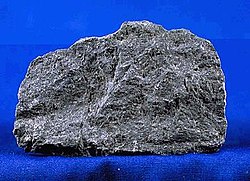
A mafic mineral or rock is a silicate mineral or igneous rock rich in magnesium and iron. Most mafic minerals are dark in color, and common rock-forming mafic minerals include olivine, pyroxene, amphibole, and biotite. Common mafic rocks include basalt, diabase and gabbro. Mafic rocks often also contain calcium-rich varieties of plagioclase feldspar. Mafic materials can also be described as ferromagnesian.

History

[edit]

The term mafic is a portmanteau of "magnesium" and "ferric" and was coined by Charles Whitman Cross, Joseph P. Iddings, Louis V. Pirsson, and Henry Stephens Washington in 1912. Cross' group had previously divided the major rock-forming minerals found in igneous rocks into salic minerals, such as quartz, feldspars, or feldspathoids, and femic minerals, such as olivine and pyroxene. However, micas and aluminium-rich amphiboles were excluded, while some calcium minerals containing little iron or magnesium, such as wollastonite or apatite, were included in the femic minerals.[1] Cross and his coinvestigators later clarified that micas and aluminium amphiboles belonged to a separate category of alferric minerals. They then introduced the term mafic for ferromagnesian minerals of all types, in preference to the term femag coined by A. Johannsen in 1911, whose sound they disliked.[2][3]

Minerals

[edit]

The term mafic is still widely used for dark-colored ferromagnesian minerals.[3] Modern classification schemes, such as the International Union of Geological Sciences (IUGS) classification of igneous rocks, include some light-colored ferromagnesian minerals, such as melilite, in the mafic mineral fraction.[4] Accessory minerals, such as zircon or apatite, may also be included in the mafic mineral fraction for purposes of precise classification.[5]

Rocks

[edit]

When applied to rocks, the term mafic is used primarily as a field term to describe dark-colored igneous rocks.[5] The term is not used as a rock classification in the IUGS classification scheme.[4] Mafic rocks are sometimes more precisely defined as igneous rocks with a high proportion of pyroxene and olivine, so that their color index (the volume fraction of dark mafic minerals) is between 50 and 90.[6] Most mafic volcanic rocks are more precisely classified as basalts.[7]

Chemically, mafic rocks are sometimes defined as rocks with a silica content between 45 and 55 wt%, corresponding to the silica content of basalt in the TAS classification.[8] Such rocks are enriched in iron, magnesium and calcium and typically dark in color. In contrast, the felsic rocks are typically light in color and enriched in aluminium and silicon along with potassium and sodium. The mafic rocks also typically have a higher density than felsic rocks. The term roughly corresponds to the older basic rock class.[9]

Upon eruption, mafic lava has less viscosity than felsic lava, due to the lower silica content in mafic magma. Water and other volatiles can more easily and gradually escape from mafic lava. As a result, eruptions of volcanoes made of mafic lavas are less explosive than felsic-lava eruptions.[10]

See also

[edit]

References

[edit]
Revisions and contributorsEdit on WikipediaRead on Wikipedia
from Grokipedia
Mafic refers to a group of igneous rocks characterized by their high content of magnesium (Mg) and iron (Fe), typically comprising minerals such as olivine, pyroxene, amphibole, magnetite, and plagioclase feldspar, with silica (SiO₂) concentrations ranging from 45% to 52%.[1][2] These rocks form from mafic magma, which originates primarily from partial melting of the Earth's mantle, and they are distinguished by their dark coloration due to the ferromagnesian minerals.[3][4] Common examples of mafic rocks include basalt, the most abundant extrusive mafic rock that erupts as lava from volcanoes and forms much of the oceanic crust, and gabbro, its intrusive counterpart that cools slowly beneath the surface to create coarse-grained textures.[1][5] Other variants, such as diabase, also fall under this category, often exhibiting densities higher than felsic rocks due to their iron and magnesium enrichment.[5][2] In geological contexts, mafic rocks play a critical role in plate tectonics, constituting the primary composition of the oceanic lithosphere and contributing to processes like seafloor spreading and subduction zone magmatism.[2] They contrast sharply with felsic rocks, which are silica-rich and lighter, influencing everything from volcanic eruption styles to the differentiation of the Earth's crust.[1] Mafic compositions are also key indicators in petrology for tracing mantle dynamics and crustal evolution over billions of years.[3]

Etymology and Definition

Origin of the Term

The term "mafic" was introduced in 1912 by American petrologists Whitman Cross, J. P. Iddings, L. V. Pirsson, and H. S. Washington as part of their refinements to a quantitative system for classifying igneous rocks based on chemical and mineralogical composition.[6] In their paper, the authors proposed "mafic" alongside "felsic" to provide concise, descriptive terms for key mineral groups: mafic for ferromagnesian minerals (rich in iron and magnesium) and felsic for feldspars, feldspathoids, and quartz.[6] The word is a portmanteau formed from "ma" (from magnesium) and "f" (from Latin ferrum, meaning iron), combined with the suffix "-ic" to denote silicates enriched in these elements.[7] This etymology reflects the term's focus on the dominant cations in mafic minerals, distinguishing them from silica-rich counterparts. The coinage emerged within early 20th-century petrology, where efforts to standardize rock nomenclature shifted to more systematic, mode-based classifications that facilitated global comparisons of igneous materials.[6]

Chemical and Mineralogical Definition

Mafic materials are defined as igneous rocks, magmas, or minerals characterized by a silica (SiO₂) content of 45–52 weight percent, distinguishing them from more silica-rich compositions.[1] This range reflects an enrichment in ferromagnesian silicates, with combined MgO and FeO typically exceeding 10 weight percent, which contributes to their fundamental compositional identity.[8] The term derives from "magnesium" (ma-) and "iron" (f- from ferrum), underscoring this emphasis on iron- and magnesium-bearing components.[9] Mineralogically, mafic compositions are dominated by iron-magnesium-rich silicates including olivine, pyroxene, and amphibole, alongside calcic varieties of plagioclase feldspar as the primary felsic mineral.[1] These minerals form the modal assemblage that defines mafic rocks, such as basalt (extrusive) and gabbro (intrusive), where ferromagnesian phases constitute a significant proportion of the total volume.[10] In classification schemes, mafic materials are delineated from intermediate compositions (52–66% SiO₂) and felsic ones (>66% SiO₂), while ultramafic extensions feature even lower silica (<45% SiO₂).[1][11] Quantitative assessment often employs the CIPW norm, a calculated mineralogy based on whole-rock chemical analysis, which for mafic rocks yields normative olivine or hypersthene plus olivine without quartz or nepheline.[9] Contemporary geological usage extends the mafic designation to both solid rocks and their parental magmas, facilitating comparisons across petrologic studies.[10]

Properties

Physical Properties

Mafic materials exhibit a characteristic dark coloration, typically ranging from deep green to black, which arises from the abundance of iron- and magnesium-rich ferromagnesian minerals such as pyroxene and olivine.[2] In mafic rocks, this appearance is complemented by textures that vary from fine-grained (aphanitic) in rapidly cooled extrusive forms like basalt to coarse-grained (phaneritic) in slowly cooled intrusive forms like gabbro.[12] The density of mafic rocks is notably high, with specific gravity values generally between 2.8 and 3.3 g/cm³, attributed to their elevated iron and magnesium content.[13] This makes them denser than felsic rocks; for example, basalt, a common mafic rock, has an average density of approximately 2.9 g/cm³.[14] Mafic magmas possess high melting points, typically in the range of 1000–1200°C, reflecting the stability of their mafic minerals at elevated temperatures.[15] Coupled with this is their low viscosity, which facilitates fluid-like flow and contributes to the formation of extensive, widespread lava flows during eruptions.[1] Other notable physical traits of mafic materials include a mechanical behavior that spans brittle fracture in finer-grained varieties to greater toughness in coarser ones, enhancing their durability in geological settings. Extrusive mafic rocks often display a vesicular texture, characterized by gas bubble voids formed during rapid cooling of lava.[16] Additionally, they exhibit elevated magnetic susceptibility compared to felsic rocks, primarily due to the presence of iron oxides like magnetite.[13]

Chemical Composition

Mafic rocks and materials are characterized by their oxide composition, which typically features silica (SiO₂) content ranging from 45% to 52% by weight, distinguishing them from more silica-rich felsic rocks. They exhibit elevated levels of magnesium oxide (MgO) at 5–15%, iron oxides (FeO and Fe₂O₃ combined) at 8–15%, calcium oxide (CaO) at 7–12%, and aluminum oxide (Al₂O₃) around 15%, while sodium oxide (Na₂O) and potassium oxide (K₂O) remain low, each below 3%. This profile reflects the dominance of ferromagnesian minerals, contributing to the overall dark color and density of mafic materials. In terms of trace elements, mafic compositions are enriched in compatible elements such as nickel (Ni), chromium (Cr), and vanadium (V), which readily incorporate into mafic minerals like olivine and pyroxene during crystallization. Conversely, they are depleted in incompatible elements like rubidium (Rb) and barium (Ba) relative to felsic rocks, due to the partitioning behavior during magmatic differentiation. These trace element signatures provide key insights into mantle-derived origins and magmatic evolution processes. Variations within mafic compositions include the ultramafic subset, which has even lower SiO₂ (<45%) and higher MgO (>20%), often found in mantle peridotites or komatiites. Compositional shifts can occur through fractional crystallization, where early removal of mafic minerals increases SiO₂ and depletes MgO in residual melts, transitioning toward intermediate compositions. Analytical determination of mafic chemical compositions commonly employs techniques like X-ray fluorescence (XRF) for major oxides and inductively coupled plasma mass spectrometry (ICP-MS) for trace elements, providing precise bulk analyses from rock samples. Normative calculations, such as the CIPW norm, further estimate modal mineralogy from oxide data by assuming equilibrium crystallization under specific conditions.

Mafic Minerals

Common Minerals

Mafic rocks are primarily composed of ferromagnesian silicate minerals that are rich in magnesium and iron, with olivine, pyroxenes, and amphiboles being the most characteristic.[1] These minerals crystallize early in the cooling of mafic magmas derived from the mantle, contributing to the dark color and density of rocks like basalt and gabbro.[17] Olivine, with the chemical formula (Mg,Fe)2SiO4, forms a solid solution series between forsterite (Mg2SiO4) and fayalite (Fe2SiO4).[18] It is a primary mineral in ultramafic to mafic rocks, often appearing as the first phase to crystallize from mantle-derived melts due to its high melting point.[19] In basalts, olivine typically constitutes 10–40% of the modal composition, forming euhedral grains that weather to a characteristic reddish-brown alteration product known as iddingsite.[20] Pyroxenes are chain silicates abundant in mafic compositions, with orthopyroxene belonging to the enstatite-ferrosilite series and clinopyroxene represented by augite.[21] These minerals are rich in calcium, magnesium, and iron, with augite having a general formula of (Ca,Na)(Mg,Fe,Al,Ti)(Si,Al)2O6, making them key components in the crystallization sequence of mafic magmas.[22] Orthopyroxenes and clinopyroxenes together often comprise a significant portion of mafic rocks, up to 50% in basalts, where they form prismatic crystals.[23] Amphiboles, such as hornblende with the formula Ca2(Mg,Fe)4AlSi7AlO22(OH)2, are hydrous minerals that typically form during later stages of crystallization in mafic magmas, often incorporating water from the melt.[24] Hornblende appears as elongated, prismatic crystals in rocks like diorite or andesite with mafic affinities, distinguishing it from earlier anhydrous phases like pyroxene.[1] Other common minerals in mafic rocks include biotite mica and magnetite, which add to the ferromagnesian content, while plagioclase feldspar in the labradorite to bytownite range (An50–An70) serves as the primary calcic component, often making up 40–60% of the rock.[25] These associations highlight the mineralogical balance in mafic assemblages, where dark mafic minerals dominate alongside sodic-calcic feldspars.

Characteristics

Mafic minerals exhibit distinct crystal structures and habits that reflect their silicate frameworks and geological formation environments. Olivine, a nesosilicate, features isolated SiO₄ tetrahedra linked by divalent cations like Mg²⁺ and Fe²⁺ in an orthorhombic crystal system, commonly displaying granular or anhedral habits in igneous rocks due to rapid crystallization.[26] Pyroxenes, as inosilicates, consist of single chains of SiO₄ tetrahedra forming a structure that yields prismatic or stubby euhedral crystals, typically in monoclinic or orthorhombic symmetry, which contribute to the compact texture of mafic rocks.[21] Amphiboles, with double-chain silicate structures, appear in fibrous, bladed, or prismatic habits and exhibit prominent cleavage in two directions at approximately 56° and 124°, often in monoclinic forms, aiding their identification in metamorphic and igneous contexts. These minerals are stable under high-temperature, low-pressure conditions typical of mantle-derived magmas, as outlined in Bowen's reaction series, where olivine crystallizes first at temperatures above 1200°C, followed by pyroxenes around 1100°C, and amphiboles at lower temperatures near 900°C.[27] However, olivine is particularly susceptible to rapid weathering and hydrothermal alteration, converting to serpentine minerals through hydration reactions involving water and CO₂, which destabilize its structure at surface conditions.[28] Amphiboles, while more stable than olivine, are prone to alteration to chlorite under greenschist-facies conditions or during retrograde metamorphism, where they lose structural integrity via devolatilization and hydration.[29] In petrographic analysis, mafic minerals display high refractive indices (typically 1.65–1.75 for olivine and pyroxenes, up to 1.70 for amphiboles), resulting in positive relief and darker appearances in thin sections under polarized light, which distinguishes them from felsic counterparts.[30] Amphiboles notably exhibit pleochroism, showing color variations from green to brown or blue depending on orientation, a trait absent or weaker in pyroxenes and olivine, facilitating their diagnostic identification in rock thin sections. Geochemically, mafic minerals play a critical role in trace element fractionation during mantle melting and magma evolution, with partitioning coefficients (K_d) indicating their affinity for certain ions; for instance, olivine has K_d(Ni) >1 (typically 5–10), preferentially incorporating nickel from basaltic melts, which influences the composition of derivative magmas.[31] This behavior underscores their importance in generating mantle-derived mafic magmas, where they control the depletion of compatible elements like Ni, Co, and Cr during partial melting processes.

Mafic Rocks

Types and Examples

Mafic rocks are primarily categorized by their texture—such as aphanitic for extrusive varieties or phaneritic for intrusive ones—and their geological setting, with ultramafic rocks representing high-magnesium extensions of mafic compositions. These rocks exhibit dark colors due to abundant iron- and magnesium-rich minerals.[1] Extrusive mafic rocks form from rapid cooling of lava at or near the surface, resulting in fine-grained textures. Basalt, the most common extrusive mafic rock, is aphanitic and constitutes the majority of oceanic crust, as well as the volcanic edifices of hotspots like the Hawaiian Islands.[32][33] Scoria and tephra represent pyroclastic ejecta from mafic eruptions, with scoria forming vesicular fragments and tephra encompassing a range of airborne debris from explosive events.[34] Intrusive mafic rocks cool slowly beneath the surface, developing coarse-grained, phaneritic textures. Gabbro is the principal intrusive equivalent of basalt, featuring visible crystals of plagioclase and pyroxene, and it forms layered sequences in ophiolite complexes that expose sections of oceanic lithosphere.[35][36] Norite, a variant of gabbro, is distinguished by its dominance of orthopyroxene alongside calcic plagioclase, often occurring in layered intrusions.[37] Ultramafic extensions of mafic rocks, with even lower silica content, include peridotite and its subtypes such as dunite, which is over 90% olivine, and harzburgite, dominated by olivine and orthopyroxene.[38] Komatiite represents an ancient extrusive ultramafic rock, derived from high-magnesium lavas with at least 18 wt% MgO, primarily preserved in Archean greenstone belts.[39] Textural variations in mafic rocks arise from differing cooling rates and eruption environments. Porphyritic basalt displays larger phenocrysts of olivine or plagioclase embedded in a fine aphanitic groundmass, indicating initial slow crystallization followed by rapid quenching.[40] Pillow lavas, a submarine form of basalt, consist of interconnected, rounded lobes formed by the quenching of fluid mafic lava underwater.[41]

Formation Processes

Mafic rocks primarily form through partial melting of the Earth's mantle, where ultramafic peridotite undergoes incomplete fusion to generate basaltic magmas rich in iron and magnesium. This process occurs predominantly at mid-ocean ridges and hotspots, where ascending mantle material experiences adiabatic decompression, reducing pressure and allowing the solidus temperature to be exceeded without a significant rise in temperature.[42][16] Flux melting, involving the addition of volatiles like water or carbon dioxide, can also contribute by lowering the melting point of peridotite, though decompression dominates in oceanic settings. Typical melt fractions range from 5% to 20%, producing silica-poor liquids that are buoyant and rise to form the oceanic crust.[43] Once generated, mafic magmas evolve through fractional crystallization within crustal magma chambers, where early-forming minerals such as olivine and pyroxene settle out, depleting the residual melt of mafic components and potentially shifting its composition toward intermediate types. This differentiation occurs as the magma cools, with denser crystals accumulating at the chamber base, while the evolving liquid may interact with surrounding rocks. Assimilation of wall rocks further modifies the magma, incorporating crustal material that alters its chemical signature without complete mixing.[42][44] These processes, often occurring in subvolcanic reservoirs, control the final erupted compositions of mafic rocks. Due to their low silica content, mafic magmas exhibit low viscosity, facilitating effusive eruptions characterized by fluid lava flows rather than explosive events. This results in the construction of broad, gently sloping shield volcanoes, where lava spreads extensively before cooling. In contrast to silicic magmas, mafic eruptions involve minimal volatile buildup and gas pressure, reducing the likelihood of violent explosions.[45][46] In ancient geological contexts, mafic magmas in Archean greenstone belts, such as those hosting komatiites, reflect higher mantle potential temperatures of 200–300°C above modern values, enabling greater degrees of partial melting and the production of ultra-high-temperature lavas. These conditions, prevalent 3.5–2.5 billion years ago, arose from enhanced heat flow in the early Earth, driving more extensive decompression melting in plume-like settings.[47][48]

Geological Significance

Distribution and Occurrence

Mafic rocks form the predominant lithology of the oceanic crust, comprising Layer 2 (extrusive basalts and sheeted dike complexes) and much of Layer 3 (intrusive gabbros), with an average total thickness of approximately 7 km.[49] This mafic composition arises primarily from partial melting of the upper mantle at mid-ocean ridges, where mid-ocean ridge basalts (MORB) are extruded, accounting for about 75% of global mafic magmatism.[50] Oceanic crust, being young and recycled through subduction, exhibits relatively uniform mafic characteristics across ocean basins, with variations in thickness and alteration influenced by age and spreading rate.[51] On continental settings, mafic rocks occur extensively in large igneous provinces, such as the Deccan Traps in India and the Siberian Traps in Russia, which represent vast flood basalt accumulations covering millions of square kilometers and exceeding 1-2 km in thickness.[52] These continental flood basalts result from episodic mantle plume activity, contrasting with the steady-state production at oceanic ridges. Additionally, mafic volcanism is prominent in rift zones, including the East African Rift System, where basaltic lavas and associated intrusions fill extensional basins and signal ongoing continental breakup.[53] Mantle-derived mafic and ultramafic materials are exposed through kimberlite pipes, which entrain peridotite xenoliths from depths of 100-200 km, providing direct samples of the subcontinental mantle lithosphere.[54] Ophiolite complexes, such as those in the Alps and Oman, represent obducted slices of ancient oceanic crust thrust onto continental margins, preserving complete sequences of mafic pillow lavas, gabbros, and underlying peridotites.[55] Mafic rocks have been abundant since the Archean eon, forming essential components of early crustal assemblages through mantle-derived magmatism.[56] In the context of plate tectonics, mafic oceanic crust is continuously recycled into the mantle via subduction zones, influencing global geochemical cycles.[57]

Applications and Uses

Mafic rocks, particularly basalt and gabbro, are widely utilized in construction and industrial applications due to their durability and abundance. Crushed basalt serves as a key aggregate in road bases, concrete, and asphalt pavements, providing high compressive strength and abrasion resistance essential for infrastructure longevity.[58][59] Similarly, crushed gabbro is employed as a coarse aggregate in concrete production, enhancing the material's mechanical properties such as tensile strength and resistance to weathering.[60] Basalt fibers, derived from melting and extruding basalt rock, are increasingly used for thermal and acoustic insulation in building materials, offering superior heat resistance up to 1000°C and chemical stability compared to traditional glass fibers.[61][62] Mafic rocks host economically significant mineral deposits, contributing to global metal production. Ultramafic rocks such as peridotite contain chromite ores that are the primary source of chromium, vital for stainless steel manufacturing and refractories, with major deposits forming through magmatic crystallization.[63][64] Komatiites, ancient mafic to ultramafic lavas, are associated with nickel-copper sulfide deposits formed by segregation of immiscible sulfides at flow bases, as exemplified by the Kambalda-type ores in Australia that supply a substantial portion of world nickel.[65] Layered mafic intrusions like the Bushveld Complex in South Africa host the world's largest reserves of platinum-group elements (PGE), including platinum and palladium, extracted from reefs such as the Merensky Reef through mining of disseminated and massive sulfides.[66][67] In scientific research, mafic rocks provide critical proxies for understanding Earth's mantle and climate history. Mid-ocean ridge basalts (MORB) exhibit low 87Sr/86Sr ratios, typically around 0.702-0.703, reflecting depleted mantle sources and serving as benchmarks for tracing mantle heterogeneity and evolution through radiogenic isotope systematics.[68] Flood basalt provinces, such as the Deccan Traps and Siberian Traps, record paleoclimate perturbations via their eruption timing, which correlates with mass extinction events through voluminous CO2 emissions causing global warming and ocean acidification.[69][70] Environmentally, mafic rocks offer solutions for carbon mitigation and renewable energy. Mineralization of CO2 in mafic formations, such as basalts, forms stable carbonates like magnesite and calcite through reaction with divalent cations, enabling permanent sequestration with reaction rates accelerated by fracturing and fluid injection, as demonstrated in field pilots storing over 100,000 tons of CO₂ as of 2025, with recent expansions allowing annual capacities up to 36,000 tons.[71][72][73] Mafic-hosted geothermal systems, often linked to volcanic arcs and intrusions, harness heat from magma or hot rocks for energy production, with examples in basalt-dominated regions like Iceland providing sustainable baseload power through enhanced geothermal systems.[74][75]

References

User Avatar
No comments yet.