Hubbry Logo
Malcolm Greene ChaceMalcolm Greene ChaceMain
Open search
Malcolm Greene Chace
Community hub
Malcolm Greene Chace
logo
8 pages, 0 posts
0 subscribers
Be the first to start a discussion here.
Malcolm Greene Chace
from Wikipedia

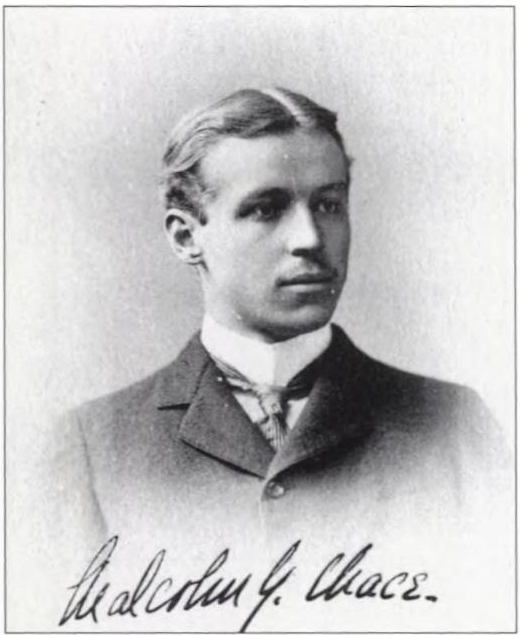
Malcolm Greene Chace (March 12, 1875 – July 16, 1955) was an American financier and textile industrialist who was instrumental in bringing electric power to New England.[1] He was a pioneer of the sport of ice hockey in the United States, and was Yale University's first hockey captain. He was also an amateur tennis player whose highest ranking was U.S. No. 3 in 1895.

Key Information

Personal life

[edit]

Chace was born March 12, 1875, in Central Falls, Rhode Island[1] into the illustrious Chace family. Malcolm's great-grandfather Oliver Chace was a textile mill owner, whose company later became Berkshire Hathaway. His grandmother was anti-slavery activist Elizabeth Buffum Chace. His parents were Brown University chancellor Arnold Buffum Chace and Eliza Greene Chace. His son, Malcolm Greene Chace, Jr. and grandson Malcolm Greene Chace III also became directors of Berkshire Hathaway.

Chace briefly attended Brown University, but transferred to Yale and graduated from Yale's Sheffield Scientific School in 1896, attaining some fame as a tennis player at both schools.[1] In 1914, he purchased Point Gammon Light on Great Island in West Yarmouth, Massachusetts, which had previously been owned by the renowned ornithologist Charles Barney Cory. By 1925, Chace owned the entire island, the majority of which has remained in the Chace family to the present day.[3][4] Chace lived for some time in Providence, Rhode Island, but spent the last 10 years of his life at 60 Sutton Place in New York City and at his summer home in Hyannis, Massachusetts.[1]

Chace's first wife Elizabeth Edwards died in 1947. His second wife Kathleen Dunster (incorrectly reported in his New York Times obituary as "Kathleen Dunbar"),[5] outlived him.[1] He had two sons (Malcolm Greene Chace, Jr. and Arnold B. Chace III) and three daughters.

"Father of ice hockey in the United States"

[edit]

According to his obituaries, Chace was "credited with having been the father of hockey in the United States."[1][5][6] In fall 1892, while still a student at Brown University, Chace visited Niagara Falls, Ontario, for a tennis tournament.[7] While there, Chace was introduced to ice hockey by members of the Victoria Hockey Club.[8][1] During Christmas Break 1894-95 Chace put together a team of men from Yale, Brown, and Harvard, and Columbia[8] and played ten (or five?[7]) games, touring Montreal, Kingston, Ottawa and Toronto as captain of this team, with the goal of learning how to play the Canadian game of hockey.[1][5] Upon their return, each of the students established hockey clubs at their respective schools.[8] Chace transferred from Brown to Yale, where he served as team captain and also the player-coach.[7]

On February 14, 1896, played in the first intercollegiate hockey match in the United States against Johns Hopkins University at Baltimore's North Avenue Rink. Yale won the game, 2–1, and both goals were scored by Chace.[9][10]

Chace played on various other hockey teams over a decade-long career, including the St. Nicholas Hockey Club in New York.[5] He was one of the financial backers of New York's St. Nicholas Rink.[5] In 1932, Chace rescued the Rhode Island Auditorium, then Providence's professional and amateur hockey arena, from foreclosure.[6]

In 2018, the Rhode Island Hockey Hall of Fame and the Chace family established the Malcolm Greene Chace Memorial Trophy to be presented each year for "Lifetime contributions of a Rhode Islander to the game of ice hockey". In 2019, Chace was enshrined in the RI Hockey Hall of Fame.

To honor Chace, Yale created an award in his name, and in 1998 created the position of Malcolm G. Chace Head Hockey Coach.[9] Tim Taylor was the first Yale coach to serve with this title.[9] A portrait of Chace hangs in the Schley Room at Ingalls Rink.[9]

Tennis career

[edit]

Chace's tennis career started in his childhood. At age 14 he became Rhode Island's youngest state tennis champion, and four times he placed among the top ten amateur tennis players.[5] He was national college champion in 1893, 1894, and 1895.[5]

Malcolm played for both Brown University and Yale while still a student.[1] When he graduated from Yale in 1896, he retired from tennis, but not before setting a record by winning the U.S. Intercollegiate Singles and Doubles titles for three consecutive years (1893–1895).[11] In 1893 he won the Narragansette Pier Open against Bill Larned.

In July 1894, he won the Tuxedo tournament in New York City defeating Clarence Hobart in the final in five sets.[12] He successfully defended his title the following year when he was victorious against future seven-time U.S. Championship winner Bill Larned in straight sets.[13]

Chace won the U.S. National Doubles Championship in 1895 and was a doubles finalist in 1896, in both cases partnering compatriot Robert Wrenn.[14] In singles, he reached the semifinals in 1894 and the quarterfinals in 1895 and 1900.

Chace was inducted in the International Tennis Hall of Fame in 1961.[6]

Grand Slam finals

[edit]

Doubles (1 title, 1 runner-up)

[edit]
Result Year Championship Surface Partner Opponents Score
Win 1895 U.S. Championships Grass United States Robert Wrenn United States Clarence Hobart
United States Fred Hovey
7–5, 6–1, 8–6
Loss 1896 U.S. Championships Grass United States Robert Wrenn United States Carr Neel
United States Sam Neel
3–6, 6–1, 1–6, 6–3, 1–6

Industrial career

[edit]

Electric power

[edit]

Shortly after graduating college, Chace became associated with the introduction of electric power to New England.[1] By 1910 he formed the firm of Chace & Harriman, which built a 24,000 kilowatt power plant on the Connecticut River near Brattleboro, Vermont.[1] Eventually Chace helped develop the New England Power Association and in 1926 he gained control of the Narragansett Electric Lighting Company.[1] In his obituary, the Providence Journal said Chace had been "one of the most influential men in the development of electric power in the Northeast."[1]

Textile mills

[edit]

In 1926, Chace formed the Berkshire Fine Spinning Associates, Inc, the largest producer of fine cotton goods in the United States.[1] It had mills in Albion, Warren, Anthony, and Fall River.[1] This company later became known as Berkshire Hathaway.[1] He was also president of the Fort Dummer textile mill in Brattleboro, Vermont.

Oil tankers

[edit]

During World War I and "most of" World War II, Chace maintained a fleet of tankers to transport oil to New England.[1] It was the largest independent oil tanker fleet in the US.[1][5]

Death and burial

[edit]
Chace's tombstone in the family plot at Swan Point

Chace died July 16, 1955 (aged 80) at his summer home in Hyannis, Massachusetts[1] and is buried at Swan Point Cemetery in Providence, Rhode Island.[2]

Legacy

[edit]
  • Chace was inducted in the International Tennis Hall of Fame in 1961.[6]
  • Yale University created the Malcolm G. Chace Award, which is given each year to the player who "best exemplifies leadership and the traditions of the sport at Yale."[9]
  • In 1998 Yale established the position of Malcolm G. Chace Head Hockey Coach.[9] Tim Taylor was the first Yale coach to serve with this title.[9]
  • A portrait of Chace hangs in the Schley Room at Ingalls Rink.[9]
  • The Malcolm Greene Chace Memorial Trophy was established in 2018 to honor “Achievement and Outstanding Service by a Rhode Islander to the Game of Hockey.”[8]
  • Chace was inducted into the Rhode Island Hockey Hall of Fame in 2019.

References

[edit]
[edit]
Revisions and contributorsEdit on WikipediaRead on Wikipedia
from Grokipedia
Malcolm Greene Chace (March 12, 1875 – July 16, 1955) was an American financier, textile industrialist, and pioneering sportsman renowned for introducing organized to the and for his accomplishments as a top-tier player. Born in Valley Falls, , Chace came from a prominent family in the ; he was the grandson of Samuel B. Chace, a co-founder of the Valley Falls Company, a major cotton goods manufacturer that later contributed to the formation of , where Malcolm served as a director. After beginning his studies at , he transferred to Yale, where he excelled in athletics. In business, Chace played a key role in advancing infrastructure, co-founding an electric utility company in 1903 with Henry Ingraham that acquired the Vernon hydroelectric project and helped bring electric power to . Chace's athletic legacy is marked by dual excellence in tennis and hockey. A right-handed player ranked No. 3 in the U.S. in 1895, he reached the semifinals of the U.S. National Singles in 1894 and won the U.S. National Doubles title in 1895 alongside Bob Wrenn; earlier, he captured intercollegiate singles and doubles championships in 1893 at Brown and repeated the feat at Yale in 1894 and 1895. In hockey, dubbed the "Father of American Hockey," Chace organized the first intercollegiate game on February 14, 1896, between Yale and Johns Hopkins, and assembled teams from Ivy League schools while leading U.S. exhibitions in Canada as early as 1894. He was inducted into the International Tennis Hall of Fame in 1961, and his influence endures through the Malcolm Greene Chace Memorial Trophy, awarded annually by the Rhode Island Hockey Hall of Fame for contributions to the sport.

Early Life and Education

Family Background

Malcolm Greene Chace was born on March 12, 1875, in , to Dr. Arnold Buffum Chace and Eliza Chace Greene. His father, a physician trained at , later became a prominent scholar and served as the eleventh of from 1907 to 1932, influencing the academic landscape of . Eliza Greene Chace, daughter of Christopher A. Greene and Sarah A. Chace, came from a family with deep roots in the state's Quaker and reformist communities. Chace was the grandson of Samuel Buffington Chace and the great-grandson of , the latter being a pioneering industrialist who founded the Valley Falls Company in , a enterprise that evolved into . This ancestral legacy tied the family to Rhode Island's early industrial growth, particularly in the textile sector centered around Pawtucket and Valley Falls, where established multiple mills after immigrating from and working under . The second of four children, Chace grew up alongside siblings Arnold Buffum Chace Jr. (born 1872), Margaret Lily Chace (born 1877), and Edward Gould Chace (born 1882) in a household marked by intellectual and civic engagement. His parents' emphasis on education and public service, rooted in the family's Quaker heritage and abolitionist ties—exemplified by his paternal grandmother Elizabeth Buffum Chace—fostered an environment that shaped his early interests in academics and community involvement. The Chaces resided in the Providence area during his childhood, immersed in a prominent Rhode Island family network connected to both burgeoning industry and progressive politics.

Academic Career

Malcolm Greene Chace began his undergraduate studies at in the fall of 1892, where he participated in intercollegiate athletics during his brief time as a . He transferred to shortly thereafter, enrolling in the , an institution dedicated to scientific and technical education. The , established in , emphasized applied sciences such as mathematics, physics, chemistry, and engineering principles, distinguishing it from Yale College's classical curriculum. At Yale, Chace pursued a three-year program leading to a Ph.B. degree, graduating in 1896 with a focus on scientific studies that provided foundational knowledge in physical sciences and emerging industrial applications. His coursework at aligned with practical disciplines, including experimental sciences and technical subjects that would later inform advancements in systems and processes. During his university years, Chace gained early exposure to organized athletics, balancing his academic pursuits with extracurricular activities. Notably, in the winter of 1894–1895, he assembled and captained Yale's inaugural team, introducing the sport to the institution through informal games against regional opponents. This involvement marked the beginning of hockey's establishment at Yale and highlighted Chace's role in fostering athletic traditions alongside his scientific education.

Sports Contributions

Ice Hockey Development

Malcolm Greene Chace played a foundational role in establishing as a collegiate in the United States, beginning with his exposure to the game during a 1892 tennis tournament in , where Canadian players introduced him to the . As a student at from 1891 to 1893, Chace assembled the first informal hockey team there, drawing on experts including undergraduates, and organized exhibition games against Canadian clubs in 1894 to promote the . After transferring to Yale University's , he organized and captained the university's inaugural team in the 1894–95 season, marking one of the earliest structured programs in American higher education. Chace's leadership culminated in Yale's participation in the first documented U.S. intercollegiate hockey match against on February 14, 1896, at Baltimore's North Avenue Rink, where Yale secured a 2–1 victory, with Chace scoring both goals for his team. This game, played under seven-per-side rules adapted from Canadian styles, helped legitimize hockey as an intercollegiate competition and spurred interest across East Coast universities. Following his graduation from Yale in 1896, Chace continued to advance hockey by playing for over a decade on prominent amateur teams, including the formation and support of the St. Nicholas Hockey Club in New York, where he contributed to the financing and construction of the St. Nicholas Rink, a key venue for early American hockey. In , his promotional efforts included rescuing the Rhode Island Auditorium from foreclosure in 1932 during the , ensuring its viability as a hub for local hockey games and community events. For these contributions, Chace earned recognition as the "Father of in the United States" and was posthumously inducted into the Rhode Island Hockey Hall of Fame in 2019.

Tennis Accomplishments

Malcolm Greene Chace emerged as a prominent player in the late , achieving national recognition during his college years. At , he captured both the Intercollegiate Singles and Doubles titles in 1893. Transferring to , Chace repeated these collegiate victories in 1894 and 1895, setting a record for three consecutive years. His consistent performance earned him a place in the U.S. top ten rankings on four occasions, with his highest position being No. 3 in 1895. Chace's most notable success came at the U.S. National Championships, where he reached the singles semifinals in 1894, falling to (who went on to the final). In doubles, he partnered with Robert Wrenn to win the 1895 men's title, defeating Fred Hovey and Clarence Hobart in the final. The duo returned as runners-up the following year, losing in the 1896 final. These accomplishments highlighted Chace's prowess in team play during an era when was gaining structure in the United States. Beyond national events, Chace's early start in the sport included becoming Rhode Island's youngest state champion at age 14, underscoring his prodigious talent. Although his competitive career was relatively brief, ending around age 21, his contributions to amateur were honored posthumously with induction into the in 1961 as a Master Player. This recognition cemented his legacy as one of the pioneering figures in American .

Professional Career

Electric Power Initiatives

In 1906, Malcolm Greene Chace and Henry Ingraham Harriman obtained charters from and to construct a and hydroelectric generating plant at Vernon on the , marking the beginning of their partnership in regional power development. The firm, initially established as Chace & Harriman around and formalized for power projects by 1906, focused on harnessing the 's potential for hydroelectric generation to supply growing industrial demands in . Construction of the Vernon began in 1907, employing up to 450 workers, and the plant came online in 1909 with an initial capacity of approximately 20,000 kW, expandable to 24,000 kW through auxiliary steam-powered facilities added in 1910. This facility represented an engineering milestone as one of the first in the northeastern U.S. to transmit power over long distances at 66,000 volts across 60-66 miles to industrial centers like Gardner and , overcoming challenges such as terrain difficulties and the need for robust high-voltage lines in remote areas. Chace and Harriman's efforts expanded rapidly, with the firm building additional hydroelectric plants on the , including the Bellows Falls facility (completed 1925-1928 with 49,000 kW capacity) and the Wilder station, as well as developments on the Deerfield River such as the Somerset Reservoir (1911-1913, supporting 18,000 kW across multiple units) and the Harriman plant (1924, 40,000 kW, the largest east of at the time). These projects addressed early 20th-century challenges like seasonal water flow variability through large reservoirs (e.g., Somerset's 2.5 billion cubic feet storage) and integrated steam backups to ensure reliable output, facilitating the of power systems across state lines. By the mid-1920s, Chace had played a pivotal role in consolidating these assets into the Power Association (NEPA) in 1926, a that unified operations and extended transmission infrastructure to 120,000 volts, enabling broader distribution. A key expansion under NEPA's formation was the 1927 acquisition and control of the Narragansett Electric Lighting Company in , which integrated local steam and hydroelectric resources to enhance grid reliability and lower costs through . This move, supported by regional political leadership, allowed NEPA to electrify rural areas and industrial zones in , , and surrounding states, connecting previously isolated communities to a networked system that powered municipalities, residences, and factories—including mills—by the late . NEPA's developments, including over 126 miles of new transmission lines by the early , overcame regulatory hurdles and environmental concerns of the era, such as dam-induced flooding, to achieve near-universal access in urban centers and 84% farm in by 1939 via federal programs.

Textile Manufacturing

In the mid-1920s, Malcolm Greene Chace played a pivotal role in consolidating New England's fragmented by orchestrating the formation of Berkshire Fine Spinning Associates in 1929. This entity emerged from the merger of multiple mills, including key facilities in Albion, Warren, Anthony, and Fall River, , creating the largest producer of fine goods in the United States at the time. The consolidation under Chace's leadership integrated operations across these sites, focusing on high-quality yarns and fabrics such as those used for shirts, sheets, and handkerchiefs, thereby enhancing efficiency amid post-World War I market challenges. Berkshire Fine Spinning Associates evolved significantly during Chace's tenure, culminating in its 1955 merger with Hathaway Manufacturing Company of , to form Berkshire Inc. This union combined Berkshire's extensive mill network with Hathaway's specialized suiting fabrics, resulting in a conglomerate with approximately 12,000 employees across 15 and a of $53 million. Additionally, Chace served as president of the Fort Dummer Mills in , a facility later incorporated into Berkshire's operations through a 1929 merger that further expanded its production capacity. Chace's strategies for modernizing textile production emphasized structural consolidation and technological upgrades to counter declining competitiveness in . By merging disparate mills, he streamlined management and reduced overhead, while integrating reliable supplies—drawn from his earlier initiatives in the sector—to power machinery and improve output consistency. These efforts represented a broader push to adapt to mechanized advancements, though the industry faced ongoing pressures from Southern competitors with lower labor costs. The economic impact of Chace's leadership on Rhode Island's sector was substantial, bolstering employment and regional output during the early . Fine Spinning Associates operated major plants in the state, employing thousands in mill towns like Warren and Albion, and contributing to Rhode Island's position as a hub for with annual outputs in the millions of yards of fabric. This consolidation helped sustain local economies through the , though later plant closures in the 1950s and 1960s underscored the sector's vulnerabilities.

Oil Transportation Ventures

Malcolm Greene Chace developed and managed one of the most significant private maritime operations in the U.S. energy sector, owning the largest independent fleet during and through most of . This fleet played a vital role in transporting products to ports, ensuring a steady supply for industrial and civilian needs along the East Coast amid global disruptions. In the post-World War I period, Chace, serving as a director and executive committee member of the New England Oil Refining Corporation, spearheaded the purchase of seven tankers with a combined deadweight tonnage of 84,000 tons from the U.S. Shipping Board for approximately $8.12 million. These vessels were essential for shipping crude oil from European refineries to the corporation's facilities in Everett, Massachusetts, addressing logistical bottlenecks in fuel importation and distribution. The acquisition, managed through a tanker syndicate in which Chace participated, highlighted the strategic value of independent fleets in maintaining domestic energy flows independent of major oil conglomerates. Chace's tanker operations faced inherent wartime perils, including threats from German U-boats that targeted merchant shipping, yet they endured to support Allied efforts and U.S. by delivering critical supplies without reliance on government-controlled vessels. Post-war, the fleet adapted to commercial demands, though specific adjustments remain less documented. These ventures complemented Chace's broader interests, such as generation, by facilitating reliable for power plants.

Personal Life

Marriages and Family

Malcolm Greene Chace married on April 15, 1903, in , New York. Elizabeth, born in 1876, passed away in 1947. The couple had five children together: two sons, Malcolm Greene Chace Jr. (1904–1996) and Arnold Buffum Chace III (1914–1988), and three daughters, Eliot J. Chace (1906–1977), Jane Chace (born 1909), and Elizabeth "Betsy" Chace (1911–2013). The Chace children grew up in a family environment shaped by their father's prominence in sports and business, with several pursuing paths in and public life. Malcolm Jr. entered the family and investment enterprises, while Arnold III also engaged in business activities. Eliot married James Cox Brady Jr. in 1929 and became involved in social and philanthropic circles in New York; Jane wed Robert Carter Nicholas Jr., connecting to prominent families; and Elizabeth, known as Betsy, married explorer William Douglas Burden before later wedding Grenville Temple Emmet Jr., reflecting the family's ties to elite society. Historical records indicate limited documentation of direct family during this period, though the Chaces maintained close-knit ties through shared interests in and community involvement in Providence. Following Elizabeth's death, Chace married Kathleen Dunster on October 18, 1947, in New York. Kathleen, born February 19, 1891, in , outlived Chace until her death in 1990. The second marriage produced no children and focused on Chace's later personal life without notable public family expansions.

Residences and Later Activities

During his professional career, Malcolm Greene Chace maintained his primary residence in , where he had lived for many years and where his business interests were centered. In the later stages of his life, he shifted his permanent home to Sutton Place in , residing there for the final decade beginning around 1945. Chace also owned a summer home in Hyannis on , , which served as a retreat during warmer months and where he increasingly spent time in his later years. As he transitioned into semi-retirement in the , following a long career in and industry, Chace pursued leisure activities reflecting his earlier interests in sports and outdoor pursuits. While based primarily in New York and Hyannis during this period, Chace maintained ties to Providence, occasionally returning to the city and sharing time at family properties there with his wife and children. His later years emphasized a quieter lifestyle focused on family, travel between his homes, and personal hobbies, away from active business engagements.

Death and Legacy

Final Years and Passing

In his later years, Malcolm Greene Chace divided his time between his residence at 60 Sutton Place in New York City and his summer home in Hyannis, Massachusetts. Chace died on July 16, 1955, at the age of 80, at his summer home in Hyannis. He was survived by his second wife, Kathleen Dunbar Chace, two sons—Malcolm G. Chace Jr. and Arnold B. Chace III—and three daughters—Mrs. W. Douglas Burden, Mrs. R. Carter Nicholas, and Mrs. James C. Brady—as well as 19 grandchildren and three great-grandchildren. Chace was buried at in .

Enduring Impact

Chace's contributions to have been honored through several enduring institutional recognitions. At , the Malcolm G. Chace Award, established in 1958 by the Yale Hockey Association, is presented annually to a team member exemplifying , spirit, and dedication to the sport. In 1998, Yale inaugurated the position of Malcolm G. Chace for Hockey, funded by a gift from his grandson, to commemorate his foundational role in American collegiate hockey. Additionally, in 2018, the and the Chace family created the Malcolm Greene Chace Memorial Trophy, an annual award recognizing outstanding achievement and service to hockey by Rhode Islanders. His family's involvement in business perpetuates a significant legacy in American industry. As an organizer of the company that evolved into , Chace's influence extended through his son, Malcolm G. Chace Jr., who served as a director, and his grandson, Malcolm G. Chace III, who joined the board in 1992 and continued until 2007. This multi-generational stewardship underscores the Chace family's lasting ties to one of the world's leading conglomerates. Chace's broader impact resonates in American sports and industry, where he is credited with pioneering in the United States and advancing infrastructure. These efforts fostered regional economic growth and cultural traditions in athletics.

References

Add your contribution
Related Hubs
User Avatar
No comments yet.