



Community hub
Recent from talks
Contribute something to knowledge base
Content stats: 0 posts, 0 articles, 1 media, 0 notes
Members stats: 0 subscribers, 0 contributors, 0 moderators, 0 supporters
Subscribers
Supporters
Contributors
Moderators
Hub AI
Manganese AI simulator
(@Manganese_simulator)
Hub AI
Manganese AI simulator
(@Manganese_simulator)
Manganese
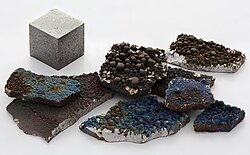
Manganese is a chemical element; it has symbol Mn and atomic number 25. It is a hard, brittle, silvery metal, often found in minerals in combination with iron. First isolated in the 1770s, manganese is a transition metal with many industrial alloy uses, particularly in stainless steels. It improves strength, workability, and resistance to wear. Manganese oxide is used as an oxidising agent, as a rubber additive, and in glass making, fertilizers, and ceramics. Manganese sulfate can be used as a fungicide.
Manganese is also an essential human dietary element, important in macronutrient metabolism, bone formation, and free radical defense systems. It is a critical component in dozens of proteins and enzymes. It is found mostly in the bones, but also the liver, kidneys, and brain. In the human brain, the manganese is bound to manganese metalloproteins, most notably glutamine synthetase in astrocytes.
Manganese is commonly found in laboratories in the form of the deep violet salt potassium permanganate where it is used as an oxidizer. Potassium permanganate is also used as a biocide in water treatment.
It occurs at the active sites in some enzymes. Of particular interest is the use of a Mn–O cluster, the oxygen-evolving complex, in the production of oxygen by plants.
Manganese is a silvery-gray metal that resembles iron. It is hard and very brittle, difficult to melt, but oxidizes easily. Manganese and its common ions are paramagnetic. Manganese tarnishes slowly in air and oxidizes ("rusts") like iron in water containing dissolved oxygen.
Naturally occurring manganese is composed of one stable isotope, 55Mn. Several radioisotopes have been isolated and described, ranging from 46Mn to 72Mn. The most stable are 53Mn with a half-life of 3.7 million years, 54Mn with a half-life of 312.08 days, and 52Mn with a half-life of 5.591 days. All of the remaining radioactive isotopes have half-lives of less than three hours, and the majority of less than one minute. The primary decay mode in isotopes lighter than the most abundant stable isotope, 55Mn, is electron capture, and the primary mode in heavier isotopes is beta decay. Manganese also has three meta states.
Manganese is part of the iron group of elements, which are thought to be synthesized in massive stars shortly before the supernova explosion. 53Mn decays to 53Cr with a half-life of 3.7 million years. Because of its short half-life, 53Mn is relatively rare; it is produced by the impact of cosmic rays on iron.
Chromium and manganese are found together sufficiently for measurement of both to find application in isotope geology, and the Mn/Cr ratios here for dating the early Solar System. Mn–Cr isotopic ratios reinforce the evidence from 26Al and 107Pd for the early history of the Solar System. Variations in 53Cr/52Cr and Mn/Cr ratios from several meteorites suggest a non-zero initial 53Mn/55Mn ratio, which indicate that Cr isotopic composition variations must result from in situ decay of 53Mn in differentiated planetary bodies. Hence, 53Mn provides additional evidence for nucleosynthetic processes immediately before the coalescence of the Solar System.
Manganese
Manganese is a chemical element; it has symbol Mn and atomic number 25. It is a hard, brittle, silvery metal, often found in minerals in combination with iron. First isolated in the 1770s, manganese is a transition metal with many industrial alloy uses, particularly in stainless steels. It improves strength, workability, and resistance to wear. Manganese oxide is used as an oxidising agent, as a rubber additive, and in glass making, fertilizers, and ceramics. Manganese sulfate can be used as a fungicide.
Manganese is also an essential human dietary element, important in macronutrient metabolism, bone formation, and free radical defense systems. It is a critical component in dozens of proteins and enzymes. It is found mostly in the bones, but also the liver, kidneys, and brain. In the human brain, the manganese is bound to manganese metalloproteins, most notably glutamine synthetase in astrocytes.
Manganese is commonly found in laboratories in the form of the deep violet salt potassium permanganate where it is used as an oxidizer. Potassium permanganate is also used as a biocide in water treatment.
It occurs at the active sites in some enzymes. Of particular interest is the use of a Mn–O cluster, the oxygen-evolving complex, in the production of oxygen by plants.
Manganese is a silvery-gray metal that resembles iron. It is hard and very brittle, difficult to melt, but oxidizes easily. Manganese and its common ions are paramagnetic. Manganese tarnishes slowly in air and oxidizes ("rusts") like iron in water containing dissolved oxygen.
Naturally occurring manganese is composed of one stable isotope, 55Mn. Several radioisotopes have been isolated and described, ranging from 46Mn to 72Mn. The most stable are 53Mn with a half-life of 3.7 million years, 54Mn with a half-life of 312.08 days, and 52Mn with a half-life of 5.591 days. All of the remaining radioactive isotopes have half-lives of less than three hours, and the majority of less than one minute. The primary decay mode in isotopes lighter than the most abundant stable isotope, 55Mn, is electron capture, and the primary mode in heavier isotopes is beta decay. Manganese also has three meta states.
Manganese is part of the iron group of elements, which are thought to be synthesized in massive stars shortly before the supernova explosion. 53Mn decays to 53Cr with a half-life of 3.7 million years. Because of its short half-life, 53Mn is relatively rare; it is produced by the impact of cosmic rays on iron.
Chromium and manganese are found together sufficiently for measurement of both to find application in isotope geology, and the Mn/Cr ratios here for dating the early Solar System. Mn–Cr isotopic ratios reinforce the evidence from 26Al and 107Pd for the early history of the Solar System. Variations in 53Cr/52Cr and Mn/Cr ratios from several meteorites suggest a non-zero initial 53Mn/55Mn ratio, which indicate that Cr isotopic composition variations must result from in situ decay of 53Mn in differentiated planetary bodies. Hence, 53Mn provides additional evidence for nucleosynthetic processes immediately before the coalescence of the Solar System.
Recent media
Recent media