Hubbry Logo
Maro ReefMaro ReefMain
Open search
Maro Reef
Community hub
Maro Reef
logo
8 pages, 0 posts
0 subscribers
Be the first to start a discussion here.
Maro Reef
Maro Reef
from Wikipedia
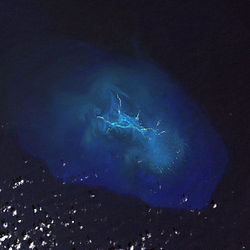
Satellite image of Maro Reef

25°24′54″N 170°35′24″W / 25.415°N 170.590°W / 25.415; -170.590 Maro Reef (Hawaiian: Nalukākala - "surf that arrives in combers") is a largely submerged coral atoll located in the Northwestern Hawaiian Islands. It was discovered in 1820 by Captain Joseph Allen of the ship Maro, after whose ship the reef was named. With a total area of 747 square miles (1,935 km2), it is the largest coral reef in the Northwestern Hawaiian Islands. It contains 37 species of stony coral. Unlike most atolls, the coral extends out from the center like spokes on a wheel. Located about 850 miles (740 nmi; 1,370 km) northwest of Honolulu, Hawaii, Maro Reef contains about 1 acre (4,000 m2) of dry land which itself can be submerged depending on the tides. Some scientists believe that it "may be on the verge of drowning" because the reefs are detached and are vulnerable to strong storm waves.[1]

Wreck of the USNS ship Mission San Miguel. All hands were evacuated before it sank in 1957. It was rediscovered in 2015.

USNS Mission San Miguel (T-AO-129) ran aground on the reef, while running at full speed and in ballast, and sank on October 8, 1957.

The ship was a Buenaventura class tanker built in WW2, and due to problems with LORAN reception (for navigation) miscalculated its location striking Maro reef. It was rediscovered in 2015 by NOAA divers. At 523 feet long it is the largest ship lost on Maro reef and noted for historical significant as WW2 T2 tank vessel.[2]

USCG image of an abandoned anchor in Maro Reef

Dowsett Reef

[edit]

Dowsett Reef (also called Dowsett's Rock) is to the south of Maro Reef.[3] The sailing ship McNear, a bark, sunk on Dowsett Reef on May 14, 1900.[3] The ship's 33 occupants survived by sailing in boats to Laysan.[3]

See also

[edit]

References

[edit]
Revisions and contributorsEdit on WikipediaRead on Wikipedia
from Grokipedia
Maro Reef, also known as Ko'anako'a or Nalukākala in Hawaiian, is a largely submerged and the largest in the , spanning approximately 1,934 square kilometers (746 square miles or 478,000 acres) of with less than 1 acre of emergent . Located about 1,160 kilometers (720 miles) northwest of the main at coordinates 25°24′N 170°38′W, it forms a complex maze of linear and reticulate structures radiating from a central , featuring sandy flats, steep slopes, heads, pinnacles, and patch reefs in shallow waters up to 100 fathoms deep. Ecologically, Maro Reef stands out for its exceptional within the , hosting 37 species of stony corals—more than any other reef in the chain—including abundant rice corals (Montipora capitata) and finger corals (Porites compressa), alongside that support a vibrant . This diversity extends to such as schools of and surgeonfish, large ulua (jacks) and omilu (bluefin trevally), and apex predators including white-tip reef sharks, gray reef sharks, and Galápagos sharks up to 6-8 feet in length. The reef's shallow-water environment, roughly 50 km long and 30 km wide, covers an estimated 1,856 square kilometers and serves as a critical foraging area for Hawaiian monk seals, though it lacks suitable haul-out sites for breeding. Named after the 1820 whaling ship Maro, the reef's remote location has preserved its relatively pristine condition, free from significant human development, making it a key site for studying undisturbed coral ecosystems amid global reef declines. However, threats like derelict fishing gear, marine debris, and potential "drowning" from sea-level rise—due to its narrow, storm-exposed structure—pose risks to its health, with ongoing removal efforts extracting tens of thousands of pounds of debris as of 2025. As part of the UNESCO World Heritage-listed monument encompassing over 1.5 million square kilometers, Maro Reef is strictly protected, with management focused on conservation, research, limited bottomfishing beyond 20 fathoms, and recent critical habitat designations for threatened species as of July 2025 to sustain its ecological integrity.

Geography

Location and Extent

Maro Reef is situated in the , approximately 850 miles (1,370 km) northwest of , . Its central coordinates are positioned at 25°22′N 170°35′W. Known in the as Koʻanakoʻa, meaning "the settlement of coral," and also as Nalukākala, referring to "surf that arrives in combers," the reef forms a key part of the remote . The reef spans an expansive area of 1,934 square kilometers (746 square miles), establishing it as the largest system within the . It measures roughly 50 km in length and 30 km in width, creating a vast, irregularly shaped platform that dominates the surrounding seascape. Despite its immense underwater extent, Maro Reef features minimal emergent land, limited to a single small rock outcrop covering less than 1 acre, which becomes submerged during high tides and is visible only at very . This near-total submersion underscores the reef's character as a predominantly marine feature.

Geological Features

Maro Reef is classified as a largely submerged open , distinct from classical ring-shaped atolls due to its lack of a continuous rim . Instead, it features a unique arrangement of linear and reticulate complexes that radiate outward from a central point, forming intricate network-like patterns resembling spokes on a . These reticulated reefs create a maze of narrow crests, deep channels, and enclosed lagoons, with the overall spanning approximately 50 km in length and 30 km in width. The reef's formation traces back to volcanic origins as part of the Hawaiian-Emperor hotspot chain, where an ancient subsided over millions of years, allowing growth to build upward and form the . This process, aligned with Darwin's theory of atoll development, has resulted in a platform-like base overlain by and capped by frameworks, with no emergent land except for occasional low-tide rock outcrops. The open configuration exposes the reefs to high wave energy, contributing to their vulnerability to "drowning," where rapid or sea-level rise can outpace vertical reef accretion, leading to detached or fragmented structures. Additionally, the reef's exposure to intense storms exacerbates and instability in these linear features. Maro Reef supports a shallow-water primarily in depths less than 100 m, encompassing crests, lagoons, sandy flats, channels, , and submerged pinnacles that foster diverse benthic . NOAA benthic mapping surveys have delineated these features, revealing an estimated total area of 1,856 km², with approximately 1,508 km² of potential in shallower zones suitable for light-dependent growth. These surveys highlight the reticulated patterns through high-resolution imagery and , showing irregular topography with terraces at depths around 28–32 m and deeper channels facilitating water exchange.

Dowsett Reef

Dowsett Reef is a distinct but adjacent feature located immediately south of the main Maro Reef, forming a connected yet separable extension of the larger complex in the . It consists of a smaller reticulated area with shallow habitats similar to those of the primary , though more fragmented owing to strong regional currents that influence distribution and morphology. This structure positions Dowsett Reef as a transitional zone between the expansive main and deeper surrounding waters, characterized by less integrated spoke-like patterns and distinctive channel formations that facilitate water flow. Like the main Maro Reef, which spans over 1,934 square kilometers, Dowsett Reef features no emergent land, remaining entirely submerged. The reef was named after Captain Dowsett, a 19th-century captain whose vessel encountered the feature in 1872. This naming reflects early maritime in the remote Pacific, highlighting Dowsett Reef's role as the southeastern terminus of the broader system, where it extends the reef's overall footprint without altering the primary atoll's dominant linear and radiating formations.

Ecology

Coral Communities

Maro Reef supports a rich diversity of stony (hermatypic) , with 37 species documented across its expansive reef system. Dominant genera include Porites, which forms massive and encrusting colonies, and , known for its branching and encrusting growth forms such as (rice coral). Other notable genera like Pocillopora and contribute to the assemblage but in lower abundances. This diversity is higher than in many other reefs, reflecting the atoll's relatively pristine conditions and varied substrates. Coral community structure at Maro Reef has been characterized through baseline surveys conducted by the Coral Reef Ecosystem Division (CRED) from 2003 to 2005, utilizing visual estimations along belt transects with 0.5 m or 1 m quadrats to assess percent cover, colony sizes, and relative abundance. These assessments revealed an average scleractinian cover of approximately 32% in detailed photoquadrat surveys, with Porites accounting for over 63% of the cover and density across sectors, followed by Montipora at up to 43%. Colony sizes varied by genus, with Pocillopora featuring the largest individuals (over 40 cm diameter comprising 13% of colonies), while Porites and showed balanced distributions of small to large sizes (over 40 cm in 36% and 34% of colonies, respectively). Relative abundance emphasized Porites dominance, particularly in wave-exposed areas, highlighting a structured community adapted to the atoll's hydrodynamics. Habitat variations across Maro Reef's unique open configuration foster distinct growth patterns, with high diversity observed in reticulate (net-like) reefs and protected lagoons interspersed with sandy flats and isolated heads. The absence of a perimeter allows for reticulated formations where thrive amid channels that facilitate water flow, supporting patchy but robust communities on pinnacle and patch reefs. In lagoons, heads rise from sandy substrates, contributing to localized high cover (up to 55% in northeastern sectors), while steeper slopes host encrusting forms resilient to currents. Health indicators for Maro Reef's coral communities show resilience despite episodic stressors, including bleaching events in 2002 and 2004 that affected 25% and 15% of cover, respectively, with subsequent recovery evident in follow-up surveys. Storm damage has caused localized breakage, particularly on exposed reticulate structures, but protected shallows exhibit lower mortality and strong recruitment rates (over 265 recruits per square meter annually). Disease prevalence remains low, with rare occurrences of tissue loss or predation by crown-of-thorns seastars, underscoring the communities' overall vitality in these isolated waters.

Marine Fauna

Maro Reef supports a high of reef-associated fish, particularly herbivores such as (Acanthuridae) and (Scaridae), which play crucial roles in maintaining by grazing on over substrates. Surveys conducted by NOAA's Coral Reef Ecosystem Division indicate that the , including Maro Reef, exhibit an average reef fish of 2.44 metric tons per hectare, significantly higher than the 0.68 metric tons per hectare observed in the main , reflecting minimal human impact and robust populations of these species. contribute to this high herbivore at Maro Reef, aiding effective algal control and resilience. The reef is also renowned for its shark and ray assemblages, designating it as an Important Shark and Ray Area (ISRA) by the IUCN due to critical aggregation sites that support reproduction and residency. Dominant shark species include the (Carcharhinus galapagensis), observed in aggregations of up to 5.6 individuals on average and present in 40% of stationary point count surveys from 2000–2004, alongside reef sharks ( amblyrhynchos), tiger sharks (Galeocerdo cuvier), and whitetip reef sharks (Triaenodon obesus). Rays, such as the (Aetobatus ocellatus) and manta rays, frequent pinnacle reefs and channels, enhancing the area's status as having the highest shark densities among Northwestern Hawaiian Islands banks, with towed-diver surveys recording up to over 20 in a single observation. Benthic thrive in the reef's channels, flats, and lagoons, including sea urchins (Echinometra spp. and Echinostrephus spp.), which exhibit low densities but influence algal dynamics, as well as diverse mollusks like ark shells, rock oysters, and spiny oysters abundant on pinnacles. Crustaceans, such as hermit crabs (Calcinus spp.), trapezid crabs, and slipper lobsters (Panulirus marginatus), occupy similar habitats, with quantitative assessments from NOAA's Reef Assessment and Monitoring Program documenting their presence in fine-scale quadrat surveys covering sponges and octocorals. Submarine canyons surrounding Maro Reef serve as hotspots for deep-sea , exporting from shallow reefs to depths of 350–1500 meters, where they support elevated megafaunal abundance—2–4 times higher than on open slopes—including unique of , , and crabs, with 27 exclusive to canyon environments at the site. Trophic interactions at Maro Reef emphasize predator-prey dynamics in its open structure, where apex predators like and large jacks comprise 54% of fish , far exceeding the less than 3% in the main , fostering a balanced with herbivores at 28% of . This structure underscores the reef's ecological richness despite its isolation, which limits overall compared to the main —resulting in fewer but larger, more abundant populations—while NOAA benthic surveys highlight vulnerable yet thriving communities adapted to the remote environment.

Avifauna and Terrestrial Life

Maro Reef features minimal emergent land, limited to less than one acre of periodically exposed coral rubble and reef rock outcrops that surface only during exceptionally low tides. This sparse terrestrial habitat supports no permanent populations of mammals, reptiles, amphibians, or vascular , a consequence of the reef's extreme isolation in the remote and the absence of stable soil or vegetation. No have established due to the lack of accessible land and human activity, preserving the area as strictly avian-dominated in its limited terrestrial component. Avifauna at Maro Reef is constrained by the unsuitable nesting conditions on the unstable, barren rocks, resulting in no known breeding colonies for . However, the reef serves as an important foraging ground for thousands of from nearby islands within the ecosystem. Species such as the (Phoebastria nigripes), (Phoebastria immutabilis), and wedge-tailed shearwater (Ardenna pacifica) frequent the area, exploiting the rich marine prey resources in the surrounding waters. These birds, part of the broader population of approximately 14 million across the region, occasionally rest on the emergent features but do not nest there. Seabirds contribute to the reef's dynamics through incidental deposition on exposed rocks, which can enhance local algal growth and indirectly support health by enriching the with and . This role, though limited by the small scale of avian use, underscores the connectivity between aerial and marine components in the atoll-like environment. The emergent habitats remain vulnerable to storm surges and high seas, which can temporarily submerge them and disrupt any transient avian activity.

History

Discovery and Naming

Maro Reef was first sighted by Europeans in 1820 during a voyage led by Captain Joseph Allen aboard the American whaler Maro. Allen, commanding the vessel from , , encountered the submerged after discovering the nearby earlier that year, marking one of the initial Western explorations of the remote . The reef's name derives directly from Allen's ship, the Maro, reflecting the era's expeditions that mapped vast stretches of the in pursuit of whales. This was common among 19th-century American whalers, who often honored their vessels in their discoveries to commemorate perilous voyages through . The event underscores the broader context of the North Pacific boom, where ships like the Maro and Rambler—the latter under Benjamin Worth—collaborated in surveying the region for navigational hazards and resource opportunities. Prior to European contact, held extensive knowledge of the , including Maro Reef, through centuries of voyaging for fishing, gathering, and cultural practices, though such indigenous understandings were not systematically recorded in Western sources until later. The traditional for the reef, Koʻanakoʻa, translates to "the settling of coral," evoking its expansive coral formations and indicating pre-contact awareness of the site's ecological significance. Early documentation of Maro Reef appeared in charts produced from 1820s whaling voyages, with Allen himself providing the initial surveying notes that warned of the area's navigational dangers, such as its shallow, maze-like reefs. These rudimentary maps, shared among fleets and later incorporated into nautical publications, laid the foundation for safer passage through the during the height of Pacific activities.

Shipwrecks and Maritime Events

Maro Reef's complex structure, featuring spoke-like ridges of coral extending from a central , has long posed significant navigational hazards to vessels traversing the remote , contributing to numerous strandings and wrecks. These radial reef formations, combined with strong currents and poor visibility, have made the area treacherous for mariners since the early . One of the most notable maritime incidents occurred on October 8, 1957, when the USNS Mission San Miguel, a 523-foot T2-SE-A2 tanker, ran aground at full speed on the reef due to a miscalculation of coordinates by the captain and chief mate amid deteriorating weather. The vessel, which had served as a fleet oiler during and the , was carrying a cargo of and was en route from , , to , . All 45 crew members were safely evacuated by the US Coast Guard cutter Winona before the ship broke apart and sank, though it posed a potential threat that was later assessed. The wreck remained lost until August 3, 2015, when a team of NOAA maritime archaeologists rediscovered and documented it during a survey of the . During the whaling era, Maro Reef claimed several vessels, with documented losses highlighting the dangers faced by 19th-century whalers navigating these waters. The American ship Huntress wrecked on the reef in 1852, becoming one of at least 10 vessels reported lost across the during this period. Potential earlier losses in the , including those involving British whalers operating in the Pacific, underscore the reef's role in the perilous expansion of the industry, though specific sites from that decade remain unverified at Maro. The maritime heritage of Maro Reef is part of a broader inventory of cultural resources in the , where over 60 shipwrecks have been reported since 1818, with 17 documented by archaeologists. These sites, including those at Maro, preserve artifacts and stories of , , and , offering insights into the human history of the region.

Conservation and Management

Protected Status

Maro Reef is designated as a core area within the Papahānaumokuākea Marine National Monument, established on June 15, 2006, by Presidential Proclamation 8031 under the authority of the Antiquities Act of 1906. The monument was expanded in 2016 by Presidential Proclamation 9478, nearly quadrupling its area to encompass approximately 583,000 square miles (1,510,000 km²) of ocean and emergent land in the Northwestern Hawaiian Islands, making it the largest fully protected marine conservation area under United States jurisdiction and one of the world's largest marine protected areas. The reef also falls within the Hawaiian Islands National Wildlife Refuge, originally established on February 3, 1909, by President to protect seabird colonies and their habitats across the . This refuge status was expanded and integrated into the monument's framework in 2006, enhancing protections for the atolls, reefs, and surrounding waters that include Maro Reef. Management of the monument, including Maro Reef, imposes strict regulations as a no-take zone, prohibiting commercial and recreational fishing, extraction of resources, and most other human activities to preserve ecosystem integrity. Access is highly restricted, permitted only for scientific research, education, conservation, and Native Hawaiian cultural practices, with all activities requiring prior approval. The monument is co-managed by three primary trustees: the National Oceanic and Atmospheric Administration (NOAA) on behalf of the Department of Commerce, the United States Fish and Wildlife Service (USFWS) on behalf of the Department of the Interior, and the State of Hawaii, ensuring coordinated enforcement and stewardship. On the international level, Papahānaumokuākea, encompassing Maro Reef, was inscribed as a on July 30, 2010, as the first mixed natural and cultural site in the United States, recognizing its exceptional and profound significance to cultural heritage and . This designation underscores commitments to holistic preservation, integrating ecological protection with the spiritual and ancestral values held by .

Research and Monitoring

Research and monitoring at Maro Reef are primarily conducted through the NOAA Coral Reef Ecosystem Division (CRED)'s Rapid Ecological Assessment (REA) surveys, which began in the in 2000 and included intensive efforts at Maro Reef during 2003–2005, with ongoing assessments as part of the National Coral Reef Monitoring Program (NCRMP). These surveys employ multidisciplinary protocols to evaluate reef , including diver-based visual assessments and photographic documentation. Complementing these are benthic habitat mapping initiatives using multibeam sonar systems, such as the Simrad EM300, to generate high-resolution and data, validated through towed camera sled deployments for ground-truthing. Key focus areas of these efforts include coral population parameters, such as colony counts and size class distributions, assessed via belt transects to track recruitment, growth, and mortality rates of dominant genera like Porites and . Monitoring also targets shark and ray aggregations, with Maro Reef designated as an Important Shark and Ray Area (ISRA) under sub-criterion C5 for undefined aggregations of species like grey reef sharks (Carcharhinus amblyrhynchos), based on stationary point count surveys documenting high densities during REA missions. Additionally, 2010 studies explored deep-sea within submarine canyons surrounding the reef, revealing elevated and of , including corals and fishes, compared to adjacent slopes, highlighting canyons as productivity hotspots. Analyses of hermatypic community structure, derived from REA data, indicate a unique open-atoll configuration with relatively low overall coral cover, with reef-wide averages of 14.0% (towed-diver surveys) to 33.8% (video transects) and limited dominated by encrusting and massive growth forms, providing baseline metrics for assessing amid rising sea temperatures and acidification in the . These findings underscore Maro Reef's relatively lower compared to the main , informing long-term monitoring of bleaching events and habitat shifts. Ongoing challenges include logistical constraints from the reef's extreme remoteness—over 1,000 km northwest of —necessitating extended vessel-based expeditions and limiting survey frequency to biennial cycles under NCRMP. Efforts are integrated into monument-wide monitoring frameworks to align data on coral demographics, assemblages, and oceanographic variables for holistic evaluation.

References

Add your contribution
Related Hubs
User Avatar
No comments yet.