
_and_other_Chaetodon_Moorea.jpg/250px-Pacific_double-saddle_butterflyfish_(Chaetodon_ulietensis)_and_other_Chaetodon_Moorea.jpg)


_and_other_Chaetodon_Moorea.jpg/2000px-Pacific_double-saddle_butterflyfish_(Chaetodon_ulietensis)_and_other_Chaetodon_Moorea.jpg)
Community hub
Recent from talks
Contribute something
Nothing was collected or created yet.
Butterflyfish
View on Wikipedia
| Saltwater butterflyfishes Temporal range:
| |
|---|---|
_and_other_Chaetodon_Moorea.jpg)
| |
| Pacific double-saddle butterflyfish, vagabond butterflyfish, threadfin butterflyfish | |
Scientific classification 
| |
| Kingdom: | Animalia |
| Phylum: | Chordata |
| Class: | Actinopterygii |
| Order: | Acanthuriformes |
| Family: | Chaetodontidae Rafinesque, 1810 |
| Genera | |
|
About 10, see text | |
| Synonyms | |
|
Chaetodontinae (but see text) | |
The butterflyfish are a group of conspicuous tropical marine fish of the family Chaetodontidae; the bannerfish and coralfish are also included in this group. The approximately 129 species in 12 genera[1] are found mostly on the reefs of the Atlantic, Indian, and Pacific Oceans. A number of species pairs occur in the Indian and Pacific Oceans, members of the huge genus Chaetodon.
Butterflyfish look like smaller versions of angelfish (Pomacanthidae), but unlike these, lack preopercle spines at the gill covers. Some members of the genus Heniochus resemble the Moorish idol (Zanclus cornutus) of the monotypic Zanclidae. All three families belong to the order Acanthuriformes[2] and share a similar habitat.
Description and ecology
[edit]
Butterflyfish mostly range from 12 to 22 cm (4.7 to 8.7 in) in length. The largest species, the lined butterflyfish and the saddle butterflyfish, C. ephippium, grow to 30 cm (12 in). The common name references the brightly coloured and strikingly patterned bodies of many species, bearing shades of black, white, blue, red, orange, and yellow. Other species are dull in colour. Butterflyfish are a boundless, different group of marine percoids with delegates on practically all coral reef frameworks and in every single tropical ocean. Their bright and color patterns have drawn in much consideration, creating an abundance of data about their conduct and environment.[3] Many have eyespots on their flanks and dark bands across their eyes, not unlike the patterns seen on butterfly wings.[4] Their deep, laterally narrow bodies are easily noticed through the profusion of reef life. The conspicuous coloration of butterflyfish may be intended for interspecies communication. Butterflyfish have uninterrupted dorsal fins with tail fins that may be rounded or truncated, but are never forked.
Generally diurnal and frequenting waters less than 18 m (59 ft) deep (though some species descend to 180 m (590 ft), butterflyfish stick to particular home ranges. These corallivores are especially territorial, forming pairs and staking claim to a specific coral head. Contrastingly, the zooplankton feeders form large conspecific groups. By night, butterflyfish hide in reef crevices and exhibit markedly different coloration.
Their coloration also makes them popular aquarium fish. However, most species feed on coral polyps and sea anemones. Balancing the relative populations of prey and predator is complex, leading hobby aquarists to focus on the few generalists and specialist zooplankton feeders.
Butterflyfish are pelagic spawners; that is, they release many buoyant eggs into the water, which become part of the plankton, floating with the currents until hatching. The fry go through a tholichthys stage, wherein the body of the postlarval fish is covered in large, bony plates extending from the head. They lose their bony plates as they mature.[4] Only one other family of fish, the scats (Scatophagidae) express such an armored stage.
Taxonomy, systematics and evolution
[edit]The Chaetodontidae can be, but are not usually, divided into two lineages that arguably are subfamilies. The subfamily name Chaetodontinae is a little-used leftover from the period when the Pomacanthidae and Chaetodontidae were united under the latter name as a single family. Hence, Chaetodontinae is today considered a junior synonym of Chaetodontidae. In any case, one lineage of Chaetodontidae (in the modern sense) contains the "typical" butterflyfish around Chaetodon, while the other unites the bannerfish and coralfish genera. As the Perciformes are highly paraphyletic, the precise relationships of the Chaetodontidae as a whole are badly resolved.[5]
Chaetodontidae is classified within the suborder Percoidei by the 5th edition of Fishes of the World, but they are placed in an unnamed clade which sits outside the superfamily Percoidea. This clade contains 7 families which appear to have some relationship to Acanthuroidei, Monodactylidae, and Priacanthidae.[6] Other authorities have paced the family in the order Chaetodontiformes alongside the family Leiognathidae.[7] Presently, based on the most recent phylogenetic analyses, Eschmeyer's Catalog of Fishes places it in the large, diverse order Acanthuriformes.[2] Molecular analyses suggest that the Chaetodontidae shared a common ancestor with the Scatophagidae and Pomacanthidae that lived during the Early Eocene (54 Ma).[8]
Before DNA sequencing, the taxonomy was confused about whether to treat these as species or subspecies. Also, numerous subgenera have been proposed for splitting out of Chaetodon, and it is becoming clear how to subdivide the genus if that is desired.[9]
Fossil record
[edit]The fossil record of this group is disputed and marginal. Their restriction to coral reefs means their carcasses are liable to be dispersed by scavengers, overgrown by corals, and any that do fossilize will not long survive erosion. Many Eocene-aged fish such as Pygaeus have been variously referred to Chaetodontidae in the past; if used for calibration, it can be deduced that most living genera were probably distinct by the end of the Paleogene 23 Mya.[10] However, these Eocene genera cannot be reliably referred to Chaetodontidae.[8]
The earliest confirmed fossil specimens of Chaetodontidae are an indeterminate larval specimen from Frauenweiler, Germany, two tholichthys specimens from the Menilite Formation of Poland, as well as the extinct species Chaetodon (Blumchaetodon) wattsi from Italy; all date to the Early Oligocene. The occurrence of the first confirmed butterflyfish in the Early Oligocene is supported by molecular phylogenies indicating that the family may have arose during the Late Eocene.[8]
Genera
[edit]The family can be divided in two groups (the bannerfish-coralfish lineage and the butterflyfish lineage) considered distinct subfamilies by Eschmeyer's Catalog of Fishes:[5][11][12]
- Family Chaetodontidae Rafinesque, 1815
- Subfamily Heniochinae Kaup, 1860 (bannerfishes and coralfishes)
- Amphichaetodon Burgess, 1978
- Coradion Kaup, 1860
- Chelmon Cloquet, 1817
- Chelmonops Bleeker, 1876
- Forcipiger Jordan & McGregor, 1898
- Hemitaurichthys Bleeker, 1876
- Heniochus Cuvier, 1816
- Johnrandallia Nalbant, 1974
- Subfamily Chaetodontinae Rafinesque, 1815
- Chaetodon Linnaeus, 1758
- Prognathodes Gill, 1862
- Subfamily incertae sedis
- Parachaetodon Bleeker, 1874
- Roa Jordan, 1923
- Subfamily Heniochinae Kaup, 1860 (bannerfishes and coralfishes)
Timeline
[edit]
Gallery
[edit]-
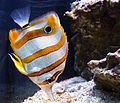 Copperband butterflyfish, Chelmon rostratus
 -
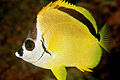 The enigmatic Johnrandallia nigrirostris
 -
 Sunburst butterflyfish, (sometimes placed in Lepidochaetodon)
 -
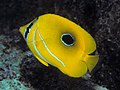 Bluelashed butterflyfish, Chaetodon bennetti (sometimes placed in Megaprotodon)


Further reading
[edit]- Pratchett, Morgan S. & Berumen, Michael L. & Kapoor, B.G. [Editors] : Biology of Butterflyfishes. CRC Press, 2014. ISBN 978-1-4665-8290-3
References
[edit]
- General
- Fessler, Jennifer L. & Westneat, Mark W. (2007): Molecular phylogenetics of the butterflyfishes (Chaetodontidae): Taxonomy and biogeography of a global coral reef fish family. Mol. Phylogenet. Evol. 45(1): 50–68. doi:10.1016/j.ympev.2007.05.018 (HTML abstract)
- FishBase [2008]: Family Chaetodontidae – Butterflyfishes. Retrieved 2008-SEP-02.
- Hsu, Kui-Ching; Chen, Jeng-Ping & Shao, Kwang-Tsao (2007): Molecular phylogeny of Chaetodon (Teleostei: Chaetodontidae) in the Indo-West Pacific: evolution in geminate species pairs and species groups. Raffles Bulletin of Zoology Supplement 14: 77–86. PDF fulltext Archived 2007-08-11 at the Wayback Machine
- Sepkoski, Jack (2002): [Chaetodon]. In: A compendium of fossil marine animal genera. Bulletins of American Paleontology 364: 560. HTML database excerpt
- Specific
- ^ "FAMILY Details for Chaetodontidae - Butterflyfishes". www.fishbase.org.
- ^ a b Fricke, R.; Eschmeyer, W. N.; Van der Laan, R. (2025). "ESCHMEYER'S CATALOG OF FISHES: CLASSIFICATION". California Academy of Sciences. Retrieved 2025-02-10.
- ^ Smith, W. (2003). The evolution of the laterophysic connection with a revised phylogeny and taxonomy of butterflyfishes (Teleostei: Chaetodontidae). Cladistics the International Journal of the Willi Hennig Society., 19(4), 287–306. https://doi.org/10.1016/S0748-3007(03)00070-7
- ^ a b Johnson, G.D.; Gill, A.C. (1998). Paxton, J.R.; Eschmeyer, W.N. (eds.). Encyclopedia of Fishes. San Diego: Academic Press. p. 184. ISBN 978-0-12-547665-2.
- ^ a b Fessler & Westneat (2007)
- ^ J. S. Nelson; T. C. Grande; M. V. H. Wilson (2016). Fishes of the World (5th ed.). Wiley. p. 453. ISBN 978-1-118-34233-6. Archived from the original on 2019-04-08. Retrieved 2020-11-19.
- ^ R. Betancur-Rodriguez; E. Wiley; N. Bailly; A. Acero; M. Miya; G. Lecointre; G. Ortí (2017). "Phylogenetic Classification of Bony Fishes – Version 4". BMC Evolutionary Biology. 17 (162): 162. doi:10.1186/s12862-017-0958-3. PMC 5501477. PMID 28683774.
- ^ a b c Marrama', Giuseppe; Giusberti, Luca; Carnevale, Giorgio (2022-04-28). "A Rupelian Coral Reef Fish Assemblage from the Venetian Southern Alps (Berici Hills, Ne Italy)". Rivista Italiana di Paleontologia e Stratigrafia. 128 (2). doi:10.54103/2039-4942/16601. hdl:11577/3443920. ISSN 2039-4942.
- ^ Fessler & Westneat (2007), Hsu et al. (2007)
- ^ Sepkoski (2002), Fessler & Westneat (2007)
- ^ Froese, Rainer; Pauly, Daniel (eds.). "Family Chaetodontidae". FishBase. February 2013 version.
- ^ Fricke, Ron; Eschmeyer, William N. & van der Laan, Richard (eds.). "Genera in the family Chaetodontidae". Catalog of Fishes. California Academy of Sciences. Retrieved 3 September 2025.

Butterflyfish
View on GrokipediaDescription
Physical Characteristics
Butterflyfishes (family Chaetodontidae) are characterized by a deep, laterally compressed body that appears almost disc-like or oval when viewed from the side, providing enhanced maneuverability among coral structures.[2] This compressed form is supported by ctenoid scales that extend onto the soft-rayed portions of the dorsal and anal fins, contributing to their streamlined profile.[2] The body depth typically measures 1.5 to 1.9 times the standard length, emphasizing their rounded, robust build.[5] A defining feature is the single continuous dorsal fin, which lacks a distinct notch between the spinous and soft-rayed sections and consists of 6–16 spines followed by 15–30 soft rays.[1] The anal fin mirrors this structure with 3–5 spines (usually 3) and 14–23 soft rays, while the caudal fin is rounded with 15 branched rays.[2] In certain species, the soft dorsal fin includes elongated, filamentous extensions that evoke the appearance of butterfly wings, enhancing their graceful silhouette during movement.[2] The fin spines are strongly sheathed at their bases, further accentuating the disc-like body shape.[2] Most butterflyfishes attain a typical length of 10–22 cm (4–8.7 in), though the range spans 9–30 cm across species, with males occasionally larger than females in a sexually monomorphic group.[2] They possess a small, protractile mouth with a pointed snout that varies in elongation, allowing precise probing and feeding; in some genera like Forcipiger, the jaws can exceed 25% of body length.[2] The mouth is lined with numerous close-set, brushlike or bristle-like teeth arranged in narrow rows, ideal for scraping invertebrates and polyps from surfaces.[6] Many species also exhibit a prominent dark vertical bar across the head that passes through the eye, aiding in camouflage by obscuring this vulnerable feature from predators.[7]Coloration and Adaptations
Butterflyfishes (family Chaetodontidae) exhibit striking, contrasting color patterns characterized by spots, stripes, and bands that enhance survival on coral reefs. These patterns often include a prominent black bar running vertically across the eye, which camouflages the actual eye from predators by disrupting the fish's outline and directing attacks away from vital areas. For instance, in the banded butterflyfish (Chaetodon striatus), this eye bar combines with vertical body bands to blend into seagrass or reef structures, reducing detection by visual hunters. Similarly, many species feature yellow tails or fins, such as the reef butterflyfish (Chaetodon sedentarius), where the bright yellow posterior contrasts with darker anterior markings to create a false eye effect, confusing predators about the fish's orientation and direction of escape. These vivid elements, evolving independently multiple times (spots approximately 12 times and eyespots 6 times over the last 7-8 million years), facilitate species recognition during courtship and territorial displays while providing crypsis against complex reef backgrounds.[6][8][9] Iridescent scales in certain species, such as those producing structural coloration through light interference, become more apparent under ultraviolet (UV) light, potentially aiding in mate attraction by revealing hidden patterns invisible to human observers. Reef fishes like butterflyfishes often possess tetrachromatic vision with UV sensitivity (peaking around 300-400 nm), allowing them to perceive these iridescent cues for intraspecific signaling in the blue-green dominated underwater spectrum. Diagonal or vertical stripes, prevalent in over half of Chaetodontidae species, correlate with habitat complexity; for example, species in coral-rich environments like Chaetodon auriga display fine-scale striping that matches the mottled reef substrate, enhancing background matching camouflage. These patterns evolve rapidly, with diversification accelerating in recent evolutionary history, driven more by social and signaling needs than strict ecological constraints.[10][8][11] Sensory adaptations complement these visual traits, with enhanced vision enabling precise detection of small invertebrate prey amid reef crevices. Butterflyfishes possess large eyes relative to body size and cone-rich retinas tuned to the reef's spectral environment, supporting high-acuity foraging in low-light conditions. The lateral line system, consisting of neuromast organs along the body, detects subtle water movements and pressure changes, allowing the fish to sense approaching predators or conspecifics from afar without relying solely on sight. In Chaetodontidae, this mechanosensory network integrates with visual cues for rapid evasion maneuvers on structurally complex reefs.[10][12] Mimicry strategies further bolster predator deterrence, particularly through eyespot patterns that resemble larger threats or divert attacks. In species like the four-eyed butterflyfish (Chaetodon capistratus), prominent ocelli near the tail mimic eyes, combined with the camouflaged real eye bar, create automimicry that misleads predators into striking the less vulnerable posterior end. Eyespots, always paired with eye stripes, have evolved independently six times and feature exaggerated pupil-like centers to enhance deflection efficacy. While Batesian mimicry resembling toxic models is less common, these visual deceptions exploit predator psychology, increasing survival rates in high-predation reef ecosystems.[8][13]Distribution and Habitat
Geographic Range
Butterflyfishes of the family Chaetodontidae exhibit a predominantly tropical distribution, with the vast majority of their approximately 130 species concentrated in the Indo-Pacific region. This range spans from the Red Sea and East Africa in the west to the Hawaiian Islands and Tuamotu Archipelago in the east, encompassing diverse marine environments across the Indian and Pacific Oceans.[14][2] The epicenter of butterflyfish diversity lies within the Coral Triangle, a marine biodiversity hotspot that includes Indonesia, the Philippines, and surrounding areas, where up to 50 species can be found co-occurring due to historical and ecological factors favoring speciation.[15] In marked contrast, the Atlantic Ocean supports far fewer species, with only nine recorded in the tropical western Atlantic, primarily along the Caribbean Sea and Brazilian coasts; these include widespread forms like Chaetodon ocellatus and regional endemics.[16] Eastern Atlantic occurrences are even sparser, often involving deep-water genera like Prognathodes.[5] Occurrences outside these core tropical zones are exceptional. In the eastern Pacific, just four species persist, representing isolated populations adapted to limited reef habitats.[2] Temperate waters are generally unsuitable due to cooler temperatures and reduced coral availability, resulting in negligible presence beyond subtropical boundaries.[17] Endemism is notable in peripheral areas, such as Chaetodon sanctaehelenae, which is confined to the shallow reefs of Saint Helena and Ascension Islands in the South Atlantic.[18]Environmental Preferences
Butterflyfishes (family Chaetodontidae) exhibit a strong association with coral reefs, where they are among the most conspicuous inhabitants, as well as with adjacent lagoons and rocky substrates in shallow tropical waters. These environments provide structural complexity essential for their ecological niche, with the majority of species occurring at depths between 1 and 60 meters, though most prefer the upper 20 meters for optimal foraging and shelter opportunities.[2][9][19] While primarily marine, butterflyfishes demonstrate tolerance for varying salinities in estuarine and protected bay habitats, including brackish conditions influenced by freshwater runoff, allowing some species to inhabit turbid nearshore areas. However, they show aversion to low-oxygen environments and polluted waters, as excessive sedimentation, nutrient enrichment, and chemical contaminants degrade water quality and indirectly impair their habitat by harming associated coral structures.[2][20][21] At the microhabitat scale, adult butterflyfishes often utilize crevices and reef overhangs for hiding and resting, particularly at night when they seek shelter to avoid predators. Juveniles, in contrast, frequently occupy seagrass beds and tidal pools, which offer protected nursery areas distinct from adult coral-dominated habitats and support early survival by reducing predation risk.[2][22] Butterflyfishes are sensitive to water temperature, thriving in the optimal range of 24–29°C characteristic of tropical reef systems, with deviations leading to physiological stress such as reduced activity or increased mortality risk. They also prefer habitats with moderate currents, which enhance oxygenation and maintain water clarity by preventing stagnation in reef crevices and lagoons.[23][24]Taxonomy and Systematics
Classification and Genera
The butterflyfishes comprise the family Chaetodontidae, classified within the order Acanthuriformes in recent phylogenetic revisions of percomorph fishes.[25] This placement reflects molecular and morphological analyses that reposition the family from the traditional Perciformes into Acanthuriformes, alongside groups like surgeonfishes and angelfishes.[26] The family encompasses approximately 133 valid species distributed across 12 genera, primarily inhabiting tropical marine environments.[27] Taxonomic subdivisions within Chaetodontidae are based on morphological traits such as fin structure, dentition, and body proportions, with the family often divided into two subfamilies: Chaetodontinae (including the nominotypical genus Chaetodon and relatives) and Heniochinae (bannerfishes, characterized by elongated dorsal fins).[28] These subfamilies highlight distinctions in feeding adaptations and habitat preferences, though some classifications treat them as informal groups due to ongoing phylogenetic refinements.[1] The genus Chaetodon is the most diverse, containing around 90 species that dominate the family's species richness and exhibit a wide array of color patterns and ecological roles.[1] Heniochus, a subgroup often referred to as bannerfishes, includes about 8 species noted for their filamentous dorsal fins and planktivorous diets.[1] Prognathodes represents deep-water specialists with roughly 10 species, adapted to mesophotic reefs and differing in jaw morphology from shallow-water congeners.[1] Other genera, such as Forcipiger, Chelmon, and Coradion, contribute fewer species but illustrate the family's morphological variety.[1] Recent taxonomic updates, as documented in Eschmeyer's Catalog of Fishes (November 2025) by Fricke et al., have involved species-level revisions, including the description and validation of new taxa like Prognathodes geminus (recognized in 2019) and synonymizations in Chaetodon based on genetic data, refining the total to 133 valid species.[27] These changes underscore the dynamic nature of chaetodontid systematics, driven by integrative approaches combining morphology, DNA barcoding, and phylogenomics.[29]Evolutionary History
The family Chaetodontidae, comprising butterflyfishes, originated in the early Eocene approximately 50 million years ago, coinciding with the expansion of coral reefs in the ancient Tethys Sea.[30] This period marked the stem lineage divergence of chaetodontids from their closest relatives, driven by the proliferation of scleractinian corals that provided new ecological niches for reef-associated fishes.[31] Molecular dating analyses, incorporating fossil calibrations and multiple genetic markers, place the crown group diversification around 33 million years ago in the Oligocene, setting the stage for subsequent radiations.[30] Phylogenetic studies confirm the monophyly of Chaetodontidae, with strong molecular evidence from mitochondrial DNA sequences such as 12S and 16S rRNA genes supporting its distinction as a cohesive family.[32] The family forms a sister group to the Pomacanthidae (marine angelfishes) within the superfamily Chaetodontoidea, with their split occurring in the early Eocene around 50 million years ago.[30] This close relationship is evidenced by shared morphological traits and genetic similarities, underscoring a common evolutionary pathway among these reef-dwelling percomorph fishes.[32] A major adaptive radiation occurred during the Miocene, approximately 18 million years ago, as butterflyfishes diversified in response to the growth of Indo-Pacific coral reefs, particularly the expansion of branching corals like Acropora and Pocillopora.[30] This period saw rapid cladogenesis within the genus Chaetodon, enabling colonization of varied reef habitats and the evolution of specialized feeding strategies.[30] Key evolutionary innovations included the development of an intramandibular jaw joint, which facilitated precise biting and protrusion for accessing coral polyps, aligning with the Miocene proliferation of coral diversity and abundance.[33] These traits enhanced trophic specialization, particularly corallivory, which arose multiple times in this lineage.[30] Modern genera of butterflyfishes descend from these Miocene lineages, reflecting ongoing adaptations to coral reef ecosystems.[30]Fossil Record
The fossil record of butterflyfishes (family Chaetodontidae) is notably sparse and fragmentary, largely attributable to the challenges of fossil preservation in shallow coral reef environments, where these fishes predominantly occur.[30] This scarcity limits insights into their early evolution, with only a limited number of valid extinct species described, estimated at around 20 across various genera, many of which are known from isolated skeletal elements or incomplete specimens.[34] No major extinction events are evident in the record, and there are significant gaps following the Pliocene, with few post-Miocene fossils documented despite the family's persistence into the present.[30] The earliest putative records come from the late Eocene (approximately 50 million years ago) of Monte Bolca, Italy, where several deep-bodied perciform fishes were initially classified within Chaetodontidae, such as species formerly assigned to genera like Pygaeus and related forms; however, subsequent revisions have reclassified these as non-chaetodontids, leaving no confirmed butterflyfish fossils from this epoch.[35] The oldest reliable chaetodontid fossils appear in the Oligocene of central Europe, including tholichthys larvae from the Rupelian deposits of Frauenweiler, Germany, and Besenbruch, Poland, which exhibit morphological similarities to extant Chaetodon species and suggest early diversification of larval forms in temperate to subtropical settings.[36] Undisputed adult butterflyfish fossils are predominantly Miocene in age, highlighting a phase of apparent diversification. In Europe, well-preserved specimens include Chaetodon ficheuri from the upper Miocene (Messinian, circa 7.2–5.3 million years ago) of the Chelif Basin near Oran, Algeria, which displays the characteristic deep, compressed body and elongated dorsal and anal fins typical of modern chaetodontids, indicating adaptation to reef-like habitats.[37] Additional European Miocene records encompass fragmentary Chaetodon remains from sites in France, Italy, and Romania. In the Indo-Pacific, fossils such as Chelmon fossilis from the Miocene of Sulawesi, Indonesia, underscore the region's role as a cradle for chaetodontid diversification, with these specimens showing morphological affinities to contemporary Indo-West Pacific genera and suggesting early establishment of tropical reef assemblages.[35] These Miocene finds collectively imply that butterflyfishes achieved much of their modern form and distribution by the mid-Cenozoic, though the incomplete record precludes detailed tracking of speciation rates or biogeographic shifts.Behavior and Ecology
Feeding and Diet
Butterflyfish, particularly within the genus Chaetodon, exhibit a high degree of dietary specialization, with more than 20 species classified as obligate corallivores that feed exclusively on live coral polyps, such as those of Acropora species.[38] Other species are more generalist or omnivorous, consuming a mix of invertebrates like polychaete worms and crustaceans, algae, and planktonic organisms.[39] Some species, such as the foureye butterflyfish (Chaetodon capistratus), also engage in opportunistic predation on hydromedusae.[40] This specialization is linked to their evolutionary adaptations for reef environments, where coral polyps provide a stable, nutrient-rich food source.[41] Recent studies indicate that specialist corallivores fail to adapt their diets during marine heatwaves causing coral bleaching, potentially exacerbating vulnerability to habitat degradation.[42] Foraging in butterflyfish involves precise nipping techniques enabled by their elongated, tubular snouts and small, protractile mouths equipped with bristle-like teeth, allowing them to extract individual coral polyps without significantly damaging the underlying skeleton.[43] In species like the multiband butterflyfish (Chaetodon multicinctus), this method can lead to localized coral tissue loss through repeated bites on preferred pocilloporid corals, potentially exacerbating reef degradation under high population densities.[44] These fish often forage in pairs, enhancing efficiency in locating and accessing polyps.[45] Daily consumption rates are substantial, with individual adult corallivores taking 400 to 700 bites per hour during active feeding periods, potentially amounting to up to 5,000 polyps per day and consuming 1.5 to 3 grams of coral tissue, which can influence local reef health by reducing coral cover.[46] Ontogenetic shifts in diet are common, as juveniles typically rely more heavily on plankton and smaller invertebrates for their broader mouths and less specialized feeding apparatus, transitioning to coral-dominated diets as adults develop narrower snouts suited for polyp extraction.[47]Social Behavior
Butterflyfishes exhibit diverse social structures that shift ontogenetically, with juveniles typically forming schools to enhance predator avoidance through collective vigilance and confusion effects. As they mature, most species transition to solitary or paired adult lifestyles, where monogamous pair-bonding predominates in territorial species.[48] This pairing is ancestral within the Chaetodontidae family, with phylogenetic analyses indicating at least seven independent evolutions of solitary behavior and seven of gregariousness since the late Miocene.[48] In paired species, mates form lifelong bonds, often retaining the same partner for over seven years, and cooperatively defend exclusive territories ranging from 10 to 100 m² depending on resource availability and species.[49] Examples include Chaetodon baronessa and C. lunulatus, where 71–84% of observed individuals occur in heterosexual pairs that exhibit high fidelity (71–89% partner retention over six weeks).[48] Solitary adults, such as C. rainfordi (88% solitary), maintain individual territories without pairing, while territorial defense benefits from pair cooperation, reducing energy expenditure compared to solitary efforts.[49] These bonds extend briefly to reproductive synchrony, though detailed mating dynamics occur separately.[49] Following coral bleaching events, such as the 2016 global mass bleaching, butterflyfishes exhibit reduced aggression and shifts in competitive interactions due to rapid resource depletion.[50] Social interactions and communication among butterflyfishes rely on visual and acoustic signals to maintain pair cohesion and deter intruders. Paired individuals frequently engage in parallel swimming at 45° angles and proximate displays within 1.5 m to reinforce bonds, while aggression toward non-partners involves body postures like staring and the tail-up display for partner recognition or threat signaling.[51] Fin displays and rapid chases serve as common communicative tools during encounters, with some species producing pulsed acoustic sounds—such as single grunts or trains of 2–10 pulses at 100–500 Hz—specifically during aggressive territorial interactions. Territorial disputes are generally low-intensity to minimize risk, featuring evasion maneuvers like fleeing or encircling rather than prolonged combat, though occasional fin nipping occurs in escalated chases against conspecific intruders.[49] In C. lunulatus, for instance, pairs direct agonistic behaviors like staring and infrequent bites primarily at non-mates to protect defended areas, ensuring efficient resource access without high injury rates.[48]Reproduction and Life Cycle
Butterflyfish (family Chaetodontidae) reproduce through external fertilization, with gametes released into the water column during spawning events typically involving monogamous pairs. Spawning occurs at dusk, often over reef structures or in open water above the bottom, where the female releases eggs and the male simultaneously ejects sperm to fertilize them externally.[52][53] In many species, such as Chaetodon capistratus and Chaetodon multicinctus, spawning peaks during periods around the full or new moon, potentially synchronizing with optimal tidal currents for larval dispersal.[52][54] Pair bonding, common in butterflyfish, facilitates these coordinated spawning rituals by maintaining stable male-female partnerships that defend territories and synchronize reproductive readiness.[48] The eggs are small (0.6–0.8 mm in diameter), transparent, and pelagic, buoyant due to an oil globule that aids flotation in the water column.[55] Hatching occurs rapidly, typically within 24–48 hours post-fertilization at temperatures of 25–26°C, yielding yolk-sac larvae measuring about 1.2–2.0 mm in length.[55][52] These larvae enter a prolonged planktonic phase, feeding on zooplankton while drifting with ocean currents; the duration varies by species but generally spans 20–50 days, during which they grow to 5–20 mm and develop characteristic tholichthys armor plating on the head for protection.[55] Settlement onto reefs follows, often at night, marking the transition to a benthic juvenile stage where larvae metamorphose into miniature adults, selecting habitats based on coral cover and prey availability.[56] Butterflyfish exhibit gonochoristic sex determination, with individuals developing as either males or females without sequential hermaphroditism in adults, though some juvenile gonads show transient bisexual characteristics that resolve into single-sex maturity.[57][58] Growth is rapid during the first year post-settlement, with juveniles expanding quickly in size and body form to evade predators and access food resources. Sexual maturity is reached at 1–2 years of age, depending on species and environmental conditions, allowing reproduction to commence in the second or third year of life.[59] In the wild, butterflyfish typically live 5–10 years, with average lifespans around 7 years influenced by predation, habitat quality, and disease.[60][59]Conservation and Human Interaction
Threats and Vulnerabilities
Butterflyfish populations face significant threats from habitat degradation, primarily driven by coral bleaching events linked to climate change. Corallivorous species, which rely heavily on live coral for food, experience severe declines following bleaching-induced coral mortality; for instance, the biomass of such corallivores can drop by over 70% in affected areas, as observed in reefs exposed to pulse heat stress.[61] This vulnerability is particularly acute for specialist feeders, whose narrow diets limit adaptability to altered reef conditions. According to the IUCN Red List (version 2025-1), most of the 132 butterflyfish species (family Chaetodontidae) are assessed as Least Concern (92 species), reflecting their wide distributions and general resilience. However, a subset faces elevated risks, with 7 species threatened: 4 Vulnerable (e.g., Chaetodon daedalma, Chaetodon mesoleucos, Chaetodon nigropunctatus, Chaetodon tricinctus), 2 Endangered (Chaetodon falcula, Chaetodon litus), and 1 Critically Endangered (Chaetodon baronessa), due to habitat dependencies and ongoing evaluations highlighting increasing pressures from reef decline.[62] Notable examples include the Chevroned butterflyfish (Chaetodon trifascialis), classified as Near Threatened since 2009, owing to its exclusive dependence on Acropora corals, which have declined sharply from bleaching and other stressors.[63] Eleven species are Near Threatened, underscoring the need for monitoring amid rising ocean temperatures. Anthropogenic activities exacerbate these issues through indirect overfishing impacts, such as bycatch in coral reef trap fisheries, where butterflyfish capture rates can reach 90-98% without mitigation measures like escape gaps.[64] Destructive fishing practices also fragment reefs, reducing structural complexity and prey availability. Pollution further diminishes food resources by altering coral health and invertebrate communities, with nutrient runoff and contaminants linked to decreased abundance of preferred prey like polyps and small crustaceans. Natural predation by groupers, sharks, and other piscivores poses an ongoing risk, intensified by habitat fragmentation that limits refuge options in degraded reefs.[65] Coral loss reduces hiding spots, elevating encounter rates with predators and contributing to higher mortality, particularly for juvenile butterflyfish. Additionally, collection for the aquarium trade represents a localized threat, though it primarily affects accessible populations rather than driving widespread declines.[66]Aquarium Trade and Protection
Butterflyfish of the family Chaetodontidae are among the most sought-after marine ornamental fishes due to their vibrant colors and patterns, ranking third in export volume by number and second in value among traded families in the global aquarium trade.[19] The annual trade volume is estimated at approximately 1 million specimens, comprising about 4% of the global marine ornamental fish market, with the vast majority wild-caught primarily from Indonesia.[67][68] Maintaining butterflyfish in captivity presents significant challenges, including high post-harvest mortality rates of 10–40% in export facilities, often attributed to difficulties in meeting their specialized dietary requirements, such as live coral polyps or small invertebrates; overall, up to 98% may die within a year of capture. Despite these issues, successes have been achieved with certain species, such as the Copperband butterflyfish (Chelmon rostratus), which can thrive in well-managed aquariums with appropriate feeding and tank conditions.[71] Conservation measures for butterflyfish include CITES Appendix II listings for select species, such as Amphichaetodon howensis, to regulate international trade and prevent overexploitation. Additionally, marine protected areas like the Great Barrier Reef have contributed to population recovery by reducing fishing pressure and enhancing fish biomass, including butterflyfish assemblages.[72] Emerging aquaculture programs aim to lessen reliance on wild stocks, with notable breeding successes in Hawaii through institutions like the Oceanic Institute and Biota Aquariums, which have produced captive-bred specimens of species such as the Longnose butterflyfish (Forcipiger flavissimus) and Milletseed butterflyfish (Chaetodon miliaris).[73] Similar efforts are developing in Australia to support sustainable production of native species.[74]References
- https://www.[researchgate](/page/ResearchGate).net/publication/232715398_Post-harvest_mortality_in_the_marine_aquarium_tradeA_case_study_of_an_Indonesian_export_facility