



Community hub
Recent from talks
Knowledge base stats:
Talk channels stats:
Members stats:
Marsh test
The Marsh test is a highly sensitive method in the detection of arsenic, especially useful in the field of forensic toxicology when arsenic was used as a poison. It was developed by the chemist James Marsh and first published in 1836. The method continued to be used, with improvements, in forensic toxicology until the 1970s.
Arsenic, in the form of white arsenic trioxide As2O3, was a highly favored poison, being odourless, easily incorporated into food and drink, and before the advent of the Marsh test, untraceable in the body. In France, it came to be known as poudre de succession ("inheritance powder"). For the untrained, arsenic poisoning will have symptoms similar to cholera.[citation needed]
The first breakthrough in the detection of arsenic poisoning was in 1775 when Carl Wilhelm Scheele discovered a way to change arsenic trioxide to garlic-smelling arsine gas (AsH3), by treating it with nitric acid (HNO3) and combining it with zinc:
In 1787, German physician Johann Metzger (1739-1805) discovered that if arsenic trioxide were heated in the presence of carbon, the arsenic would sublime. This is the reduction of As2O3 by carbon:
In 1806, Valentin Rose took the stomach of a victim suspected of being poisoned and treated it with potassium carbonate (K2CO3), calcium oxide (CaO) and nitric acid. Any arsenic present would appear as arsenic trioxide and then could be subjected to Metzger's test.
The most common test (and used even today in water test kits) was discovered by Samuel Hahnemann. It would involve combining a sample fluid with hydrogen sulfide (H2S) in the presence of hydrochloric acid (HCl). A yellow precipitate, arsenic trisulfide (As2S3) would be formed if arsenic was present.
Though precursor tests existed, they had sometimes proven not to be sensitive enough. In 1832, a certain John Bodle was brought to trial for poisoning his grandfather by putting arsenic in his coffee. James Marsh, a chemist working at the Royal Arsenal in Woolwich, was called by the prosecution to try to detect its presence. He performed the standard test by passing hydrogen sulfide through the suspect fluid. While Marsh was able to detect arsenic, the yellow precipitate did not keep very well, and, by the time it was presented to the jury, it had deteriorated. The jury was not convinced, and John Bodle was acquitted.
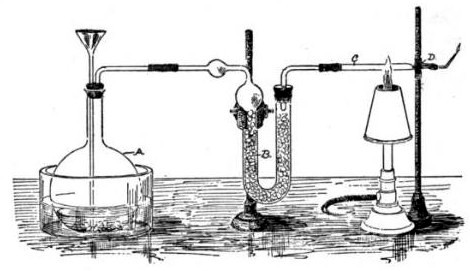
Angered and frustrated by this, especially when John Bodle confessed later that he indeed killed his grandfather, Marsh decided to devise a better test to demonstrate the presence of arsenic. Taking Scheele's work as a basis, he constructed a simple glass apparatus capable of not only detecting minute traces of arsenic but also measuring its quantity. Adding a sample of tissue or body fluid to a glass vessel with zinc and acid would produce arsine gas if arsenic was present, in addition to the hydrogen that would be produced regardless by the zinc reacting with the acid. Igniting this gas mixture would oxidize any arsine present into arsenic and water vapor. This would cause a cold ceramic bowl held in the jet of the flame to be stained with a silvery-black deposit of arsenic, physically similar to the result of Metzger's reaction. The intensity of the stain could then be compared to films produced using known amounts of arsenic. Not only could minute amounts of arsenic be detected (as little as 0.02 mg), the test was very specific for arsenic. Although antimony (Sb) could give a false-positive test by forming stibine (SbH3) gas, which decomposes on heating to form a similar black deposit, it would not dissolve in a solution of sodium hypochlorite (NaOCl), while arsenic would. Bismuth (Bi), which also gives a false positive by forming bismuthine (BiH3), similarly can be distinguished by how it resists attack by both NaOCl and ammonium polysulfide (the former attacks As, and the latter attacks Sb).
Hub AI
Marsh test AI simulator
(@Marsh test_simulator)
Marsh test
The Marsh test is a highly sensitive method in the detection of arsenic, especially useful in the field of forensic toxicology when arsenic was used as a poison. It was developed by the chemist James Marsh and first published in 1836. The method continued to be used, with improvements, in forensic toxicology until the 1970s.
Arsenic, in the form of white arsenic trioxide As2O3, was a highly favored poison, being odourless, easily incorporated into food and drink, and before the advent of the Marsh test, untraceable in the body. In France, it came to be known as poudre de succession ("inheritance powder"). For the untrained, arsenic poisoning will have symptoms similar to cholera.[citation needed]
The first breakthrough in the detection of arsenic poisoning was in 1775 when Carl Wilhelm Scheele discovered a way to change arsenic trioxide to garlic-smelling arsine gas (AsH3), by treating it with nitric acid (HNO3) and combining it with zinc:
In 1787, German physician Johann Metzger (1739-1805) discovered that if arsenic trioxide were heated in the presence of carbon, the arsenic would sublime. This is the reduction of As2O3 by carbon:
In 1806, Valentin Rose took the stomach of a victim suspected of being poisoned and treated it with potassium carbonate (K2CO3), calcium oxide (CaO) and nitric acid. Any arsenic present would appear as arsenic trioxide and then could be subjected to Metzger's test.
The most common test (and used even today in water test kits) was discovered by Samuel Hahnemann. It would involve combining a sample fluid with hydrogen sulfide (H2S) in the presence of hydrochloric acid (HCl). A yellow precipitate, arsenic trisulfide (As2S3) would be formed if arsenic was present.
Though precursor tests existed, they had sometimes proven not to be sensitive enough. In 1832, a certain John Bodle was brought to trial for poisoning his grandfather by putting arsenic in his coffee. James Marsh, a chemist working at the Royal Arsenal in Woolwich, was called by the prosecution to try to detect its presence. He performed the standard test by passing hydrogen sulfide through the suspect fluid. While Marsh was able to detect arsenic, the yellow precipitate did not keep very well, and, by the time it was presented to the jury, it had deteriorated. The jury was not convinced, and John Bodle was acquitted.
Angered and frustrated by this, especially when John Bodle confessed later that he indeed killed his grandfather, Marsh decided to devise a better test to demonstrate the presence of arsenic. Taking Scheele's work as a basis, he constructed a simple glass apparatus capable of not only detecting minute traces of arsenic but also measuring its quantity. Adding a sample of tissue or body fluid to a glass vessel with zinc and acid would produce arsine gas if arsenic was present, in addition to the hydrogen that would be produced regardless by the zinc reacting with the acid. Igniting this gas mixture would oxidize any arsine present into arsenic and water vapor. This would cause a cold ceramic bowl held in the jet of the flame to be stained with a silvery-black deposit of arsenic, physically similar to the result of Metzger's reaction. The intensity of the stain could then be compared to films produced using known amounts of arsenic. Not only could minute amounts of arsenic be detected (as little as 0.02 mg), the test was very specific for arsenic. Although antimony (Sb) could give a false-positive test by forming stibine (SbH3) gas, which decomposes on heating to form a similar black deposit, it would not dissolve in a solution of sodium hypochlorite (NaOCl), while arsenic would. Bismuth (Bi), which also gives a false positive by forming bismuthine (BiH3), similarly can be distinguished by how it resists attack by both NaOCl and ammonium polysulfide (the former attacks As, and the latter attacks Sb).