Hubbry Logo
Merlion ParkMerlion ParkMain
Open search
Merlion Park
Community hub
Merlion Park
logo
8 pages, 0 posts
0 subscribers
Be the first to start a discussion here.
Merlion Park
Merlion Park
from Wikipedia

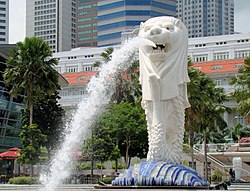
Merlion Park[a] is a famous Singapore landmark and a major tourist attraction, located at One Fullerton, Singapore, near the Central Business District (CBD). The Merlion is a mythical creature with a lion's head and a fish's tail that is widely used as a mascot and national personification of Singapore. Two Merlion statues are located at the park. The original Merlion structure measures 8.6 meters tall and spouts water from its mouth. It has subsequently been joined by a Merlion cub, which is located near the original statue and measures just 2 metres tall.

Key Information

History

[edit]

The original Merlion Park was first designed by the Singapore Tourism Board (STB) near the mouth of the Singapore River in 1964 as an emblem of Singapore. On 15 September 1972, the park was officially opened at an installation ceremony for the statue, officiated at by then Prime Minister of Singapore, Mr Lee Kuan Yew.[1] The original statue of the Merlion used to stand at the mouth of the Singapore River. The building of the Merlion was started in November 1971 and was completed in August 1972. It was crafted by the late Singaporean sculptor, Mr Lim Nang Seng[2] and his 8 children. The sculpture measures 8.6 meters high and weighs 70 tons.[3][4] This massive statue with the spouting stream was constructed by Stanley Mok [5]

Relocation of Merlion

[edit]
Aerial panorama of Merlion Park and its surrounds

Upon the completion of the Esplanade Bridge in 1997, the original Merlion Park location was also no longer the entrance of Singapore River and the statue could no longer be viewed clearly from the Marina Bay Waterfront.[3] On 23 April 2002, the statue was relocated to a new pier specially built on the other side of The Esplanade Bridge adjacent to The Fullerton Hotel. The move, which cost $7.5 million, was completed on 25 April 2002.[6] On 15 September 2002, then-Senior Minister Lee Kuan Yew ceremonially welcomed the Merlion again on its new location, the current Merlion Park, which is four times bigger than the original site.[7]

Merlion statue damage

[edit]

On 28 February 2009, between 4 pm and 5 pm, the Merlion statue was struck by lightning. Staff in the vicinity said they heard an explosion followed by a loud thud when broken pieces fell to the ground.[8] Repairs were completed in March that year, the Merlion itself resumed spouting water on 18 March 2009.

Restoration Works

[edit]

During restoration, the Merlion statue would be closed off throughout the whole restoration process. The sculpture would be cleaned thoroughly, and new plaster or paint would be put on the Merlion to keep the Merlion looking bright and clean. Occasionally fillers are used for the cracks and hollow areas of the Sculpture.[9]

See also

[edit]

Notes

[edit]

References

[edit]
[edit]
Revisions and contributorsEdit on WikipediaRead on Wikipedia
from Grokipedia
Merlion Park is a popular waterfront park located in , renowned for featuring the original statue, a mythical hybrid creature with the head of a and the body of a fish that spouts water from its mouth. This 8.6-meter-tall, 70-tonne concrete statue, accompanied by a smaller 2-meter "Merlion cub," serves as a major and photo spot, offering panoramic views of the Marina Bay skyline, including landmarks like the and the . The park itself is an open, free-access public space along the promenade adjacent to One Fullerton, open 24 hours a day, and draws millions of visitors annually for its scenic setting and cultural significance. The Merlion emblem originated in 1964 when it was designed by zoologist Alec Fraser-Brunner as the corporate logo for the Singapore Tourist Promotion Board (STPB), symbolizing Singapore's historical roots as a fishing village (represented by the fish body, referencing ancient Temasek) and its legendary founding as the "Lion City" (Singapura, evoked by the lion head from Prince Sang Nila Utama's sighting). The logo was trademarked on 20 July 1966, and the physical statue was commissioned in 1972, with architect Kwan Sai Kheong providing the blueprint and local sculptor Lim Nang Seng crafting it from cement fondue. Unveiled on 15 September 1972 by then-Prime Minister Lee Kuan Yew at the mouth of the Singapore River, it quickly became a national icon, boosting tourism and representing Singapore's transformation from a humble port to a modern global hub. Due to urban development, including the construction of the Esplanade Bridge, the statue was relocated in 2002 from its original riverside site to the current Merlion Park location, a process involving cranes and a to move it approximately 120 meters over several days in . The park has since endured challenges, such as a on 28 February 2009 that damaged the statue, which was repaired within a month, underscoring its enduring role in Singapore's identity. Today, Merlion Park not only highlights this emblem but also integrates into broader Marina Bay attractions, fostering a sense of heritage amid contemporary vibrancy.

Overview

Description

Merlion Park is situated at the mouth of the , facing Marina Bay, and occupies approximately 2,500 square meters of waterfront land adjacent to One Fullerton. This compact serves as a prominent in Singapore's , offering panoramic views of the bay and the city skyline. The park's central features include the iconic 8.6-meter-tall statue, constructed from concrete over a and weighing 70 tonnes, which spouts water into Marina Bay from its mouth. Adjacent to it stands the smaller 2-meter-tall cub statue, weighing 3 tonnes and adorned with inlaid Chinese porcelain, providing a family-oriented focal point. Visitors can access viewing platforms that extend toward the water, along with landscaped gardens featuring tropical plants that enhance the serene, green ambiance amid the urban setting. Positioned near landmarks such as the and integrated into the broader Marina Bay waterfront, the park exemplifies Singapore's urban efforts. It was established in its current form in through projects that expanded the area up to four times its original size, creating a more accessible . The statue, symbolizing Singapore's origins and lion-named heritage, was relocated here during this .

Cultural Significance

The Merlion has been Singapore's official tourism mascot since its creation in 1964 by the Singapore Tourist Promotion Board (now the ), serving as the organization's logo until 1997 and remaining under its protection as a key emblem of . Although not formally designated as a national symbol like the state crest, it functions as a emblem of , appearing in official promotions and representing the city's spirit to both locals and visitors. Central to its cultural role is the Merlion's embodiment of Singapore's historical narrative: the fish body evokes the island's origins as the ancient fishing village of , meaning "lake" in , while the lion head honors the legend of Prince , who reportedly sighted a upon landing and named the settlement , or "Lion City," in the . This fusion captures the transition from maritime humility to aspirational strength, embedding the creature in Singapore's foundational myths and heritage storytelling. Merlion Park plays a pivotal role in , drawing millions of international visitors each year who pose for photographs with the , making it one of Singapore's most photographed landmarks and a of the nation's $30 billion sector. The icon permeates branding through merchandise, motifs, and cultural events, fostering a sense of pride and global recognition while highlighting Singapore's blend of and innovation. Emerging just after in 1965, the evolved from a promotional into a broader of national resilience and , reflecting Singapore's rapid development from a resource-scarce to a dynamic global hub. Its enduring presence in public narratives underscores themes of adaptability and progress, inspiring contemporary artistic interpretations and reinforcing cultural unity in a multicultural society.

History

Design and Creation

The Merlion figure originated as a corporate logo created in 1964 by the Singapore Tourist Promotion Board (STPB, now the Singapore Tourism Board) to symbolize Singapore's identity and promote tourism. British zoologist and aquarium curator Alec Fraser-Brunner designed the emblem, drawing inspiration from the 14th-century Malay text Sejarah Melayu (Malay Annals), which recounts local legends of the island's founding. The design blended mythical elements akin to the sphinx—featuring a lion's head atop a fish's body—with Singaporean folklore, specifically the legend of Prince Sang Nila Utama, who reportedly sighted a lion upon landing in Temasek, leading him to name the island Singapura ("Lion City"). The fish body evoked the area's heritage as a fishing village known as Temasek, meaning "lake" or "sea" in old Javanese, while the lion head honored the ancient sighting described in the Sejarah Melayu. This hybrid form was not endorsed by the government as an official national symbol but served as a tourism-specific icon. Initially adopted as the STPB's logo in 1964 and trademarked on 20 July 1966, the Merlion appeared in promotional materials to highlight Singapore's maritime roots and emerging tourist appeal. Following independence in 1965, the STPB decided in the late 1960s to commission a physical statue to further boost tourism, marking the transition from emblem to tangible landmark, though the sculpture itself was not realized until 1972.

Installation and Relocation

The original Merlion statue, measuring 8.6 meters in height and weighing 70 tonnes, was installed on 15 September 1972 at the mouth of the adjacent to Anderson Bridge. It was sculpted by local artist Lim Nang Seng using cement fondue reinforced with a , with spanning from November 1971 to August 1972 at a cost of S$165,000 funded by the . The unveiling ceremony was officiated by then-Prime Minister , marking the statue's role as a prominent overlooking the river. By the early 2000s, urban development in the Marina Bay area, including extensive and the completion of the Esplanade Bridge in 1997, necessitated the statue's relocation to preserve its visibility and integrate it with the evolving waterfront. On 25 April 2002, the was moved approximately 120 meters to a newly constructed pier at Merlion Park adjacent to One Fullerton, facing east in accordance with principles. The relocation process, which began on 23 April and concluded on 28 April at a total cost of S$7.5 million, involved moving the intact statue in three stages: lifting it with a crane from its , ferrying it by across the water, and transporting it by road to the new site. The repositioned statue was re-unveiled on 15 September 2002 by then-Senior Minister , coinciding with the 30th anniversary of its original installation. While the original Merlion's journey centered on these two key sites in , authorized replicas have been erected elsewhere to promote . These copies, however, do not alter the primary narrative of the iconic statue's logistical adaptations to Singapore's dynamic urban landscape.

Damage and Restoration

The Merlion statue at Merlion Park has faced several challenges from environmental exposure since its installation, primarily due to its prominent seaside position, which subjects it to , , and severe weather events. In the 1980s and early 1990s, the statue's water-spouting mechanism experienced repeated breakdowns caused by , necessitating periodic replacements of the to maintain functionality. The most significant incident occurred on 28 February 2009, when the statue was struck by during a between 4 and 5 p.m., resulting in a crack along the mane and a hole at the base from falling debris. The damage was exacerbated by the statue's elevated and exposed location at the water's edge, making it vulnerable to such strikes. The (NParks), which owns and maintains the statue, promptly closed the site for repairs, which involved rectifying the structural damage and installing lightning protection measures. The statue reopened to the public on 18 March 2009 after approximately three weeks of work. Following the 2002 relocation to its current site adjacent to One Fullerton, the statue underwent comprehensive assessments and restoration as part of the project, including thorough cleaning to address accumulated and ensure structural integrity. Ongoing preservation efforts by NParks include regular inspections, routine to combat and cracks, and the lightning protection system added in 2009, reflecting Singapore's commitment to safeguarding heritage icons against natural degradation. For instance, the statue underwent cleaning and works in July 2024, December 2024, February 2025, and November 2025, as announced by the .

The Merlion Statue

Symbolism and Design

The Merlion embodies a dual symbolism that encapsulates Singapore's historical and cultural identity. The fish tail represents the nation's ancient maritime and fishing village origins, drawing from its pre-colonial name , meaning "sea town" in Javanese and alluding to the island's watery beginnings as a bustling port. In contrast, the lion head signifies the legendary founding of —"Lion City" in —stemming from the 14th-century tale of Prince Sang Nila Utama, who reportedly sighted a lion-like creature upon landing and named the island accordingly, evoking themes of strength and majesty. The design of the Merlion fuses these elements into a mythical hybrid creature, blending Southeast Asian folklore—rooted in the legend—with a nod to Singapore's seafaring heritage. Created as a in by British zoologist Alec Fraser-Brunner for the Singapore Tourist Promotion Board, it draws on the creature's aquatic form to symbolize the flow of the and the island's role as a historic trading hub, with water spouting from its mouth to reinforce this maritime essence. This hybrid form echoes broader mythical motifs, such as guardians of waterways in regional lore, while the spouting feature adds a dynamic, life-giving quality to the static emblem. Replicas of the in maintain core design consistency for branding purposes, though variations exist in scale and pose to suit different contexts; for instance, the 37-meter tower at includes internal viewing areas, while smaller versions at Tourism Court feature porcelain inlays. As of 2024, there are six authorized statues in : at Merlion Park (original and cub), , Tourism Court, , and the Merlion Walk. As a 20th-century invention crafted for promotion, the has faced occasional cultural critiques for its perceived inauthenticity compared to traditional symbols like the lion in Singapore's , which derives directly from historical . Some local artists and writers, such as poet Alvin Pang in his poem "Merlign," have mocked it as a superficial, government-engineered lacking deeper soul or historical weight, viewing it more as a tourist gimmick than an organic emblem of identity.

Physical Characteristics

The primary Merlion statue at Merlion Park stands 8.6 meters tall and weighs 70 tonnes, while the accompanying Merlion cub measures 2 meters in height and 3 tonnes. The statue is constructed from over an internal for structural support, with reinforcements including a 0.6-meter concrete beam beneath its base, creating a hollow interior that reduces overall weight while ensuring stability. It incorporates elements of , a durable composite blending , , and aggregates, which provides weather resistance suitable for Singapore's . The exterior is painted white, accented with gold on the eyes and mane for visual emphasis. Water spouts from the statue's mouth through a dedicated system connected to underground pipes drawing from the nearby Marina Reservoir, enabling continuous operation with alternating units to prevent downtime. Designed for longevity in humid conditions, the undergoes regular , including , structural repairs, and repainting every few years to combat and effects.

Visitor Information

Access and Facilities

Merlion Park is situated at 1 Fullerton Road, 049213, along the mouth of the in the Marina Bay area. The park operates 24 hours a day and offers free entry to all visitors, making it accessible at any time. For optimal viewing, evenings are recommended when the Merlion statue is illuminated against the Marina Bay skyline. Public transportation provides convenient access to the park. The nearest MRT stations are Raffles Place (North South and East West lines, Exit A or H, followed by a 10- to 15-minute walk) and Promenade (Circle and Downtown lines, about a 15-minute walk). Multiple bus services, such as 97, 106, 131, 196, stop at nearby points like the Fullerton Hotel or Esplanade Bridge. For a scenic option, water taxis or bumboat cruises depart from Marina Bay Sands, taking approximately 10 minutes along the Singapore River. Taxis and ride-hailing services like Grab are also readily available, with fares typically ranging from SGD 10 to 20 depending on origin. Basic facilities cater to visitor needs within the compact park. Restrooms, including wheelchair-accessible options, are available near the entrance, along with benches for seating and souvenir kiosks selling Merlion-themed merchandise. Ramps and smooth pathways ensure full accessibility for wheelchair users and strollers. There is no dedicated parking at the park itself, but paid multi-story car parks are located nearby at the Fullerton Hotel (approx. SGD 7.80 per hour daytime as of 2025) and Drive (SGD 2.30 per hour). Safety and etiquette guidelines help maintain the park's appeal. As a designated non-smoking area under Singapore's regulations, is prohibited throughout, with fines up to SGD 1,000 for violations. Climbing or sitting on the statue is strictly forbidden to protect the structure and ensure public safety. Peak visiting times, particularly evenings and weekends, can draw large crowds, so visitors are advised to stay vigilant, avoid blocking pathways, and follow directional for orderly movement. Note: The statue will be closed for scheduled cleaning on 19-20, 2025.

Events and Attractions

Merlion Park serves as a prime vantage point for several annual events that draw crowds to Marina Bay. During the i Light Singapore festival, held annually in May-June such as the 2025 edition from 29 May to 21 June, light projections and interactive installations illuminate nearby landmarks, including works like "Mozart" on the Helix Bridge steps. On National Day, August 9, visitors flock to the park for unobstructed views of the fireworks display over the bay, often combined with naval diver performances visible from the promenade. New Year's Eve celebrations transform the area into a festive hub, with the statue overlooking the central countdown fireworks launched from Marina Bay, accompanied by laser shows and live music. The park's location enhances its appeal by integrating with nearby attractions, all within a short walking distance. Merlion Walk, the adjacent waterfront promenade, offers seamless access to the —a 280-meter pedestrian structure known for its DNA-like design—just a 5-minute stroll away. Further along, the at provides interactive exhibits on technology and art, reachable in under 10 minutes on foot. The park also complements the Spectra light and water show at , where evening performances of fountains, lasers, and projections create a synchronized spectacle visible from the Merlion's overlook. Visitors are drawn to the park's photographic and experiential elements, making it a highlight for casual exploration. Iconic photo spots frame the against the Marina Bay skyline, particularly at sunset when the golden hour lighting accentuates the statue's silhouette and the spouting water feature, allowing interactive poses as the jet arcs toward the bay. The water spout itself invites engagement, with tourists timing shots to capture the spray in motion against the cityscape. Seasonal variations add to the park's dynamic atmosphere, especially during holidays like in late or early , when crowds swell due to nearby festive light-ups and markets at , including snake-themed installations for 2025's Year of the Snake. Temporary decorative elements, such as illuminated lanterns along the promenade, enhance the celebratory vibe without altering the park's core layout.

References

Add your contribution
Related Hubs
User Avatar
No comments yet.