Hubbry Logo
Michael BroadbentMichael BroadbentMain
Open search
Michael Broadbent
Community hub
Michael Broadbent
logo
8 pages, 0 posts
0 subscribers
Be the first to start a discussion here.
Michael Broadbent
Michael Broadbent
from Wikipedia

Ordre national du Mérite insignia

Key Information

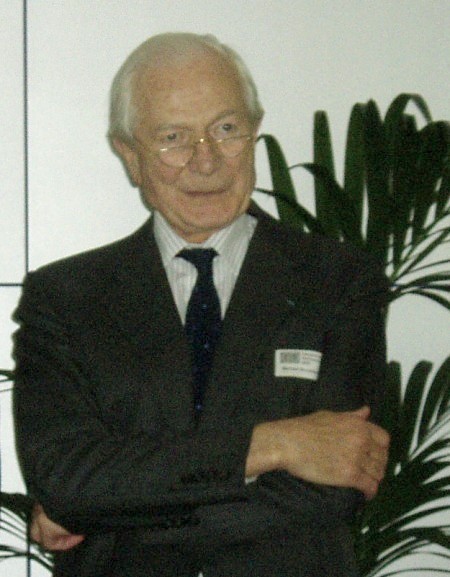
John Michael Broadbent, MW (2 May 1927 – 17 March 2020), was a British wine critic, writer and auctioneer in a capacity as a Master of Wine. He was an authority on wine tasting and old wines.[1]

Career

[edit]

Born in Yorkshire, the elder son of John Broadbent (1891–1963) and Hilary née Batty (1905–1998), he was educated at Oundle School. Commissioned into the Royal Artillery as Second Lieutenant in 1945, he served as Assistant Adjutant at Dover Castle 1947-48, before leaving the Army to train as an architect (ARIBA). In 1952, at the age of twenty-five, Broadbent entered the wine trade first with Layton's,[2] then with the West End wine merchants, Saccone & Speed, and from 1955 with Harvey's of Bristol. In 1960, he received the qualification of Master of Wine.[3][4]

In 1966, he resigned as Sales Director to start wine auctions at the London auction house Christie's which would lead him to trade in and taste a greater number of fine and rare wines than anyone else in the world. His tasting notes are estimated to number over 90,000 in more than 140 notebooks.[4]

Until 1992, he was the senior director of Christie's wine department,[1] and he remained a senior consultant with the firm until 2009. Journalist Harry Eyres, who worked as a junior expert at Christie's, wrote that Broadbent "created a small niche of glamour for himself as a jet-setting wine celebrity, while everybody else in the office toiled in near Dickensian conditions".[5]

As a wine writer, Broadbent was noted for publications of his records from a life of tasting wine.[6] The Great Vintage Wine Book is a reference work with tasting notes from more than 6,000 wines dating back to the 17th century.[7] In addition to authoring several wine books, he was a regular contributor to the wine magazines Vinum and Falstaff , and wrote monthly for Decanter since its inception in 1975.[4] Broadbent lectured on the subject since the mid-1950s.[8] Broadbent awarded a wine up to five stars, a system unlike the numerical score of the American wine critic Robert Parker.[4]

Appointed a Chevalier of the Ordre national du Mérite in 1979, Broadbent was also a Chevalier du Tastevin and an honorary member of the Académie du Vin de Bordeaux as well as of numerous other French wine associations. Among other positions held, Broadbent served as Chairman of the Institute of Masters of Wine 1970, Master of the Worshipful Company of Distillers 1991/92, President of The International Wine and Food Society 1985–92, President of the Wine & Spirit Education Trust (WSET) 2007–09 and Chairman of The Wine & Spirit Trades' Benevolent Society 1991/92. He also stood for election as Lay Sheriff of the City of London in 1993.[4]

In 2006, he participated as a judge in the 30th anniversary repetition of the original "Judgment of Paris" wine tasting competition.[9]

Personal life

[edit]

Broadbent was widowed by his first wife, Daphne née Joste (1931–2015), whom he married in 1954:
their daughter, Dame Emma Arbuthnot DBE, known professionally as Mrs Justice Arbuthnot, married the Rt Hon. the Lord Arbuthnot of Edrom, formerly James Arbuthnot, MP, and their son, Bartholomew Broadbent,[10] is a wine importer in the United States who also makes Port, Madeira and Vinho Verde in Portugal and was a 50% owner of Dragon's Hollow winery in China.

Broadbent married secondly in London, on 25 April 2019, Valerie Smallwood,[11] widow of Simon Smallwood, MW,[12] and died on 17 March 2020, in Berkshire, aged 92.[13][14]

Controversy

[edit]

Broadbent was among the wine industry experts whose association with alleged wine forger, Hardy Rodenstock, during the 1980s caused much embarrassment.[15]

In July 2009, it was announced that Broadbent would sue Random House, the publishers of The Billionaire's Vinegar by Benjamin Wallace, an account of the "Jefferson bottles affair" and its court cases, for defamation of character, on claims that the book asserts Broadbent invented an auction bid and contains references to him colluding with Rodenstock. The suit was filed in London, and Random House initially stated it did not believe it had defamed Broadbent and would defend the lawsuit.[16]

In October 2009, Random House accepted that the allegations in the book were without foundation, removed the book from sale in the UK, made a full apology and paid Broadbent an undisclosed sum in damages.[17][18]

As Wallace was not party to the lawsuit or settlement, Random House continued to publish the book unamended, outside UK jurisdiction.[19][20]

Bibliography

[edit]

See also

[edit]

References

[edit]
[edit]
Revisions and contributorsEdit on WikipediaRead on Wikipedia
from Grokipedia
Michael Broadbent (2 May 1927 – 17 March 2020) was a British , auctioneer, writer, and critic who transformed the fine wine market by reviving and modernizing wine auctions at , while also standardizing the practice of professional and description through his meticulous documentation of over 90,000 wines. Born in , , Broadbent initially trained as an architect at the , , and served as a in the Royal Artillery from 1945 to 1948 before entering the wine trade in 1952 as a trainee at Laytons Wine Merchants. He progressed through roles at Saccone & Speed and , where he became sales director, and qualified as a in 1960, later serving as chairman of the Institute of Masters of Wine from 1970 to 1971. In 1966, at age 39, he joined auction house, where he founded and led the wine department as senior director until 1992 and as consultant until 2009, establishing as a global hub for fine wine trade by auctioning rare vintages alongside art and antiques. Broadbent also founded the Wine Trade Arts Society in 1954 and held leadership roles such as president of the International Wine & Food Society from 1985 to 1992, earning honors including honorary freeman of the Vintners' Company in 2001 and honorary president of the Wine & Spirit Education Trust in 2008. As a prolific , Broadbent began recording tasting notes on 13 September 1952 in pocket-sized red notebooks, amassing a lifetime archive that informed his influential publications and a monthly column in magazine from 1977 to 2012. His key books include (1968, translated into eight languages), which codified tasting methodologies; The Great Vintage Wine Book (1980, updated as Vintage Wine in 2002), drawing on notes from historic vintages back to the ; and a final work launched in 2019. Broadbent's work earned him the Distinguished Service Award in 1991, and he was recognized as an honorary life member of the Circle of Wine Writers for his enduring contributions to wine education and appreciation.

Early life and education

Childhood and family background

John Michael Broadbent was born on 2 May 1927 in Greenfield, , in the , . He was the elder son of John Fred Broadbent and Hilary Louise Broadbent (née Batty). His father's family had deep roots in the region's , with paternal forebears prominent in the mills of the area, providing the family with a stable middle-class socioeconomic background. Broadbent grew up in the rural moorland setting of alongside his younger brother, Roger. The family's business-oriented heritage in Yorkshire's industrial heartland likely contributed to Broadbent's practical outlook, shaped by the area's blend of rural landscapes and manufacturing traditions. He later transitioned to formal education at near Halifax.

Education and military service

Broadbent received his early education at near Halifax in , where he developed an aptitude for drawing that would shape his initial career path. His family's roots influenced this choice, with his mother recommending based on his artistic skills after the family firm was sold. He began studying architecture at the Bartlett School of Architecture, University College London, in the mid-1940s, focusing on design principles, , and building techniques. His training was interrupted by , but he resumed in 1948 and earned a certificate in architecture after four years of post-war study, during which he encountered challenges in subjects like engineering and sanitation. Following graduation in 1952, Broadbent briefly practiced as an architect, applying his analytical and precision-oriented skills honed through rigorous coursework. Broadbent's military service occurred from 1945 to 1948 as a in the Royal Artillery, fulfilling obligations in the immediate . He underwent training and served, later reflecting on himself as an unenthusiastic soldier during demobilization. His final assignment at involved administrative duties as assistant , alongside minor roles as assistant and , before he was demobilized in 1948 and returned to his architectural studies.

Professional career

Entry into the wine trade

In the early 1950s, Michael Broadbent abandoned his burgeoning career in , driven by a burgeoning passion for wine, and entered the industry through entry-level positions at wine merchants. He began as a at Laytons Wine Merchants in 1952, at the age of 25, where he gained foundational experience in the trade. Broadbent's architectural training, which emphasized precision and detail, instilled a disciplined approach that later informed his meticulous wine analysis. Following his time at Laytons, he moved to the West End firm Saccone & Speed, further honing his skills in wine sales and procurement. In 1955, he joined in , continuing to build practical expertise in the merchant sector. A pivotal milestone came in 1960 when Broadbent achieved the (MW) qualification, one of the earliest recipients in the post-World War II era. The MW exam, administered by the Institute of Masters of Wine, rigorously tests candidates through theoretical papers on , , and business, alongside blind tasting assessments requiring identification of wines by region, vintage, and style. This credential, earned after years of study and practical immersion, marked Broadbent's emergence as a serious authority in the field and was held by only a select few in the 1950s and early 1960s. Parallel to his professional roles, Broadbent developed a lifelong habit of tasting and note-taking starting in 1952, initially concentrating on European wines to deepen his understanding of classic regions like , , and the . These early tastings, often conducted systematically to compare vintages and producers, laid the groundwork for his expertise in assessing wine quality and .

Role at Christie's

In 1966, Michael Broadbent joined auction house as head of the wine department, where he was tasked with reviving fine wine s that had been suspended since the Second World War. Drawing on his prior experience in the wine trade, he proposed a projecting rapid growth in sales, launching the first postwar in 1967 and establishing as a global hub for fine wine trading. Broadbent progressed to senior director of the wine department, a role he held until his official retirement in 1992, after which he served as a until 2009. During his leadership, he oversaw numerous high-profile sales, including the 1971 auction featuring 41 magnums of 1870 , which helped solidify reputation for handling exceptional cellars. His tenure also included supervision of record-breaking auctions that drove in the wine market, with annual sales reaching multimillion-pound figures by the . Broadbent innovated auction practices by incorporating his detailed tasting notes into catalogs, providing buyers with expert assessments to build confidence in purchases. He cultivated strong relationships with international collectors through personal visits to cellars and global travel, expanding wine sales to new markets, including the first U.S. auction in 1969. These efforts transformed wine auctions from niche events into a major sector of the .

Writing and editorial roles

Michael Broadbent maintained a long-standing column in Decanter magazine, beginning as a contributor at its in 1975 and launching his regular vintage reports and tasting advice in 1977. Over the next 35 years, he authored more than 400 consecutive monthly columns, offering practical guidance on wine selection, maturation, and appreciation to a broad readership. In addition to his journalistic output, Broadbent held significant editorial roles that extended his influence on . He established Wine Publications in the 1970s, overseeing the production of a series of illustrated monographs on key wine regions and producers during the 1970s and 1980s, which remain valued references for their detailed visual and textual insights. He also contributed articles to international periodicals such as Vinum and Falstaff, further disseminating his expertise on European wines. Broadbent's writings emphasized a structured for wine , advocating for consistent, descriptive tasting notes that prioritized clarity and over subjective . This approach, prominent during the peak of his career from the to the , helped elevate standards in wine by promoting systematic documentation of sensory attributes like aroma, flavor, and balance. His practical style, informed by decades of auction experience at , bridged professional tasting with accessible public discourse.

Contributions to wine knowledge

Tasting notes and vintage assessments

Michael Broadbent maintained an extensive personal archive of tasting notes, beginning in and ultimately comprising over 90,000 entries across more than 140 red notebooks. These notes followed a structured format that systematically evaluated each wine's appearance, aroma (or ""), taste profile, and potential for further aging, allowing for consistent comparisons over time. Broadbent's methodical approach emphasized objective descriptors drawn from sensory experience, such as fruit intensity, structure, and balance, which he refined through decades of professional tastings. Broadbent developed the influential five-star vintage rating system in the 1980s, first featured in his book The Great Vintage Wine Book (1980), where he assessed vintages on a scale of one to five stars based on overall , balance, and longevity. This system rated major regions like and , providing collectors and professionals with a concise guide to vintage performance derived from his cumulative tastings. For instance, he awarded five stars to exceptional years such as 1961 in for their profound depth and aging prowess, influencing subsequent vintage charts in publications like . Through vertical tastings of rare vintages, Broadbent uncovered key insights into wine evolution. Broadbent claimed to have tasted more fine and rare wines than anyone else in history, a assertion supported by his unparalleled access to lots and private collections over five decades.

Leadership and judging activities

Michael Broadbent served as chairman of the Institute of Masters of Wine from 1970 to 1971, a pivotal role in shaping the organization's direction during a period of growing interest in professional wine education. From 2008 to 2010, he held the position of the first honorary president of the Wine & Spirit Education Trust (WSET), contributing to its mission of advancing global standards in wine and spirits education through qualifications offered in over 70 countries. Broadbent's expertise extended to prominent judging roles, including his participation as a panelist in the 2006 30th anniversary re-enactment of the Judgment of Paris tasting, where wines were again compared against French counterparts by international experts. His contributions to the wine world were recognized with prestigious awards, such as his appointment as Chevalier of the by the French government in 1979 and induction as a Chevalier du Tastevin, honoring his influence in appreciation.

Personal life

Marriages and family

Michael Broadbent married Joste in 1954, and the couple shared a close partnership that lasted until her death in 2015. Daphne accompanied Broadbent on his extensive travels for wine tastings and auctions, providing essential support during his tenure at by typing his detailed tasting notes after each event. Their shared enthusiasm for wine strengthened their bond, enabling Broadbent to pursue his demanding career while maintaining a stable family life. The marriage produced two children: a daughter, , a prominent judge and former of , and a son, Bartholomew Broadbent, who works as a wine importer. The couple had six grandchildren. pursued a distinguished legal career independent of her father's profession, rising to significant judicial roles, while Bartholomew entered the wine trade, importing fine wines to the . In his later years, Broadbent remarried on 25 April 2019 to Valerie Smallwood, the widow of fellow Simon Smallwood, whom he had known for decades through professional circles. This union provided companionship in Broadbent's final years, reflecting his enduring personal connections within the wine community.

Later years and death

Following his retirement from consulting roles at in 2009, Broadbent continued to engage with the wine world through occasional writing and meticulous note-keeping on tastings, a practice he maintained for decades despite advancing age. His health gradually declined in the ensuing years, limiting his public activities, though he remained an influential figure admired for his vast knowledge. In 2019, at the age of 91, Broadbent married Valerie Smallwood, the widow of fellow Master of Wine Simon Smallwood, in a union that provided companionship during his final months. He died at his home in Berkshire, England, on 17 March 2020, aged 92. News of his passing prompted widespread tributes from the wine industry, with figures such as describing him as a "towering figure in the " for his pioneering role in auctions and documentation of vintages. Others, including contributors to and The Circle of Wine Writers, hailed his lifelong dedication to tasting notes—numbering over 90,000—and his enduring legacy in elevating wine appreciation and trade standards.

Controversies

Association with Hardy Rodenstock

Michael Broadbent's professional association with Hardy Rodenstock, a prominent dealer and collector, began in the mid-1980s and centered on collaborative tastings and auctions of rare, aged wines. Broadbent, as head of wine department, frequently attended Rodenstock's elaborate annual tastings in , where participants sampled exceptional vintages from the 18th and 19th centuries, opportunities Broadbent later praised for their generosity in his writings. These events fostered a close working relationship, with Rodenstock supplying wines for Broadbent to evaluate and feature in auctions. A pivotal element of their collaboration involved the so-called Jefferson bottles, a cache of 18th-century wines purportedly owned by , which Rodenstock claimed to have discovered in a bricked-up cellar. Prior to the 1985 auction, Broadbent organized a tasting that included a 1784 engraved with "Th.J.", which he described as "perfect in every sense: colour, bouquet, taste." In June 1986, he tasted a 1787 Château Branne-Mouton (predecessor to ) also engraved with "Th.J.", describing it as "sensationally good." These notes underscored their perceived authenticity and quality. Following evaluation, Broadbent consigned one of the bottles—a 1787 —to London auction on December 5, 1985, where it sold for £105,000 (equivalent to about $156,000), setting a record as the most expensive bottle ever auctioned at the time. Their partnership continued through the late 1980s and 1990s, with Broadbent participating in additional Rodenstock-hosted tastings and incorporating sourced wines into sales, further promoting Rodenstock's collection to international buyers. Doubts about the Jefferson bottles' emerged shortly after the 1985 and intensified in the through investigations by collectors such as William Koch, who purchased several bottles in 1988 and began forensic analysis in 2005 revealing inconsistencies in their engravings and contents, including chemical evidence of 20th-century forgery. Subsequent forensic analyses, including cesium-137 testing and engraving examinations, confirmed the bottles as modern forgeries. These findings cast on Broadbent's earlier endorsements, though he maintained the wines' legitimacy based on sensory assessments.

Libel lawsuit over wine forgery claims

In 2008, Random House published The Billionaire's Vinegar by Benjamin Wallace, which accused Michael Broadbent of overlooking evident signs of forgery in the Jefferson wine bottles auctioned at Christie's in 1985, including implying he acted unprofessionally or dishonestly by ignoring suspect provenance and even inventing a bid for a 1784 Château Margaux half-bottle to inflate prices. Broadbent filed a libel suit against in London's in July 2009, alleging the book's claims damaged his reputation by suggesting complicity in fraud related to his prior dealings with Hardy Rodenstock-sourced wines. In his defense, Broadbent emphasized his during the 1985–1987 auctions and tastings, stating that he had consulted experts, issued disclaimers on authenticity, and relied on scientific testing that supported the bottles' legitimacy at the time, rejecting accusations that he had "lost his grip." The case settled in October 2009, with issuing a formal apology in , acknowledging the passages about Broadbent were untrue, paying him an undisclosed sum in damages, and agreeing to withdraw the book from distribution in the . Broadbent's , Sarah Webb, described the outcome as restoring his , while Broadbent himself called it a "great relief," reaffirming his good faith actions.

Bibliography

Major books

Michael Broadbent's first major book, , published in 1968 by Books, introduced a systematic approach to sensory of wine, covering appearance, aroma, bouquet, , and aftertaste through structured techniques. This work revolutionized wine appreciation by providing amateurs and professionals alike with a methodical framework previously lacking in the field, establishing Broadbent as a pioneer in objective tasting . The book underwent numerous editions and translations, with updates incorporating evolving wine trends and Broadbent's additional insights from decades of tastings, influencing generations of wine educators and enthusiasts. Its enduring impact is evident in its status as a cornerstone text, frequently reprinted and cited in wine education programs for promoting precise, replicable tasting practices. In 1980, Broadbent released The Great Vintage Wine Book through Knopf, a comprehensive compilation of over 6,000 tasting notes from his career, organized by region and vintage to provide ratings and assessments for collectors and investors. This 432-page volume drew on Broadbent's experience at auctions, offering practical guidance on vintage quality across , , and other key areas, which helped shape market perceptions and buying decisions among serious wine aficionados. Its influence extended to the auction world, where Broadbent's star-based ratings became a reference for valuing rare bottles. The sequel, The Great Vintage Wine Book II, published in 1991 by Mitchell Beazley in association with Wine Publications, expanded the original with updated notes on post-1980 vintages and refined assessments of classics, totaling around 10,000 entries. This 455-page edition reinforced Broadbent's authority on vintage performance, aiding collectors in tracking aging potential and investment risks through detailed, comparative evaluations. Broadbent's final major work, Vintage Wine: Fifty Years of Tasting Three Centuries of Wine, appeared in 2002 from Harcourt, synthesizing his lifetime of assessments into a 560-page overview of standout vintages from the onward, with emphasis on regional highlights and personal anecdotes from tastings. Serving as an updated culmination of his earlier , it incorporated new evaluations up to the early , providing collectors with a consolidated resource for understanding historical and contemporary wine quality. The book's popularity among investors stemmed from its role in demystifying long-term vintage trends, contributing to informed decisions in the growing fine wine market.

Other publications and contributions

In addition to his major monographs, Michael Broadbent authored several supplementary works that provided practical guidance on wine appreciation and regional expertise. His Michael Broadbent's Pocket Guide to Wine Tasting, first published in 1979 by Mitchell Beazley, served as a compact primer on tasting techniques, emphasizing sensory evaluation of color, bouquet, and flavor while offering criteria for assessing various wine types; it underwent seven editions, reflecting its enduring utility for both novices and enthusiasts. Broadbent also collaborated on reference materials that mapped and historicized key wine regions. In 1997, he co-authored The Bordeaux Atlas and Encyclopaedia of Chateaux with Hubrecht Duijker, published by Ebury Press, which profiled thousands of estates through detailed maps, photographs, and essays on appellations, geography, history, and the wine trade structure, drawing on Broadbent's extensive tasting experience to provide authoritative insights. Early in his career, Broadbent contributed pamphlets and articles that laid foundational advice for wine professionals and amateurs. His Guidance in the Techniques of Tasting, issued around 1964 by of , offered initial instruction on systematic tasting methods, marking one of his first published efforts to standardize in the field. Beyond these, Broadbent made significant contributions to wine through encyclopedias and journals. He provided entries and expertise for The Oxford Companion to Wine (multiple editions, ), including detailed notes on vintages, regions, and tasting practices that informed its comprehensive coverage. Additionally, he wrote regularly for European wine magazines such as Vinum and Falstaff, offering in-depth articles on mature wines, auction insights, and global trends outside his column. In 2019, a commemorative edition of was published by Academie du Vin Library, featuring the original 1975 text with updates to vintages, an expanded glossary, insightful essays, and tributes from leading wine experts, marking Broadbent's final associated publication. No major posthumous compilations of Broadbent's unpublished notes or writings have been formally recognized or published as of , though his extensive tasting records—exceeding 100,000 entries—continue to influence wine scholarship through referenced excerpts in secondary analyses.

References

Add your contribution
Related Hubs
User Avatar
No comments yet.