



Community hub
Recent from talks
Knowledge base stats:
Talk channels stats:
Members stats:
Military acquisition
Military acquisition or defense acquisition is the "bureaucratic management and procurement process", dealing with a nation's investments in the technologies, programs, and product support necessary to achieve its national security strategy and support its armed forces. Its objective is to acquire products that satisfy specified needs and provide measurable improvement to mission capability at a fair and reasonable price.
Military acquisition has a long history spanning from ancient times (e.g., blacksmithing, shipbuilding) to modern times.
Modern military acquisition is a complex blend of science, management, and engineering disciplines within the context of a nation's law and regulation framework to produce military material and technology. This complexity evolved from the increasing complexity of weapon systems starting in the 20th century. For example, the Manhattan Project involved more than 130,000 people at an estimated cost of nearly $24 billion in 2008 dollars.
In the twenty-first century, the trend has been for countries to cooperate in military procurement, due to the rising cost-per-unit of digital age military hardware such as ships and jets. For example, Nordic Defence Cooperation (established 2009), a grouping of Nordic countries that cooperate in defence spending, the Defence and Security Co-operation Treaty, signed between the United Kingdom and France in 2010, and Joint Strike Fighter program, which selected the Lockheed Martin F-35 Lightning II in 2001, included the United States, the United Kingdom, Australia, Italy, Canada, the Netherlands, Norway, Denmark, Turkey, Israel and Japan.
Major activities related to military acquisition are:
EU member states' procurement of arms, munitions, war material and related works and services acquired for defence purposes and procurement of sensitive supplies, works and services required for security purposes are subject to the EU's Directive 2009/81/EC on Defence and Sensitive Security Procurement. The purpose of the directive is to balance the need for transparency and openness in defence markets within the European single market with the need to protect individual countries' security interests. Like all EU directives, its requirements need to be transposed into the domestic laws of each member state.
The Defence and Security Public Contracts Regulations 2011, which were derived from EU law, apply to defence procurement in the UK, along with Parts 1 and 2 of the Defence Reform Act 2014. A white paper entitled Better Defence Acquisition: Improving how we procure and support Defence equipment was published in June 2013, taking forward the reform of defence procurement, equipment support, single-source supply arrangements and logistics in the UK. The white paper included a requirement for the department's large sole-source suppliers to report annually on their engagement with small and medium-sized enterprises and their involvement in their supply chains. The Defence Reform Act established a statutory "Single Source" scheme applicable to situations where there is no competition between suppliers.
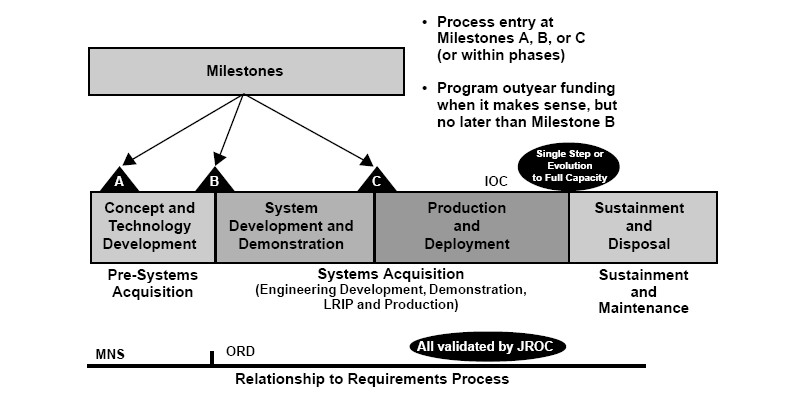
The US Department of Defense has three principal decision-making support systems associated with military acquisition: The Center for Strategic & International Studies releases a report every year on defense acquisition trends.
Hub AI
Military acquisition AI simulator
(@Military acquisition_simulator)
Military acquisition
Military acquisition or defense acquisition is the "bureaucratic management and procurement process", dealing with a nation's investments in the technologies, programs, and product support necessary to achieve its national security strategy and support its armed forces. Its objective is to acquire products that satisfy specified needs and provide measurable improvement to mission capability at a fair and reasonable price.
Military acquisition has a long history spanning from ancient times (e.g., blacksmithing, shipbuilding) to modern times.
Modern military acquisition is a complex blend of science, management, and engineering disciplines within the context of a nation's law and regulation framework to produce military material and technology. This complexity evolved from the increasing complexity of weapon systems starting in the 20th century. For example, the Manhattan Project involved more than 130,000 people at an estimated cost of nearly $24 billion in 2008 dollars.
In the twenty-first century, the trend has been for countries to cooperate in military procurement, due to the rising cost-per-unit of digital age military hardware such as ships and jets. For example, Nordic Defence Cooperation (established 2009), a grouping of Nordic countries that cooperate in defence spending, the Defence and Security Co-operation Treaty, signed between the United Kingdom and France in 2010, and Joint Strike Fighter program, which selected the Lockheed Martin F-35 Lightning II in 2001, included the United States, the United Kingdom, Australia, Italy, Canada, the Netherlands, Norway, Denmark, Turkey, Israel and Japan.
Major activities related to military acquisition are:
EU member states' procurement of arms, munitions, war material and related works and services acquired for defence purposes and procurement of sensitive supplies, works and services required for security purposes are subject to the EU's Directive 2009/81/EC on Defence and Sensitive Security Procurement. The purpose of the directive is to balance the need for transparency and openness in defence markets within the European single market with the need to protect individual countries' security interests. Like all EU directives, its requirements need to be transposed into the domestic laws of each member state.
The Defence and Security Public Contracts Regulations 2011, which were derived from EU law, apply to defence procurement in the UK, along with Parts 1 and 2 of the Defence Reform Act 2014. A white paper entitled Better Defence Acquisition: Improving how we procure and support Defence equipment was published in June 2013, taking forward the reform of defence procurement, equipment support, single-source supply arrangements and logistics in the UK. The white paper included a requirement for the department's large sole-source suppliers to report annually on their engagement with small and medium-sized enterprises and their involvement in their supply chains. The Defence Reform Act established a statutory "Single Source" scheme applicable to situations where there is no competition between suppliers.
The US Department of Defense has three principal decision-making support systems associated with military acquisition: The Center for Strategic & International Studies releases a report every year on defense acquisition trends.