Hubbry Logo
Hi-MDHi-MDMain
Open search
Hi-MD
Community hub
Hi-MD
logo
8 pages, 0 posts
0 subscribers
Be the first to start a discussion here.
Hi-MD
Hi-MD
from Wikipedia
Hi-MD
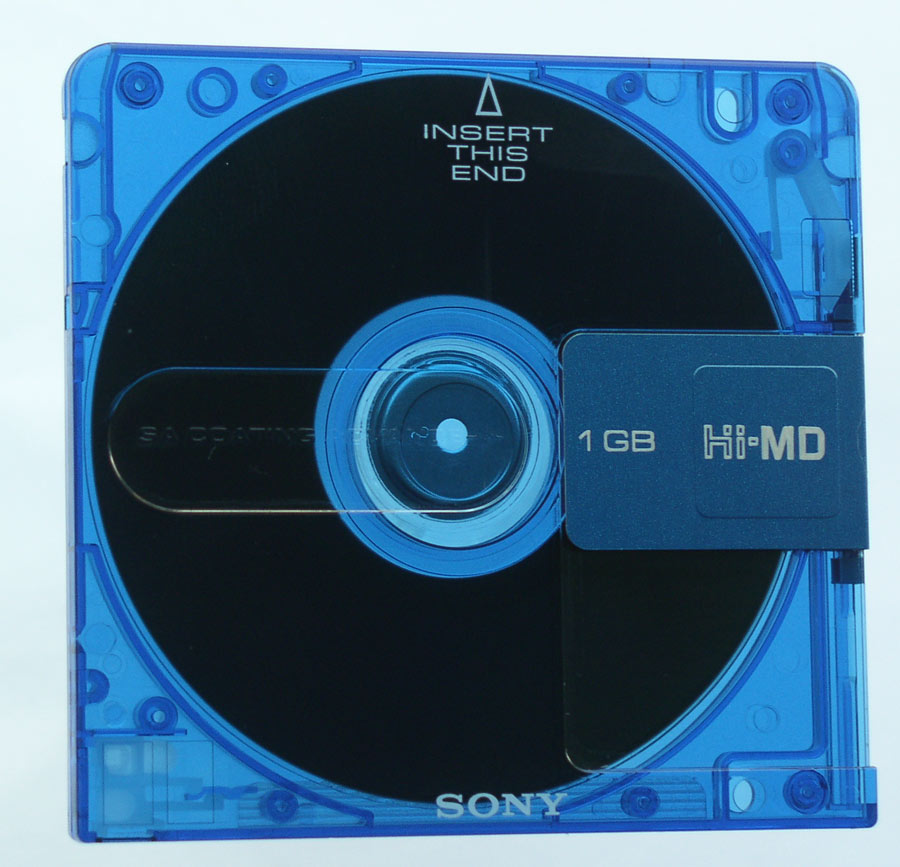
Front view
Media typeMagneto-optical disc
EncodingLinear PCM
CapacityGB
Read mechanism780 nm semiconductor laser diode
Write mechanismMagnetic field modulation
Developed bySony
UsageAudio and data storage
Extended fromMiniDisc
MD Data
ReleasedJanuary 2004
Rear view

Hi-MD is a magneto-optical disc-based data storage format. It was a further development of the MiniDisc.[1] With its release in late 2004,[2] came the ability to use newly developed, high-capacity 1 gigabyte Hi-MD discs, in the same dimensions as MiniDisc.[2] The last recorder and player was discontinued in 2011.[3] Blank discs stopped production in September 2012.

Overview

[edit]
Hi-MD Walkman MZ-NH1 with blank Hi-MD

Hi-MD has several Walkman-selectable audio recording codecs, in order of quality: PCM, Hi-SP, and Hi-LP. Hi-MD Walkmans are backward compatible with MiniDisc playback and most can record. Hi-MD can store computer files and audio data. A bus-powered Hi-MD Walkman is seen as standard USB Mass Storage device[2] with a FAT filesystem.

Since the release of Sony's music management program, SonicStage 3.4, virtually all digital rights management was removed for compatible Hi-MD machines.

In 2005, Sony released its second-generation Hi-MD devices offering native MP3 support.

In 2005, Sony announced Hi-MD Photo.[4] The Sony MZ-DH10P Walkman was released to showcase the format with a 1.3 megapixel digital camera.

In March 2006, Sony released the MZ-RH1 Hi-MD Walkman in Japan, which was later followed in other regions. With this unit, Sony enabled faster-than-real time transfers from MiniDisc to computers. Sony made tangible speed improvements to the device over previous generations of Hi-MD recorders. The result being that the transfer times to and from computer are—under certain circumstances—cut in half over previous models, but still noticeably slower than flash memory and hard drive-based portables, because of the nature of the Hi-MD magneto-optical system.

Marketing

[edit]

In 2006, Sony positioned Hi-MD as a Digital Audio Tape (DAT) alternative after discontinuing the format the year before, placing the MZ-RH1 Hi-MD Walkman under the Pro Audio section of its "Broadcast & Business Solutions Company" website, alongside its flash memory-based recorder, the PCM-D1. DAT is a high-quality digital tape format that found a niche with musicians and studios. DAT portables have commonly been used for field recording, but have gradually been replaced by solid-state and hard drive-based units like the Aaton Cantar, the Zaxcom Deva, and similar units from Fostex and Sound Devices.

Sony MZ-RH1, the last Hi-MD Walkman by Sony

The MZ-M200 Walkman is Sony's MZ-RH1 with a stereo microphone included. The MZ-RH1 was targeted to a more general customer on Sony's consumer electronics sites and comes with no microphone bundle. The microphone was included to enable Hi-MD as a field recorder, and the higher price reflects the added value of the microphone.

MD had success in Asia (particularly in Japan and Hong Kong), but North America and Europe leaned toward either flash or hard drive-based systems. For professional recording, many offer features such as professional XLR microphone inputs, among other pro-centric features. These units were typically significantly larger and heavier than a Hi-MD Walkman, often with reduced battery life and higher prices. Hi-MD and MiniDisc recorders are no longer being manufactured, but their role has been taken over by relatively inexpensive flash memory based portable field recorders such as the Edirol R-09HR and the Olympus LS-10.

See also

[edit]

References

[edit]
Revisions and contributorsEdit on WikipediaRead on Wikipedia
from Grokipedia
Hi-MD is a magneto-optical disc-based and audio recording format developed by as an advanced evolution of the (MD) standard, enabling higher storage capacities, CD-quality linear PCM audio recording, and versatile data handling for music, images, and text files. Introduced on January 8, 2004, the format utilizes ATRAC3plus compression for efficient high-quality audio storage and supports reformatting of existing 74-minute MD discs to approximately 300 MB, while new 1 GB Hi-MD discs offer up to 45 hours of recording time in Hi-MD mode. It incorporates the file system for PC compatibility via USB Mass Storage Class and includes copyright protection through OpenMG and technologies. The Hi-MD format was designed to bridge portable audio with in the broadband era, allowing users to record and playback audio in modes such as Hi-SP (near-CD quality at 256 kbps ATRAC3plus) and Hi-LP (extended playback), alongside full-resolution PCM for uncompressed sound. ensured that standard MD discs could be played on Hi-MD devices, though Hi-MD recording on legacy discs was limited to about 300 MB to prevent data loss. Sony promoted Hi-MD players like the MZ-RH1, targeting musicians and audio enthusiasts with features for direct PC integration and high-fidelity capture. Despite its technical advancements, Hi-MD saw limited market adoption amid the rise of flash memory-based players and digital downloads, leading to discontinue production of Hi-MD hardware in 2011. By 2013, ceased manufacturing all MiniDisc-related products, including Hi-MD components, though recordable MD media production continued until its announced end in February 2025. The format's legacy persists among collectors and in niche audio communities for its durable, rewritable magneto-optical media and superior sound quality in compressed formats.

Development and Release

Origins from MiniDisc

Hi-MD was developed by as a successor to the format, which the company introduced in 1992 as a portable medium based on magneto-optical disc . The original offered compressed audio storage using the codec, but faced challenges in matching the flexibility of emerging digital formats. Hi-MD also built upon the short-lived MD Data variant, launched by in 1993 with 140 MB capacity for computer data storage, though it achieved only limited commercial success due to incompatibility with audio s and lack of widespread adoption. Key motivations for Hi-MD's development stemmed from the original MiniDisc's constraints, including its limited audio capacity of approximately 74 or 80 minutes per disc and reliance on a file system that hindered broader data versatility. These limitations became increasingly evident amid intensifying from compact discs (CDs) and the rapid rise of players in the late and early , which offered greater storage and easier file management for digital . aimed to revitalize the platform for the broadband era by enhancing capacity and functionality while preserving the compact form factor, thereby supporting legal distribution and expanding to recording. Technologically, Hi-MD extended the magneto-optical recording principles established in , where a and enable rewritable data storage on a 64 mm disc encased in a protective cartridge. It incorporated an evolution of the compression family, progressing from the original in early MiniDisc players to in later models and culminating in for Hi-MD, which improved efficiency for higher-density audio encoding. This lineage allowed Hi-MD to maintain with existing MiniDisc content while introducing advancements like Displacement Detection for finer data pits, enabling increased storage without altering the physical design.

Announcement and Initial Launch

Sony announced the Hi-MD format on January 8, 2004, presenting it as an advanced evolution of the system designed to offer significantly higher storage capacity while maintaining compatibility with existing media. The format introduced 1 GB Hi-MD discs, capable of holding up to 45 hours of compressed audio using ATRAC3plus encoding or 94 minutes of uncompressed linear PCM audio, positioning Hi-MD as a versatile upgrade for both music recording and data storage. This announcement occurred at the Consumer Electronics Show in , where emphasized the format's use of magneto-optical technology to achieve these capacities on discs the same physical size as standard MiniDiscs. The initial product launch followed in in 2004 with the MZ-NH1, Sony's first Hi-MD portable recorder, supporting both ATRAC3plus compression and linear PCM recording for high-quality audio playback and capture. Priced at ¥45,000 (approximately $400 USD at the time), the MZ-NH1 featured a body, USB connectivity for direct PC integration as a device, and with standard MiniDiscs, allowing users to reformat them for up to 300 MB of additional capacity. highlighted this compatibility as a key selling point, enabling seamless transition for existing owners without requiring new hardware. The launch targeted the Japanese and broader Asian markets initially, with the MZ-NH1 bundled with a and charging stand to appeal to portable audio enthusiasts. Early reception to Hi-MD focused on its potential to revitalize the ecosystem amid rising competition from flash-based digital players, with reviewers noting the MZ-NH1's robust build and extended recording times as strengths for and hobbyist audio applications. However, the high initial price and niche appeal limited widespread adoption outside , though it garnered praise for bridging traditions with digital storage advancements. Sony's marketing stressed the format's dual audio and data capabilities, including support for PC transfers, as a forward-looking feature for use.

Technical Specifications

Disc and Hardware Design

Hi-MD discs maintain the same physical form factor as standard MiniDiscs, featuring a diameter of 64.8 mm and a thickness of 1.2 mm, encased in a protective cartridge measuring approximately 68 mm by 72 mm by 5 mm. New Hi-MD discs provide a capacity of 1 GB, while standard MiniDiscs can be reformatted for Hi-MD use to achieve up to 305 MB of storage through increased data density. These discs employ a 780 nm semiconductor laser diode for reading and writing, consistent with MiniDisc technology, and utilize a polycarbonate substrate overlaid with a thin magnetic layer to enable data storage. A key design innovation in Hi-MD is the reduction in track pitch to 1.5 μm—compared to the 1.6 μm pitch of standard MiniDiscs—allowing for higher storage capacity on reformatted discs without altering the overall form factor; for 1 GB Hi-MD discs, the track pitch is further reduced to 1.25 μm. The cartridge includes a sliding protective shutter to shield the disc surface from dust and damage, mirroring the robust enclosure of MiniDiscs for portability and reliability. Hi-MD players incorporate a that uses modulation for writing data, where a varying aligns the disc's magnetic domains while a heats the surface to the for thermal-magnetic overwrite erasure and recording. For 1 GB Hi-MD discs, Displacement Detection (DWDD) technology is employed to enable higher density by resolving smaller magnetic domains. This mechanism ensures erasability, with discs rated for over 1 million re-recording cycles without significant degradation, providing exceptional durability for repeated use.

Recording and Playback Mechanisms

The recording process in Hi-MD employs magneto-optical technology, where a heats a precise spot on the disc's rare-earth magnetic recording layer—composed of materials like terbium-iron-cobalt—to its of approximately 180–185°C. At this temperature, the material temporarily loses its , allowing an positioned above the disc to apply a modulated that orients the magnetic domains in alignment with the incoming signal. This mechanism supports direct overwrite functionality, enabling new to be written over existing tracks without a preliminary erasing pass, which enhances efficiency in real-time audio and operations. Hi-MD achieves data transfer rates of 4.37 Mbps at a linear velocity of 2.4 m/s for reformatted discs and 9.83 Mbps at 1.98 m/s for 1 GB discs, representing refinements relative to standard rates of 1.25 Mbps at 1.2 m/s; later models like the MZ-RH1 support up to 10x speeds for accelerated digital transfers. The writing operates at approximately 7 mW to reach the required threshold, contrasting with the subdued reading power to prevent unintended heating. Certain Hi-MD devices, including portable units, draw power directly from USB connections during operation and data exchange, eliminating the need for separate batteries in connected scenarios. During playback, a lower-power (typically around 0.9 mW) is directed at the disc surface, reflecting off the pre-grooved substrate and interacting with the magnetic domains via the magneto-optical . This causes a in the polarization plane of the reflected proportional to the domain orientation, which is detected by a and assembly to reconstruct the stream. For 1 GB Hi-MD discs, DWDD enhances detection of smaller domains (bit 0.16 μm, shortest mark 0.21 μm) using partial response maximum likelihood (PRML) , compared to bit-by-bit detection in standard modes. To mitigate errors from disc imperfections or environmental factors, Hi-MD incorporates Reed-Solomon-based error correction codes, such as an advanced cross-interleaved Reed-Solomon (ACIRC) scheme with modifications for higher density, capable of correcting burst errors and ensuring .

Formats and Capabilities

Audio Encoding Options

Hi-MD supports several audio encoding options designed to balance quality, compression, and storage efficiency on its magneto-optical discs. The primary modes include uncompressed Linear PCM for highest fidelity and compressed ATRAC3plus variants for longer recording times while maintaining perceptual quality close to levels. These options were introduced with the format's launch in , allowing users to select based on needs for professional recording or extended listening. Linear PCM provides uncompressed stereo audio at 16-bit depth and 44.1 kHz sampling rate, equivalent to standard quality, delivering approximately 94 minutes of recording time on a 1 GB Hi-MD disc. This mode avoids any , preserving all original audio data for applications requiring exact reproduction, such as mastering or archival purposes. In contrast, the Hi-SP mode uses ATRAC3plus compression at 256 kbps, offering near- quality sound with about 475 minutes (7 hours 55 minutes) of playback on a 1 GB disc, making it suitable for high-fidelity portable use without significant artifacts. The Hi-LP mode further compresses audio via ATRAC3plus at 64 kbps (or optionally 48 kbps for longer duration), enabling up to 2,040 minutes (34 hours) or 45 hours, respectively, on a 1 GB disc, ideal for extended playback scenarios like long trips or voice recording where duration prioritizes over subtle audio nuances. In 2005, Sony expanded Hi-MD capabilities with second-generation devices that added native support for playback and direct transfer of files without at bitrates up to 320 kbps, allowing use of popular digital music files. These models also facilitated file imports, which are handled as uncompressed Linear PCM for seamless integration with computer-based workflows. The codec underlying the Hi-SP and Hi-LP modes employs a (MDCT) as part of its hybrid compression process, dividing audio into frequency bands for efficient perceptual encoding while minimizing data size.

Data Storage Features

Hi-MD introduced versatile data storage capabilities, transforming the format into a general-purpose removable medium beyond its audio origins. New Hi-MD discs provided a capacity of 1 GB, while standard MiniDiscs reformatted in Hi-MD mode achieved approximately 305 MB of storage space. This expansion allowed users to store a variety of non-audio files, such as documents, images, and other , functioning similarly to a . The format employed the (FAT) file system from its inception, ensuring broad compatibility with personal computers without the need for for basic file operations. Hi-MD devices connected via USB as standard class peripherals, enabling drag-and-drop file management directly in operating systems like Windows and macOS. This approach eliminated restrictions on file types post-launch in 2004, allowing unrestricted storage of any data format supported by the host system. Devices operated in a bus-powered manner through the USB connection, drawing necessary power from the host computer without requiring an external adapter for data transfer sessions. Data transfer rates to the disc were governed by the magneto-optical mechanism, reaching up to 9.83 Mbps (approximately 1.23 MB/s) on 1 GB Hi-MD discs, which supported efficient handling of larger files despite the physical limitations of the medium. These features positioned Hi-MD as a portable, rewritable storage option in an era transitioning toward digital file management.

Compatibility and Integration

Backward Compatibility with MiniDisc

Hi-MD devices maintain full for playback of standard media, enabling them to read and reproduce audio tracks encoded in , ATRAC3, or ATRAC3plus formats on conventional 60-, 74-, or 80-minute discs at their native capacities, such as up to 80 minutes in SP mode or extended times in LP modes. However, when playing standard s, Hi-MD players do not activate Hi-MD-specific features, limiting operation to the original format's constraints without access to higher-density recording or Linear PCM playback. Recording onto standard MiniDiscs is also supported on Hi-MD devices, allowing use of either traditional MD modes or Hi-MD modes on blank discs. In Hi-MD mode, a standard disc must first be reformatted to achieve higher recording density, yielding approximately 291 MB of usable storage on an 80-minute disc and enabling extended durations like 2 hours 20 minutes in Hi-SP mode (256 kbps ATRAC3plus) or 10 hours 10 minutes in Hi-LP mode (64 kbps). This reformatting irreversibly erases any preexisting content, converting the disc to Hi-MD compatibility while adding support for Hi-SP and Hi-LP modes (using ATRAC3plus compression), as well as Linear PCM recording, which are not available in standard MD operation. A key limitation is that standard MiniDisc players cannot read or play discs formatted or recorded in Hi-MD mode, restricting Hi-MD media exclusively to compatible hardware. As a result, users transitioning from legacy libraries faced one-way compatibility, with Hi-MD enhancing standard media only in forward direction. To ease adoption, bundled transition software like with Hi-MD devices, enabling format conversion and content transfer from standard MiniDiscs to Hi-MD for seamless upgrading.

Software and Connectivity Support

Hi-MD devices relied on Sony's software, starting with version 3.0, for managing audio libraries, importing tracks from CDs or the , and transferring content to and from recorders. This software supported direct import and transfer of and files to compatible Hi-MD units beginning in 2005, alongside ATRAC3plus encoding options. Later iterations of , such as version 3.4 released in 2006, removed certain (DRM) restrictions via OpenMG technology, allowing greater flexibility for non-protected files like personal recordings. Connectivity for Hi-MD was facilitated through USB 2.0 ports, enabling devices to function as standard Mass Storage Class peripherals on compatible computers without additional drivers. This allowed drag-and-drop file operations for data storage, treating Hi-MD discs as removable FAT-formatted drives for documents, images, or other non-audio content. Audio transfers, however, required for formatting and management, supporting high-speed operations up to 100 times real-time on models like the MZ-RH1. Additional features included integration for Hi-MD Photo functionality, where captured images in DCF/ format could be accessed and managed via standard image viewing software on connected PCs, leveraging the disc's data storage capabilities. updates for select Hi-MD models enhanced playback compatibility, ensuring seamless handling of imported tracks without conversion on supported hardware. emphasized compatibility with Windows operating systems (XP, 2000, ME, or 98SE) for full functionality, while Macintosh users required dedicated Hi-MD Music Transfer software (version 2.0), supporting / downloads, title editing, and track erasure on models like the MZ-RH1. Portable Hi-MD units drew bus power from the USB connection for charging rechargeable batteries, achieving up to 80% capacity in about one hour during transfers. As of 2010, Sony discontinued , and it is not compatible with modern operating systems beyond without workarounds; community tools like Web MiniDisc provide ongoing support for Hi-MD integration.

Devices and Models

Portable Consumer Devices

The portable consumer devices in the Hi-MD lineup were designed as compact, battery-powered recorders and players primarily for personal audio enjoyment, emphasizing high-capacity storage and digital transfer capabilities for music lovers. These units featured ergonomic designs with jog dials for navigation and LCD screens for displaying track information, making them suitable for on-the-go use by music enthusiasts. Battery life across models typically reached up to 20 hours of playback in compressed modes, supporting extended listening sessions without frequent recharging. The MZ-NH1, released in July 2004 as Sony's inaugural Hi-MD portable recorder, supported ATRAC3plus compression and uncompressed PCM recording, allowing users to store up to 45 hours of audio on a single 1GB Hi-MD disc. Priced at ¥45,000 upon launch in , it targeted audiophiles with its sturdy construction, optical input for high-quality recording, and a backlit with jog dial for intuitive operation. Battery performance included up to 17.5 hours of playback in Hi-LP mode using the LIP-4WM rechargeable pack. Following closely, the MZ-NH900 debuted in April 2004 as a more affordable variant of the MZ-NH1, incorporating Net MD compatibility for PC transfers while maintaining Hi-MD functionality with ATRAC3plus and PCM options. It featured a front-mounted jog dial, a stick-type backlit remote, and a charging stand, with battery life extending to 33 hours of playback when combining the NH-10WM rechargeable and an in Hi-LP mode. This model was primarily available outside and appealed to consumers seeking a balance of features and cost in a lightweight 110-gram body. In 2006, Sony introduced the MZ-RH1, the final flagship portable Hi-MD Walkman, which added native support for MP3 and WAV file playback alongside traditional ATRAC3plus and PCM modes, enabling up to 10x faster USB data transfers. Launched at ¥40,000, it included G-PROTECTION shock resistance and an OLED display for enhanced visibility, with battery life up to 19 hours of playback using the LIP-4WM pack. The MZ-M200, released the same year as a variant of the MZ-RH1, incorporated built-in stereo microphones for direct ambient recording, offering up to 34 hours of compressed audio storage on a 1GB Hi-MD disc and similar battery performance. These later models rounded out the consumer series with improved connectivity and recording versatility for everyday music capture and playback.

Professional and Specialized Hardware

Sony developed several Hi-MD devices tailored for recording and specialized applications, emphasizing high-fidelity PCM capture and compatibility with external peripherals to meet demands in field environments. The MZ-M200, released in , served as a key professional model positioned as a portable alternative to DAT recorders, offering 16-bit/44.1 kHz linear PCM recording (CD quality) directly onto 1 GB Hi-MD discs for approximately 94 minutes of uncompressed audio. This capability allowed professionals such as sound engineers and journalists to capture broadcast-quality audio without compression artifacts, while the device's built-in stereo and support for external via a 3.5 mm input enabled versatile on-location setups. The MZ-M200's design prioritized durability and functionality for demanding workflows, including digital recording level control and to handle varying input levels during live events or interviews. It supported up to 34 hours of Hi-MD recording in compressed modes, making it suitable for extended field sessions in or documentary production, though its magneto-optical disc mechanism required careful handling to avoid shocks. The 44.1 kHz 16-bit PCM provided CD-equivalent resolution for , distinguishing it from consumer models by focusing on professional audio fidelity rather than casual playback. For applications, the MZ-RH910, introduced in 2005, offered robust features like adjustable microphone sensitivity (high/low) and digital input options, allowing integration with external for capturing ambient sounds or interviews in broadcast settings. Its compact, aluminum-accented build contributed to a semi-rugged profile suitable for mobile , with users noting its reliability in outdoor scenarios despite the era's shift toward solid-state alternatives. In specialized hardware, the MZ-DH10P, launched in 2005, integrated Hi-MD audio with capabilities, featuring a 1.3-megapixel camera for image storage on discs holding up to 1,200 photos. This hybrid device targeted niche users in reporting or event documentation, where audio playback via or and photo capture converged, though its color LCD screen and 4x digital zoom were optimized for basic visual archiving alongside 1 GB Hi-MD audio storage. Production of these professional and specialized Hi-MD units was primarily limited to markets in and , where demand for portable high-resolution recording persisted longer than in . The last such devices, including variants in the MZ-RH series, were discontinued around 2011 as phased out formats in favor of flash-based systems.

Marketing and Legacy

Promotion and Market Strategies

Sony launched the Hi-MD format on January 8, 2004, with promotional announcements emphasizing its 1GB disc capacity—equivalent to up to 45 hours of music recording—and enhanced portability as a versatile USB storage medium compatible with existing s. The campaign targeted the broadband era, highlighting legal music distribution and data applications to appeal to consumers seeking high-capacity, . Initial devices, such as the MZ-NH900, debuted in on July 10, 2004, positioning Hi-MD as an evolution of for audio enthusiasts. To promote compression, leveraged partnerships with approximately 80 hardware and media companies that had licensed the technology, integrating it into services launched in spring 2004. In response to rising competition from Apple's , Sony expanded Hi-MD capabilities in March 2005 by adding native playback alongside ATRAC3plus and Linear PCM formats, aiming to broaden music format compatibility and user accessibility. This update was marketed as enhancing Hi-MD's versatility for digital music enjoyment, with devices like the MZ-DH10P combining audio playback and photo capture on cost-effective, durable discs. By 2006, Sony shifted focus toward professional audio applications, promoting models like the MZ-RH1 as a successor to (DAT) through features such as uncompressed Linear PCM recording and 3.5 mm microphone input for high-fidelity . Marketing efforts concentrated on , particularly and Korea, where Hi-MD saw primary rollout and strong initial adoption among portable audio users, while availability in the and remained limited to select imports. Key tactics included bundling Hi-MD devices with software for seamless music management and transfer, simplifying integration with PCs and encouraging . In-store demonstrations highlighted the format's ease of use and capacity advantages over standard MiniDiscs, with progressive price adjustments making entry-level models more affordable by 2007 to stimulate consumer uptake. However, these efforts faced challenges from the dominance of flash-based players like the , which offered simpler file handling and broader ecosystem support, compounded by Sony's internal divisions across competing formats such as and hard-disk Walkmans.

Adoption, Decline, and Current Status

Hi-MD, launched by Sony in 2004 as an enhanced iteration of the MiniDisc format, saw limited mainstream adoption, particularly outside Japan, where the broader MiniDisc ecosystem had already established a strong foothold. By March 2011, Sony had sold approximately 22 million MiniDisc players worldwide, with the majority of units concentrated in the Japanese market due to cultural preferences for portable recording devices and robust domestic distribution. The Hi-MD variant, however, represented only a small subset of these sales, as its advanced features like 1GB storage capacity and MP3 compatibility appealed primarily to a niche audience rather than driving widespread consumer uptake. In professional contexts, Hi-MD found more targeted success, particularly in broadcasting and live audio production in Japan, where its reliable magneto-optical recording and features like XLR microphone inputs made it a staple for field reporters and studios. The decline of Hi-MD accelerated between 2005 and 2010, as solid-state flash storage in devices like the and emerging smartphones rapidly outpaced the format's mechanical limitations and higher media costs. Sony discontinued production of Hi-MD recorders in 2011, with the final model being the MZ-RH1 (and its regional variant MZ-M200), released in 2006. Recordable MiniDisc media production, including Hi-MD blanks, continued until February 2025. This downturn was exacerbated by Hi-MD's proprietary ecosystem, which restricted interoperability compared to the open standard, and the elevated price of Hi-MD discs relative to plummeting costs. Sony's strategic pivot to flash-based E-series players around the mid-2000s further diverted resources away from MiniDisc technologies. As of , Hi-MD persists as a legacy format with no official support from , following the complete halt of all media production in February 2025. Enthusiast communities, such as those centered around minidisc.org, maintain interest through hardware preservation, software emulation, and content sharing. The format retains niche utility in archival audio applications, where its durability and lossless PCM recording capabilities on vintage hardware continue to serve preservationists and collectors.

References

Add your contribution
Related Hubs
User Avatar
No comments yet.