Hubbry Logo
Minimum deviationMinimum deviationMain
Open search
Minimum deviation
Community hub
Minimum deviation
logo
8 pages, 0 posts
0 subscribers
Be the first to start a discussion here.
Minimum deviation
Minimum deviation
from Wikipedia

In a prism, the angle of deviation (δ) decreases with increase in the angle of incidence (i) up to a particular angle. This angle of incidence where the angle of deviation in a prism is minimum is called the minimum deviation position of the prism and that very deviation angle is known as the minimum angle of deviation (denoted by δmin, Dλ, or Dm).

Light is deflected as it enters a material with refractive index > 1.
A ray of light is deflected twice in a prism. The sum of these deflections is the deviation angle.
When the entrance and exit angles are equal, the deviation angle of a ray passing through a prism will be minimal.

The angle of minimum deviation is related with the refractive index as:
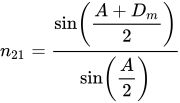
This is useful to calculate the refractive index of a material. Rainbow and halo occur at minimum deviation. Also, a thin prism is always set at minimum deviation.

Formula

[edit]

In minimum deviation, the refracted ray in the prism is parallel to its base. In other words, the light ray is symmetrical about the axis of symmetry of the prism.[1][2][3] Also, the angles of refractions are equal i.e. r1 = r2. The angle of incidence and angle of emergence equal each other (i = e). This is clearly visible in the graph below.

The formula for minimum deviation can be derived by exploiting the geometry in the prism. The approach involves replacing the variables in the Snell's law in terms of the Deviation and Prism Angles by making the use of the above properties.

From the angle sum of ,

Using the exterior angle theorem in ,

This can also be derived by putting i = e in the prism formula: i + e = A + δ

From Snell's law,

[4][3][1][2][5][excessive citations]

(where n is the refractive index, A is the Angle of Prism and Dm is the Minimum Angle of Deviation.)

This is a convenient way used to measure the refractive index of a material(liquid or gas) by directing a light ray through a prism of negligible thickness at minimum deviation filled with the material or in a glass prism dipped in it.[5][3][1]

Worked out examples:

Also, the variation of the angle of deviation with an arbitrary angle of incidence can be encapsulated into a single equation by expressing δ in terms of i in the prism formula using Snell's law:

Finding the minima of this equation will also give the same relation for minimum deviation as above.

Putting , we get,

, and by solving this equation we can obtain the value of angle of incidence for a definite value of angle of prism and the value of relative refractive index of the prism for which the minimum angle of deviation will be obtained. The equation and description are given here

In this graph of the angle of deviation vs the angle of incidence, δ corresponds to two values of i and e(i'). For minimum deviation, however, i equals e.

For thin prism

[edit]

In a thin or small angle prism, as the angles become very small, the sine of the angle nearly equals the angle itself and this yields many useful results.

Because Dm and A are very small,

[1][4]

Using a similar approach with the Snell's law and the prism formula for an in general thin-prism ends up in the very same result for the deviation angle.

Because i, e and r are small,

From the prism formula,

Thus, it can be said that a thin prism is always in minimum deviation.

Experimental determination

[edit]

Minimum deviation can be found manually or with spectrometer. Either the prism is kept fixed and the incidence angle is adjusted or the prism is rotated keeping the light source fixed.[6][7][8]

Minimum angle of dispersion

[edit]
The angle of dispersion in a prism

The minimum angle of dispersion for white light is the difference in minimum deviation angle between red and violet rays of a light ray through a prism.[2]

For a thin prism, the deviation of violet light, is and that of red light, is . The difference in the deviation between red and violet light, is called the Angular Dispersion produced by the prism.

Applications

[edit]
Drawing radii to the points of interference reveals that the angles of refraction are equal, thereby proving minimum deviation.

One of the factors that causes a rainbow is the bunching of light rays at the minimum deviation angle that is close to the rainbow angle (42°).[3][9]

It is also responsible for phenomena like halos and sundogs, produced by the deviation of sunlight in mini prisms of hexagonal ice crystals in the air bending light with a minimum deviation of 22°.[3][10]

See also

[edit]

References

[edit]
[edit]
Revisions and contributorsEdit on WikipediaRead on Wikipedia
from Grokipedia
Minimum deviation is the smallest angle by which a ray of is bent upon passing through a prism, occurring when the light path inside the prism is symmetric such that the angle of incidence at the first face equals the angle of emergence at the second face. This condition results in equal at both prism surfaces, with approximately half the total deviation contributed by each interface. The minimum deviation angle, denoted as δm\delta_m, depends on the prism's apex angle α\alpha and the nn of the prism material relative to the surrounding medium. To achieve minimum deviation, the incident angle is adjusted to achieve a symmetric configuration in which the angle of incidence equals the angle of , often visualized with the internal ray parallel to the prism base for equilateral prisms. This setup minimizes the overall bending and is a key observable in prism experiments, where further changes in incidence increase the deviation angle. The phenomenon is fundamental in understanding and dispersion, as δm\delta_m varies with due to the wavelength-dependent , leading to spectral separation of light. The refractive index can be precisely determined from the minimum deviation using the formula n=sin((α+δm)/2)sin(α/2)n = \frac{\sin((\alpha + \delta_m)/2)}{\sin(\alpha/2)}, enabling accurate measurements in optical instruments like spectrometers with precisions up to 1 part in 10610^6. This relation, derived from Snell's law applied at both prism faces under symmetric conditions, is widely used to characterize materials' optical properties, particularly for dispersive elements in spectroscopy. For a typical 60° glass prism with n1.5n \approx 1.5, δm\delta_m is around 37°.

Fundamentals

Definition and Principles

Minimum deviation in the context of prism optics refers to the smallest angle by which a ray of light is deflected when passing through a prism, achieved under specific conditions of incidence that result in a symmetric path of the light ray inside the prism. This phenomenon occurs when the angle of incidence on the first face of the prism equals the angle of emergence from the second face, leading to equal angles of refraction at both surfaces and a balanced bending of the light path. The total deviation is minimized because the light ray travels in a way that the refractions at the two faces contribute equally to the overall deflection, avoiding the larger bends that occur with asymmetric incidence angles. The underlying principles stem from the refraction of light at the boundaries between media of different refractive indices, governed by Snell's law, which describes how the direction of a light ray changes upon entering or exiting the prism material. When monochromatic light enters a prism, it bends toward the normal at the first face due to the higher refractive index of the glass compared to air, travels straight through the interior, and then bends away from the normal at the second face upon emergence. The net effect is a deviation of the emergent ray from the original incident direction, with the minimum deviation representing the optimal configuration for the least overall angular shift. The systematic application of minimum deviation in optical spectroscopy emerged in the early 19th century, building on earlier work such as Isaac Newton's 17th-century prism experiments, notably through the work of , who in 1814 employed high-quality prisms to analyze the solar spectrum and identify dark absorption lines, laying foundational techniques for spectral dispersion. Fraunhofer's precise prism-based observations utilized minimum deviation to achieve clear separation of wavelengths without excessive light bending, influencing subsequent developments in astronomical and chemical analysis. A typical ray diagram for minimum deviation illustrates a light ray entering the prism at an such that the internal path is parallel to the base in an equilateral prism, with the incident and emergent rays forming symmetric angles relative to the prism apex; in contrast, diagrams for higher deviations show asymmetric paths where the ray strikes one face more obliquely than the other, resulting in greater total bending. This symmetry underscores the principle that minimum deviation corresponds to the condition where the prism's dispersive effect is maximized relative to the angular spread.

Angle of Deviation in Prisms

When a passes through a prism, occurs at both the incident and emergent faces according to , which states that for the first face, n1sini1=n2sinr1n_1 \sin i_1 = n_2 \sin r_1, and for the second face, n2sinr2=n1sini2n_2 \sin r_2 = n_1 \sin i_2, where n1n_1 and n2n_2 are the refractive indices of the surrounding medium and prism material, respectively, i1i_1 and i2i_2 are the angles of incidence and emergence, and r1r_1 and r2r_2 are the angles of refraction inside the prism. These relations determine the bending of the ray at each interface, with the sum of the internal refraction angles r1+r2r_1 + r_2 equaling the prism's apex angle AA. The total angle of deviation δ\delta represents the net change in direction of the light ray after traversing the prism, calculated as δ=i+eA\delta = i + e - A, where ii is the angle of incidence at the first face, ee is the angle of emergence at the second face, and AA is the fixed apex angle of the prism. This deviation arises from the cumulative effects at the two non-parallel faces, altering the ray's path relative to its initial direction. The magnitude of δ\delta is influenced by several key factors: the prism angle AA, which directly scales the deviation as it widens the angular separation between faces; the refractive index nn of the prism material, where higher nn enhances bending and thus increases δ\delta; and the wavelength of the incident light, since nn varies with wavelength (dispersion), leading to greater deviation for shorter wavelengths like blue light compared to longer ones like red. A typical plot of δ\delta versus the angle of incidence ii exhibits a characteristic that decreases to a minimum value before increasing again, with the curve displaying due to the nonlinear relationship between incidence and emergence angles governed by . This minimum point corresponds to the condition of minimum deviation, where the ray path through the prism is symmetric.

Theoretical Framework

Condition for Minimum Deviation

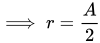
The condition for minimum deviation in a prism occurs when the angle of incidence ii equals the angle of emergence ee, resulting in a symmetric ray path through the prism. In this configuration, the light ray experiences equal at both faces of the prism, minimizing the total angular deviation δm\delta_m. For an equilateral prism with apex angle A=60A = 60^\circ, this symmetry implies that the ray travels parallel to the base inside the prism. This minimum arises because the deviation angle δ\delta as a function of the angle of incidence ii exhibits a graphical minimum at the symmetric point, as observed in plots of δ\delta versus ii. Physically, the equal bending at the two refracting surfaces ensures that the total deflection is as small as possible for a given prism material, avoiding asymmetric paths that would increase the overall deviation. This condition can also be understood through the principle of least action or , where the symmetric path represents the extremum in ray trajectory. Under the minimum deviation condition, the angles of refraction at the two faces satisfy r1=r2=A/2r_1 = r_2 = A/2, where AA is the prism's apex angle, further reinforcing the internal symmetry. For a fixed apex angle AA, the minimum deviation δm\delta_m is unique and directly depends on the refractive index nn of the prism material, making this condition a key indicator of the medium's optical properties.

Derivation of Refractive Index Formula

The angle of deviation δ\delta for a light ray traversing a prism with apex angle AA is expressed as δ=i+eA\delta = i + e - A, where ii is the angle of incidence at the first face and ee is the angle of emergence at the second face. This relation arises from the of the ray path, considering the sum of the external angles ii and ee relative to the internal traversal across angle AA. Under the condition of minimum deviation δm\delta_m, the ray path through the exhibits , such that i=ei = e and the angles of at the two faces are equal, r1=r2r_1 = r_2. From the prism's internal geometry, the sum of the refraction angles equals the apex angle, so r1+r2=Ar_1 + r_2 = A, which simplifies to r1=r2=A/2r_1 = r_2 = A/2 under this . Applying at the first face of the prism, where the ray transitions from air (refractive index approximately 1) to the prism material with nn, yields sini=nsinr1\sin i = n \sin r_1. Substituting r1=A/2r_1 = A/2 gives sini=nsin(A/2)\sin i = n \sin(A/2). By , at the second face confirms the same relation, as e=ie = i and r2=A/2r_2 = A/2, ensuring consistency: sine=nsinr2\sin e = n \sin r_2. To relate ii to the minimum deviation angle, consider the overall ray geometry. The total deviation δm\delta_m bends the ray by ir1i - r_1 at the first face and er2e - r_2 at the second, but with , this combines such that i=(A+δm)/2i = (A + \delta_m)/2. Substituting this into the equation produces sin[(A+δm)/2]=nsin(A/2)\sin[(A + \delta_m)/2] = n \sin(A/2). Rearranging for the refractive index gives the standard formula: n=sin(A+δm2)sin(A2)n = \frac{\sin\left(\frac{A + \delta_m}{2}\right)}{\sin\left(\frac{A}{2}\right)} This equation allows direct computation of nn from measured values of AA and δm\delta_m. This derivation assumes monochromatic light to define a single nn, avoiding complications from wavelength-dependent dispersion, and holds for general prism apex angles AA without invoking small-angle approximations.

Experimental Methods

Setup and Procedure

The standard laboratory setup for measuring the angle of minimum deviation in a prism utilizes a , which includes a to produce parallel light rays, a rotatable prism table to hold the sample, a for observing the deviated beam, and an angular scale with verniers for precise measurements. A monochromatic light source, such as a providing discrete spectral lines (e.g., yellow at 579 nm), illuminates a narrow adjustable slit in the collimator to ensure sharp imaging. The prism, typically made of or another transparent material, is placed on the table for rotation. The procedure involves several key steps to ensure accurate alignment and measurement:
  1. Level the spectrometer base and prism table using built-in screws and a to align all optical axes vertically.
  2. Adjust the for clear crosshairs and focus on a distant object to set it for (parallel rays); then, illuminate the slit and fine-tune the lens until the slit image is sharp and vertical in the field.
  3. Place the prism on the table with its refracting edge parallel to the slit and apex toward the ; rotate the table to observe reflections from the two prism faces through the , recording vernier positions to calculate the prism A as half the difference between these positions.
  4. Reposition the prism so enters one face and exits the other; without the prism, note the "direct" position for the , then insert the prism and rotate the table while viewing a specific (e.g., the mercury line) until the appears stationary, indicating minimum deviation—clamp the table and record the position to find δ_m as the angular difference from the direct position.
  5. For greater precision, vary the angle of incidence i by rotating the prism table in increments around the minimum, measure the corresponding deviation angles δ using the , and plot δ versus i to identify the minimum δ_m at the curve's lowest point; repeat for multiple lines if needed, always reading both verniers and clamping components during observations.
In modern variants, digital spectrometers incorporate automated rotary encoders for angle measurement and CCD sensors in the telescope for automated spectral analysis, enabling higher precision and reducing manual errors, as seen in advanced refractometry systems developed post-2020. Common sources of error include misalignment of the collimator or telescope axes, which introduces angular offsets; a slit width exceeding 0.3 mm, causing image blur and reduced resolution; and prism imperfections like surface irregularities or internal defects that alter light paths unevenly. Using non-monochromatic light can overlap images, obscuring the exact minimum deviation point. When employing sources (e.g., lasers for precise monochromatic beams) as alternatives to vapor lamps, updated protocols emphasize wearing wavelength-specific protective to guard against injury from direct exposure or reflections, avoiding direct beam viewing, and ensuring enclosed paths to prevent . These measurements of δ_m, combined with the prism angle A, facilitate computation of the via the standard formula.

Thin Prism Approximation

The thin prism approximation provides a simplified method to estimate the using the minimum deviation angle for s with small apex angles. For such prisms, the minimum deviation δm\delta_m is approximately δm(n1)A\delta_m \approx (n - 1) A, where nn is the refractive index and AA is the apex angle in radians. This formula arises from applying the sinxx\sin x \approx x to the general minimum deviation relation n=sin(A+δm2)sin(A2)n = \frac{\sin\left(\frac{A + \delta_m}{2}\right)}{\sin\left(\frac{A}{2}\right)}, where the arguments are small, leading to a Taylor expansion that linearizes the expression and neglects higher-order terms. The approximation is suitable for prisms with A<10A < 10^\circ, a configuration frequently employed in student laboratories for straightforward refractive index determinations without complex setups. In adapted experimental procedures, the near constancy of deviation with respect to incidence angle for thin prisms enables direct measurement of δm\delta_m at a convenient orientation, bypassing the need for graphing deviation against incidence to identify the minimum, as the response remains approximately linear. Limitations include reduced accuracy when higher-order angular terms become significant or for materials with notable dispersion, where wavelength-dependent variations in nn cause the deviation to spread across the spectrum, compromising the single-value approximation.

Dispersion in Prisms

Dispersion in prisms refers to the phenomenon where white is separated into its spectral components due to the variation of the nn with λ\lambda. This dependence causes shorter , such as violet , to experience a higher and thus greater bending at the prism surfaces compared to longer like . As a result, different colors deviate by distinct angles when passing through the prism, forming a continuous from to violet. In the minimum deviation configuration, typically analyzed for monochromatic light, dispersion manifests as varying minimum deviation angles δm\delta_m across wavelengths because δm\delta_m depends on n(λ)n(\lambda). For instance, blue light exhibits a larger δm\delta_m than red light due to its higher nn, leading to spatial separation of colors in the emergent beam. The angular dispersion, which measures the rate of spectral spreading, is approximated by dδdλdndλ×dδdn\frac{d\delta}{d\lambda} \approx \frac{dn}{d\lambda} \times \frac{d\delta}{dn}, where dndλ\frac{dn}{d\lambda} captures the material's inherent dispersion and dδdn\frac{d\delta}{dn} reflects the prism's geometric sensitivity to refractive index changes. This relation conceptually arises from the differential minimum deviation angles for each wavelength, enabling precise control in optical instruments. To counteract dispersion while preserving net deviation, achromatic prisms combine materials with differing dispersive properties, such as low-dispersion glass and high-dispersion , cemented together so that the angular spreads cancel for a mean . This design achieves achromatic deviation, minimizing chromatic blurring in applications requiring light handling. In modern optics, prisms play a key role in dispersion management for ultrafast systems, where pairs of prisms compensate higher-order dispersion to maintain pulse integrity, similar to how material dispersion in optical fibers causes pulse broadening and degrades signal quality in high-speed communications.

Minimum Angle of Dispersion

The minimum angle of dispersion in a prism refers to the angular spread of polychromatic light into its spectral components when the prism is oriented at the position of minimum deviation for a central wavelength, such as the separation between red and violet extremes. This occurs because the refractive index nn varies with wavelength λ\lambda, causing different colors to deviate by slightly different amounts even at the symmetric passage condition where the incident and emergent angles are equal. For white light, this results in a dispersed spectrum where the total angular width θm\theta_m approximates θm(dδmindλ)Δλ\theta_m \approx \left( \frac{d\delta_{\min}}{d\lambda} \right) \Delta\lambda, with Δλ\Delta\lambda being the wavelength range (e.g., from 400 nm violet to 700 nm red). The rate of angular dispersion at minimum deviation is given by dδmindλ=dndλ2sin(A/2)1n2sin2(A/2),\frac{d\delta_{\min}}{d\lambda} = \frac{dn}{d\lambda} \cdot \frac{2 \sin(A/2)}{\sqrt{1 - n^2 \sin^2(A/2)}},
Add your contribution
Related Hubs
User Avatar
No comments yet.