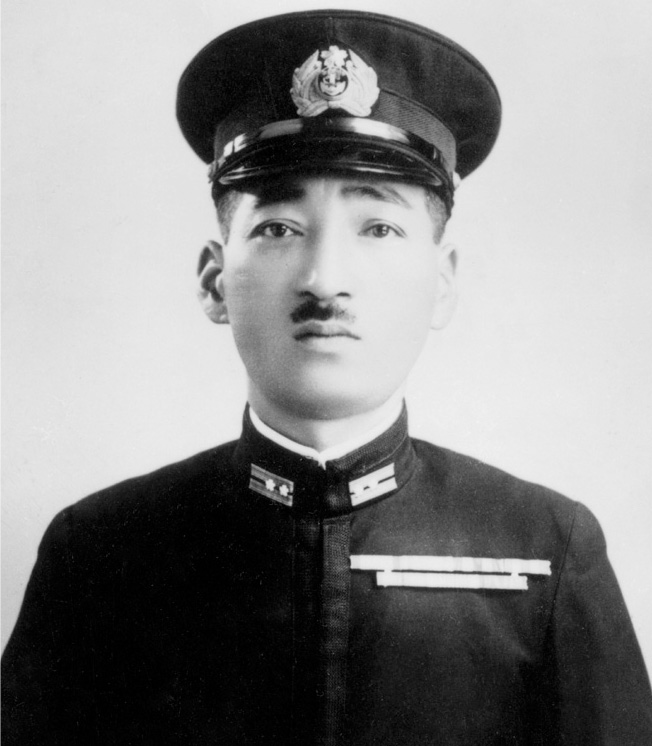

Mitsuo Fuchida
View on WikipediaMitsuo Fuchida (淵田 美津雄, Fuchida Mitsuo; 3 December 1902 – 30 May 1976) was a Japanese captain in the Imperial Japanese Navy Air Service and a bomber observer in the Imperial Japanese Navy before and during World War II.[1] He is perhaps best known for leading the first wave of air attacks on Pearl Harbor on 7 December 1941. Working under the fleet commander, Vice Admiral Chūichi Nagumo, Fuchida was responsible for the coordination of the aerial attack.
Key Information


After the war ended, Fuchida became a Christian convert and evangelist, traveling in the United States and Europe to tell his story. He later settled in the U.S. (although never taking American citizenship).[2] Some of Fuchida's wartime claims have been challenged as self-serving by historians, including his claimed advocacy for a third wave attack on Pearl Harbor.
Early life and education
[edit]Mitsuo Fuchida was born in what is now part of Katsuragi, Nara Prefecture, Japan to Yazo and Shika Fuchida on 3 December 1902. He entered the Imperial Japanese Naval Academy at Etajima, Hiroshima, in 1921, where he befriended classmate Minoru Genda and discovered an interest in flying. Specializing in horizontal bombing, Fuchida was made an instructor in that technique in 1936. He gained combat experience during the Second Sino-Japanese War, when he was assigned to the aircraft carrier Kaga in 1929 and then to the Sasebo Air Group, He was promoted to lieutenant commander on 1 December 1936 and was accepted into the Naval Staff College. Fuchida joined the aircraft carrier Akagi in 1939 as the commander of the air group. Fuchida was made commander in October 1941.[3]
World War II
[edit]Pearl Harbor
[edit]
On Sunday, 7 December 1941, a Japanese force under the command of Vice Admiral Chūichi Nagumo—consisting of six carriers with 423 aircraft—was ready to attack the United States base at Pearl Harbor, Hawaii. At 06:00, the first wave of 183 dive bombers, torpedo bombers, horizontal bombers and fighters took off from carriers 250 mi (400 km) north of Oahu and headed for the U.S. Pacific Fleet at Pearl Harbor.
At 07:40 Hawaiian Standard Time, Mitsuo Fuchida, who by this time had achieved the rank of commander, arrived with the first attack wave on Oahu's north shore near Kahuku Point. The first attack wave then banked west and flew along the northwest coast. Fuchida ordered "Tenkai" (Take attack position), and upon seeing no U.S. activity at Pearl Harbor, Fuchida slid back the canopy of his Nakajima B5N2 torpedo bomber, tailcode AI-301 and fired a dark blue flare known as a "black dragon", the signal to attack.
Passing Waimea Bay at 07:49, Fuchida instructed his radio operator, Petty Officer 1st Class Norinobu Mizuki, to send the coded signal "To, To, To" (totsugekiseyo—"to charge") to the other aircraft. Fuchida, thinking Lt Cmdr Shigeru Itaya's Zeroes had missed the signal, fired a second flare. Lt Cmdr Kakuichi Takahashi, overall leader of the first wave dive bombers, saw both flares and misunderstood the signal. Thinking the dive bombers were to attack, he led his dive bombers into immediate attack position. Lt Cmdr Shigeharu Murata, overall leader of the torpedo bombers, observed both flares and saw Takahashi's planes gliding into attack formation. He knew there was a misunderstanding which could not be rectified, so he led his torpedo bombers into attack positions. At this point, Cmdr Fuchida's pilot, Lieutenant Mitsuo Matsuzaki, guided their bomber along with the remaining horizontal bombers in a formation sweep around Kaena Point and headed down the western coast of Oahu.
At 07:53, Fuchida ordered Mizuki to send the code words "Tora! Tora! Tora!" back to the carrier Akagi, the flagship of 1st Air Fleet.[4][a] The message meant that complete surprise had been achieved. Due to favorable atmospheric conditions, the transmission of the "Tora! Tora! Tora!" code words from the moderately powered transmitter were heard over a ship's radio in Japan by Admiral Isoroku Yamamoto, the naval commander, and his staff, who were sitting up through the night awaiting word on the attack.[5]
As the first wave returned to the carriers, Fuchida remained over the target to assess damage and observe the second-wave attack. He returned to his carrier only after the second wave had completed its mission. With great pride, he announced that the U.S. battleship fleet had been destroyed. Fuchida inspected his craft and found 21 large flak holes: the main control wires were barely holding together. The successful attack made Fuchida a national hero who was granted a personal audience with Emperor Hirohito.
Other actions
[edit].jpg)
On 19 February 1942, Fuchida led the first of two waves of 188 aircraft in a devastating air raid on Darwin, Australia.[6] On 5 April, he led another series of air attacks by carrier-based Japanese aircraft against Royal Navy bases in Ceylon, which was the headquarters of the British Eastern Fleet, in what Winston Churchill described as "the most dangerous moment" of World War II.[7][8]
On 4 June 1942, while on board Akagi, Fuchida was wounded at the Battle of Midway. Unable to fly while recovering from an emergency shipboard appendectomy a few days before the battle, he was on the ship's bridge during the morning attacks by U.S. aircraft. After Akagi was hit, a chain reaction from burning fuel and live bombs began the destruction of the ship. When flames blocked the exit from the bridge, the officers evacuated down a rope, and as Fuchida slid down, an explosion threw him to the deck and broke both his ankles.
Staff officer
[edit]After spending several months recuperating, Fuchida spent the rest of the war in Japan as a staff officer. On 15 October 1944, he was promoted to captain. The day before the first nuclear weapon was dropped on Hiroshima, he was in that city to attend a week-long military conference with Japanese army officers. Fuchida received a long-distance phone call from Navy Headquarters asking him to return to Tokyo. The day after the bombing, he returned to Hiroshima with a party sent to assess the damage. Many members of Fuchida's party later died of radiation poisoning, but Fuchida exhibited no symptoms.[9] Fuchida's military career ended with his demobilization in November 1945 during the American-led occupation of Japan.[10]
Postwar activities
[edit]After the war, Fuchida was called on to testify at the trials of some of the Japanese military for Japanese war crimes. This infuriated him, as he believed this was little more than "victors' justice". In the spring of 1947, convinced that the U.S. had treated the Japanese the same way and determined to bring that evidence to the next trial, Fuchida went to Uraga Harbor near Yokosuka to meet a group of returning Japanese prisoners of war. He was surprised to find his former flight engineer, Kazuo Kanegasaki, who all had believed had died in the Battle of Midway. When questioned, Kanegasaki told Fuchida that they were not tortured or abused, much to Fuchida's surprise. He then went on to tell him of a young lady, Peggy Covell, who served them with the deepest love and respect, but whose missionary parents had been killed by Japanese soldiers on the island of Panay in the Philippines.
For Fuchida, this was inexplicable, as in the Bushido code revenge was not only permitted, it was "a responsibility" for an offended party to carry out revenge to restore honor. The murderer of one's parents would be a sworn enemy for life. He became almost obsessed trying to understand why anyone would treat their enemies with love and forgiveness.[11][12]
In the fall of 1948, Fuchida was passing by the bronze statue of Hachikō at the Shibuya Station when he was handed a pamphlet about the life of Jacob DeShazer, a member of the Doolittle Raid who was captured by the Japanese after his B-25 bomber ran out of fuel over occupied China. In the pamphlet, "I Was a Prisoner of Japan"[13] DeShazer, a former U.S. Army Air Forces staff sergeant and bombardier, told his story of imprisonment, torture and his account of an "awakening to God."[14] This experience increased Fuchida's curiosity of the Christian faith. In September 1949, after reading the Bible for himself, he became a Christian. In May 1950, Fuchida and DeShazer met for the first time.[15] Fuchida created the Captain Fuchida Evangelistical Association based in Seattle, Washington and spoke full-time of his conversion to the Christian faith in presentations titled "From Pearl Harbor To Calvary".
In 1951, Fuchida, along with a colleague, published an account of the Battle of Midway from the Japanese side. In 1952, he toured the United States as a member of the Worldwide Christian Missionary Army of Sky Pilots. Fuchida remained dedicated to a similar initiative as the group for the remainder of his life.
In February 1954, Reader's Digest published Fuchida's story of the attack on Pearl Harbor.[16] Fuchida also wrote and co-wrote books, including From Pearl Harbor to Golgotha, a.k.a. From Pearl Harbor to Calvary, and a 1955 expansion of his 1951 book Midway, a.k.a. Midway: The Battle that Doomed Japan, the Japanese Navy's Story.[17] His autobiography, titled "Shinjuwan Kogeki no Sotaicho no Kaiso", was published in Japan in 2007. This was translated into English by Douglas Shinsato and Tadanori Urabe and published in 2011 under the title, "For That One Day: The Memoirs of Mitsuo Fuchida, Commander of the Attack on Pearl Harbor". Fuchida's story is also recounted in God's Samurai: Lead Pilot at Pearl Harbor by Donald Goldstein, Katherine V. Dillon and Gordon W. Prange.[18]
In 1959, Fuchida was among a group of Japanese visiting the tour of U.S. Air Force equipment given by General Paul Tibbets, who piloted the Enola Gay that dropped the atomic bomb on Hiroshima. Fuchida recognized Tibbets and had a conversation with him. Tibbets said to Fuchida that "[y]ou sure did surprise us [at Pearl Harbor]" in which he replied "what do you think you did to us [at Hiroshima]?" Fuchida further told him that:
You did the right thing. You know the Japanese attitude at that time, how fanatic they were, they'd die for the Emperor ... Every man, woman, and child would have resisted that invasion with sticks and stones if necessary ... Can you imagine what a slaughter it would be to invade Japan? It would have been terrible. The Japanese people know more about that than the American public will ever know.[19]
According to Fuchida's son, his father had a green card allowing permanent residence in the U.S. but he never obtained U.S. citizenship. This is contrary to the assertions of several authors.[quantify][20] Fuchida died of complications caused by diabetes in Kashiwara, near Osaka on 30 May 1976 at the age of 73.
Published works
[edit]Fuchida was the author of three books: one on the Battle of Midway, one a memoir, and one on his conversion to Christianity.
- Midway: The Battle that Doomed Japan, the Japanese Navy's Story (Naval Institute Press, 2000) was coauthored with Masatake Okumiya. In a section entitled "Five Fateful Minutes", Fuchida (as translated) writes "Five minutes! Who would have believed that the tide of battle would shift in that brief interval of time? ... We had been caught flatfooted in the most vulnerable condition possible—decks loaded with planes armed and fueled for attack."[21] Later scholarship (Parshall et al.) dispute Fuchida's description. (Edited by Clarke H. Kawakami and Roger Pineau; ISBN 9781557504289)
- For That One Day: The Memoirs of Mitsuo Fuchida, the Commander of the Attack on Pearl Harbor (eXperience, Incorporated, 2011) was his memoir. In it, Fuchida makes a claim that has not been corroborated by others: "In my role as Staff of General Navy Headquarters, I was assigned miscellaneous tasks to help the Japanese side's preparations. Since I was not an official attaché, I was watching the signing ceremony from the upper deck along with the crews of the USS Missouri."[22] (Translated by Douglas T. Shinsato and Tadanori Urabe; ISBN 9780984674503)
- From Pearl Harbor to Calvary (Pickle Partners Publishing, March 28, 2016, ISBN 9781786259066), originally published as From Pearl Harbor to Golgotha, is the story of Fuchida's Christian conversion.
Historical controversy
[edit]Fuchida was an important figure in the early portion of the Pacific War, and his written accounts, translated into English and published in the U.S., were highly influential.[23] However, the veracity of Fuchida's statements on several topics has been subsequently called into question. This process began in Japan in 1971, with the publication of the Japanese official war history volume on the Battle of Midway, that explicitly contradicted Fuchida's version of events.[24]
In 2001, historians H.P. Willmott and Haruo Tohmatsu in their Pearl Harbor, dismissed Fuchida's rendition of having demanded a third-wave against Pearl Harbor's fuel tanks as "blatant and shameless self-advertisement" regarding "an episode which never took place."[25] These criticisms were repeated by historian Jonathan Parshall[26] and Mark Stille's Tora! Tora! Tora! Pearl Harbor 1941.[27] Alan Zimm's 2011 Attack on Pearl Harbor: Strategy, Combat, Myths, Deceptions, reinforced and enlarged these earlier criticisms[28] and added new charges, including Fuchida having fabricated a battle damage assessment that was presented to Emperor Hirohito.[29] Zimm subsequently accused Fuchida of lying about important decisions and signals he made as strike leader immediately prior to the attack, while blaming others for his own errors.[30]
With respect to the Battle of Midway, Fuchida's account of the readiness of the Japanese counterstrike aircraft during the American dive-bomber attack has been disputed by historians Parshall and Anthony Tully in their 2005 work Shattered Sword,[31] as well as Dallas Isom's Midway Inquest,[32] Craig Symonds' The Battle of Midway,[33] and Evan Mawdsley,[34] with Mawdsley noting "Parshall and Tully compellingly contradict Fuchida."[35] Parshall also disputed Fuchida's uncorroborated claims of attendance on the battleship USS Missouri during the Surrender of Japan in 1945, these criticisms being later amplified by Zimm.[36][26]
Portrayals
[edit]In the 1970 film Tora! Tora! Tora!, Fuchida was portrayed by Japanese actor Takahiro Tamura.
Gordon Prange wrote Fuchida's biography, titled God's Samurai: Lead Pilot at Pearl Harbor, in 1990.[37]
Auction
[edit]Fuchida's hand-drawn map showing the post-Pearl Harbor attack destruction sold at auction for $425,000 in New York City on 6 December 2013. The map had previously been owned by Malcolm Forbes.[38]
The map was purchased by the Jay I. Kislak foundation, who then donated it to Miami-Dade Library. The library then sold it to the Library of Congress in 2018.[39]
References
[edit]Notes
[edit]- ^ (虎 tora is Japanese for "tiger" but in this case "To" is the initial syllable of the Japanese word 突撃 totsugeki meaning "charge" or "attack" and "ra" is the initial syllable of 雷撃 raigeki meaning "torpedo attack".
Citations
[edit]- ^ National Geographic Society.
- ^ Fuchida 2011, p. [page needed].
- ^ Prange, Dillon & Goldstein 2011, pp. 5, 9, 11, 14, 21–22.
- ^ Agawa 2000, p. 267.
- ^ Prange, Goldstein & Dillon 1991, p. 548.
- ^ Smith, Aaron On this day: Darwin under attack February 19, 2011 Archived February 22, 2017, at the Wayback Machine Australian Geographic Retrieved February 21, 2017
- ^ Clancy, John (19 November 2015). "Introduction". 'The Most Dangerous Moment of the War': Japan's Attack on the Indian Ocean, 1942 (1st ed.). Oxford: Casemate. pp. 1–10. ISBN 978-1-61-200335-1. Retrieved 15 August 2021 – via Google Books.
- ^ Tomlinson, Michael (1976). Kimber, William (ed.). The Most Dangerous Moment: The Japanese Assault on Ceylon 1942 (1st ed.). London: William Kimber & Co. ISBN 978-0-71-830434-8.
- ^ Prange, Dillon & Goldstein 2011, pp. 178–179.
- ^ Fuchida, Mitsuo (1 September 1952). Pineau, Roger (ed.). "I Led the Air Attack on Pearl Harbor". United States Naval Institute Proceedings. 78 (9). Annapolis, MD: United States Naval Institute/Naval Institute Foundation/United States Naval Academy: 939–952. ISSN 0041-798X. Archived from the original on 13 March 2020. Retrieved 11 August 2021.
- ^ Martin, Miriam, ed. (27 March 1957). "Former enemy speaks as ally in Christ". The Echo. Vol. XL, no. 11. Upland, Indiana, United States of America: Taylor University. p. 2. Archived from the original (PDF) on 26 November 2020. Retrieved 11 August 2021 – via Ringenberg Archives & Special Collections of Taylor University.
- ^ Boyle, Timothy D. (7 November 2014). Ghotbi, Nader (ed.). Proceedings of the 15th Asian Bioethics Conference (ABC 15) & 12th Asia Pacific Conference (APC 12) (PDF). 15th Asian Bioethics Conference (ABC 15) & 12th Asia Pacific Conference (APC 12): Ethics, Human Security and Sustainability: Knowledge and Practices in Asia Pacific. Beppu, Japan: Kumamoto University/Ritsumeikan Asia Pacific University (APU). pp. 229–232. Retrieved 11 August 2021.
Breaking the vicious cycle of hate and revenge: the true life story of 'Wounded Tiger', a lesson from history
- ^ DeShazer, Don (10 January 1950). Falkenberg, Don R.; McMullen, Sharon Ann (eds.). "I was a prisoner of Japan". Digital Resources. Wilmore, Kentucky, United States of America: Asbury Theological Seminary/The Bible Meditation League (BML). OCLC 29335720. Archived from the original on 19 July 2011. Retrieved 20 August 2021 – via ePlace (B.L. Fisher Library/Asbury Theological Seminary).
- ^ Fuchida 1953.
- ^ Coffman 2008.
- ^ Fuchida 1954.
- ^ Doyle, John J. (23 September 1993). Uhlig Jr., Frank (ed.). ""Midway: The Battle that Doomed Japan, The Japanese Navy's Story" and "Incredible Victory"". Naval War College Review. 46 (4). Newport, RI: Naval History and Heritage Command/United States Naval War College (United States Department of the Navy): 142–143. ISSN 0028-1484. LCCN 75617787. OCLC 01779130. Archived from the original (PDF) on 19 March 2020. Retrieved 11 August 2021.
- ^ Prange, Dillon & Goldstein 2011.
- ^ Davis, Raymond; Winn, Dan (15 July 1999). Bottorff, Todd (ed.). Clear Conscience: The Atom Bomb Vs.– the Super Holocaust (1st ed.). Paducah, KY: Turner Publishing Company. p. 87. ISBN 9781563114458. OCLC 43675004.
- ^ Fuchida 2011, p. 11.
- ^ Fuchida & Okumiya 1976, p. 177-178.
- ^ Fuchida 2011, p. 204.
- ^ Nofi, A.A. "The Japanese Navy in World War II, in the Words of Former Japanese Naval Officers Book Reviews". StrategyWorld.com. Retrieved September 3, 2017.
Originally published in 1969, The Japanese Navy in World War II was virtually the only thing available that looked at the Pacific war as experienced by the Japanese officers who helped plan, command, and fight it. As such, the book quickly becoming an essential read for anyone interested in the naval war in the Pacific, and a revised and expanded second edition appeared in 1986, which is the edition under review here, available in paperback for the first time.
- ^ War History Section of the Japanese Defense Agency 1971, pp. 372–378.
- ^ H.P. Willmott, Pearl Harbor, pp. 156-157.
- ^ a b Parshall 2010.
- ^ Stille pp. 73–75.
- ^ Zimm 2011, pp. 301–308.
- ^ Zimm 2011, pp. 255–258, 361–365.
- ^ Zimm 2016, pp. 19–22..
- ^ ParshallTully 2005, pp. 437–442.
- ^ Dallas Isom, Midway Inquest, pp. 204–206.
- ^ Craig Symonds The Battle of Midway, p. 304.
- ^ Evan Mawdsley, The War For The Seas, p. 219.
- ^ Evan Mawdsley, The War For The Seas, ffn. 496.
- ^ Zimm 2011, pp. 260–263.
- ^ Burkman, Thomas W. (August 10, 1993). "God's Samurai: Lead Pilot at Pearl Harbor. By Gordon W. Prange, with Donald M. Goldstein and Katherine V. Dillon. Washington, D.C.: Brassey's, 1990. $21.95". The Journal of Asian Studies. 52 (3): 733–734. doi:10.2307/2058892. JSTOR 2058892 – via Cambridge University Press.
- ^ The Associated Press (6 December 2013). "Japanese map of Pearl Harbor damage, drawn by attack's lead pilot, sells for $425K at auction". The Republic. Columbus, Indiana. Retrieved 13 December 2013.
{{cite news}}: CS1 maint: deprecated archival service (link) - ^ Tucker, Neely (2020-03-16). "Japanese Pilot's Map of Pearl Harbor Attack Now at Library | Library of Congress Blog". blogs.loc.gov. Retrieved 2020-04-02.
Bibliography
[edit]- Agawa, Hiroyuki (2000). The Reluctant Admiral: Yamamoto and the Imperial Navy. Tokyo: Kodansha International. ISBN 4-7700-2539-4.
- Bennett, Martin. Lord, Carnes (ed.). "Research & Debate: Parshall's 'Whoppers' Examined, Fact-Checking the Various Claims and Conclusions of Jonathan Parshall". Naval War College Review. 66 (1). Newport, Rhode Island, United States of America: Naval History and Heritage Command/United States Naval War College (United States Department of the Navy). ISSN 0028-1484. LCCN 75617787. OCLC 01779130. Archived from the original (PDF) on 22 November 2020.
- Bennett, Martin (1 March 2013). "In My View: Fireside chats and chasing rabbits" (PDF). Naval War College Review. 66 (3). Newport, Rhode Island, United States of America: Naval History and Heritage Command/United States Naval War College (United States Department of the Navy): 155–157. ISSN 0028-1484. LCCN 75617787. OCLC 01779130. Retrieved 11 August 2021.
- "Capt. Mitsuo Fuchida (1902–1976)". Beyond the Movie: Pearl Harbor. National Geographic Society. Archived from the original on 13 October 2012. Retrieved 13 July 2013.
- Coffman, Elesha (8 August 2008). Galli, Mark (ed.). "Beyond Pearl Harbor". Christianity Today. Christian History. Carol Stream, Illinois, United States of America. ISSN 0009-5753. Archived from the original on 10 September 2008. Retrieved 11 August 2021.
- DeShazer, Don (10 January 1950). Falkenberg, Don R.; McMullen, Sharon Ann (eds.). "I was a prisoner of Japan". Digital Resources. Wilmore, Kentucky, United States of America: Asbury Theological Seminary/The Bible Meditation League (BML). OCLC 29335720. Archived from the original on 19 July 2011. Retrieved 20 August 2021 – via ePlace (B.L. Fisher Library/Asbury Theological Seminary).
- Fuchida, Mitsuo (1953). "From Pearl Harbor to Calvary". biblebelievers.com. Retrieved 13 July 2013.
- Fuchida, Mitsuo (1 February 1954). Wallace, Lila Bell; Wallace, DeWitt (eds.). "I led the attack on Pearl Harbor". Reader's Digest. 64 (382). New York City, New York, United States of America: Trusted Media Brands, Inc. ISSN 0034-0375. OCLC 1763471.
- Fuchida, Mitsuo; Okumiya, Masatake (1976) [1955]. Clark K. Kawakami (ed.). Midway: The Battle that Doomed Japan, the Japanese Navy's Story. Annapolis, Maryland: Naval Institute Press. ISBN 0-87021-372-5.
- Fuchida, Mitsuo (2011). For That One Day: The Memoirs of Mitsuo Fuchida, Commander of the Attack on Pearl Harbor. Translated by Douglas T. Shinsato; Tadanori Urabe. Waimea, Hawaii: eXperience, Inc. ISBN 978-0-9846745-0-3.
- Prange, Gordon W.; Dillon, Katherine V.; Goldstein, Donald (2011) [1990]. God's Samurai: Lead Pilot at Pearl Harbor. Warriors series (3rd ed.). Washington, D.C., United States of America: Prange Enterprises, Inc./Brassey's. Inc. ISBN 9781597973588 – via Google Books.
- Isom, Dallas (2007). Midway Inquest. Bloomington, Indiana: Indiana University Press. ISBN 978-0-253-34904-0.
- War History Section of the Japanese Defense Agency (1971). Midowei kaisen [Battle of Midway]. Boeicho Boeikenshujo Senshibu (in Japanese). Vol. 43. Tokyo, Japan: Asagumo Shimbunsha. p. 289.
- Karpicky, Gregory (17 December 2005). "Pearl Harbor – "Tiger, Tiger, Tiger"". Military History Online.com. Retrieved 13 July 2013.
- Mawdsley, Evan (2019). The War For The Seas: A Maritime History of World War II. New Haven & London: Yale University Press. ISBN 978-0-300-19019-9.
- Parshall, Jonathan; Tully, Anthony (2005). Shattered Sword: The Untold Story of the Battle of Midway. Dulles, Virginia: Potomac. ISBN 978-1-57488-924-6.
- Parshall, Jonathan (21 March 2010). "Reflecting on Fuchida or "A Tale of Three Whoppers"". Naval War College Review. 63 (2). Newport, Rhode Island, United States of America: Naval History and Heritage Command/United States Naval War College (United States Department of the Navy): 127–138. ISSN 0028-1484. JSTOR 26397106. LCCN 75617787. OCLC 01779130. Archived from the original on 27 November 2011. Retrieved 15 August 2021.
- Peattie, Mark R. (2001). Sunburst: The Rise of Japanese Naval Air Power 1909–1941. Annapolis, Maryland: Naval Institute Press. ISBN 1-55750-432-6.
- Prange, Gordon W.; Goldstein, Donald M.; Dillon, Katherine V. (1 December 1991). At dawn we slept: The untold story of Pearl Harbor (2 ed.). London, United Kingdom of Great Britain: Penguin Books. ISBN 9780140064551. LCCN 82005896 – via Google Books.
- Stille, Mark (2011). Tora! Tora! Tora! Pearl Harbor 1941. Oxford, England: Osprey Publishing. ISBN 978-1-84908-509-0.
- Symonds, Craig (2013). The Battle of Midway. Oxford, England: Oxford University Press. ISBN 978-0-19-931598-7.
- Willmott, H.P. (2001). Pearl Harbor. London, England: Cassell & Co. ISBN 978-0-304-35884-7.
- Wright, Mike (2000) [1998]. What They Didn't Teach You About World War II (2nd ed.). Novato, California, United States of America: Presidio Press. ISBN 9780891416494. LCCN 97039073 – via Internet Archive.
- Zimm, Alan D. (2011). The Attack on Pearl Harbor: Strategy, Combat, Myths, Deceptions. Haverton, Pennsylvania: Casemate Publishing. ISBN 978-1-61200-010-7.
- Zimm, Alan D. (December 2016). Daly, Peter H.; Ripley, Mark; Kane, Adam (eds.). "Commander Fuchida's Decision". Naval History. 30 (6). Annapolis, Maryland, United States of America: U.S. Naval Institute: 16–23.
External links
[edit]

- Film project in development on the life of Fuchida
- Road to Redemption (NHK documentary in English on Mitsuo Fuchida and Jacob DeShazer)
- Fuchida, Mitsuo; et al. (directed by Carson Dick, production by Bob Murphy and Merv Griffin, narration by Arthur Treacher, script by Jerry Bresler) (26 August 1965). "Capt. Mitsuo Fuchida – Architect of Pearl Harbor bombing (S2.E72: Mitsuo Fuchida, Phyllis Diller, Sandy Baron, Bruce Scott)". The Merv Griffin Show (Interview). Interviewed by Griffin, Merv. Merv Griffin Productions/National Broadcasting Company – via Television broadcast.

Mitsuo Fuchida
View on GrokipediaEarly Life and Education
Family Background and Childhood
Mitsuo Fuchida was born on December 3, 1902, in Kashihara, Nara Prefecture, Japan, to Yazo Fuchida, the principal of a local primary school, and his wife, Shika. His family background reflected modest rural circumstances in early 20th-century Japan, with his father's role in education providing a stable environment amid the Meiji-era transformations following the country's modernization. Fuchida's maternal grandfather had served as an officer in the Russo-Japanese War (1904–1905), potentially instilling early exposure to military valor through family narratives. During his childhood, Fuchida demonstrated academic diligence, excelling as a student in the local school system under his father's oversight, which emphasized discipline and intellectual rigor.[14] This upbringing in Nara Prefecture, a region with historical significance but limited industrialization at the time, likely fostered a sense of duty and aspiration that later aligned with his naval career pursuits.[1]Naval Training and Early Assignments
Fuchida entered the Imperial Japanese Naval Academy at Etajima, Hiroshima, in 1921 at the age of 19, following a patriotic upbringing influenced by his father's role as a school principal.[5][15] During his time there, he developed a strong interest in aviation, forming a close friendship with classmate Minoru Genda, who shared similar aspirations.[16] He graduated as a midshipman in 1924 after three years of rigorous training focused on naval tactics, seamanship, and leadership.[5][17] Following graduation, Fuchida received progressive promotions: to ensign on December 1, 1925; sub-lieutenant on December 1, 1927; and full lieutenant on December 1, 1930.[16] He pursued specialized aviation training, qualifying as a pilot and completing his first active duty flight assignment at the Kasumigaura Naval Air Station in 1928, where he accumulated experience in carrier-based operations.[1] This marked his transition to the Imperial Japanese Navy Air Service, emphasizing bomber observation and air group coordination skills essential for fleet aviation.[18] In his early assignments, Fuchida served aboard the aircraft carrier Kaga, gaining practical exposure to carrier deck operations and air wing management.[19] By the late 1930s, after attending the Japanese Naval War College in 1938, he was assigned to the carrier Akagi in 1939, honing his expertise in multi-carrier strike planning.[1] These roles solidified his reputation as a skilled aviator, with over 3,000 flight hours by the outset of World War II, preparing him for higher command in naval air operations.[18]World War II Service
Leadership of the Pearl Harbor Attack
Mitsuo Fuchida served as the air operations officer and flight commander for the Imperial Japanese Navy's First Air Fleet under Vice Admiral Chūichi Nagumo during the attack on Pearl Harbor.[18] On December 7, 1941, he led the first wave of 183 aircraft launched from six carriers positioned approximately 230 miles north of Oahu, consisting of 40 Mitsubishi A6M Zero fighters, 49 Nakajima B5N high-level bombers, 51 Aichi D3A dive bombers, and 43 B5N torpedo bombers.[18] [1] Flying in a Nakajima B5N carrier attack aircraft from the carrier Akagi, Fuchida's mission was to assess the level of surprise and direct the coordinated assault on U.S. naval forces in the harbor.[18] Approaching Oahu at around 7:40 a.m. local time, Fuchida observed minimal initial American defensive activity, confirming the tactical surprise of the raid.[18] He signaled "Tora! Tora! Tora!" via radio—meaning "tiger," the code for a successful surprise attack—to inform Nagumo that defenses had not been alerted in advance.[18] [1] Fuchida then fired a green flare from his aircraft to initiate the assault, directing the torpedo bombers to commence their low-level runs on Battleship Row while positioning his bomber group for high-level attacks.[18] As anti-aircraft fire intensified, he opted for level bombing rather than a dive approach to synchronize with the ongoing torpedo strikes and maintain formation integrity.[18] Throughout the first wave, which inflicted severe damage including the sinking or crippling of multiple battleships like the Arizona and Oklahoma, Fuchida circled overhead to coordinate and observe, with only nine Japanese aircraft lost.[3] [18] He remained in the vicinity during the subsequent second wave of 171 planes, providing real-time assessments of damage and enemy response until fuel constraints forced his withdrawal.[1] [18] His B5N sustained over 20 hits from defensive fire, severing control cables and killing his navigator, yet the pilot navigated back to Akagi amid deteriorating weather, where Fuchida crash-landed successfully.[18] Fuchida's leadership emphasized rapid execution and adaptation to emerging threats, contributing to the attack's initial success in neutralizing much of the U.S. Pacific Fleet's battleship force, though post-raid analysis revealed missed opportunities against carriers and infrastructure due to Nagumo's decisions.[20] [18] Some historical analyses question his flare signals, suggesting a potential miscommunication that led to suboptimal attack profiles assuming lost surprise, but Fuchida's account maintains the signals aligned with observed conditions of partial alertness.[20]Midway and Subsequent Combat Roles
During the Battle of Midway on 4 June 1942, Fuchida served as an air staff officer aboard the aircraft carrier Akagi, coordinating aerial operations under Vice Admiral Chūichi Nagumo.[1] Suffering from appendicitis, he had undergone an emergency appendectomy shortly before the engagement and was thus unable to fly in combat missions.[1] From the ship's bridge, he witnessed the devastating American dive-bomber attack that ignited Akagi; during the ensuing evacuation amid explosions and fires, an blast fractured both his ankles, necessitating prolonged hospitalization.[1] Following approximately one year of recovery from his injuries, Fuchida returned to duty in June 1943 as senior staff officer of the 1st Air Fleet, initially based at Kanoya, Japan, before relocating to Tinian in the Mariana Islands to oversee operations in the central Pacific.[1] In this capacity, he contributed to planning and execution of air defenses during the Marianas campaign, including engagements against advancing Allied forces.[1] By April 1944, he transitioned to the role of staff officer for overall Japanese Navy air operations, a position he held until Japan's surrender in August 1945, focusing on strategic coordination rather than direct combat flying.[1] These staff assignments marked the end of his frontline aviation involvement, as his wounds and evolving war demands shifted him toward higher-level operational planning.[1]Transition to Staff Duties and Injuries
Following the Battle of Midway on June 4, 1942, Fuchida sustained severe injuries aboard the carrier Akagi. Already sidelined from flying duties due to an emergency shipboard appendectomy performed shortly before the engagement, he was on the bridge when American dive bombers struck the ship, triggering explosions that threw him to the deck and fractured both ankles.[1][21] These injuries, compounded by the appendectomy complications, rendered him unfit for further combat aviation, marking the end of his frontline piloting role.[22] After several months of recuperation, which extended nearly a year due to the severity of his ankle fractures and ongoing recovery from abdominal surgery, Fuchida transitioned to non-combat staff positions in Japan.[1] He was assigned as a staff officer under Vice Admiral Kakuji Kakuta, focusing on operational planning rather than direct command of air units.[21] This shift aligned with the Imperial Japanese Navy's reorganization amid mounting losses, prioritizing experienced officers like Fuchida for headquarters coordination over hazardous carrier-based missions. By April 1944, Fuchida had advanced to the role of air operations staff officer for the Combined Fleet, serving aboard the light cruiser Oyodo before the headquarters relocated ashore to Hiyoshi.[22] In this capacity, he contributed to strategic air planning amid Japan's defensive posture, though his physical limitations from the injuries persisted, confining him to desk duties. On October 15, 1944, he received promotion to captain, reflecting his accumulated expertise despite the enforced career pivot.[5] These health setbacks effectively preserved his life as carrier losses escalated, but they also curtailed his influence in tactical aviation leadership during the war's latter phases.[1]Immediate Post-War Experiences
Testimony at War Crimes Trials
Following Japan's surrender in August 1945, Mitsuo Fuchida was summoned by General Douglas MacArthur, Supreme Commander for the Allied Powers, to provide testimony at war crimes trials conducted under Allied occupation, including proceedings related to the mistreatment of prisoners of war.[23][4] These trials encompassed the International Military Tribunal for the Far East (Tokyo Trials, 1946–1948) and subsequent military tribunals, such as those examining Japanese conduct toward Allied captives, where Fuchida's firsthand knowledge of naval operations was deemed relevant.[1][21] Fuchida testified as a witness rather than a defendant, focusing on aspects of Japanese military actions and the context of wartime decisions, though specific transcripts detail limited direct involvement in POW-related defenses. He expressed strong resentment toward the proceedings, perceiving them as "victor's justice"—a selective application of standards that ignored comparable Allied actions, such as the firebombing of Japanese cities or internment policies, while prosecuting Japanese officers for systemic abuses like forced labor and executions of captives.[1][24] This view stemmed from Fuchida's belief that warfare inherently involved harsh measures on all sides, rendering the trials hypocritical rather than impartial reckonings with atrocities.[21][8] The experience deepened Fuchida's disillusionment with the post-war order, as he later recounted preparing for testimony around 1947 amid a sense of national humiliation under occupation.[25] Despite his bitterness, the trials did not result in his indictment, allowing him to return to civilian life, though the perceived inequities reinforced his initial skepticism toward American mercy claims until subsequent events altered his perspective.[1][4]Initial Reflections on Defeat
Following the atomic bombings of Hiroshima and Nagasaki in August 1945, Emperor Hirohito announced Japan's surrender on August 15, prompting widespread despair among military officers including Fuchida, who felt the nation had been defeated despite fierce resistance.[26] [27]Fuchida personally opposed capitulation, stating he would have preferred fighting to the last man rather than submitting to unconditional terms.[28] He contributed logistically by arranging transportation for the Japanese surrender delegation to the USS Missouri for the formal ceremony on September 2, 1945, and observed the proceedings, later recounting the event in his writings.[29]
Demobilized from the Imperial Japanese Navy in November 1945 amid the American occupation, Fuchida initially harbored resentment toward the post-war order. Summoned by General Douglas MacArthur to testify at the International Military Tribunal for the Far East (Tokyo Trials) beginning in 1946, he expressed strong disgust at the process, denouncing it as victors' justice wherein only Japanese actions were scrutinized despite atrocities committed by all belligerents in the brutal Pacific War.[4] [5] Fuchida argued that war inherently involved cruel acts on both sides, reflecting a defensive posture rooted in national pride and rejection of unilateral accountability for defeat.[4]