


Community hub
Recent from talks
Contribute something
Nothing was collected or created yet.
Bas-Rhin
View on Wikipedia | This article needs additional citations for verification. (May 2015) |
Key Information


| Part of a series on |
| Alsace |
|---|
 |
 |
Bas-Rhin (French pronunciation: [bɑ ʁɛ̃] ⓘ)[3] is a department in Alsace which is a part of the Grand Est region of France. The name means 'Lower Rhine', referring to its lower altitude among the two French Rhine departments: it is downstream of the Haut-Rhin (Upper Rhine) department. Both belong to the European Upper Rhine region. It is, with the Haut-Rhin (Upper Rhine), one of the two departments of the traditional Alsace region which until 1871, also included the area now known as the Territoire de Belfort. The more populous and densely populated of the pair, it had 1,152,662 inhabitants in 2021.[4] The prefecture is based in Strasbourg. The INSEE and Post Code is 67.
On 1 January 2021, the departemental councils of Bas-Rhin and Haut-Rhin merged into the European Collectivity of Alsace.
The inhabitants of the department are known as Bas-Rhinois or Bas-Rhinoises.[5]
Geography
[edit]The Rhine has always been of great historical and economic importance to the area, and it forms the eastern border of Bas-Rhin. The area is also home to some of the foothills of the Vosges Mountains.
To the north of Bas-Rhin lies the Palatinate forest (Pfälzerwald) in the German State of Rhineland-Palatinate, and the German State of Baden-Württemberg lies to the east. To the south lies the department of Haut-Rhin, the town of Colmar and southern Alsace, and to the west the department of Moselle. On its south-western corner, Bas-Rhin also joins the departments of Vosges and Meurthe-et-Moselle.
Principal towns
[edit]The most populous commune is Strasbourg, the prefecture. As of 2021, there are 7 communes with more than 15,000 inhabitants:[4]
| Commune | Population (2021) |
|---|---|
| Strasbourg | 291,313 |
| Haguenau | 35,715 |
| Schiltigheim | 34,129 |
| Illkirch-Graffenstaden | 27,118 |
| Lingolsheim | 20,266 |
| Sélestat | 19,300 |
| Bischheim | 17,939 |
Climate
[edit]The Bas-Rhin has a continental-type climate, characterised by cold, dry winters and hot, stormy summers, due to the western protection provided by the Vosges. The average annual temperature is 10.4 °C (51 °F) in the lowlands (Entzheim) and 7 °C (45 °F) on high ground. The annual maximum temperature is high (30 °C (86 °F)). The average rainfall is 700 mm (27.56 in) per year.
Established according to data from the Infoclimat station at Strasbourg-Entzheim (the airport), over the period from 1961 to 1990.
| Lowest temperature | −23.2 °C |
| Coldest day | 2 January 1971 |
| Highest temperature | 37.4 °C |
| Hottest day | 2 July 1952 |
| Highest 24-hour rainfall | 62.9 mm |
| Wettest day | 23 May 1978 |
| Wettest year | 1987 (811.1mm) |
| Dryest year | 1949 (392.6mm) |
| Town | Sunshine (hours/yr) |
Rain (mm/yr) |
Snow (days/yr) |
Storm (days/yr) |
Fog (days/yr) |
|---|---|---|---|---|---|
| National average | 1,973 | 770 | 14 | 22 | 40 |
| Strasbourg | 1,693 | 665 | 29 | 29 | 56 |
| Paris | 1,661 | 637 | 12 | 18 | 10 |
| Nice | 2,724 | 767 | 1 | 29 | 1 |
| Brest | 1,605 | 1,211 | 7 | 12 | 75 |
| Climate data for Strasbourg | |||||||||||||
|---|---|---|---|---|---|---|---|---|---|---|---|---|---|
| Month | Jan | Feb | Mar | Apr | May | Jun | Jul | Aug | Sep | Oct | Nov | Dec | Year |
| Mean daily maximum °C (°F) | 4.5 (40.1) |
6.4 (43.5) |
11.4 (52.5) |
15.7 (60.3) |
20.2 (68.4) |
23.4 (74.1) |
25.7 (78.3) |
25.4 (77.7) |
21.0 (69.8) |
15.3 (59.5) |
8.8 (47.8) |
5.2 (41.4) |
15.3 (59.5) |
| Daily mean °C (°F) | 1.9 (35.4) |
2.9 (37.2) |
7.0 (44.6) |
10.5 (50.9) |
15.0 (59.0) |
18.1 (64.6) |
20.1 (68.2) |
19.8 (67.6) |
15.8 (60.4) |
11.2 (52.2) |
5.8 (42.4) |
2.8 (37.0) |
10.9 (51.6) |
| Mean daily minimum °C (°F) | −0.8 (30.6) |
−0.6 (30.9) |
2.5 (36.5) |
5.2 (41.4) |
9.8 (49.6) |
12.8 (55.0) |
14.5 (58.1) |
14.1 (57.4) |
10.6 (51.1) |
7.1 (44.8) |
2.8 (37.0) |
0.4 (32.7) |
6.5 (43.7) |
| Average precipitation mm (inches) | 32.2 (1.27) |
34.5 (1.36) |
42.8 (1.69) |
45.9 (1.81) |
81.9 (3.22) |
71.6 (2.82) |
72.7 (2.86) |
61.4 (2.42) |
63.5 (2.50) |
61.5 (2.42) |
47.0 (1.85) |
50.0 (1.97) |
665.0 (26.18) |
| Average precipitation days (≥ 1 mm) | 8.4 | 8.1 | 9.1 | 9.2 | 11.5 | 10.7 | 10.8 | 9.9 | 8.6 | 9.5 | 9.3 | 9.8 | 114.9 |
| Mean monthly sunshine hours | 58 | 84 | 135 | 180 | 202 | 224 | 229 | 220 | 164 | 99 | 55 | 43 | 1,693 |
| Source: Meteorological data for Strasbourg - 150m altitude, from 1981 to 2010 January 2015 (in French) | |||||||||||||
Etymology
[edit]Bas-Rhin is the last French department to have kept the term Bas meaning "Lower" in its name. Other departments using this prefix preferred to change their names—e.g.: Basses-Pyrénées in 1969 became Pyrénées-Atlantiques and Basses-Alpes in 1970 became the department of Alpes-de-Haute-Provence. The same phenomenon was observed for the inférieur (also meaning "lower") departments such as Charente-Inférieure, Seine-Inférieure, and Loire-Inférieure.
History
[edit]Bas-Rhin is one of the original 83 departments created on 4 March 1790, during the French Revolution.
On 14 January 1790 the National Constituent Assembly decreed:
- "- That Alsace be divided into two departments with Strasbourg and Colmar as their capitals;
- - That the Department of Strasbourg will be divided into three districts [...];
- - That the land of the German princes, coming under the sovereignty of France will be included in the division of districts;
- - That Landau, an enclave in the Palatinate, will have special justice [...]."
The borders of Bas-Rhin have changed many times:
- In 1793 it absorbed the following territories newly annexed by France:
- The County of Sarrewerden;
- The County of Drulingen;
- The lordship of Diemeringen;
- The lordship of Asswiller of the Steinkallenfels family;
- Several communes from the Palatinate[7]
- In 1795[8] the region of Schirmeck, where the people did not speak Alsatian, was detached from the district of Sélestat and attached to Vosges (District of Senones);[9]
- In 1808 some territories east of the Rhine were annexed, especially the city of Kehl;
- In 1814, after the first Treaty of Paris, France gained the territories north of the Lauter from the former department of Mont-Tonnerre and including the city of Landau,[10] but lost all the territories east of the Rhine;[11]
- In 1815, following the second Treaty of Paris, France lost all the territories north of the Lauter[12] and the department was occupied by troops from Baden and Saxony from June 1815 to November 1818.
- In 1871 Bas-Rhin was annexed by Germany (by the Treaty of Frankfurt) and then became Bezirk Unterelsass in Reichsland Elsaß-Lothringen;
- In 1919 Bas-Rhin became French again (Treaty of Versailles) and retained the territories that Germany had taken from the department of Vosges in 1871 (the Canton of Schirmeck and Canton of Saales);
- Between 1941 and 1944, the Natzweiler-Struthof concentration camp was in operation
- In 1944 Kehl was attached to Bas-Rhin before being reassigned to the new West Germany in 1953;
- In 1982 the department was included in the newly created Alsace region;
- On 7 April 2013 a referendum was held on the creation of a single community in Alsace for joining the Alsace region and the two departments of Haut-Rhin and Bas-Rhin.
Strasbourg, the chef lieu (principal city) of Bas-Rhin is the official seat of the European Parliament as well as of the Council of Europe.
Heraldry
[edit] |
The coat of arms of Bas-Rhin is closely linked to the history of Basse-Alsace. It appeared for the first time in 1262 on a seal of the Counts of Werd who originated from Woerth near Erstein and who became landgrafs of Lower Alsace in 1156.
Blazon:
|
Demography
[edit]The demography of Bas-Rhin is characterized by high density and high population growth since the 1950s.
In January 2014 Bas-Rhin officially had 1,112,815 inhabitants and was 18th by population at the national level. In fifteen years, from 1999 to 2014, its population grew by more than 86,000 people, or about 5,800 people per year. But this variation is differentiated among the 517 communes that make up the department.
The population density of Bas-Rhin is 234 inhabitants per square kilometre in 2014 which is more than twice the average in France, which was 112 in 2009.
Changing demographics in Bas-Rhin
[edit]The first census was conducted in 1801 and this count, renewed every five years from 1821, provides precise information on the evolution of population in the department.
With 540,213 inhabitants in 1831, the department represented 1.66% of the total French population, which was then 32,569,000 inhabitants. From 1831 to 1866, the department gained 48,757 people, an increase of 0.26% on average per year compared to the national average of 0.48% over the same period.
Demographic change between the Franco-Prussian War of 1870 and the First World War was higher than the national average. Over this period, the population increased by 100,532 inhabitants, an increase of 16.74%, compared to 10% nationally. The population increased by 9.23% between the two world wars from 1921 to 1936 compared to a national growth of 6.9%.
Like other French departments, Bas-Rhin experienced a population boom after the Second World War, higher than the national level. The rate of population growth between 1946 and 2007 was 83.83%, compared to 57% nationally.
|
| |||||||||||||||||||||||||||||||||||||||||||||||||||||||||||||||||||||||||||||||||||||||||||||||||||||||||
| Source: SPLAF[13] and INSEE[14] | ||||||||||||||||||||||||||||||||||||||||||||||||||||||||||||||||||||||||||||||||||||||||||||||||||||||||||
Economy
[edit] |
The Bas-Rhin department has a high density of SMEs and SMIs and a higher proportion of workers in industry than the national average. Tourism activity is intense and creates many indirect jobs. The rate of unemployment is among the lowest in France: 6.5%. The average GDP per capita is €18,795 which places the region as the second largest in France with 2.9% of national GDP. Employment is distributed in the following way, as a percentage of the labor force:
- Agriculture: 8,411 or 2%
- Crafts and industry: 97,349 or 24.2%
- Building and public works: 23,928 or 6.0%
- Tertiary sector: 271,984 or 67.8%
- Frontaliers:[15] 28,186
- Weighting of the major economic sectors[citation needed]
Trades: 11,358 companies comprising:
- Supply: 11%
- Production: 21%
- Building: 37%
- Services: 31%
Food industry: 568 units employing 15,884 employees
Commerce:
- Hypermarkets: 15
- Supermarkets: 117
- Other retail: 7,507 including non-food 5,229
Tourism: 3,216 hotels with 11,100 rooms
Law
[edit]Alsace and the adjacent Moselle department have a legal system slightly different from the rest of France. The statutes in question date from the period 1871–1919 when the area was part of the German Empire. With the return of Alsace-Lorraine to France in 1919, Paris accepted that Alsace and Moselle should retain some local laws in respect of certain matters, especially with regard to hunting, economic life, local government relationships, health insurance and social rights. It includes notably the absence of any formal separation between church and state: several mainstream denominations of the Christian church benefit from state funding, in contrast to principles applied in the rest of France.
Politics
[edit]Presidential elections 2nd round
[edit]| Election | Winning candidate | Party | % | 2nd place candidate | Party | % | |
|---|---|---|---|---|---|---|---|
| 2022 | Emmanuel Macron | LREM | 58.96 | Marine Le Pen | FN | 41.04 | |
| 2017[16] | Emmanuel Macron | LREM | 63.07 | Marine Le Pen | FN | 36.93 | |
| 2012 | Nicolas Sarkozy | UMP | 63.44 | François Hollande | PS | 36.56 | |
| 2007 | Nicolas Sarkozy | UMP | 65.58 | Ségolène Royal | PS | 34.42 | |
| 2002[16] | Jacques Chirac | RPR | 79.32 | Jean-Marie Le Pen | FN | 20.68 | |
| 1995[17] | Jacques Chirac | RPR | 58.97 | Lionel Jospin | PS | 41.03 | |
Current National Assembly Representatives
[edit]Administration
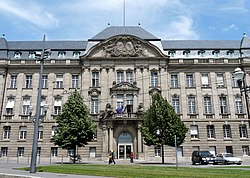
[edit]The seat of the General Council is located in Strasbourg, in a building designed by the architect Claude Vasconi. The current prefect of the Bas-Rhin is Stéphane Fratacci. The representative of the Lower Rhine for the National Youth Council is Mr. Gautier Lutz.
Bas-Rhin is composed of five arrondissements (Haguenau-Wissembourg, Molsheim, Saverne, Sélestat-Erstein, and Strasbourg)[19] and 23 cantons.[20]
Higher education
[edit]Through its secondary and higher education institutions, Alsace is a very important region for students and is very internationally oriented. Strasbourg alone welcomes 75% of students in its university. Since the merger of three faculties and the IUT of Illkirch and of Schiltigheim it has become one of the largest universities in France. There are also renowned institutions such as the National School of Administration (ENA), the National Institute of Territorial Studies (INET), the Higher European Institute of Management, and the National School of Physics of Strasbourg.
Tourism
[edit]
The Château du Haut-Kœnigsbourg: built in the 12th century, the castle of Haut-Koenigsbourg dominates the plain of Alsace more than 700 metres (2,297 feet) above sea level. Destroyed during the Thirty Years' War, it was restored from 1900 to 1908 by the German Emperor Wilhelm II. It houses a large collection of weapons and period furniture.
The Château du Fleckenstein: early 12th century, built by the imperial family of Hohenstaufen, the castle was occupied and turned into an impregnable fortress by the Fleckenstein family. Many activities are offered such as the "Castle of challenges". There is a large selection of 20 games crossing the forest and in the secret rooms of the castle to discover life in the Middle Ages.
The Château de Lichtenberg: built in the early 13th century on a hill overlooking the village, the site includes contemporary space-related cultural activities.
With more than 27 million tourists per year, Bas-Rhin is the 5th largest French department for the number of room-nights for visitors per year.
Other sites of interest are:
- Château de La Petite-Pierre
- Château du Haut-Barr
- Château de Diedendorf
- Château d'Andlau
- Château de Kintzheim
Religious monuments
[edit]
Strasbourg Cathedral: Strasbourg Cathedral is a masterpiece of Gothic art. Measuring 142 metres high from the Parvise to the top of the tower, it is considered the second largest cathedral in France after that of Rouen. Its astronomical clock dates from the Renaissance and the mechanism dated 1492 is a masterpiece in itself.
The Mont Sainte-Odile: a living spiritual place. Rising to 764 metres, this mountain in Vosges is topped by a monastery founded by Saint-Odile, the patron saint of Alsace. It is a tourist attraction and also a place of pilgrimage.
Museums
[edit]- Museums in Strasbourg
The Alsatian Museum: A museum of art and popular traditions. There is a large collection of utilitarian objects, decorative objects, as well as costumes that depict everyday life in Alsace in the 18th and 19th centuries.
The Strasbourg Museum of Modern and Contemporary Art: Located in the heart of the city of Strasbourg, the Museum of Modern and Contemporary houses nearly 18,000 works divided into three departments: fine arts, graphic art, and photography. Some of the greatest innovators of the 20th century are on display.
The Tomi Ungerer Museum: there is a large collection of drawings, archives, magazines, and toys donated to his hometown by the French illustrator Tomi Ungerer. It also hosts temporary exhibitions.
The Palais Rohan: The Rohan Palace was built between 1731 and 1742 at the request of Armand de Rohan-Soubise, Cardinal and Bishop of Strasbourg, who made his residence in the historic heart of the city. It also hosts the Arts and Crafts Museum, Archaeological Museum, and the Museum of Fine Arts.
Second homes
[edit]As of 2020, 3.3% of available housing in the department were second homes.[21]
| Town | Municipal population | Percentage of second homes |
|---|---|---|
| Wangenbourg-Engenthal | 1,332 | 23.6% |
| Grendelbruch | 1,218 | 17.2% |
| Bœrsch | 2,442 | 14.2% |
| Lembach | 1,548 | 12.8% |
| Entzheim | 2,453 | 12.2% |
Transport
[edit]Airport
[edit]Bas-Rhin is served by Strasbourg Airport, providing direct routes to major domestic destinations as well as international destinations in Europe and northern Africa. The airport is linked to the Gare de Strasbourg by a frequent train service.[23][24] However, other airports such as EuroAirport Basel Mulhouse Freiburg, Karlsruhe/Baden-Baden Airport and Stuttgart Airport are also used by air travellers from the department.
Popular traditions
[edit]The stork
[edit]The stork is the emblematic bird of Alsace. According to legend, it brings newborn babies wrapped in a cloth tightly in its beak. Having disappeared from the local habitat, it has now returned, being protected, and has become an integral part of the landscape. They can be seen mostly on the roofs of public buildings and more on houses.[25]
Traditional costume
[edit]The traditional Alsatian costume is a symbol of the region. Although it is usually composed of a black hat and a red skirt, the symbol of Alsace, there are many other outfits that vary between villages but also according to the social status of the person. Today virtually disappeared, they can still be seen in some villages at various events and through folk groups.
Festivals
[edit]Many traditions[26] have their origins in a quest for the meaning of life or in the rites of protection e.g. Christian festivals, even today create the rhythm of life in the villages of the region. The four seasons each have their share of celebrations: crop harvest, grape harvest, employers' feast days, crafts, yard sales, local produce.
-
 Covered Bridge at Strasbourg
 -

-
 Church at Niederhaslach
 -
 Clock Tower at Sélestat


See also
[edit]References
[edit]- ^ Décret du 15 janvier 2020 portant nomination de la préfète de la région Grand Est, préfète de la zone de défense et de sécurité Est, préfète du Bas-Rhin (hors classe), Légifrance
- ^ "Populations de référence 2022" (in French). National Institute of Statistics and Economic Studies. 19 December 2024.
- ^ traditional German: Niederrhein; Alsatian: Unterelsàss, ‘s Unterlànd or ‘s Ingerlànd; Office pour la Langue et la Culture d’Alsace. "Wàs brücht m'r im Elsàss? Petit lexique français-alsacien" (PDF). oclalsace.org (in French). Archived (PDF) from the original on 2022-10-09. Retrieved 10 December 2013..
- ^ a b "Populations légales en vigueur à compter du 1er janvier 2024: 67 Bas-Rhin" (PDF). INSEE. Retrieved 16 January 2024.
- ^ "Le nom des habitants des communes de France - Habitants". www.habitants.fr.
- ^ Paris, Nice, Strasbourg, Brest
- ^ Decree of 14 March 1793, which reunited 32 communes on the edge of the Rhine with France: "The National Convention, after hearing the report of the diplomatic committee, declares in the name of the people of France that it accepts the vote freely made by the sovereign people of the following towns and communes: Berglabren, Glengenmenster, Billirchein, Oberhofen , Barbelrod, Winten, Dierbach, Pleisweiler , Klingen, Oberhausen, Kleishorbach, Fiderhorbach, Kleiszellen, Kaplen, Herchiersveiler, Horbach, Erlebach, Mertzheim, Steinweiler , Volsfisbeim, Appenhoffen, Heichelheim, Mulheffen, Volmersheim, Nidershorst, Oberhorst, Effingen, Aldorff, Germersheim , Freisbach , Ilvesheim, their enclaves and dependencies; in their primary assemblies, for their reunification with France, and, accordingly, the said towns and communes are an integral part of the French Republic. - Commissioners of the National Convention in the departments of Meurthe, Moselle, and Bas-Rhin are responsible for taking all necessary measures for the execution of the laws of the Republic in those towns and communes as well as sending delegates to the National Convention to enable the setting up of a permanently organization. - These towns and communes form the fifth district of Bas-Rhin. The capital [of the district] will be Landau."
- ^ Decree of 30 Pluviôse III (18 February 1795), which reunites several communes in the District of Schelestadt with the district of Senones
- ^ Decree of 30 Pluviôse III (18 February 1795): "The communes of Russ, Wisches, Schirmeck, Rothau, Neuviller, Natzwiller, Wildersbach, Waldersbach, and Barembach, part of the district of Sélestat in the department of Bas-Rhin are to be reunited with the District of Senones in the Vosges department."
- ^ The Peace Treaty, signed in Paris on 30 May 1814, Article 3: "5° The Fortress of Landau, having been built before the year 1792, is an isolated point in Germany, France is to retain beyond its borders part of the Departments of Mont-Tonnerre and Bas-Rhin to link the fortress of Landau and its radius to the rest of the Kingdom. The new boundaries are, starting from a point near Obersteinbach (which remains outside the limits of France), the boundary between the department of Moselle and Mont-Tonnerre until the department of Bas-Rhin then following the line that separates the Cantons of Weissenbourg and Bergzabern (on the French side), the cantons of Pirmasens, Dahn, and Annweiler (on the German side), to the point where this line, near the village of Wolmersheim, touches the edge of the radius of the fortress of Landau. From this area, which remains as it was in 1792, the new frontier will follow the arm of the Queich river which, on leaving the radius near Queichheim (which remains in France), passes near the villages of Mertenheim, Knittelsheim, and Belheim (also remaining French) to the Rhine, which then continues to form the boundary of France and Germany."
- ^ The Treaty of Peace signed in Paris on 30 May 1814, Article 3: "5° [...] On the Rhine, the Thalweg will be the border so that any changes that may occur later in the course of the River will have no effect on the ownership of the islands therein. The state of possession of these islands will be established as it existed at the time of the signing of the Treaty of Luneville."
- ^ The Peace Treaty signed at Paris on 20 November 1815 Article I: "The borders of France will be as they were in 1790 except for changes and other matters which are summarized in this present article.
- 1. [...] Of the border of the country of Saarbrücken: the line of demarcation will be the same that now separates Germany from the departments of Moselle and Bas-Rhin to the Lauter [river], which will then serve as the border until its intersection with the Rhine. All the territory on the left bank of the Lauter, including Landau, will be part of Germany, but the city of Wissenbourg, traversed by the river, will remain wholly in France, with a radius on the left bank not exceeding one thousand Toises [two thousand metres], and will be specifically determined by the commissioners who are responsible for the final boundary.
- 2. From the mouth of the Lauter, along the departments of Bas-Rhin, Haut-Rhin, Doubs and Jura to the canton of Vaud [Switzerland], the boundaries remain as they were set by the Treaty of Paris. The Thalweg of the Rhine forms the boundary between France and the German states but the ownership of the islands, as will be fixed after a new survey of the course of the river, will remain unchanged with some changes to be submitted in the course of time. Commissioners will be appointed from both sides by the High Contracting Parties within a period of three months to proceed with such survey. Half the bridges between Strasbourg and Kehl belong to France, and the other half to the Grand Duchy of Baden [...]."
- ^ Historique du Bas-Rhin, SPLAF
- ^ Population en historique depuis 1968, INSEE
- ^ People who live in France and work in Germany
- ^ a b "Présidentielles".
- ^ "Résultats de l'élection présidentielle de 1995 par département - Politiquemania".
- ^ Nationale, Assemblée. "Assemblée nationale ~ Les députés, le vote de la loi, le Parlement français". Assemblée nationale.
- ^ Décret n° 2014-1722 du 29 décembre 2014 portant suppression des arrondissements de Strasbourg-Campagne et de Wissembourg (département du Bas-Rhin)
- ^ Décret n° 2014-185 du 18 février 2014 portant délimitation des cantons dans le département du Bas-Rhin
- ^ Catégories et types de logements, INSEE (in French)
- ^ "Statistiques locales: Part des résidences secondaires, population municipale". INSEE.
- ^ "Destination map". Aéroport Strasbourg. Archived from the original on 18 September 2015. Retrieved 6 October 2025.
- ^ "Shuttle train". Aéroport Strasbourg. Archived from the original on 18 September 2015. Retrieved 6 October 2025.
- ^ Official site for the protection and reintroduction of storks in Alsace-Lorraine (in French)
- ^ See Departmental Association for tourism Archived July 28, 2013, at the Wayback Machine (in French)
External links
[edit]
- Prefecture website (in French)
(in English)
- Collectivité européenne d'Alsace (in French)
- Departmental Archives of Bas-Rhin Archived 2013-01-26 at the Wayback Machine (in French)
- Tourism Development agency for Bas-Rhin (in French)
- Official website for Tourism in Alsace (in French)

.svg)


| International | |
|---|---|
| National | |
| Geographic | |
| Other | |

Bas-Rhin
View on GrokipediaGeography
Location and borders
Bas-Rhin is a department located in northeastern France, forming the northern part of the historical Alsace region within the Grand Est administrative region. It lies along the Rhine River, which serves as its eastern boundary and marks the frontier with Germany. The department's coordinates span approximately from 48°30′N to 49°10′N latitude and 7°00′E to 8°00′E longitude, positioning it in close proximity to major European transport corridors.[3] To the east, Bas-Rhin borders the German states of Rhineland-Palatinate to the north and Baden-Württemberg to the south, with the Rhine River acting as the natural divide since the department's delineation in 1790. Internally, it adjoins the Moselle department to the northwest, Meurthe-et-Moselle to the west, Vosges to the southwest, and Haut-Rhin to the south. These borders reflect the department's integration into France's post-Revolutionary administrative structure, separating it from Lorraine regions to the west and southern Alsace to the south.[6][7] The Rhine frontier has historically facilitated cross-border exchanges while serving as a strategic demarcation, influencing the department's economic and cultural ties with neighboring German territories. Strasbourg, the departmental prefecture, sits directly on this border, underscoring Bas-Rhin's role as a gateway between France and Germany.[8]Topography and hydrology
The topography of Bas-Rhin encompasses a transition from the rugged foothills of the northern Vosges Mountains in the west to the flat alluvial plains of the Alsace region in the east, shaped by the Rhine Graben tectonic structure. The western sector features elevated terrain with crystalline massifs and schistous plateaus, reaching the department's highest point at Champ du Feu (1,098 meters) in the Ban de la Roche area. Central zones exhibit undulating hills and low plateaus formed by Quaternary glacial and fluvial deposits, while the eastern Rhine Valley consists of low-lying, fertile floodplains with minimal relief, averaging around 140 meters near Strasbourg. The department's mean elevation stands at 315 meters, reflecting this east-west gradient across its 4,755 square kilometers.[9][10][11] Hydrologically, the Rhine River dominates as the principal waterway, forming the eastern border with Germany over approximately 100 kilometers and serving as a major navigable corridor for freight transport since canalization efforts in the 19th and 20th centuries. Key tributaries include the Ill River (51 kilometers within the department), which drains the central plains and joins the Rhine downstream of Strasbourg, and the Bruche River (103 kilometers total, originating in the Vosges), which cuts through forested gorges before entering the alluvial zone. Additional significant streams such as the Moder, Lauter, and Giessen contribute to a dense network exceeding 3,000 kilometers of watercourses, many exhibiting torrent-like profiles in upland areas conducive to erosion and sediment transport. These systems support agriculture via irrigation but pose flood risks in the Rhine floodplain, mitigated by dikes and reservoirs established post-19th-century inundations.[12][13][14]Climate and environmental features
The climate of Bas-Rhin exhibits semi-continental characteristics, moderated by its position in the Rhine valley and sheltering from westerly winds by the Vosges Mountains to the south and west, leading to colder winters and warmer summers compared to coastal France. Annual mean temperatures average 11.1 °C in Strasbourg, the departmental prefecture, with January lows typically around 0 °C or below and July highs reaching 25 °C. Precipitation totals approximately 964 mm yearly, distributed relatively evenly but peaking in early summer; May records the highest at about 79 mm, while February sees the lowest at 35 mm. Snowfall occurs regularly in winter, averaging 20-30 cm annually in lower elevations, though less than in adjacent mountainous areas.[15][16] Environmental features include extensive alluvial floodplains and forests along the Rhine River, which forms the department's eastern border with Germany and supports diverse wetland habitats critical for flood control and biodiversity. These riparian zones, spanning thousands of hectares, host species-rich ecosystems with varying moisture levels, including hardwood galleries of oak, ash, and elm, though historically impacted by river engineering for navigation. Restoration initiatives, such as the EU-funded "Living Rhine" project, have targeted 16,000 hectares of French-side habitats since 2000, focusing on renaturalization to enhance ecological connectivity and mitigate erosion. In southern Bas-Rhin, forested plateaus transition to the Vosges foothills, contributing to the Grand Est region's high afforestation rate of over 30%, with mixed deciduous and coniferous stands providing habitat for wildlife like deer and birds of prey. Protected areas include regional nature reserves in the Ill River valley and Grand Ried floodplain, preserving rare flora adapted to periodic inundation.[17][18][19]Major settlements
Strasbourg is the prefecture and largest settlement in Bas-Rhin, with a population of 291,709 inhabitants in 2022, functioning as the department's primary administrative, economic, and cultural hub.[20] Located on the Rhine River, it hosts the European Parliament and serves as a major center for international institutions, contributing significantly to the department's urban density and connectivity.[1] Other notable settlements include Haguenau, with 36,070 residents in 2022, known for its historical role as a regional center and proximity to forested areas.[21] Schiltigheim, adjacent to Strasbourg, has 34,382 inhabitants and features a dense urban fabric with industrial heritage.[22] Illkirch-Graffenstaden, a southern suburb of Strasbourg, recorded 27,339 people in 2022 and supports suburban residential and commercial development.[23] Further south, Sélestat maintains 19,523 inhabitants in 2022, valued for its medieval architecture and position along the Ill River, fostering tourism and local commerce.[24] Smaller yet significant towns like Molsheim, with approximately 9,300 residents, host automotive manufacturing sites, including Bugatti facilities, bolstering industrial employment in the department.[25] These settlements collectively account for a substantial portion of Bas-Rhin's 1,156,963 total population in 2022, reflecting urban concentration in the northern and central areas.[1]| Settlement | Population (2022) | Key Features |
|---|---|---|
| Strasbourg | 291,709 | Prefecture, EU institutions hub |
| Haguenau | 36,070 | Historical town, subprefecture |
| Schiltigheim | 34,382 | Industrial suburb of Strasbourg |
| Illkirch-Graffenstaden | 27,339 | Residential and commercial suburb |
| Sélestat | 19,523 | Medieval heritage site |
Name and symbols
Etymology
The name Bas-Rhin literally translates to "Lower Rhine" in French, denoting the department's position along the downstream, northern stretch of the Rhine River, which demarcates its eastern boundary with Germany. This nomenclature distinguishes it from the neighboring Haut-Rhin ("Upper Rhine") department to the south, reflecting their relative locations along the river's northward flow from the Swiss Alps.[26][27] The department was formally established on 4 March 1790 as one of France's original 83 departments during the reorganization under the French Revolution's National Constituent Assembly, which subdivided the historic province of Alsace to align administrative boundaries with natural geographic features like the Rhine's course. The "bas" prefix emphasizes not only the downstream positioning but also the relatively lower elevation of the Bas-Rhin's terrain, comprising the Rhine plain and foothills, in contrast to the higher Vosges Mountains dominating the Haut-Rhin. Notably, Bas-Rhin remains the sole French department retaining "bas" in its official name, a term once viewed as less prestigious amid 19th- and 20th-century proposals to rename it (e.g., to Alsace Supérieure or Nordgau).[28] The component "Rhin" derives from the Latin Rhenus, the Roman designation for the river, which itself stems from the Gaulish Renos or Rēnos, signifying "that which flows" or "raging flow." This traces to the Proto-Indo-European root *h₁reǵ- or rei-, connoting straight or rapid flowing water, a linguistic heritage shared with other ancient hydronyms across Indo-European languages.[26][29]Heraldry and emblems
The coat of arms of Bas-Rhin is blazoned de gueules à la bande d'argent côtoyée de deux cotices fleuronnées du même, depicting a red shield bearing a silver diagonal band flanked by two parallel narrow silver bands terminating in fleurs-de-lis. This design derives from the arms of the medieval Landgraviate of Lower Alsace, whose territory aligns closely with the modern department. The motif first appears in historical records in 1262 on the seal of the Counts of Werd, feudal lords controlling key areas in northern Alsace.[30][31] The departmental arms were adopted in the post-World War II period to symbolize regional heritage, with the blazon confirmed in heraldic references as early as the late 1940s. They emphasize continuity with pre-Revolutionary provincial symbols, avoiding post-1789 revolutionary iconography. Usage includes official departmental documents and buildings, underscoring Bas-Rhin's distinct Alsatian identity separate from broader French administrative emblems.[32] Bas-Rhin lacks a formally decreed departmental flag, but the historical banner of Basse-Alsace serves as its primary emblem in unofficial and cultural contexts. This flag features a red field with a white diagonal band mirroring the principal charge of the coat of arms, originating from 13th-century provincial heraldry tied to the Counts of Werd's red-and-white livery. It predates the unified Alsace flag, which combines elements from both Lower and Upper Alsace, and remains in use for regional events and representations of the department.[33]History
Prehistoric and ancient periods
Evidence of human presence in the Bas-Rhin region dates back to the Middle Paleolithic period, with Neanderthal occupation documented at sites such as Achenheim, where animal butchering activities occurred between 75,000 and 35,000 years ago.[34] Similarly, the Mutzig-Rain site has yielded Middle Paleolithic artifacts from excavations starting in 2009, confirming repeated occupations by early hominins in loess deposits.[35] During the Neolithic era, around 6000 years ago, agricultural settlements emerged across Bas-Rhin, as evidenced by extensive excavations at Obernai spanning over 7.5 hectares of continuous occupation, including Linear Pottery Culture influences from approximately 5300 BCE.[36] At Achenheim, a violent incident circa 4000 BCE resulted in the massacre of at least 17 individuals, with skeletal remains showing trauma from clubs and adzes, suggesting interpersonal conflict in a farming community.[37] Recent digs at Pfulgriesheim uncovered over 60 elongated structures of undetermined function and Neolithic silos for grain storage, alongside low-status settlements indicating organized agrarian life.[38] Middle Neolithic tool assemblages, including macrolithic implements for processing plants and cereals, were found at Dambach-la-Ville, highlighting technological adaptations for food production.[39] The Bronze and Iron Ages saw the arrival of Celtic groups, with Iron Age La Tène culture sites like Pfulgriesheim featuring small settlements and burial wealth disparities reflective of emerging social hierarchies around 500–100 BCE.[40] These Hallstatt and La Tène phases involved fortified oppida precursors and metallurgical shifts from bronze to iron, as genetic studies of regional remains indicate population continuity with external Gaulish influxes.[41] In the ancient period, Roman expansion established Argentoratum as a military garrison in 12 BCE under General Drusus along the Rhine frontier in Upper Germany, serving as a key outpost in present-day Strasbourg within Bas-Rhin.[42] The site evolved into a fortified castrum with civilian vicus development, supporting legions against Germanic tribes until the 5th century CE.[43]Medieval and early modern eras
Following the decline of Roman authority in the 5th century, the region of Lower Alsace, corresponding to modern Bas-Rhin, experienced settlement by Alemannic tribes around 406 AD, who established semi-independent confederations amid the power vacuum left by withdrawing Roman legions.[44] These Germanic groups were subdued by the Frankish king Clovis I in 496 AD, integrating the area into the Merovingian kingdom as part of Austrasia.[45] Under Carolingian rule after 751 AD, Alsace formed a distinct duchy, but the Treaty of Verdun in 843 AD placed it in the Middle Frankish Kingdom (Lotharingia), which fragmented further with the 870 Treaty of Meerssen assigning it to East Francia.[46] By 962 AD, with Otto I's coronation, Lower Alsace entered the Holy Roman Empire, where it remained until the 17th century, organized into counties such as Nordgau encompassing the northern territories around Strasbourg.[46] The duchy dissolved in the 11th century, yielding to feudal fragmentation under local counts and bishops, with episcopal Strasbourg emerging as a key power center; its bishop held temporal authority over extensive lands until burgher revolts in the 13th century shifted control.[47] Strasbourg gained status as a free imperial city in 1262 after citizens ousted the bishop's forces, fostering urban autonomy and economic growth through Rhine trade, evidenced by the construction of the Strasbourg Cathedral starting in 1015 and its iconic spire completed in 1439.[47] Other towns like Haguenau and Sélestat developed similar privileges, with guilds and markets driving prosperity amid imperial protection against feudal overlords.[48] The Black Death in 1348-1349 triggered pogroms, including the Strasbourg massacre of February 14, 1349, where approximately 2,000 Jews were burned alive amid scapegoating for the plague.[47] The Reformation reached Alsace in the 1520s, with Strasbourg adopting Protestantism under reformers like Martin Bucer, influencing much of Lower Alsace's urban centers while rural Catholic strongholds persisted, leading to confessional tensions.[49] The Thirty Years' War (1618-1648) brought devastation, with armies ravaging the region; population in some areas dropped by up to 50% due to famine, disease, and combat.[43] The Peace of Westphalia in 1648 transferred sovereignty of about 40 villages in Lower Alsace to France under Louis XIV, alongside most of Upper Alsace, though Strasbourg and other imperial cities retained autonomy within the Holy Roman Empire.[50] Louis XIV's forces occupied Strasbourg in 1681, confirmed by the 1697 Treaty of Ryswick, gradually integrating the department's territories into the French monarchy while preserving local German-speaking customs, legal privileges, and Protestant rights under the 1697 Edict.[51] The House of Rohan provided several prince-bishops of Strasbourg in the 18th century, leaving architectural legacies including the Palais Rohan in Strasbourg commissioned by Cardinal Armand-Gaston de Rohan (1732–1742), the Château des Rohan in Mutzig as an episcopal residence, and the Rohan Castle in Saverne.[52] This period saw administrative centralization, with intendants imposing royal control, yet Alsace's economy rebounded through viticulture and textile production by the mid-18th century.[53]French Revolution to 1871
The department of Bas-Rhin was established on March 4, 1790, as part of the revolutionary reorganization of France into 83 departments, drawing primarily from the northern half of the historic province of Alsace (Basse-Alsace).[54] Strasbourg served as its prefecture and a key revolutionary center, where the Army of the Rhine was organized in 1792 to defend against Austrian and Prussian forces, and where Claude Joseph Rouget de Lisle composed "La Marseillaise" on April 25, 1792, for the garrison. The period saw fervent Jacobin activity, including dechristianization campaigns and executions during the Terror, with Bishop Henri Grégoire influencing local ecclesiastical reforms, though resistance persisted among Catholic and Protestant populations. Economic disruptions from wartime requisitions strained agriculture and early textile industries, yet the abolition of feudal dues and church tithes redistributed land via biens nationaux sales, benefiting smallholders but exacerbating divisions.[55] Under the Directory and Consulate, Bas-Rhin contributed heavily to French military efforts, with conscription quotas drawing from its rural populace; by the Napoleonic era (1800–1815), the department supplied thousands of recruits, including 70 generals from Alsace overall, amid campaigns that depleted local manpower and fueled desertions due to linguistic and cultural affinities with German-speaking foes.[56] The Continental System disrupted Rhine trade, but tobacco processing and cotton spinning grew modestly in Strasbourg and surrounding areas. Post-Waterloo (1815), Allied occupation until 1818 imposed indemnities, yet the Bourbon Restoration restored relative stability, with the department's electorate showing loyalty to the July Monarchy by the 1830s, prioritizing economic recovery over radicalism.[57] Emigration surged from 1815 onward, driven by overpopulation, agrarian crises, and industrial competition; in 1817 alone, Bas-Rhin recorded about 1,000 passport requests for roughly 4,800 individuals, mainly to the United States, targeting rural districts like Wissembourg.[58] The 1848 Revolution elicited minimal unrest, with local alignments favoring conservative religious influences over republican fervor.[57] Under the Second Republic and Second Empire (1848–1870), Bonapartist support strengthened in elections, as in 1850 when personal loyalty to Louis-Napoléon Bonaparte secured rural votes; textile and metallurgical sectors expanded, though agricultural stagnation persisted.[59] The Franco-Prussian War erupted in July 1870, with Bas-Rhin's territory hosting early clashes; the Battle of Frœschwiller-Wœrth on August 6 near Wœrth saw Marshal Patrice de MacMahon's 43,000 French troops overwhelmed by 82,000 Prussians, resulting in 12,000 French casualties and shattering northern defenses.[60] Strasbourg endured a grueling siege from August 12 to September 28, bombarded by over 200,000 shells that destroyed swathes of the city, culminating in General Ulrich de Neubronn's surrender of the garrison and civilian authorities, with terms preserving French sovereignty pending peace.[61] The Treaty of Frankfurt on May 10, 1871, ceded Bas-Rhin entirely to the German Empire as part of Reichsland Elsass-Lothringen, excluding only the Belfort enclave from neighboring Haut-Rhin, prompting mass francophile emigration and resentment over the 5 billion franc indemnity.[62]German annexation and World War I
The department of Bas-Rhin, encompassing much of Lower Alsace including Strasbourg, was annexed to the German Empire following France's defeat in the Franco-Prussian War, formalized by the Treaty of Frankfurt on May 10, 1871, which ceded nearly all of Alsace except Belfort to Germany.[63] This annexation incorporated Bas-Rhin into the Reichsland of Alsace-Lorraine, an imperial territory directly administered from Berlin under a governor-general, with initial military governance transitioning to civilian control amid efforts to integrate the region economically and culturally into the empire.[64] German policies promoted linguistic assimilation, mandatory German-language education, and settlement of German officials and colonists, though these faced resistance from the predominantly Alsatian-speaking population, leading to protests, petitions for autonomy, and significant emigration—estimated at over 100,000 residents from Alsace-Lorraine in the 1870s alone.[63] Under German rule, Bas-Rhin experienced infrastructural development, including railway expansions and industrialization around Strasbourg, which grew as a fortified imperial city renamed Straßburg, but political autonomy remained limited until a 1911 constitution granted partial self-governance via a diet, reflecting ongoing tensions over local identity.[64] The annexation fueled French revanchism, viewing the loss as a national humiliation, while in the region, dual loyalties persisted: many Alsatians served in German institutions, yet cultural francophone ties and resentment toward centralization bred separatist sentiments and expatriate communities abroad.[63] During World War I, Bas-Rhin as part of Alsace-Lorraine served as a frontier zone, witnessing early French offensives in August 1914 that briefly recaptured Mulhouse before German counterattacks stabilized the lines along the Vosges Mountains, with the region largely spared major fighting thereafter due to its strategic defensibility.[63] German authorities conscripted approximately 250,000 Alsatians, including from Bas-Rhin, into the imperial army, often deploying them to the Eastern Front against Russia to mitigate perceived disloyalty risks near the Western theater; this policy exacerbated grievances, sparking mutinies and desertions amid food shortages and repressive measures like censorship and internment of suspected francophiles.[63] The armistice of November 11, 1918, precipitated the collapse of German control, with revolutionary councils forming in Strasbourg on November 10, 1918, declaring Alsace-Lorraine's separation from the Reich and appealing for French protection amid socialist unrest.[63] French troops entered Bas-Rhin unopposed by late November, restoring administrative continuity by reestablishing the department alongside Haut-Rhin and Moselle, though formal cession awaited the Treaty of Versailles in 1919; this reintegration marked the end of 48 years of German rule, greeted with mixed local relief and apprehension over impending francization.[65]Interwar autonomy debates and World War II
Following the reintegration of Alsace into France after World War I, autonomist movements emerged in Bas-Rhin driven by resentment toward Paris's centralizing policies, which disregarded local linguistic and cultural practices rooted in Alemannic dialects and Protestant-Catholic divides. The Elsässische Heimat- und Autonomiebewegung (Alsatian Homeland and Autonomy Movement), active from the early 1920s, demanded devolved powers including a regional diet, bilingual administration, and exemption from French military service obligations, echoing the limited self-rule Alsace had under German imperial constitutions of 1911.[66] This grouping, led by figures like Robert Lichtenberger, secured electoral gains in the 1920s, with affiliates holding up to 20% of seats in the Strasbourg departmental council by 1927, but French officials suppressed it as a vector for irredentism, dissolving associations and prosecuting leaders under charges of undermining national unity.[67] By the late 1920s and 1930s, autonomism fragmented amid economic stagnation and the Great Depression, with radical fringes incorporating pan-German nationalist rhetoric or fascist elements that blurred into sympathy for the rising Nazi regime across the Rhine; for instance, some autonomist publications praised Weimar Germany's federalism while critiquing French "Jacobinism."[68] Mainstream autonomists, however, emphasized loyalty to France while seeking safeguards against cultural erasure, as evidenced by petitions to the League of Nations in 1920s for minority rights protections. The movement waned by 1939, overshadowed by broader European tensions, though its grievances highlighted persistent Franco-German cultural frictions in Bas-Rhin's border communities.[69] German forces occupied Bas-Rhin in late June 1940 after France's armistice, bypassing treaty formalities to annex the department de facto into the Third Reich as part of the enlarged Gau Baden-Elsaß (or Oberrhein), administered from Stuttgart by Gauleiter Robert Heinrich Wagner, who enforced rapid Germanization.[70] Policies included mandatory German-language education from July 1940, re-Germanization of surnames and toponyms (e.g., Strasbourg to Straßburg), expulsion of 40,000-50,000 French officials and Jews, and confiscation of French assets, aiming to erase French identity within a generation.[71] Resistance simmered through clandestine networks like the "Stella" group in Strasbourg, which smuggled intelligence to Free French forces, though reprisals were severe, including executions and deportations to concentration camps.[70] Conscription into the Wehrmacht, decreed obligatory on August 25, 1942, targeted Bas-Rhin's youth born 1920-1922, incorporating approximately 100,000 Alsatians overall (including 60,000-70,000 from Bas-Rhin) as "Malgré-nous" ("against our will"), with many assigned to Eastern Front units amid high desertion rates—up to 40% in some cohorts—and over 32,000 casualties or missing by 1945.[72] Families faced hostage-taking for deserters, and Waffen-SS recruitment intensified from 1944, drafting another 10,000-15,000 under duress. Allied advances, spearheaded by U.S. Seventh Army forces, liberated Strasbourg on November 23, 1944, after intense fighting around the Maginot Line's Schoenenbourg fortification, which had held defensively in 1940; full departmental clearance followed by March 1945, restoring French sovereignty amid purges of collaborators.[70] Post-liberation amnesties controversially shielded some autonomist-leaning figures, reflecting the blurred lines between pre-war regionalism and wartime opportunism.[73]Post-1945 recovery and regional reforms
The liberation of Bas-Rhin began with the capture of Strasbourg on November 23, 1944, by French forces under General Leclerc, marking the start of the Alsace campaign that concluded in March 1945 with the elimination of the Colmar Pocket.[74][75] Reintegration into France reinstated the Republic's authority while affirming local particularities, including the Concordat on worship, bilingual school options, and association rights, avoiding the assimilationist errors of the post-1918 period.[75] Efficient prefects, familiar with the region, oversaw initial reconstruction efforts, including infrastructure repair and economic revival amid wartime devastation.[75] Postwar recovery in Bas-Rhin benefited from France's national modernization under the Monnet Plan (1946–1952), which prioritized steel, energy, and transport sectors; Alsace's prewar industrial base in textiles and chemicals around Mulhouse and Strasbourg facilitated rapid rebound, with departmental GDP growth aligning with the national Trente Glorieuses boom of 4–5% annual increases through the 1960s.[76] Strasbourg's designation as host for the Council of Europe in 1949 and later the European Parliament in 1979 injected investment and jobs, enhancing services and fostering Franco-German reconciliation via cross-border initiatives.[77] Socially, "cleansing" measures interned over 6,000 suspected collaborators from November 1944 to July 1945, followed by amnesties in 1953–1955, while nursery schools promoted French language acquisition.[75] Regional reforms evolved through France's decentralization laws. Alsace, encompassing Bas-Rhin and Haut-Rhin, gained regional council status in 1974 and full administrative regionhood by 1982, becoming metropolitan France's smallest such entity with enhanced powers over planning and culture.[78] The 2014 territorial reform merged it into Grand Est effective January 1, 2016, dissolving Alsace's standalone governance amid centralization aims, though local opposition ran high—83% of residents favored restoring historical status per a 2018 Ifop poll.[79] In response, the European Collectivity of Alsace (CEA) was established in 2021, fusing departmental assemblies of Bas-Rhin and Haut-Rhin into a single entity with competencies in economic development, tourism, and EU affairs, restoring partial autonomy without full regional revival.[80] This structure preserves Bas-Rhin's departmental framework while addressing bilingual and cross-border needs.[75]Demographics
Population evolution
The population of Bas-Rhin has demonstrated steady growth since the late 1960s, with annual average increases ranging from 0.4% to 0.9% across census periods, driven primarily by net migration gains and a positive natural balance in recent decades.[1] This contrasts with stagnation in the broader Grand Est region, where Bas-Rhin remains the only department recording consistent population gains between 2016 and 2023.[81] As of 2023, the department's population stood at 1,163,810 inhabitants, reflecting a density of 244.7 inhabitants per square kilometer.[5] INSEE census data illustrate this trajectory:| Year | Population |
|---|---|
| 1968 | 827,367 |
| 1975 | 882,121 |
| 1982 | 915,676 |
| 1990 | 953,053 |
| 1999 | 1,026,120 |
| 2006 | 1,079,016 |
| 2011 | 1,099,269 |
| 2016 | 1,121,407 |
| 2023 | 1,163,810 |
Linguistic and cultural composition
The linguistic landscape of Bas-Rhin is dominated by French as the official and primary language of communication, reflecting France's centralized language policies since the 19th century, though regional dialects derived from Alemannic and Franconian German varieties—collectively known as Alsatian—persist among a minority, particularly in rural areas and among older generations. Surveys indicate that approximately 30% of the Alsace population, including Bas-Rhin residents, report some proficiency in Alsatian, but only about 5% use it as their primary language, with usage declining sharply among those under 50 due to limited transmission in homes and schools. Bilingual education programs incorporating Alsatian alongside French exist in some primary schools, but Standard German is more commonly taught as a foreign language rather than the dialect, contributing to the dialect's intergenerational erosion.[84][85] Culturally, Bas-Rhin exhibits a hybrid identity shaped by centuries of alternating French and German sovereignty, manifesting in architecture (half-timbered houses akin to those in southwestern Germany), cuisine (dishes like choucroute garnie and flammeküche blending sauerkraut fermentation techniques with French culinary refinement), and festivals (such as Strasbourg's Christmas markets, rooted in medieval German traditions but adapted to French civic life). This Franco-German synthesis fosters a distinct Alsatian regionalism, evident in local pride for symbols like the stork (a migratory bird emblematic of rural folklore) and wine production centered on varietals like Riesling and Gewürztraminer, which draw from German viticultural heritage while adhering to French appellation controls. Post-World War II assimilation efforts emphasized French national identity, yet surveys of self-perception among residents highlight enduring cross-border affinities, with many viewing Alsace as a cultural bridge rather than strictly French or German.[86][87][88]Religious demographics and migration trends
The religious landscape of Bas-Rhin reflects its historical position as a border region influenced by Catholic traditions and the Protestant Reformation, resulting in a predominantly Christian population with Catholicism as the largest affiliation. Due to France's policy of laïcité, no official census data on religion exists, but surveys and institutional estimates provide approximations: a 2010s regional poll indicated 71% identifying as Catholic, 8% as Protestant (primarily Lutheran), 7% as Muslim, 1% as Jewish, and 9% as unaffiliated or other. The Catholic Diocese of Strasbourg, covering Bas-Rhin and neighboring Haut-Rhin, estimates around 1.3 million Catholics across Alsace (population approximately 1.92 million), suggesting a nominal Catholic majority exceeding 60% in Bas-Rhin when adjusted for its share of the regional population (about 1.16 million). Secularization has advanced, akin to national trends where 51% of adults aged 18-59 reported no religion in 2019-2020 surveys, though Alsace-Moselle's concordat status—preserving religious education and taxation—sustains higher nominal adherence than in mainland France.[89][90][91] The Protestant minority, historically stronger in Bas-Rhin than in Haut-Rhin, has declined from 26% of the department's population in 1962 to an estimated 23,000 Lutherans today, affiliated with the Church of the Augsburg Confession. Judaism maintains a small but longstanding presence, with regional estimates of 30,000 adherents across Alsace, rooted in medieval communities. Islam represents the fastest-growing affiliation, driven by immigration; regional estimates place Muslims at 150,000-200,000 (about 10% of Alsace), with Bas-Rhin's share concentrated in urban areas like Strasbourg, primarily from Turkish (majority of local Muslims) and Maghrebi origins. These figures, while not official, align with local observatory data and ecclesiastical reports, though surveys may undercount due to non-response or cultural shifts.[92][93] Migration trends in Bas-Rhin have bolstered population growth amid low native fertility, with immigrants comprising 11.8% of residents as of 2020—higher than the national average—and foreign nationals at 98,070 (8.5%) in 2021 out of a total population of 1,152,662. The department records a positive net migration balance, gaining about 1,100 residents annually from internal French mobility (e.g., inflows from Haut-Rhin and urban Strasbourg suburbs) and international arrivals, contrasting with outflows in much of Grand Est. Principal immigrant origins include North Africa (Algeria and Morocco, historically labor migrants from the 1960s onward), Turkey (prominent among Muslims), Portugal, sub-Saharan Africa, and Germany (30% of immigrants in earlier decades, now a minority but sustained by cross-border ties). Naturalization rates have risen, with two-thirds of long-term immigrants acquiring French citizenship, diversifying origins toward Asia and Eastern Europe in recent years; projections indicate continued modest growth to 2030, supporting economic sectors like services and industry.[94][95][96]Economy
Sectoral breakdown
The economy of Bas-Rhin exhibits a strong predominance of the tertiary sector, which encompassed around 77% of total employment in 2022, reflecting the department's role as a hub for administrative, financial, and European institutional activities centered in Strasbourg.[1] Secondary sector activities, including manufacturing and construction, accounted for approximately 22% of jobs, bolstered by cross-border industrial clusters in chemicals, pharmaceuticals, and mechanical engineering near the German frontier.[1] The primary sector remained marginal at about 1.3%, limited by urbanization but sustained by specialized agriculture such as viticulture in the Alsace wine region.[1]| Sector | Employment Share (2022) | Approximate Jobs |
|---|---|---|
| Primary (Agriculture) | 1.3% | 6,555 |
| Secondary (Industry + Construction) | 21.7% | 107,686 |
| Tertiary (Services) | 77.0% | 381,031 |
Agriculture, wine and beer production, and industry
Agriculture in Bas-Rhin is constrained by urbanization and fragmented land use, employing 6,257 individuals as of December 2023, or roughly 2% of the departmental workforce. Principal activities include cereal cultivation, vegetable production, and livestock rearing, with pig farming prominent at 73,600 heads in 2023.[98] The sector benefits from fertile plains along the Rhine but faces challenges from soil variability and competition with industrial expansion. Wine production forms a vital subset of agriculture, concentrated in the northern Alsace vineyards stretching along the Vosges mountain foothills. Bas-Rhin specializes in dry Riesling and aromatic Gewürztraminer varietals, yielding lighter-bodied whites compared to southern counterparts due to less mountain sheltering.[99] These contribute to the broader Alsace AOC, emphasizing varietal labeling and late-harvest styles, though exact departmental hectarage remains subordinate to Haut-Rhin's dominance in the region's 16,000 hectares of vines.[100] Beer production remains important in Bas-Rhin, although it has declined from historical peaks. Kronenbourg in Obernai provides significant employment as France's largest brewery. Brasserie Météor in Hochfelden has continuously operated since 1640, adopting its current name in 1925.[101] Schiltigheim and Mutzig formerly hosted major breweries. Traditionally, most Alsatian beers originate from Bas-Rhin.[102] Industry drives economic output, sustaining 75,250 jobs in Bas-Rhin as of 2024, accounting for 19.7% of employment.[103] Key subsectors encompass pharmaceuticals (exports €4.01 billion), general machinery (€1.22 billion), and motor vehicles (€1.22 billion). Notable firms include Groupe Kuhn in Saverne (agricultural machinery), Fehr Group in Reichshoffen (concrete and precast elements), Haemmerlin in Monswiller (wheelbarrows, gardening tools, and construction equipment), CAF in Reichshoffen (rail vehicles), Alsapan in Dinsheim-sur-Bruche (furniture), Bugatti in Molsheim (automobiles), and Lohr Industrie in Hangenbieten (transportation systems and vehicle manufacturing).[104][105][106][107] These are bolstered by proximity to European markets and skilled labor.[108] The agri-food processing segment, integral to industrial activity, leverages local agriculture, including sugar production at the Sucrerie d'Erstein established in 1893 and operated by Cristal Union, which processes regional sugar beets.[109] The sector also exhibits strengths in mechanical equipment, plastics, and automotive components.[110] Bas-Rhin also hosted a historical petrol industry centered at Pechelbronn, Europe's first industrial oil field, with exploitation beginning in 1745 and continuing until 1970. Remnants of this industry are preserved at the Musée Français du Pétrole in Merkwiller-Pechelbronn, contributing to industrial heritage tourism.[111] Bas-Rhin hosts hydroelectric power plants along the Grand Canal d'Alsace and the Rhine, including the Vogelgrun station commissioned in 1959, contributing to regional energy production.[112]Services, innovation, and recent developments
The services sector dominates the economy of Bas-Rhin, employing over 240,000 individuals in market tertiary activities as of 2020, according to official statistics from the French National Institute of Statistics and Economic Studies (INSEE). This includes business services, retail, and administrative functions, with notable logistics firms such as Groupe Heppner, headquartered in Strasbourg and employing over 3,750 people.[113] Bolstered by Strasbourg's role as a hub for European institutions such as the European Parliament and the Council of Europe, which generate demand for professional, scientific, and technical services. Tourism contributes significantly, with Strasbourg Events reporting a 23% revenue increase in 2024, attracting 675,600 visitors primarily through business tourism events that support ancillary jobs in hospitality and logistics.[114] Innovation in Bas-Rhin centers on Strasbourg's burgeoning startup ecosystem, which features deeptech and AI-focused ventures amid regional efforts to position Grand Est as a European AI leader. Key facilities include the Strasbourg Innovation Park, established in 1983 to foster high-tech company growth through research collaboration and incubation services. Notable startups as of 2025 encompass Leanspace in satellite data management, DOMAIN Therapeutics in neuroscience drug discovery, and HypnoVR in virtual reality therapeutics, reflecting strengths in biotech, space tech, and digital health; the Eurométropole de Strasbourg supports these via tailored incubators and funding access. The regional network of excellence incubators, approved by Grand Est authorities, aids over 100 early-stage firms annually, emphasizing cross-border collaboration with neighboring Germany.[115][116][117] Recent developments highlight resilience and targeted investments, including the Eurométropole's September 2025 digital sovereignty initiative to enhance cybersecurity and remote work for 6,700 public agents using Alcatel-Lucent Enterprise infrastructure. Fitch Ratings affirmed the Eurométropole's AA- credit rating in June 2025, citing stable revenues from state transfers (29% of total) and growth prospects in services amid post-pandemic recovery. Circular economy strategies, initiated around 2010, aim to reduce emissions and create jobs through waste prevention and recycling, with OECD analysis projecting broader environmental and employment gains from such policies. A notable advancement in renewable energy is the Centrale géothermique de Rittershoffen, inaugurated on 7 June 2016 as the world's first deep geothermal power plant combining heat and electricity production with a thermal capacity of approximately 27 MW, supporting industrial applications and local sustainability goals.[118] Emerging projects include the Arverne Group's geothermal direct lithium extraction demonstrator in Bas-Rhin, with construction starting in 2025 and projected production by 2031.[119] These efforts align with Grand Est's innovation accelerator, which since 2023 has expanded support for startups via equity funding and mentorship, countering economic pressures like inflation through ecosystem-driven diversification.[120][121][122][123]Governance and administration
Departmental structure
The Bas-Rhin department is administratively organized into five arrondissements: Haguenau-Wissembourg (with subprefecture in Haguenau), Molsheim (subprefecture in Molsheim), Saverne (subprefecture in Saverne), Sélestat-Erstein (subprefecture in Sélestat), and Strasbourg (prefecture in Strasbourg). These divisions facilitate state administration and coordination of services such as education, security, and infrastructure.[124][125] Each arrondissement encompasses multiple cantons, with the department totaling 23 cantons following the nationwide territorial reform implemented via decree on 18 February 2014. These cantons serve primarily for electoral purposes in departmental council elections and as intermediate units for policy implementation.[126] At the base level, Bas-Rhin consists of 514 communes as of 2024, representing the smallest self-governing municipalities responsible for local services including urban planning, waste management, and civil registries. Communes vary widely in size, from densely populated urban centers like Strasbourg to rural villages, and many participate in voluntary intercommunal groupings (EPCI) such as communautés d'agglomération for shared competencies like economic development and public transport.[127][128]Prefecture and local divisions
The prefecture of Bas-Rhin, which concurrently functions as the prefecture for the Grand Est region, is located in Strasbourg at 5 Place de la République.[129] It serves as the central administrative authority representing the French state at the departmental level, overseeing public services, security, and coordination with local governance. Subprefectures are established in Haguenau, Molsheim, Saverne, and Sélestat to manage regional administrative tasks within their respective areas.[130] Bas-Rhin is subdivided into five arrondissements: Haguenau-Wissembourg, Molsheim, Saverne, Sélestat, and Strasbourg. These arrondissements group the department's territory for administrative purposes, with Strasbourg as the sole prefecture-led division and the others headed by subprefects. Further subdivision occurs into 23 cantons, which serve as electoral and administrative units, and 514 communes as of January 1, 2025, representing the basic municipal level of local government.[124][131] This structure, reformed in 2015 through the suppression and merger of prior arrondissements such as Strasbourg-Campagne and Wissembourg, aims to streamline administration while preserving local representation.[125]Politics
Electoral patterns
In national elections, Bas-Rhin voters have shown a preference for centrist and conservative options, with a notable urban-rural divide influencing outcomes. In the 2022 presidential election runoff, Emmanuel Macron secured 59.00% of the votes (319,370), outperforming Marine Le Pen's 41.00%, though Le Pen's first-round performance exceeded the national average, reflecting stronger support in rural areas.[132] [133] Similarly, in the 2024 European Parliament elections, the Rassemblement National list led by Jordan Bardella obtained 31.55% of the vote, slightly above the national result, driven by gains in peripheral and agricultural communes.[134] [135] Legislative elections highlight fragmentation along geographical lines, with Strasbourg and northern urban centers favoring left-leaning coalitions, while southern and rural districts lean toward conservative or nationalist candidates. In the 2024 snap legislative elections across nine circonscriptions, the New Popular Front captured four seats (circonscriptions 1, 2, 3, and possibly others in urban zones), Les Républicains held three (including 5, 7, and 8), Ensemble retained one (circonscription 4), and Rassemblement National won one (circonscription 6).[136] [137] This contrasts with 2022, where Ensemble and Les Républicains dominated, securing seven of nine seats amid higher centrist turnout.[138] Abstention rates, around 33% in 2024's first round, underscore varying mobilization, with rural areas exhibiting higher participation in contests favoring right-wing platforms.[139] Historically, Bas-Rhin has maintained a conservative electoral base, with right-wing parties controlling the departmental council from 1945 until the 2015 Alsace merger, reflecting Alsatian preferences for fiscal prudence and local autonomy over centralized left-wing policies.[140] The rise of Rassemblement National since the 1980s, accelerating post-2010 with shares exceeding one-third in some presidential first rounds, correlates with demographic shifts and economic pressures in non-urban areas, though centrist figures like those from MoDem have mediated divides.[140] This pattern persists despite Strasbourg's progressive tilt, yielding overall results more right-leaning than metropolitan France.[141]Dominant parties and ideologies
In departmental elections held in 2021 for the Collectivité Européenne d'Alsace (encompassing Bas-Rhin), a union of right-wing parties secured 34.78% of the vote and 16 seats on the council, while Les Républicains (LR) obtained 26.09% and 12 seats, establishing center-right dominance in local governance.[142] This outcome reflects a long-standing pattern, with right-wing coalitions controlling the Bas-Rhin departmental council consistently since 1945, including majorities in cantonal elections up to the 2015 reorganization. LR remains the leading force, emphasizing conservative values such as fiscal responsibility, local autonomy, and preservation of Alsatian cultural identity amid France's centralized system.[143] Ideologically, Bas-Rhin voters prioritize pragmatism rooted in regional traditions, with strong support for pro-business policies, border security given proximity to Germany, and resistance to over-centralization from Paris—traits aligning with moderate conservatism rather than radical nationalism. Regionalist sentiments persist, fueled by historical bilingualism and cross-border ties, but mainstream parties like LR incorporate these without endorsing separatism; smaller groups such as Unser Land advocate greater Alsatian self-rule, garnering under 2% in recent legislative races.[144] The Rassemblement National (RN) has gained traction, capturing over 30% in some northern rural cantons during the 2022 presidential first round, driven by concerns over immigration and economic stagnation, though it trails LR in institutional control.[140] Urban areas like Strasbourg exhibit more centrist or left-leaning pockets, influenced by EU institutions and cosmopolitan demographics, yet the department overall tilts rightward compared to national averages, as evidenced by LR's hold on multiple legislative seats in 2022 (e.g., 4th and 5th constituencies).[145] This balance underscores a causal link between Alsace's industrial heritage, Protestant work ethic, and skepticism toward Parisian progressive policies, sustaining ideological continuity despite national shifts.Regionalism, identity politics, and controversies
Regionalism in Bas-Rhin reflects a persistent desire for enhanced autonomy rooted in Alsace's history of alternating French and German control, fostering a distinct cultural identity centered on bilingualism and local governance. Autonomist groups, such as Unser Land established in 2009, advocate for prioritizing Alsatian interests, including legislative devolution and protection of regional dialects, within the broader French framework.[146] The 2014 territorial reforms incorporating Alsace into the expansive Grand Est region ignited widespread backlash, with movements decrying the erosion of local decision-making and identity. This culminated in the 2019 law promulgating the Collectivité européenne d'Alsace, effective January 1, 2021, which merged the Bas-Rhin and Haut-Rhin departmental councils to consolidate competencies in culture, education, and transborder relations while subordinated to Grand Est.[147] Notwithstanding this concession, surveys indicate 80% of Alsatians favor exiting Grand Est to restore a standalone region, underscoring unresolved tensions over centralization.[148] Identity politics emphasize safeguarding the Alsatian dialect—a Germanic variant—amid its declining usage, with bilingual signage and schooling policies contested as insufficient against French linguistic hegemony.[149] Proponents argue these measures preserve historical heritage, while critics view them as relics hindering national cohesion. Controversies arise from historical associations of autonomism with pro-German sympathies during interwar periods and World War II collaborations, casting modern regionalism under suspicion of disloyalty despite its focus on cultural and economic self-rule.[66] Groups like Alsace First blend regional advocacy with anti-immigration rhetoric, positing demographic shifts as threats to ethnic continuity, which attracts far-right labels and debates over whether such stances safeguard or politicize identity.[84] These frictions highlight causal links between borderland volatility, cultural dilution via migration and policy, and demands for devolved powers to mitigate assimilation.Culture
Alsatian dialect and language policy
The Alsatian dialect, a variety of Low Alemannic German, is traditionally spoken in Bas-Rhin, the northern department of Alsace, where it incorporates influences from both Alemannic and Franconian substrates.[150] Approximately 46% of the population in Bas-Rhin reported some familiarity with Alsatian dialects as of surveys around 2020, higher than the 38% in neighboring Haut-Rhin, though proficiency is concentrated among older generations.[151] Overall, Alsace-wide estimates indicate around 650,000 regular speakers of Alsatian, but only about 5% of the population uses it as a primary language, reflecting a sharp decline driven by intergenerational transmission failure.[152][84] France's language policy enforces French as the sole official language under Article 2 of the 1958 Constitution, with no co-official status granted to regional tongues like Alsatian despite its widespread historical use in Bas-Rhin prior to the 20th century.[150] This centralist approach, rooted in post-Revolutionary standardization and reinforced after Alsace's 1918 reintegration into France, prioritizes French immersion in public life, media, and administration, contributing causally to Alsatian's erosion as younger residents—particularly millennials in urban centers like Strasbourg—adopt French as their native tongue. Teaching of Alsatian occurs as an optional subject in primary and secondary schools under the 2001 "Languages of France" law, with bilingual programs offering up to 50% instruction in German (often approximating Standard German rather than dialect) in select Bas-Rhin establishments, yet enrollment remains low at under 20% of students due to limited certification value and curriculum constraints.[150] Preservation initiatives, led by associations such as the Office pour la Langue et la Culture d'Alsace (OLCA), promote dialect through media, festivals, and community courses in Bas-Rhin, but these lack state funding comparable to French-language programs and face resistance from national policies viewing regional languages as potential vectors of separatism.[152] Regionalist advocates argue for greater recognition, citing a 2020 survey showing 30% Alsace-wide usage, yet French authorities maintain that dialect vitality depends on private efforts rather than policy shifts, underscoring tensions between cultural pluralism and unitary state identity.[84][150]Traditions, folklore, and festivals
The white stork (Ciconia ciconia) holds a central place in Bas-Rhin's folklore as a symbol of fidelity, fertility, and good luck, with nests traditionally adorning rooftops and chimneys across the department, particularly in Strasbourg and surrounding villages. Rooted in Germanic mythology, storks are depicted as sacred messengers delivering newborn souls, a legend that evolved into the local belief that they bring babies to families, reinforced by tales of children leaving sugar cubes on windowsills to attract them. This cultural motif dates back centuries, with historical records noting stork associations in Alsace from 817, and modern conservation programs since the 1970s have increased nesting pairs to over 500 in the region by promoting artificial platforms amid habitat loss from agriculture.[153][154][155] Strasbourg's Christkindelsmärik, one of Europe's oldest Christmas markets, originated in 1570 as a gathering of vendors around the cathedral to sell Advent-related goods, evolving into a multi-site event with over 300 wooden chalets offering bredle cookies, vin chaud, and handmade ornaments. Held annually from late November to late December, it attracts approximately 2 million visitors, featuring illuminations, a towering Christmas tree, and processions honoring Saint Nicholas on December 6, who distributes treats to children in a tradition blending Catholic rites with pre-Christian winter solstice customs.[156][157] The Carnival of Strasbourg, celebrated in March, culminates in a grand cavalcade parade covering over 2 kilometers through the city center, with participants in elaborate costumes, floats satirizing current events, and brass bands performing schlitte music to ritually expel winter. Dating to medieval Shrove Tuesday observances, the 2025 edition on March 23 emphasized animal-themed tales, drawing tens of thousands and incorporating Alsatian dialect chants and fireworks.[158][159] Local wine festivals, such as Obernai's Fête du Vin held annually in August since the mid-20th century, feature parades in traditional attire, folk dances, and tastings of regional varietals like Riesling from the department's 4,000 hectares of vineyards, underscoring viticultural heritage tied to Roman-era plantings. Village events like the Streisselhochzeit in nearby hamlets revive 18th-century wedding customs with costumed reenactments and brass ensembles, preserving communal folklore amid seasonal harvests.[160][161]Cuisine and daily life
Alsatian cuisine in Bas-Rhin emphasizes hearty, fermented, and meat-centric dishes influenced by the department's historical position along the Rhine, blending French techniques with Germanic preservation methods like sauerkraut fermentation. Choucroute garnie, consisting of fermented cabbage slow-cooked with pork sausages, bacon, and potatoes, exemplifies this tradition and is a staple in local winstub taverns.[162] Baeckeoffe, a slow-baked stew of marinated lamb, beef, and pork layered with potatoes and onions, originated as a Sunday dish prepared by women before church, reflecting resource-efficient rural practices.[162] Tarte flambée (flammekueche), a thin-crust tart topped with crème fraîche, onions, and lardons, is commonly baked in wood-fired ovens and served as an appetizer or light meal.[162] Cheeses like Munster, a pungent cow's milk variety from nearby meadows, pair with rye bread and local beers, while desserts such as kougelhopf—a yeast cake with raisins, almonds, and rum—mark festive occasions.[162] The region's vineyards produce dry white wines like Riesling and Gewürztraminer, often used in dishes such as coq au Riesling, where chicken is braised in the namesake wine with mushrooms and cream.[163] Daily life in Bas-Rhin integrates agricultural rhythms with urban professional demands, particularly in Strasbourg, where over half the department's 1.1 million residents live amid a dynamic economy driven by manufacturing (e.g., automotive and pharmaceuticals), services, and tourism. Rural areas along the Alsace Wine Route sustain family-run vineyards and orchards, with harvests dictating seasonal work cycles from spring pruning to autumn vendanges.[164] Urban dwellers commute via efficient rail and tram networks, balancing office jobs in EU institutions or industry with evening family meals featuring local produce bought at weekly markets.[165] Winters bring cold snaps and snow, prompting indoor gatherings around pot-au-feu or spiced wines, while summers facilitate outdoor activities like cycling through vineyards or attending village fetes.[165] Cost of living remains moderate for France, with monthly expenses for a single person averaging €1,800 including rent, supported by above-average wages in tech and trade sectors.[166] Cultural bilingualism persists informally, with French dominant in public life but Alsatian dialect heard in homes and rural taverns, fostering a resilient community identity tied to cross-border ties with Germany.[165]Tourism and heritage
Historical and religious sites
Strasbourg Cathedral, known as Cathédrale Notre-Dame, exemplifies Gothic architecture with construction of its Romanesque predecessor beginning in 1015 and Gothic phases advancing from the 12th century, culminating in the 142-meter spire completed in 1439, which held the record as the world's tallest structure until 1874.[167][168] As a central religious site, it transitioned between Catholic and Protestant use during the Reformation but reverted to Catholicism after Strasbourg's 1681 annexation by France.[169] Adjacent historical fortifications include the Ponts Couverts, a series of covered bridges and towers built between 1230 and 1250 as part of Strasbourg's medieval ramparts to control river access and defend the city.[170][171] The nearby Saint Thomas Church, a Gothic structure finished in 1521, serves as Strasbourg's principal Lutheran church since 1681, housing the Silbermann organ installed in 1741 and reflecting the region's Protestant heritage established by 1523.[172][173] The Château du Haut-Kœnigsbourg, originating in the 12th century as a Hohenstaufen stronghold amid feudal conflicts, fell into ruin by the 19th century before German Emperor Wilhelm II commissioned its restoration from 1900 to 1908 to evoke 15th-century medieval defenses, following its 1899 donation by Sélestat amid Alsace's annexation.[174][175] Other notable castles include the Château du Haut-Barr, 12th-century ruins overlooking the Zorn Valley near Saverne for strategic control;[176] the Rohan Castle in Saverne, an 18th-century neoclassical palace built as a residence for the prince-bishops of Strasbourg and now housing museums;[177] the Château de Lichtenberg, 13th-century ruins built by the Lichtenberg family on a hill at 400 meters elevation near the village of Lichtenberg for strategic oversight;[178][179] the Château de Wangenbourg, 13th-century ruins in Wangenbourg-Engenthal amid forested terrain;[180] the Château de La Petite-Pierre, 13th-century stronghold modernized by Vauban in 1684 as a key defensive site;[181] the Château de Fleckenstein, 12th-century semi-troglodyte ruins elevated above Vosgian forests;[182] and the Château de Kintzheim, 13th-century ruins hosting La Volerie des Aigles;[183] and the Château de la Léonardsau near Obernai, constructed in the early 20th century by Baron Albert de Dietrich and recently restored.[184] Further exemplifying 20th-century military history, Ouvrage Schoenenbourg forms a key Maginot Line artillery fortification constructed between 1930 and 1935 near Hunspach, featuring 3 kilometers of underground galleries accommodating 630 personnel; it endured intense German bombardment in June 1940 without capitulating.[185][186] Among other religious landmarks, the Jesuit Church in Molsheim, constructed between 1615 and 1617 in Baroque style as a Counter-Reformation initiative, stands as one of Alsace's largest churches housing a Silbermann organ.[187] The Église Saints-Pierre-et-Paul in Wissembourg, stemming from a Benedictine abbey founded around 660, showcases Gothic architecture mainly from the 13th and 14th centuries.[188] The Église Saints-Pierre-et-Paul in Rosheim, a 12th-century Romanesque church, exemplifies regional style with intricate sculpted bestiary decorations.[189] The Église Saint-Pierre-et-Paul of Andlau, a Romanesque abbey church founded in the 9th century and consecrated in 1049 by Pope Leo IX, features an 11th-century crypt.[190] The Église Saint-Pierre-et-Paul of Neuwiller-lès-Saverne, a former abbey church, houses four late 15th- or early 16th-century tapestries depicting the life and miracles of Saint Adelphus. The Collegiate Church of Saint Florent in Niederhaslach, erected in Gothic style from 1274 on a site tied to a 7th-century monastery, has drawn pilgrims since 810 due to relics of Saint Florentius, Strasbourg's 7th bishop.[191] The former Abbey Church of Marmoutier (today Église Saint-Martin, formerly Abbatiale Saint-Étienne), founded around 589 by Irish monk Saint Léobard, represents one of Alsace's oldest Benedictine monasteries with Romanesque architecture.[192][193] Mont Sainte-Odile Abbey, founded around 680 by Saint Odile near Ottrott, stands as Alsace's spiritual hub at 753 meters elevation, blending early medieval monastic origins with later fortifications.[194][195] Additional medieval churches include Notre-Dame de l'Assomption in Rosenwiller with Gothic elements and 14th-century stained glass,[196] Sainte-Walburge abbey church in Walbourg, a Roman-Gothic structure built from 1105,[197] and the fortified Gothic church in Domfessel from the 14th century.[198] Other historical sites encompass the city gates of Rosheim as remnants of medieval ramparts,[199] and the old town architecture of Barr featuring timber-framed houses,[200] Bouxwiller's picturesque historic center,[201] and Mittelbergheim's Renaissance heritage village.[202]Museums and cultural institutions
Strasbourg, the prefecture of Bas-Rhin, hosts a network of ten municipal museums managed by the city, forming one of France's largest such ensembles, with collections spanning archaeology, fine arts, history, and Alsatian traditions.[203] The Musée Alsacien, established on 11 May 1907, preserves artifacts and reconstructed interiors illustrating rural and urban Alsatian life from the 17th to 19th centuries, including furniture, costumes, and religious objects. This museum, along with the Musée alsacien de Haguenau and the Musée du Pays de Hanau in Bouxwiller, serves as a repository of traditional objects and customs from Alsace before 1914.[204] The Palais Rohan complex encompasses the Musée Archéologique, featuring Gallo-Roman and medieval exhibits from regional excavations; the Musée des Beaux-Arts, displaying European paintings from the 14th to 20th centuries; and the Musée des Arts Décoratifs, with Alsatian and French decorative arts.[204] The Musée de l'Œuvre Notre-Dame specializes in medieval religious art, housing original sculptures and stained glass from Strasbourg Cathedral and surrounding sites, dating primarily from the 12th to 16th centuries.[204] The Musée d'Art Moderne et Contemporain (MAMCS), opened in 1998, exhibits international modern art from 1870 onward, including works by Monet, Kandinsky, and Picasso, alongside a collection of Alsatian avant-garde pieces.[204] The Musée Historique de Strasbourg traces the city's evolution from prehistoric settlements through Roman, medieval, and modern periods, with notable Reformation-era artifacts and 19th-century industrial exhibits.[203] Beyond Strasbourg, notable museums include the Musée archéologique de Brumath, displaying Gallo-Roman and local archaeological exhibits;[205] the Musée de la Chartreuse in Molsheim, exhibiting archaeology, art, and history in a former charterhouse;[206] the Musée Würth in Erstein, part of the Würth Group's collection, features over 600 modern and contemporary artworks, including sculptures by Henry Moore and paintings by Dalí, acquired since 1995;[207] the Musée Historique de Haguenau, displays artifacts from the Stone Age to the 20th century, emphasizing local archaeology, crafts, and military history in an elaborate neo-Renaissance building built 1900-1905 by the architects Joseph Müller and Richard Kuder from Strasbourg;[208][209] the Musée alsacien de Haguenau, presenting utilitarian and decorative objects illustrating 19th-century Alsatian daily life;[210] the Musée du patrimoine et du judaïsme alsacien in Marmoutier, preserving artifacts of Alsatian rural life from the 18th to 20th centuries alongside Jewish cult and domestic objects, housed in a 1590 Renaissance patrician residence;[211] the Musée du Pays de Hanau in Bouxwiller, exploring the history, culture, and environment of the Hanau region;[212] the Musée de la Folie Marco in Barr, focusing on decorative arts with Alsatian bourgeois furniture from the 17th to 19th centuries;[213] the Musée municipal de Saverne in Château des Rohan, with archaeology, art, and history collections;[214] the Mémorial de l'Alsace-Moselle in Schirmeck, opened in 2005, which documents the region's 1940-1945 annexation through multimedia exhibits and personal testimonies;[215] the Musée historique et industriel - musée du fer in Reichshoffen, focusing on local industrial heritage and the history of iron production;[216] the Maison de l'archéologie des Vosges du Nord in Niederbronn-les-Bains, dedicated to regional archaeology of the Northern Vosges;[217] and the Musée Lalique in Wingen-sur-Moder, dedicated to the glass and jewelry works of René Lalique.[218] Key cultural institutions complement these museums. Notable performing arts venues in Bas-Rhin include the Théâtre National de Strasbourg (TNS), TJP Centre Dramatique National, Le Maillon, Espace K (Le Kafteur), TAPS, and Théâtre de la Choucrouterie in Strasbourg; Relais Culturel in Haguenau; Théâtre de Saverne (Espace Rohan); and Tanzmatten and Théâtre du Vieux Rempart in Sélestat. The Opéra national du Rhin, formed in 1972 from Strasbourg, Mulhouse, and Colmar ensembles, stages operas, ballets, and concerts across venues in Strasbourg, with a repertoire blending classical and contemporary works.[219] The Orchestre Philharmonique de Strasbourg, France's oldest symphony orchestra founded in the early 19th century with roots tracing to 1808, performs a Germanic-French repertoire of over 110 musicians at the Palais de la Musique et des Congrès.[220] The Haute École des Arts du Rhin integrates Strasbourg's conservatory, school of decorative arts, and dance academy, training professionals in music, visual arts, and performance since its establishment.[221]Natural attractions and outdoor activities
The Parc naturel régional des Vosges du Nord, established in 1975, constitutes the primary natural attraction in Bas-Rhin, encompassing approximately 1,300 square kilometers across 111 communes in the department and adjacent Moselle.[222] This protected area features a 66% forest cover, with 49% under state ownership, characterized by pink sandstone plateaus, ruiniform rock formations, wetlands, and diverse flora including beech and oak woodlands alongside endemic species adapted to the geology.[223] The region's biodiversity supports varied wildlife, such as woodpeckers, hawks, and bullfinches, within an ecosystem linking French and German massifs via the transboundary Vosges du Nord-Pfälzerwald Biosphere Reserve.[224] Outdoor activities center on extensive trail networks, totaling over 2,600 kilometers of marked paths suitable for hiking, mountain biking, horseback riding, and cycling, with 1,700 kilometers dedicated to pedestrian and equestrian routes.[225] Popular hikes include the ascent to Nideck Waterfall, a 25-meter cascade amid forested gorges, and circuits around pagus walls and sandstone outcrops like those near Le Donon peak, offering elevation gains up to 500 meters and panoramic views of the Rhine Valley.[226] The department's topography, blending alluvial plains along the Rhine River with Vosges foothills rising to 567 meters at Grandfontaine, enables cycling on over 2,500 kilometers of regional paths, including segments of the EuroVelo 5 route paralleling the river for birdwatching and flat-terrain exploration.[227] Additional pursuits involve kayaking on the Rhine and nature observation in 2,350 hectares of traditional orchards, which sustain local pollinators and seasonal blooms.[225]Education and research
Educational system overview
The educational system in Bas-Rhin adheres to France's national framework, encompassing écoles maternelles (preschool, ages 3-6), écoles élémentaires (primary, ages 6-11), collèges (lower secondary, ages 11-15), and lycées (upper secondary, ages 15-18), with compulsory education from age 3 to 16. The department is part of the Académie de Strasbourg, which coordinates curricula, teacher assignments, and examinations while allowing regional adaptations. In the 2023-2024 school year, Bas-Rhin enrolled 99,791 pupils in premier degré (maternelle and élémentaire), representing 59.6% of the academy's primary-level total, across approximately 501 public elementary schools.[228][229] Bilingual education in French and German—often incorporating Alsatian dialects—distinguishes Bas-Rhin's system, driven by historical cross-border influences and policies promoting regional languages. These programs typically allocate four hours weekly to German-specific instruction plus immersion in two non-linguistic disciplines taught in German, available from maternelle through lycée. As of the 2024-2025 rentrée, 16,622 pupils (17.4% of the department's school population) participated in bilingual sections, distributed across 195 schools with 761.5 such classes.[230][231] Regional conventions, such as the 2015-2030 plurilingual policy framework signed by Alsace's authorities, departments, and the Office pour la Langue et la Culture d'Alsace, target 50% enrollment in regional language sections by 2030 to bolster linguistic heritage amid declining native speakers.[232][233] Secondary enrollments in Bas-Rhin have remained relatively stable, gaining 82 pupils in general and technological lycées for 2024-2025 despite a 0.2% academy-wide decline, contrasting with losses in Haut-Rhin. Success metrics exceed national averages in some indicators, such as an 86% baccalauréat pass rate. Private schools under contract supplement public options, though public institutions dominate, with effectifs influenced by demographic trends like urban concentration in Strasbourg.[234][235]Higher education institutions
The primary higher education institution in Bas-Rhin is the Université de Strasbourg, a public research university founded in 1538 as a Protestant gymnasium by Johannes Sturm and elevated to university status in the 17th century.[236] It encompasses 35 departments across fields including arts, law, economics, sciences, and medicine, serving as a central hub for academic and research activities in the department.[237] As of recent data, the university enrolls approximately 56,875 students, of whom 11,339 are international, supported by 2,814 lecturers and 2,388 administrative staff, with 70 research units contributing to its output.[237] Specialized grandes écoles and institutes affiliated with or operating independently in Bas-Rhin complement the university's offerings, particularly in engineering, business, and international studies. For instance, the International Space University in Illkirch-Graffenstaden provides postgraduate programs in space sciences and interdisciplinary applications, drawing global participants through short-term professional masterclasses and workshops.[238] Business education is advanced by institutions such as EM Strasbourg Business School, integrated within the Université de Strasbourg, which focuses on management, finance, and entrepreneurship with a strong emphasis on European cross-border programs.[239] Other specialized institutions include the École Nationale du Génie de l'Eau et de l'Environnement de Strasbourg (ENGEES), focusing on water and environmental engineering;[240] the École Nationale Supérieure d'Architecture de Strasbourg (ENSAS), focusing on architecture education;[241] the Haute-École des Arts du Rhin (HEAR), with a campus in Strasbourg offering higher education in visual arts, design, and multimedia;[242] and the Institut National du Service Public (INSP), providing training for senior public administration cadres at its Strasbourg site.[243] The department's higher education landscape benefits from the Eucor – The European Campus network, linking the Université de Strasbourg with counterparts in Germany and Switzerland to foster trilingual research and mobility, enhancing Bas-Rhin's role in binational academic collaboration near the Franco-German border.[244] Enrollment in these institutions reflects Alsace's appeal, with over 20% of students in the broader region being international, driven by Strasbourg's status as a European Union hub.[244]References
- https://commons.wikimedia.org/wiki/File:Flag_of_Basse-Alsace.svg